CLIMAX Magazine

CLIMAX Magazine is an independent digital publication dedicated to delivering accurate, original, and engaging coverage of entertainment, sports, celebrity news, movies, TV shows, music, and trending stories. We are committed to factual reporting, reliable information, and reader-first journalism, keeping our audience informed with trusted and engaging content.

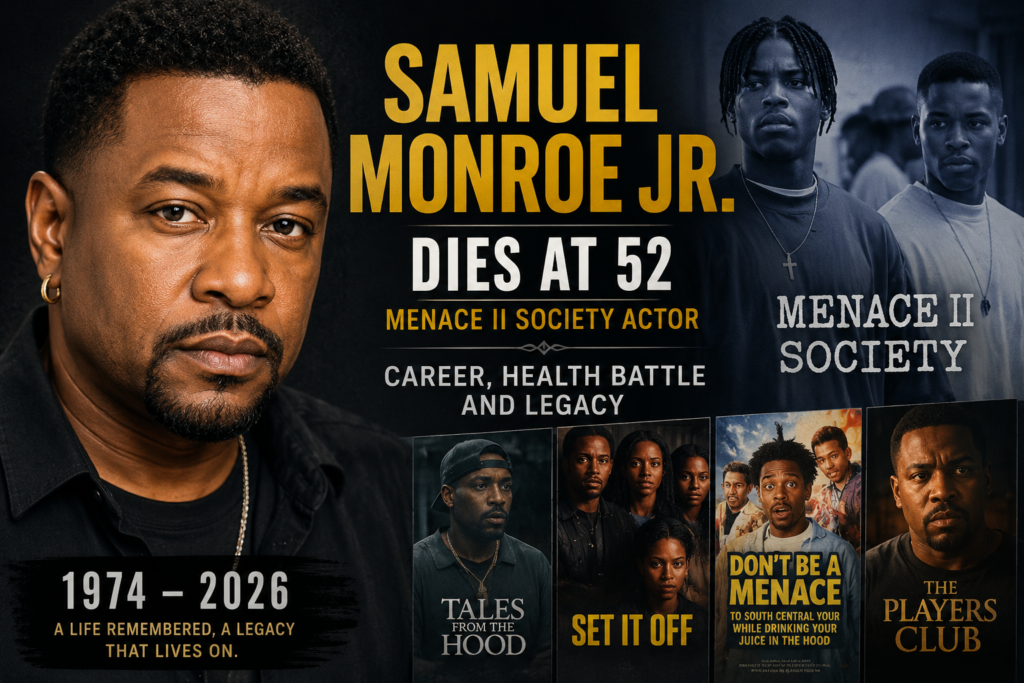
Samuel Monroe Jr. memorial tribute featuring the Menace II Society actor and his film career

Samuel Monroe Jr. Dies at 52: Menace II Society Actor’s Career, Health Battle and Legacy

Samuel Monroe Jr., the actor remembered for his appearances in Menace II Society, Tales from the Hood, Set It Off, and The Players Club, has died at 52. His family confirmed the news on August 27, 2026, following months of serious health problems that left him hospitalized and fighting multiple complications. Monroe’s death closes the story of an actor whose career became closely connected with some of the most recognizable Black films of the 1990s. Although many viewers first remember him from Menace II Society, his work extended across movies and television for years. He continued appearing in screen projects after his best-known 1990s roles, building a career largely through memorable supporting performances. The news also follows a difficult medical battle that had drawn increasing concern from his family and supporters. Monroe had spent months dealing with severe illness, including meningitis and MRSA pneumonia, before his condition deteriorated further. His final months became a period of repeated medical procedures, neurological complications, and family appeals for prayers and support. Samuel Monroe Jr. Dies at 52 After a Prolonged Health Battle Samuel Monroe Jr. died on August 26, 2026, according to current reports, and his mother, Joyce Patton, publicly confirmed his death the following day. He was 52. Patton’s announcement thanked people who had prayed for her son and asked supporters to continue praying for the family, particularly his three children. The circumstances surrounding his death followed months of serious illness. Reports say Monroe had been hospitalized since April after developing severe meningitis and MRSA pneumonia. His health problems later became more complicated, affecting his neurological condition and kidney function. He also required intensive medical treatment during the prolonged hospitalization. The exact medical circumstances surrounding his final hours have not been described consistently in every report. Some accounts have cited information from his wife and family about his condition and final treatment, while other reporting has raised questions about his hospital status shortly before his death. For that reason, it is important to separate confirmed family announcements from details that remain unclear. What is clear is that Monroe’s death came after a prolonged and devastating health crisis. His passing has prompted renewed attention to a career that began in the early 1990s and included several films that remain influential among fans of 1990s Black cinema. What Happened to Samuel Monroe Jr.? Samuel Monroe Jr.’s final months were marked by a severe illness that progressed into a complicated medical crisis. His family said he had been battling meningitis, while later reports described additional problems involving pneumonia, kidney function, seizures, and serious neurological complications. The Meningitis Diagnosis and Hospitalization Monroe’s health battle became public earlier in 2026 when his family began asking supporters to pray for him. Reports said he had been hospitalized in April with severe meningitis and MRSA pneumonia. His condition required intensive treatment, including dialysis for kidney problems and, at points, life support. According to reports based on statements from his family, the illness had caused serious complications before doctors could stabilize him. Some family accounts also alleged that the meningitis had gone undiagnosed for an extended period, allowing the infection to become increasingly severe. Those details come from family accounts and should therefore be treated as reported claims rather than independently established medical findings. The prolonged hospitalization became a major concern for Monroe’s relatives and supporters. A fundraising campaign was also established during his illness to help with medical expenses and the possibility of long-term care. His family continued sharing updates as his condition changed over the following months. Later Complications and Medical Crisis Monroe’s condition reportedly worsened during the summer. His wife, Shawna Stewart, said he experienced more than 20 seizures around the end of July, followed by severe swelling in his brain. Reports also said he underwent multiple brain surgeries as doctors attempted to manage the neurological complications. The situation eventually became critical. The Hollywood Reporter reported that Monroe had been placed on life support following his lengthy hospitalization, while other reports described a medically induced coma and continuing neurological problems. His family continued seeking prayers as doctors worked to manage his deteriorating condition. His medical battle was therefore far more complicated than a single diagnosis. Meningitis formed the central part of the family’s account, but the illness was followed by other serious complications that affected multiple parts of his health. Reports have described MRSA pneumonia, kidney problems, seizures, brain swelling, and repeated surgeries. By the time his family announced his death, Monroe had spent months fighting an illness that had dramatically changed his health and placed enormous emotional and financial pressure on those closest to him. Samuel Monroe Jr.’s Acting Career Samuel Monroe Jr.’s acting career began in the early 1990s, with his first widely documented screen credit coming in the 1993 crime drama Menace II Society. That film introduced him to audiences during a period when a new generation of filmmakers and performers was reshaping American Black cinema. Early Career and Menace II Society Born in Los Angeles, Monroe entered the industry at a time when films centered on urban life, family, identity, violence, and community were gaining major attention. His appearance in Menace II Society became the first major association many viewers had with him, even though his role was relatively small. The Hughes Brothers’ 1993 film developed a lasting reputation and became one of the defining titles of its era. Monroe’s participation gave him an early connection to a movie that continued to be discussed and revisited decades after its release. Rather than becoming known through a single starring role, Monroe developed his career through a series of supporting appearances. That path became a defining feature of his work. He repeatedly appeared in recognizable productions, often sharing the screen with established performers while building his own filmography. His subsequent credits included Tales from the Hood, Set It Off, and Don’t Be a Menace to South Central While Drinking Your Juice in the Hood. He also appeared in The Players Club, another notable title

Samuel Monroe Jr. Dies at 52: Menace II Society Actor’s Career, Health Battle and Legacy Read More »
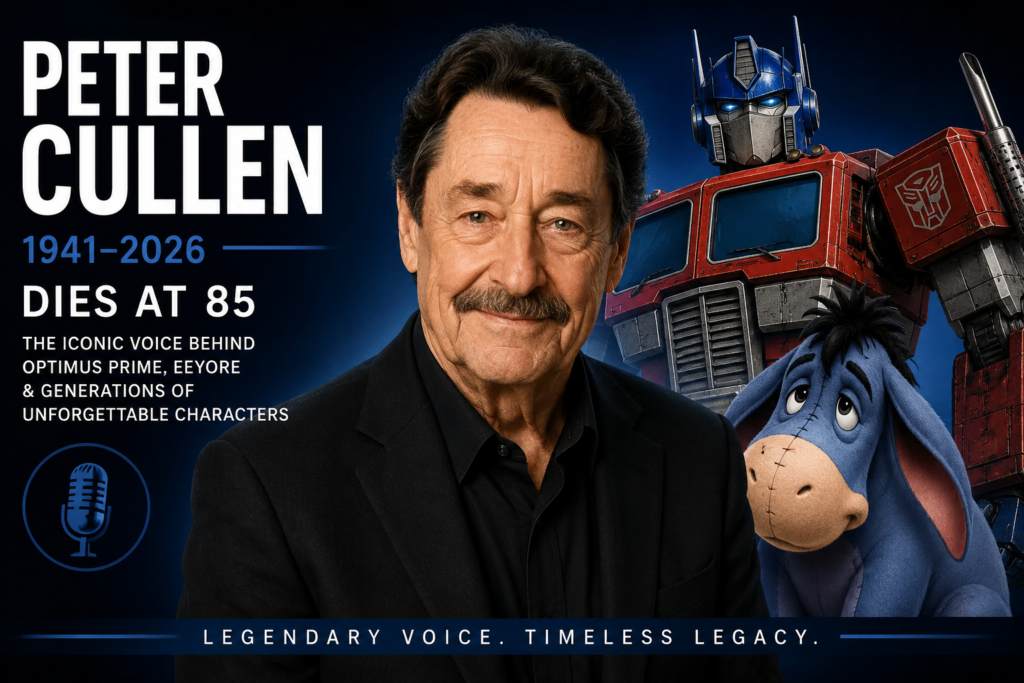
Peter Cullen, the voice of Optimus Prime and Eeyore, dies at 85

Peter Cullen Dies at 85: Optimus Prime, Eeyore, Career & Lasting Legacy

Peter Cullen, the voice actor whose deep, steady delivery helped define Optimus Prime for generations of Transformers fans, has died at 85. Cullen died Wednesday, August 26, 2026, at his home in Los Angeles, according to his agent, Kevin Motley. His family said he died peacefully surrounded by loved ones. No cause of death has been publicly announced. For many viewers, Cullen’s name immediately brings to mind Optimus Prime, the heroic Autobot leader whose voice became one of the most recognizable sounds in animated entertainment. Yet his career stretched far beyond Transformers. He also became closely associated with Eeyore from Winnie the Pooh, while his credits included television, animation, film and vocal-effects work. Cullen’s career lasted for decades and reached audiences across several generations. His performances showed an unusual range: he could give Optimus Prime commanding authority, bring quiet sadness to Eeyore, and create unsettling non-human sounds for the Predator. That versatility helped make him one of the most respected voice performers in popular entertainment. Peter Cullen Dies at 85: What We Know Peter Cullen’s Death Was Confirmed in August 2026 Peter Cullen died at his Los Angeles home on August 26, 2026, at the age of 85. His agent confirmed the news to ABC News on August 27. A statement from Cullen’s family described his passing as peaceful and said he was surrounded by his loved ones. The news marked the end of a career that had connected Cullen with some of the most recognizable characters in animation and genre entertainment. His professional credits spanned more than six decades, with Transformers and Winnie the Pooh standing among his most enduring associations. Cullen’s family also asked fans to remember his values alongside his work. Their statement emphasized service, compassion, integrity and loyalty, reflecting qualities that also fit the heroic image he helped give Optimus Prime. What Is Known About Peter Cullen’s Cause of Death? As of the initial announcement, no cause of death has been publicly disclosed. Cullen’s agent confirmed his death, but neither the agent nor the family provided a medical explanation. That distinction matters because early reports surrounding a celebrity’s death can quickly generate speculation. At this stage, there is no verified public information establishing a cause, so claims beyond the confirmed details should not be treated as fact. Who Was Peter Cullen? Early Life and the Discovery of His Voice Peter Cullen was born in Canada and developed an interest in voices and performance long before he became Optimus Prime. In a later interview, he recalled discovering his ability to command attention with sound while working around his family’s farm as a child. He remembered making a loud noise in the dairy barn and watching the cows react to him. That childhood experience became an early clue to a talent that would eventually shape his career. Cullen learned that his voice could communicate personality and emotion even without a visible performance. Like other actors whose careers have crossed multiple generations and genres, Cullen built a professional legacy that extended far beyond the role that made him famous. He later pursued formal training and built experience as a performer before moving deeper into television, comedy and voice work. His early years gave him a foundation that would prove valuable when animation became a major part of his professional life. From Canadian Performer to American Television Before audiences knew him as Optimus Prime or Eeyore, Cullen worked in radio and television. He eventually became the announcer on The Sonny & Cher Comedy Hour during the 1970s, a role that helped open the door to further acting opportunities. His career developed during an era when performers often moved between radio, television, comedy, live performance and voice work. That versatility became one of Cullen’s defining strengths. Rather than building his reputation around a single type of performance, he accumulated experience across different formats. By the time major animation opportunities arrived, Cullen had already spent years learning how to use timing, tone, rhythm and vocal character to make a performance memorable. Peter Cullen and Optimus Prime How Cullen Became the Voice of Optimus Prime Cullen’s defining breakthrough came with Transformers, where he became the voice of Optimus Prime. The character required more than a commanding voice. Prime needed to sound like a leader who could project strength while still conveying restraint, responsibility and compassion. Cullen developed a performance that gave the Autobot leader a distinctive identity. His delivery was measured rather than frantic, allowing individual words to carry weight. That approach helped establish Optimus Prime as a character whose authority came from confidence and conviction rather than anger. The inspiration for the voice also had a personal connection. Cullen had spoken about his brother Larry, a U.S. Marine, as an influence on the way he approached the character. That experience helped him think about the qualities of a military leader and translate them into a fictional robot commander. Why His Optimus Prime Voice Became Iconic The enduring power of Cullen’s Optimus Prime performance came from its emotional balance. He could make the character sound imposing without making him cold. Prime could deliver instructions, confront enemies and inspire his allies while retaining a sense of humanity. That distinction became crucial to the character’s longevity. Transformers introduced Optimus Prime to audiences in the 1980s, but Cullen’s voice remained strongly associated with the character long after that original era ended. For fans, hearing Cullen return as Optimus Prime became more than a casting choice. His voice carried continuity between different generations of Transformers storytelling, helping preserve the character’s familiar identity even as the franchise changed around him. Peter Cullen’s Transformers Legacy From the Original Cartoon to The Transformers: The Movie Peter Cullen first became Optimus Prime in the original Transformers animated series in 1984. The role quickly became the defining performance of his career, but Cullen’s connection with the character did not end when the original television era changed. He returned as Optimus Prime for The Transformers: The Movie in 1986, giving the character

Peter Cullen Dies at 85: Optimus Prime, Eeyore, Career & Lasting Legacy Read More »

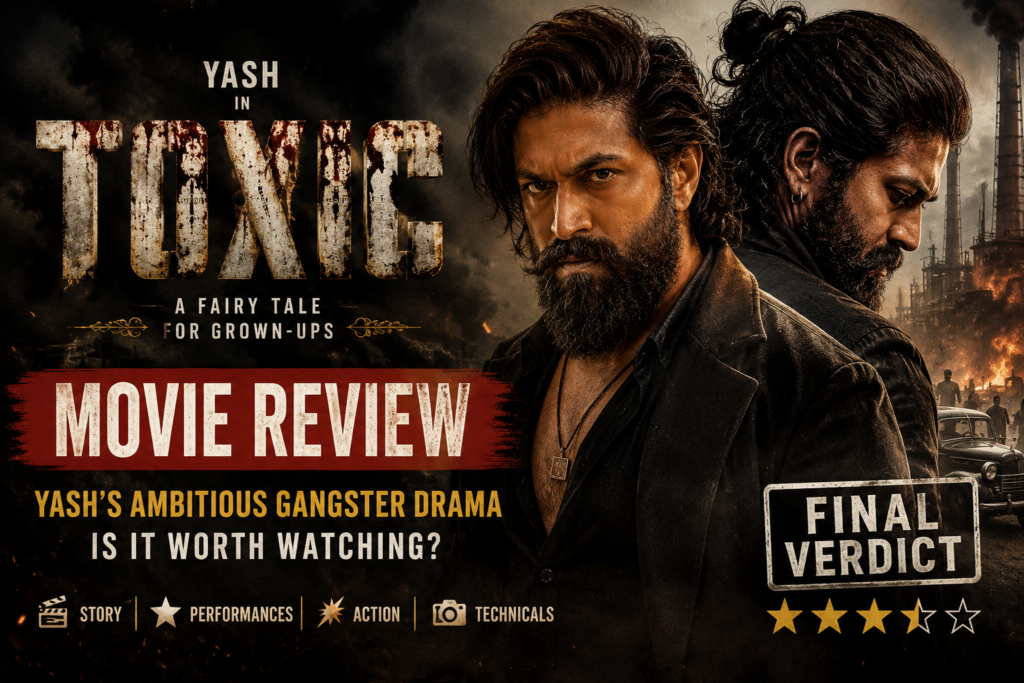
Toxic movie review featuring Yash in the 2026 gangster drama

Toxic Movie Review: Is Yash’s Ambitious Gangster Drama Worth Watching?

Toxic Movie Review: Yash’s return to the big screen comes with enormous expectations. Toxic: A Fairy Tale for Grown-Ups, directed by Geetu Mohandas, aims to be much more than a conventional gangster film. The movie blends crime, family conflict, romance, violence and fantasy-inspired visual design into a stylized world built around Yash’s commanding screen presence. Released in theaters on August 26, 2026, Toxic has already sparked one of the year’s most divided early reactions. This Toxic movie review looks at what works, what does not, and whether the film’s ambition translates into a satisfying theatrical experience. Supporters have praised its scale, action, cinematography and Yash’s performance, while critics and disappointed viewers have raised concerns about the screenplay, pacing, editing and emotional depth. The result is an intriguing contrast: Toxic can look spectacular on screen while still leaving some viewers unconvinced by the story holding everything together. The central question is not whether Toxic looks ambitious—it clearly does. The bigger question is whether that ambition delivers a compelling gangster drama. For viewers coming primarily for Yash, large-scale action and striking visuals, the film offers plenty to enjoy. However, audiences expecting a tightly written and emotionally consistent crime story may find the experience considerably more uneven. The debate surrounding Toxic also reflects how audiences increasingly judge major theatrical releases through story, performances, pacing and overall execution rather than spectacle alone. That makes comparisons with other big-screen releases particularly interesting, especially when a film is expected to satisfy both dedicated fans and general movie audiences. Toxic Movie Review: A Quick Verdict Toxic is an ambitious, visually driven gangster drama that places Yash at the center of an unusually stylized world. The actor plays two roles, Raya and his estranged son Ticket, giving the film a built-in contrast between its older gangster figure and the younger character connected to him. The story combines the criminal underworld with family relationships, romance and personal conflict rather than following a straightforward rise-and-fall gangster formula. Its strongest weapon remains Yash. His screen presence gives the larger-than-life sequences the weight audiences expect from the star behind KGF. The action and production design also provide genuine theatrical scale. Even viewers who disliked the screenplay have frequently singled out Yash’s presence and the film’s visual presentation as positives. The biggest weakness is the storytelling. Early reactions repeatedly point to an overloaded screenplay, uneven pacing and difficulty following the film’s many characters and ideas. The lengthy runtime makes those problems more noticeable when individual sequences fail to maintain momentum. So, is Toxic worth watching? For fans of Yash and theatrical action, there is a strong case for seeing it on the big screen. For viewers who place story clarity and emotional depth above spectacle, expectations should be more measured. What Is Toxic About? Toxic builds its story around a dangerous criminal world and the complicated relationship between Raya and Ticket. Yash’s dual role is central to the film’s structure, with the two characters representing different sides of the narrative and its family conflict. The film does not remain limited to gangster politics, though. Family, loyalty, romance, desire and personal history become increasingly important as the story develops. That combination explains why the film can feel difficult to categorize. It has the machinery of a gangster movie, but it also wants to function as a family drama and an emotionally charged character study. At the same time, Mohandas gives the production a highly stylized visual identity that pushes it away from realism. The result is a film that asks viewers to accept a heightened version of its world. Characters can behave in extreme ways, violence can become theatrical, and the presentation often takes priority over everyday realism. That approach may appeal to viewers looking for something visually distinctive, but it can also make the story harder to connect with when the emotional motivations are not equally clear. Importantly, Toxic does not appear interested in giving audiences a simple hero-versus-villain narrative. Its central conflict is tied to identity, family and power. That makes the film more ambitious than a conventional action vehicle, even if the execution does not always make those ambitions easy to follow. Raya, Power and the World of the Film Raya sits at the heart of Toxic and represents the film’s fascination with power. Yash approaches the character with the kind of confidence that immediately establishes authority, making Raya feel larger than the people surrounding him. The gangster environment around him is equally important. Rather than using crime merely as background, the film builds an elaborate world of rivalries, relationships and shifting loyalties. The setting gives the story room to explore how violence affects family and personal identity. This is also where Geetu Mohandas’ visual approach becomes apparent. The film does not present its criminal world as a plain, documentary-style environment. Instead, it uses heightened production design and a deliberately stylized atmosphere to create a fairy-tale quality for adults. That choice gives Toxic an identity of its own, but it also creates a challenge. The more extravagant the world becomes, the more important the screenplay must be in explaining its emotional rules. When the writing keeps pace, the unusual setting can feel immersive. When it does not, the spectacle risks becoming disconnected from the characters. The Story’s Family and Revenge Thread Beneath the gangster machinery, Toxic depends heavily on family relationships. The conflict between Raya and Ticket gives the film an emotional foundation that distinguishes it from a purely action-focused story. Their relationship creates questions of legacy, loyalty and personal history that extend beyond the criminal world. This family dimension also gives Yash’s dual performance a practical purpose. The two characters are not simply an excuse for the actor to appear twice. Their contrasting identities help shape the film’s central dramatic tension. However, the film’s emotional impact depends on how effectively viewers connect those relationships with the larger story. Some early reactions have praised the emotional elements, while others have argued that the spectacle and violence overwhelm the drama. That

Toxic Movie Review: Is Yash’s Ambitious Gangster Drama Worth Watching? Read More »

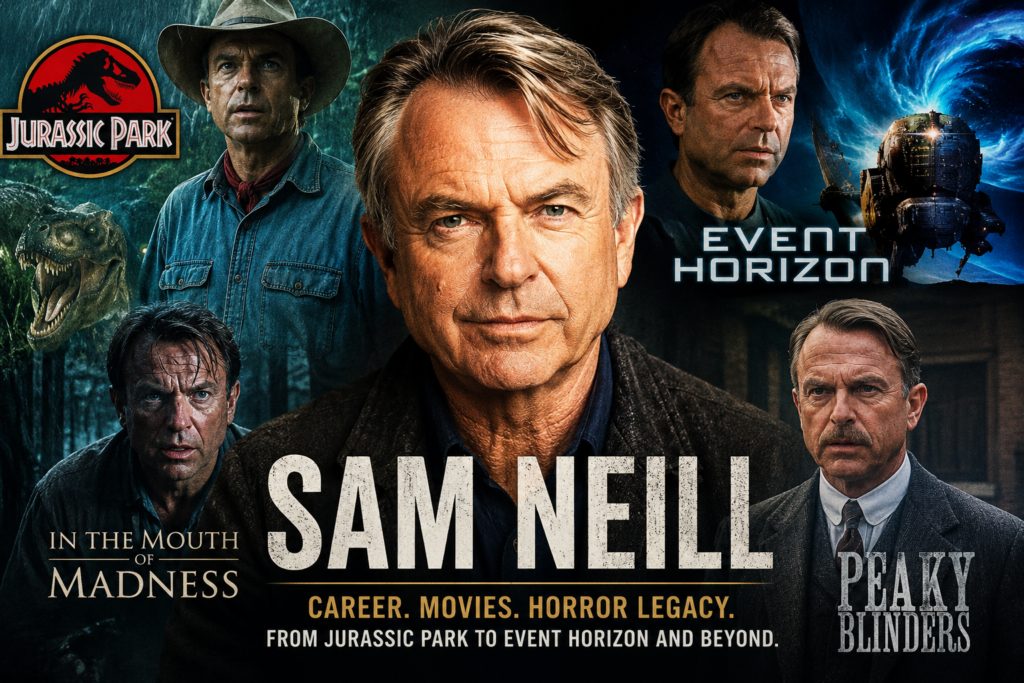
Sam Neill featured in a cinematic collage highlighting Jurassic Park, Event Horizon, In the Mouth of Madness, and Peaky Blinders

Sam Neill: Career, Movies, Horror Legacy, Event Horizon & Jurassic Park

Sam Neill built a career that could have easily been defined by one role. Instead, the New Zealand actor moved between intimate dramas, international thrillers, television, blockbuster adventures, and some of the most unsettling horror films of his era. For many viewers, he will always be Dr. Alan Grant from Jurassic Park. Others remember him as the troubled John Trent in In the Mouth of Madness or Dr. William Weir in Event Horizon. His work reached far beyond those recognizable performances. Neill died in Sydney on July 13, 2026, at age 78. His death closed a career that had stretched across five decades and included more than 50 films, along with extensive television work. Yet his screen legacy remains unusually broad. He could bring warmth and humor to one project, then create an intimidating or psychologically fragile character in the next. That range helps explain why audiences continue returning to his films. The renewed interest in his horror work also gives his career a fascinating modern angle. A forthcoming documentary, Beyond the Horizon of Madness: The Horrors of Sam Neill, is set to revisit two of his most distinctive genre performances, In the Mouth of Madness and Event Horizon. Together, those films show a different side of an actor best known to mainstream audiences as the rational scientist who faced dinosaurs. Who Was Sam Neill? Sam Neill was born Nigel John Dermot Neill on September 14, 1947, in Omagh, Northern Ireland. His family moved to New Zealand when he was a child, and the country became the foundation of both his personal identity and professional career. He studied at the University of Canterbury and later Victoria University of Wellington before developing his interest in acting and filmmaking. His path into cinema was not an instant rise to Hollywood fame. Neill worked with theater groups and the New Zealand National Film Unit, where he directed, edited, and wrote documentary material. That experience gave him an understanding of filmmaking beyond performance. He knew how productions worked from behind the camera as well as in front of it. His feature-film breakthrough came with Sleeping Dogs in 1977. The New Zealand thriller helped establish him as a serious screen performer and became an important early milestone in the country’s developing film industry. From there, Neill gradually built an international career rather than relying on a single breakthrough. That gradual progression became one of the defining features of his professional life. He worked across different genres and often accepted roles that allowed other performers or the story itself to take center stage. His understated approach could make him seem almost effortless on screen, but that restraint became a major part of his appeal. By the time Hollywood audiences discovered him through Jurassic Park, Neill had already spent years developing the qualities that would make Dr. Alan Grant convincing: intelligence, authority, dry humor, and a grounded sense of danger. Sam Neill’s Early Career and Rise to International Fame Neill’s early career developed primarily through New Zealand and Australian cinema before international productions began giving him wider exposure. After Sleeping Dogs, he appeared in projects that demonstrated how comfortable he was with dramatically different characters. My Brilliant Career, Omen III: The Final Conflict, Possession, Dead Calm, and A Cry in the Dark each added another dimension to his growing reputation. From New Zealand Cinema to International Roles The importance of this period goes beyond the number of films Neill made. He developed a screen presence that did not depend on conventional leading-man behavior. He could appear tough without becoming exaggerated, vulnerable without losing authority, and threatening without resorting to obvious theatricality. My Brilliant Career helped place him within the emerging international conversation around Australian and New Zealand filmmaking. Omen III, meanwhile, demonstrated that he could carry darker material. Later, Dead Calm placed him in a tense psychological thriller alongside Nicole Kidman, giving international audiences another reason to notice him. His work in the 1980s also showed that he was willing to move between art-house cinema and commercial productions. That flexibility became crucial later. Instead of being locked into one genre, Neill accumulated experience that allowed him to enter major Hollywood projects without losing the qualities that had defined his earlier work. The Breakthrough That Changed Sam Neill’s Career The decisive turning point arrived in 1993. Neill appeared in two very different films that year: Steven Spielberg’s Jurassic Park and Jane Campion’s The Piano. The contrast was remarkable. One became a global blockbuster built around dinosaurs and groundbreaking visual effects; the other became an acclaimed dramatic film. Jurassic Park transformed Neill’s public profile. As Dr. Alan Grant, he gave the enormous adventure film a believable human center. His performance did not depend on exaggerated heroics. Instead, Grant felt like a working scientist suddenly forced into an impossible survival situation. That combination of credibility and accessibility made Neill an ideal blockbuster lead. At the same time, The Piano confirmed that his abilities extended well beyond mainstream adventure cinema. The two films together captured something essential about his career: Sam Neill could move between completely different cinematic worlds while remaining unmistakably himself. His international reputation was now firmly established, but the most interesting chapter of his career was still ahead. Alongside major dramas and blockbusters, he would increasingly become associated with darker stories, including the horror films that later developed devoted cult audiences. Sam Neill and Jurassic Park For millions of moviegoers, Sam Neill became synonymous with Dr. Alan Grant. Steven Spielberg’s Jurassic Park gave him the role that would define his mainstream career, but the performance worked because Neill avoided turning Grant into a conventional action hero. He played him as a serious paleontologist who preferred fossils to people and felt far more comfortable studying prehistoric life than dealing with children. Dr. Alan Grant and the Original Jurassic Park Grant’s journey begins when he accepts an invitation to visit John Hammond’s dinosaur theme park. What initially looks like a scientific opportunity quickly becomes a fight for survival after

Sam Neill: Career, Movies, Horror Legacy, Event Horizon & Jurassic Park Read More »

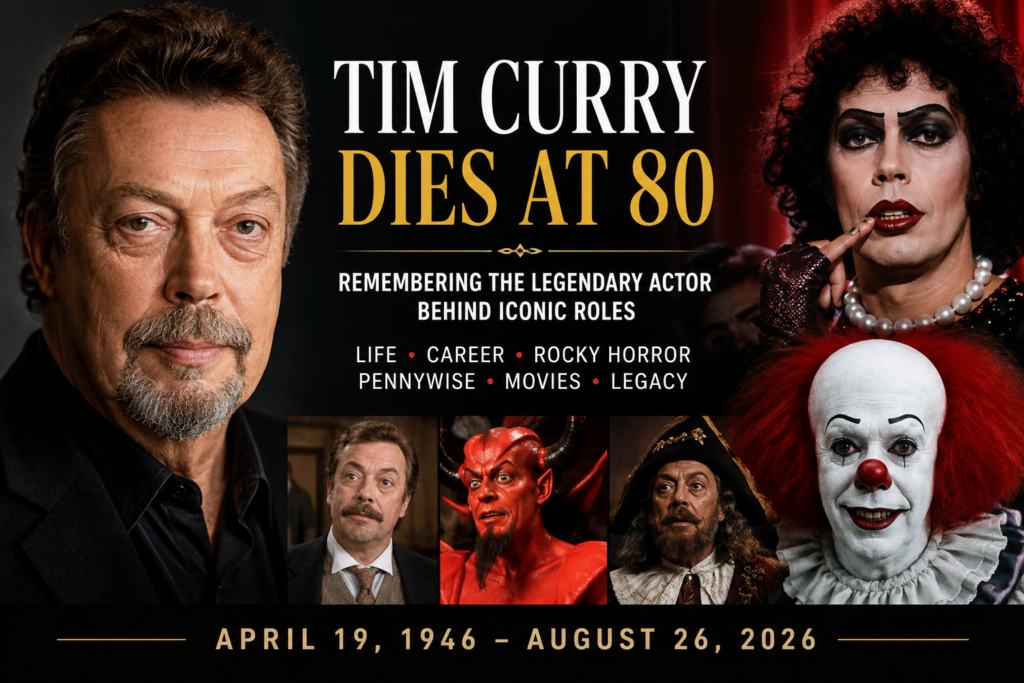
Tim Curry featured in a tribute image celebrating his life, career, Rocky Horror and Pennywise roles

Tim Curry Dies at 80: Life, Career, Rocky Horror, Pennywise and Lasting Legacy

Tim Curry, the British actor whose unforgettable performances helped define cult cinema, stage comedy, horror television, and animated entertainment, has died at 80. Curry died at his Los Angeles home in August 2026, according to his longtime manager and friend Marcia Hurwitz. His death marks the end of a career that stretched across more than five decades, from London’s theater scene to Hollywood films and major voice-acting roles. For many fans, Curry will always be Dr. Frank-N-Furter from The Rocky Horror Picture Show. Others remember him as Pennywise in the 1990 television adaptation of Stephen King’s It, Wadsworth in Clue, the Lord of Darkness in Legend, or Nigel Thornberry in The Wild Thornberrys. Yet those familiar roles represent only part of his work. Curry also earned three Tony Award nominations for Broadway performances and built a respected career as a singer and stage performer. His death also brings renewed attention to the breadth of his career. Curry could move from flamboyant musical theater to dark horror, broad comedy, children’s animation, and Shakespearean performance without losing the distinctive voice and presence that made him instantly recognizable. Tim Curry Dies at 80: What We Know When Tim Curry died Tim Curry died at his home in Los Angeles at the age of 80. His longtime manager, Marcia Hurwitz, confirmed the death, while major reports published on August 26, 2026, identified the actor as having died in Los Angeles. Some early reports differed over whether his death occurred late Tuesday or Wednesday, so the safest account is that Curry died in Los Angeles during the August 25–26 period. Curry was born Timothy James Curry in Cheshire, England, in 1946. Over the following decades, he became one of the most recognizable British performers to build a major career in American entertainment. His work crossed several generations, giving different audiences their own way into his filmography. For older moviegoers, he was the magnetic performer behind Frank-N-Furter. Horror fans knew him as Pennywise. Families encountered his voice work in animated productions, while theater audiences followed his performances on Broadway. That range helps explain why news of his death resonated far beyond a single genre or generation. What is known about the cause of death A cause of death has not been publicly disclosed. Reports from the Associated Press, Reuters and other major outlets have confirmed Curry’s death but have not identified a specific medical cause. Curry had experienced serious health problems during his later years. In 2012, he suffered a major stroke that affected his mobility and led him to use a wheelchair. The stroke also reduced his on-camera workload, although he continued working through voice performances, appearances and other projects. That history should not be confused with the cause of his death. At this time, there is no confirmed public information establishing that his earlier stroke caused his death. The responsible account is therefore simple: Curry died at 80, and no cause has been announced. Who Was Tim Curry? Early life and education Tim Curry was born in Cheshire, England, in 1946 and developed an interest in performance before establishing himself professionally. He studied drama and English at the University of Birmingham, graduating in 1968. Soon afterward, he joined the London production of Hair, beginning a professional theater career that would shape almost everything that followed. The stage gave Curry an ideal environment for the qualities that later became his trademarks: a commanding voice, strong physical presence, comic timing, and a willingness to embrace unusual characters. Rather than following a conventional path toward leading-man roles, he gravitated toward complicated, eccentric, and often theatrical personalities. That choice became central to his identity as a performer. Curry could dominate a scene without necessarily being its traditional hero. His characters often arrived with exaggerated confidence, strange mannerisms, or an unmistakable sense of danger. Those qualities eventually made him perfect for one of the most unconventional musical characters of the 1970s. From London’s stage to Rocky Horror Curry’s career changed dramatically when he originated Dr. Frank-N-Furter in The Rocky Horror Show on the London stage. The production premiered in 1973 and became a phenomenon, eventually leading to the 1975 film The Rocky Horror Picture Show. The role transformed Curry from a promising stage performer into an international cult figure. Frank-N-Furter demanded theatrical confidence, musical ability, comic precision, and a willingness to challenge conventional ideas about gender and performance. Curry brought all of those elements together in a character that audiences could not easily forget. The film initially had a difficult commercial journey, but its midnight screenings and highly participatory fan culture gradually turned it into one of cinema’s most enduring cult classics. Curry’s performance stood at the center of that transformation. For many viewers, Frank-N-Furter became the defining Tim Curry role. However, the success of Rocky Horror did not trap him in one character. Instead, it gave Curry the visibility to pursue increasingly varied work across film, television, theater, and music. Tim Curry and The Rocky Horror Picture Show Why Frank-N-Furter became his signature role Dr. Frank-N-Furter remains the role most closely associated with Tim Curry because the performance combined nearly every strength he had developed onstage. Curry played the character with theatrical swagger, sharp humor, musical confidence, and a deliberately provocative style. The result was not simply a memorable musical performance; it became part of the identity of the film itself. The Rocky Horror Picture Show also found a life beyond its original theatrical release. Midnight screenings encouraged audiences to dress as characters, respond aloud to the movie, and participate in rituals that turned ordinary viewing into a communal event. Over time, Curry’s Frank-N-Furter became one of the most recognizable figures in that tradition. The role also mattered culturally because it gave audiences an unconventional screen presence at a time when mainstream American entertainment offered far fewer openly transgressive characters. Curry approached Frank-N-Furter as a performer rather than reducing the character to a simple shock device. That distinction helped the role endure. Decades later, audiences still discover

Tim Curry Dies at 80: Life, Career, Rocky Horror, Pennywise and Lasting Legacy Read More »

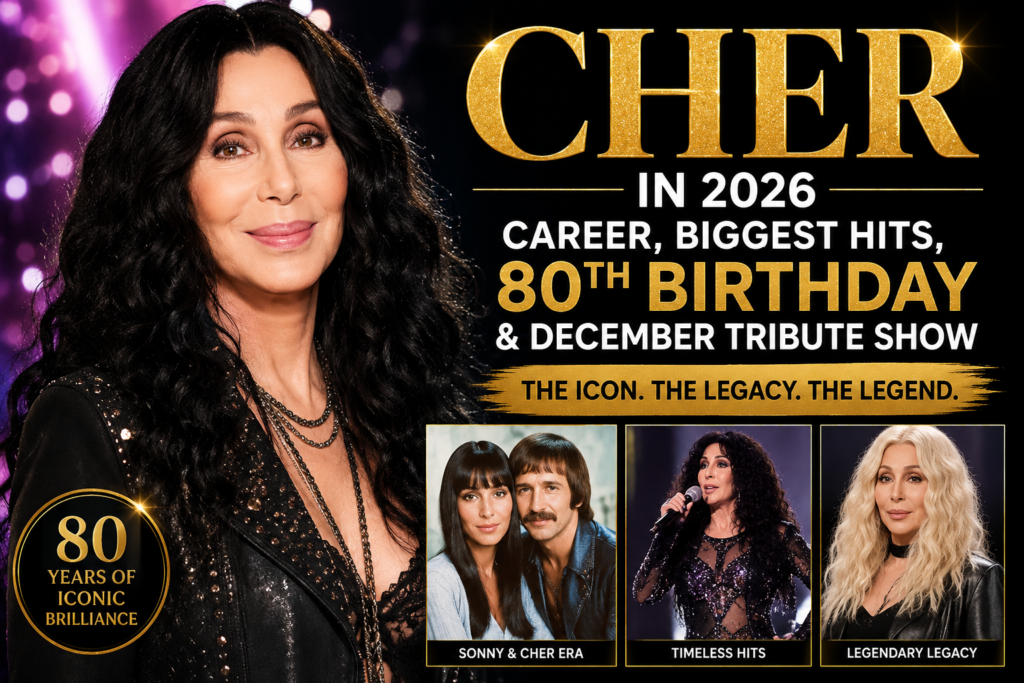
Cher in 2026 featured in a magazine-style graphic celebrating her career, biggest hits, 80th birthday, legacy, and December tribute show.

Cher in 2026: Career, Biggest Hits, 80th Birthday & December Tribute Show

Cher remains one of the rare entertainers whose name alone can define an era. In 2026, that legacy feels especially significant as she celebrates her 80th birthday while continuing to stand as a major figure in music, film, television, fashion, and pop culture. Her career has crossed generations, musical styles, and entertainment formats without losing the distinctive identity that made her famous. The current interest in Cher also comes with a timely development. A December 2026 tribute event at Andiamo Celebrity Showroom in Warren, Michigan, has brought renewed attention to her songs, stage image, and decades-long influence. However, a tribute performance should not be confused with a concert by Cher herself. That distinction matters as fans look for details about the event. Long before tribute shows celebrated her work, Cher built a career through constant reinvention. She moved from a young singer working alongside Sonny Bono to a successful solo artist, television personality, Oscar-winning actress, fashion icon, and late-career pop phenomenon. Few performers have maintained that level of recognition for so long. Who Is Cher? Cher is an American singer, actress, television personality, and cultural icon whose professional career began in the early 1960s. Born Cherilyn Sarkisian on May 20, 1946, she developed a recognizable contralto voice and a striking public image that quickly separated her from many other performers of her generation. Her long career also places her among the classic Hollywood and entertainment figures whose work continues to attract renewed interest from modern audiences. Her breakthrough came through her partnership with Sonny Bono. Together, Sonny & Cher became a successful musical act, with their distinctive sound and television presence helping them reach a large national audience. Cher later established herself independently, proving that her identity did not depend on the partnership that first made her famous. What makes Cher unusual is the range of her career. She has recorded pop, rock, disco, dance, and other styles while also building a respected acting résumé. Her film work eventually earned her an Academy Award, while her television career helped make her a household name beyond music. Cher also became known for taking risks with fashion and presentation. Her dramatic costumes, powerful stage presence, and willingness to change her image helped turn her into more than a recording artist. She became a recognizable symbol of reinvention. By 2026, Cher’s career spans seven decades, giving her a rare position in popular entertainment. Cher’s Early Life and Rise to Fame Cher was born in El Centro, California, and grew up in a family with financial challenges. Her mother, Georgia Holt, worked in entertainment and encouraged her daughter’s creative ambitions. Cher eventually moved toward Los Angeles, where she hoped to establish herself in the music business. Her early path was not an instant success story. Instead, she entered the recording world through background work and studio opportunities before finding the partnership that would change her career. Her unusually deep voice became an important part of her identity. Even when she was not the featured performer, her vocal tone could stand out in a crowded studio. That distinctive quality later became one of the defining characteristics of her solo recordings. Cher’s early experiences also taught her how the entertainment industry worked behind the scenes. She learned to adapt, perform under pressure, and develop a public persona. Those lessons became important as she moved from supporting roles into the spotlight. Meeting Sonny Bono proved to be the major turning point. Their personal and professional relationship eventually created the platform from which Cher launched her first major period of fame. Sonny & Cher and the First Wave of Stardom Cher and Sonny Bono became one of the most recognizable entertainment partnerships of the 1960s. Their breakthrough recording, “I Got You Babe,” gave them a signature hit and established a sound that audiences immediately associated with the duo. Their appeal extended beyond music. Cher’s voice contrasted with Sonny’s, while their relaxed chemistry gave their performances a distinctive character. The partnership also opened the door to television, where their personalities became as important as their recordings. The success came with an important complication: Cher was developing into a star in her own right. While Sonny & Cher remained a major part of her early identity, Cher’s growing confidence and individual appeal suggested that she could sustain a career beyond the duo. Television played a major role in that transition. Their variety programming introduced Cher to audiences who might not have followed a young pop singer through records alone. Her appearance, humor, costumes, and unmistakable voice all contributed to a personality that audiences could recognize instantly. Eventually, the professional partnership ended, but Cher’s career did not. Instead, she entered one of the most important phases of her life as a solo performer. Cher’s Music Career Begins to Stand on Its Own Cher’s solo career developed alongside the success of Sonny & Cher, but she gradually demonstrated that she could command attention without the duo. Her recordings allowed her to experiment with different sounds while preserving the vocal character that had made her recognizable. Songs such as “Gypsys, Tramps & Thieves” helped establish her as a major solo recording artist. The track showcased her ability to turn a distinctive vocal performance into a commercially successful pop record while giving her a musical identity separate from her earlier partnership. That ability to change direction became a recurring theme throughout her career. Cher did not remain tied to the sound that first made her famous. Instead, she continued exploring new musical trends as the industry changed around her. Her career would later move through rock, disco, pop, dance music, and electronic sounds. Each period introduced a different version of Cher, yet the core remained recognizable: a powerful voice, an unmistakable presence, and a willingness to take creative risks. That pattern of reinvention would eventually become one of the strongest explanations for Cher’s remarkable longevity. Cher’s Music Career and Biggest Hits Cher’s solo career continued to grow as she moved beyond the Sonny

Cher in 2026: Career, Biggest Hits, 80th Birthday & December Tribute Show Read More »

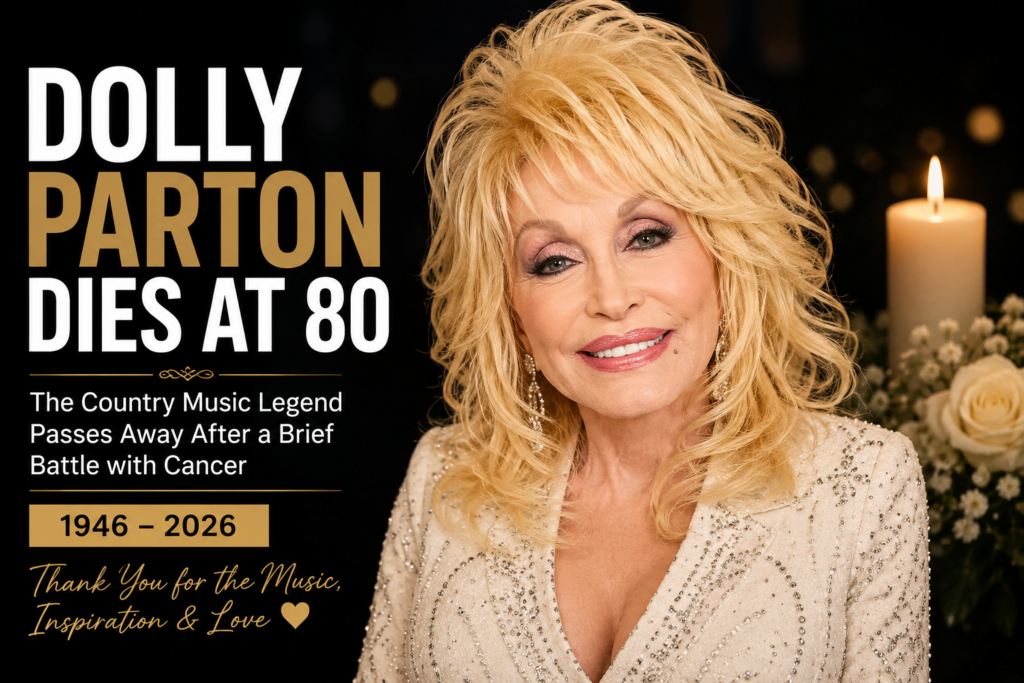
Dolly Parton dies at 80 after a brief battle with cancer

Dolly Parton Dies at 80: Cause of Death, Cancer, Career, Music and Legacy

Dolly Parton dies at 80, marking the end of an extraordinary career that transformed country music, songwriting, film and philanthropy. The legendary entertainer died on August 25, 2026, following a brief battle with cancer, according to her representatives. The news closes the life of an artist whose influence stretched far beyond country music. Parton became a successful recording artist, actress, songwriter, entrepreneur and philanthropist while maintaining a close connection to her Tennessee roots. Songs such as “Jolene,” “I Will Always Love You” and “Coat of Many Colors” established her as an exceptional storyteller, while projects such as Dollywood and the Imagination Library expanded her impact into business, tourism and children’s literacy. For generations of fans, however, Parton’s appeal was never limited to her achievements. Her warmth, quick wit and ability to turn personal experiences into universally relatable stories helped make her a rare entertainer whose audience crossed age, geography and musical boundaries. Her death therefore represents not simply the loss of a country star, but the end of one of the most expansive careers in modern American entertainment. Dolly Parton Dies at 80: What We Know About Her Death Dolly Parton’s Death Was Confirmed on August 25, 2026 Dolly Parton died Tuesday, August 25, at age 80. Her family and representatives announced the news after she died in Nashville. Her team said she was surrounded by loved ones at Vanderbilt-Ingram Cancer Center. The announcement prompted an immediate wave of tributes from musicians, actors, public figures and fans. Parton’s career had lasted nearly six decades, giving multiple generations a personal connection to her work. She could move between traditional country, pop, film and television without losing the identity that made her distinctive. Her nephew Bryan Seaver also reflected on the doors Parton opened for her family and for generations of performers, songwriters and dreamers. That idea captures an important part of her legacy: Parton built an extraordinary career for herself while using her success to create opportunities for others. Her death also came while several aspects of her professional life remained active. She had continued working on entertainment, business and philanthropic projects even as her health became more difficult in the final months of her life. What Has Been Confirmed About Dolly Parton’s Cause of Death Parton’s representatives confirmed that she died following a brief battle with cancer. However, they have not publicly disclosed the specific type of cancer she had. That distinction matters because several reports and online discussions have circulated additional claims that have not been confirmed by her representatives. The available information therefore supports a simple conclusion: cancer was identified by her team as the cause surrounding her death, but the public does not have an officially disclosed diagnosis beyond that description. Parton had spoken publicly about experiencing health difficulties before her death. Still, those earlier issues should not automatically be treated as the cause of her final illness. The responsible account is to separate what Parton and her representatives confirmed from reports or speculation that appeared elsewhere. That approach is particularly important with a celebrity of Parton’s stature. Her enormous public profile means that health rumors can spread rapidly. Her representatives’ statement provides the clearest available account of what happened. Dolly Parton’s Final Years and Health Struggles Health Challenges Before Her Death Parton’s death followed a period in which she had become more open about difficulties with her health. On August 21, just four days before her death, she spoke about going through “hard times” with her health while emphasizing that she remained determined to work. The comments came after several public appearances and events had been affected by her health. She had recently missed the debut of a new Dollywood attraction and appeared by video rather than attending in person. Those developments generated concern among fans, although Parton continued to communicate optimism about her ability to recover and keep working. Her approach reflected a pattern that had defined much of her public life. Even when discussing difficult personal circumstances, Parton often focused on resilience and the next thing she wanted to accomplish. In her final period, she was still associated with new creative and business projects rather than presenting herself as someone ready to step away. That makes the speed of the final developments especially striking. Public information about her health had emerged only days before her death, while the confirmation of her cancer battle came after her passing. Her Hospitalization Shortly Before Her Death Parton was admitted to a Nashville hospital on August 21, four days before she died. Her nephew later confirmed the timing of her hospitalization. The hospitalization followed the health update she shared publicly that same day. Reports before the confirmation of her cause of death contained varying accounts about her medical problems, but those reports should not be confused with the official explanation subsequently provided by her representatives. Parton ultimately died in Nashville, the city that had become central to her professional life after she left her East Tennessee upbringing to pursue music. The setting carries symbolic weight: the young songwriter who once dreamed of making it in Nashville ultimately became one of the city’s most influential cultural figures. Her final days also underline how little the public knew about the seriousness of her illness. Parton had continued discussing work and future plans shortly before her death. Her representatives’ later confirmation of a brief cancer battle provided the first clear explanation of the circumstances surrounding her passing. Dolly Parton’s Early Life in Tennessee Growing Up in a Large Appalachian Family Dolly Rebecca Parton was born on January 19, 1946, in Tennessee and grew up in a large family in the Appalachian region. She was one of twelve children, and music became part of her life at an early age. Her childhood circumstances shaped much of the storytelling that later became central to her songwriting. Parton frequently drew from family memories, poverty, faith, love and the landscape of East Tennessee. Instead of hiding those beginnings, she turned them into creative material.

Dolly Parton Dies at 80: Cause of Death, Cancer, Career, Music and Legacy Read More »

Malaysian drummer Raja Azreen Raja Talib performing with Meditasi before his death

Malaysian Drummer Raja Azreen Raja Talib Dies Onstage During Concert at 56

Malaysian drummer dies onstage after Raja Azreen Raja Talib collapsed during a Meditasi performance at the Teruntum Rock Festival in Kuantan, Malaysia. The 56-year-old musician suddenly fell over his drum kit during the band’s second song. Medics took him to Tengku Ampuan Afzan Hospital, where he later died. Raja Azreen had been playing with Meditasi when he suddenly slumped over his drum kit. The band had completed only two songs from a planned 10-song set when the drummer collapsed, leaving fellow musicians, festival staff and audience members alarmed. He was taken backstage and then transported to Tengku Ampuan Afzan Hospital, where he was later pronounced dead. The news has drawn attention well beyond Malaysia because of the circumstances surrounding the death. Raja Azreen was not simply a session musician appearing for a one-off performance. He was a longtime member of Meditasi, a Malaysian rock group with roots reaching back to the 1980s and a history connected to the country’s influential rock scene. His death therefore represents both a personal loss for his bandmates and another significant moment for fans of Malaysian rock music. Malaysian Drummer Dies Onstage During Meditasi Performance Raja Azreen Raja Talib’s death occurred in the middle of what was expected to be a regular festival appearance for Meditasi. The band was booked to perform a 10-song set at the Teruntum Rock Festival, but the performance stopped after only its second song when Azreen suddenly collapsed at his drum kit. The incident happened on July 18 in Kuantan, a city in Malaysia’s Pahang state. According to reports, the drummer lost consciousness while performing, prompting an immediate response from those around him. Meditasi frontman Bakaruddin Daud, known as Burn, rushed toward his bandmate after realizing something was seriously wrong. Festival personnel and members of the band then moved Raja Azreen from the stage area so he could receive medical attention. An ambulance arrived shortly afterward, and he was taken to Tengku Ampuan Afzan Hospital. Despite medical efforts, he did not recover. The sudden nature of the incident made the loss particularly shocking. Reports indicate that Azreen had appeared cheerful before the show and had not given his bandmates an obvious indication that he would be unable to perform. His collapse came only minutes into the band’s set, turning a routine rock festival appearance into the final performance of his career. For fans who witnessed the performance, the moment was especially difficult because Raja Azreen was doing what he had spent much of his life doing: playing drums onstage with a band he had remained connected to for decades. Who Was Raja Azreen Raja Talib? Raja Azreen Raja Talib was a veteran Malaysian musician best known for his work as the drummer of Meditasi. He was 56 when he died on July 18, 2026. His career was closely associated with the Malaysian rock scene, particularly through his long relationship with Meditasi. His Role as Meditasi’s Drummer Azreen’s importance to Meditasi extended beyond simply occupying the drummer’s seat. He was part of a band whose history stretches back to the early years of Malaysia’s rock movement. The group originally formed in 1983 under the name Metal Wizard before adopting the Meditasi name in 1989. The band later became known among fans during the prominent Malaysian rock era of the 1990s. After a period away from the active music scene, Meditasi reunited in 2015. That return allowed the group to reconnect with longtime listeners while introducing its music to newer audiences. Azreen remained part of that continuing chapter of the band’s story. His death consequently affects more than the immediate Meditasi lineup. For followers who had known the group for years, Raja Azreen represented continuity between different generations of Malaysian rock. His final appearance with the band also became an unexpectedly significant part of that history. The circumstances of his death have now brought renewed attention to both the drummer and the group he helped carry forward. What Happened When the Drummer Collapsed Onstage? The performance at Teruntum Rock Festival had barely begun when the situation changed. Meditasi was working through its planned set when Raja Azreen suddenly collapsed over his drum kit during the second song. Reports identify the performance date as July 18, 2026. Bandmates and Festival Staff Respond Burn, Meditasi’s frontman, noticed the drummer’s collapse and moved toward him. The incident immediately caused concern among people watching the performance. According to reporting from Malaysian outlets, Azreen did not respond when his bandmate attempted to get his attention. The band and festival crew then moved him backstage while waiting for emergency assistance. Medical personnel arrived and transported him to Tengku Ampuan Afzan Hospital for further treatment. He later died at the hospital. The sequence lasted only a short time, but its impact on the people at the festival was profound. A live music performance that had begun normally suddenly became an emergency, and the band lost a longtime member in front of an audience. Reports also say that Azreen had seemed healthy and in good spirits before going onstage. That detail helps explain why the collapse came as such a shock to those who knew him and had seen him shortly before the performance. The tragedy has since become the defining story surrounding what was meant to be another appearance by a veteran Malaysian rock band. What Was Reported About Raja Azreen’s Cause of Death? Reports link Raja Azreen Raja Talib’s death to heart complications. His older brother shared that information with Malaysian media after the drummer collapsed during Meditasi’s performance. Azreen also had recent health concerns. His family said doctors had diagnosed him with diabetes. They also said he had spent time in the hospital in June because of heart-related problems. Reports indicate that he had two hospital stays during that period. His health history also connects with the wider stories of musicians whose careers have been shaped by serious health challenges. Those details provide important context, but they do not establish every medical detail behind his death.

Malaysian Drummer Raja Azreen Raja Talib Dies Onstage During Concert at 56 Read More »

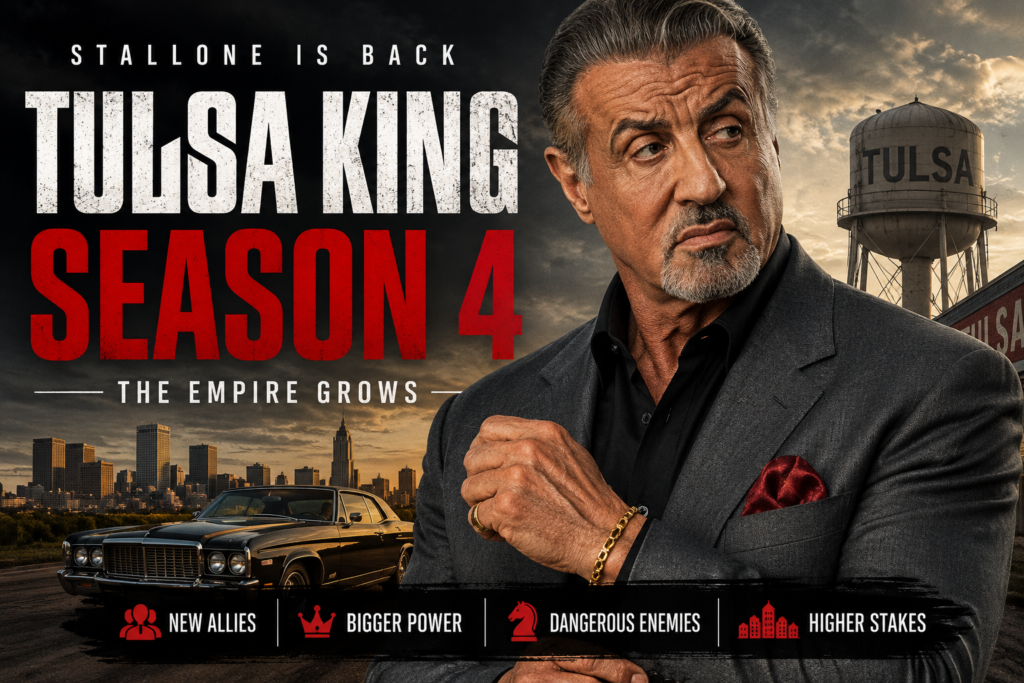
Tulsa King Season 4 poster featuring Sylvester Stallone as Dwight Manfredi

Tulsa King Season 4: Release Date, Cast, Story & Everything We Know

If you are searching for Tulsa King Season 4, the good news is that Dwight Manfredi’s story is definitely continuing. Paramount+ renewed the Sylvester Stallone-led crime drama for a fourth season before Season 3 even premiered. The bigger question now is when the new episodes will arrive and what direction the series will take after its latest run. Production has already moved forward, and recent reporting says filming wrapped at the end of March 2026. However, Paramount+ has not announced an exact premiere date. Current reporting points to an October 2026 release window, so fans have a clearer idea of when to expect the show even though the official day remains unconfirmed. Season 4 also arrives at an interesting point for the franchise. Dwight’s criminal operation has become larger and more complicated, while the show’s creative leadership is shifting again. Terence Winter, who helped shape the first season, is returning as head writer and executive producer. That change could have a noticeable impact on the tone and storytelling of the next chapter. Tulsa King Season 4 Is Officially Happening Paramount+ Renewed Tulsa King for Season 4 There is no uncertainty about the show’s renewal. Paramount+ officially announced Tulsa King Season 4 on September 17, 2025, shortly before Season 3 debuted. The renewal confirmed that the streamer still sees strong value in the series and intends to keep Dwight Manfredi at the center of its original programming lineup. The timing also matters. Paramount+ did not wait for the entire third season to finish before committing to another chapter. That decision reflects the show’s established audience and its position within the broader Taylor Sheridan television universe. For viewers, the renewal removes the biggest question surrounding the series: Tulsa King is not ending after Season 3. Season 4 is part of the official plan, and production has already taken place. The new season will continue the story of Dwight, the former New York mob capo who built a powerful operation after his exile to Oklahoma. What began as a punishment has gradually turned into an empire, creating new opportunities but also attracting increasingly dangerous enemies. What the Renewal Means for Dwight Manfredi Sylvester Stallone remains the face of the series and is expected to return as Dwight “The General” Manfredi. Paramount+’s own Season 4 guide identifies Stallone as the returning central star, although the streamer has not yet published a complete official Season 4 cast announcement. That distinction is important. Fans can confidently expect Dwight’s story to continue, but not every returning supporting character has received the same level of official confirmation. Tulsa King Season 4 Release Date: When Will It Premiere? Is There an Official Premiere Date? As of August 25, 2026, Tulsa King Season 4 does not have an officially announced premiere date. Paramount+’s current Season 4 information page still lists the release date as TBA. That means headlines claiming a specific October day should be treated carefully unless Paramount+ confirms it directly. There is a difference between an expected release window and an official premiere announcement. The available information does, however, narrow the waiting period considerably. Production has already wrapped, meaning the season is no longer simply a project in development. The remaining work includes post-production and the promotional rollout that Paramount+ will use to introduce the new episodes. For viewers, the safest answer right now is simple: Season 4 is coming, but the exact release date remains unconfirmed. Why October 2026 Is the Current Expectation Recent reporting places the Season 4 premiere in October 2026. Decider reported that production finished at the end of March and that the series is expected to return during October. That makes October the most useful current window for fans planning their watchlists, but it should not be presented as a locked date. Paramount+ has also confirmed that all three existing seasons are available on the service, giving viewers plenty of time to revisit Dwight’s journey before Season 4 arrives. The release timing could become especially important because Season 4 follows a major creative transition. With Terence Winter returning to a leading writing role, the new season represents more than another continuation of the same formula. Tulsa King Season 4 Cast: Who Is Returning? Sylvester Stallone as Dwight Manfredi The most important casting question has the clearest answer: Sylvester Stallone is expected back as Dwight Manfredi. Paramount+ built its Season 4 renewal announcement around Stallone, and its current Season 4 guide continues to identify him as the show’s central star. Dwight’s presence remains essential because Tulsa King is ultimately built around his transformation from an aging New York mobster into the leader of a new criminal organization in Oklahoma. Stallone’s Dwight also gives the series its unusual mix of crime drama, dark humor and character-driven conflict. His age, old-school Mafia background and willingness to adapt have repeatedly shaped the show’s central tension. Season 4 therefore has a clear foundation: Dwight is back, and his expanding empire remains the story’s main engine. Additional Cast and New Faces Paramount+ has not released a complete official Season 4 cast list yet. However, the Season 3 ensemble included Martin Starr, Jay Will, Annabella Sciorra, Neal McDonough, Robert Patrick, Beau Knapp, Bella Heathcote, Kevin Pollak and other returning performers. Recent reporting has also identified new Season 4 additions, including Gretchen Mol as Tulsa politician Amanda Clark and Eden Lee as Maya, the Governor of Oklahoma’s chief of staff. Those additions suggest that Dwight’s world could expand beyond traditional gang rivalries. Political influence, business interests and organized crime may become increasingly intertwined as his operation grows. That shift could give Season 4 a broader power struggle while keeping Dwight at the center. What Could Tulsa King Season 4 Be About? Dwight’s Growing Empire Season 4 has a natural starting point: Dwight Manfredi is no longer simply trying to establish himself in Tulsa. His operation has expanded, and that success creates a different kind of problem. The more territory, money and influence Dwight controls, the harder it becomes to protect

Tulsa King Season 4: Release Date, Cast, Story & Everything We Know Read More »

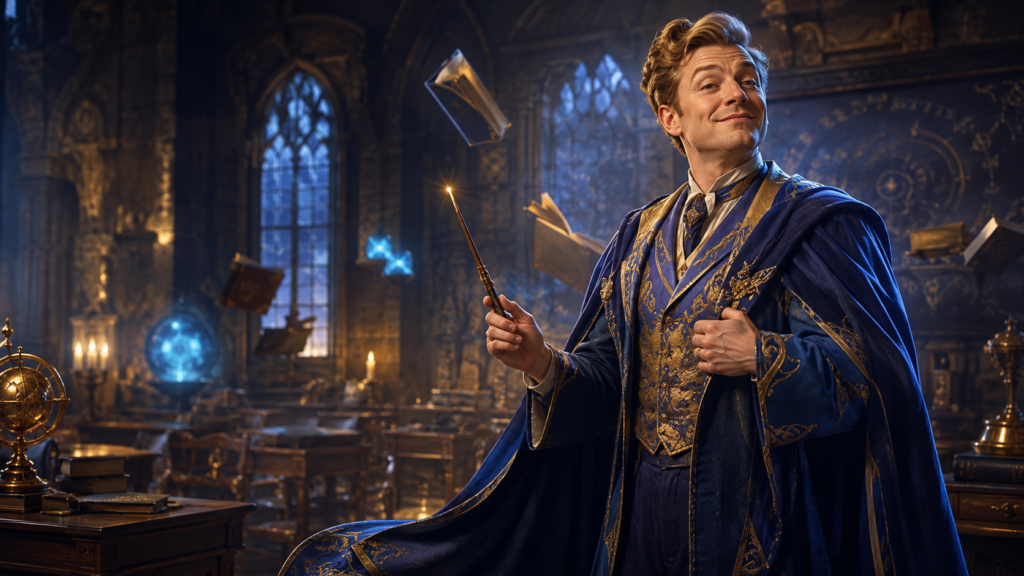
Gilderoy Lockhart-inspired wizard professor in a magical classroom for Harry Potter Season 2

Gilderoy Lockhart in Harry Potter Season 2: Kit Harington Replaces Nicholas Hoult

Gilderoy Lockhart is getting a new face in HBO’s Harry Potter series. Kit Harington has taken over the role for Season 2, replacing Nicholas Hoult, whose departure came after scheduling conflicts. The change adds an unexpected twist to one of the most recognizable supporting characters in Harry Potter and the Chamber of Secrets. For fans, the casting news is interesting for another reason. Harington is not completely new to Gilderoy Lockhart. He previously voiced the character in the full-cast audiobook edition of Harry Potter and the Chamber of Secrets. That connection gives the actor an unusual head start as he moves from an audio performance to a live-action interpretation. The recasting also arrives as HBO expands its new television adaptation of J.K. Rowling’s Harry Potter novels. Season 2 will move into the story of Chamber of Secrets, bringing Hogwarts back to the screen with a new generation of actors. Lockhart’s arrival will be especially important because his larger-than-life personality makes him one of the season’s most distinctive characters. Gilderoy Lockhart Gets a New Face in Harry Potter Season 2 Kit Harington Is Now Playing Gilderoy Lockhart Kit Harington will portray Gilderoy Lockhart in the second season of HBO’s Harry Potter. The actor joins the growing cast as the story moves into its second Hogwarts adventure, where Lockhart becomes the new Defense Against the Dark Arts professor. The casting gives HBO an actor best known for dramatic roles a chance to explore a much more flamboyant character. Lockhart is confident, theatrical and deeply invested in his own celebrity. His public image depends on charm, polished appearances and an impressive list of supposed achievements. Harington’s involvement also carries an unusual connection to the Harry Potter franchise. Before HBO’s television adaptation, he had already performed as Lockhart for the full-cast audiobook of The Chamber of Secrets. That means the new live-action role is not his first experience with the character. For HBO, however, this will be Harington’s first opportunity to define Lockhart visually and physically for a major screen adaptation. His performance will need to balance the character’s humor and charm with the insecurity hiding beneath his carefully constructed reputation. Nicholas Hoult Has Left the Role Nicholas Hoult was originally attached to play Gilderoy Lockhart in HBO’s series, but he will no longer appear in the role. Current reporting attributes the change to scheduling conflicts. The transition happened relatively early in the production process, allowing HBO to recast the character before his appearance in Season 2 became a finished part of the series. Rather than removing Lockhart from the adaptation, the production has moved forward with Harington. That distinction matters because Lockhart remains an important part of the Chamber of Secrets storyline. The recasting does not indicate that HBO has abandoned the character or changed his basic function within the story. Instead, viewers will see a different interpretation of the same Hogwarts professor. Hoult’s version will never reach the screen, while Harington now becomes the actor audiences will associate with HBO’s Gilderoy Lockhart. Who Is Gilderoy Lockhart? The Famous Hogwarts Professor Gilderoy Lockhart enters the Harry Potter story as a celebrated wizard with an enormous public profile. He has written multiple books about his supposed encounters with dangerous magical creatures and difficult supernatural situations. His reputation makes him appear ideally qualified to teach Defense Against the Dark Arts at Hogwarts. However, Lockhart’s personality is almost as important as his résumé. He enjoys attention, expects admiration and rarely misses an opportunity to promote himself. He presents himself as a fearless expert, yet his confidence often feels more polished than genuine. That contrast makes him different from many of the series’ darker or more intimidating characters. Lockhart can appear ridiculous rather than immediately threatening, but his role still contributes meaningfully to the story. His popularity also creates an interesting dynamic at Hogwarts. Students know his name before they properly know him, and his fame gives him an authority that does not necessarily come from his actual abilities. The Reality Behind His Reputation Lockhart’s greatest strength is his ability to create an image. He understands how to make himself look impressive, and he has built his career around stories that present him as the hero of extraordinary magical adventures. The problem is that his public reputation does not tell the whole story. As Chamber of Secrets develops, the difference between Lockhart’s claims and his real capabilities becomes increasingly important. His character works because he is not simply a comic teacher. He represents the gap between appearance and substance. That idea fits naturally into the wider Harry Potter universe, where characters frequently discover that reputation can be misleading. Lockhart simply takes that concept to an exaggerated level. For the HBO adaptation, that creates plenty of room for a performer to make the character funny, irritating and memorable at the same time. Harington will have to sell both sides of Lockhart: the dazzling public persona and the much less impressive reality underneath it. Why Gilderoy Lockhart Matters in Harry Potter Season 2 Lockhart and the Defense Against the Dark Arts Class Lockhart becomes part of Hogwarts during a particularly difficult year. The second story introduces a new threat inside the school, while Harry and his friends begin uncovering clues that connect the danger to Hogwarts’ past. Against that backdrop, Lockhart arrives as the new Defense Against the Dark Arts teacher. His confidence immediately separates him from the other adults at the school. Unlike a quiet or mysterious professor, Lockhart actively seeks attention. He enjoys being recognized, talks freely about his accomplishments and presents himself as an authority on magical danger. That personality creates comedy, but it also serves a larger storytelling purpose. Lockhart’s exaggerated confidence becomes increasingly difficult to reconcile with the serious events surrounding Harry, Ron and Hermione. His classroom scenes can therefore provide lighter moments while still advancing the characters and the larger mystery. His Connection to Harry, Ron and Hermione Lockhart’s relationship with the young trio gives the character much of his dramatic value.

Gilderoy Lockhart in Harry Potter Season 2: Kit Harington Replaces Nicholas Hoult Read More »