
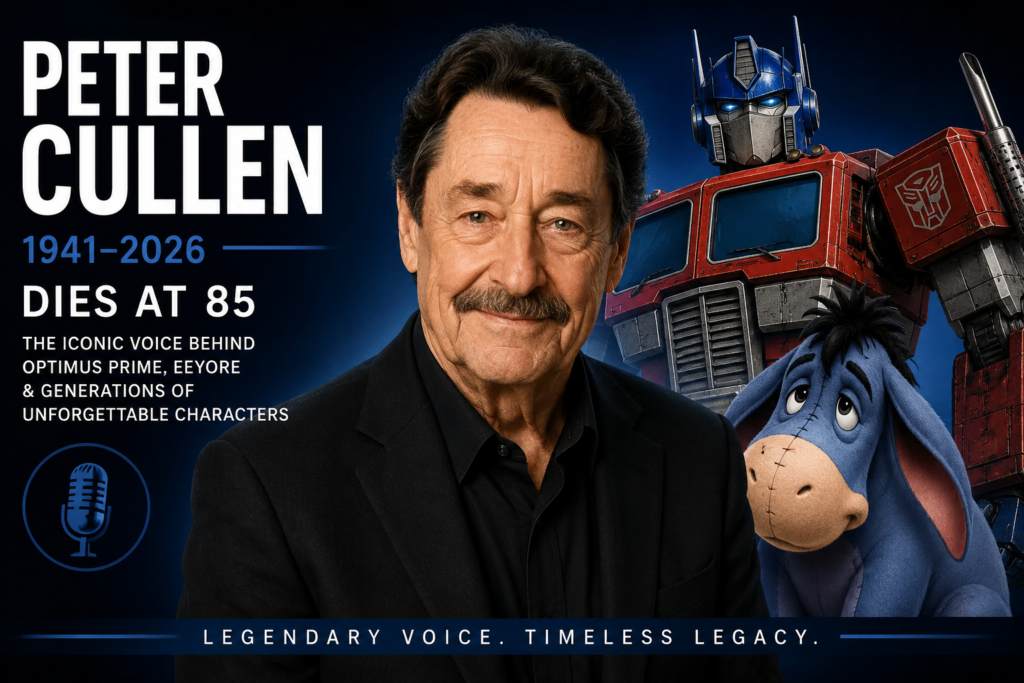
Peter Cullen, the voice actor whose deep, steady delivery helped define Optimus Prime for generations of Transformers fans, has died at 85. Cullen died Wednesday, August 26, 2026, at his home in Los Angeles, according to his agent, Kevin Motley. His family said he died peacefully surrounded by loved ones. No cause of death has been publicly announced.
For many viewers, Cullen’s name immediately brings to mind Optimus Prime, the heroic Autobot leader whose voice became one of the most recognizable sounds in animated entertainment. Yet his career stretched far beyond Transformers. He also became closely associated with Eeyore from Winnie the Pooh, while his credits included television, animation, film and vocal-effects work.
Cullen’s career lasted for decades and reached audiences across several generations. His performances showed an unusual range: he could give Optimus Prime commanding authority, bring quiet sadness to Eeyore, and create unsettling non-human sounds for the Predator. That versatility helped make him one of the most respected voice performers in popular entertainment.
Peter Cullen Dies at 85: What We Know
Peter Cullen’s Death Was Confirmed in August 2026
Peter Cullen died at his Los Angeles home on August 26, 2026, at the age of 85. His agent confirmed the news to ABC News on August 27. A statement from Cullen’s family described his passing as peaceful and said he was surrounded by his loved ones.
The news marked the end of a career that had connected Cullen with some of the most recognizable characters in animation and genre entertainment. His professional credits spanned more than six decades, with Transformers and Winnie the Pooh standing among his most enduring associations.
Cullen’s family also asked fans to remember his values alongside his work. Their statement emphasized service, compassion, integrity and loyalty, reflecting qualities that also fit the heroic image he helped give Optimus Prime.
What Is Known About Peter Cullen’s Cause of Death?
As of the initial announcement, no cause of death has been publicly disclosed. Cullen’s agent confirmed his death, but neither the agent nor the family provided a medical explanation.
That distinction matters because early reports surrounding a celebrity’s death can quickly generate speculation. At this stage, there is no verified public information establishing a cause, so claims beyond the confirmed details should not be treated as fact.
Who Was Peter Cullen?
Early Life and the Discovery of His Voice
Peter Cullen was born in Canada and developed an interest in voices and performance long before he became Optimus Prime. In a later interview, he recalled discovering his ability to command attention with sound while working around his family’s farm as a child. He remembered making a loud noise in the dairy barn and watching the cows react to him.
That childhood experience became an early clue to a talent that would eventually shape his career. Cullen learned that his voice could communicate personality and emotion even without a visible performance.
Like other actors whose careers have crossed multiple generations and genres, Cullen built a professional legacy that extended far beyond the role that made him famous.
He later pursued formal training and built experience as a performer before moving deeper into television, comedy and voice work. His early years gave him a foundation that would prove valuable when animation became a major part of his professional life.
From Canadian Performer to American Television
Before audiences knew him as Optimus Prime or Eeyore, Cullen worked in radio and television. He eventually became the announcer on The Sonny & Cher Comedy Hour during the 1970s, a role that helped open the door to further acting opportunities.
His career developed during an era when performers often moved between radio, television, comedy, live performance and voice work. That versatility became one of Cullen’s defining strengths.
Rather than building his reputation around a single type of performance, he accumulated experience across different formats. By the time major animation opportunities arrived, Cullen had already spent years learning how to use timing, tone, rhythm and vocal character to make a performance memorable.
Peter Cullen and Optimus Prime
How Cullen Became the Voice of Optimus Prime
Cullen’s defining breakthrough came with Transformers, where he became the voice of Optimus Prime. The character required more than a commanding voice. Prime needed to sound like a leader who could project strength while still conveying restraint, responsibility and compassion.
Cullen developed a performance that gave the Autobot leader a distinctive identity. His delivery was measured rather than frantic, allowing individual words to carry weight. That approach helped establish Optimus Prime as a character whose authority came from confidence and conviction rather than anger.
The inspiration for the voice also had a personal connection. Cullen had spoken about his brother Larry, a U.S. Marine, as an influence on the way he approached the character. That experience helped him think about the qualities of a military leader and translate them into a fictional robot commander.
Why His Optimus Prime Voice Became Iconic
The enduring power of Cullen’s Optimus Prime performance came from its emotional balance. He could make the character sound imposing without making him cold. Prime could deliver instructions, confront enemies and inspire his allies while retaining a sense of humanity.
That distinction became crucial to the character’s longevity. Transformers introduced Optimus Prime to audiences in the 1980s, but Cullen’s voice remained strongly associated with the character long after that original era ended.
For fans, hearing Cullen return as Optimus Prime became more than a casting choice. His voice carried continuity between different generations of Transformers storytelling, helping preserve the character’s familiar identity even as the franchise changed around him.
Peter Cullen’s Transformers Legacy
From the Original Cartoon to The Transformers: The Movie
Peter Cullen first became Optimus Prime in the original Transformers animated series in 1984. The role quickly became the defining performance of his career, but Cullen’s connection with the character did not end when the original television era changed.
He returned as Optimus Prime for The Transformers: The Movie in 1986, giving the character the same commanding presence that audiences had come to recognize. The film expanded the emotional stakes of the franchise and helped establish Optimus Prime as more than a traditional cartoon hero.
Cullen’s performance gave Prime a sense of consistency. Even as the character moved between television, film and later forms of entertainment, audiences could immediately recognize the voice. That continuity became increasingly important as Transformers developed into a multigenerational franchise.
The character’s popularity also helped cement Cullen’s place in animation history. His voice became so closely connected with Optimus Prime that later appearances could use it as an immediate signal of the character’s identity. Decades after the original series, Cullen remained the performer audiences associated most strongly with the Autobot leader.
Returning to Optimus Prime for Live-Action Transformers
When Transformers moved to live-action cinema in 2007, Cullen returned as Optimus Prime. That decision gave the new film series a direct vocal connection to the classic animated era.
He continued voicing Prime in Transformers: Revenge of the Fallen, Dark of the Moon, Age of Extinction and The Last Knight. He also continued the role in animated productions and other franchise projects.
Cullen’s return mattered because the live-action films introduced a new generation to the character while retaining a voice familiar to longtime fans. His performance helped bridge those audiences rather than treating the character as something completely new.
He later reprised Optimus Prime in Transformers: Rise of the Beasts in 2023, extending his association with the character into another era of the franchise.
Peter Cullen as Eeyore in Winnie the Pooh
A Completely Different Kind of Character
If Optimus Prime represented Cullen’s commanding side, Eeyore revealed his ability to create a much quieter personality.
Cullen began voicing Eeyore in The New Adventures of Winnie the Pooh, which premiered in 1988. The character’s personality stood almost completely opposite to Optimus Prime. Instead of a powerful leader, Eeyore was a gloomy, understated donkey whose dry observations often carried a gentle sadness.
Cullen did not need a dramatic performance to make Eeyore memorable. His restrained delivery, deliberate pacing and low-key humor gave the character a recognizable personality. The voice made Eeyore sound tired without turning him into a one-note joke.
That contrast is one of the clearest examples of Cullen’s range as a performer. Someone who could make Optimus Prime sound like a decisive commander could also make Eeyore feel vulnerable and quietly funny.
The role remained part of Cullen’s career for decades. He returned to Eeyore across numerous Winnie the Pooh projects, television appearances and other Disney productions. His performance became another major part of his identity, especially for audiences who knew his work through family entertainment rather than Transformers.
Why Eeyore Became One of His Signature Roles
Eeyore demonstrated that Cullen’s talent did not depend on a heroic character or an imposing voice. He could use the same fundamental vocal control to create an entirely different emotional effect.
That versatility also explains why Cullen remained recognizable across different generations. One audience member might remember him primarily as Optimus Prime, while another might know him first as Eeyore.
The two roles created an unusual career pairing. Optimus Prime is associated with courage, leadership and strength, while Eeyore is associated with melancholy, patience and understated humor. Cullen made both characters distinctive without making them sound like variations of one another.
His work as Eeyore therefore deserves to be viewed as more than a secondary credit. Alongside Optimus Prime, it became one of the performances that defined his public legacy.
Peter Cullen’s Other Famous Voice Roles
K.A.R.R. in Knight Rider
Cullen’s work extended well beyond animation. One notable television role came in Knight Rider, where he provided the voice of K.A.R.R., the dangerous predecessor to K.I.T.T.
The part gave Cullen another opportunity to use his deep voice for a character whose personality contrasted with the heroic Optimus Prime. Instead of reassuring audiences, K.A.R.R.’s voice helped establish a darker and more threatening presence.
His work on the series showed how effectively Cullen could alter the emotional meaning of his voice depending on the character.
Predator and King Kong
Cullen also contributed to two major creature performances.
For the 1976 King Kong, he provided vocal work connected with the giant ape. More than a decade later, he supplied distinctive vocal effects for the Predator in the 1987 science-fiction action film Predator.
The Predator work was particularly different from conventional voice acting. Cullen helped create the creature’s vocal sounds rather than delivering conventional human dialogue. His contribution became part of the unsettling sound identity of one of cinema’s most recognizable monsters.
These roles showed that Cullen could communicate character without relying on ordinary speech.
Animation, Games and Later Roles
Cullen’s credits also included characters across animation, family entertainment and games. Among the better-known examples were Monterey Jack in Chip ‘n Dale: Rescue Rangers, Captain Flint in Treasure Planet, and Thaedus in Invincible.
His work reached different generations and formats, including television series, feature films and video games. That breadth helps explain why his career cannot be reduced to one franchise.
Cullen’s career also belongs to a wider tradition of performers who became memorable through distinctive voices and character-driven performances. That connection can be seen across generations of entertainment, from animation and fantasy to horror and genre cinema. Tim Curry’s career, for example, similarly demonstrates how a distinctive performer can move between screen acting, voice work and unforgettable genre characters.
Even when audiences did not immediately recognize his name, they often recognized the sound of his work. That became one of Cullen’s greatest professional strengths: he could disappear into a character while leaving a memorable vocal signature behind.
Peter Cullen’s Career Timeline
The 1960s and 1970s: Building a Performance Career
Cullen’s professional journey began long before Transformers. Born in Montreal in 1941, he graduated from Canada’s National Theatre School in 1963 and developed experience in radio and television.
His early career included announcing and performing on television programs, including The Sonny & Cher Comedy Hour. Those opportunities helped him develop the timing, projection and character control that later became essential to his voice work.
The 1980s and 1990s: The Voice of a Generation
The 1980s transformed Cullen’s career. He became Optimus Prime in 1984 and Eeyore in 1988, giving him two roles that would remain associated with him for the rest of his life.
During the same period, he worked across other television and film projects, including Knight Rider, Predator and Gremlins.
The decade established his range and turned him into one of the most recognizable voice performers in popular entertainment.
The 2000s and 2020s: A Career That Kept Evolving
Cullen entered the 21st century with his classic characters still in demand. His return as Optimus Prime for the 2007 live-action Transformers film introduced his performance to another generation.
He continued working in animation, games and film, including later Transformers productions and Invincible. His career therefore remained active across multiple entertainment eras rather than ending with the characters that made him famous.
Peter Cullen’s Awards and Industry Recognition
A Lifetime Achievement Honor
Peter Cullen’s influence eventually received formal recognition from the television industry. In December 2023, the National Academy of Television Arts & Sciences presented him with a Lifetime Achievement Award at the second annual Children’s & Family Emmy Awards. The honor recognized a career that had stretched across animation, television, film and other forms of voice performance.
The award arrived after decades of work rather than because of a single performance. Cullen had already become one of the most recognizable voices in children’s and family entertainment through Optimus Prime and Eeyore. His broader credits, however, showed that his contribution extended well beyond those two characters.
Fellow voice actor Frank Welker, who worked alongside Cullen in the Transformers franchise, presented the honor. The moment also highlighted the professional relationships Cullen built during a career that repeatedly brought him back to the same major franchises.
Recognition Beyond Optimus Prime
Cullen’s honors also reflected the lasting importance of his work as a voice performer. He was inducted into the Hasbro Transformers Hall of Fame in 2010, and his performance as Optimus Prime in Transformers: Prime earned him a Daytime Emmy nomination for Outstanding Performer in an Animated Program.
These recognitions helped establish that Cullen’s contribution was not simply nostalgia. His work remained professionally respected even as animation technology, production methods and audience expectations changed.
Cullen’s story also reflects the broader way CLIMAX Magazine continues to document the careers and legacies of performers whose work left a lasting mark on audiences.
Peter Cullen’s Final Years and Later Work
Returning to Optimus Prime Across New Generations
Cullen continued to voice Optimus Prime long after the original 1980s cartoon ended. He returned for the live-action Transformers films beginning in 2007 and continued through Transformers: Rise of the Beasts in 2023. He also performed Prime in animated series, video games and other franchise projects.
That longevity was unusual. Many performers become closely identified with a character for a specific era, while Cullen continued carrying the same role across changing versions of the franchise.
His work also expanded beyond traditional screen appearances. He contributed to Transformers video games, promotional projects and other franchise experiences, allowing his interpretation of Optimus Prime to remain part of the character’s identity outside movies and television.
His Later Voice Acting Work
Cullen continued accepting voice roles into his 80s. One of his later notable performances came as Thaedus in Invincible. His work on the series extended his career into contemporary adult animation and demonstrated that his voice remained useful for complex, dramatic characters.
His final years therefore did not represent a quiet retirement from performance. Instead, they showed how a voice actor could continue contributing to major entertainment franchises across generations.
Cullen died on August 26, 2026, at his Los Angeles home. His family confirmed his peaceful passing and asked fans to honor his legacy through compassion, integrity and service to their communities.
Peter Cullen’s Family and Personal Life
His Family
Peter Cullen’s public career often centered on fictional characters, but family remained an important part of his personal life. He was survived by his wife, Brandi, and four children: Angus, Claire, Pilar and Clay. His son Clay Cullen also worked in the entertainment industry as a stunt performer.
Cullen generally maintained a lower public profile than many performers whose work reached such a large audience. That allowed his professional achievements to remain the main focus of his public identity.
His family became central to the news of his death in August 2026. Relatives confirmed that he died peacefully at home surrounded by loved ones. They also encouraged admirers to remember the principles he represented rather than focusing only on the loss itself.
The Influence of His Brother Larry
Cullen’s brother Larry played an especially important role in the creation of his Optimus Prime performance. Larry served in the U.S. Marine Corps, and Cullen drew inspiration from his brother’s sense of leadership and duty when preparing for the role.
The influence helped Cullen approach Optimus Prime differently from a conventional action hero. Instead of relying solely on volume or aggression, he built the character around controlled authority and compassion. The result became one of the defining vocal performances in animation.
That personal connection adds another dimension to Cullen’s legacy. Optimus Prime became famous as a fictional leader, but the voice behind him drew part of its character from Cullen’s own experience and admiration for his brother.
Why Peter Cullen’s Voice Mattered
More Than an Iconic Voice
Peter Cullen’s importance came from his ability to make a voice communicate character. Optimus Prime did not sound heroic simply because Cullen had a deep voice. His pauses, pacing and controlled delivery gave Prime a sense of responsibility.
The same performer could then move in the opposite direction with Eeyore. That character required vulnerability, dry humor and resignation rather than command. Cullen created those qualities without losing the character’s distinct identity.
His work on the Predator provided another example. There, he helped create vocal effects for a creature that did not communicate through ordinary human dialogue. This ability to make a character memorable through voice is one of the qualities shared by many celebrated performers in genre entertainment.
Tim Curry’s work across film, television and voice acting offers another example of how a distinctive performance can become inseparable from an iconic character.
These roles reveal why Cullen’s career deserves attention beyond a list of famous credits. He understood that voice acting requires performance choices, not simply an unusual voice.
A Career Built on Character and Range
Cullen’s career covered comedy, children’s entertainment, science fiction, action, animation and video games. He could play heroes, villains, creatures and supporting characters while giving each a recognizable personality.
That range also helped him remain relevant as entertainment changed. The audience that discovered him through the original Transformers cartoon could later hear him in live-action films or modern animated series.
His longevity demonstrates an important point about voice acting: a successful performer does not merely create a memorable sound. The performer creates an emotional identity that audiences can recognize even when the character, medium and production have changed.
For Cullen, that identity became especially powerful through Optimus Prime, but it never stopped there. His career showed how much expressive possibility can exist in a voice alone.
Why Peter Cullen’s Voice Mattered
More Than an Iconic Voice
Peter Cullen’s greatest contribution was not simply having a naturally recognizable voice. He understood how vocal performance could define a character’s personality, values and emotional world.
That skill became especially clear through Optimus Prime. Cullen gave the Autobot leader a deep, controlled delivery that suggested strength without unnecessary aggression. Prime could sound powerful while still communicating patience and compassion. Those qualities helped audiences understand the character before the animation even revealed what he was doing.
Cullen achieved something equally distinctive with Eeyore. The character required a quieter approach, with pauses and understated delivery doing much of the emotional work. His performance made Eeyore’s pessimism funny, but it also allowed audiences to sense the character’s vulnerability.
His creature work demonstrated another side of the same talent. For Predator, Cullen helped create the alien’s vocal effects rather than simply performing conventional dialogue. That required him to communicate danger and personality through unusual sounds.
Together, these performances show why Cullen’s career mattered. He could make a character recognizable through sound alone, whether that character was a heroic robot, a melancholy donkey or an extraterrestrial hunter. His work helped demonstrate that voice acting can carry the same emotional weight as an on-camera performance.
A Career Built on Character and Range
Cullen’s career covered an unusually broad range of genres and formats. He worked in radio, television, animation, feature films, video games and franchise entertainment. His credits included heroes, villains, creatures and comic characters, allowing him to repeatedly demonstrate his adaptability.
That range also helped him remain relevant as entertainment changed. The performer who became famous during the 1980s animation boom later appeared in major live-action franchises and modern animated productions.
More than 100 voice credits are associated with Cullen’s career, according to contemporary reporting. That volume matters, but the variety of his best-known work matters even more. Optimus Prime and Eeyore alone represent dramatically different performance styles, while K.A.R.R. and the Predator show another side of his abilities.
Cullen’s career ultimately demonstrated that successful voice acting depends on choices. Pitch, rhythm, pauses, emphasis and emotional restraint can transform the same human voice into completely different personalities.
That lesson remains part of his professional legacy. Cullen did not simply lend his voice to characters. He helped establish how audiences heard them.
Peter Cullen’s Legacy After His Death
The Legacy of Optimus Prime
Peter Cullen’s connection with Optimus Prime became one of the longest-running relationships between a performer and a fictional character in popular entertainment.
He first voiced the Autobot leader in the 1984 animated series and continued playing Prime across later television projects, animated productions, video games and feature films. His return for the live-action franchise beginning in 2007 introduced his interpretation to audiences who had not grown up with the original cartoon. He most recently voiced Prime in Transformers: Rise of the Beasts in 2023.
That continuity gave the character a rare sense of identity. Different directors, writers, animation teams and actors could change the presentation of Transformers, but Cullen’s voice provided a familiar connection to its history.
His influence also became especially visible whenever the franchise revisited major emotional moments involving Optimus Prime. The character’s voice carried memories of earlier stories, making Cullen’s performance part of the franchise’s emotional foundation.
For many fans, Optimus Prime will remain inseparable from the sound Cullen created. Future performers may portray the character, but Cullen established the benchmark against which many versions will naturally be compared.
A Voice Shared Across Generations
Cullen’s legacy reaches beyond Transformers because his work crossed age groups. Children could know him as Eeyore, teenagers could discover him through Optimus Prime, and older audiences could encounter his work in films, television and other projects.
That broad reach helped make his career unusual. A performer does not often become associated with both a major action franchise and one of children’s entertainment’s most recognizable supporting characters.
His work also survived changes in technology and distribution. Cullen began his career during the radio and broadcast-television era and remained active during the age of streaming, blockbuster franchises and digital entertainment.
That six-decade span gave him an unusual place in popular culture. His performances were not confined to one generation or medium. Instead, they moved with audiences as entertainment itself evolved.
His death therefore represents more than the loss of a familiar voice. It closes a remarkable chapter in the history of voice performance while leaving behind characters that remain active in new stories.
What Made Peter Cullen’s Career Exceptional
He Gave Different Characters Distinct Emotional Identities
Cullen’s most impressive achievement may be the distance between his signature roles. Optimus Prime and Eeyore could hardly be more different, yet audiences can identify both almost immediately.
Prime communicates leadership. Eeyore communicates resignation. K.A.R.R. suggests menace, while the Predator vocalizations create an entirely different kind of threat.
Cullen approached each role as its own performance rather than simply applying the same recognizable voice. That distinction helped his characters feel complete.
For Optimus Prime, his measured delivery gave speeches and conversations a sense of importance. For Eeyore, his slower rhythm created a comic sadness that became central to the character. In creature roles, he showed that expression does not always require conventional words.
This ability to change the emotional meaning of his voice is a major reason his performances lasted.
His Work Connected Different Eras of Entertainment
Cullen’s career provides a timeline of changing entertainment technology. He started with radio and television, entered the major animation boom of the 1980s, worked in theatrical films, returned to major franchises in the 2000s and continued into modern streaming animation.
Few performers maintain that kind of continuity.
His career also demonstrates how voice actors can remain essential even when audiences increasingly focus on visible stars. Cullen rarely appeared on screen as the face of Optimus Prime, yet his vocal performance became one of the most recognizable elements of the franchise.
That achievement is particularly significant because audiences often remember characters before they remember the people who performed them. Cullen’s work succeeded precisely because the characters felt larger than the performer behind them.
Peter Cullen’s Lasting Cultural Impact
Optimus Prime Became a Voice of Leadership
Optimus Prime’s cultural importance is closely tied to Cullen’s performance. The character represents courage and leadership within the Transformers universe, but Cullen’s delivery helped make those qualities feel believable.
His version of Prime rarely needed to shout to establish authority. Instead, the character could sound calm and deliberate even during moments of conflict. That vocal approach separated Prime from a conventional action hero.
The result was a character whose strength could coexist with compassion. That balance became one of the reasons Cullen’s interpretation remained so influential.
It also explains why his voice continued to matter when Transformers moved into new formats. The franchise could change visually, but the emotional identity of Optimus Prime remained connected to the sound Cullen created.
His contribution was therefore not limited to performing dialogue. He helped define the character’s personality at the most fundamental level.
His Influence Reached Beyond Transformers
Although Optimus Prime remains Cullen’s best-known role, his influence on voice acting extends further.
Eeyore showed that a performance could be memorable without heroic speeches or dramatic action. His work on Predator demonstrated how vocal effects could become an essential part of a creature’s identity. His television and animation roles further showed that a performer could move comfortably between comedy, drama, science fiction and family entertainment.
That versatility gave Cullen a career that could speak to different audiences simultaneously.
It also helped establish voice acting as a serious performance discipline. The audience may never see the actor’s face, but the performance still requires timing, emotional control and precise character choices.
Cullen’s body of work made that invisible craft easier to appreciate. His characters sounded different because he understood that every character needed a different emotional center.
Peter Cullen’s Legacy After 2026
Remembering the Performer Behind the Characters
Peter Cullen’s death on August 26, 2026, ended a career that had lasted more than six decades. He was 85 and died at his Los Angeles home surrounded by family. His cause of death had not been publicly disclosed at the time of the announcement.
Yet his career makes the word “legacy” especially appropriate. Cullen leaves behind performances that remain accessible to audiences through television, films, games and streaming platforms.
For longtime Transformers fans, his voice will forever recall Optimus Prime. For generations who grew up with Winnie the Pooh, it may instead bring back Eeyore. Others will remember K.A.R.R., the Predator’s distinctive sounds or one of his many supporting animation roles.
Those memories can coexist because Cullen built a career around character rather than celebrity.
A Voice That Will Continue to Be Heard
The characters Cullen played will continue appearing in entertainment long after his death. That means new audiences will keep encountering his work, even if they discover it years after its original release.
Optimus Prime remains one of the central figures in Transformers, while Eeyore remains part of the wider Winnie the Pooh world. Their continued presence gives Cullen’s performances a life beyond their original production dates.
His family asked admirers to remember his legacy through compassion, integrity, loyalty and service to their communities. That message fits naturally with the qualities Cullen helped build into Optimus Prime: strength paired with restraint and responsibility.
Ultimately, Peter Cullen’s legacy is not only the sound of one famous robot. It is the record of a performer who spent decades proving that a voice can create personality, emotion and memory.
For millions of viewers, hearing that voice will continue to bring those characters back to life.