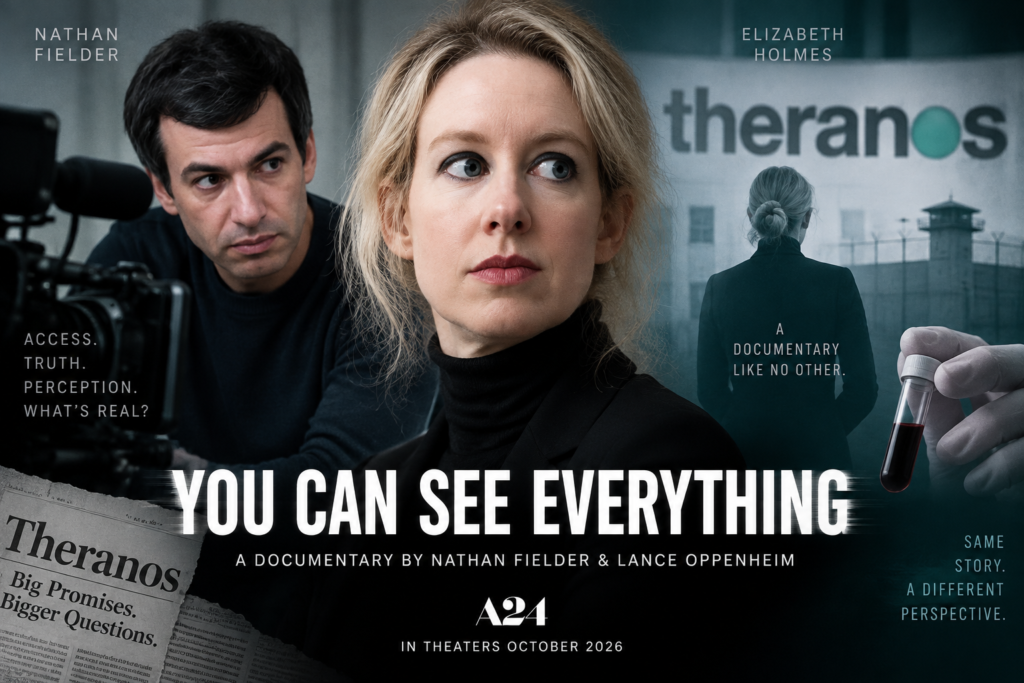
Elizabeth Holmes Documentary: You Can See Everything Release Date, Trailer & What to Know
The Elizabeth Holmes documentary has taken an unexpected turn with You Can See Everything, a secret film from Nathan Fielder and Lance Oppenheim that suddenly emerged at the 2026 Telluride Film Festival. Instead of another conventional examination of the Theranos scandal, the documentary follows Holmes through an unusually intimate period of her life and then pushes into much stranger territory. The film begins 34 days before Holmes was due to report to federal prison. At that point, she invited a skeptical film crew to document her life with her partner, Billy Evans, and their young children. What started as an attempt to capture Holmes’s perspective developed into a three-year filmmaking project. Directed by Fielder and Oppenheim, You Can See Everything was kept largely secret until its surprise Telluride screening. A24 has announced a theatrical release in October 2026, while the studio’s teaser has now given audiences their first official glimpse at the film. That combination makes the documentary especially intriguing. Holmes’s story has already been explored through books, documentaries and scripted television. This time, however, the filmmakers had direct access to Holmes during a pivotal moment, while Fielder’s unconventional approach creates a much less predictable film. Elizabeth Holmes Documentary: What Is You Can See Everything? You Can See Everything is a documentary about Elizabeth Holmes, the former Theranos founder whose rise and collapse became one of Silicon Valley’s most closely scrutinized scandals. The film is directed by Nathan Fielder and Lance Oppenheim. Fielder initially questioned whether another project about Holmes was necessary. After meeting her, however, his uncertainty about her personality and presentation became part of the reason he wanted to continue. Oppenheim had learned that Holmes was looking for filmmakers to document her life, setting the project in motion. The documentary begins with Holmes opening her home to the crew shortly before she entered federal prison. She and Evans presented the access as an opportunity to show what they believed the public had misunderstood about Holmes. That setup gives the movie a personal starting point rather than beginning with the familiar history of Theranos. However, You Can See Everything reportedly does not remain a straightforward observational documentary. As Fielder becomes increasingly involved in the story, questions about honesty, control and performance become central to the film. The filmmakers also use reenactments and increasingly unconventional sequences, turning the documentary into something considerably more experimental than a standard true-crime production. That approach is important because the film is not simply asking what happened at Theranos. It also examines how Holmes presents herself and how filmmakers decide what to believe. You Can See Everything Release Date and Theatrical Plans A24 has confirmed that You Can See Everything will arrive in theaters in October 2026. The film received its surprise world premiere at the Telluride Film Festival on September 6, where it occupied the festival’s previously secret screening slot. For now, October is the confirmed theatrical window. An exact nationwide release date has not been clearly established by the available official information, so readers should treat specific dates circulating online with caution. The film’s theatrical rollout is particularly notable because of its length and unusual festival debut. Reports from Telluride describe the documentary as running for approximately 174 minutes, or nearly three hours. When does You Can See Everything come out? The documentary is scheduled for a theatrical release in October 2026 through A24. The studio has not yet provided a complete public schedule for every market, so the exact date may vary as the theatrical rollout develops. Will You Can See Everything stream online? A streaming service and streaming release date have not been confirmed in the information currently available. For now, the confirmed plan is a theatrical release. That means audiences should not assume a specific streaming platform or digital date until A24 makes an official announcement. Elizabeth Holmes Documentary Trailer: What the Teaser Reveals The first official teaser for You Can See Everything immediately establishes the unusual relationship between Holmes and Fielder. Rather than presenting a conventional collection of archival footage and talking-head interviews, the teaser places the two in direct conversation. Fielder appears skeptical as he questions Holmes about whether she is genuinely being herself. Holmes, meanwhile, remains composed while caring for her newborn child. That simple setup creates the central tension of the documentary: how much can the audience trust what it sees? The teaser also avoids explaining the film’s biggest developments. That restraint appears intentional. Viewers who attended Telluride have described the documentary as moving far beyond its initial setup, with reenactments and major shifts in tone that are difficult to understand from the short promotional footage alone. That makes the teaser more of a mood-setter than a traditional plot preview. It introduces Holmes, Fielder and the central question of the filmmaker-subject relationship without giving away the film’s later surprises. For audiences already familiar with the Theranos story, that may be the most compelling part of the marketing. The documentary does not need to convince viewers that Holmes’s story is remarkable. Instead, it asks what happens when an unconventional filmmaker gets unusually close to the person at the center of it. Why Nathan Fielder Made an Elizabeth Holmes Documentary Nathan Fielder’s decision to make an Elizabeth Holmes documentary did not begin with a simple desire to revisit the Theranos scandal. He initially questioned whether audiences needed another project about Holmes after years of intense media coverage. That changed after he met Holmes. Instead of approaching her story only as a completed scandal, Fielder became interested in the gap between the public’s understanding of Holmes and the way Holmes understood herself. That uncertainty became a driving force behind the project. Fielder’s involvement also changes the documentary’s perspective. He is not simply observing Holmes from a distance. His skepticism becomes part of the filmmaking process, creating a relationship in which the subject and filmmaker continually test each other. The result is a documentary built around access and uncertainty. Holmes gets an opportunity to present her own perspective,