
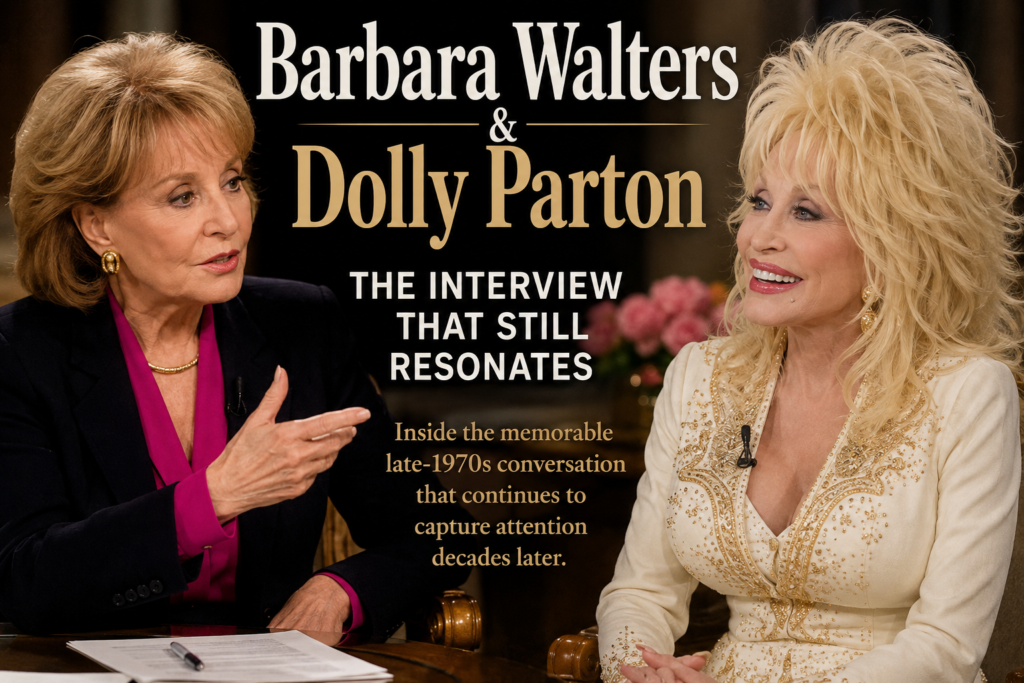
Barbara Walters and Dolly Parton: The Interview That Still Resonates
Barbara Walters built her reputation by asking questions that other television journalists sometimes avoided. She could be warm and conversational, yet she could also become direct when a guest gave a carefully prepared answer. That combination made her one of the most recognizable interviewers in American television. Her conversation with Dolly Parton remains one of the more memorable examples of that approach. The late-1970s interview brought together two women with very different ways of communicating. Walters wanted to look beyond Parton’s polished celebrity image and examine the person behind it. Parton, meanwhile, understood how quickly an interviewer could shape public perception. She responded with humor, confidence and a strong sense of who she was. The discussion eventually touched on Parton’s rural upbringing and the word “hillbilly.” That language can sound particularly uncomfortable to modern audiences because the term has often carried class-based stereotypes. However, the exchange becomes more interesting when viewed through Parton’s response rather than through the controversial wording alone. Instead of rejecting her roots, Parton separated her actual background from the assumptions attached to it. She did not need to deny where she came from to establish her success. That approach helps explain why the interview continues to attract attention. It was not simply a difficult celebrity interview. The conversation became a revealing moment about identity, class, appearance and the power of controlling your own story. Why Barbara Walters Was Such a Formidable Interviewer Barbara Walters developed a style that made even familiar celebrities feel less predictable. Her interviews often moved beyond career achievements and promotional talking points. She wanted to understand what motivated a person, what worried them and how they viewed their own public image. The Interview Style That Made Walters Famous Direct questions formed a major part of Walters’ approach. She could challenge a guest’s explanation, return to an uncomfortable subject or ask about something that another interviewer might avoid. That method sometimes created tension. Yet tension could make a conversation more revealing. Walters understood that celebrities arrived with polished answers, especially when they were promoting a new project. Her job was to discover what remained after those prepared responses. This approach became especially noticeable when she interviewed entertainers. Rather than treating fame as a reason to avoid difficult subjects, Walters often treated celebrity status as a reason to examine those subjects more closely. The technique could produce emotional, surprising or uncomfortable moments. It also helped distinguish Walters from interviewers who focused primarily on friendly promotion. Her conversation with Parton followed that philosophy. Walters did not simply ask about music. She explored the singer’s upbringing, appearance and carefully developed public persona. That choice created the tension that eventually made the interview memorable. Barbara Walters’ Place in Television History Walters’ importance extends far beyond individual interviews. She joined ABC News in 1976 and became the first woman to anchor an evening news program. Her career later included 20/20, where she became known for major interviews, and The View, the daytime program she helped create. Those achievements placed her among the most influential women in American television. Her rise also happened during a period when women faced significant barriers in broadcast journalism. Walters had to establish credibility in an industry that often treated serious news reporting as a male-dominated field. She eventually built a career that crossed several television formats. Political leaders, entertainers and other major public figures all became subjects of her interviews. That range is important when considering her conversation with Dolly Parton. Walters did not necessarily separate entertainment interviews from serious journalism. She approached a famous singer with the same instinct that shaped much of her work: ask the question that might reveal something audiences had not heard before. Her legacy therefore rests not only on the people she interviewed but also on the interviewing culture she helped create. What Happened When Barbara Walters Interviewed Dolly Parton? The conversation occurred during an important stage of Dolly Parton’s rise as a national celebrity. Her success in country music had already established her name, while her distinctive appearance and personality were becoming central to her public image. Parton’s Career Before the Interview Parton’s story differed from the glamorous image she eventually developed. She grew up in rural Tennessee in a large family with limited financial resources. Those early experiences later became important sources for her songwriting and storytelling. Rather than hiding that background after becoming successful, Parton continued to discuss it openly. Her childhood remained connected to the themes of family, poverty, ambition and resilience that appeared throughout her work. That history gave Walters plenty of material to explore. Parton was no longer simply a country singer from Tennessee. She had become a recognizable entertainment personality whose appearance, accent and humor were inseparable from the way audiences perceived her. Walters wanted to understand how much of that image represented the real woman. Parton’s answer, however, showed that she did not see a conflict between her public persona and her personal identity. The glamorous presentation was something she understood and controlled. That distinction became increasingly important as the interview moved toward questions about her background. The Question About Her Background One of the most discussed parts of the conversation involved the word “hillbilly.” The term connected Parton to her rural Appalachian background, but it also carried negative class associations. That created an uncomfortable tension. Parton did not respond as though her upbringing were something shameful. Instead, she acknowledged her origins while resisting the idea that those origins made her less intelligent, ambitious or successful. Her response reflected a pattern that would remain visible throughout her career. Parton could joke about her background without allowing other people to define its value. The distinction is subtle but important. Someone can acknowledge a stereotype without accepting the judgment attached to it. Parton demonstrated that difference during the conversation by treating her roots as part of her identity rather than as an obstacle she needed to erase. The exchange therefore became larger than a single label. Walters was examining how
Barbara Walters and Dolly Parton: The Interview That Still Resonates Read More »