
Movie News

Explore the latest Movie News, casting updates, trailers and releases. Discover stories about upcoming films, actors and filmmakers. Get fresh updates from Hollywood and the global film industry on CLIMAX Magazine every day.

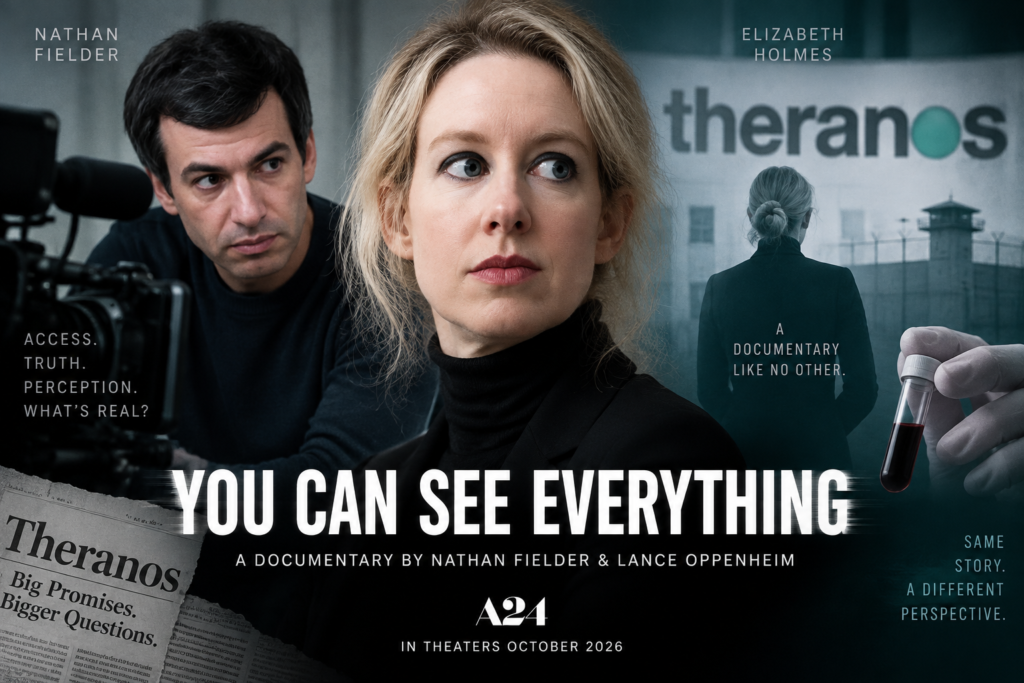
Elizabeth Holmes in You Can See Everything documentary featuring Nathan Fielder

Elizabeth Holmes Documentary: You Can See Everything Release Date, Trailer & What to Know

The Elizabeth Holmes documentary has taken an unexpected turn with You Can See Everything, a secret film from Nathan Fielder and Lance Oppenheim that suddenly emerged at the 2026 Telluride Film Festival. Instead of another conventional examination of the Theranos scandal, the documentary follows Holmes through an unusually intimate period of her life and then pushes into much stranger territory. The film begins 34 days before Holmes was due to report to federal prison. At that point, she invited a skeptical film crew to document her life with her partner, Billy Evans, and their young children. What started as an attempt to capture Holmes’s perspective developed into a three-year filmmaking project. Directed by Fielder and Oppenheim, You Can See Everything was kept largely secret until its surprise Telluride screening. A24 has announced a theatrical release in October 2026, while the studio’s teaser has now given audiences their first official glimpse at the film. That combination makes the documentary especially intriguing. Holmes’s story has already been explored through books, documentaries and scripted television. This time, however, the filmmakers had direct access to Holmes during a pivotal moment, while Fielder’s unconventional approach creates a much less predictable film. Elizabeth Holmes Documentary: What Is You Can See Everything? You Can See Everything is a documentary about Elizabeth Holmes, the former Theranos founder whose rise and collapse became one of Silicon Valley’s most closely scrutinized scandals. The film is directed by Nathan Fielder and Lance Oppenheim. Fielder initially questioned whether another project about Holmes was necessary. After meeting her, however, his uncertainty about her personality and presentation became part of the reason he wanted to continue. Oppenheim had learned that Holmes was looking for filmmakers to document her life, setting the project in motion.   The documentary begins with Holmes opening her home to the crew shortly before she entered federal prison. She and Evans presented the access as an opportunity to show what they believed the public had misunderstood about Holmes. That setup gives the movie a personal starting point rather than beginning with the familiar history of Theranos. However, You Can See Everything reportedly does not remain a straightforward observational documentary. As Fielder becomes increasingly involved in the story, questions about honesty, control and performance become central to the film. The filmmakers also use reenactments and increasingly unconventional sequences, turning the documentary into something considerably more experimental than a standard true-crime production. That approach is important because the film is not simply asking what happened at Theranos. It also examines how Holmes presents herself and how filmmakers decide what to believe. You Can See Everything Release Date and Theatrical Plans A24 has confirmed that You Can See Everything will arrive in theaters in October 2026. The film received its surprise world premiere at the Telluride Film Festival on September 6, where it occupied the festival’s previously secret screening slot. For now, October is the confirmed theatrical window. An exact nationwide release date has not been clearly established by the available official information, so readers should treat specific dates circulating online with caution. The film’s theatrical rollout is particularly notable because of its length and unusual festival debut. Reports from Telluride describe the documentary as running for approximately 174 minutes, or nearly three hours. When does You Can See Everything come out? The documentary is scheduled for a theatrical release in October 2026 through A24. The studio has not yet provided a complete public schedule for every market, so the exact date may vary as the theatrical rollout develops. Will You Can See Everything stream online? A streaming service and streaming release date have not been confirmed in the information currently available. For now, the confirmed plan is a theatrical release. That means audiences should not assume a specific streaming platform or digital date until A24 makes an official announcement. Elizabeth Holmes Documentary Trailer: What the Teaser Reveals The first official teaser for You Can See Everything immediately establishes the unusual relationship between Holmes and Fielder. Rather than presenting a conventional collection of archival footage and talking-head interviews, the teaser places the two in direct conversation. Fielder appears skeptical as he questions Holmes about whether she is genuinely being herself. Holmes, meanwhile, remains composed while caring for her newborn child. That simple setup creates the central tension of the documentary: how much can the audience trust what it sees? The teaser also avoids explaining the film’s biggest developments. That restraint appears intentional. Viewers who attended Telluride have described the documentary as moving far beyond its initial setup, with reenactments and major shifts in tone that are difficult to understand from the short promotional footage alone. That makes the teaser more of a mood-setter than a traditional plot preview. It introduces Holmes, Fielder and the central question of the filmmaker-subject relationship without giving away the film’s later surprises. For audiences already familiar with the Theranos story, that may be the most compelling part of the marketing. The documentary does not need to convince viewers that Holmes’s story is remarkable. Instead, it asks what happens when an unconventional filmmaker gets unusually close to the person at the center of it. Why Nathan Fielder Made an Elizabeth Holmes Documentary Nathan Fielder’s decision to make an Elizabeth Holmes documentary did not begin with a simple desire to revisit the Theranos scandal. He initially questioned whether audiences needed another project about Holmes after years of intense media coverage. That changed after he met Holmes. Instead of approaching her story only as a completed scandal, Fielder became interested in the gap between the public’s understanding of Holmes and the way Holmes understood herself. That uncertainty became a driving force behind the project. Fielder’s involvement also changes the documentary’s perspective. He is not simply observing Holmes from a distance. His skepticism becomes part of the filmmaking process, creating a relationship in which the subject and filmmaker continually test each other. The result is a documentary built around access and uncertainty. Holmes gets an opportunity to present her own perspective,

Elizabeth Holmes Documentary: You Can See Everything Release Date, Trailer & What to Know Read More »

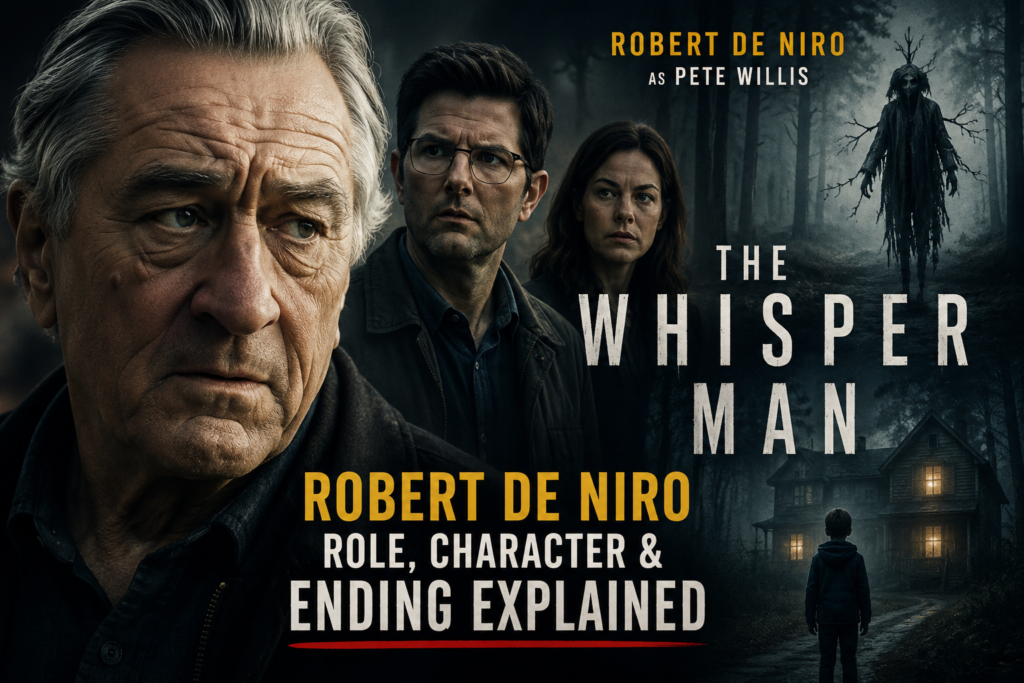
Robert De Niro as Pete Willis in The Whisper Man with the Whisper Man figure and a dark forest backdrop

Robert De Niro in The Whisper Man: Role, Character & Ending Explained

Robert De Niro takes on a very different kind of role in Netflix’s The Whisper Man. He plays Pete Willis, a retired detective whose career remains tied to one of the most disturbing serial-killer cases in his town’s history. When a new child disappears under circumstances that resemble the old crimes, Pete finds himself pulled back into an investigation he thought he had left behind. The case becomes even more personal when Pete learns that the missing child is his grandson, Jake. His estranged son, Tom Kennedy, has returned to the town with Jake following the death of his wife. That reunion forces Pete to confront two unfinished parts of his past: the Whisper Man case and his fractured relationship with his son. Directed by James Ashcroft and adapted from Alex North’s novel, The Whisper Man combines a serial-killer mystery with a family drama. That combination gives De Niro’s character more to do than simply provide the veteran-detective perspective. Pete becomes one of the story’s main links between its past crimes and its present-day threat. Robert De Niro in The Whisper Man: Who Does He Play? Robert De Niro plays Pete Willis, a retired detective who previously investigated the serial killer known as the Whisper Man. Years before the main events of the movie, Pete helped put Frank Carter behind bars after a series of child murders. However, the case never completely left him. Pete continued to believe that something about the investigation remained unresolved. Pete Willis and His History With the Case Pete’s connection to the original Whisper Man investigation gives him knowledge that the younger detectives do not have. When a new series of crimes begins to resemble the old killings, authorities turn toward the retired investigator for answers. The similarities are unsettling. The original Whisper Man abducted children, and the new crimes suggest that someone may be copying his methods. Pete therefore becomes an important source of historical context while the police try to determine whether they are dealing with a copycat, an accomplice, or a continuation of the original killer’s influence. Yet Pete’s involvement is not simply professional. The case also brings him back into the life of Tom, his estranged son. That connection changes the emotional stakes of the investigation. Why Pete Returns to the Investigation At first, Pete does not appear eager to return to police work. He has already spent years carrying the weight of the original case. However, Jake’s disappearance gives him a reason he cannot ignore. Jake is not just another missing child. He is Pete’s grandson, a boy Pete has never properly known because of his damaged relationship with Tom. Once Jake becomes the target, Pete has both a professional reason and a deeply personal one to find him. That combination drives his return and makes his role central to the film’s mystery. What Is Robert De Niro’s Role in The Whisper Man? Pete Willis serves as the film’s connection between the original Whisper Man murders and the new investigation. As the detective who helped capture Frank Carter, he understands the killer’s behavior in a way that Tom and the current investigators cannot easily replicate. Pete as a Retired Detective Pete’s experience becomes particularly valuable because the new crimes appear to echo the methods associated with Frank Carter. His knowledge allows the investigation to look beyond the surface similarities and consider whether the person responsible has a direct connection to the original case. However, the movie does not portray Pete as an infallible crime-solving machine. His history with the case has left emotional scars, and those scars affect how he approaches the new investigation. He is still searching for answers connected to the old crimes, including questions that remained unresolved after Carter’s arrest. That history also gives Pete a reason to take the threat seriously before everyone else understands how personal it will become. Pete as Tom Kennedy’s Estranged Father Pete’s second role is even more important to the emotional story. He is Tom’s father, but the two men have been separated for years. Their relationship has suffered because Pete devoted so much of himself to his career and the Whisper Man investigation. When Tom needs help finding Jake, the old resentment cannot simply disappear. Instead, the investigation forces both men to confront their shared history while racing against time. This makes Pete’s character more complicated than a conventional retired detective. He is simultaneously trying to solve a crime, protect his grandson, and repair a relationship that has been broken for years. De Niro’s restrained approach allows those tensions to remain largely beneath the surface rather than turning Pete into an overly dramatic character. Robert De Niro and Adam Scott’s Father-Son Dynamic The relationship between Pete Willis and Tom Kennedy gives The Whisper Man much of its emotional weight. Tom is a grieving father trying to protect his young son, while Pete is a former detective who has spent years living with the consequences of his choices. Why Tom and Pete Are Estranged Tom’s relationship with Pete has deteriorated long before Jake disappears. The film deliberately avoids turning their history into a long exposition dump. Instead, their strained interactions reveal that Pete’s commitment to his police work came at a significant personal cost. That approach also makes their reunion uncomfortable. Tom does not suddenly forget years of resentment simply because Pete has investigative experience. At the same time, Pete clearly wants another opportunity to connect with his son. The result is a relationship built around things neither man easily says. Their shared crisis becomes the pressure point that brings those unresolved emotions back to the surface. Pete’s Chance to Reconnect With Tom and Jake Jake’s kidnapping gives Pete something he never had before: a direct opportunity to act as a grandfather rather than remain a distant figure in Tom’s life. For Tom, however, Pete’s help carries mixed emotions. He needs the retired detective’s expertise, but accepting that help also means confronting the father he believes failed him. That tension

Robert De Niro in The Whisper Man: Role, Character & Ending Explained Read More »

Ella Langley featured in a country music graphic celebrating “Choosin’ Texas” and its Billboard Hot 100 success

Ella Langley’s “Choosin’ Texas” Makes Country Music History in 2026: 19-Week Billboard No. 1 Run Explained

Ella Langley has become one of the biggest names in country music in 2026, and “Choosin’ Texas” sits at the center of that rise. The song has reached a remarkable 19 weeks at No. 1 on the Billboard Hot 100, tying the longest run for a non-holiday song. That achievement places Langley in rare company. “Choosin’ Texas” is no longer simply a successful country single. It has become a mainstream hit with enough staying power to compete with some of the most dominant songs of the modern chart era. The milestone also gives Langley’s career a larger meaning. Her rise shows how a country artist can build a strong genre identity while reaching listeners far beyond the traditional country audience. Her 2026 success combines country radio, mainstream chart performance, sales and widespread listener interest into one unusually sustained breakthrough. Why Ella Langley Is Making Country Music Headlines in 2026 The “Choosin’ Texas” milestone The biggest reason for Langley’s current headlines is the extraordinary performance of “Choosin’ Texas.” Billboard’s latest reporting places the song at No. 1 on the Hot 100 for a 19th week, tying the record for the longest reign by a non-holiday song. The accomplishment is especially notable because the Hot 100 measures success across genres. A country song must compete directly with pop, hip-hop, R&B, rock and other styles. “Choosin’ Texas” has managed to remain at the top despite that competition. Its continued performance shows that the song has moved well beyond the audience that first discovered Langley through country music. The milestone also changes the way the industry views the Alabama singer. Rather than simply being a promising new country artist, Langley now has one of the year’s most significant mainstream chart achievements. Why the 19-week Hot 100 run matters Reaching No. 1 is difficult. Staying there for nearly five months is considerably harder. A long Hot 100 run reflects sustained activity across the factors that determine chart performance, including streaming, sales and radio consumption. That longevity separates “Choosin’ Texas” from songs that experience a short burst of attention and then quickly fall down the rankings. Langley’s single has maintained enough audience interest to remain dominant week after week. For country music, the achievement carries another layer of importance. A country-centered song has become one of the most persistent all-genre hits of the year, reinforcing the genre’s growing influence on the wider American music market. “Choosin’ Texas” and Its Billboard Record-Breaking Run From country hit to No. 1 across genres “Choosin’ Texas” established itself as a major country record before reaching the highest level of the mainstream charts. Earlier Billboard reporting showed the song building momentum on country charts while simultaneously climbing the Hot 100. That progression is important because the Hot 100 does not reserve space for any particular genre. Country artists compete on equal terms with performers from every major area of popular music. Langley’s success therefore represents more than strong country-radio performance. It demonstrates that the song has developed an audience large enough to cross genre boundaries without losing its country identity. The result is a particularly notable kind of crossover: instead of a country artist temporarily moving toward pop, a country record has become a mainstream leader while remaining closely associated with the genre. The records connected to Lil Nas X and Shaboozey Langley’s 19-week run places “Choosin’ Texas” alongside two recent chart giants: Lil Nas X’s “Old Town Road” and Shaboozey’s “A Bar Song (Tipsy).” Billboard reports that Langley’s song has tied the non-holiday record for consecutive weeks at No. 1. That connection also highlights the increasingly fluid relationship between country music and mainstream popular music. Both earlier records crossed traditional genre boundaries, and Langley’s achievement continues that trend from a different direction. For country music, the comparison is particularly revealing. “Choosin’ Texas” demonstrates that a song can retain a recognizable country foundation while becoming powerful enough to dominate the broader national chart. How Ella Langley Became One of Country Music’s Biggest New Stars Her Alabama roots and early career Langley’s success did not begin with “Choosin’ Texas.” Her career developed through earlier releases, collaborations and growing recognition within country music. Billboard identifies Langley as an artist from Hope Hull, Alabama, and records her early Hot 100 history through her work with Riley Green. Her Alabama background has also become part of her artistic identity. Like many successful country performers, she draws on regional storytelling and personal experiences while presenting them in a contemporary format. One of the key early milestones in that process came through her collaboration with Riley Green. “You Look Like You Love Me” introduced Langley to a broader country audience and demonstrated that she could hold her own alongside an established name. That foundation mattered. When “Choosin’ Texas” began its explosive rise, Langley already had an audience familiar with her voice and style. The breakthrough before “Choosin’ Texas” Langley’s earlier work helped establish her as more than a one-song discovery. “You Look Like You Love Me” became a major career marker, while additional releases continued expanding her presence in the country market. Her progress on Country Airplay offered another important sign of momentum. “Choosin’ Texas” eventually became her first No. 1 on the chart, giving her a major country-radio achievement alongside the song’s much larger Hot 100 success. That progression helps explain why her 2026 breakthrough feels significant. Langley had already spent time building credibility within country music before the current record-setting run transformed her into a mainstream chart leader. In other words, “Choosin’ Texas” may have changed the scale of her career, but it did not create that career from nothing. Why “Choosin’ Texas” Has Connected With Country Music Fans The song’s Texas-centered identity “Choosin’ Texas” carries a strong sense of place, beginning with its title and extending into the song’s broader country identity. Texas has long occupied an important position in American country culture, giving the track an immediately recognizable setting. Yet its appeal does not depend entirely on geography. At its center, the

Ella Langley’s “Choosin’ Texas” Makes Country Music History in 2026: 19-Week Billboard No. 1 Run Explained Read More »

Spider Man Post Credits explained with a masked superhero overlooking the New York skyline at sunset

Spider Man Post Credits Explained (2026): Brand New Day Ending, Hidden Meaning & MCU Future

The Spider Man Post Credits scenes in Spider-Man: Brand New Day have quickly become one of the biggest talking points among Marvel fans. While the movie delivers an emotional journey for Peter Parker, the final moments after the credits leave audiences with even more questions than answers. Instead of simply wrapping up the story, the post-credit sequences tease new possibilities, hint at future conflicts, and spark fresh theories about where Spider-Man could fit into the Marvel Cinematic Universe next. Unlike many superhero films that use post-credit scenes only as quick jokes or simple teasers, Brand New Day appears to take a more meaningful approach. Every detail, no matter how small, has encouraged viewers to revisit earlier scenes, compare clues, and discuss potential connections with upcoming Marvel projects. As a result, the Spider Man Post Credits discussion has become just as exciting as the movie itself. Before diving deeper into the Spider Man Post Credits scenes, it’s helpful to understand the movie’s complete story and ending. If you haven’t already, read our Spider-Man Brand New Day Review (2026): Story, Cast, Ending Explained & Verdict, where we break down the plot, cast, ending, and our overall review before exploring the post-credit scenes in detail. In this guide, we’ll focus entirely on the Spider Man Post Credits scenes, explain what happens after the movie ends, explore possible hidden meanings, examine popular fan theories, and discuss how these moments could shape Spider-Man’s future in the MCU. Why the Spider Man Post Credits Scenes Matter Marvel has built a long tradition of rewarding audiences who stay until the very end of a movie. Over the years, post-credit scenes have introduced new heroes, teased major villains, and connected standalone stories to larger cinematic events. Therefore, fans now expect every Marvel film to include important hints about what comes next. The Spider Man Post Credits scenes continue that tradition while adding a unique layer of mystery. Instead of answering every question directly, they encourage viewers to think carefully about the clues presented on screen. Consequently, discussions about the ending have spread across social media, fan forums, and entertainment websites almost immediately after the film’s release. Several factors make these scenes especially significant: They expand Spider-Man’s future beyond the events of Brand New Day. They introduce fresh questions instead of providing simple answers. They create excitement for future Marvel stories. They encourage multiple viewings to spot hidden details. They give longtime Marvel fans new theories to explore. Because of these elements, many viewers believe the post-credit scenes may become one of the most important pieces of the movie’s overall narrative. Spider Man Post Credits: A Quick Recap Before diving into detailed analysis, here’s a spoiler-friendly overview of what happens after the main story concludes. Scene What It Suggests Why It Matters Mid-Credits Scene Introduces a mysterious development connected to Spider-Man’s future. Opens the door for the next chapter of Peter Parker’s journey. Post-Credits Scene Expands the larger Marvel universe with new possibilities. May connect future MCU films and crossover events. Rather than serving as standalone extras, both scenes appear carefully designed to build anticipation. Although Marvel leaves several questions unanswered, each moment feels intentional and encourages audiences to keep following Peter Parker’s story. Spider Man Post Credits and the Movie’s Ending The ending of Spider-Man: Brand New Day creates an emotional turning point for Peter Parker. By the time the main story concludes, he has already faced difficult choices, personal sacrifices, and unexpected challenges. However, the credits reveal that his journey is far from over. This is why the Spider Man Post Credits scenes feel so important. Instead of acting as separate moments, they naturally continue the themes established during the film. The emotional weight of the ending makes the post-credit reveals even more impactful because viewers already understand what Peter has gained—and what he still stands to lose. Moreover, Marvel continues its tradition of planting seeds for future stories without revealing every detail immediately. That storytelling style keeps fans invested while allowing future films to expand on the mysteries introduced here. Why Marvel Fans Are Analyzing Every Detail Marvel audiences have developed a habit of examining every frame for hidden clues, and Brand New Day is no exception. Small visual details, brief dialogue, background references, and even camera movements often become part of larger fan discussions. Several reasons explain why the Spider Man Post Credits scenes have generated so much attention: Spider Man Post Credits Raise New Questions Rather than providing complete answers, the scenes introduce fresh mysteries. As a result, viewers continue debating what each clue might mean. Spider Man Post Credits Connect to Future Stories Marvel frequently uses post-credit scenes to bridge one movie with another. Therefore, many fans believe these moments could influence upcoming MCU projects. Spider Man Post Credits Reward Careful Viewers Fans who pay close attention often notice subtle details that casual viewers might miss. These hidden elements frequently become the foundation for popular online theories. Spider Man Post Credits Encourage Community Discussion Every Marvel release creates conversations across social media, podcasts, YouTube channels, and fan communities. The latest post-credit scenes continue that tradition by giving everyone something new to analyze. Spider Man Post Credits Scene Breakdown: What Really Happens? The first Spider Man Post Credits scene continues the movie’s emotional momentum instead of shifting to a completely different storyline. Rather than relying on flashy action alone, Marvel uses the sequence to suggest that Peter Parker’s journey has entered a new phase. Although the scene is brief, every moment appears carefully placed to encourage discussion. Instead of giving audiences a straightforward explanation, the filmmakers leave several important details open to interpretation. Consequently, viewers are invited to connect the dots using what they learned throughout the movie. Spider Man Post Credits Focus on Peter’s New Reality One of the strongest themes carried into the post-credit scene is change. Peter’s world no longer looks the same as it did earlier in the film. His experiences have reshaped both his personal life and his

Spider Man Post Credits Explained (2026): Brand New Day Ending, Hidden Meaning & MCU Future Read More »

Doctor Doom inspired original dark fantasy armored ruler with green mystical energy and gothic castle

Doctor Doom: Origin, Powers, Marvel History, and Avengers: Doomsday Explained

Doctor Doom has remained one of Marvel’s most compelling characters for decades. While superheroes often take center stage, few villains have earned the same level of respect, curiosity, and long-term popularity as Victor Von Doom. His combination of unmatched intelligence, political power, scientific brilliance, and mystical knowledge makes him unlike anyone else in the Marvel Universe. Interest in Doctor Doom has grown rapidly as Marvel Studios prepares for Avengers: Doomsday. Longtime comic book readers are revisiting his legendary stories, while newer fans are eager to learn why this character has become such an important part of Marvel’s future. Discussions about his role, abilities, and possible impact on the Marvel Cinematic Universe (MCU) continue to dominate fan communities and entertainment news. Unlike many fictional villains, Doctor Doom is not driven solely by revenge or destruction. Instead, he genuinely believes that his leadership can create a better world. Although his methods are often ruthless, his motivations are more complex than those of a typical antagonist. This moral ambiguity has helped him remain one of Marvel’s most layered and memorable characters. In this guide, you’ll discover Doctor Doom’s origins, comic book history, remarkable abilities, greatest rivalries, and growing importance in the MCU. Whether you’re a lifelong Marvel fan or simply curious about the character behind the recent excitement, this article offers a detailed and easy-to-follow introduction to one of comic books’ greatest icons. Who Is Doctor Doom? Doctor Doom is the alter ego of Victor Von Doom, one of Marvel Comics’ most iconic supervillains. Since his debut in the early 1960s, he has challenged nearly every major superhero while building a reputation as one of the smartest and most dangerous figures in comic book history. What makes Doctor Doom unique is his extraordinary range of abilities. He is a world-class inventor, an accomplished scientist, a skilled sorcerer, an expert strategist, and the ruler of the fictional nation of Latveria. Few Marvel characters possess such a diverse set of talents. Despite his reputation as a villain, Doom rarely sees himself that way. From his perspective, he is a leader willing to make difficult decisions for the greater good. That belief creates constant conflict between his ideals and his actions, making him far more complex than a traditional comic book antagonist. Over the years, Doctor Doom has fought heroes such as the Fantastic Four, the Avengers, Spider-Man, Doctor Strange, Black Panther, and the X-Men. At the same time, larger threats have occasionally forced him to cooperate with those same heroes. These unexpected alliances reveal another side of his personality and add depth to his character. The Origin of Victor Von Doom Victor Von Doom was born in the fictional European nation of Latveria, a country known for political instability and economic hardship. His difficult childhood played a major role in shaping the person he would eventually become. His father worked as a talented physician who cared deeply about helping others. Meanwhile, Victor’s mother secretly practiced powerful mystical arts. As a result, he developed an early interest in both science and magic. Everything changed when he lost his parents at a young age. Those painful experiences left a lasting emotional impact and fueled his determination to become powerful enough to control his own future. Instead of accepting tragedy, Victor dedicated his life to acquiring knowledge that could overcome every limitation. A Childhood Shaped by Tragedy Growing up without his parents forced Victor to become independent much earlier than most children. Rather than relying on others, he trusted his own intelligence and determination. His natural talent became obvious from an early age. Teachers and scholars recognized his remarkable ability to solve difficult scientific problems, build complex machines, and understand advanced mathematics. However, personal loss also influenced his personality. Over time, Victor became increasingly confident in his own judgment and less willing to accept advice from others. That mindset would later define Doctor Doom’s leadership style. A Passion for Knowledge Victor’s curiosity extended far beyond ordinary education. He constantly searched for new discoveries and challenged ideas that others considered impossible. Science became one of his greatest strengths. At the same time, he continued studying ancient magical traditions connected to his family’s past. This unusual combination allowed him to develop skills that very few Marvel characters could match. Instead of choosing one path, Victor mastered both disciplines. That decision eventually made him one of the most versatile figures in the Marvel Universe. Education and Scientific Ambitions Victor’s extraordinary intelligence eventually earned him the opportunity to study at a prestigious university in the United States. There, he met another brilliant student who would shape the course of his life—Reed Richards. Both students possessed exceptional scientific talent. However, they approached research very differently. Reed believed careful testing and collaboration produced the best results. Victor preferred complete confidence in his own calculations and rarely accepted criticism. Their opposing philosophies quickly created a fierce intellectual rivalry. Although each respected the other’s abilities, neither wanted to admit that the other might be smarter. A Rivalry Begins Competition between Victor and Reed grew stronger with every project. Both students wanted to become the world’s greatest scientist. Their debates covered engineering, theoretical physics, and advanced technology. As their ambitions increased, so did the tension between them. Eventually, that rivalry extended far beyond the classroom and became one of Marvel’s most famous conflicts. The Experiment That Changed Everything Victor eventually attempted an ambitious experiment involving advanced technology and mystical energy. He believed the project could unlock knowledge beyond ordinary science. Some people questioned the accuracy of his calculations. Even so, Victor refused to make significant changes because he trusted his own abilities completely. The experiment ended in disaster. A powerful explosion severely injured Victor and permanently scarred his face. Although the accident resulted from his own decisions, he blamed Reed Richards for failing to support him. That resentment remained with him for years and helped shape the identity of Doctor Doom. From Brilliant Inventor to Ruthless Ruler Following the accident, Victor disappeared from public life for

Doctor Doom: Origin, Powers, Marvel History, and Avengers: Doomsday Explained Read More »

RIDLEY SCOTT'S BEST SCI-FI MOVIE RETURNS

Ridley Scott Sci-Fi: Best Movie Tops Prime Video Ahead of Sequel Series

Science fiction has always evolved alongside technology, but only a handful of films continue to shape the genre decades after their release. Among those classics, the Blade Runner franchise stands in a league of its own and remains one of the most influential examples of Ridley Scott Sci-Fi. While the original film established the universe, the sequel has found an entirely new audience through streaming. Its recent climb to the top of Prime Video has sparked renewed conversations about one of cinema’s most influential futuristic worlds. The timing could not be better. With a new television series expanding the franchise on the horizon, longtime fans are revisiting the story while newcomers are discovering why the Blade Runner universe continues to captivate audiences. The surge in streaming popularity shows that thoughtful science fiction remains just as compelling today as it was years ago. For viewers who enjoy visually stunning worlds, philosophical storytelling, and unforgettable characters, this renewed interest is hardly surprising. It also reinforces why discussions surrounding Ridley Scott Sci-Fi Movies continue to dominate conversations whenever groundbreaking science fiction is mentioned. Why the Blade Runner Universe Is Trending Again Streaming platforms have changed the way audiences discover movies. A film no longer depends solely on its theatrical release or home media sales to reach viewers. Instead, a title can experience a remarkable resurgence years after its premiere simply by becoming available to millions of subscribers worldwide. That appears to be exactly what is happening with the Blade Runner franchise. Several factors have combined to fuel its growing popularity: A new generation of viewers discovering the series for the first time. Existing fans revisiting the films before the upcoming television adaptation. Increased interest in futuristic storytelling driven by rapid advancements in artificial intelligence. Strong word-of-mouth recommendations across social media. Streaming accessibility making the film easier to watch than ever before. Unlike many blockbuster science-fiction movies that focus primarily on action, Blade Runner invites viewers to slow down and think. Its layered storytelling encourages multiple viewings, making it particularly well suited to streaming platforms where audiences can revisit details they may have missed. Ridley Scott Sci-Fi and Its Lasting Influence Few filmmakers have left a larger mark on science fiction than Ridley Scott. Across several decades, his work has consistently pushed the genre beyond spectacular visual effects by asking difficult questions about humanity, technology, morality, and survival. Instead of relying only on futuristic gadgets or large-scale battles, Scott’s films often explore emotional conflicts that remain relevant regardless of the era in which audiences watch them. Some recurring themes include: Theme Why It Matters Artificial Intelligence Challenges traditional definitions of consciousness and identity. Human Nature Explores what separates people from machines. Corporate Power Examines the influence of powerful organizations over society. Survival Focuses on difficult choices under extreme circumstances. Ethics of Technology Questions whether scientific progress always benefits humanity. These themes explain why discussions about Ridley Scott Sci-Fi Movies continue long after individual films leave theaters. Rather than becoming outdated, many of their ideas feel increasingly relevant as real-world technology advances. A Franchise That Rewards Patient Viewers One reason the Blade Runner universe has endured is its willingness to trust its audience. Many modern science-fiction films prioritize nonstop action. By contrast, the Blade Runner stories embrace quieter moments that allow viewers to absorb the atmosphere, reflect on philosophical questions, and connect emotionally with the characters. This deliberate pacing creates an experience that feels more immersive than conventional blockbusters. Rather than explaining every mystery, the films encourage audiences to form their own interpretations. That approach has helped build an exceptionally loyal fan community over the years. Why Streaming Has Given the Film New Life The streaming era has transformed how audiences interact with older movies. Instead of disappearing after theatrical runs, acclaimed films now have countless opportunities to find entirely new viewers. Several advantages make streaming especially valuable for visually rich science-fiction movies: Easy Accessibility Millions of subscribers can begin watching with just a few clicks, eliminating many barriers that previously limited older films. Strong Recommendation Algorithms Modern streaming services frequently recommend acclaimed science-fiction titles based on viewing habits, introducing the franchise to people who may never have searched for it directly. Shared Online Conversations Social media platforms encourage viewers to discuss theories, hidden details, memorable scenes, and connections between installments. Those conversations often motivate others to watch the film themselves. Growing Appreciation Over Time Some movies receive greater appreciation years after release than they did initially. As audiences mature and cinematic trends evolve, thoughtful storytelling often gains recognition that may have been overlooked during theatrical release. The Perfect Moment Before a New Chapter Whenever an established franchise prepares to expand, audience interest naturally increases. Fans often revisit earlier entries to refresh their memories, while newcomers want to understand the universe before exploring new stories. This creates an ideal environment for streaming success. Instead of simply serving as nostalgia, these revisits allow audiences to notice details that connect with today’s technological conversations, including artificial intelligence, automation, digital identity, and ethical innovation. Many viewers now find the franchise even more relevant than when it first appeared. The Enduring Appeal of Thoughtful Science Fiction Science fiction succeeds when it balances imagination with meaningful ideas. The most memorable stories do more than predict future inventions—they explore how those inventions might change people, relationships, and society. That philosophy sits at the heart of the Blade Runner universe. Rather than presenting technology as either entirely good or entirely evil, the franchise explores its complexity. Questions frequently emerge throughout the story: What truly defines a human being? Can memories shape identity regardless of their origin? Does artificial intelligence deserve empathy? How should society balance innovation with ethics? What responsibilities accompany technological progress? These questions remain just as compelling today because they increasingly resemble real-world debates surrounding AI and emerging technologies. Why Younger Audiences Are Discovering the Franchise A growing number of younger viewers are experiencing Blade Runner for the first time. Several cultural trends explain this renewed interest. Artificial Intelligence

Ridley Scott Sci-Fi: Best Movie Tops Prime Video Ahead of Sequel Series Read More »