
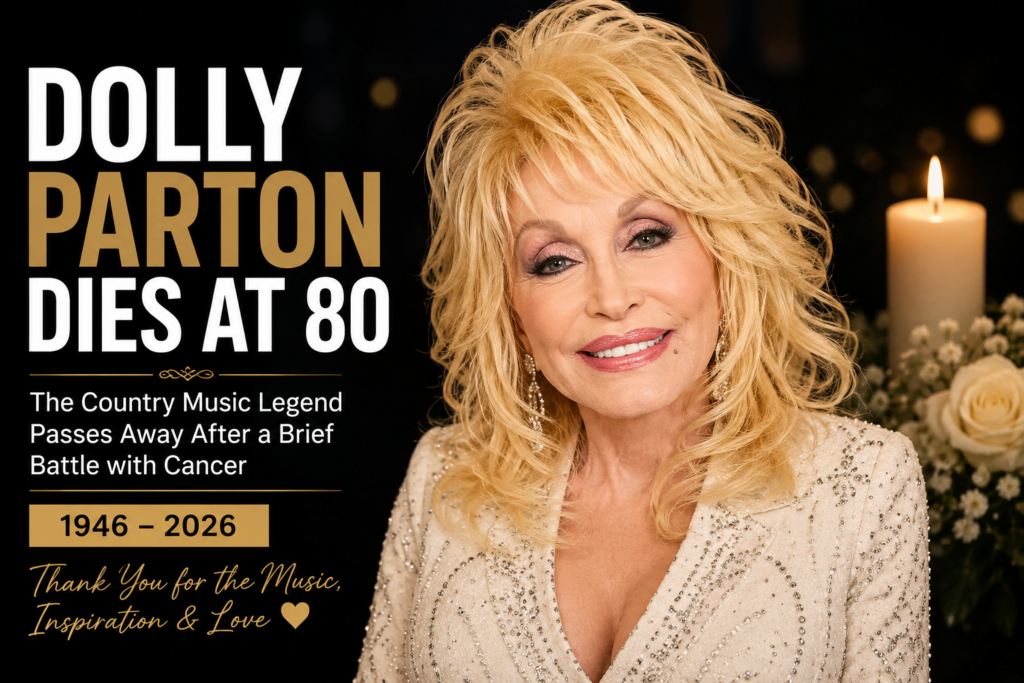
Dolly Parton dies at 80, marking the end of an extraordinary career that transformed country music, songwriting, film and philanthropy. The legendary entertainer died on August 25, 2026, following a brief battle with cancer, according to her representatives.
The news closes the life of an artist whose influence stretched far beyond country music. Parton became a successful recording artist, actress, songwriter, entrepreneur and philanthropist while maintaining a close connection to her Tennessee roots. Songs such as “Jolene,” “I Will Always Love You” and “Coat of Many Colors” established her as an exceptional storyteller, while projects such as Dollywood and the Imagination Library expanded her impact into business, tourism and children’s literacy.
For generations of fans, however, Parton’s appeal was never limited to her achievements. Her warmth, quick wit and ability to turn personal experiences into universally relatable stories helped make her a rare entertainer whose audience crossed age, geography and musical boundaries. Her death therefore represents not simply the loss of a country star, but the end of one of the most expansive careers in modern American entertainment.
Dolly Parton Dies at 80: What We Know About Her Death
Dolly Parton’s Death Was Confirmed on August 25, 2026
Dolly Parton died Tuesday, August 25, at age 80. Her family and representatives announced the news after she died in Nashville. Her team said she was surrounded by loved ones at Vanderbilt-Ingram Cancer Center.
The announcement prompted an immediate wave of tributes from musicians, actors, public figures and fans. Parton’s career had lasted nearly six decades, giving multiple generations a personal connection to her work. She could move between traditional country, pop, film and television without losing the identity that made her distinctive.
Her nephew Bryan Seaver also reflected on the doors Parton opened for her family and for generations of performers, songwriters and dreamers. That idea captures an important part of her legacy: Parton built an extraordinary career for herself while using her success to create opportunities for others.
Her death also came while several aspects of her professional life remained active. She had continued working on entertainment, business and philanthropic projects even as her health became more difficult in the final months of her life.
What Has Been Confirmed About Dolly Parton’s Cause of Death
Parton’s representatives confirmed that she died following a brief battle with cancer. However, they have not publicly disclosed the specific type of cancer she had. That distinction matters because several reports and online discussions have circulated additional claims that have not been confirmed by her representatives.
The available information therefore supports a simple conclusion: cancer was identified by her team as the cause surrounding her death, but the public does not have an officially disclosed diagnosis beyond that description.
Parton had spoken publicly about experiencing health difficulties before her death. Still, those earlier issues should not automatically be treated as the cause of her final illness. The responsible account is to separate what Parton and her representatives confirmed from reports or speculation that appeared elsewhere.
That approach is particularly important with a celebrity of Parton’s stature. Her enormous public profile means that health rumors can spread rapidly. Her representatives’ statement provides the clearest available account of what happened.
Dolly Parton’s Final Years and Health Struggles
Health Challenges Before Her Death
Parton’s death followed a period in which she had become more open about difficulties with her health. On August 21, just four days before her death, she spoke about going through “hard times” with her health while emphasizing that she remained determined to work.
The comments came after several public appearances and events had been affected by her health. She had recently missed the debut of a new Dollywood attraction and appeared by video rather than attending in person. Those developments generated concern among fans, although Parton continued to communicate optimism about her ability to recover and keep working.
Her approach reflected a pattern that had defined much of her public life. Even when discussing difficult personal circumstances, Parton often focused on resilience and the next thing she wanted to accomplish. In her final period, she was still associated with new creative and business projects rather than presenting herself as someone ready to step away.
That makes the speed of the final developments especially striking. Public information about her health had emerged only days before her death, while the confirmation of her cancer battle came after her passing.
Her Hospitalization Shortly Before Her Death
Parton was admitted to a Nashville hospital on August 21, four days before she died. Her nephew later confirmed the timing of her hospitalization.
The hospitalization followed the health update she shared publicly that same day. Reports before the confirmation of her cause of death contained varying accounts about her medical problems, but those reports should not be confused with the official explanation subsequently provided by her representatives.
Parton ultimately died in Nashville, the city that had become central to her professional life after she left her East Tennessee upbringing to pursue music. The setting carries symbolic weight: the young songwriter who once dreamed of making it in Nashville ultimately became one of the city’s most influential cultural figures.
Her final days also underline how little the public knew about the seriousness of her illness. Parton had continued discussing work and future plans shortly before her death. Her representatives’ later confirmation of a brief cancer battle provided the first clear explanation of the circumstances surrounding her passing.
Dolly Parton’s Early Life in Tennessee
Growing Up in a Large Appalachian Family
Dolly Rebecca Parton was born on January 19, 1946, in Tennessee and grew up in a large family in the Appalachian region. She was one of twelve children, and music became part of her life at an early age.
Her childhood circumstances shaped much of the storytelling that later became central to her songwriting. Parton frequently drew from family memories, poverty, faith, love and the landscape of East Tennessee. Instead of hiding those beginnings, she turned them into creative material.
That connection to her roots remained visible throughout her career. Even after becoming internationally famous, Parton continued to reference the people and places that shaped her childhood. Her songs often carried the emotional texture of Appalachian life without requiring listeners to share the same background.
The contrast between her modest upbringing and her eventual global success became one of the defining narratives of her career. Yet Parton’s story was never simply about escaping poverty. It was also about preserving the values, relationships and experiences that gave her something meaningful to write about.
How Dolly Parton Found Her Way to Nashville
Parton’s musical ambitions appeared early. She performed publicly as a child and teenager before moving toward the professional Nashville music world. Her first appearance at the Grand Ole Opry came when she was only 13, an early indication that she possessed both the confidence and talent to command a professional stage.
Nashville eventually became the place where her songwriting career could expand. Parton arrived with a strong sense of where she came from and an ability to transform ordinary experiences into memorable songs.
Her early career was not an overnight success. Like many young performers, she had to establish herself within an industry that already had powerful personalities and established stars. Her songwriting, however, quickly became an important advantage.
That talent would eventually help her move from being a promising young country performer to one of the most influential singer-songwriters of her generation.
Dolly Parton Dies at 80: What We Know About Her Death
The Porter Wagoner Years
Dolly Parton’s breakthrough arrived in 1967 when she joined The Porter Wagoner Show, replacing singer Norma Jean. The move gave the young performer a national platform and placed her alongside one of country music’s most established television personalities. Parton and Porter Wagoner quickly became a popular duo, recording a string of successful songs while Parton also developed her identity as a solo artist.
The partnership helped Parton learn how to operate at a much larger level within Nashville’s music business. RCA Records signed her as both Wagoner’s duet partner and a solo recording artist. That arrangement allowed her to build an audience while continuing to sharpen the songwriting skills that would eventually define her career.
Their professional relationship produced fourteen Top Ten duet hits, including “Please Don’t Stop Loving Me,” which reached No. 1 in 1974. Yet Parton’s ambition extended beyond being part of a successful duo. She wanted to establish herself on her own terms, and her growing success made that goal increasingly realistic.
By the early 1970s, Parton’s songwriting had become impossible to overlook. Her first solo No. 1, “Joshua,” arrived in 1971. Three years later, she scored three more country No. 1s: “Jolene,” “Love Is Like a Butterfly” and “I Will Always Love You.”
Leaving the Show and Finding Her Own Voice
Parton’s decision to leave Wagoner’s television show in 1974 became one of the defining turning points of her career. She wanted independence, but leaving a successful partnership carried professional and personal tension.
Her answer came through music. Parton wrote “I Will Always Love You” as a farewell to Wagoner and their professional relationship. The song expressed gratitude rather than hostility, turning a difficult career transition into something emotionally lasting. Wagoner ultimately produced her recording of the song, which became a No. 1 country hit.
After the split, Parton formed her own touring band and continued building a solo career. Her independence did not erase the influence of her years with Wagoner; instead, it gave her the freedom to decide what kind of artist she wanted to become.
Dolly Parton’s Greatest Songs and Songwriting Legacy
“Jolene” and the Art of Storytelling
“Jolene” remains one of Dolly Parton’s signature songs because of how much emotional tension she creates with a remarkably simple premise. The narrator pleads with another woman not to take the man she loves. Instead of turning the story into a conventional accusation, Parton gives the narrator vulnerability and fear.
Released in 1973 and featured on the 1974 Jolene album, the song became Parton’s second No. 1 country single. Its enduring appeal comes partly from its directness: the narrator does not pretend to be invulnerable. She recognizes the other woman’s beauty and openly admits that she feels threatened.
Parton’s ability to make a specific situation feel universal became one of her greatest songwriting strengths. “Jolene” does not require listeners to know anything about Parton’s own life to understand the emotion at its center.
The song also demonstrates her gift for character-driven storytelling. In only a few minutes, Parton creates three people, a relationship in danger and an emotional conflict that listeners can immediately understand.
The Country Music Hall of Fame has preserved handwritten material connected to “Jolene” in its Parton exhibition, reflecting the song’s importance within her creative legacy.
“I Will Always Love You” and Its Global Reach
“I Will Always Love You” began as a deeply personal song about professional separation, but its meaning expanded dramatically over time. Parton’s original recording became a major country success, while Whitney Houston’s 1992 version transformed the composition into a global pop phenomenon through The Bodyguard.
Her ability to remain influential across generations reflects the longevity seen in the careers of other major recording artists, including Phil Collins and his enduring musical legacy.
The song’s remarkable journey illustrates why Parton’s reputation extends beyond country music. She could write from a deeply personal perspective while creating material that other performers could reinterpret for entirely different audiences.
Its emotional strength also comes from restraint. Rather than relying on complicated imagery, the song centers on the difficult act of saying goodbye while maintaining affection. That simplicity allowed different singers to make it their own.
Parton’s authorship remained crucial to the song’s story. Houston’s enormous recording success did not erase the fact that the composition originated with Parton; instead, it introduced her songwriting to millions of listeners who may not previously have known her work.
“Coat of Many Colors” and Her Appalachian Roots
“Coat of Many Colors” showed another side of Parton’s songwriting. Instead of focusing on romance, she drew from childhood memories and transformed an experience of poverty into a story about dignity, family and love.
The song became part of the larger body of work through which Parton repeatedly returned to her Tennessee upbringing. Her early life was not merely background information for her career; it became a source of characters, imagery and emotional perspective.
That connection helped distinguish Parton’s writing from songs designed only around commercial trends. Even as her career expanded, she could return to the people and places that shaped her.
The Country Music Hall of Fame later included “Coat of Many Colors” among the defining songs examined in its major Parton exhibition, alongside “Jolene” and “I Will Always Love You.”
Dolly Parton’s Hollywood Career
9 to 5 and Her Breakthrough as an Actress
Dolly Parton’s career took another major turn when she moved into Hollywood. Her most important early breakthrough came with the 1980 comedy 9 to 5, in which she starred alongside Jane Fonda and Lily Tomlin.
The film gave Parton an opportunity to bring the personality audiences already knew from music into a completely different entertainment format. Her performance demonstrated that her appeal did not depend solely on singing.
Her success as a screen performer also placed her among the musicians who successfully expanded their careers into film and television, much like other celebrated entertainers who built lasting legacies on screen.
She also wrote the film’s title song, creating one of the most recognizable songs associated with her career. The success of 9 to 5 helped establish Parton as a genuine crossover entertainer rather than a country musician making occasional appearances in movies.
Her move between music and screen entertainment reflects the broader appeal of performers who successfully cross from one entertainment medium into another.
The transition was significant because it expanded her audience while preserving her songwriting identity. She did not abandon music when she entered Hollywood. Instead, she used music as a bridge between the two industries.
Her later Broadway work showed that this creative expansion continued for decades. Parton eventually wrote the music and lyrics for the stage musical adaptation of 9 to 5, earning a Tony nomination for Best Original Score.
Steel Magnolias, Television and Beyond
Parton’s film career continued with projects including The Best Little Whorehouse in Texas and Steel Magnolias. While not every movie became a lasting hit, the range of roles helped strengthen her reputation as a recognizable screen personality.
She also remained a familiar television presence through specials, interviews and entertainment programs. Her ability to move comfortably between music, comedy and acting became an important part of her public image.
At the same time, Parton continued recording. Her career included collaborations with artists such as Kenny Rogers, Emmylou Harris and Linda Ronstadt. The 1987 album Trio, recorded with Harris and Ronstadt, became another important chapter in her musical story.
Parton’s Hollywood success therefore never replaced her identity as a songwriter. Instead, it broadened the meaning of her career. By the 1980s, she had become something much larger than a country recording artist: she was a mainstream American entertainer whose music, personality and storytelling could work across several forms.
Dolly Parton’s Business Empire and Dollywood
How Dollywood Became Part of Her Legacy
Dolly Parton’s influence eventually moved well beyond recording studios and movie sets. One of the clearest examples is Dollywood, the theme park in Pigeon Forge, Tennessee, that became closely associated with her name and her connection to the Smoky Mountains.
Parton became involved with the park in the mid-1980s, when she partnered with the Herschend family to transform the existing Silver Dollar City attraction. The new Dollywood opened in 1986 and combined amusement rides with music, crafts, Appalachian culture and entertainment.
The park gave Parton a way to celebrate the region that shaped her rather than simply using Tennessee as a backdrop for her personal story. Visitors could experience performances and attractions connected to Appalachian traditions while also enjoying a modern theme park.
Over time, Dollywood developed into one of Tennessee’s best-known attractions. Its significance to Parton’s legacy goes beyond tourism. The project showed how she could turn her personal brand into an institution with a strong regional identity.
That combination became characteristic of Parton’s business philosophy. She repeatedly connected commercial success with the places, people and values that mattered to her. Dollywood therefore became both a business venture and an extension of the cultural identity she had carried throughout her career.
From Entertainer to Entrepreneur
Parton’s business career expanded as her fame grew. She became involved in ventures connected to entertainment, hospitality, publishing and consumer products, demonstrating that her ambitions extended well beyond selling records.
Her approach differed from the traditional celebrity endorsement model. Parton often attached her name to projects that reflected recognizable parts of her identity: music, family, Tennessee, storytelling and optimism.
That strategy helped make her personal brand unusually durable. Her image remained recognizable across generations because it did not depend on one particular musical era.
Parton’s business success also reinforced her independence. The same determination that pushed her to establish herself as a solo performer allowed her to build enterprises in which she could shape the creative direction and public identity.
By combining entertainment with entrepreneurship, she created several channels through which her influence could continue even when she was not releasing a new album or starring in a film.
Dolly Parton’s Philanthropy and Imagination Library
Why the Imagination Library Became So Important
Among Parton’s many projects, the Imagination Library became one of the clearest expressions of her commitment to children’s literacy. She launched the program in 1995 in honor of her father, who could not read or write.
The basic idea was simple: provide young children with books at no cost to their families. What began as a local effort in Tennessee eventually expanded far beyond the region.
The program sends carefully selected books to registered children from birth through age five. Families do not pay for the books, and the program works with local partners to make the service available in participating communities.
Its growth transformed a personal philanthropic idea into a large-scale literacy initiative. The program’s appeal also reflects something central to Parton’s own story. She grew up in a large, working-class family where resources were limited, so access to books represented an opportunity she believed every child should have.
The Imagination Library therefore became more than another celebrity charity. It connected Parton’s personal history with a practical goal: putting books into children’s hands during the earliest years of development.
Dolly Parton’s Wider Humanitarian Work
Parton’s philanthropy extended into several other areas. She supported education, disaster relief, health-related causes and communities affected by hardship.
Her response to the 2016 wildfires in the Great Smoky Mountains became particularly significant. Through the My People Fund, she provided financial assistance to families whose homes had been damaged or destroyed.
She also contributed to medical and research initiatives. In 2020, her financial support for Vanderbilt University Medical Center became associated with the development of the Moderna COVID-19 vaccine, after she donated to the institution’s research efforts. That contribution brought renewed attention to her willingness to support scientific and medical work.
Yet philanthropy was never presented as separate from Parton’s identity. She frequently connected giving with gratitude for the opportunities her career had provided.
Her charitable work helped reshape the public image of celebrity philanthropy. Instead of treating generosity as a side project, Parton made it a lasting part of her professional legacy.
Dolly Parton’s Awards and Cultural Legacy
A Career That Crossed Musical Boundaries
Parton’s achievements accumulated across multiple areas of entertainment. She became a member of the Country Music Hall of Fame in 1999, recognizing her lasting contribution to country music.
Her honors did not stop there. She earned Grammy Awards, received recognition from the Songwriters Hall of Fame and eventually entered the Rock & Roll Hall of Fame.
Her songwriting also received recognition independent of her performances. That distinction matters because Parton’s influence came from both sides of the creative process. She could command a stage as a singer while also creating songs that other artists could transform through their own interpretations.
Her catalog crossed genre boundaries as well. Country remained her foundation, but her work reached pop audiences, Hollywood and Broadway.
That versatility helped explain why she remained relevant across decades of changing musical tastes.
Why Dolly Parton Became a Cultural Icon
Parton’s cultural importance cannot be explained by record sales alone. She developed a public persona that combined glamour, humor, self-awareness and accessibility.
She also understood the power of storytelling. Whether she was discussing childhood, romance, ambition or hardship, she often presented complicated subjects in language that felt direct and approachable.
Her distinctive appearance became part of that identity, but it never overshadowed her creative work. Instead, she used humor and confidence to control how the public understood her image.
Perhaps most importantly, Parton rarely separated success from gratitude. She frequently acknowledged her Appalachian roots and the people who helped her along the way.
That combination of talent and approachability allowed her to become a rare figure whose audience extended far beyond country music. She could be celebrated by traditional country fans, pop listeners, movie audiences, families and readers alike.
Dolly Parton’s Family, Husband and Personal Life
Dolly Parton and Carl Dean
Dolly Parton’s personal life remained comparatively private despite her enormous fame. She married Carl Dean in 1966, and the couple remained together for nearly six decades.
Dean generally avoided the public spotlight, creating a contrast with Parton’s highly visible career. Their long marriage became one of the more enduring relationships in entertainment, even though Parton rarely presented their private life as a public spectacle.
Carl Dean died in March 2025. His death preceded Parton’s by roughly a year and a half.
Parton spoke about their relationship over the years with a mixture of affection and humor. Their different approaches to public life appeared to work for them, with Dean maintaining his privacy while Parton continued performing and building her career.
Their marriage also became an example of how Parton separated her public identity from the parts of her life she wanted to keep personal.
Her Family and Tennessee Roots
Family remained central to Parton’s identity. Growing up as one of twelve children shaped both her worldview and her songwriting.
Several of her siblings pursued music, and the family environment helped establish the musical foundation that Parton carried into adulthood.
Her connection to Tennessee also remained strong throughout her career. Even after becoming internationally famous, she continued investing in the region through Dollywood, philanthropy and other projects.
That connection helped make her success feel less like a departure from her origins and more like an expansion of them.
Parton’s family story therefore belongs alongside her professional achievements. It helps explain why themes such as poverty, resilience, faith, family loyalty and ambition repeatedly appeared in her songs.
Her public image may have become larger than life, but many of the stories behind it remained rooted in the experiences of a girl from rural Tennessee who dreamed of becoming a performer.
Dolly Parton’s Awards and Cultural Legacy
Recognition Across Music and Entertainment
Dolly Parton’s career earned recognition from institutions that represent very different parts of American entertainment. Her induction into the Country Music Hall of Fame in 1999 reflected her influence on the genre that first established her career. She later received major recognition from the Recording Academy, the Songwriters Hall of Fame and the Rock & Roll Hall of Fame.
These honors illustrate the unusual breadth of her work. Parton was not simply a successful country vocalist. She became an influential songwriter whose compositions could move between country, pop and other musical styles. Her songs also became vehicles through which other performers introduced her writing to new generations.
Her Grammy recognition further demonstrated her ability to remain relevant as musical tastes changed. Instead of being defined by one period of country music, Parton continually found ways to collaborate, reinterpret her catalog and introduce her work to younger audiences.
That longevity became one of her greatest achievements. Many entertainers experience a period of peak popularity before their cultural influence begins to fade. Parton largely avoided that pattern by continuing to write, record, perform, act and develop new projects throughout her career.
Why Dolly Parton Became a Cultural Icon
Parton’s cultural influence came from the combination of talent and personality. Her rhinestone-heavy style, unmistakable voice and playful humor made her instantly recognizable, but those qualities worked alongside serious songwriting ability.
She also developed an unusually approachable public persona. Despite becoming one of the most successful entertainers in America, she continued to speak openly about her humble beginnings and the experiences that influenced her.
Her humor played an important role as well. Parton often used jokes about her appearance, fame and public image to maintain control over how audiences perceived her. That self-awareness helped turn what could have become a limiting celebrity persona into a source of strength.
Most importantly, her influence reached outside entertainment. Through Dollywood, the Imagination Library and other charitable initiatives, she built institutions that could affect people’s lives beyond a concert or movie.
That combination of artistic achievement, entrepreneurship and generosity explains why Parton’s cultural significance extends well beyond her discography.
Dolly Parton’s Philanthropy and Imagination Library
A Literacy Program With a Global Reach
The Imagination Library became one of the most enduring parts of Parton’s philanthropic legacy. She created the program in 1995 as a tribute to her father, who was unable to read or write.
The program’s model remained straightforward: children could receive books without their families having to purchase them. Local partners help deliver the program, while participating children receive books selected according to age and developmental stage.
The initiative eventually expanded beyond Tennessee and reached children in communities across the United States and other countries. Its growth demonstrated how a program built around one family’s experience could become an international literacy effort.
The significance of the project lies partly in its simplicity. Parton did not frame literacy as an abstract issue. Instead, the program puts an actual book into a child’s home, encouraging parents and children to share reading from the earliest years.
The project also reflects Parton’s understanding of opportunity. Her own childhood was marked by limited financial resources, but she never treated those circumstances as a reason to lower her ambitions.
By supporting children’s access to books, she created a legacy that reaches people who may never have attended one of her concerts or watched one of her films.
Why Her Philanthropy Outlived the Spotlight
Parton’s charitable work became especially meaningful because it did not depend on her remaining at the center of popular culture.
Songs can become classics, movies can leave the spotlight and celebrities can eventually disappear from daily entertainment news. Institutions, however, can continue serving communities.
The Imagination Library is an example of that lasting structure. Its work can continue through local partnerships and book distribution even after Parton’s death.
Her philanthropy also helped change the way many people viewed celebrity generosity. Rather than making occasional high-profile donations, Parton built programs with identifiable goals and long-term operations.
Her charitable response to the 2016 Tennessee wildfires offered another example. Through the My People Fund, she provided financial assistance to families affected by the disaster.
She also supported medical research at Vanderbilt University Medical Center, including a donation that became associated with research contributing to the development of the Moderna COVID-19 vaccine.
These efforts strengthened an aspect of Parton’s legacy that cannot be measured through awards or record charts: the tangible impact of her resources on other people’s lives.
What Happens to Dolly Parton’s Legacy After Her Death?
The Music and Stories She Leaves Behind
Parton’s recordings will remain the most visible part of her artistic legacy. Her catalog contains songs that have already demonstrated an unusual ability to survive across generations.
“Jolene” remains recognizable far beyond traditional country audiences. “I Will Always Love You” became even larger through Whitney Houston’s interpretation. “Coat of Many Colors” continues to represent the autobiographical side of Parton’s writing, while “9 to 5” connects her songwriting with her Hollywood career.
Together, these songs reveal the range of her creative identity. She could write about jealousy, poverty, ambition, love, work and family without losing the emotional directness that made her songs accessible.
Her influence will also continue through artists who reinterpret her compositions. A songwriter’s legacy becomes particularly durable when later performers continue finding new meanings in older material.
Parton’s stories have another advantage: they are deeply personal without being inaccessible. She wrote from her own experiences, but the emotions at their center often belong to everyone.
That quality should help keep her work relevant long after the circumstances that inspired individual songs have passed.
Projects and Institutions That Continue Her Work
Parton’s legacy also exists outside recorded music. Dollywood remains a major Tennessee attraction, while the Imagination Library continues its mission of providing books to young children.
Those institutions give her legacy a physical presence. Fans do not have to rely solely on recordings or old performances to encounter something connected to her work.
Her Broadway project, Dolly: A True Original Musical, represents another way her story was being developed for future audiences. The production draws on her life and music, allowing her career to become part of a new theatrical format.
The continued life of these projects matters because Parton’s influence was never limited to a single medium. She spent decades creating songs, films, businesses, charitable programs and stories.
As a result, remembering Dolly Parton will not mean looking back at only one chapter of entertainment history. Her work exists across multiple institutions and generations.
That breadth may ultimately prove to be the strongest part of her legacy.