
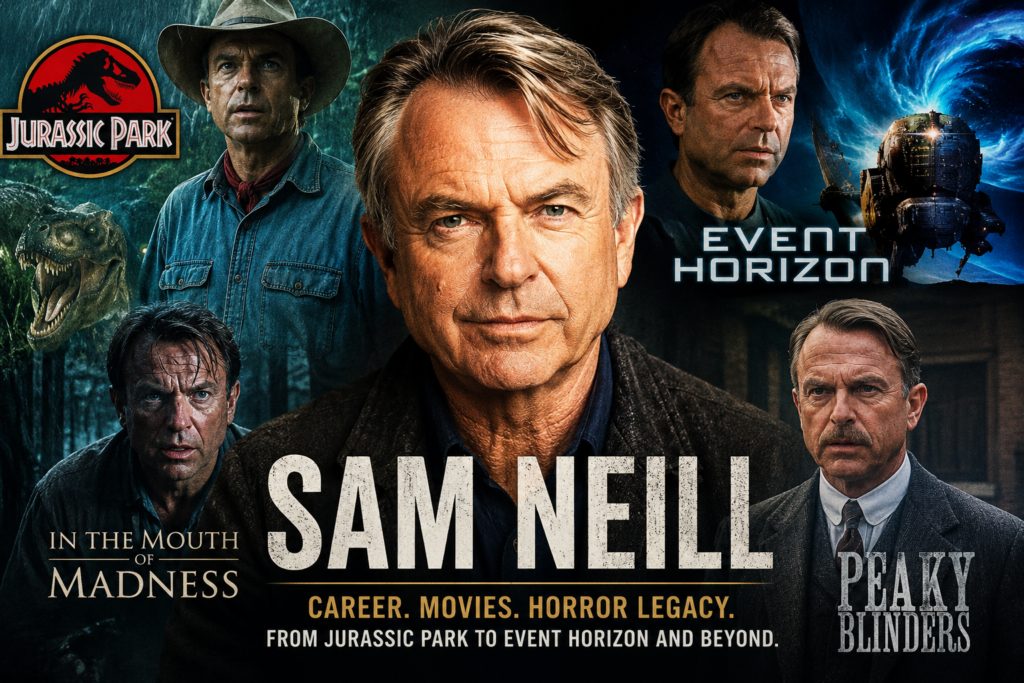
Sam Neill built a career that could have easily been defined by one role. Instead, the New Zealand actor moved between intimate dramas, international thrillers, television, blockbuster adventures, and some of the most unsettling horror films of his era. For many viewers, he will always be Dr. Alan Grant from Jurassic Park. Others remember him as the troubled John Trent in In the Mouth of Madness or Dr. William Weir in Event Horizon. His work reached far beyond those recognizable performances.
Neill died in Sydney on July 13, 2026, at age 78. His death closed a career that had stretched across five decades and included more than 50 films, along with extensive television work. Yet his screen legacy remains unusually broad. He could bring warmth and humor to one project, then create an intimidating or psychologically fragile character in the next. That range helps explain why audiences continue returning to his films.
The renewed interest in his horror work also gives his career a fascinating modern angle. A forthcoming documentary, Beyond the Horizon of Madness: The Horrors of Sam Neill, is set to revisit two of his most distinctive genre performances, In the Mouth of Madness and Event Horizon. Together, those films show a different side of an actor best known to mainstream audiences as the rational scientist who faced dinosaurs.
Who Was Sam Neill?
Sam Neill was born Nigel John Dermot Neill on September 14, 1947, in Omagh, Northern Ireland. His family moved to New Zealand when he was a child, and the country became the foundation of both his personal identity and professional career. He studied at the University of Canterbury and later Victoria University of Wellington before developing his interest in acting and filmmaking.
His path into cinema was not an instant rise to Hollywood fame. Neill worked with theater groups and the New Zealand National Film Unit, where he directed, edited, and wrote documentary material. That experience gave him an understanding of filmmaking beyond performance. He knew how productions worked from behind the camera as well as in front of it.
His feature-film breakthrough came with Sleeping Dogs in 1977. The New Zealand thriller helped establish him as a serious screen performer and became an important early milestone in the country’s developing film industry. From there, Neill gradually built an international career rather than relying on a single breakthrough.
That gradual progression became one of the defining features of his professional life. He worked across different genres and often accepted roles that allowed other performers or the story itself to take center stage. His understated approach could make him seem almost effortless on screen, but that restraint became a major part of his appeal.
By the time Hollywood audiences discovered him through Jurassic Park, Neill had already spent years developing the qualities that would make Dr. Alan Grant convincing: intelligence, authority, dry humor, and a grounded sense of danger.
Sam Neill’s Early Career and Rise to International Fame
Neill’s early career developed primarily through New Zealand and Australian cinema before international productions began giving him wider exposure. After Sleeping Dogs, he appeared in projects that demonstrated how comfortable he was with dramatically different characters. My Brilliant Career, Omen III: The Final Conflict, Possession, Dead Calm, and A Cry in the Dark each added another dimension to his growing reputation.
From New Zealand Cinema to International Roles
The importance of this period goes beyond the number of films Neill made. He developed a screen presence that did not depend on conventional leading-man behavior. He could appear tough without becoming exaggerated, vulnerable without losing authority, and threatening without resorting to obvious theatricality.
My Brilliant Career helped place him within the emerging international conversation around Australian and New Zealand filmmaking. Omen III, meanwhile, demonstrated that he could carry darker material. Later, Dead Calm placed him in a tense psychological thriller alongside Nicole Kidman, giving international audiences another reason to notice him.
His work in the 1980s also showed that he was willing to move between art-house cinema and commercial productions. That flexibility became crucial later. Instead of being locked into one genre, Neill accumulated experience that allowed him to enter major Hollywood projects without losing the qualities that had defined his earlier work.
The Breakthrough That Changed Sam Neill’s Career
The decisive turning point arrived in 1993. Neill appeared in two very different films that year: Steven Spielberg’s Jurassic Park and Jane Campion’s The Piano. The contrast was remarkable. One became a global blockbuster built around dinosaurs and groundbreaking visual effects; the other became an acclaimed dramatic film.
Jurassic Park transformed Neill’s public profile. As Dr. Alan Grant, he gave the enormous adventure film a believable human center. His performance did not depend on exaggerated heroics. Instead, Grant felt like a working scientist suddenly forced into an impossible survival situation.
That combination of credibility and accessibility made Neill an ideal blockbuster lead. At the same time, The Piano confirmed that his abilities extended well beyond mainstream adventure cinema. The two films together captured something essential about his career: Sam Neill could move between completely different cinematic worlds while remaining unmistakably himself.
His international reputation was now firmly established, but the most interesting chapter of his career was still ahead. Alongside major dramas and blockbusters, he would increasingly become associated with darker stories, including the horror films that later developed devoted cult audiences.
Sam Neill and Jurassic Park
For millions of moviegoers, Sam Neill became synonymous with Dr. Alan Grant. Steven Spielberg’s Jurassic Park gave him the role that would define his mainstream career, but the performance worked because Neill avoided turning Grant into a conventional action hero. He played him as a serious paleontologist who preferred fossils to people and felt far more comfortable studying prehistoric life than dealing with children.
Dr. Alan Grant and the Original Jurassic Park
Grant’s journey begins when he accepts an invitation to visit John Hammond’s dinosaur theme park. What initially looks like a scientific opportunity quickly becomes a fight for survival after the park’s security systems fail and genetically recreated dinosaurs escape.
Neill gave Grant a calm, practical personality that helped ground the film’s extraordinary premise. His reactions made the dinosaurs feel dangerous because he responded to them as a scientist confronting something impossible rather than as a superhero facing another obstacle. His relationship with Lex and Tim also brought an emotional dimension to the character.
That balance helped make Jurassic Park more than a special-effects spectacle. The film had enormous visual ambition, yet Neill’s performance kept its human story accessible. Grant’s fear, skepticism, frustration, and growing responsibility gave audiences someone to follow through the chaos.
The movie became a defining cultural moment of the 1990s, and Neill’s performance became one of its most recognizable elements. Even viewers who had never followed his earlier work could immediately associate his face with the franchise.
Returning as Alan Grant
Neill later returned to the role for Jurassic Park III in 2001. The sequel placed Grant in another dangerous encounter with dinosaurs, although his motivation differed from the first film. Rather than willingly entering another dinosaur-filled adventure, he becomes involved after accepting what he believes is a legitimate opportunity.
More than two decades later, Neill returned once again in Jurassic World Dominion. The reunion brought him back alongside Laura Dern and Jeff Goldblum, reconnecting the original trio with a new generation of characters.
The return also demonstrated how strongly audiences continued to associate Neill with Alan Grant. However, his career had never depended entirely on the character. While Jurassic Park made him globally recognizable, some of his most unusual performances came from darker films that developed their reputations more gradually.
Sam Neill’s Horror Career
Horror became one of the most distinctive threads running through Neill’s filmography. He did not limit himself to straightforward monsters or traditional villains. Instead, many of his genre performances placed ordinary or intelligent characters inside situations that gradually became psychologically disturbing.
That approach suited his understated acting style. Neill could begin a story as the most rational person in the room and then allow fear, confusion, obsession, or supernatural forces to erode that stability. The change often happened gradually, making his characters more unsettling than a performance built around immediate terror.
His horror-related work includes Omen III: The Final Conflict, Possession, Event Horizon, and In the Mouth of Madness. Each film uses him differently. Sometimes he plays a character surrounded by supernatural danger. At other times, the horror comes from uncertainty about what is real.
His place in horror also invites comparison with performers such as Tim Curry, whose career similarly crossed cult horror, mainstream entertainment, and memorable genre characters.
This distinction matters when looking at Neill’s genre legacy. His appeal was not simply that he appeared in frightening movies. He brought credibility to stories that demanded increasingly strange reactions from their protagonists.
That quality became especially important in two films from the 1990s: John Carpenter’s In the Mouth of Madness and Paul W. S. Anderson’s Event Horizon. Both films place Neill in worlds where reality becomes difficult to trust. Both also give him characters whose attempts to understand what is happening eventually become part of the horror.
For that reason, the films now sit near the center of discussions about Neill’s genre legacy.
Sam Neill in In the Mouth of Madness
John Carpenter’s In the Mouth of Madness arrived in 1995 and gave Neill one of the strangest leading roles of his career. He plays John Trent, an insurance investigator whose work normally depends on facts, evidence, and rational explanations.
John Trent and the Collapse of Reality
Trent begins the story investigating the disappearance of horror novelist Sutter Cane. His assignment seems unusual but manageable. As the investigation progresses, however, the boundaries between Cane’s fictional creations and the real world begin to collapse.
Neill’s performance works because Trent initially behaves like someone who refuses to accept supernatural explanations. He questions what he sees, searches for rational answers, and approaches the investigation with professional confidence. That makes the later transformation more effective.
As the story becomes increasingly surreal, Neill gradually changes Trent’s emotional rhythm. His confidence gives way to confusion, disbelief, and fear. Yet he never abandons the character’s underlying intelligence. Trent keeps trying to understand the situation even when the rules governing reality appear to have disappeared.
The performance also fits Carpenter’s broader approach to horror. The film does not rely solely on physical threats. It attacks the idea that people can trust their own perception of the world.
Why the Performance Still Matters
Neill gives the film a human perspective. Without that grounding, its increasingly bizarre events could become difficult for audiences to emotionally follow. Trent serves as the bridge between normal reality and the nightmare surrounding him.
That makes his performance particularly valuable in retrospect. Rather than simply reacting to frightening images, Neill portrays a man watching his understanding of reality collapse.
The result is one of his most memorable genre performances. In the Mouth of Madness initially divided audiences and critics, but it developed a strong cult following over time. Its reputation has continued to grow among horror viewers, while Neill’s performance remains central to the film’s appeal.
The film also established a useful connection between Neill and psychologically demanding horror. He could carry a story even when the narrative deliberately destabilized everything around his character.
That same quality would soon appear in another major genre role. Just a year later, Neill entered the claustrophobic world of Event Horizon, where science fiction, psychological horror, and supernatural terror collided.
Sam Neill in Event Horizon
If In the Mouth of Madness showed Sam Neill confronting the collapse of reality on Earth, Event Horizon placed him at the edge of something even more terrifying: a spacecraft that seemed to have returned from somewhere humanity was never meant to reach.
Paul W. S. Anderson’s 1997 science-fiction horror film stars Neill as Dr. William Weir, the brilliant designer of the experimental Event Horizon spacecraft. When the ship mysteriously reappears after disappearing for seven years, Weir joins Captain S. J. Miller and the crew of the Lewis and Clark to investigate.
The mission quickly turns into a nightmare. The Event Horizon has not simply vanished. Its experimental gravity drive appears to have opened a gateway into another dimension, and something has returned with the ship.
Dr. William Weir
Neill gives Weir a very different quality from Alan Grant. Grant is skeptical, practical, and emotionally grounded. Weir begins with similar intelligence but carries much more personal grief. His wife Claire died before the events of the film, and his emotional connection to her becomes one of the mechanisms through which the ship attacks him.
That personal vulnerability makes Weir increasingly important as the story progresses. At first, he helps the crew understand the technology behind the Event Horizon. Eventually, however, the distinction between the scientist and the thing influencing him becomes harder to maintain.
Neill does not transform Weir into a conventional monster immediately. Instead, he allows the character’s behavior to become increasingly unstable. His voice, expressions, and physical presence gradually change as the ship’s influence grows.
That progression makes the performance effective. The horror comes partly from watching someone who understands the ship better than anyone else become one of its most dangerous victims.
Why Event Horizon Became a Cult Horror Film
Event Horizon did not become a major commercial success when it opened in 1997. Its reputation changed considerably over the years, particularly as home-video audiences discovered its disturbing imagery, dark atmosphere, and unusual mixture of science fiction and supernatural horror.
The film’s cult status also grew because viewers became fascinated by what they had not seen. Reports of a much longer and more graphic version created years of speculation about missing footage and a possible director’s cut. That mystery became part of the movie’s mythology.
Neill himself later expressed frustration with the theatrical version, arguing that the film felt rushed and could have benefited from more time. His comments are revealing because they come from an actor who experienced the production firsthand rather than from fans reconstructing the movie from rumors.
Why Sam Neill’s Horror Roles Stand Out
Sam Neill’s horror performances share an important characteristic: he usually starts from realism. His characters tend to behave like intelligent people trying to understand extraordinary circumstances. That gives the audience a stable viewpoint before the story begins taking it away.
In In the Mouth of Madness, John Trent relies on investigation and logic until reality itself becomes unreliable. In Event Horizon, William Weir begins as the person most capable of explaining the spacecraft’s technology. Yet his expertise cannot protect him from the psychological forces surrounding the ship.
That pattern makes Neill particularly effective in stories about uncertainty. He does not need to announce that a character is frightened. Instead, small changes in his expression or delivery can communicate that something has gone badly wrong.
His performances also benefit from restraint. Horror can become less frightening when actors constantly signal how terrifying a situation should feel. Neill often does the opposite. He allows the situation to become strange while maintaining a measured performance. As a result, the audience discovers the horror alongside his characters.
There is also an interesting contrast between his mainstream and genre work. Dr. Alan Grant represents knowledge used to survive. William Weir represents knowledge that may have opened the door to something humanity cannot control. Both characters are intelligent scientists, but their stories reach dramatically different destinations.
That contrast helps explain why Event Horizon remains such an important part of Neill’s filmography. The film did not erase his reputation as a serious actor. Instead, it showed how effectively his grounded style could work inside extreme horror.
The Missing Event Horizon Footage and Sam Neill’s Thoughts
The missing footage from Event Horizon has become one of the most persistent stories surrounding the film. Anderson originally assembled a substantially longer cut, but the production faced an unusually compressed post-production schedule. The finished theatrical version was shortened considerably, while much of the removed material was not preserved in a form suitable for reconstruction.
What Was Cut?
Some surviving descriptions indicate that the longer version contained additional character material, more disturbing imagery, and expanded sequences involving the crew’s fears. Weir also had a longer psychological storyline involving his wife, Claire.
One particularly notable deleted moment showed Weir hallucinating that Justin had transformed into Claire. Other removed material expanded the film’s violent visions and gave several crew members more background.
A few pieces survived through home-video releases, but most of the legendary longer cut did not. Anderson has repeatedly explained that the missing material was not properly archived, making a conventional director’s cut extremely difficult.
Why the Lost Cut Still Matters
The missing footage matters because Event Horizon already feels compressed. Viewers can sense that some character relationships and explanations received less development than the film’s atmosphere deserved.
Neill later echoed that criticism. In an interview, he said the film felt as though it had been cut too quickly and suggested that additional running time could have strengthened its tension and horror.
That perspective adds another layer to the film’s legacy. The fascination is not simply about seeing more gore. Fans want to understand whether the additional material could have made the characters, mythology, and psychological horror more complete.
For Sam Neill, the surviving version still contains one of his most memorable transformations. Yet the lost footage ensures that his Event Horizon performance remains partly surrounded by mystery—a fitting legacy for a film built around a spacecraft that disappeared into the unknown.
Beyond the Horizon of Madness: The Sam Neill Documentary
Sam Neill’s horror legacy is now receiving a dedicated retrospective through Beyond the Horizon of Madness: The Horrors of Sam Neill. The documentary focuses on the actor’s influential horror work from the 1990s, particularly In the Mouth of Madness and Event Horizon. Its approach gives fans an opportunity to look beyond individual scenes and examine how those productions shaped Neill’s reputation within genre cinema.
The project comes from filmmaker Mike Gencarelli, who has assembled interviews with people connected to both films. The documentary’s participants include John Carpenter and Julie Carmen from In the Mouth of Madness, along with Paul W. S. Anderson, Kathleen Quinlan, and Jack Noseworthy from Event Horizon. Kevin Smith has also been involved as an executive producer and interview participant.
What Beyond the Horizon of Madness Is About
Rather than presenting Neill’s entire career as a conventional biography, the documentary concentrates on a specific period when he became closely associated with ambitious and unsettling genre films. That focus makes sense because both In the Mouth of Madness and Event Horizon have grown in stature since their original releases.
The project also arrives at a meaningful moment for Neill’s legacy. His death in July 2026 has prompted renewed attention to performances that sometimes sat in the shadow of Jurassic Park. A documentary centered on his horror work therefore offers another way to understand the actor’s range.
The filmmakers currently target an October 2027 release. That date remains a planned target rather than a completed release, so viewers should treat future scheduling details as subject to change.
Sam Neill’s Most Important Movies and TV Roles
Although horror provides one of the strongest themes in Neill’s career, it represents only part of his work. His filmography stretched across drama, adventure, historical stories, thrillers, family entertainment, science fiction, and television.
The Piano and The Hunt for Red October
1993 was particularly important because Jurassic Park was not Neill’s only major performance that year. Jane Campion’s The Piano placed him in a much quieter dramatic setting. His role as Alisdair Stewart demonstrated that he could create a compelling character without relying on spectacle or action.
Three years earlier, he had appeared alongside Sean Connery and Alec Baldwin in The Hunt for Red October. As Captain Vasily Borodin, Neill became part of a large-scale Cold War thriller while maintaining the understated screen presence that often distinguished his supporting performances.
These roles show why reducing Neill to one genre misses the larger story. His career developed through different kinds of filmmaking, with each project adding another dimension to his reputation. The Television Academy lists The Piano, Jurassic Park, The Hunt for Red October, Merlin, The Tudors, and Peaky Blinders among his notable credits.
Peaky Blinders, Merlin and Television
Television gave Neill another opportunity to work outside the shadow of his film roles. He played Merlin in the 1998 miniseries Merlin, a performance that earned him an Emmy nomination for Outstanding Lead Actor in a Miniseries or Special. He later appeared in series including The Tudors and Peaky Blinders.
His role as Major Chester Campbell in Peaky Blinders introduced him to another generation of viewers. Campbell is a very different character from Alan Grant: controlled, intimidating, politically connected, and often morally difficult to read.
That ability to enter a long-running television world without repeating his earlier screen persona became another strength of Neill’s later career. He could remain recognizable without making every character feel like the same performance.
Sam Neill’s Broader Career Beyond His Biggest Roles
Neill’s filmography becomes even more impressive when the famous titles are removed. His early work in New Zealand cinema helped establish him before Hollywood recognized him, while later projects allowed him to keep experimenting.
He appeared in Dead Calm, Evil Angels, Possession, Omen III: The Final Conflict, The Dish, Hunt for the Wilderpeople, Rams, Peter Rabbit, and numerous other productions. His television credits were similarly broad, including Reilly, Ace of Spies, Merlin, The Tudors, Peaky Blinders, and later appearances in contemporary series.
That variety was not accidental. Neill often seemed more interested in the role itself than in protecting a fixed public image. He could move from prestige drama to horror, from blockbuster adventure to television, without needing every project to reinforce his previous success.
His career also extended beyond acting. Neill co-wrote and co-directed Cinema of Unease: A Personal Journey by Sam Neill, a documentary examining New Zealand cinema through his personal perspective. He also developed a significant connection to winemaking through Two Paddocks, his Central Otago vineyard.
This broader picture makes his career easier to understand. Sam Neill was never simply the actor who played Dr. Alan Grant. He was a performer who spent decades moving between different cinematic worlds, often choosing roles that allowed him to explore a new side of his craft.
That is also why his horror performances remain so important. In the Mouth of Madness and Event Horizon were not isolated detours. They were part of a larger career built around curiosity, versatility, and a willingness to inhabit characters very different from one another.
Sam Neill’s Lasting Legacy
Sam Neill’s legacy reaches well beyond the role that made him internationally famous. Dr. Alan Grant remains the character most closely associated with his name, but his career cannot be reduced to Jurassic Park. Over five decades, Neill moved between blockbuster entertainment, serious drama, television, science fiction, comedy, and horror. The Television Academy highlights major credits including The Piano, Jurassic Park, The Hunt for Red October, Merlin, The Tudors, and Peaky Blinders.
What made Neill distinctive was his ability to make very different characters feel believable. He rarely needed exaggerated gestures or grand speeches to command attention. His understated style worked equally well for a scientist facing dinosaurs, a troubled man confronting supernatural forces, or a morally complicated television character.
His horror work has gained particular significance because films such as In the Mouth of Madness and Event Horizon continued finding new audiences long after their original releases. The planned documentary Beyond the Horizon of Madness reflects that lasting interest, focusing specifically on Neill’s 1990s horror films.
Neill’s career also extended beyond acting. He directed, wrote, produced, narrated documentaries, and became associated with New Zealand’s film culture and his Two Paddocks vineyard. His work consistently reflected a connection to the country he considered home.
In the end, Sam Neill left behind something more valuable than a single iconic performance: a filmography that allowed different generations to discover him in completely different ways.
Frequently Asked Questions About Sam Neill
Who was Sam Neill?
Sam Neill was a New Zealand actor, director, producer, and screenwriter whose career spanned five decades. Born in Northern Ireland in 1947 and raised in New Zealand, he became internationally recognized through films including The Piano, Jurassic Park, The Hunt for Red October, Event Horizon, and In the Mouth of Madness. He also became well known for television roles in Merlin, The Tudors, and Peaky Blinders.
How old was Sam Neill when he died?
Sam Neill died on July 13, 2026, at the age of 78. He was born on September 14, 1947, in Omagh, County Tyrone, Northern Ireland. His death brought renewed attention to a career that had included more than five decades of film and television work.
What was Sam Neill’s most famous role?
His most famous role was arguably Dr. Alan Grant in Jurassic Park. Neill first played the paleontologist in Steven Spielberg’s 1993 blockbuster and later returned as Grant in Jurassic Park III and Jurassic World Dominion. The role introduced him to a huge international audience and became the character most closely connected with his public image.
What role did Sam Neill play in Event Horizon?
Neill played Dr. William Weir, the scientist responsible for designing the experimental Event Horizon spacecraft. The character becomes central to the film’s psychological horror as the crew discovers that the ship’s disappearance was connected to something far more disturbing than a technical failure. Neill’s performance moves from controlled scientific confidence toward psychological instability.
What are Sam Neill’s best horror movies?
Among his most notable horror performances are Omen III: The Final Conflict, In the Mouth of Madness, and Event Horizon. His horror filmography is especially interesting because each role approaches fear differently. In In the Mouth of Madness, he plays a man whose understanding of reality collapses. In Event Horizon, he portrays a scientist whose own creation becomes a source of terror. His genre work remains an important part of his wider legacy.
What is Beyond the Horizon of Madness?
Beyond the Horizon of Madness: The Horrors of Sam Neill is a documentary examining Neill’s horror work from the 1990s, with particular attention to In the Mouth of Madness and Event Horizon. The project brings together filmmakers and performers connected with those productions and explores why the films remain important to horror audiences. Its current focus makes it a timely retrospective of a distinctive part of Neill’s career.
Was Sam Neill in Jurassic Park?
Yes. Sam Neill played paleontologist Dr. Alan Grant in the original Jurassic Park in 1993. He returned to the role in Jurassic Park III in 2001 and Jurassic World Dominion in 2022. The character became his signature mainstream role and helped establish him as an international film star.
What other major roles did Sam Neill have?
Beyond Jurassic Park, Neill appeared in The Piano, Dead Calm, The Hunt for Red October, Possession, The Dish, Hunt for the Wilderpeople, and Event Horizon. On television, he played Merlin in the miniseries Merlin and Major Chester Campbell in Peaky Blinders. His broad filmography is one reason he is remembered as a versatile performer rather than a one-franchise actor.
Sam Neill’s Career in Perspective
Sam Neill’s career is ultimately a story of range. He became a worldwide star through Jurassic Park, but that blockbuster represented only one part of his work. Before Alan Grant, he had already built a substantial reputation in New Zealand, Australian, and international cinema. Afterward, he continued moving between genres instead of allowing one successful character to determine the rest of his career.
That choice explains why his filmography remains so rewarding to explore. A viewer might discover Neill through Jurassic Park, then encounter a completely different performer in The Piano. Another might find him through Peaky Blinders before discovering the darker intensity of Event Horizon or In the Mouth of Madness. His career offers several entry points, and each one reveals another side of his talent.
His death in 2026 marked the end of an extraordinary acting career, but it did not end interest in his work. Current retrospectives continue to emphasize the breadth of his performances, while the planned Beyond the Horizon of Madness documentary gives particular attention to his horror legacy.
For audiences who remember him as Alan Grant, Sam Neill will always be part of Jurassic Park history. For horror fans, however, his legacy includes something darker and stranger. And for anyone exploring his complete body of work, the bigger picture is clear: Sam Neill was never defined by one role. He built a career by repeatedly becoming someone else, while bringing the same quiet intelligence and unmistakable presence to every performance.