
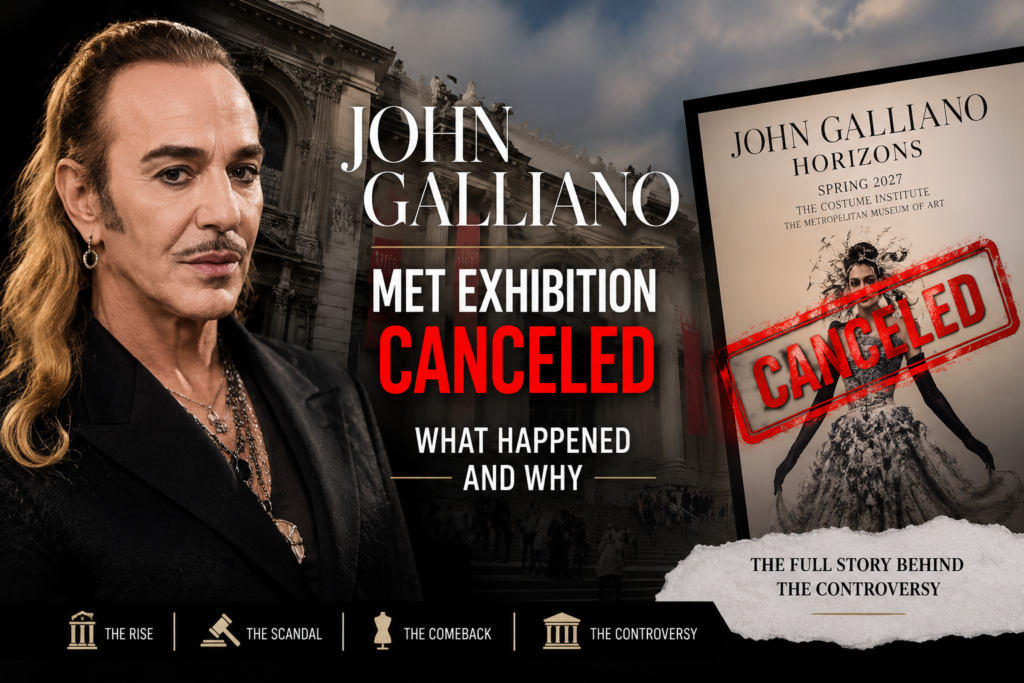
John Galliano Met Exhibition Canceled: What Happened and Why
John Galliano has spent more than four decades at the center of fashion’s most dramatic transformations. His career includes landmark work at Givenchy, Christian Dior and Maison Margiela, along with a reputation for elaborate storytelling, historical references and highly theatrical collections. Yet his legacy has always carried another dimension: the serious consequences of his antisemitic, racist and anti-Asian conduct in 2010 and 2011. That complicated history returned to the spotlight in 2026 when The Metropolitan Museum of Art announced a major exhibition devoted to his work. The planned exhibition, John Galliano: Horizons, was scheduled to open in May 2027 and was intended to become the first major museum exhibition examining the full scope of his creative career. On August 31, however, the Met and Galliano announced that the exhibition would not proceed as planned. The decision followed discussions between the designer and the museum, with both sides acknowledging the pain and concerns surrounding the proposed retrospective. The Met also said that information about a new Spring 2027 Costume Institute exhibition and the 2027 Met Gala would come later. The decision makes Galliano’s story more complicated than a simple tale of success or scandal. His creative achievements remain influential, while his past conduct continues to shape how institutions, designers and audiences evaluate his work. Who Is John Galliano? John Galliano is a British fashion designer born in Gibraltar in 1960. He became one of the defining creative figures of late-20th- and early-21st-century fashion, building a career around dramatic silhouettes, historical inspiration, elaborate narratives and theatrical runway presentations. The Met described him in its original 2026 exhibition announcement as one of the most inventive and influential designers of the previous four decades. Galliano first gained major attention after graduating from Central Saint Martins in London in 1984. His graduate collection quickly established him as a designer with an unusually strong ability to combine research, fantasy and clothing. From there, he developed his own label before moving into the highest levels of the Paris fashion industry. His career eventually took him to Givenchy and then Christian Dior, where he became one of the industry’s most recognizable creative forces. Years later, he rebuilt his professional career at Maison Margiela, where he continued experimenting with construction, storytelling and unconventional references. Today, however, Galliano cannot be discussed solely through his creative accomplishments. His 2010–2011 conduct resulted in his dismissal from Dior and his eponymous label, as well as a Paris court conviction over public insults based on race, religion, ethnicity or origin. The Met’s original exhibition plan explicitly intended to address that rupture rather than omit it. John Galliano’s Early Life and Education Galliano was born in Gibraltar in 1960 and later moved with his family to England. His education at Central Saint Martins proved decisive in shaping his future career. In 1984, he graduated with a collection inspired by the French Revolution. The work attracted attention for its historical references and theatrical presentation, helping establish Galliano as a young designer with a distinctive creative identity. Rather than approaching fashion simply as a method of producing wearable clothes, Galliano treated garments as part of a larger visual story. Historical research, characters, cultural references and performance became recurring elements of his work. That approach became increasingly important as his career developed. Galliano’s early collections demonstrated an ability to transform research into dramatic fashion narratives, a quality that later became central to his reputation in Paris. The Met’s planned Horizons exhibition was designed in part around this creative process. Its proposed galleries were expected to include garments, accessories, sketches, toiles, research books and archival material, allowing visitors to see how Galliano developed ideas from initial research through finished designs. How Galliano Built His Fashion Reputation After establishing his own label, Galliano moved increasingly into the international fashion spotlight. His work attracted attention for its combination of craftsmanship, historical imagination and theatrical presentation. His career took a major step forward when he became associated with Givenchy in Paris. He then moved to Christian Dior, where his influence expanded dramatically. His influence also reflects the broader relationship between fashion and personal style, a connection that continues to shape how modern fashion figures are presented to global audiences. At Dior, Galliano had access to the resources of one of fashion’s most famous houses while retaining the creative freedom that had distinguished his earlier work. His collections often turned runway shows into elaborate performances, connecting clothing with characters, periods of history and imagined worlds. That approach helped make Galliano more than a successful designer. He became a major figure in fashion culture, influencing how designers and audiences understood the relationship between clothing, performance and storytelling. The Met’s 2026 exhibition proposal reflected that broad view of his career. It planned to connect his work from his 1984 graduation collection through his independent label, Givenchy, Dior and later Maison Margiela collections. John Galliano’s Rise Through Givenchy and Dior Galliano’s move into Parisian haute couture marked a turning point. His appointment at Givenchy placed a British designer at one of France’s most prestigious fashion houses, while his subsequent move to Christian Dior gave him an even larger platform. His Dior years became particularly important to his reputation because they combined the traditions of an established luxury house with his highly individual creative language. Galliano could draw from Dior’s heritage while building collections around his own fascination with history, performance and visual spectacle. The scale of the Dior platform also allowed his ideas to reach a global audience. His work became closely associated with elaborate runway productions and strong visual concepts, helping reinforce the idea that a fashion collection could function as a complete artistic narrative. At the same time, the enormous attention surrounding Galliano’s work meant that his personal conduct became inseparable from his professional legacy when controversy emerged later in his career. His Givenchy Appointment Galliano’s Givenchy period represented an important step in his transition from celebrated independent designer to major Paris fashion figure. The appointment demonstrated that his unconventional approach had gained
John Galliano Met Exhibition Canceled: What Happened and Why Read More »