
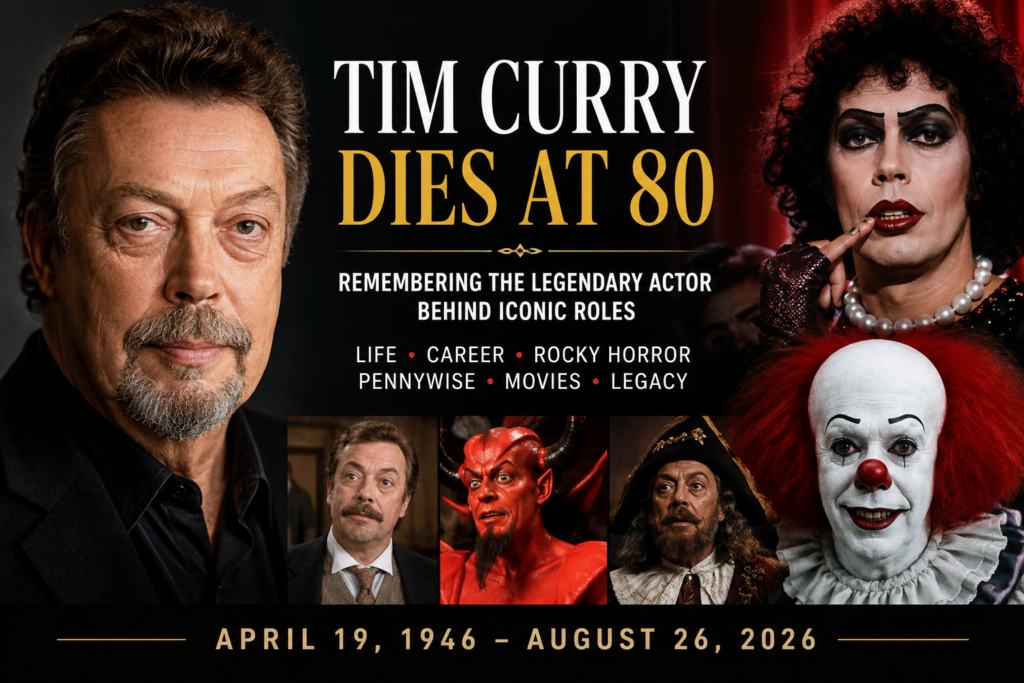
Tim Curry, the British actor whose unforgettable performances helped define cult cinema, stage comedy, horror television, and animated entertainment, has died at 80. Curry died at his Los Angeles home in August 2026, according to his longtime manager and friend Marcia Hurwitz. His death marks the end of a career that stretched across more than five decades, from London’s theater scene to Hollywood films and major voice-acting roles.
For many fans, Curry will always be Dr. Frank-N-Furter from The Rocky Horror Picture Show. Others remember him as Pennywise in the 1990 television adaptation of Stephen King’s It, Wadsworth in Clue, the Lord of Darkness in Legend, or Nigel Thornberry in The Wild Thornberrys. Yet those familiar roles represent only part of his work. Curry also earned three Tony Award nominations for Broadway performances and built a respected career as a singer and stage performer.
His death also brings renewed attention to the breadth of his career. Curry could move from flamboyant musical theater to dark horror, broad comedy, children’s animation, and Shakespearean performance without losing the distinctive voice and presence that made him instantly recognizable.
Tim Curry Dies at 80: What We Know
When Tim Curry died
Tim Curry died at his home in Los Angeles at the age of 80. His longtime manager, Marcia Hurwitz, confirmed the death, while major reports published on August 26, 2026, identified the actor as having died in Los Angeles. Some early reports differed over whether his death occurred late Tuesday or Wednesday, so the safest account is that Curry died in Los Angeles during the August 25–26 period.
Curry was born Timothy James Curry in Cheshire, England, in 1946. Over the following decades, he became one of the most recognizable British performers to build a major career in American entertainment. His work crossed several generations, giving different audiences their own way into his filmography.
For older moviegoers, he was the magnetic performer behind Frank-N-Furter. Horror fans knew him as Pennywise. Families encountered his voice work in animated productions, while theater audiences followed his performances on Broadway. That range helps explain why news of his death resonated far beyond a single genre or generation.
What is known about the cause of death
A cause of death has not been publicly disclosed. Reports from the Associated Press, Reuters and other major outlets have confirmed Curry’s death but have not identified a specific medical cause.
Curry had experienced serious health problems during his later years. In 2012, he suffered a major stroke that affected his mobility and led him to use a wheelchair. The stroke also reduced his on-camera workload, although he continued working through voice performances, appearances and other projects.
That history should not be confused with the cause of his death. At this time, there is no confirmed public information establishing that his earlier stroke caused his death. The responsible account is therefore simple: Curry died at 80, and no cause has been announced.
Who Was Tim Curry?
Early life and education
Tim Curry was born in Cheshire, England, in 1946 and developed an interest in performance before establishing himself professionally. He studied drama and English at the University of Birmingham, graduating in 1968. Soon afterward, he joined the London production of Hair, beginning a professional theater career that would shape almost everything that followed.
The stage gave Curry an ideal environment for the qualities that later became his trademarks: a commanding voice, strong physical presence, comic timing, and a willingness to embrace unusual characters. Rather than following a conventional path toward leading-man roles, he gravitated toward complicated, eccentric, and often theatrical personalities.
That choice became central to his identity as a performer. Curry could dominate a scene without necessarily being its traditional hero. His characters often arrived with exaggerated confidence, strange mannerisms, or an unmistakable sense of danger. Those qualities eventually made him perfect for one of the most unconventional musical characters of the 1970s.
From London’s stage to Rocky Horror
Curry’s career changed dramatically when he originated Dr. Frank-N-Furter in The Rocky Horror Show on the London stage. The production premiered in 1973 and became a phenomenon, eventually leading to the 1975 film The Rocky Horror Picture Show.
The role transformed Curry from a promising stage performer into an international cult figure. Frank-N-Furter demanded theatrical confidence, musical ability, comic precision, and a willingness to challenge conventional ideas about gender and performance. Curry brought all of those elements together in a character that audiences could not easily forget.
The film initially had a difficult commercial journey, but its midnight screenings and highly participatory fan culture gradually turned it into one of cinema’s most enduring cult classics. Curry’s performance stood at the center of that transformation.
For many viewers, Frank-N-Furter became the defining Tim Curry role. However, the success of Rocky Horror did not trap him in one character. Instead, it gave Curry the visibility to pursue increasingly varied work across film, television, theater, and music.
Tim Curry and The Rocky Horror Picture Show
Why Frank-N-Furter became his signature role
Dr. Frank-N-Furter remains the role most closely associated with Tim Curry because the performance combined nearly every strength he had developed onstage. Curry played the character with theatrical swagger, sharp humor, musical confidence, and a deliberately provocative style. The result was not simply a memorable musical performance; it became part of the identity of the film itself.
The Rocky Horror Picture Show also found a life beyond its original theatrical release. Midnight screenings encouraged audiences to dress as characters, respond aloud to the movie, and participate in rituals that turned ordinary viewing into a communal event. Over time, Curry’s Frank-N-Furter became one of the most recognizable figures in that tradition.
The role also mattered culturally because it gave audiences an unconventional screen presence at a time when mainstream American entertainment offered far fewer openly transgressive characters. Curry approached Frank-N-Furter as a performer rather than reducing the character to a simple shock device.
That distinction helped the role endure. Decades later, audiences still discover Rocky Horror, and Curry’s performance remains the film’s most immediate point of recognition.
The lasting impact of Rocky Horror
The importance of Rocky Horror to Curry’s career is difficult to overstate, but its impact also goes beyond Curry himself. The film developed a dedicated fan community that continued introducing new audiences to his work long after its original release.
Curry remained closely connected to that legacy throughout his life. Even after health problems limited his public appearances, he continued to participate in celebrations of the film. His connection with Rocky Horror also became particularly meaningful to LGBTQ audiences, who embraced the movie’s themes of individuality, self-expression, and freedom from conventional expectations.
Yet Curry’s career ultimately tells a larger story. He did not spend the rest of his professional life attempting to recreate Frank-N-Furter. Instead, he moved into dramatically different territory, taking on villains, comic characters, literary figures, musical roles, and animated personalities.
That versatility became one of the defining features of his career. Frank-N-Furter opened the door, but Curry repeatedly proved that he could walk through it in almost any direction.
How Tim Curry Became a Cult Movie Icon
Tim Curry’s success in The Rocky Horror Picture Show gave him international recognition, but he never limited himself to one kind of performance. During the 1980s and 1990s, he built a film career around characters that could be theatrical, sinister, eccentric, or unexpectedly funny. That versatility made him especially effective in movies where a larger-than-life personality could steal a scene.
His filmography from this period shows how easily he moved between genres. He appeared in musicals, fantasy films, comedies, thrillers, and family adventures. Instead of chasing conventional leading-man parts, Curry often chose characters with distinctive personalities. That decision helped him create a career based on memorable performances rather than a single screen image.
Clue and Wadsworth
One of Curry’s most beloved movie roles came in Clue, the 1985 mystery comedy based on the classic board game. Curry played Wadsworth, the seemingly composed but increasingly frantic butler who guides the film’s chaotic group of suspects through the mansion.
The role allowed Curry to use his theatrical instincts in a completely different way from Frank-N-Furter. Wadsworth is controlled at first, but the character gradually becomes part of the movie’s escalating comic energy. Curry’s timing and expressive delivery helped make him one of the film’s standout performers.
Although Clue was not initially a major box-office success, its reputation grew through home video and television. It eventually became a cult favorite, adding another enduring character to Curry’s résumé.
The performance also demonstrated an important part of his appeal: Curry did not need a supernatural character or elaborate costume to dominate a scene. A sharp voice, physical comedy, and precise timing were often enough.
Legend and other memorable film roles
Curry took a much darker turn in Ridley Scott’s 1985 fantasy film Legend, playing the Lord of Darkness. The character required a striking physical presence and a deliberately theatrical performance, qualities Curry used to create one of the movie’s most memorable figures.
His film work continued to span very different audiences. He appeared in Annie, The Shadow, Home Alone 2: Lost in New York, and Muppet Treasure Island, among other projects. In each case, he adjusted his performance to fit the tone rather than simply repeating the style that had made him famous.
That ability became one of Curry’s greatest professional strengths. His characters could be frightening one year and comic the next, while his voice remained recognizable enough to give each performance a distinct identity.
Tim Curry as Pennywise in It
The 1990 It miniseries
If Frank-N-Furter introduced Tim Curry to one generation, Pennywise introduced him to another. Curry played the shape-shifting killer clown in the 1990 television adaptation of Stephen King’s It, a two-part miniseries that became a major reference point for horror audiences.
Pennywise gave Curry an opportunity to use the theatrical qualities that had defined his earlier career in a completely different context. Instead of inviting the audience into a strange musical world, he used the same confidence and showmanship to create discomfort. His voice could shift from playful to threatening within moments, making the clown’s apparent friendliness feel dangerous.
The performance became one of Curry’s most recognizable horror roles. For many viewers who encountered It during its original television run or through later home-video releases, Curry’s Pennywise became the face of the character.
Curry’s horror legacy also connects him with other actors whose careers moved between mainstream cinema and darker genre work. That broader tradition is worth exploring through Sam Neill’s career, horror roles and genre legacy, which show another path from acclaimed drama to unforgettable genre performances.
His portrayal also demonstrated why Curry worked so effectively as a villain. He understood that memorable villains do not always need constant aggression. Sometimes the most unsettling moments come from a character who appears calm, playful, or even welcoming.
Why Curry’s Pennywise still matters
Curry’s Pennywise remained influential because he created a character that could frighten viewers without relying entirely on graphic violence. Much of the performance came through suggestion: an unusual smile, a sudden change in tone, exaggerated movements, and the contrast between childish playfulness and genuine menace.
The character also became an important part of Curry’s broader legacy because it proved that his Rocky Horror persona was not the limit of his range. Frank-N-Furter and Pennywise are radically different characters, yet both depend on Curry’s ability to command attention.
Later adaptations of It introduced Pennywise to another generation, with Bill Skarsgård taking the role in the 2017 and 2019 films. However, Curry’s interpretation remained an essential part of the character’s screen history.
That distinction matters when discussing his legacy. Curry did not simply play a famous horror villain. He helped establish a version of Pennywise that audiences continued to remember decades later.
For horror fans, his performance remains a bridge between television horror of the early 1990s and the much larger modern mythology surrounding Stephen King’s character.
Tim Curry’s Other Memorable Movies and Characters
Curry’s movie career extended well beyond the two roles that receive the most attention after his death. His filmography contains a long list of supporting performances that became memorable because of his ability to give even secondary characters a strong identity.
In Annie, Curry played Rooster Hannigan, bringing a theatrical sense of villainy to the musical adaptation. The role suited his ability to combine exaggerated behavior with comic energy.
His appearance in Home Alone 2: Lost in New York offered another example of his range. As the hotel concierge, Curry played against Macaulay Culkin with a more restrained comic performance. His facial expressions and controlled reactions helped make the character memorable even though he was not the central antagonist.
Muppet Treasure Island gave Curry another opportunity to combine comedy and musical performance. Playing Long John Silver, he could balance the character’s adventurous side with the humor expected from a Muppet production. The movie also showed how naturally his stage background translated into family entertainment.
Other projects, including The Shadow, Congo, and The Three Musketeers, added further variety to his screen résumé. Curry frequently gravitated toward characters with a clear personality, even when the film itself belonged to a very different genre.
Curry’s filmography also highlights how audiences continue to follow distinctive performers across changing eras of cinema. Today’s major theatrical releases, including Christopher Nolan’s The Odyssey, show how star-driven filmmaking and ambitious storytelling remain central to the movie landscape.
This pattern explains why his filmography remains so searchable. People may discover Curry through one iconic performance, then encounter an entirely different character in another movie. His career rewards that kind of exploration.
Rather than becoming associated with one fixed genre, Curry became associated with something broader: a memorable performance.
Tim Curry’s Broadway and Theater Career
Tim Curry’s screen fame sometimes overshadows the stage career that established him as a serious performer. Long before audiences knew him as Pennywise or Wadsworth, Curry built his reputation in London’s theater world. That foundation remained important throughout his career, and he repeatedly returned to the stage even after becoming an international film star.
His Broadway résumé includes three Tony-nominated performances: Mozart in Amadeus, Alan Swann in My Favorite Year, and King Arthur in Spamalot. Those nominations covered both drama and musical comedy, reflecting the range that became a defining feature of his career.
Amadeus and My Favorite Year
Curry’s Broadway performance as Wolfgang Amadeus Mozart in Amadeus earned him a 1981 Tony nomination for Best Actor in a Play. The production gave him an opportunity to move away from the flamboyance associated with Frank-N-Furter and tackle a demanding dramatic character.
More than a decade later, he returned to Broadway in My Favorite Year. Curry played Alan Swann, an aging movie star whose larger-than-life personality drives much of the musical’s comedy. His performance earned another Tony nomination in 1993.
The two roles illustrate why Curry’s theater career deserves separate recognition. He could handle serious dramatic material while also using his comic instincts in musical theater. The stage remained a place where he could build a character through voice, movement, timing, and direct audience connection.
Spamalot and later stage work
In 2005, Curry returned to Broadway as King Arthur in Spamalot, the musical inspired by Monty Python and the Holy Grail. His performance earned his third Tony nomination, this time for Best Actor in a Musical.
The production also demonstrated how naturally Curry fit the exaggerated comic style of the material. He brought authority to King Arthur while allowing the character’s absurdity to remain central.
His stage credits also included The Pirates of Penzance, Me and My Girl, and other major productions. Broadway was never simply a chapter Curry left behind after Hollywood success. Instead, it remained a second home that repeatedly showcased the theatrical skills behind his most famous screen performances.
Tim Curry’s Voice Acting Career
Voice acting became one of the most important parts of Curry’s later career. His distinctive baritone could communicate authority, humor, menace, and eccentricity without relying on physical appearance. That made him especially valuable in animation, where a recognizable voice can define a character as strongly as a face does.
Curry worked across children’s television, animated features, and other voice projects. His animation résumé included Captain Hook in Peter Pan and the Pirates, a performance that earned him a Daytime Emmy, as well as Nigel Thornberry in Nickelodeon’s The Wild Thornberrys.
The Wild Thornberrys and animation
Nigel Thornberry became one of Curry’s most recognizable animated characters. The eccentric explorer’s energetic personality allowed Curry to lean into his gift for comic vocal performance. The series ran from 1998 through 2004, giving him a substantial presence in children’s entertainment.
For younger audiences, this work offered an entirely different introduction to Tim Curry. They could know his voice long before discovering Rocky Horror, Clue, or It. That cross-generational reach helped expand his cultural footprint beyond live-action film.
Voice work after his stroke
Voice acting became particularly valuable after Curry’s 2012 stroke affected his mobility and reduced his ability to take on conventional on-camera roles. He could continue performing without the physical demands associated with film and stage productions.
That later work also demonstrated that Curry remained an active creative presence rather than simply a nostalgic figure from earlier decades. His voice continued to connect him with audiences even when his public appearances became less frequent.
Tim Curry’s Music Career
Acting was Curry’s best-known profession, but music formed another important strand of his creative life. His musical abilities were already evident through theater, particularly in The Rocky Horror Show, yet he also pursued a career as a recording artist.
Curry released three studio albums: Read My Lips in 1978, Fearless in 1979, and Simplicity in 1981. His recordings moved through rock, pop, and other influences, giving him another outlet for the vocal style that audiences recognized from his acting work.
From Read My Lips to Fearless
His debut album, Read My Lips, arrived through A&M Records in 1978. The following year, Fearless became his most commercially successful studio album. It included “I Do the Rock,” which became his best-known U.S. charting single.
Curry’s third album, Simplicity, followed in 1981 and combined original material with selected covers. Although his recording career never approached the scale of his acting success, the albums reveal another side of his artistic identity.
Music also reinforced the connection between Curry’s different careers. Whether he was performing onstage, recording in a studio, or delivering dialogue for an animated character, his voice remained one of his most distinctive tools.
Tim Curry’s Health and Later Career
His 2012 stroke
Tim Curry’s later career changed significantly after he suffered a severe stroke in July 2012. The emergency left him with paralysis on his left side and long-term mobility problems. He underwent emergency brain surgery and an extended rehabilitation process before returning to professional work.
Curry later discussed the experience in his 2025 memoir, Vagabond. Rather than allowing the stroke to become the only story people told about him, he continued finding ways to work and connect with audiences. His mobility remained limited, and he used a wheelchair, but his creative career did not simply stop.
The change was most visible in the kinds of projects he accepted. Physical stage performances and demanding live-action roles became harder to pursue, while voice work offered a practical way to continue acting. He also remained involved with fan events and celebrations connected to The Rocky Horror Picture Show.
That period showed another side of Curry’s personality. His career had always depended on theatrical confidence, but his later years required persistence of a different kind. He adapted to circumstances that could have ended many performers’ careers and continued participating in entertainment on his own terms.
Returning to performance and public life
Curry gradually became less visible in conventional film and television roles, but he never disappeared completely. He continued voice work and made occasional appearances connected to his most celebrated performances.
In 2025, he participated in events marking the 50th anniversary of The Rocky Horror Picture Show. He also spoke openly about his health and continued relationship with the film’s fans. His appearance at the anniversary celebration became one of his most notable late public moments.
The important point is that Curry’s later career was not defined solely by what he could no longer do. Instead, he found different ways to remain an actor, storyteller, and public figure.
Tim Curry’s Final Years and Last Screen Work
Curry continued working even after his stroke, although his output became more selective. Voice acting, guest appearances, interviews, and fan events allowed him to remain connected with audiences without requiring the physical demands of his earlier stage career.
One notable late screen credit came with the 2024 horror film Stream. The appearance marked a return to live-action filmmaking after years in which much of his professional activity had shifted toward voice work and public appearances.
His 2025 memoir and reflections
Curry’s 2025 memoir, Vagabond, offered another important window into his life. The book allowed him to revisit his career, his health struggles, and the experiences that shaped him without reducing his story to a list of famous roles.
He also spoke candidly about mortality during a 2025 interview. Curry said he did not fear death and described a sense of acceptance about the end of life. Those comments have received renewed attention following his death, although they should be understood as reflections from an earlier conversation rather than predictions about when or how he would die.
His final public appearances
Curry’s final years included several meaningful connections with the audience that had followed him for decades. In October 2025, he appeared at a Grammy Museum event related to Rocky Horror, while his final public appearance came at a 50th-anniversary celebration in New York in November 2025. He also participated in an Academy retrospective interview in February 2026.
Those appearances offered a fitting final chapter for an actor whose career had always depended on a direct relationship with audiences. Even when his physical abilities had changed, his voice, humor, and personality remained unmistakably Tim Curry.
Why Tim Curry’s Legacy Will Last
An actor who refused easy categories
Tim Curry’s legacy rests partly on the difficulty of putting him into one category. He was a stage performer who became a film star, a singer who became a television actor, a horror icon who voiced children’s characters, and a comic performer who earned recognition for dramatic theater.
Frank-N-Furter remains his defining role, but the rest of his career makes the legacy much larger. Clue showed his comic precision. It demonstrated his ability to create fear. Legend showcased his theatrical villainy. Muppet Treasure Island brought his energy to family entertainment, while animation introduced his voice to viewers who might never have seen his earlier films.
Curry’s appeal also reflects the enduring fascination with theatrical, eccentric characters in popular entertainment. That tradition continues in modern fantasy franchises, where memorable personalities can become as important to audiences as the heroes themselves. Gilderoy Lockhart’s role in the Harry Potter universe offers another example of how distinctive character performances can shape a franchise.
That variety explains why Curry continued to attract new fans decades after his breakthrough. Each generation could discover a different version of him.
From cult cinema to multiple generations
Curry’s career also demonstrates how popular culture can give performers a second, third, or even fourth life. The Rocky Horror Picture Show became a midnight-screening tradition. It introduced his work to horror fans. Animated series brought him to younger audiences, while Broadway preserved his connection to theater.
His later appearances proved that those audiences had not forgotten him. The reception he received during Rocky Horror anniversary events showed the lasting emotional connection between Curry and his fans.
Ultimately, Curry’s importance comes from more than the number of memorable characters he played. He made eccentricity compelling, theatricality accessible, and villains strangely magnetic. His performances encouraged audiences to embrace characters who did not fit neatly into conventional roles.
That quality is difficult to replicate. Tim Curry did not simply leave behind famous movies and characters. He left behind a distinctive way of performing—bold, playful, unpredictable, and completely his own.
Tim Curry’s Most Important Roles at a Glance
Tim Curry’s career covered nearly six decades, and his most recognizable characters came from remarkably different worlds. From cult musicals and horror to family entertainment and comedy, each role revealed another part of his range. His work also reached audiences who may have discovered him through very different generations of entertainment.
| Work | Year | Role | Why It Matters |
|---|---|---|---|
| The Rocky Horror Picture Show | 1975 | Dr. Frank-N-Furter | Curry’s signature screen performance and the role that made him a cult icon |
| Annie | 1982 | Rooster Hannigan | A memorable musical villain that showcased his comic energy |
| Clue | 1985 | Wadsworth | One of his most beloved comedy performances |
| Legend | 1985 | Lord of Darkness | A visually striking fantasy villain |
| It | 1990 | Pennywise | His defining horror performance |
| Home Alone 2 | 1992 | Concierge | A memorable mainstream comedy role |
| Muppet Treasure Island | 1996 | Long John Silver | A family-friendly performance combining comedy and adventure |
| The Wild Thornberrys | 1998–2004 | Nigel Thornberry | One of his most recognizable animated characters |
Taken together, these performances show why reducing Curry to either Frank-N-Furter or Pennywise misses much of his contribution. His film career included comedy, fantasy, horror, musicals and family entertainment, while his stage and voice work expanded that range even further.
Frequently Asked Questions About Tim Curry
How old was Tim Curry when he died?
Tim Curry was 80 years old when he died in August 2026. He was born on April 19, 1946, in Cheshire, England, and spent almost six decades working across theater, film, television, music and voice acting.
When did Tim Curry die?
Tim Curry died at his home in Los Angeles in August 2026. His longtime manager and friend, Marcia Hurwitz, confirmed his death. Some early reports differed over whether he died late on August 25 or on August 26, but major reporting confirms the same overall circumstances: Curry died peacefully at his Los Angeles home at age 80.
What was Tim Curry’s cause of death?
A cause of death had not been publicly disclosed in the initial reports following his death. Curry had suffered a major stroke in 2012, but that medical history should not be presented as his confirmed cause of death. No reliable public source had established such a connection at the time of reporting.
What was Tim Curry famous for?
Tim Curry was best known for playing Dr. Frank-N-Furter in The Rocky Horror Picture Show and Pennywise in the 1990 television adaptation of Stephen King’s It. He was also widely recognized for Clue, Legend, Annie, Home Alone 2: Lost in New York, Muppet Treasure Island, and his extensive voice-acting work.
Did Tim Curry play Pennywise?
Yes. Curry played Pennywise the clown in the 1990 television miniseries adaptation of Stephen King’s It. His performance became one of the most celebrated versions of the character and helped establish Pennywise as one of his defining horror roles. Later films featured Bill Skarsgård as Pennywise, but Curry’s interpretation remains an important part of the character’s screen history.
What movies was Tim Curry in?
Curry appeared in many notable films, including The Rocky Horror Picture Show, Annie, Clue, Legend, Home Alone 2: Lost in New York, The Shadow, and Muppet Treasure Island. His later screen work included a cameo in the 2024 horror film Stream.
What happened to Tim Curry after his stroke?
Curry suffered a major stroke in 2012 that affected his mobility and led him to use a wheelchair. Although the event reduced his live-action workload, he continued working through voice performances, selective screen appearances, interviews and fan events. He also remained connected to The Rocky Horror Picture Show community.
Was Tim Curry a Broadway actor?
Yes. Curry had a significant Broadway career and received three Tony Award nominations. His nominated performances included Mozart in Amadeus, Alan Swann in My Favorite Year, and King Arthur in Spamalot. His theater career was an important part of his professional identity long before his film work made him internationally famous.
Tim Curry’s Lasting Legacy
Tim Curry leaves behind a career that is unusually difficult to summarize with a single role. Frank-N-Furter made him a cult icon, while Pennywise established him as a horror favorite. Yet those performances represent only two points in a much broader body of work.
He could play flamboyant villains, anxious comic characters, theatrical kings, animated explorers and dramatic stage figures. His voice became as recognizable as his face, allowing him to reach audiences through animation and television as well as film and theater. He also earned three Tony nominations and a Daytime Emmy, further demonstrating that his reputation extended well beyond cult cinema.
Perhaps the most fitting measure of Curry’s legacy is the number of generations that found different reasons to remember him. Older audiences may associate him with Rocky Horror. Horror fans may think immediately of Pennywise. Families may remember Nigel Thornberry, while theater audiences may remember his Broadway performances.
Curry’s cross-generational appeal places him within a larger tradition of performers whose screen identities continued to influence audiences long after their breakthrough years. John Wayne’s enduring film legacy offers another example of how a recognizable screen presence can remain part of popular culture across generations.
His final public appearance brought that story full circle. In November 2025, Curry reunited with Rocky Horror cast members during the film’s 50th-anniversary celebrations in New York. Months later, his death prompted renewed appreciation for a performer whose career had crossed so many boundaries.
Tim Curry’s legacy ultimately rests on more than fame. He made unusual characters unforgettable, treated theatricality as a strength, and showed that an actor could move freely between genres without losing a distinctive identity. For that reason, his work is likely to keep introducing him to new audiences long after his final performance.