
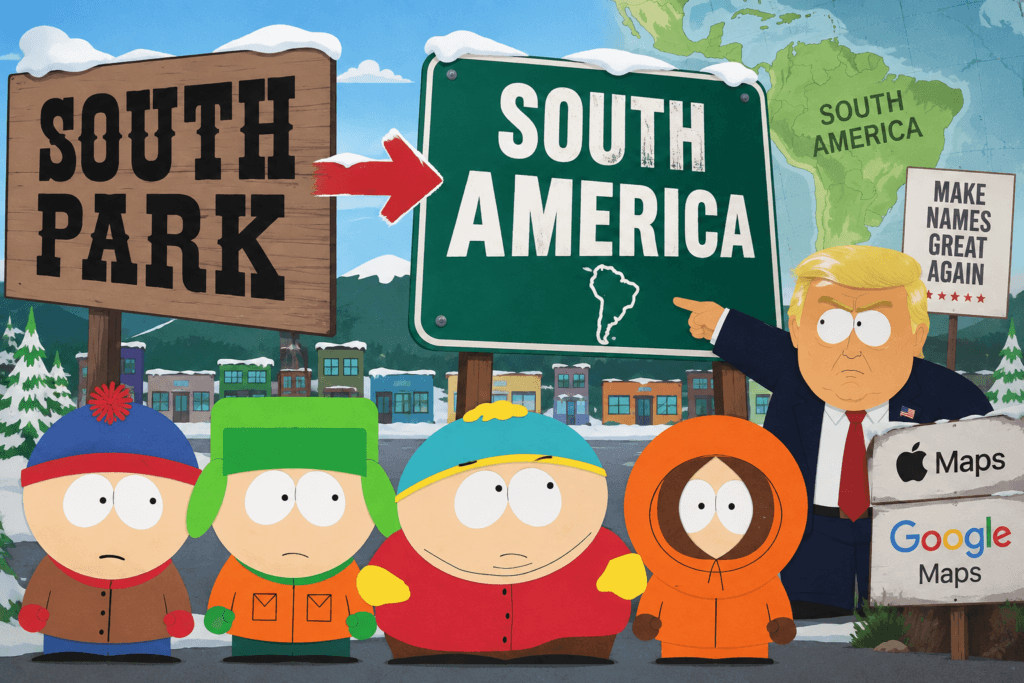
South Park is getting a new name — at least for now. Ahead of Season 29, creators Trey Parker and Matt Stone announced a satirical name change to “SOUTH AMERICA.” The deliberately absurd rebranding comes just days before the show’s September 16 return to Comedy Central.
The announcement follows another major moment for the series. South Park recently won the 2026 Creative Arts Emmy for Outstanding Animated Program, giving the show plenty of attention just before its new season arrives.
Parker and Stone are using the name change as another piece of political satire. The joke draws on recent efforts to change the names of geographic locations in ways that emphasize “America,” while also taking aim at the technology companies that display those names on digital maps.
Rather than simply commenting on those changes, South Park turns the naming controversy into a joke about its own identity. If a familiar geographic name can change for political reasons, the show’s creators are asking what happens when a television series does the same thing.
That makes the South Park “South America” stunt more than a simple promotional move. It transforms a current political controversy into a self-referential joke while setting the tone for Season 29.
Why Did South Park Change Its Name?
Parker and Stone’s decision is fundamentally a satirical move. In their announcement, the creators sarcastically credited Apple and Google for inspiring the change, turning the language surrounding geographic renaming into part of the punchline.
The timing also matters. The announcement arrived shortly before Season 29 premieres, allowing the creators to fold the joke directly into the show’s return.
The move fits South Park’s long-running approach to political comedy. The series regularly targets politicians, corporations and cultural institutions, often combining several subjects in one exaggerated joke. Trump has remained a frequent target as the show has responded to events surrounding his second administration.
The name change also works because it is intentionally self-aware. Instead of giving viewers another fictional character or storyline to explain the joke, Parker and Stone apply the naming controversy directly to the series itself.
For viewers, the key distinction is important: “South America” functions as a satirical name change rather than a conventional rebrand of the series. The show’s identity, characters and upcoming season remain tied to the long-established South Park franchise.
The result is a joke that works on two levels. It references a real political controversy while also poking fun at the idea that changing a familiar name can somehow change the thing itself.
The Trump Connection Behind “South America”
The political reference becomes clearer when viewed alongside President Donald Trump’s recent focus on geographic names.
Trump has promoted changes that put greater emphasis on American terminology. One major example is the U.S. government’s adoption of “Gulf of America” instead of “Gulf of Mexico.” Other naming disputes have also raised questions about how political decisions can influence familiar geographic labels.
That gives Parker and Stone a simple setup for a joke. They take the same basic idea — adding “America” to a familiar name — and apply it to one of television’s most recognizable titles.
The result is “South America.” The phrase already refers to a continent. However, it sounds deliberately absurd as the name of an animated comedy. That contrast forms the core of the joke.
The stunt also allows South Park to mock the broader idea of political renaming. Rather than focusing only on Trump, the series applies the naming logic to its own identity.
That gives the joke a wider appeal. Viewers do not need to agree with Trump’s policies to understand the humor. The absurdity comes from changing a familiar name and expecting people to accept the new one.
Political satire has long been central to South Park. Parker and Stone often take current events and push them to an exaggerated extreme. The “South America” stunt follows that same approach.
With Season 29 approaching, the timing gives the joke even more attention. The name change has arrived just as viewers are turning their attention toward the show’s return.
Why Apple and Google Became Part of the Joke
Apple and Google became part of the story because digital mapping services play a major role in how people encounter geographic names.
Recent U.S. naming changes have therefore created an unusual intersection between politics and technology. When a government adopts a new geographic designation, map platforms can become the place where users actually see that change in everyday life.
Parker and Stone use that connection as another layer of satire. Their announcement sarcastically praises Apple and Google, effectively treating the companies’ handling of geographic names as part of the political spectacle.
The joke then becomes a chain reaction: a political decision changes a geographic label, technology companies reflect the change, and South Park responds by changing its own name.
The creators also aimed their humor at Paramount, their corporate home. Their reference to a “Skydance Capitulation” adds another target and suggests that the announcement is not meant as a narrowly focused joke about Trump alone.
That multi-target approach is typical of South Park. The series often combines politics, corporations and pop culture instead of limiting a joke to one individual.
The result is a deliberately ridiculous premise with several layers. “South America” sounds like a geographic designation, a political slogan and a television title at the same time.
That ambiguity is what makes the stunt effective. Rather than simply telling viewers what to think about a political controversy, South Park turns the controversy itself into a branding joke — and makes its own title the punchline.
What Trey Parker and Matt Stone Said About the Name Change
Trey Parker and Matt Stone presented the name change with the kind of dry, exaggerated humor that has defined South Park for decades. Instead of treating the announcement like a serious corporate rebranding, the creators framed it as a response to the way major companies and institutions handle changing geographic names.
Their statement specifically pointed toward Apple and Google, while also taking a swipe at Paramount. That combination makes the announcement broader than a simple Trump parody. Parker and Stone are mocking the entire ecosystem around political decisions, corporate responses and the public’s reaction to new terminology.
The creators’ approach also keeps the joke deliberately unclear about how seriously viewers should take the new title. “SOUTH AMERICA” is presented as a bold new identity, but the absurdity of applying a continental name to a television comedy makes the satirical intent obvious.
The timing adds another layer. After nearly three decades under its familiar name, the series is suddenly promoting itself with a completely different title just as a new season is about to begin.
That makes the announcement useful as both comedy and promotion. It gives audiences something to discuss before the premiere while reinforcing the show’s willingness to make itself part of the joke.
Rather than separating current events from the show’s marketing, Parker and Stone have combined the two. The result is a publicity stunt that feels closely aligned with South Park’s creative identity: irreverent, topical and deliberately provocative.
South Park Season 29: Premiere Date and What to Know
Season 29 is scheduled to premiere on September 16, 2026, bringing South Park back to Comedy Central for another run of episodes. The official announcement lists a 10 p.m. ET/PT premiere time, followed by additional Wednesday episodes.
The season arrives at an important moment for the franchise. The “South America” announcement has already generated attention online, giving the returning series a fresh promotional hook before the first episode airs.
For viewers in the United States, the key Season 29 details include:
- Premiere: September 16, 2026
- Network: Comedy Central
- Premiere time: 10 p.m. ET/PT
- Streaming: Paramount+
- New episodes: Scheduled for Wednesday nights
The official announcement also provides the initial episode rollout, giving fans a clearer picture of when they can expect the next installments after the premiere.
Importantly, the “South America” branding does not mean viewers need to look for an entirely different series. The upcoming episodes remain part of the established South Park franchise.
For longtime viewers, the most interesting question is therefore not whether the show has actually disappeared under its old name. It is how Parker and Stone will use the name-change joke around the Season 29 launch.
The stunt has already created a recognizable talking point. Now the season itself will determine whether the joke remains primarily a marketing gag or becomes part of the show’s broader political commentary.
Where to Watch South Park Season 29
For U.S. viewers, Season 29 will return through Comedy Central, with new episodes scheduled for Wednesday nights. The official announcement places the premiere at 10 p.m. ET/PT on September 16.
Viewers who prefer streaming can also watch the season through Paramount+. The streaming option gives audiences another way to catch the series without relying solely on the traditional cable broadcast.
The availability is especially relevant for viewers searching for South Park after seeing the “South America” name in headlines. The unusual branding does not create a separate program or require a different viewing platform.
For a quick reference:
| Viewing option | Season 29 availability |
|---|---|
| Comedy Central | New episodes on Wednesday nights |
| Paramount+ | Streaming option |
| Premiere | September 16, 2026 |
| Premiere time | 10 p.m. ET/PT |
The safest way to follow the season is to use the official listings for current episode availability, since streaming schedules and regional access can change.
For now, the important point is straightforward: South Park Season 29 is still South Park, even while the show’s marketing temporarily embraces the joke of calling it “South America.”
Is South Park Really Being Renamed South America?
The short answer is yes for the current Season 29 promotion, but the move is clearly rooted in satire. Trey Parker and Matt Stone announced that South Park would be called “SOUTH AMERICA”, directly connecting the joke to recent geographic renaming decisions.
The creators have even doubled down on the gag. When asked how long the new name would last, Parker and Stone reportedly responded that they were “100% committed to SOUTH AMERICA.” That answer keeps the joke going while leaving the long-term branding question deliberately playful.
For viewers, however, there is no need to search for a completely different series. The franchise remains the same animated comedy created by Parker and Stone, with Season 29 scheduled to premiere on September 16.
The official South Park site still identifies the franchise as South Park, while its latest announcement uses the “SOUTH AMERICA” name-change joke.
So, the safest way to understand the situation is this: “South America” is the show’s latest satirical identity, not evidence that the entire franchise has abandoned the name South Park.
The joke works precisely because viewers know the original name. Without nearly three decades of history behind South Park, changing it to “South America” would not carry the same punch.
How the Name Change Fits South Park’s Political Satire
Political satire has been part of South Park’s identity since its earliest years. The series has built its reputation by taking recognizable political figures, cultural controversies and institutions and pushing them into deliberately ridiculous situations.
The latest name-change stunt follows that formula closely. Instead of creating a fictional political scenario, Parker and Stone have taken a real-world naming controversy and applied its logic to their own television series.
That approach also reflects the show’s willingness to target more than one side or institution at a time. The “South America” joke points toward Trump, but it also pokes at Apple, Google and Paramount.
That broader target list is important because South Park rarely treats political satire as a straightforward endorsement of one viewpoint. Its comedy often comes from exposing the absurdity, hypocrisy or contradictions surrounding an issue.
The current stunt does exactly that. A geographic naming dispute becomes a television-branding joke, while the companies involved become part of the punchline.
The timing makes the satire even more effective. The announcement arrived immediately after the series won the 2026 Creative Arts Emmy for Outstanding Animated Program, an award for an episode that itself took aim at Trump.
Rather than moving away from political comedy after the award, Parker and Stone immediately used another political subject as material.
That makes South Park’s South America stunt feel less like an isolated publicity trick and more like a continuation of the show’s current creative direction.
South Park and Its Ongoing Trump Satire
Trump satire has become a prominent part of South Park’s recent seasons.
The series has used exaggerated versions of Trump and figures from his administration as material for political comedy. Some jokes directly reference current events. Others place political figures in absurd fictional situations.
The show’s recent Emmy-winning episode, “Sermon on the ‘Mount,” offers another example. The episode targeted Trump with provocative humor and helped South Park win Outstanding Animated Program at the 2026 Creative Arts Emmys.
After the win, Parker and Stone kept the political humor going. Their response to Trump, followed by the “South America” announcement, linked the Emmy moment to the show’s ongoing political satire.
That context helps explain the latest name-change stunt.
The “South America” joke did not appear without context. It followed a period of highly visible political comedy and arrived soon after the creators received recognition for that work.
The approach is consistent with the show’s style. South Park takes a major political story, exaggerates its central idea and brings recognizable institutions into the joke.
The creators also target more than Trump. Their references to Apple, Google and Paramount show that the name-change stunt has several targets.
For Season 29, that suggests current events will remain an important source of material. However, the exact political subjects of future episodes should not be treated as confirmed unless the creators or official sources announce them.
Why South Park Keeps Turning Politics Into Comedy
Political stories work well for South Park because they already contain strong material for comedy. They involve public figures, controversy, opposing opinions and fast-moving news.
The series can take a complex political story and turn it into one simple joke. The “South America” stunt is a good example. The basic idea is easy to understand: South Park changes its own name because other names are changing.
That simplicity gives the joke an immediate impact. Viewers can understand the reference without needing a long explanation.
The approach also lets Parker and Stone comment on politics without making a traditional political statement. Instead of telling viewers whether a naming decision is right or wrong, the show exaggerates the idea and applies it to something completely unrelated.
That technique is familiar to South Park fans. The series often takes a real issue and pushes it to an absurd extreme. The resulting contradiction becomes the joke.
This approach also helps the show stay relevant. Political stories can disappear from the news quickly. Satire can give those moments a longer life by turning them into memorable comedy.
The “South America” name works on several levels. It references Trump and recent naming debates. It also targets technology companies and corporate responses. At its core, however, the joke is about the power and absurdity of changing familiar names.
As Season 29 approaches, that ability to turn current events into comedy remains one of South Park’s defining strengths.
Why the South America Joke Matters Beyond the Name
The “South America” gag works because it turns a political naming dispute into a question about branding, language and authority. Instead of simply making another joke about Trump, South Park applies the logic of geographic renaming to itself.
That creates an intentionally strange result. A television series suddenly adopts the name of an entire continent, while its familiar identity remains recognizable to viewers. The contradiction is the joke.
The stunt also shows how political decisions can move beyond government documents and enter everyday technology. Apple and Google have reflected U.S. geographic naming changes in their mapping services, meaning political terminology can quickly become something people encounter on their phones.
That makes South Park’s response particularly timely. The series takes a real-world naming change, exaggerates it and turns the process into entertainment.
There is also a media-business layer. Parker and Stone included Paramount in their announcement, making the joke broader than a presidential parody. Their reference to a “Skydance Capitulation” points toward the corporate environment surrounding the show as well.
Ultimately, the joke asks a simple question: If powerful institutions can change familiar names, what happens when South Park decides to change its own?
The answer is not a serious rebranding strategy. It is satire designed to make the naming controversy look as strange as it can be.
What Viewers Should Expect From South Park Season 29
Season 29 arrives with the series already generating headlines before its first episode airs. The official announcement confirms that the season premieres Wednesday, September 16, 2026, at 10 p.m. ET/PT on Comedy Central, with episodes available the next day on Paramount+ in the U.S., Canada and Australia.
The new season arrives during a busy period for television. Other shows are also keeping viewers engaged with major episode developments, including Lanterns Episode 4.
The announced schedule also includes new episodes on:
- September 30
- October 14
- October 28
- November 11
- November 25
The spaced-out schedule means viewers should not expect a new episode every Wednesday. The official Paramount release confirms the listed dates and the streaming arrangement.
As for the content, viewers can expect the show’s established mix of political satire, celebrity commentary, social criticism and deliberately exaggerated comedy. However, it is important not to treat speculation about specific Season 29 storylines as confirmed information.
The “South America” announcement does provide one clear clue about the season’s opening atmosphere. Current political events remain fertile material for Parker and Stone, and the creators have already demonstrated that they are willing to make the naming controversy part of the show’s promotional identity.
The franchise also remains firmly rooted in its established format. Official materials continue to identify the program as South Park, with the four central characters — Stan, Kyle, Cartman and Kenny — at its core.
So while the branding may say SOUTH AMERICA, viewers are still getting the same irreverent animated series.
The Name Change Could Become Part of the Season 29 Joke
One of the most interesting questions is whether “South America” will exist only as promotional branding or become part of the actual Season 29 storyline.
The official announcement confirms the name change, but it does not establish that the entire season will permanently use “South America” as the show’s in-universe title. That distinction matters because South Park often turns real-world events into story material rather than treating promotional jokes as permanent changes.
The timing does, however, make the possibility worth watching. The name announcement arrived immediately before the September 16 premiere, so the creators have a natural opportunity to extend the joke into the season itself.
If the title appears within the premiere, the joke could become part of the episode’s broader political commentary. If it remains outside the episodes, it can still function effectively as a marketing stunt.
Either way, the name change has already accomplished something important: it has created a recognizable hook for Season 29 before audiences have even seen the new episodes.
That is especially useful for a show approaching its 30th anniversary in 2027. Paramount’s official information notes that South Park debuted on Comedy Central in 1997 and will celebrate three decades on television next year.
For a franchise this established, creating fresh attention without changing its fundamental identity is difficult. “SOUTH AMERICA” gives the creators a simple solution — turn the show’s own name into the latest joke.
Why the Timing Matters for South Park
The name change did not happen in isolation. It followed South Park’s Emmy win for Outstanding Animated Program. That victory gave the series extra attention just before Season 29.
The timing creates a strong promotional moment for the show.
First, South Park received recognition for its political comedy. Soon after, Trey Parker and Matt Stone turned the spotlight toward another political joke involving Trump and the broader debate over geographic names. The “South America” announcement then became part of the conversation around Season 29.
For a long-running series, that kind of attention can be valuable. Instead of relying only on a traditional premiere campaign, South Park has created a news story around its own name.
The strategy also fits the show’s identity. South Park has spent decades turning current events into comedy. This time, the creators have taken the joke further by changing the show’s public-facing name.
That makes the campaign feel less like a standard advertisement and more like an extension of the series itself.
The Emmy win adds another layer to the timing. The award highlighted the show’s political humor, while the “South America” announcement kept that conversation going ahead of the new season.
The result is a memorable setup for Season 29. Before the first episode arrives, South Park has already given viewers something to discuss, share and debate.
What the South Park Name Change Says About the Show
The biggest takeaway may be that South Park remains comfortable making itself part of the joke.
Many television shows use political controversy as story material. South Park has often gone further by allowing its marketing, characters and public image to become extensions of its satire.
The “South America” announcement follows that tradition. It does not simply criticize a political naming decision from the outside. Instead, it pretends to adopt the same logic.
That approach gives the joke an additional layer of self-parody. Viewers know that South Park is not actually a continent, yet the announcement treats the name change as though it were an ordinary institutional decision.
The absurdity becomes the commentary.
It also reinforces one of the show’s most recognizable creative characteristics: very little is considered too established to become a punchline. Even the title itself can be changed if doing so creates a stronger joke.
That is particularly fitting for a series that has survived for almost 30 years by constantly reacting to changing political and cultural conversations. Other TV projects can also attract attention through major franchise changes, including Spider-Noir.
Whether “South America” lasts beyond the Season 29 rollout remains less important than the joke itself. The stunt has already connected the show to a major news story, generated attention ahead of the premiere and reinforced South Park’s reputation for political irreverence.
In that sense, the name change does exactly what good satire is supposed to do: take something familiar, change one fundamental detail and make the audience see the original situation differently.
South Park Name Change FAQs
Why is South Park being called South America?
The “South America” name is a satirical response to recent geographic renaming controversies. Trey Parker and Matt Stone are applying that naming logic to their own show, creating an intentionally absurd title. The joke also targets Apple, Google and Paramount, which the creators referenced in their announcement.
Did South Park permanently change its name?
No. The “SOUTH AMERICA” name is part of the show’s current satire. The creators announced the change as a joke tied to recent debates over geographic names. The official announcement still identifies the series as South Park while using “SOUTH AMERICA” for the gag.
Is South America the name of Season 29?
No. Season 29 remains the 29th season of South Park. “SOUTH AMERICA” is the promotional name associated with the current satirical stunt. The official Season 29 announcement continues to describe the series as South Park.
When does South Park Season 29 premiere?
South Park Season 29 premieres on September 16, 2026, at 10 p.m. ET/PT on Comedy Central. The official announcement also lists additional Wednesday episode dates later in the season.
Where can I watch South Park Season 29?
U.S. viewers can watch new episodes on Comedy Central. The episodes will also be available through Paramount+ the following day, according to the official announcement.
Is the South Park name change related to Trump?
Yes. The joke draws on recent geographic naming decisions associated with President Donald Trump and the broader emphasis on “America” in those names. However, the creators also direct the joke toward technology companies and their own corporate environment, so the satire has multiple targets.
What did Trey Parker and Matt Stone say about the name change?
Parker and Stone announced the new “SOUTH AMERICA” identity in their characteristically sarcastic style. Their statement referenced Apple and Google and included a joke about Paramount’s corporate situation. The creators later reinforced the gag by indicating that they were committed to the new name.
Final Takeaway
South Park has turned its own title into the latest target of its political comedy. By calling the show “SOUTH AMERICA,” Trey Parker and Matt Stone have transformed a real-world debate over geographic names into a self-referential joke.
The stunt works because it does not require a complicated explanation. Viewers recognize South Park, recognize “South America” and immediately understand the absurdity of replacing one with the other.
It also arrives at an ideal moment for the franchise. Season 29 is preparing to premiere on September 16, while the series is still benefiting from the attention surrounding its recent Emmy victory. The name-change joke gives the returning season another talking point before its first episode airs.
For now, viewers should continue searching for South Park when looking for the series. “South America” is the satirical twist, not a separate show.
More importantly, the stunt demonstrates why the series remains culturally relevant after nearly three decades. South Park can take a political controversy, a corporate reference and a familiar phrase, then turn all three into one deliberately ridiculous joke.
And with Season 29 about to begin, the real question is no longer why the show changed its name. It is what Parker and Stone will find next to make fun of.