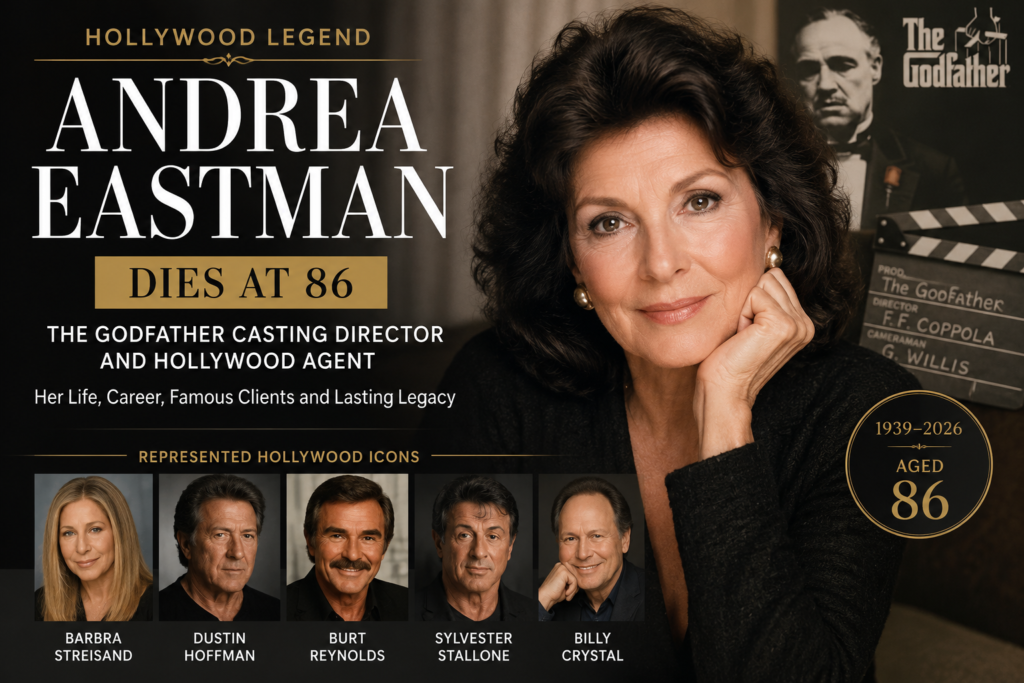
Andrea Eastman Dies at 86: The Godfather Casting Director and Hollywood Agent
Andrea Eastman, the Hollywood casting executive and longtime talent agent whose career helped shape some of the industry’s most recognizable names, has died at 86. Eastman died at her home in Santa Barbara, California, with a career that stretched from Paramount Pictures’ casting department to the upper ranks of International Creative Management. For many movie fans, Andrea Eastman is closely associated with The Godfather. She was part of the casting team behind Francis Ford Coppola’s 1972 classic, a film that introduced or elevated several performers who would become major Hollywood figures. Her work, however, went well beyond one celebrated movie. Eastman also played an important role in bringing Ali MacGraw to Goodbye, Columbus and later built a formidable career representing actors and entertainers. At ICM, she became one of Hollywood’s pioneering female superagents and worked with stars including Barbra Streisand, Dustin Hoffman, Burt Reynolds and Sylvester Stallone. Her professional story is therefore larger than a single casting credit. Eastman’s career crossed several influential areas of the entertainment business, giving her a rare perspective on how Hollywood discovered talent, built careers and turned performers into lasting stars. Andrea Eastman Dies at 86 Andrea Eastman’s death closes a remarkable Hollywood career that lasted for decades and crossed several different eras of the entertainment industry. What Happened to Andrea Eastman Eastman died Wednesday at her Santa Barbara home at the age of 86, according to a family spokesperson. Reports described her as having died in her sleep. Her death was reported in late August 2026, prompting tributes from former colleagues, friends and people whose careers she had helped shape. The news quickly drew attention because of the unusual range of her professional accomplishments. Eastman was not simply a casting executive or an agent. She moved between both sides of the talent business and developed a reputation for recognizing performers with unusual potential. Her work on The Godfather remains one of her most widely remembered contributions. Yet her career also included major casting decisions at Paramount and years of representation work at leading Hollywood agencies. Why Her Death Matters to Hollywood Eastman’s importance comes from the influence she exercised behind the scenes. She helped connect performers with roles, guided established stars and became a powerful advocate for talent at a time when senior positions in Hollywood were overwhelmingly controlled by men. That combination made her career distinctive. She could recognize an unknown performer, understand the commercial value of established stars and negotiate within a rapidly changing entertainment industry. Her legacy consequently reaches beyond the credits attached to individual movies. Who Was Andrea Eastman? Andrea Eastman built a reputation as one of Hollywood’s most influential behind-the-scenes figures, although audiences rarely saw her name on screen. Her Early Hollywood Career Eastman emerged as a casting executive at Paramount during the period often associated with the rise of New Hollywood. The late 1960s and early 1970s brought major changes to American filmmaking, with younger directors, unconventional stories and new performers challenging the established studio system. Eastman proved particularly skilled at identifying talent before audiences knew their names. One early example came with Goodbye, Columbus, the 1969 film adaptation of Philip Roth’s novella. Eastman encountered Ali MacGraw when the future star was still working as a model and helped bring her into the film as Brenda Patimkin. That decision became an early example of Eastman’s eye for performers who could make an immediate impression. MacGraw would soon become one of Hollywood’s most recognizable leading women. Eastman’s casting work also brought her into the orbit of major filmmakers and producers. Those relationships eventually led to her involvement with The Godfather, where her judgment became part of one of cinema’s most consequential casting processes. From Casting to Industry Powerhouse Eastman eventually moved beyond casting and entered talent representation. That transition gave her a different kind of influence. Instead of helping decide who would appear in a production, she began advocating for performers after they entered the industry. She worked at several agencies before rising at International Creative Management, better known as ICM. Her advancement marked an important moment for women in Hollywood. Eastman became one of the industry’s first female superagents, reaching the senior ranks of an agency world that had historically been dominated by men. Her career would soon include representation of some of the biggest names in American entertainment. Andrea Eastman and The Godfather Andrea Eastman’s connection to The Godfather represents the most recognizable chapter of her casting career. Helping Shape the Film’s Central Cast Released in 1972, The Godfather became a landmark of American cinema and established a cast that included Marlon Brando, Al Pacino, James Caan, Robert Duvall and Diane Keaton. Paramount’s official history credits the film with career-making performances, while the movie’s production records list Eastman among its casting personnel. Eastman worked with producer Fred Roos and director Francis Ford Coppola during the casting process. Her contribution became particularly important as the production assembled the actors who would define the Corleone family. Al Pacino’s casting as Michael Corleone became one of the film’s most consequential decisions. Pacino was relatively unestablished at the time, and the choice faced resistance within the studio. Coppola nevertheless continued to push for him. Eastman’s work also connected directly to James Caan’s casting as Sonny Corleone. Caan had impressed during his screen test, and Eastman later took responsibility for securing him for the role. The finished film demonstrated how important those choices were. Pacino’s Michael became the emotional center of the story, while Caan’s Sonny emerged as one of its most memorable supporting characters. Why Her Casting Work Still Matters Casting rarely receives the same public attention as directing, acting or writing. Yet The Godfather illustrates how strongly an actor’s presence can shape a film’s identity. Eastman’s contribution was part of a larger collaborative effort involving Coppola, Roos and other casting professionals. Still, her role gives her an important place in the history of a movie whose performances became cultural touchstones. The Academy Museum’s archival recognition of Eastman’s casting work
Andrea Eastman Dies at 86: The Godfather Casting Director and Hollywood Agent Read More »