
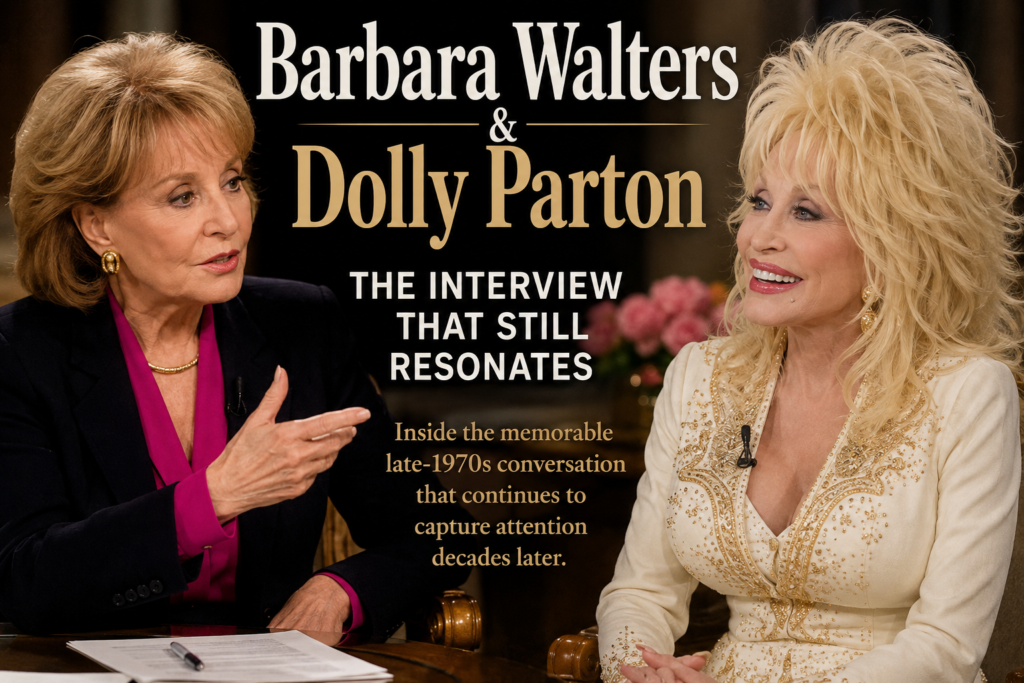
Barbara Walters built her reputation by asking questions that other television journalists sometimes avoided. She could be warm and conversational, yet she could also become direct when a guest gave a carefully prepared answer. That combination made her one of the most recognizable interviewers in American television.
Her conversation with Dolly Parton remains one of the more memorable examples of that approach.
The late-1970s interview brought together two women with very different ways of communicating. Walters wanted to look beyond Parton’s polished celebrity image and examine the person behind it. Parton, meanwhile, understood how quickly an interviewer could shape public perception. She responded with humor, confidence and a strong sense of who she was.
The discussion eventually touched on Parton’s rural upbringing and the word “hillbilly.” That language can sound particularly uncomfortable to modern audiences because the term has often carried class-based stereotypes. However, the exchange becomes more interesting when viewed through Parton’s response rather than through the controversial wording alone.
Instead of rejecting her roots, Parton separated her actual background from the assumptions attached to it. She did not need to deny where she came from to establish her success.
That approach helps explain why the interview continues to attract attention. It was not simply a difficult celebrity interview. The conversation became a revealing moment about identity, class, appearance and the power of controlling your own story.
Why Barbara Walters Was Such a Formidable Interviewer
Barbara Walters developed a style that made even familiar celebrities feel less predictable. Her interviews often moved beyond career achievements and promotional talking points. She wanted to understand what motivated a person, what worried them and how they viewed their own public image.
The Interview Style That Made Walters Famous
Direct questions formed a major part of Walters’ approach. She could challenge a guest’s explanation, return to an uncomfortable subject or ask about something that another interviewer might avoid.
That method sometimes created tension.
Yet tension could make a conversation more revealing. Walters understood that celebrities arrived with polished answers, especially when they were promoting a new project. Her job was to discover what remained after those prepared responses.
This approach became especially noticeable when she interviewed entertainers. Rather than treating fame as a reason to avoid difficult subjects, Walters often treated celebrity status as a reason to examine those subjects more closely.
The technique could produce emotional, surprising or uncomfortable moments. It also helped distinguish Walters from interviewers who focused primarily on friendly promotion.
Her conversation with Parton followed that philosophy. Walters did not simply ask about music. She explored the singer’s upbringing, appearance and carefully developed public persona.
That choice created the tension that eventually made the interview memorable.
Barbara Walters’ Place in Television History
Walters’ importance extends far beyond individual interviews. She joined ABC News in 1976 and became the first woman to anchor an evening news program. Her career later included 20/20, where she became known for major interviews, and The View, the daytime program she helped create.
Those achievements placed her among the most influential women in American television.
Her rise also happened during a period when women faced significant barriers in broadcast journalism. Walters had to establish credibility in an industry that often treated serious news reporting as a male-dominated field.
She eventually built a career that crossed several television formats. Political leaders, entertainers and other major public figures all became subjects of her interviews.
That range is important when considering her conversation with Dolly Parton. Walters did not necessarily separate entertainment interviews from serious journalism. She approached a famous singer with the same instinct that shaped much of her work: ask the question that might reveal something audiences had not heard before.
Her legacy therefore rests not only on the people she interviewed but also on the interviewing culture she helped create.
What Happened When Barbara Walters Interviewed Dolly Parton?
The conversation occurred during an important stage of Dolly Parton’s rise as a national celebrity. Her success in country music had already established her name, while her distinctive appearance and personality were becoming central to her public image.
Parton’s Career Before the Interview
Parton’s story differed from the glamorous image she eventually developed.
She grew up in rural Tennessee in a large family with limited financial resources. Those early experiences later became important sources for her songwriting and storytelling.
Rather than hiding that background after becoming successful, Parton continued to discuss it openly. Her childhood remained connected to the themes of family, poverty, ambition and resilience that appeared throughout her work.
That history gave Walters plenty of material to explore.
Parton was no longer simply a country singer from Tennessee. She had become a recognizable entertainment personality whose appearance, accent and humor were inseparable from the way audiences perceived her.
Walters wanted to understand how much of that image represented the real woman.
Parton’s answer, however, showed that she did not see a conflict between her public persona and her personal identity. The glamorous presentation was something she understood and controlled.
That distinction became increasingly important as the interview moved toward questions about her background.
The Question About Her Background
One of the most discussed parts of the conversation involved the word “hillbilly.” The term connected Parton to her rural Appalachian background, but it also carried negative class associations.
That created an uncomfortable tension.
Parton did not respond as though her upbringing were something shameful. Instead, she acknowledged her origins while resisting the idea that those origins made her less intelligent, ambitious or successful.
Her response reflected a pattern that would remain visible throughout her career. Parton could joke about her background without allowing other people to define its value.
The distinction is subtle but important.
Someone can acknowledge a stereotype without accepting the judgment attached to it. Parton demonstrated that difference during the conversation by treating her roots as part of her identity rather than as an obstacle she needed to erase.
The exchange therefore became larger than a single label.
Walters was examining how Parton’s public image connected to her upbringing. Parton was showing that she could acknowledge the connection while maintaining control over its meaning.
That balance helped turn an uncomfortable question into one of the most memorable aspects of the interview.
The exact interview year also requires caution. Recent accounts have identified the conversation as either 1977 or 1978, so the article refers to it as a late-1970s interview rather than treating the conflicting dates as definitively settled.
Dolly Parton’s Response Changed the Direction of the Conversation
The most memorable part of the Barbara Walters interview was not simply the difficult questions. Dolly Parton’s responses gave the conversation its lasting character. Instead of becoming defensive, she used humor, confidence and self-awareness to explain how she viewed her background and public image.
Parton Understood Her Public Image
By the time of the interview, Parton had already developed an unmistakable public persona. Her blonde wigs, glamorous clothing, makeup and playful personality attracted considerable attention.
Walters questioned whether that appearance reflected the real woman behind the celebrity image. Parton, however, understood exactly what her appearance communicated.
The glamorous style was part of her entertainment identity, but it did not represent everything about her. Her songwriting ability, ambition and personality remained equally important to her career.
That awareness allowed Parton to discuss her appearance without sounding embarrassed by it. She knew people would notice the spectacle, but she also understood that attention could introduce audiences to her larger body of work.
Rather than treating her image as a contradiction, Parton presented it as a deliberate choice. That confidence helped her remain composed when Walters examined the difference between the performer and the person.
Parton Did Not Reject Her Appalachian Roots
Parton’s rural Tennessee upbringing was another important part of the discussion. She came from a large family with limited financial resources, and those early experiences later influenced her songwriting and storytelling.
Success did not make her abandon that history.
Throughout her career, Parton continued to speak about her childhood and the people who shaped her. Family, poverty, rural life and ambition became recurring themes in her work.
Her public identity therefore contained an interesting contrast. She could embrace glamorous fashion while remaining proud of her modest beginnings. The two sides did not have to conflict.
That perspective helped Parton avoid a common celebrity trap: believing that success requires distance from one’s origins.
For her, the opposite was often true. Her background gave her stories, memories and experiences that audiences could recognize.
The Walters interview brought that attitude into focus. Parton could discuss where she came from without treating it as something that reduced her status.
She Reframed What “Hillbilly” Meant
The word “hillbilly” remains one of the most discussed elements of the interview because it can carry different meanings.
The term may refer to rural Appalachian or Southern culture, but it has also been used as a dismissive label connected to class and stereotypes.
Parton’s response was significant because she did not appear ashamed of her origins. Instead, she separated the reality of her upbringing from the negative assumptions that others might attach to it.
That approach changed the direction of the conversation.
Rather than allowing the label to define her, Parton placed it within a much larger story about family, ambition and success. Her career itself challenged the idea that rural origins represented a limitation.
Humor also played an important role. Parton often used self-awareness to acknowledge jokes about her background without accepting the judgment behind them.
The distinction is powerful. A person can recognize a stereotype while refusing to let that stereotype determine their identity.
Parton’s response demonstrated exactly that kind of confidence.
Barbara Walters’ Question About Dolly Parton’s Imagination
The conversation also explored Parton’s imagination and the relationship between her real life and her elaborate public persona.
Parton’s Fairy-Tale Answer
Parton had always possessed a strong storytelling instinct. Her songs transformed personal experiences into narratives, while her stage image added a theatrical quality to her public identity.
When the discussion turned toward imagination, she did not treat the concept as something negative.
Instead, Parton embraced it.
Her description of her life as something resembling a fairy tale reflected the extraordinary distance between her childhood and later success. She grew up with limited resources but imagined a much bigger future for herself.
That dream eventually became reality through years of songwriting, performing and hard work.
For Parton, imagination was therefore more than fantasy. It was a way of seeing possibilities before they became achievable.
Her career illustrates that idea clearly. She moved from rural Tennessee into country music, established herself as a songwriter and performer, and later expanded into acting, business and philanthropy.
The fairy-tale idea also revealed something about how Parton understood ambition. Dreams did not make her unrealistic. They gave her a direction.
That perspective allowed her to turn another potentially difficult question into an expression of optimism and confidence.
What Dolly Parton Later Said About Barbara Walters
Looking back at the interview only through its most uncomfortable moments can create an incomplete picture. Parton’s later reflections provide additional context about how she viewed Walters.
Parton’s Initial Concerns
Parton reportedly knew that Walters had a reputation for difficult interviews before agreeing to appear. That reputation meant she could expect direct questions rather than a conventional promotional conversation.
Even with that warning, Parton accepted the interview.
Her decision showed confidence in her ability to discuss her life and career under pressure. She did not need every question to be comfortable because she understood her own story.
That confidence became important once the conversation moved toward her appearance and background.
Instead of reacting defensively, Parton generally used humor and explanation to guide the discussion back toward her own perspective.
The strategy allowed her to maintain control without turning the interview into an obvious confrontation.
It also provides useful context when the conversation is described today as though Walters simply attacked Parton. The interaction was more complicated than that.
Walters was known for challenging guests, while Parton was skilled at handling difficult questions.
Their contrasting styles created the tension that made the interview memorable.
Her Later View of Walters
Parton’s later perspective adds another layer to the story. Rather than treating Walters as someone she permanently disliked, accounts of Parton’s reflections suggest that she eventually recognized the journalist’s ability to see beyond her public image.
That detail changes the way the original interview can be interpreted.
Walters could be persistent without the encounter becoming a lasting personal feud. Parton could feel challenged while still respecting the interviewer who challenged her.
Their relationship therefore appears more nuanced than a simple story of conflict.
The distinction is particularly important when older interviews resurface online. Short clips can remove the surrounding conversation and make a complicated interaction appear more hostile than it was.
Parton’s later comments provide some of that missing context.
Walters wanted to uncover the person behind the celebrity persona. Parton responded by showing that the persona and the person were not necessarily opposites.
Her glamorous image could coexist with her rural roots. Humor could coexist with ambition. A difficult childhood could coexist with extraordinary success.
That complexity ultimately made the interview more revealing.
The conversation showed Walters doing what she did best: asking questions that tested a public image. It also showed Parton doing what she did best: answering those questions without surrendering control of her identity.
Was Barbara Walters Really Insulting Dolly Parton?
The Barbara Walters–Dolly Parton interview is often remembered because some of Walters’ questions feel uncomfortable when viewed through a modern lens. However, describing the entire exchange as a deliberate insult would go further than the available evidence allows.
Walters had built her reputation on direct questioning. She frequently explored subjects that celebrities might rather avoid, especially when those subjects involved appearance, relationships, personal history or public perception. The tension was often part of the interview rather than evidence of personal hostility.
Why the Exchange Can Feel Uncomfortable Today
The discussion of the word “hillbilly” is the clearest example.
The term can describe a cultural connection to rural Appalachian or Southern communities. At the same time, it has also been used as a class-based insult. Because of that history, modern viewers may hear the word differently from audiences who watched the interview when it originally aired.
Parton’s response makes the moment particularly interesting.
She did not appear ashamed of her rural background. Instead, she acknowledged where she came from while separating that reality from the negative assumptions sometimes attached to it.
The distinction matters because a difficult question and an intentionally insulting question are not necessarily the same thing.
Walters was testing Parton’s public image. Parton was deciding how that image should be understood.
That dynamic explains why the exchange remains worth examining decades later.
Why the Context Matters
Television interviews reflect the standards and expectations of their time. Language, cultural attitudes and ideas about celebrity have all changed considerably since the late 1970s.
Modern viewers therefore bring a different perspective to an older interview.
Walters’ professional reputation provides important context. She became known for asking questions that could make even famous guests uncomfortable. Her objective was often to move beyond prepared promotional answers and discover something more personal or revealing.
That method could produce tense moments.
With Parton, the approach encountered a particularly media-savvy guest. Parton already understood that her appearance, accent and rural background shaped public perception. She had also learned how to use humor when people made assumptions about her.
As a result, Walters could frame a question, but Parton could reshape its meaning through her answer.
That difference prevents the interview from fitting neatly into a story about an interviewer attacking a celebrity.
A more balanced interpretation recognizes two things at once: some of the language can sound dismissive today, while the evidence does not establish that Walters deliberately set out to humiliate Parton.
Parton’s later positive assessment of Walters also adds another layer to the story. It suggests that the interaction should not automatically be treated as the beginning of a lasting personal dispute.
Barbara Walters’ Interviewing Style Versus Dolly Parton’s Communication Style
The contrast between Walters and Parton helps explain why the conversation became so memorable. Each woman exercised control in a different way.
Walters controlled the questions and the direction of the interview. Parton controlled the interpretation of those questions through her answers.
Walters Pressed for the Person Behind the Image
Walters often looked beyond a celebrity’s public presentation. She wanted to understand what existed beneath the polished image that audiences already knew.
That approach made sense with Parton.
Her public persona was unusually distinctive. The blonde wigs, elaborate clothing, humor and unmistakable Southern accent immediately communicated a particular image.
Walters questioned what that image represented.
Was it simply an entertainment character? Did it reflect Parton’s real personality? Could someone who presented herself in such an exaggerated way also be taken seriously?
Those questions went beyond music.
Walters was effectively asking the audience to consider whether the performer and the persona were the same person.
Parton’s answers suggested that there was no need to choose between the two.
She could enjoy glamour while remaining connected to her roots. She could use humor without lacking intelligence. She could build an exaggerated stage image while remaining completely aware of what that image was doing for her career.
That complexity made Walters’ questions more interesting, but it also gave Parton plenty of room to explain herself.
Parton Turned Pressure Into Control
Parton’s communication style relied heavily on humor and confidence.
Instead of responding to uncomfortable questions with anger, she often softened the moment and then redirected the conversation. That strategy allowed her to remain entertaining while still making her position clear.
Her approach was particularly effective because she understood the value of self-awareness.
Parton knew that people noticed her appearance. She knew that her accent attracted attention. She also knew that her rural background could become an easy source of stereotypes.
Rather than pretending those things did not exist, she incorporated them into her public identity.
That gave her an unusual advantage.
An interviewer could point toward a stereotype, but Parton could decide whether the stereotype would define her. Her answers repeatedly suggested that she understood the joke without accepting the judgment behind it.
This communication style became one of the reasons audiences connected with her.
Parton rarely needed to announce that she was confident. Her ability to remain composed when challenged demonstrated it.
The contrast with Walters was therefore not simply interviewer versus guest.
Walters created pressure through questions.
Parton answered that pressure with control.
Why Dolly Parton’s Response Became More Important Than the Question
A provocative question may create the moment, but a memorable answer determines whether the moment lasts.
Parton’s responses have remained interesting because they did more than defend her against a particular description. They challenged the assumption that success required her to distance herself from her origins.
Turning a Stereotype Into a Story
Parton’s background became part of the story she told about herself.
Her childhood in rural Tennessee provided material for songs and memories, but she did not present those experiences merely as obstacles she had overcome. They remained connected to her understanding of family, ambition and personal values.
That perspective changed the meaning of the conversation.
A label such as “hillbilly” could be used to suggest limitation. Parton’s career offered a different interpretation. Her rural identity could coexist with extraordinary ambition, business ability, songwriting talent and international fame.
She did not need to erase one part of herself to prove the other.
That idea gives the interview a significance beyond celebrity gossip.
Parton demonstrated that people can acknowledge where they came from without allowing others to determine what those origins mean.
Her response also illustrates why stereotypes can lose their power when the person being described refuses to accept the assumptions attached to them.
Instead of fighting the label directly, Parton placed it inside a much larger story.
Her story was not about being a “hillbilly” who escaped her roots.
It was about becoming successful while continuing to claim those roots as part of who she was.
Confidence Without Confrontation
Parton’s most effective response was not anger.
It was composure.
She did not need to attack Walters to defend herself. Humor gave her space to respond, while confidence allowed her to remain comfortable with parts of her identity that others might have treated as embarrassing.
That combination made the exchange unusually effective.
Parton showed that resistance does not always have to look aggressive. Sometimes it can take the form of a calm answer that refuses to accept the premise behind a question.
The technique has broader relevance.
Public figures regularly encounter questions that contain assumptions about their appearance, background, success or personal choices. A defensive reaction can allow the assumption to dominate the conversation.
Parton’s approach offered another option.
Answer the question, but define yourself in the process.
That principle became increasingly important as celebrities gained more control over their own public narratives. Parton had already developed that skill during an era when television interviews gave journalists much more control over how a celebrity’s story reached the public.
Her ability to maintain that control without social media or direct-to-audience platforms makes the exchange particularly striking.
Walters asked the difficult questions.
Parton demonstrated that the person answering could still control the story.
Barbara Walters’ Legacy Beyond the Dolly Parton Interview
The Dolly Parton conversation represents only one part of Barbara Walters’ extraordinary television career. Her influence came from decades of reporting, interviewing and creating programs that changed how audiences engaged with major public figures.
Breaking Barriers in Television News
Walters’ career became historic long before her celebrity interviews attracted attention. She joined ABC News in 1976 and became the first woman to anchor an evening news program.
Her move into that role represented an important moment for women in American broadcast journalism. At a time when television news remained heavily male-dominated, Walters established herself as a serious journalist and interviewer.
Earlier in her career, she had also become the first female co-host of NBC’s Today. Those achievements helped establish a path for women who followed her into television news.
Walters did not remain limited to one format. Her career eventually included political interviews, international affairs, entertainment and long-form conversations.
That range became one of her greatest strengths.
She could interview a world leader one day and a major entertainer the next while maintaining the same basic philosophy: ask questions that reveal something beyond the public image.
The Interviews That Defined Her Career
Walters became particularly famous for asking questions that other interviewers might avoid.
Her conversations frequently explored relationships, family, personal fears, controversies and the difference between a public persona and private reality. Those subjects could make guests uncomfortable, but they also produced memorable television.
The same approach appeared in her interview with Dolly Parton.
Walters did not focus exclusively on Parton’s music career. Instead, she examined the singer’s appearance, upbringing and public identity.
That method was consistent with Walters’ broader reputation. She wanted audiences to understand the person behind the celebrity.
Her interview history included major political and cultural figures as well as entertainers. Conversations with presidents, international leaders and celebrities demonstrated the extraordinary level of access she developed during her career.
The approach helped transform the television interview into something more substantial than promotion.
Walters’ questions could challenge a guest’s assumptions, but the answers often revealed why that person had become interesting to audiences in the first place.
The View and Barbara Walters’ Lasting Influence
Walters expanded her television legacy when she helped create The View in 1997. The daytime program brought women with different backgrounds and viewpoints together to discuss politics, entertainment, culture and current events.
Creating a New Kind of Television Conversation
The format differed from Walters’ traditional interview work.
Instead of one journalist questioning one guest, The View relied on conversation among multiple hosts. Disagreement, personality and differing opinions became part of the program’s appeal.
Walters understood that television audiences could be interested in discussion as much as traditional reporting.
Her involvement with the program also demonstrated how her career continued to evolve. She had already broken barriers in broadcast news, but The View gave her another opportunity to influence the way women and public issues were represented on daytime television.
The program eventually became a significant part of American television culture.
Walters remained connected to The View after ending her regular on-air role. Her influence continued through the format she helped establish and the generations of television personalities who followed.
A Career That Changed Television
Walters’ achievements extended across several decades and television formats.
She became a major news anchor, a respected interviewer and a creator of a successful daytime program. Her career demonstrated that a woman could occupy multiple influential positions within an industry that had once offered women far fewer opportunities.
Her interviewing legacy was particularly important.
Walters showed that a television interview could be both entertaining and revealing. A celebrity’s career might attract viewers, but personal questions could keep them watching.
That philosophy influenced later interviewers and helped establish the style of probing celebrity conversation that remains common today.
Her legacy also helps explain why the Dolly Parton interview continues to attract attention.
The conversation was not an isolated moment. It reflected the interviewing method Walters had developed throughout her career.
She wanted to move beyond the obvious story.
Parton gave her an unusually confident subject who understood how to turn difficult questions into opportunities for self-definition.
Why the Barbara Walters–Dolly Parton Interview Matters in 2026
The renewed interest in the interview comes from a very different cultural environment than the one in which it originally aired.
A Different Generation Is Rewatching the Conversation
Older television interviews can take on new meaning when they resurface through online clips and social media.
Modern viewers often encounter only a short portion of a much longer conversation. Without the original context, an exchange can appear more confrontational or simplistic than it actually was.
The Walters–Parton interview illustrates that problem.
Today’s audiences are also more sensitive to discussions involving class, appearance and cultural identity. Words that were commonly used decades ago can carry different meanings for contemporary viewers.
Parton’s response remains especially relevant because she demonstrated how a public figure can acknowledge an uncomfortable description without allowing it to define her.
That approach feels familiar in today’s celebrity culture.
Modern entertainers frequently manage their own public narratives through social media, podcasts and direct communication with fans. Parton had already developed a similar ability through television interviews, songwriting and her carefully maintained public persona.
The Interview Also Shows How Television Has Changed
The relationship between journalists, celebrities and audiences has changed dramatically since the late 1970s.
During Walters’ era, major television networks controlled much of the public conversation. A celebrity appearing on a prominent interview program could reach millions of people through a single broadcast.
Today, entertainers have many more ways to communicate directly with audiences.
Social platforms, podcasts, livestreams and personal websites allow public figures to respond to stories without depending entirely on traditional media.
That difference makes Parton’s performance in the Walters interview even more interesting.
She did not have social media available as a tool for correcting assumptions or explaining her personality. Instead, she relied on the interview itself.
Humor, confidence and careful answers became her method of narrative control.
The conversation therefore provides an early example of a skill that has become increasingly important in modern celebrity culture: understanding how to participate in media without allowing the media to completely define you.
What the Interview Reveals About Celebrity Interviews
The Barbara Walters and Dolly Parton conversation also provides a useful lesson about how celebrity interviews work.
A memorable interview does not always need to be comfortable. Some of the strongest conversations contain tension because the interviewer is trying to move beyond predictable answers.
Interviewers Shape the Conversation
The interviewer controls the questions, topic changes and overall direction of the discussion.
Walters understood that power. Her questions could introduce subjects that a celebrity might not have chosen to discuss independently.
That influence means interviewers play an important role in shaping how audiences understand public figures.
However, control does not belong entirely to the interviewer.
A skilled guest can challenge the assumptions behind a question while still answering it. Parton demonstrated that ability throughout the conversation.
Her responses showed that an interviewer could raise an issue without determining its final meaning.
That balance is one reason the interview remains compelling.
Walters controlled the framework.
Parton controlled much of the interpretation.
Celebrities Have Learned to Control Their Own Narratives
Parton’s approach also anticipated a major change in celebrity culture.
Modern entertainers can communicate directly with fans and explain their choices without relying entirely on television journalists. Social media has made personal narrative management much easier.
Yet Parton developed many of those skills before digital platforms existed.
Her songs told stories about her life. Her interviews explained her perspective. Her humor allowed her to address stereotypes without becoming defined by them.
The result was a remarkably consistent public identity.
That consistency helps explain her longevity.
Parton’s ability to combine glamour, humor, rural roots and professional ambition created a persona that audiences could recognize immediately.
The Walters interview captured that strategy in action.
The journalist asked questions designed to examine the celebrity image. Parton responded by explaining the person behind that image without abandoning the persona itself.
That remains the central lesson of their conversation.
A question can frame a story, but a confident subject can still decide what that story means.
Why the Barbara Walters–Dolly Parton Interview Still Matters
The Barbara Walters and Dolly Parton interview remains relevant because it captures more than a difficult celebrity conversation. It shows how television once approached questions about class, appearance and personal identity.
Walters represented an era when major interviewers had significant control over how celebrities presented themselves to television audiences. Parton represented a different kind of power: the ability to understand your own story and decide what other people’s assumptions should mean.
That contrast makes the interview worth revisiting.
A Conversation About Identity and Success
Parton’s success did not require her to hide her rural Tennessee upbringing. Instead, she incorporated her childhood experiences into her music, stories and public personality.
Her response to questions about her background therefore carried a broader message. A person’s origins can explain part of their story without determining their intelligence, ambition or future.
That idea remains relevant today.
The interview also demonstrates how cultural language changes over time. Terms that once appeared casually on television can sound very different to contemporary audiences.
Rather than judging the entire conversation through one phrase, it is more useful to examine how both women handled the exchange.
Walters asked challenging questions.
Parton responded by defining herself on her own terms.
Why Parton’s Response Has Endured
A provocative question can create a memorable television moment, but a strong answer often determines whether that moment survives.
Parton’s response remains interesting because she did not simply reject discussion of her background. She acknowledged her roots while refusing to treat them as a source of shame.
That approach became a recurring feature of her career.
Her music frequently drew from family, childhood and rural life. Those experiences were not presented merely as problems she had escaped. They became part of the story behind her success.
Parton’s ability to embrace both glamour and rural identity also challenged simple stereotypes.
She could be highly polished while remaining connected to her origins. The combination became part of her appeal rather than a contradiction.
That is one reason the old interview continues to resonate.
What the Interview Teaches About Handling Stereotypes
The conversation offers a broader lesson about stereotypes and personal identity.
Labels can simplify complicated people. A celebrity may become known for a particular appearance, accent, background or personality trait until everything else disappears behind that single description.
Parton repeatedly resisted that kind of reduction.
Owning Your Background Without Being Defined by It
Parton never needed to pretend that her childhood was wealthy or privileged. She openly discussed growing up with limited resources.
At the same time, she did not allow poverty or rural origins to become definitions of her worth.
That distinction is important.
Someone can acknowledge difficult circumstances without accepting the idea that those circumstances make them inferior.
Parton’s career became a powerful example of that principle. Her origins remained visible, but they did not prevent her from becoming a successful songwriter, performer, actress, businesswoman and philanthropist.
The Walters interview captured an early version of that philosophy.
Parton could discuss where she came from while making it clear that her background did not determine how audiences should judge her.
Turning Perception Into Personal Branding
Parton also understood the relationship between perception and entertainment.
Her distinctive appearance immediately attracted attention. The wigs, clothing, makeup and humor became recognizable elements of her persona.
However, she did not allow those features to become the entire story.
Her songwriting and personality gave the image substance.
That combination became a form of personal branding long before social media transformed celebrity marketing. Parton understood that audiences could be drawn in by a memorable appearance, but they would stay interested because of the person and talent behind it.
The Walters interview provides an early example of that strategy.
Walters questioned the image.
Parton explained why the image existed.
That distinction helped her maintain control over her public identity.
Barbara Walters and Dolly Parton: The Lasting Takeaway
The most useful way to remember the interview is not as a contest between Walters and Parton.
It was an encounter between two highly skilled communicators.
What Walters Brought to the Interview
Walters brought curiosity, persistence and a willingness to ask uncomfortable questions.
Those qualities became central to her reputation. She often looked beyond prepared celebrity answers and tried to uncover the person behind the public image.
Her questions could create tension, but that tension was part of the method.
With Parton, Walters encountered a guest whose public identity was already carefully developed. That made the conversation particularly interesting because the journalist was examining an image that the celebrity herself understood extremely well.
Walters’ role was to challenge.
Parton’s role was to respond.
The resulting exchange demonstrated why Walters became such a significant television interviewer.
What Parton Brought to the Conversation
Parton brought humor, confidence and an unusually strong understanding of her own identity.
She did not need to reject every difficult question. Instead, she could acknowledge the issue and then redirect its meaning.
That ability gave her considerable control over the conversation.
Her rural background could be discussed without becoming a weakness. Her appearance could be examined without becoming the whole story. Her imagination could be presented as ambition rather than fantasy.
Parton’s responses therefore did more than answer Walters.
They reinforced the identity she had built throughout her career.
The exchange remains memorable because both women demonstrated professional strengths that complemented one another.
Walters knew how to ask the difficult question.
Parton knew how to answer it without losing herself.
Frequently Asked Questions About Barbara Walters and Dolly Parton
What did Barbara Walters ask Dolly Parton?
Barbara Walters questioned Dolly Parton about her public image, appearance and rural upbringing. The conversation included discussion of the term “hillbilly” and explored how Parton viewed the relationship between her background and celebrity persona.
How did Dolly Parton respond to Barbara Walters?
Parton responded with humor, confidence and self-awareness. Rather than rejecting her rural background, she acknowledged her roots while resisting the negative assumptions that could be attached to them.
Was Barbara Walters insulting Dolly Parton?
Some questions can sound uncomfortable to modern audiences, particularly the discussion surrounding “hillbilly.” However, the available accounts do not establish that Walters deliberately intended to humiliate Parton. Her broader reputation was based on asking direct and challenging questions.
Did Dolly Parton dislike Barbara Walters?
The relationship appears more nuanced than a simple celebrity feud. Later accounts of Parton’s reflections indicate that she recognized Walters’ interviewing ability and did not simply regard her as an enemy.
When did Barbara Walters interview Dolly Parton?
Accounts differ on the exact year, with some identifying the interview as 1977 and others as 1978. Because of that discrepancy, describing it as a late-1970s interview is the safest approach unless a definitive archival broadcast record establishes the exact date.
Why is the interview discussed again?
Renewed interest in Parton’s life and career has encouraged audiences to revisit older interviews. The conversation also remains relevant because it touches on class, cultural identity, appearance and the ability of public figures to control their own narratives.
What made Barbara Walters famous?
Walters became famous for her groundbreaking television journalism and direct interviewing style. She broke important barriers for women in broadcast news and became associated with programs including 20/20 and The View.
What is the main lesson from the interview?
The central lesson is that an interviewer can frame a question, but the guest can still control the meaning of the answer. Parton’s confidence allowed her to discuss difficult subjects without surrendering control of her identity.