
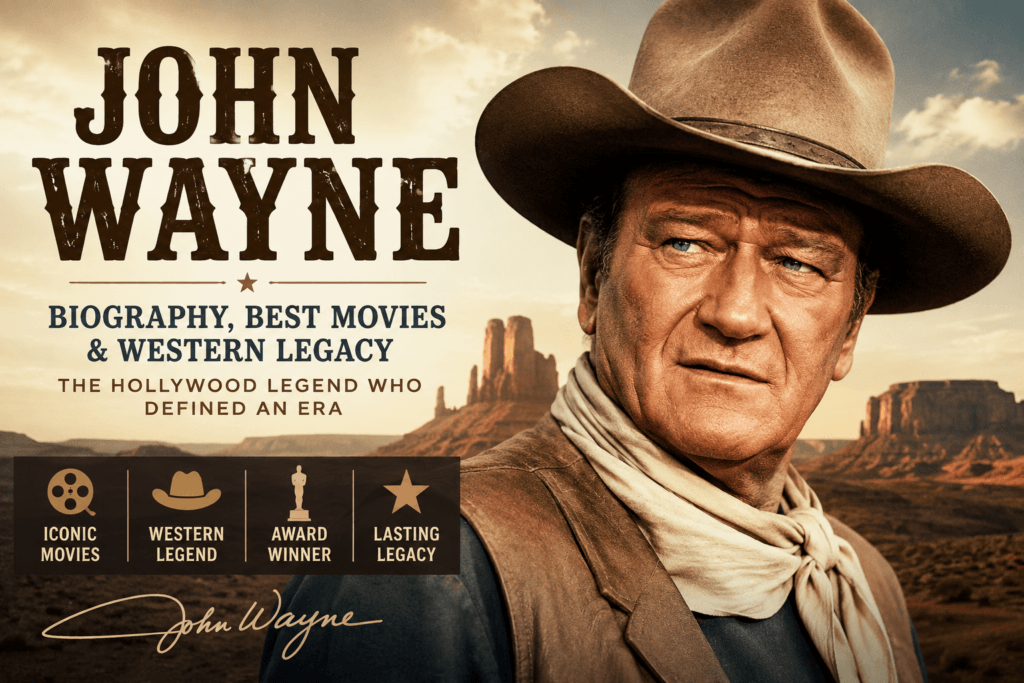
John Wayne: Why the Hollywood Legend Still Captivates Audiences
More than four decades after his passing, John Wayne remains one of the most recognizable names in American cinema. His image is closely tied to the Western genre, rugged individualism, and classic Hollywood storytelling. Whether people remember him as a fearless cowboy, a military hero on screen, or a cultural icon, his influence continues to shape film discussions across generations.
Interest in John Wayne has grown again in 2026. New streaming releases, classic movie restorations, anniversary celebrations, and conversations about Hollywood history have introduced his work to younger audiences while longtime fans continue revisiting his most famous performances.
Unlike many stars whose popularity fades over time, Wayne’s legacy continues because his films represent an important chapter in American entertainment. His performances helped define an era when Westerns dominated theaters, and his career offers a fascinating look at how Hollywood evolved throughout the twentieth century.
This guide explores the life, career, biggest movies, lasting influence, and continued relevance of John Wayne, providing both longtime fans and first-time viewers with a complete overview of one of cinema’s greatest legends.
Quick Facts About John Wayne
| Category | Details |
|---|---|
| Full Name | Marion Robert Morrison |
| Popular Name | John Wayne |
| Nickname | The Duke |
| Birth | May 26, 1907 |
| Birthplace | Winterset, Iowa, USA |
| Raised In | Southern California |
| Occupation | Actor, Producer, Director |
| Active Years | 1926–1976 |
| Total Films | More than 170 |
| Best Known For | Western and war films |
| Academy Award | Best Actor for True Grit |
| Signature Image | Cowboy hat, boots, confident walk |
| Legacy | One of Hollywood’s most influential stars |
Why John Wayne Is Trending in 2026
Although John Wayne has not appeared in a film for decades, his name regularly returns to entertainment headlines. Several factors continue driving renewed interest in his remarkable career.
Streaming platforms have made classic Westerns easier to watch than ever before. Many viewers who never experienced these movies in theaters are now discovering them from home. As a result, discussions about Wayne’s performances frequently appear across social media and movie communities.
As streaming platforms continue bringing classic and modern films to new audiences, both timeless Westerns and today’s blockbuster releases are finding fresh viewers across generations.
Film critics also continue publishing updated rankings of the greatest Western films ever made. Many of Wayne’s classics consistently earn top positions, reminding audiences why his work still matters.
Collectors, historians, and film preservation organizations have also restored several classic titles in higher resolutions, allowing modern audiences to appreciate cinematography and performances with improved picture quality.
Anniversary celebrations for iconic movies have further renewed interest, while documentaries examining Hollywood’s Golden Age continue introducing John Wayne to younger generations.
The Early Life of John Wayne
Growing Up Before Hollywood
Long before becoming an international movie star, John Wayne was born as Marion Robert Morrison in Iowa before moving with his family to California during childhood.
Growing up in Southern California placed him close to the rapidly expanding motion picture industry. At the time, Hollywood was transforming into the world’s filmmaking capital, although few could have predicted that Morrison would eventually become one of its biggest stars.
He enjoyed outdoor activities, sports, and academics. Friends often described him as hardworking, disciplined, and determined—qualities that later became central to his on-screen image.
Education and Athletic Dreams
Before acting became his career, Wayne hoped athletics would shape his future.
He attended the University of Southern California (USC), where he played football. Coaches admired his physical strength and leadership, and many believed he could build a successful athletic career.
However, injuries and financial challenges changed his direction. Instead of continuing sports, he began working around movie studios, performing small production jobs while gradually learning how films were made.
That unexpected career change ultimately led him toward acting.
How John Wayne Entered Hollywood
Breaking into Hollywood was not easy.
Like many aspiring actors, Wayne started with small appearances that often went unnoticed. During the silent film era, he worked as an extra, moved equipment, and assisted production crews while observing experienced actors and directors.
These early years became an informal education in filmmaking.
Rather than gaining overnight success, Wayne spent years developing his screen presence. He learned camera positioning, action choreography, dialogue delivery, and audience expectations.
Eventually, filmmakers recognized his height, confidence, and distinctive appearance, believing he possessed the qualities needed for leading roles.
John Wayne and the Road to Stardom
Early Leading Roles
The transition from background performer to leading man happened gradually.
Wayne appeared in several lower-budget productions that allowed him to gain valuable experience. Although these films did not immediately make him a household name, they helped him become comfortable carrying entire stories.
Directors appreciated his reliability and willingness to perform physically demanding scenes.
Audiences also responded positively to his calm confidence and natural charisma.
The Breakthrough That Changed Everything
Every legendary career includes one defining turning point.
For John Wayne, that breakthrough arrived when he starred in a major Western that dramatically expanded his reputation.
The film demonstrated that Wayne possessed far more than an impressive physical presence. He could portray determination, vulnerability, leadership, and quiet strength while carrying emotionally engaging stories.
Its success opened the door to decades of starring roles across Hollywood.
Soon afterward, Wayne became one of the industry’s most bankable actors.
Why John Wayne Became the Face of Western Movies
Many talented actors appeared in Westerns throughout Hollywood history.
Yet John Wayne became almost synonymous with the genre itself.
Several factors explain this lasting association.
A Distinctive Screen Presence
Wayne projected confidence without appearing rushed.
His deliberate movements, recognizable voice, and commanding posture created characters who felt dependable under pressure.
Audiences believed he could lead wagon trains, defend frontier towns, or protect families simply through his calm demeanor.
That authenticity distinguished him from many contemporaries.
Memorable Characters
Rather than portraying identical heroes in every movie, Wayne often explored different personalities.
Some characters displayed patience and wisdom.
Others struggled with personal loss, revenge, or moral conflict.
This variety allowed audiences to remain invested throughout his long career.
Strong Partnerships with Directors
Wayne collaborated with several influential filmmakers whose storytelling complemented his acting style.
These partnerships produced visually striking Westerns featuring memorable landscapes, emotional narratives, and unforgettable performances.
Together, they elevated the genre beyond simple action stories into complex dramas exploring courage, justice, loyalty, and sacrifice.
John Wayne Beyond Western Films
Although Westerns defined much of his reputation, John Wayne enjoyed success across multiple genres.
His filmography includes:
- Military dramas
- Adventure films
- Historical epics
- Romantic stories
- Family entertainment
- Action movies
This diversity demonstrated that audiences appreciated Wayne regardless of setting.
Whether portraying military officers, explorers, ranchers, or lawmen, he consistently delivered performances built on confidence and determination.
As Hollywood expanded into new genres during the mid-twentieth century, Wayne adapted while maintaining the qualities audiences expected from him.
The Qualities That Made John Wayne Unique
Hollywood has produced thousands of actors.
Only a small number become enduring cultural symbols.
Several characteristics helped John Wayne achieve that status.
Leadership
His characters often accepted responsibility even when situations became dangerous.
Rather than seeking recognition, they focused on protecting others.
Resilience
Wayne frequently portrayed individuals overcoming setbacks through persistence.
These stories resonated with audiences facing their own challenges.
Moral Complexity
Although remembered as a heroic figure, many of Wayne’s later performances featured more nuanced characters.
Some struggled with difficult decisions.
Others confronted changing societies or personal regrets.
These layered portrayals added emotional depth to his career.
The Greatest John Wayne Movies That Defined a Hollywood Era
Throughout his career, John Wayne appeared in more than 170 productions, but only a select group became timeless classics. These films continue attracting new audiences because they combine memorable storytelling, unforgettable characters, and cinematic craftsmanship.
Some are celebrated for their historical importance, while others remain favorites because of Wayne’s commanding performances.
Stagecoach (1939)
Many film historians consider Stagecoach the movie that transformed John Wayne into a genuine Hollywood star.
The story follows a group of strangers traveling through dangerous territory by stagecoach. Each passenger carries personal secrets, fears, and motivations, creating tension long before the main conflict unfolds.
Wayne portrays the Ringo Kid, an outlaw with a strong moral code who becomes one of the film’s emotional anchors.
Why it remains important:
- Introduced Wayne to a global audience
- Elevated the Western genre in Hollywood
- Combined action with character-driven storytelling
- Influenced generations of filmmakers
Red River (1948)
In Red River, John Wayne plays a determined cattle rancher leading one of the largest cattle drives ever attempted.
Unlike many earlier heroes, this character possesses flaws that create conflict throughout the journey.
His stubborn leadership style leads to disagreements, forcing viewers to question whether determination can become destructive when taken too far.
The film demonstrated Wayne’s ability to portray emotionally complicated characters rather than traditional heroes.
The Searchers (1956)
For many critics, The Searchers represents the finest performance of John Wayne’s career.
Instead of portraying a straightforward hero, Wayne plays Ethan Edwards, a Civil War veteran driven by obsession after tragedy strikes his family.
The movie explores themes of revenge, identity, prejudice, forgiveness, and redemption.
Its breathtaking cinematography, layered storytelling, and emotionally complex protagonist continue inspiring filmmakers worldwide.
Today, The Searchers frequently appears on lists of the greatest American films ever made.
Rio Bravo (1959)
Rio Bravo remains one of the most entertaining examples of the classic Western.
Wayne portrays a sheriff defending a small town while waiting for reinforcements.
Rather than relying solely on gunfights, the film emphasizes teamwork, trust, friendship, and resilience.
Its relaxed pacing allows audiences to become invested in the characters before the action intensifies.
Many fans appreciate its balance between suspense, humor, and heartfelt moments.
The Man Who Shot Liberty Valance (1962)
This film explores the relationship between myth and history.
John Wayne plays Tom Doniphon, a respected rancher whose quiet sacrifices shape the future of an entire community.
Instead of celebrating violence, the story examines how legends form and why societies often remember simplified versions of history.
The film’s emotional ending continues generating discussion decades after its release.
True Grit (1969)
One of the defining moments in John Wayne’s career came with True Grit.
He portrays Rooster Cogburn, an aging U.S. Marshal hired to help a determined young girl track her father’s killer.
Cogburn combines humor, toughness, experience, and vulnerability in ways audiences had rarely seen from Wayne before.
His performance earned him the Academy Award for Best Actor, recognizing decades of outstanding work.
Even today, True Grit remains one of the most accessible entry points for viewers discovering Wayne’s films.
John Wayne and His Collaboration With Legendary Directors
A successful actor benefits greatly from talented directors, and John Wayne worked alongside some of Hollywood’s finest filmmakers.
These partnerships produced films that continue influencing modern cinema.
John Ford
Wayne’s collaboration with John Ford became one of the most celebrated actor-director partnerships in film history.
Together, they created numerous Western classics that balanced spectacular landscapes with emotionally rich storytelling.
Ford understood how to use Monument Valley and other dramatic locations to create unforgettable cinematic images, while Wayne delivered performances that perfectly matched those settings.
Their creative relationship helped define the visual language of the American Western.
Howard Hawks
Howard Hawks brought a different perspective to Wayne’s talents.
Instead of focusing solely on large-scale adventures, Hawks emphasized character relationships, teamwork, and dialogue.
Movies such as Rio Bravo demonstrated Wayne’s natural charisma while allowing supporting characters to shine equally.
The result was a more relaxed, conversational style that influenced countless action films.
How John Wayne Changed the Western Genre
Before John Wayne, many Westerns followed straightforward good-versus-evil stories.
As his career progressed, however, the genre evolved.
Wayne’s later films introduced more emotionally complicated heroes.
Instead of perfect protagonists, audiences encountered characters who:
- Made difficult moral choices
- Faced personal regrets
- Questioned past decisions
- Struggled with changing societies
- Learned from failure
These deeper portrayals encouraged filmmakers to explore more sophisticated storytelling.
Modern Westerns often build upon themes first popularized during Wayne’s career.
John Wayne and American Popular Culture
Few actors become symbols extending far beyond movies. John Wayne achieved that rare status. His distinctive walk, voice, posture, and screen presence became instantly recognizable across American culture. Television programs referenced him. Comedians impersonated him. Advertisers borrowed elements of his image. Writers discussed his influence when exploring American history and entertainment. Even people who have never watched one of his films often recognize his name. That level of cultural recognition reflects decades of extraordinary popularity.
Few actors achieve the kind of lasting Hollywood influence that keeps their work relevant across generations, a distinction shared by only a handful of entertainment icons.
Awards and Recognition Earned by John Wayne
Although audiences admired Wayne throughout his career, formal recognition also followed.
Some of his most notable achievements include:
| Award | Recognition |
|---|---|
| Academy Award | Best Actor for True Grit |
| Presidential Medal of Freedom | Awarded posthumously |
| Hollywood Walk of Fame | Honored with a permanent star |
| Numerous Lifetime Honors | Recognized for contributions to cinema |
Beyond trophies, Wayne earned something even more valuable—lasting public admiration.
His films continue attracting viewers decades after their original release, a remarkable achievement in an industry constantly introducing new stars.
John Wayne’s Acting Style
Calm Under Pressure
Unlike actors who relied on dramatic emotional outbursts, John Wayne often communicated through subtle expressions.
A slight smile.
A measured pause.
A determined glance.
These small moments frequently carried greater emotional weight than lengthy speeches.
Physical Presence
Standing over six feet tall, Wayne naturally commanded attention.
However, his appeal extended beyond height.
His deliberate walk, relaxed posture, and confident body language made even simple scenes memorable.
Viewers believed he belonged in every environment, whether crossing deserts, riding horseback, or standing silently before a difficult decision.
Natural Dialogue Delivery
Wayne avoided sounding theatrical.
His conversations felt straightforward and conversational.
This approachable style helped audiences connect with his characters despite the extraordinary situations they often faced.
Why Younger Audiences Continue Discovering John Wayne
Streaming has transformed how people explore classic cinema. Instead of waiting for television broadcasts or purchasing physical media, viewers can now discover older films with just a few clicks. Several reasons explain why younger audiences continue embracing John Wayne:
While John Wayne’s classics represent the golden age of Hollywood, today’s audiences also appreciate modern epic filmmaking, showing how large-scale cinematic storytelling continues to evolve across generations.
Timeless Stories
Many of Wayne’s movies focus on universal themes.
These include:
- Family
- Courage
- Loyalty
- Justice
- Sacrifice
- Friendship
- Personal responsibility
Such ideas remain relevant regardless of generation.
Beautiful Cinematography
Classic Westerns showcase breathtaking natural landscapes rarely matched by modern digital productions.
The sweeping deserts, mountains, rivers, and valleys create immersive viewing experiences that continue impressing modern audiences.
Strong Character Development
Unlike some contemporary action movies that emphasize spectacle above all else, many Wayne films dedicate significant time to character growth.
Viewers become emotionally invested before major conflicts begin.
As a result, dramatic moments feel more meaningful.
Essential John Wayne Movies for First-Time Viewers
If someone has never watched a John Wayne film, these titles offer an excellent introduction.
| Movie | Why Watch It |
|---|---|
| Stagecoach | Breakthrough performance |
| Red River | Emotional depth |
| The Searchers | Widely considered his masterpiece |
| Rio Bravo | Entertaining ensemble Western |
| The Man Who Shot Liberty Valance | Powerful storytelling |
| True Grit | Oscar-winning performance |
Together, these films provide an excellent overview of Wayne’s versatility and enduring appeal.
How Film Critics View John Wayne Today
Modern critics often examine John Wayne from multiple perspectives.
Many praise:
- His extraordinary screen presence
- His influence on Hollywood
- His contribution to the Western genre
- His collaborations with legendary directors
- His lasting impact on American cinema
At the same time, discussions surrounding Wayne sometimes explore how cultural values have changed over time. These conversations have encouraged audiences to view classic films within their historical context while still appreciating their artistic achievements.
As a result, Wayne’s legacy remains both influential and widely discussed, ensuring his work continues to be studied, debated, and enjoyed by film enthusiasts around the world.