
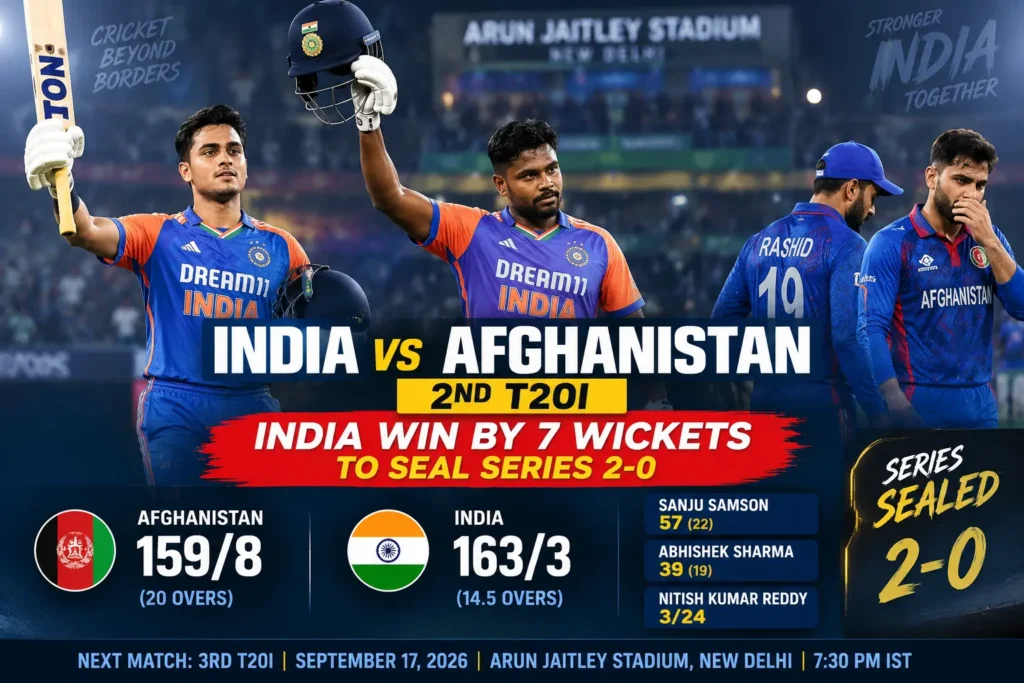
India vs Afghanistan 2nd T20I ended with another convincing seven-wicket victory for India at the Arun Jaitley Stadium in New Delhi. After restricting Afghanistan to 159/8, India chased the 160-run target in just 14.5 overs to take an unassailable 2-0 lead in the three-match series.
The victory combined disciplined bowling with another aggressive batting display. Nitish Kumar Reddy led India’s bowling effort with 3/24, while Sanju Samson produced one of the defining innings of the match with a rapid 57.
India vs Afghanistan 2nd T20I Match Overview
The second T20I took place on September 15, 2026, at the Arun Jaitley Stadium in Delhi. India won the toss and chose to bowl first, giving Afghanistan the opportunity to establish a competitive total.
Afghanistan struggled to build a sustained scoring rate during the middle portion of its innings. Ibrahim Zadran top-scored with 37, while late contributions from Mohammad Nabi, Rashid Khan and Noor Ahmad helped Afghanistan reach 159/8 after 20 overs.
India responded with intent. Abhishek Sharma continued his aggressive approach at the top, while Samson initially took a more measured role before accelerating. Their partnership put the chase firmly under India’s control.
Samson eventually scored 57, while India’s middle order completed the chase with five balls remaining. The final score read 163/3 in 14.5 overs, giving India another seven-wicket win and confirming the series victory at 2-0.
How Afghanistan Reached 159/8
Afghanistan’s innings never developed the sustained momentum needed to put India under serious pressure. India’s bowlers attacked early and continued taking wickets at regular intervals, leaving Afghanistan at 105/6 after 15 overs.
Ibrahim Zadran provided the main anchor for the innings. The Afghanistan captain scored 37, helping his team recover from a difficult start. Darwish Rasooli added 26, but Afghanistan still needed a strong finish to push the total toward a competitive range.
The late overs brought some much-needed acceleration. Rashid Khan and Mohammad Nabi joined forces and added valuable runs before India’s bowlers struck again. Bumrah removed one of the set batters in the 19th over, while Nitish Kumar Reddy struck in the final over.
Noor Ahmad then supplied the finishing touches as Afghanistan reached 159/8.
That total gave India a target of 160, but the visitors needed an exceptional bowling performance to defend it. India’s opening display in the chase quickly showed why the target was unlikely to prove sufficient.
India vs Afghanistan 2nd T20I Bowling Highlights
India’s bowling attack set up the victory before the batting innings began. Jasprit Bumrah opened with a maiden over, and Arshdeep Singh immediately followed with the wicket of Rahmanullah Gurbaz, who departed without scoring.
From there, India maintained pressure through regular breakthroughs.
Nitish Kumar Reddy Leads the Attack
Nitish Kumar Reddy produced the standout bowling figures, finishing with 3/24. His wickets arrived at an important stage as Afghanistan attempted to accelerate toward the end of the innings.
Arshdeep Singh supported him with 2/35, while Bumrah, Axar Patel and Ravi Bishnoi claimed one wicket apiece. Together, they prevented Afghanistan from turning its late-order recovery into a much larger total.
The bowling performance also reflected India’s ability to keep Afghanistan’s scoring under control after the powerplay. Although Nabi and Rashid found some boundaries late in the innings, India continued to create opportunities and eventually restricted the visitors to 159.
For India, the most important feature was not simply the number of wickets. It was the timing of those breakthroughs. Afghanistan repeatedly attempted to build partnerships, but India’s bowlers disrupted those efforts before they could become match-defining stands.
Sanju Samson Changes the Shape of India’s Chase
India’s chase initially revolved around Abhishek Sharma’s attacking approach, but Sanju Samson soon became the central figure.
Samson began carefully and allowed Abhishek to take the initiative. However, he shifted gears during the fifth over, hitting a boundary followed by a six against Azmatullah Omarzai. That sequence changed the tempo of the innings and gave India another aggressive option at the crease.
The wicketkeeper-batter eventually reached 57, giving India the acceleration required to move rapidly beyond Afghanistan’s total.
His innings mattered for another reason. Samson had entered the series after a difficult run of scores, and his return to form provided India with another reliable attacking option in the top order. ICC had noted before the series that Samson had struggled for runs since India’s T20 World Cup triumph, making his response in Delhi particularly significant.
India did not need to chase aggressively from the opening delivery because Afghanistan’s 159 was within reach. Instead, Samson and his teammates gradually increased the scoring rate until the required run rate ceased to pose any real challenge.
Abhishek Sharma and Samson Set Up the Chase
India began the chase with the same attacking intent that had defined their batting approach throughout the series. Abhishek Sharma and Sanju Samson quickly put Afghanistan’s bowlers under pressure, turning a target of 160 into a straightforward chase.
The opening pair added 88 runs, with Abhishek contributing 39 from 19 balls. Samson then took over the acceleration, reaching his half-century from only 20 deliveries. By the end of the Powerplay, India had raced to 82/0, giving themselves a huge advantage with 14 overs still available.
The partnership also prevented Afghanistan from settling into a rhythm with its main bowling options. India attacked the scoring opportunities early rather than allowing the required rate to climb.
Once India crossed 100 in the eighth over, the equation became extremely comfortable. The required rate had dropped below five runs per over, leaving India with little pressure despite losing both openers in quick succession.
India’s Powerplay Creates Early Separation
The Powerplay proved decisive in India’s chase. Abhishek and Samson combined boundary hitting with aggressive running between the wickets, pushing the scoring rate well beyond what Afghanistan needed to defend its total.
Abhishek’s dismissal eventually came against Rashid Khan. He attempted another big hit after striking the spinner for six, but Afghanistan finally found a breakthrough. Samson continued attacking at the other end before Rashid claimed his wicket from the final delivery of the same over.
Despite those two wickets, India had already created enough separation. The openers had taken the chase beyond the early danger period, and the required rate remained comfortably manageable.
That early acceleration became especially important because Afghanistan had managed only 159/8. India’s opening approach meant the visitors needed wickets almost immediately after the Powerplay, but the damage had already been done.
Ishan Kishan and Tilak Varma Finish the Job
With both openers dismissed, India still needed only a manageable number of runs. Ishan Kishan then provided the stability required to close out the match.
Kishan remained unbeaten on 38 from 28 balls, striking three fours and two sixes. He received support from Shreyas Iyer, who scored 11, before Tilak Varma joined him and finished unbeaten on 15.
The middle order did not need to take unnecessary risks. Instead, Kishan maintained control while India’s remaining batters picked off the runs required to finish the contest.
India eventually reached 163/3 in 14.5 overs, completing the chase with 31 deliveries to spare. The result gave India a seven-wicket victory and confirmed the team’s 2-0 series lead with one match remaining.
The finish also highlighted the depth of India’s batting lineup. The openers had done most of the damage, while Kishan and Tilak ensured Afghanistan never got an opportunity to force a late collapse.
India vs Afghanistan 2nd T20I Key Numbers
The second T20I produced a clear statistical picture of India’s control. Afghanistan posted 159/8, but India reached 163/3 in 14.5 overs, winning with seven wickets and 31 balls remaining.
| Statistic | India | Afghanistan |
|---|---|---|
| Final score | 163/3 | 159/8 |
| Overs | 14.5 | 20 |
| Result | Won by 7 wickets | Lost |
| Top scorer | Sanju Samson — 57 | Ibrahim Zadran — 37 |
| Best bowler | — | Rashid Khan — 3/36 |
Samson’s 57 came from only 22 deliveries, while Abhishek Sharma added 39 from 19 balls. Ishan Kishan then remained unbeaten on 38, ensuring India maintained control after the openers departed.
With the ball, Nitish Kumar Reddy’s 3/24 stood out as India’s best bowling performance. Arshdeep Singh contributed two wickets, while Jasprit Bumrah, Ravi Bishnoi and Axar Patel took one each.
Why India’s Seven-Wicket Win Was Decisive
India’s victory came from combining pressure with acceleration at the right moments. Afghanistan lost wickets regularly during the first 15 overs and reached only 105/6 at that stage. Although Mohammad Nabi and Rashid Khan helped revive the innings, India’s bowlers removed both before Afghanistan could push the total substantially higher.
India then attacked the chase from the beginning. Abhishek and Samson’s opening partnership put Afghanistan on the defensive, while Samson’s rapid half-century transformed the chase into a comfortable pursuit.
The difference between the two innings was particularly visible in scoring speed. Afghanistan needed the full 20 overs to reach 159/8. India, meanwhile, crossed the target inside 15 overs.
That contrast explains why Afghanistan never had a realistic opportunity to defend its total. Even after India lost both openers, the required rate remained low enough for Kishan and the middle order to finish without taking excessive risks.
The result also settled the series. India now lead 2-0, with the third T20I still to come in Delhi on September 17. Readers can also explore our latest coverage of major sports stories beyond cricket.
India Seal the T20I Series 2-0
India’s second consecutive seven-wicket victory has settled the three-match series with one game still to play. After winning the opening T20I by the same margin, India repeated the result in the second match and moved to an unassailable 2-0 lead.
The series result reflects India’s stronger execution across both matches. The team has combined effective bowling with aggressive top-order batting, while Afghanistan has struggled to sustain partnerships for long enough to put India under extended pressure.
For Afghanistan, the final match now becomes an opportunity to avoid a clean sweep and finish the series with a win. For India, it offers another chance to assess combinations and maintain momentum before the next phase of the international schedule.
When Is the Next India vs Afghanistan Match?
The next India vs Afghanistan match is the third and final T20I on September 17, 2026. The game will again take place at the Arun Jaitley Stadium in New Delhi, completing a three-match series played at the same venue. The official schedule confirms the third T20I for September 17.
The match is scheduled to begin at 7:30 PM IST.
India vs Afghanistan 3rd T20I Details
| Detail | Information |
|---|---|
| Match | 3rd T20I |
| Date | September 17, 2026 |
| Venue | Arun Jaitley Stadium, New Delhi |
| Start time | 7:30 PM IST |
| Series score | India lead 2-0 |
| Series status | India have already sealed the series |
Because India have already secured the series, the third T20I will not change the overall series winner. However, it can still shape the final scoreline and give both teams another opportunity to test their combinations.
What to Watch in the Third T20I
The final match should provide another look at India’s batting combination after the team’s top order produced two rapid chases. Sanju Samson’s return to form in the second T20I adds another storyline, particularly after his explosive 57 helped India finish the chase well inside 15 overs. Beyond cricket, sports fans can also explore the latest Messi vs Yamal World Cup Final story.
Afghanistan, meanwhile, will need a more consistent batting performance. The visitors reached 159/8 in the second match but could not defend the total after India’s openers attacked from the Powerplay.
The bowling contest will also remain important. India’s attack has repeatedly created pressure through early wickets and middle-over breakthroughs, while Afghanistan will look for a way to slow India’s scoring rate.
With the series already decided, the final T20I could therefore offer both sides a chance to experiment while still providing a meaningful conclusion to the Delhi series. For more sports coverage, explore the latest MLB and other major sports stories.
India vs Afghanistan 2nd T20I FAQs
The second T20I gave India a 2-0 series lead after a seven-wicket win in Delhi. Here are the key answers readers may want after the match.
Who won the India vs Afghanistan 2nd T20I?
India won the second T20I by seven wickets at the Arun Jaitley Stadium in New Delhi. Afghanistan scored 159/8 after batting first, but India chased the 160-run target in only 14.5 overs. The result gave India an unassailable 2-0 lead in the three-match series.
What was India’s score in the second T20I?
India finished on 163/3 in 14.5 overs. Sanju Samson scored 57, Abhishek Sharma added 39, and Ishan Kishan remained unbeaten on 38. The quick chase gave India a seven-wicket victory with 31 balls still available.
How many runs did Sanju Samson score?
Sanju Samson scored 57 runs from 22 balls. His innings included seven fours and four sixes, and he played a major role in India’s rapid chase. Samson also combined with Abhishek Sharma for an 88-run opening partnership before both batters departed.
Who was India’s top bowler?
Nitish Kumar Reddy produced India’s best bowling figures, taking 3/24. His wickets helped India control Afghanistan through the middle overs. Arshdeep Singh also contributed two wickets, while Jasprit Bumrah, Axar Patel and Ravi Bishnoi took one each.
What was Afghanistan’s score?
Afghanistan scored 159/8 in 20 overs after India chose to field first. Ibrahim Zadran led the scoring with 37, while Mohammad Nabi and Rashid Khan added useful runs late in the innings. However, India restricted Afghanistan before it could build a substantially larger total.
What is the India vs Afghanistan series score?
India lead the three-match T20I series 2-0 after winning both of the opening matches by seven wickets. India have therefore already secured the series with one match remaining. Afghanistan can still finish the series with a victory in the final game.
When is the next India vs Afghanistan match?
The third and final T20I is scheduled for September 17, 2026, at the Arun Jaitley Stadium in New Delhi. The match is scheduled to begin at 7:30 PM IST. All three matches in the series are being played at the Delhi venue.
Final Takeaway
The India vs Afghanistan 2nd T20I gave India another convincing result and, more importantly, secured the three-match series with a game still remaining. Afghanistan’s 159/8 provided a target that India never allowed to become difficult, thanks to an aggressive opening partnership and a rapid 57 from Sanju Samson.
India’s bowling effort laid the foundation for the chase. Nitish Kumar Reddy’s 3/24 helped limit Afghanistan’s scoring during the middle overs, while the Indian batting lineup then attacked the target at a much faster rate.
Samson’s return to form became one of the major talking points from the match. His 57 off 22 balls, combined with Abhishek Sharma’s 39 from 19, gave India an explosive start. Ishan Kishan then helped complete the chase without allowing Afghanistan to create a late opening.
With the series already decided at 2-0, attention now turns to the third T20I on September 17. India will look to finish the series strongly, while Afghanistan will have one final opportunity to put a win on the board.