
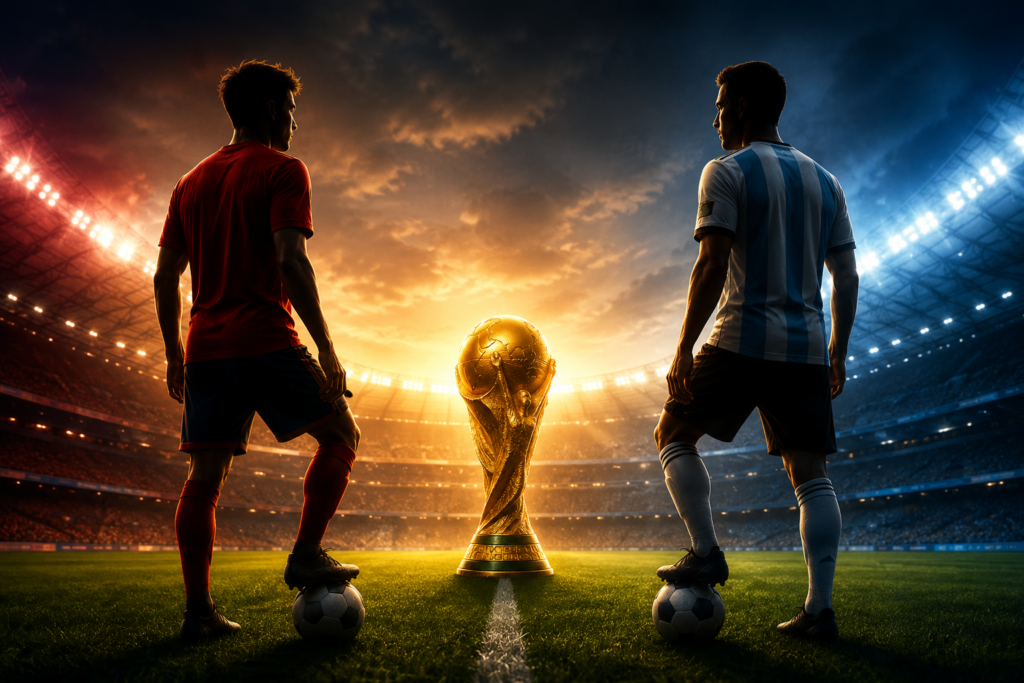
Lamine Yamal has already achieved what many footballers spend an entire career chasing. At just 18 years old, the Spanish sensation has become one of the biggest names in world football, earned the trust of millions of fans, and helped lead Spain to the FIFA World Cup final. Now, he stands on the sport’s biggest stage opposite a player whose legacy has inspired football fans for nearly two decades—Lionel Messi.
This World Cup final is more than a championship match. It brings together two remarkable footballers from different generations. On one side is Messi, one of the greatest players in the history of the sport. On the other is Lamine Yamal, a fearless young talent who represents the future of international football.
Although their careers are at very different stages, both players share one goal: lifting the FIFA World Cup trophy. That contrast has turned this final into one of the most anticipated football matches in recent memory.
Why This World Cup Final Feels Different
Every FIFA World Cup final attracts worldwide attention. However, some matches become larger than the competition itself because they tell a story that extends beyond ninety minutes.
This final belongs in that category.
Football supporters are not simply debating which nation has the stronger squad. Instead, conversations have focused on what this matchup represents for the sport’s future. One generation continues to demonstrate its greatness, while another begins writing its own history.
That contrast has created extraordinary excitement.
Several factors make this final unique:
- A legendary icon facing football’s newest superstar.
- Two nations known for attacking football and technical excellence.
- A clash between experience and youthful fearlessness.
- The possibility of witnessing a historic passing of the torch.
- Worldwide interest from both longtime supporters and younger fans discovering the sport.
As a result, the match has attracted attention far beyond traditional football audiences. Casual viewers, former players, analysts, and sports media have all recognized the broader significance of this occasion.
A Meeting Between Football’s Past, Present, and Future
Football rarely offers perfect storylines. Great players often belong to different eras and never share the same stage during major international tournaments.
This final changes that.
Lionel Messi represents nearly twenty years of sustained excellence. Throughout his career, he has collected domestic titles, continental trophies, individual awards, and international success while maintaining extraordinary consistency. His influence stretches across multiple generations of football fans.
By contrast, Lamine Yamal has emerged during a new era shaped by faster tactical systems, advanced analytics, and relentless global attention through social media. Despite the added pressure, he has displayed remarkable maturity both on and off the pitch.
Their encounter reflects more than age differences.
It highlights how football constantly reinvents itself.
Every decade introduces new stars who learn from previous legends before developing their own identity. Today’s young players grew up watching Messi perform impossible feats. Now, many of them compete against him on football’s biggest stage.
For Lamine Yamal, that reality becomes especially meaningful.
Only a few years ago, he admired players like Messi from afar. Today, he prepares to challenge him in a World Cup final.
Few athletes experience such a remarkable transition.
How Lamine Yamal Became Spain’s Biggest Breakthrough
Spain has produced world-class footballers for generations. From elegant midfielders to clinical forwards, the nation’s football culture emphasizes intelligence, creativity, and technical precision.
Even within that tradition, Lamine Yamal has stood out.
His rise has been remarkably rapid.
Instead of requiring several seasons to establish himself, he adapted almost immediately to elite competition. Coaches quickly recognized his ability to make smart decisions under pressure. Defenders discovered how difficult it was to predict his movement. Fans embraced his fearless approach against experienced opponents.
Several qualities explain his rapid development:
| Attribute | Why It Matters |
|---|---|
| Close ball control | Allows him to escape tight defensive pressure. |
| Quick acceleration | Creates separation in one-on-one situations. |
| Vision | Helps identify passing lanes before defenders react. |
| Creativity | Produces unpredictable attacking opportunities. |
| Composure | Maintains confidence during high-pressure moments. |
Rather than relying solely on speed, Lamine Yamal combines technical skill with intelligent positioning. Consequently, he influences matches even when opponents focus heavily on limiting his space.
That complete attacking profile has made him one of Spain’s most valuable players throughout the tournament.
Messi Continues to Inspire Football’s Greatest Stage
While Lamine Yamal represents football’s future, Lionel Messi remains its enduring symbol of excellence.
Many athletes struggle to maintain elite performance after years of intense competition. Messi, however, continues to demonstrate exceptional vision, technical quality, and leadership whenever Argentina needs him most.
His role has naturally evolved.
Earlier in his career, he frequently dominated matches through explosive dribbling and constant attacking runs. Today, he combines experience with intelligence, choosing the right moments to influence the game rather than relying solely on physical attributes.
That evolution has made him even more dangerous.
Opponents understand his strengths. Yet stopping him remains one of football’s most difficult challenges.
Argentina’s younger players also benefit from his presence. His calm leadership helps teammates remain composed during tense situations, especially in knockout matches where every mistake carries enormous consequences.
As another World Cup final approaches, Messi once again finds himself at the center of football’s biggest story.
The stage is now set for one of the most anticipated World Cup finals in recent memory. While Lionel Messi seeks another defining achievement in an already legendary career, Lamine Yamal has the chance to announce himself as the new face of international football. Their meeting promises far more than a contest between two exceptional players—it offers a rare moment where football’s past and future collide under the brightest lights in the sport.
Spain’s Road to the FIFA World Cup Final
Spain entered the tournament carrying high expectations, but questions surrounded the team’s ability to balance youthful energy with international experience. Although the squad featured several established stars, much of the spotlight quickly shifted toward Lamine Yamal, whose performances became one of the defining stories of the competition.
From the opening group-stage match, Spain displayed the qualities that have long defined its football identity. The team controlled possession, pressed aggressively after losing the ball, and moved with confidence through midfield. However, this version of Spain added another important dimension—direct attacking play.
Instead of relying only on patient build-up, Spain attacked with greater speed whenever opportunities appeared. That tactical flexibility made the team more unpredictable and significantly harder to defend.
As the tournament progressed, Spain continued to improve. Every knockout match tested the squad in different ways, yet the players consistently responded with discipline and composure. Whether protecting a narrow lead or searching for a late winner, they demonstrated the mental strength required to reach football’s biggest stage.
Throughout this journey, Lamine Yamal became one of Spain’s most influential players. His ability to create chances in difficult situations often changed the rhythm of matches and forced opposing defenses to adjust their game plans.
How Lamine Yamal Transformed Spain’s Attack
Great attacking players do more than score goals. They change how opponents defend.
That has been one of the biggest contributions of Lamine Yamal during the World Cup.
Whenever he receives possession near the penalty area, defenders rarely leave him isolated. Instead, they often send additional players to limit his space. Consequently, other Spanish attackers benefit from the extra room created elsewhere on the pitch.
This influence cannot always be measured through goals or assists alone.
Several aspects of Lamine Yamal’s game have strengthened Spain’s attack:
Outstanding One-on-One Ability
Modern football places enormous value on players who can beat defenders individually.
Lamine Yamal excels in these situations because he combines quick feet with excellent balance and close control. Rather than relying on one predictable move, he constantly varies his approach, making it difficult for defenders to anticipate his next action.
As a result, Spain gains valuable territory whenever he drives forward with the ball.
Intelligent Decision-Making
Young attackers often attempt spectacular plays at every opportunity. However, Lamine Yamal has shown impressive maturity throughout the tournament.
He recognizes when to dribble.
He recognizes when to pass.
Most importantly, he recognizes when slowing the game benefits his teammates.
Those decisions have helped Spain maintain attacking momentum without forcing unnecessary risks.
Confidence Under Pressure
Few environments create more pressure than a World Cup knockout match.
Crowds become louder.
Mistakes become more costly.
Every decision carries greater importance.
Even so, Lamine Yamal has continued playing with confidence. Instead of becoming cautious, he remains willing to challenge defenders and create scoring opportunities.
That fearless mindset has become one of Spain’s greatest strengths.
Spain’s Tactical Identity Has Continued to Evolve
For years, Spain became synonymous with patient possession football.
While ball control remains central to the team’s philosophy, today’s Spanish side offers far greater tactical variety.
The coaching staff has encouraged players to attack vertically whenever opportunities emerge. Therefore, possession now serves as a tool rather than the final objective.
This evolution benefits Lamine Yamal significantly.
Instead of receiving the ball only against organized defensive blocks, he frequently attacks defenders during quick transitions, where his pace and creativity become even more dangerous.
Spain’s tactical approach now emphasizes:
- Fast attacking transitions.
- Intelligent positional rotations.
- High pressing after losing possession.
- Wide attacking options.
- Technical superiority in midfield.
- Flexible movement across the front line.
Together, these principles have created one of the tournament’s most balanced teams.
Argentina’s Journey Back to the World Cup Final
While Spain impressed through youthful energy, Argentina reached the final by combining experience, resilience, and tactical discipline.
Every championship-winning team encounters difficult moments.
Argentina proved capable of overcoming them.
Some matches demanded defensive organization.
Others required patience against compact opponents.
Several became physical battles where controlling emotions proved just as important as controlling possession.
Regardless of the challenge, Argentina consistently found solutions.
That consistency reflects the team’s maturity.
Instead of depending on individual brilliance alone, Argentina has built a squad capable of adapting to different styles of football. Each player understands their responsibilities, allowing the team to remain organized even during intense periods of pressure.
Naturally, Lionel Messi continues to provide inspiration whenever Argentina needs composure.
Yet the team’s success also depends upon collective effort.
Defenders protect leads.
Midfielders control tempo.
Attackers stretch opposing defenses.
Together, those contributions have guided Argentina to another opportunity for football’s biggest prize.
Messi’s Leadership Extends Beyond Individual Brilliance
Statistics often highlight goals and assists.
Leadership tells a different story.
Throughout this tournament, Lionel Messi has influenced Argentina in ways that cannot always be measured numerically.
His experience helps teammates remain calm during difficult moments.
His movement creates space for younger attackers.
His communication improves the team’s organization both in possession and without the ball.
These qualities become increasingly valuable in knockout football, where emotional control often separates champions from runners-up.
Messi also understands the rhythm of major finals.
He knows when to accelerate attacks.
He knows when to slow possession.
He knows how to manage pressure during the closing stages of matches.
Those instincts come only through years of competing at the highest level.
Consequently, Argentina enters the final with one of football’s greatest leaders guiding every phase of play.
The Supporting Cast Could Decide the Championship
Although global attention naturally centers on Lamine Yamal and Lionel Messi, World Cup finals rarely depend upon only two players.
Championships are won by complete teams.
Both finalists possess talented squads capable of changing matches in multiple ways.
Spain’s Supporting Strengths
Spain’s midfield continues controlling possession with intelligence and precision.
Its defenders remain comfortable building attacks from the back.
The team’s wide players constantly create space through intelligent movement.
Consequently, Lamine Yamal receives strong support rather than carrying the entire attacking responsibility.
Argentina’s Collective Experience
Argentina also benefits from outstanding squad depth.
Experienced defenders provide stability.
Creative midfielders connect defense with attack.
Hard-working forwards contribute both offensively and defensively.
That balance allows Messi to focus on influencing decisive moments without needing to dominate every minute of the match.
Comparing the Two Finalists Before Kickoff
| Category | Spain | Argentina |
|---|---|---|
| Playing Style | Possession with direct attacking options | Balanced attack and defensive discipline |
| Key Star | Lamine Yamal | Lionel Messi |
| Greatest Strength | Technical movement and attacking creativity | Experience and tactical maturity |
| Defensive Approach | High pressing | Compact defensive organization |
| Midfield Philosophy | Ball control and quick circulation | Game management and intelligent positioning |
| Mental Advantage | Fearless youthful confidence | Championship experience |
Although each team approaches matches differently, both have consistently demonstrated why they deserve a place in the World Cup final.
Momentum Meets Experience
One of the most fascinating aspects of this final lies in the contrast between momentum and experience.
Spain enters the match with youthful confidence and attacking freedom. The squad has embraced pressure rather than fearing it, and Lamine Yamal has become the symbol of that fearless approach.
Argentina, meanwhile, brings years of experience at the highest level. The players understand how to manage emotions, control difficult moments, and remain composed when the stakes are greatest. With Lionel Messi leading the way, they know exactly what it takes to compete on football’s biggest stage.
When these contrasting strengths collide, the result promises to be one of the most compelling World Cup finals in recent history.
Messi vs Lamine Yamal: The Tactical Battle That Could Decide the Final
Every World Cup final features moments that shape the outcome. Sometimes they come from a brilliant goal. At other times, they emerge through tactical adjustments that slowly change the balance of the match.
This final promises both.
Although millions of fans will focus on Lamine Yamal and Lionel Messi, the real contest extends far beyond individual talent. Every run, defensive rotation, and passing sequence could influence the direction of the game.
Spain and Argentina approach football differently. Spain prefers controlling possession through quick passing and intelligent movement. Argentina, meanwhile, balances patient build-up with the ability to attack directly whenever opportunities appear.
Because both teams possess outstanding technical quality, small tactical details may determine who lifts the trophy.
Can Spain Create Space for Lamine Yamal?
Stopping Lamine Yamal has become one of the biggest challenges for opposing defenses throughout the tournament.
Whenever Spain attacks down the right flank, defenders immediately face a difficult decision.
Should they close him down quickly?
Or should they maintain their defensive shape?
Neither option guarantees success.
If a defender commits too early, Lamine Yamal has the pace and close control to dribble past the challenge. However, if defenders hesitate, he gains valuable time to deliver a cross, play a through ball, or cut inside toward goal.
Argentina will likely attempt to reduce his influence through collective defending rather than relying on a single player.
Possible defensive strategies include:
- Preventing quick passes into wide areas.
- Forcing him toward the touchline instead of allowing central movement.
- Providing immediate support whenever he beats the first defender.
- Limiting Spain’s opportunities in transition.
Even with those adjustments, containing Lamine Yamal for ninety minutes remains an enormous challenge.
How Argentina Could Maximize Messi’s Influence
Lionel Messi no longer relies on constant sprinting to dominate matches.
Instead, he controls games through positioning, awareness, and timing.
Rather than remaining fixed in one attacking position, Messi frequently drops into midfield to receive possession. This movement creates uncertainty for defenders because following him opens space behind the defensive line.
Argentina often benefits from this tactical pattern.
Messi receives the ball between midfield and defense.
Opponents step forward to pressure him.
Suddenly, teammates find space to attack.
This sequence has defined many of Argentina’s best attacking moments throughout the tournament.
Spain must therefore balance aggression with discipline.
Pressing Messi too aggressively could expose dangerous passing lanes.
Giving him too much time, however, may prove even more costly.
Midfield Control Will Shape the Championship
While headlines naturally focus on star forwards, many football experts believe the midfield battle will decide the final.
Winning possession means controlling tempo.
Controlling tempo often means controlling the match.
Spain’s midfield thrives on quick combinations and intelligent positioning. Players constantly rotate into different spaces, making it difficult for opponents to apply sustained pressure.
Argentina approaches midfield differently.
Its players prioritize balance.
Instead of rushing attacks, they carefully select moments to increase the pace. That patience allows Argentina to remain organized while minimizing unnecessary risks.
The team that establishes midfield control will likely create more opportunities for its attacking stars.
Consequently, both coaching staffs will pay close attention to this area throughout the match.
Five Key Matchups That Could Decide the World Cup Final
Although football remains a team sport, individual battles frequently influence major tournaments.
Here are five matchups worth watching.
1. Lamine Yamal vs Argentina’s Left Side
This contest may receive the greatest attention.
If Lamine Yamal consistently wins one-on-one situations, Spain could generate numerous scoring opportunities.
Conversely, if Argentina limits his space, Spain may need to attack through different areas.
2. Messi vs Spain’s Midfield Press
Spain prefers winning possession high up the pitch.
However, pressing Messi requires exceptional coordination.
One poorly timed challenge could allow Argentina’s captain to launch a dangerous counterattack.
Maintaining defensive discipline will therefore remain essential.
3. Wide Players Against Full-Backs
Modern football depends heavily on attacking width.
Both finalists possess dangerous wide players capable of stretching defensive lines.
Full-backs must therefore balance attacking support with defensive responsibility.
Overcommitting in either direction could create costly opportunities.
4. Set Pieces
World Cup finals often feature limited scoring chances.
Consequently, corners and free kicks become increasingly valuable.
Both teams possess technical quality capable of delivering dangerous crosses into crowded penalty areas.
Maintaining concentration during these moments could prove decisive.
5. The Final Twenty Minutes
Fatigue changes football matches.
Defensive mistakes become more common.
Passing accuracy declines.
Substitutes begin influencing play.
If the score remains close entering the closing stages, fresh players and tactical adjustments may determine the champion.
Managers Face Their Biggest Tactical Challenge
Players execute game plans.
Managers create them.
Preparing for a World Cup final involves far more than selecting a starting lineup.
Coaching staffs analyze countless details, including:
- Opponent formations.
- Pressing triggers.
- Set-piece routines.
- Defensive transitions.
- Substitution strategies.
- Match tempo.
- Injury management.
Both managers understand that flexibility will be critical.
No tactical plan survives unchanged once the match begins.
If Spain dominates possession, Argentina may adjust its defensive structure.
Likewise, if Argentina controls midfield, Spain could introduce additional attacking players earlier than expected.
These in-game decisions often separate victory from defeat.
Where Spain Holds the Advantage
Spain enters the final with several important strengths.
Youthful Energy
The squad plays with tremendous confidence.
Players attack aggressively without appearing overwhelmed by the occasion.
That fearless mentality has produced exciting football throughout the tournament.
Technical Precision
Spain remains one of the world’s strongest passing teams.
Quick combinations allow players to escape pressure while maintaining attacking momentum.
Creativity in Wide Areas
With Lamine Yamal leading the attack, Spain possesses outstanding ability to create chances from wide positions.
Defenders rarely enjoy comfortable afternoons against such unpredictable movement.
Where Argentina Holds the Advantage
Argentina counters Spain’s youthful enthusiasm with remarkable experience.
Championship Mentality
Many Argentine players have already competed in high-pressure international matches.
They understand how to remain composed when games become tense.
Tactical Discipline
Argentina rarely loses its defensive organization.
Even during difficult periods, players continue protecting important spaces.
Leadership
Lionel Messi provides far more than technical quality.
His calm presence influences teammates throughout every phase of the match.
That leadership becomes increasingly valuable during close contests.
Can Lamine Yamal Outshine Lionel Messi?
This question has dominated football conversations ever since the finalists were confirmed.
Comparisons are inevitable.
However, they should also be viewed with perspective.
Lionel Messi has spent nearly two decades building one of football’s greatest careers.
His achievements have inspired millions around the world.
Meanwhile, Lamine Yamal is only beginning his international journey.
Expecting him to replicate an entire legendary career overnight would be unrealistic.
Nevertheless, football has always celebrated breakthrough moments.
One extraordinary performance on the biggest stage can define a generation.
For Lamine Yamal, this final presents exactly that opportunity.
If he delivers another memorable display, he will strengthen his reputation as one of football’s brightest young stars while proving that he belongs among the sport’s elite.
Pressure Will Affect Both Teams Differently
Pressure never disappears before a World Cup final.
Instead, players learn to manage it.
Spain’s younger squad may approach the occasion with freedom, embracing the excitement rather than fearing the consequences.
Argentina, however, understands the emotional weight that accompanies championship matches.
Its experienced players know how quickly momentum can shift.
Therefore, maintaining concentration from the opening whistle until the final minute will remain absolutely essential.
Whichever team handles pressure more effectively could ultimately celebrate with the World Cup trophy.
The Story That Connects Lionel Messi and Lamine Yamal
World Cup finals often produce unforgettable memories. However, very few carry a story that feels almost impossible to believe.
Long before Lamine Yamal became one of football’s brightest young stars, a photograph quietly captured a moment that would later fascinate fans around the world. The image showed Lionel Messi holding a baby during a charity calendar photo shoot. At the time, no one could have imagined that the child would grow up to become one of Spain’s biggest football talents.
Years later, football supporters rediscovered that photograph, giving it new meaning. Social media users described it as a full-circle moment, while many fans viewed it as a symbolic connection between two generations of the sport.
Although the image has become part of football folklore, it does not change what happens on the pitch. Once the referee blows the opening whistle, history and emotion give way to competition. Even so, the photograph adds another fascinating chapter to an already remarkable World Cup final.
Why the Photo Resonates With Football Fans
Supporters love stories that connect different eras of the game. That famous photograph does exactly that.
For many fans, it represents more than a memorable image. Instead, it highlights how quickly football evolves. One generation inspires the next, and today’s young players eventually challenge the legends they once admired.
That idea has fueled countless conversations before the final. As a result, the story has become part of the broader narrative surrounding Lamine Yamal and Lionel Messi.
Still, both players have earned their places through talent, dedication, and consistent performances. The photograph may be symbolic, but their achievements on the field speak for themselves.
Records That Could Be Broken in the World Cup Final
Every World Cup final creates opportunities for history.
Some records are planned years in advance, while others emerge naturally during the match. This championship game could add several new milestones to football’s record books.
Here are some of the biggest storylines to watch:
| Potential Milestone | Why It Matters |
|---|---|
| A memorable final performance from Lamine Yamal | Could further strengthen his reputation as one of football’s brightest young stars. |
| Another defining World Cup moment for Lionel Messi | Would add to one of the greatest international careers in football history. |
| Spain winning another World Cup title | Would reinforce the nation’s place among football’s elite. |
| Argentina capturing another championship | Would extend an already proud football tradition. |
| A classic final remembered for years | Great matches often become part of football history regardless of the result. |
Records alone never guarantee greatness. Instead, unforgettable performances usually define how fans remember World Cup finals.
A Final That Represents Two Different Eras
Every generation believes it is watching football at its best.
This final offers a rare opportunity to compare two different football eras on the same stage.
Lionel Messi represents years of consistency, creativity, and excellence. His career has influenced countless young players across the globe. Many of today’s professionals grew up studying his style and trying to copy his movements.
Lamine Yamal, meanwhile, belongs to a new generation shaped by modern coaching methods, advanced sports science, and global exposure from an early age. Despite those differences, both players share important qualities.
They play with confidence.
They value teamwork.
They embrace responsibility during important matches.
That combination explains why this final has attracted such enormous attention from football fans everywhere.
Football Never Truly Stops Evolving
Every great player eventually inspires someone else.
That cycle has defined football for decades.
Legends leave behind unforgettable memories, while young stars build fresh stories for the next generation of supporters.
Lamine Yamal now finds himself at the beginning of that journey. Although comparisons with Lionel Messi are natural, his career will ultimately be measured by his own achievements rather than anyone else’s.
The World Cup final offers another important step in that process.
What Victory Would Mean for Lamine Yamal
Winning a World Cup at a young age would represent a remarkable achievement for Lamine Yamal.
More importantly, it would strengthen his growing reputation as one of the sport’s most exciting talents.
A championship would also demonstrate that young players can handle the pressure of football’s biggest occasions when surrounded by the right teammates and coaching staff.
Beyond trophies, success would increase expectations for the years ahead. Fans, media outlets, and football experts would closely follow every stage of his career.
That attention brings both opportunities and challenges.
Remaining consistent after major success often proves just as difficult as reaching the top in the first place.
Building a Legacy Takes Time
Many players enjoy one outstanding tournament.
Only a select few remain among the world’s best for more than a decade.
That is why patience remains important when discussing Lamine Yamal.
His talent is undeniable, but every great career develops over time. Continued improvement, smart decisions, and strong performances across multiple seasons will shape his long-term legacy far more than one individual match.
Still, delivering on football’s biggest stage could become a defining milestone in his journey.
What Another World Cup Triumph Would Mean for Lionel Messi
Lionel Messi has already secured a place among football’s greatest players.
Even so, elite athletes rarely stop chasing new achievements.
Another World Cup triumph would add yet another memorable chapter to an extraordinary international career. It would also highlight his ability to remain influential while adapting his game to different stages of his career.
Perhaps even more importantly, another championship would celebrate years of leadership, consistency, and commitment to Argentina.
His influence extends beyond goals and assists.
Younger teammates continue learning from his experience, professionalism, and calm approach during high-pressure situations.
Those qualities have remained just as valuable as his technical ability throughout the tournament.
Why Fans Around the World Are So Invested
Few sporting events unite global audiences like a World Cup final.
Supporters from different countries may cheer for different teams, yet many share the same excitement about witnessing history unfold.
Several reasons explain the worldwide anticipation:
- Lamine Yamal represents football’s exciting future.
- Lionel Messi continues to inspire millions with his remarkable career.
- Spain and Argentina have rich football traditions.
- The final promises contrasting tactical styles.
- Historic moments often emerge when expectations are highest.
Because of these factors, interest in the match extends far beyond the two competing nations.
Football fans simply do not want to miss a contest that could be remembered for generations.
Looking Beyond the Final Score
Every World Cup champion celebrates lifting the trophy.
However, the tournament’s greatest legacy often comes from the stories it creates.
Years from now, supporters may remember the courage shown by young players, the leadership displayed by experienced veterans, and the emotional moments shared after the final whistle.
Whether Lamine Yamal celebrates victory or Lionel Messi adds another remarkable achievement to his career, this final already represents an important chapter in football history.
The result will decide the champion.
The memories, however, will belong to the sport forever.
Head-to-Head Comparison: Lamine Yamal vs Lionel Messi
Comparing players from different stages of their careers is never easy. Experience, age, team roles, and tactical responsibilities all influence how footballers perform. Even so, this World Cup final naturally invites comparisons between Lamine Yamal and Lionel Messi because both players have become the biggest talking points ahead of kickoff.
One represents a legendary career built over many years.
The other represents a future filled with possibilities.
Although their paths are different, both have earned the spotlight through performances that have helped their countries reach football’s biggest match.
A Quick Comparison
| Category | Lamine Yamal | Lionel Messi |
|---|---|---|
| Team | Spain | Argentina |
| Position | Attacking winger | Forward / Playmaker |
| Playing Style | Direct, creative, fearless | Intelligent, calm, creative |
| Biggest Strength | Pace and one-on-one ability | Vision and decision-making |
| Role in the Team | Creates width and attacking momentum | Controls attacks and creates chances |
| Key Quality | Confidence under pressure | Leadership through experience |
The table highlights one important point.
Both players influence matches in different ways.
As a result, their impact cannot be measured using identical standards.
Lamine Yamal Brings Speed and Creativity
One of the biggest reasons Spain has reached the World Cup final is the confidence shown by Lamine Yamal throughout the tournament.
Whenever he receives possession in attacking areas, defenders immediately become alert. They understand that one mistake could allow him to create a dangerous opportunity.
His greatest strengths include:
- Explosive acceleration.
- Excellent close control.
- Quick changes of direction.
- Strong awareness in attacking areas.
- Confidence in one-on-one situations.
Instead of forcing difficult plays, Lamine Yamal usually makes smart decisions based on the situation. Sometimes he attacks defenders directly. At other times, he chooses a simple pass that keeps Spain moving forward.
That balance has made him one of the tournament’s most exciting attacking players.
His Biggest Area for Growth
Every young footballer continues learning.
The same applies to Lamine Yamal.
As he gains more experience, he will likely become even stronger in areas such as:
- Game management during difficult moments.
- Leadership under sustained pressure.
- Decision-making late in close matches.
- Physical consistency across long seasons.
Those qualities usually improve with experience rather than age alone.
Messi Continues to Set the Standard
Few footballers have maintained elite performance for as long as Lionel Messi.
Throughout his career, he has shown that intelligence can be just as valuable as speed.
Today, his greatest strength lies in reading the game before others do.
He recognizes passing lanes early.
He notices defensive gaps quickly.
He understands exactly when to slow the tempo or increase it.
Those qualities continue making Argentina one of the world’s most dangerous teams.
Experience Makes the Difference
While Lamine Yamal relies on youthful energy, Messi relies on years of experience.
That difference becomes especially important during major finals.
Experienced players often recognize situations that younger footballers have not encountered before.
For example, they know:
- When to protect possession.
- When to slow the pace.
- When to invite pressure before launching a counterattack.
- When patience produces better opportunities than immediate attacks.
These small decisions rarely dominate headlines.
However, they often decide championships.
Different Styles, Same Objective
Although football fans enjoy comparing stars, Lamine Yamal and Lionel Messi approach the game differently.
Lamine Yamal prefers attacking defenders with speed and confidence.
Messi prefers creating space through movement and intelligent positioning.
Neither style is inherently better.
Instead, each reflects the player’s strengths and role within the team.
That contrast makes the final even more fascinating.
Why Direct Comparisons Can Be Misleading
Many supporters naturally ask whether Lamine Yamal is “the next Messi.”
While the comparison reflects admiration, it may also create unrealistic expectations.
Every legendary footballer develops a unique identity.
Messi became famous because he played differently from everyone else.
Likewise, Lamine Yamal will build his reputation by developing his own style rather than copying another player.
Therefore, this final should not be viewed as a contest to determine whether one player replaces the other.
Instead, it offers a chance to appreciate two exceptional footballers at different stages of remarkable careers.
Which Team Holds the Tactical Edge?
Both finalists possess enough quality to become world champions.
However, each side enters the match with different advantages.
Spain’s Advantages
Spain could benefit from:
- Fast ball movement.
- Young, energetic attackers.
- Flexible positioning in midfield.
- High pressing.
- Creative wing play led by Lamine Yamal.
These qualities allow Spain to create chances even against organized defenses.
Argentina’s Advantages
Argentina brings different strengths.
The team relies on:
- Championship experience.
- Defensive organization.
- Strong leadership.
- Intelligent game management.
- Clinical finishing in important moments.
Those qualities have helped Argentina remain competitive throughout the tournament.
What Experts Are Watching Closely
Before every World Cup final, analysts focus on the tactical details that could influence the outcome.
Several questions continue generating discussion.
Can Lamine Yamal Handle Constant Defensive Pressure?
Opponents rarely allow creative players time on the ball.
Argentina will likely apply pressure whenever Lamine Yamal receives possession.
How he responds may shape Spain’s attacking success.
Will Messi Find Space Between the Lines?
Spain’s midfield usually presses aggressively.
Even so, Messi has repeatedly shown an ability to find pockets of space where others see none.
Preventing those moments remains one of Spain’s biggest defensive challenges.
Which Team Adjusts Better During the Match?
World Cup finals rarely unfold exactly as expected.
Managers often change formations.
Players switch positions.
Substitutions introduce fresh energy.
The team that adapts more effectively may ultimately gain the decisive advantage.
Football Is Bigger Than Individual Rivalries
Modern football often celebrates individual stars.
Yet championships are almost always won by complete teams.
Neither Lamine Yamal nor Lionel Messi can control every aspect of the final.
They depend on teammates.
They depend on tactical organization.
They depend on collective effort.
That reality makes football unique among global sports.
Even the greatest players need a strong team around them to succeed.
A Match That Could Inspire the Next Generation
Millions of young football fans will watch this final dreaming of one day playing on the same stage.
Some may admire Lionel Messi’s calm leadership.
Others may be inspired by Lamine Yamal’s fearless approach.
Both examples offer valuable lessons.
Talent matters.
Hard work matters.
Teamwork matters.
Most importantly, continuous improvement matters.
Those principles remain true regardless of age or experience.
Looking Ahead After the Final
When the final whistle blows, one team will celebrate while the other reflects on what might have been.
Even so, the impact of this match will extend far beyond one evening.
If Spain wins, Lamine Yamal will move another step closer to becoming one of football’s defining stars.
If Argentina lifts the trophy, Lionel Messi will add another unforgettable chapter to an already extraordinary career.
Either outcome would become an important part of football history.
That is exactly why this World Cup final has captured the attention of supporters around the globe.
How This World Cup Final Could Shape the Future of International Football
Every World Cup leaves a lasting mark on football. Some tournaments introduce new stars, while others redefine how the game is played. This final has the potential to do both.
The spotlight naturally falls on Lamine Yamal and Lionel Messi. However, the bigger story extends beyond two remarkable players. The match reflects how international football continues to evolve while honoring the achievements of previous generations.
Spain arrives with a squad built around youth, technical quality, and fearless attacking football. Argentina, meanwhile, combines experienced leaders with talented younger players who understand the value of teamwork and discipline.
Regardless of the final score, this championship will influence conversations about football for years to come.
Young Players Have Two Great Examples to Follow
One reason this final has attracted so much attention is that it offers valuable lessons for aspiring footballers.
Both stars reached the biggest stage through different journeys, yet they share several important qualities.
They Never Stop Improving
Natural talent opens doors.
Continuous improvement keeps those doors open.
Throughout his career, Lionel Messi has adapted his game to remain effective at the highest level. Likewise, Lamine Yamal continues developing new skills while gaining valuable experience with every major competition.
Young players can learn that success is not about reaching the top quickly. Instead, it comes from improving every season.
They Put the Team First
Football rewards teamwork more than individual brilliance.
Although Lamine Yamal can produce spectacular moments, he regularly looks for teammates in better positions. Messi has shown the same approach throughout his career, often creating opportunities for others instead of chasing personal milestones.
That willingness to share responsibility helps strong teams become champions.
They Stay Calm Under Pressure
Playing before millions of viewers creates enormous pressure.
Even so, both players have shown impressive composure throughout the tournament.
They remain focused on the next pass.
They continue making smart decisions.
They avoid allowing emotions to dictate their performance.
That mental strength often separates elite athletes from good players.
Fan Expectations Continue to Grow
Excitement surrounding the final has reached extraordinary levels.
Supporters from every continent have discussed possible outcomes, memorable moments, and tactical battles. Many simply want to witness great football, regardless of which team wins.
Several storylines continue capturing global attention:
- Can Lamine Yamal deliver another unforgettable performance?
- Will Lionel Messi add another historic achievement to his legendary career?
- Which tactical approach will prove more effective?
- Will the match produce a dramatic finish?
- Which players beyond the two stars will make the biggest impact?
These questions have fueled anticipation across the football community.
Why Neutral Fans Are Also Watching
Not everyone watching the final supports Spain or Argentina.
Many neutral fans have become interested because of the unique story surrounding the match.
Some want to celebrate Lionel Messi’s remarkable career.
Others are eager to watch Lamine Yamal continue his rapid rise on football’s biggest stage.
That combination has transformed the final into a truly global sporting event.
Possible Match Scenarios
Predicting a World Cup final is never easy.
Small details often determine the outcome.
Still, several realistic scenarios could unfold.
Scenario 1: Spain Controls Possession
If Spain dominates the ball, Lamine Yamal may receive more opportunities to attack defenders in wide areas.
Quick passing and intelligent movement could gradually stretch Argentina’s defensive shape.
Should that happen, Spain may create several dangerous scoring chances.
Scenario 2: Argentina Stays Patient
Argentina may choose a more balanced approach.
Instead of pressing aggressively, the team could remain compact before launching quick attacks through experienced playmakers.
This strategy would reduce unnecessary risks while allowing Messi to influence key moments.
Scenario 3: The Match Goes Into Extra Time
World Cup finals often remain close until the closing stages.
If neither team finds a breakthrough during regular time, fitness, concentration, and substitutions could become decisive.
Fresh players might change the rhythm of the match when fatigue begins affecting both sides.
Five Factors That Could Decide the Champion
Every final contains countless tactical details.
Even so, these five factors may prove especially important.
- Lamine Yamal’s effectiveness in one-on-one situations.
- Lionel Messi’s ability to control attacking moves.
- Midfield possession and passing accuracy.
- Defensive concentration during set pieces.
- Tactical adjustments made after halftime.
Whichever team performs better in these areas will significantly improve its chances of lifting the trophy.
More Than a Trophy Is at Stake
Winning the World Cup always represents an extraordinary achievement.
However, the significance of this final extends beyond medals and celebrations.
For Spain, victory would confirm the success of a new generation that has embraced responsibility with confidence.
For Argentina, another championship would reinforce the team’s remarkable consistency on football’s biggest stage.
Individually, Lamine Yamal could take another major step toward becoming one of the defining players of his generation.
At the same time, Lionel Messi could add another unforgettable chapter to one of football’s greatest careers.
That combination makes this final especially meaningful.
Final Thoughts
Football has always connected generations.
One group of players inspires the next, and each era introduces new stars capable of creating unforgettable memories.
This World Cup final captures that tradition perfectly.
On one side stands Lionel Messi, a player whose influence has shaped modern football for nearly two decades.
On the other stands Lamine Yamal, a fearless young talent whose future appears incredibly bright.
Regardless of the final result, the match celebrates everything that makes football the world’s most popular sport.
It highlights skill.
It rewards teamwork.
It showcases resilience.
Most importantly, it reminds fans that every generation brings new stories worth celebrating.
When the referee signals the end of the match, one nation will lift the trophy.
Yet the legacy of Lamine Yamal, Lionel Messi, and this unforgettable World Cup final will continue inspiring football supporters for many years to come.
Frequently Asked Questions
Who is Lamine Yamal?
Lamine Yamal is a Spanish professional footballer known for his creativity, pace, and technical ability. He has become one of the brightest young stars in world football and plays an important role for Spain on the international stage.
Why is the Messi vs Lamine Yamal matchup so significant?
The matchup brings together one of football’s greatest legends and one of its most exciting young talents. Many fans see it as a symbolic meeting between different generations of the sport.
Has Lionel Messi played against Lamine Yamal before?
As both players have competed at the highest level, opportunities to face each other have attracted significant attention. However, a FIFA World Cup final carries far greater importance than any previous meeting.
What makes Lamine Yamal such a special player?
Lamine Yamal combines speed, close control, creativity, and confidence. His ability to beat defenders and create scoring opportunities has made him one of Spain’s key attacking players.
What could this World Cup final mean for football?
The final represents more than a battle for the trophy. It highlights the transition between generations, celebrates football’s global appeal, and may become one of the sport’s most memorable championship matches.
Conclusion
The World Cup has always been a stage where legends are remembered and new heroes emerge. This meeting between Lionel Messi and Lamine Yamal perfectly captures that tradition.
While Messi continues to demonstrate the qualities that have defined his extraordinary career, Lamine Yamal represents the excitement, ambition, and promise of football’s future. Their contrasting journeys have created one of the most compelling storylines of the tournament, giving supporters around the world another reason to celebrate the game’s enduring appeal.
Whatever happens when the final whistle blows, this championship match will be remembered as more than a contest between Spain and Argentina. It will stand as a moment when two generations shared the biggest stage in world football, reminding fans why the FIFA World Cup continues to produce stories that inspire millions across the globe.