
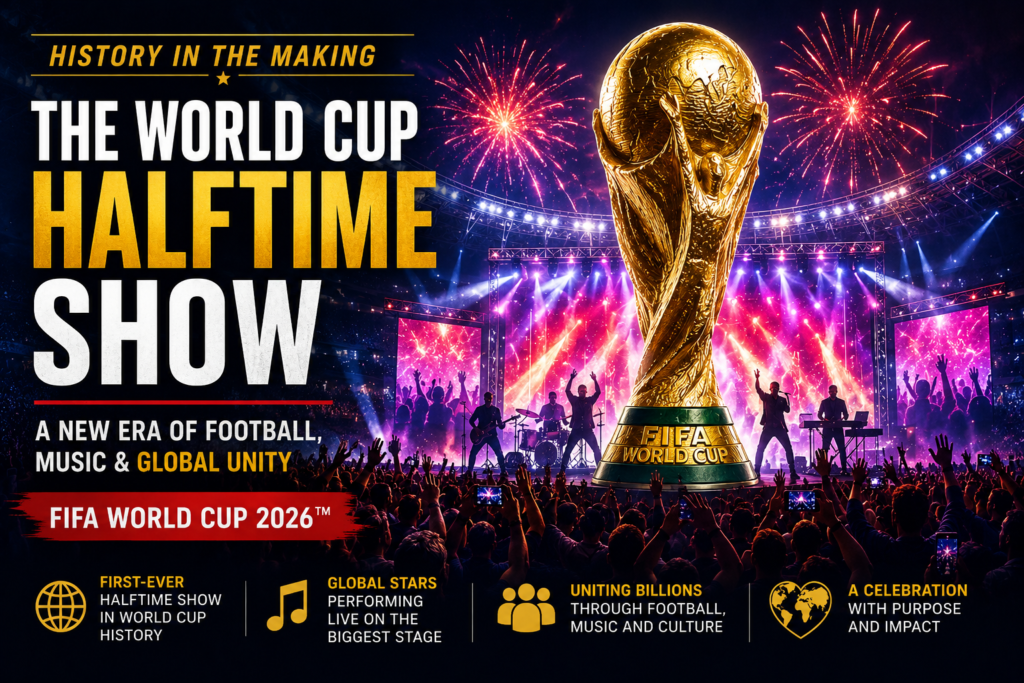
For generations, the FIFA World Cup final has followed a familiar rhythm. Forty-five minutes of football, a brief halftime interval for tactical adjustments, and another forty-five minutes that often decide sporting history. That routine has remained almost untouched despite decades of change across the game.
Now, that tradition has entered a new era.
The world cup halftime show has become one of the biggest talking points surrounding the 2026 FIFA World Cup final. Instead of a quiet intermission, fans are witnessing a large-scale live entertainment production featuring internationally recognized music stars. It marks the first time FIFA has introduced a Super Bowl-style halftime performance during the men’s World Cup final, signaling a major shift in how the organization presents its flagship event.
While millions are excited about the spectacle, others are asking important questions. Will the added entertainment enhance the experience? Could it distract from football’s biggest match? And what does this change mean for future World Cups?
This article explores the story behind FIFA’s historic decision, why the halftime show matters, and how it could reshape the future of global sports entertainment.
A Historic First for the FIFA World Cup
The FIFA World Cup has always celebrated football above everything else. Opening ceremonies, cultural performances, and pre-match entertainment have been part of previous tournaments, but once kickoff arrived, the focus stayed entirely on the action.
Halftime traditionally lasted around 15 minutes. Players headed to the locker room, coaches adjusted tactics, broadcasters analyzed the first half, and fans caught their breath before the match resumed.
That formula remained unchanged for nearly a century.
The 2026 tournament breaks from that history by introducing an official halftime entertainment show during the final. FIFA announced the initiative months before the championship match, describing it as a landmark moment that combines football, music, and social impact on one of the world’s largest stages. The performance is produced alongside Global Citizen, while Coldplay’s Chris Martin helped curate the artistic lineup.
Rather than replacing football, FIFA says the goal is to create an unforgettable celebration that reflects the tournament’s worldwide audience.
Why FIFA Introduced a World Cup Halftime Show
The decision did not happen overnight.
Football has become more global than ever before. Every World Cup attracts billions of viewers across television, streaming platforms, mobile devices, and social media.
At the same time, sports organizations increasingly compete for attention in an entertainment-driven media landscape.
Several factors likely influenced FIFA’s decision.
Creating a Global Entertainment Event
Modern audiences expect more than just competition. They also want memorable moments that extend beyond the game itself.
Major sporting events now include:
- Celebrity appearances
- Live concerts
- Interactive fan experiences
- Social media campaigns
- Behind-the-scenes digital content
The World Cup already attracts enormous audiences. Adding premium entertainment creates another reason for viewers who may not usually watch football to tune in.
Reaching Younger Audiences
Generation Z and younger Millennials often consume sports differently than previous generations.
Many fans discover sporting moments through:
- TikTok clips
- Instagram Reels
- YouTube Shorts
- Live reaction videos
- Streaming highlights
A halftime performance featuring globally recognized artists creates additional viral moments that spread across multiple platforms within minutes.
That broader digital reach helps introduce football to audiences who might otherwise overlook the event.
Strengthening Football’s Cultural Influence
Football is already the world’s most popular sport.
Music is one of the world’s most universal languages.
Combining both creates an event capable of reaching virtually every demographic regardless of language or nationality.
Instead of limiting halftime to tactical discussions, FIFA has transformed it into another opportunity to celebrate culture, creativity, and global unity.
The Inspiration Behind the New Format
Whenever people discuss the world cup halftime show, another event quickly enters the conversation.
The NFL’s Super Bowl.
For decades, the Super Bowl halftime show has evolved into one of the most anticipated entertainment events anywhere in the world.
Some viewers watch primarily for the musical performance rather than the football game itself.
Legendary performers have used the Super Bowl stage to deliver career-defining performances, creating moments that remain part of pop culture years later.
FIFA has clearly recognized that entertainment can amplify a sporting event without replacing its competitive significance.
Still, there are important differences.
| FIFA World Cup Final | Super Bowl |
|---|---|
| Global football audience | Primarily North American audience |
| International national teams | Professional club franchises |
| Played every four years | Played annually |
| First halftime show in 2026 | Halftime tradition spanning decades |
| Football remains the central attraction | Entertainment has long been part of the event |
Although comparisons are inevitable, FIFA is creating its own version rather than copying the NFL outright.
The Star Power Behind the Event
One reason the announcement generated worldwide attention is the scale of the performer lineup.
FIFA confirmed that several internationally known artists would headline the historic performance, with Chris Martin serving as curator. Later announcements expanded the lineup even further, emphasizing the event’s global appeal and charitable mission.
The combination represents multiple musical styles, generations, and fan communities.
Instead of targeting one region, FIFA assembled performers with worldwide recognition.
That strategy reflects the tournament itself.
Every World Cup brings together nations from every continent.
The halftime show follows the same philosophy by showcasing artists whose music resonates across different cultures.
More Than Entertainment
One important aspect often overlooked is that the halftime show is tied to a broader charitable initiative.
According to FIFA, the event supports the FIFA Global Citizen Education Fund, which aims to expand educational opportunities and football access for children worldwide. FIFA has also pledged contributions connected to ticket sales for the tournament.
This means the performance serves multiple purposes:
- Global entertainment
- International cultural celebration
- Fundraising awareness
- Educational advocacy
- Worldwide broadcast event
That combination distinguishes it from many traditional sporting performances.
Why the Announcement Sparked Debate
Almost immediately after FIFA revealed its plans, opinions divided.
Some supporters welcomed the innovation.
Others questioned whether football should adopt traditions associated with American sports.
The discussion quickly expanded beyond music.
It became a conversation about football’s identity.
Supporters of the idea argue that:
- Football continues evolving.
- The World Cup already includes elaborate opening ceremonies.
- Millions enjoy both music and sport together.
- New traditions can coexist with old ones.
Critics raise different concerns.
Many worry about:
- Longer halftime breaks.
- Interrupting players’ momentum.
- Shifting attention away from the match.
- Commercializing football’s biggest occasion.
Neither perspective is unreasonable.
Instead, they highlight how deeply people care about preserving the traditions of the World Cup while also embracing innovation.
How Fans Around the World Reacted
Social media reflected almost every possible opinion.
Many younger fans celebrated the announcement, especially those who follow both football and international music.
Others appreciated the chance to see multiple global artists perform during one of the year’s biggest broadcasts.
Online discussions also showed significant skepticism.
Some lifelong football supporters argued that the World Cup does not need additional entertainment because the match itself already captures global attention.
Community discussions on Reddit illustrate this divide, with enthusiastic supporters praising the ambitious lineup while others expressing concern that football should remain the central focus.
Despite differing opinions, one thing became clear.
People everywhere were talking about the World Cup long before kickoff.
From FIFA’s perspective, that alone demonstrates the event’s enormous cultural impact.
A New Chapter in Football History
Every generation experiences moments that redefine sport.
The introduction of VAR.
Goal-line technology.
Expanded tournaments.
Women’s football reaching record audiences.
The 2026 world cup halftime show now joins that list of milestones.
Whether it becomes a permanent tradition or remains a one-time experiment will depend on fan reception, logistical success, and FIFA’s long-term vision.
One thing is certain.
The World Cup final is no longer only the biggest football match on Earth.
It has also become one of the largest entertainment stages in the world.