
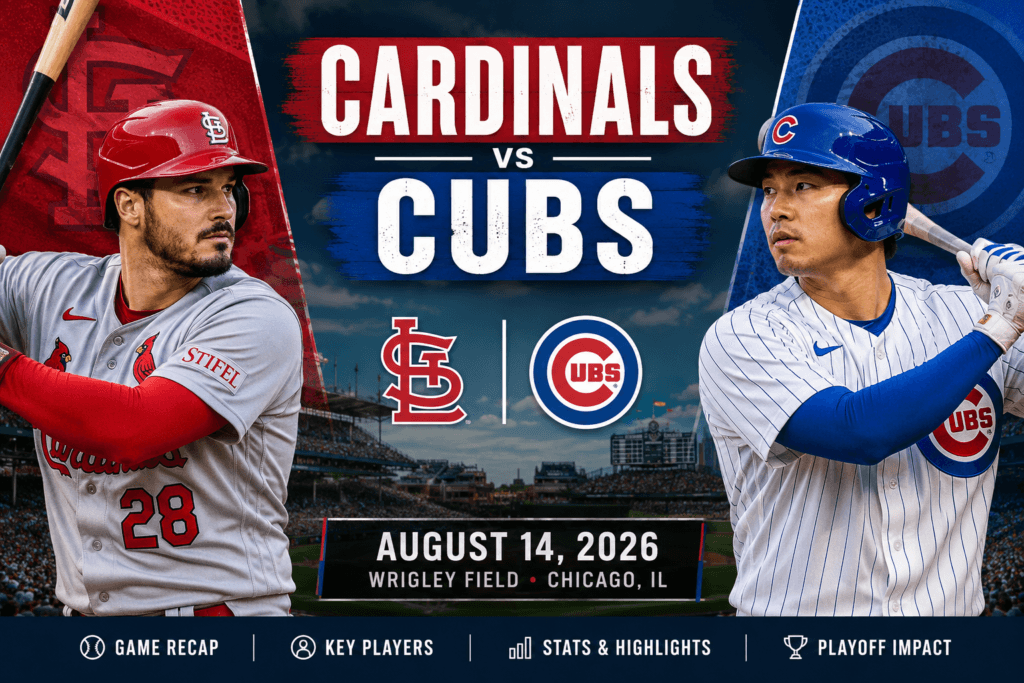
The Cardinals vs Cubs rivalry added another memorable chapter at Wrigley Field on August 14, 2026, as Chicago blanked St. Louis 3–0 in the opening game of their weekend series. The Cubs relied on outstanding pitching and one decisive offensive moment to take control of the matchup.
For most of the afternoon, neither lineup could break through. Clay Holmes kept the Cardinals off the scoreboard deep into the game, giving Chicago’s offense time to find an opening. That opportunity finally arrived in the sixth inning, when Seiya Suzuki launched a three-run homer that changed the entire complexion of the contest.
The Cubs then turned to their bullpen to protect the advantage. St. Louis managed only three hits and could not produce the late rally it needed, allowing Chicago to secure a convincing shutout victory.
However, the significance of this Cardinals vs Cubs matchup extends beyond one afternoon at Wrigley Field. Both teams entered the series with important postseason goals, although they were approaching the final stretch of the regular season from very different positions.
Chicago was looking to maintain its momentum and strengthen its position in the National League Central race. St. Louis, meanwhile, needed wins to keep its postseason hopes alive and build momentum during a critical part of August.
With more games still to be played, the series remains an important test for both clubs. Here’s a closer look at the August 14 result, the players who shaped the game, the latest standings picture, and what this rivalry could mean for the remainder of the 2026 season.
Cardinals vs Cubs: What Happened in the August 14 Game?
The August 14 matchup quickly became a pitching battle, with both teams struggling to generate offense during the early innings. Chicago eventually broke the deadlock in the sixth, and Suzuki’s three-run blast gave the Cubs the only runs they would need.
Holmes continued to control the Cardinals after Chicago took the lead, while the bullpen completed the shutout.
For St. Louis, the biggest frustration was the inability to turn limited opportunities into runs. For Chicago, the game demonstrated the value of combining efficient pitching with timely hitting.
The 3–0 final score also reflected the contrasting approaches of the two teams. The Cubs did not need a huge offensive performance because their pitching staff prevented St. Louis from creating sustained pressure.
That made the opening game an important early statement in the series.
Chicago’s Pitching Sets the Tone
The Cubs controlled the game from the mound and prevented the Cardinals from building sustained offensive pressure.
Clay Holmes delivered the key performance for Chicago, working deep into the game while keeping St. Louis scoreless. The bullpen then protected the lead and completed the shutout.
The final pitching effort was particularly impressive because Chicago did not need a large offensive output. Three runs were enough because the pitching staff allowed only three Cardinals hits.
That balance is important during a long MLB season. Teams will not score five, six or seven runs every night. Strong pitching gives a club another way to win when the bats are quiet.
For Chicago, Friday’s game was a clear example of that formula.
St. Louis Struggles to Convert Opportunities
The Cardinals faced a different problem.
Even when St. Louis managed to put traffic on the bases, the lineup could not turn those opportunities into runs. Against an opponent pitching confidently, that lack of production quickly became costly.
The Cardinals eventually found themselves chasing a three-run deficit, but Chicago’s bullpen never allowed the game to become competitive again.
For St. Louis, the immediate challenge is therefore not simply getting runners on base. The lineup needs timely hits that can change innings and put pressure on opposing pitchers.
That became one of the biggest differences between the two clubs in the opener.
Cardinals vs Cubs: Why Clay Holmes Was So Important
Clay Holmes entered the matchup with questions surrounding his form after returning from a fractured fibula. Instead of allowing those concerns to dominate the afternoon, he produced one of his strongest outings of the season.
Holmes retired the first 16 batters he faced before the Cardinals finally reached base. He ultimately worked 6⅔ scoreless innings, allowing only one hit and one walk.
That performance gave Chicago exactly what it needed in a divisional rivalry game.
Rather than forcing the Cubs to rely heavily on their bullpen early, Holmes carried the game deep into the afternoon. He also prevented St. Louis from creating the kind of early lead that could have changed Chicago’s offensive approach.
Holmes Controls the Early Innings
The opening innings were especially important because neither offense generated much momentum.
Holmes kept attacking the strike zone and avoided allowing extended baserunning sequences. As a result, St. Louis had very little opportunity to build a big inning.
That allowed Chicago’s hitters to remain patient.
The Cubs did not need to manufacture runs immediately. Instead, they could wait for one mistake or one favorable matchup.
That approach eventually paid off in the sixth inning.
Chicago’s Bullpen Finishes the Job
Once the Cubs established a 3–0 advantage, the bullpen took over.
Ryan Rolison, Ryan Zeferjahn and Jacob Webb combined to preserve the shutout and prevent the Cardinals from mounting a late comeback.
The performance gave Chicago a complete three-hit pitching effort.
That type of game can be especially valuable during a playoff race. A team that can win close games without exhausting its bullpen has an important advantage over the long stretch of a season.
Chicago received both elements on Friday: length from Holmes and a clean finish from the relievers.
Seiya Suzuki Delivers the Decisive Moment
While Holmes supplied the foundation, Seiya Suzuki delivered the moment that changed the game.
Chicago created pressure in the sixth inning when Tyrone Taylor reached base and moved into scoring position. Dansby Swanson then singled, creating an opportunity for the Cubs’ middle of the order.
Suzuki took advantage.
His three-run homer suddenly transformed a scoreless game into a 3–0 Chicago lead. More importantly, the Cubs did not need another offensive rally after that swing.
The timing of the home run was just as important as the power behind it.
Why Suzuki’s Home Run Mattered
A scoreless game can remain unpredictable until the final pitch. One defensive mistake, one extra-base hit or one well-placed single can change everything.
Suzuki’s home run eliminated much of that uncertainty.
With Holmes still pitching effectively, Chicago suddenly had enough breathing room to play from ahead. The Cubs could focus on protecting the lead rather than chasing additional runs.
That is precisely what they did.
Suzuki’s role also illustrates why middle-of-the-order production matters during a postseason push. A lineup does not always need several consecutive hits when one hitter can turn a small opportunity into multiple runs.
Suzuki’s Growing Importance to Chicago
Suzuki has become one of Chicago’s most important offensive players.
Earlier in the 2026 season, he reached 100 career Major League home runs, becoming the fourth Japanese-born player to reach that milestone.
His value, however, extends beyond his home-run total.
The Cubs need hitters capable of producing extra-base damage while also handling pressure situations. Against St. Louis, Suzuki provided exactly that combination.
One swing supplied every run Chicago would score.
Cardinals vs Cubs: The Bigger NL Central Picture
The rivalry becomes even more significant when viewed through the 2026 standings.
Entering the August 14 matchup, Chicago held a considerably stronger record than St. Louis. The Cubs were 61–46, while the Cardinals were 53–54.
Chicago had also been playing better baseball recently, giving the matchup an additional competitive edge.
Chicago Enters With Stronger Momentum
The Cubs entered the series after putting together a strong stretch of baseball during the summer.
According to a series preview published before the matchup, Chicago had gone 21–11 since early July.
That type of run can dramatically change the complexion of a division race.
The Cubs were not simply trying to remain competitive. They were positioning themselves for the final stretch of the season and attempting to close the gap on Milwaukee in the NL Central.
St. Louis Faces a Smaller Margin for Error
The Cardinals entered the matchup in a more difficult position.
Their record left them within the broader postseason conversation, but the club could not afford an extended losing streak. Games against division rivals therefore carried additional weight.
A series victory over Chicago could have helped St. Louis gain ground and build momentum.
Instead, the Cardinals opened the weekend with a shutout loss.
That does not determine their season, but it increases the importance of the games that follow.
What the August 14 Result Means for St. Louis
For the Cardinals, the shutout highlighted a familiar challenge: reaching base is only the first step.
A team must eventually turn opportunities into runs.
St. Louis could not create enough sustained pressure against Chicago’s pitching staff. Once Suzuki gave the Cubs a three-run lead, the Cardinals had no offensive answer.
Offensive Production Becomes the Key Question
The Cardinals entered the matchup with lower offensive production than Chicago across several important categories.
That difference becomes particularly important against a team capable of generating quick offense through power hitting.
If St. Louis cannot consistently score, its pitchers have very little margin for error.
A single three-run homer can therefore decide an entire game.
That is exactly what happened at Wrigley Field.
The Series Is Still Far From Over
One loss does not define a series or a season.
St. Louis still had opportunities to respond during the remainder of the weekend.
A strong performance in the next game could quickly change the narrative. However, another loss would increase the pressure surrounding the Cardinals as the regular season moves toward its final weeks.
For that reason, the response matters almost as much as the opening result.
What the August 14 Result Means for Chicago
The Cubs received almost everything they wanted from the series opener.
They received length from their starting pitcher, timely power from Suzuki and a clean performance from the bullpen.
Just as importantly, Chicago avoided turning the game into a high-scoring contest where one late mistake could have changed the result.
Chicago Shows Another Way to Win
The Cubs demonstrated a useful formula for postseason baseball.
They dominated the pitching matchup, waited patiently for an offensive opportunity and then protected their advantage.
That approach will not work identically every night, but having multiple ways to win is essential during a long MLB season.
Chicago’s recent form suggests that the club has been finding those different methods more consistently.
The NL Central Race Remains Important
Despite the strong victory, Chicago still had work to do in the division.
The Brewers remained ahead of the Cubs in the NL Central, meaning Chicago could not afford to relax.
Every divisional victory matters because it simultaneously improves the Cubs’ own record and prevents a rival from gaining ground.
The Cardinals, meanwhile, had every reason to fight back.
That made the rest of the series important for both teams, even though they entered it with different objectives.
Cardinals vs Cubs: How the Rivalry Has Shaped the 2026 Season
The Cardinals vs Cubs rivalry has carried more than its usual divisional importance in 2026. The teams entered their August series with very different postseason situations, yet both had plenty to play for at Wrigley Field.
Chicago arrived after a strong road trip in which the Cubs went 4–2 in Washington. That stretch pushed their season record to 71–51 and kept them within striking distance of the Brewers in the NL Central.
St. Louis, meanwhile, reached the weekend at 61–61. Although the Cardinals had endured an inconsistent stretch, they had recently kept their postseason hopes alive with a series of encouraging results against quality opponents.
That contrast made the series especially interesting.
For Chicago, the goal was to keep pressure on Milwaukee and strengthen its position among the National League’s leading contenders. For St. Louis, the priority was different. The Cardinals needed wins to remain part of the Wild Card conversation and avoid allowing the final weeks of the regular season to become a long uphill climb.
A Divisional Rivalry With Playoff Consequences
The Cubs and Cardinals are familiar opponents, but the standings add urgency to every meeting.
Division games can have a double effect. A victory improves one team’s record while simultaneously handing a loss to a direct rival.
That makes the August series more valuable than an ordinary three-game set.
Chicago’s 3–0 opening victory therefore gave the Cubs another boost at a crucial point in the season. St. Louis, on the other hand, immediately faced pressure to respond.
Cardinals vs Cubs: Saturday’s Pitching Matchup
The second game of the series featured another intriguing pitching contrast.
Chicago was scheduled to send Matthew Boyd to the mound, while St. Louis planned to counter with Michael McGreevy. Boyd entered the matchup with an 8–1 record and a 3.50 ERA, while McGreevy carried a 4–9 record with a 3.64 ERA.
Those records do not tell the entire story, but they illustrate why Chicago entered Saturday with considerable confidence.
Matthew Boyd Gives Chicago Stability
Boyd had become an important part of the Cubs’ rotation during their push toward the top of the NL Central.
His job against St. Louis was not necessarily to match Holmes’ exact performance from Friday. Instead, Chicago needed another quality start that could keep the Cardinals from generating an early advantage.
That becomes particularly important after a shutout victory.
When a team wins the opening game of a series behind dominant pitching, the following starter can help maintain the momentum. If Boyd could work efficiently and prevent St. Louis from producing a large inning, Chicago’s offense would have a strong opportunity to create another advantage.
Michael McGreevy Faces a Difficult Assignment
McGreevy entered Saturday looking to give the Cardinals a stronger answer after Friday’s offensive shutout.
The challenge was significant because Chicago’s lineup had already demonstrated that it could punish a mistake.
St. Louis therefore needed McGreevy to keep the game manageable while giving the offense enough time to find its rhythm.
A low-scoring game would favor the Cardinals if their hitters could finally convert opportunities. However, another early deficit would place additional pressure on a lineup that had struggled to generate runs in the series opener.
Cardinals vs Cubs: Players Who Could Change the Series
Every rivalry series has familiar stars, but the August matchup also created opportunities for less-established players to become important.
Chicago entered the weekend with a deep collection of offensive contributors, while St. Louis was looking for additional production as it attempted to remain in the postseason race.
Seiya Suzuki Remains a Major Offensive Threat
Suzuki immediately became the headline player after his three-run homer decided Friday’s game.
He finished the opener with two hits, including the home run and a double. His performance also continued a strong stretch in which he had recorded four two-hit games across his previous six contests.
That type of consistency matters because Chicago does not have to rely on one specific offensive formula.
Suzuki can change a game with one swing, but his ability to produce multiple hits also gives the Cubs more opportunities to build innings.
Pete Crow-Armstrong Adds Another Dimension
Pete Crow-Armstrong remained another important name for Chicago.
His value is not limited to the batting order. His speed and defense can influence games even when he does not collect multiple hits.
That becomes especially important in close divisional contests.
When pitching keeps the score low, a defensive play or baserunning decision can become just as valuable as a home run. Chicago’s overall roster gives the Cubs several ways to win those types of games.
Alec Burleson Leads St. Louis’ Offensive Push
The Cardinals entered the series looking to Alec Burleson for offensive production.
Burleson had returned to stronger form during the Cardinals’ recent push, making him one of the hitters Chicago needed to manage carefully.
If St. Louis is going to turn the series around, productive at-bats from its established hitters will be critical.
The Cardinals cannot afford to depend entirely on isolated home runs. They need baserunners, productive outs and timely hits to put pressure on Chicago’s pitching staff.
Joshua Baez Adds a New Storyline for the Cardinals
The Cardinals also introduced an intriguing new element during the series.
St. Louis called up outfield prospect Joshua Baez, who made his Major League debut against Chicago. MLB Pipeline had ranked Baez as the organization’s No. 3 prospect and No. 59 overall prospect.
His promotion came at an important moment.
The Cardinals were attempting to stay alive in the postseason race, so the club had an opportunity to evaluate a young player while also searching for an offensive spark.
Why Baez’s Promotion Matters
Baez arrived with significant power potential.
At Triple-A Memphis, he had produced 34 home runs and 90 RBIs in 103 games before his promotion. Those numbers showed why the Cardinals were interested in seeing whether his power could translate against Major League pitching.
However, his development still involves questions.
Plate discipline has been an area requiring continued attention, and Major League pitchers can expose weaknesses much faster than Triple-A competition.
That makes his debut particularly interesting.
The Cardinals do not need Baez to become a superstar overnight. Instead, they need to determine whether his tools can help the club immediately while also becoming part of its longer-term offensive foundation.
Cardinals vs Cubs: What Chicago’s Recent Form Says
Chicago entered the weekend playing some of its best baseball of the season.
The Cubs had gone 21–11 since early July, according to the series preview published before the matchup. They also finished their most recent road trip with a 4–2 record.
That momentum changed the expectations surrounding the series.
Nine Wins in the Last Eleven Games
The Cubs’ form became even more impressive after Friday.
The 3–0 victory over St. Louis represented Chicago’s ninth win in its previous 11 games.
That kind of run can have a major psychological effect during August.
Players begin to trust the pitching staff. Close games become more manageable. The lineup does not need to score excessively because the team knows its pitchers can protect small leads.
Chicago demonstrated all of those characteristics in the opener.
The Cubs did not overwhelm St. Louis offensively. Instead, they waited until the sixth inning and then used one powerful sequence to take control.
Why Momentum Matters in August
August is when the postseason race becomes increasingly difficult to ignore.
Teams can no longer rely on the idea that there is plenty of time to recover. Every series has greater significance because the number of remaining opportunities continues to shrink.
For Chicago, recent momentum provides valuable breathing room.
For St. Louis, the opposite is true.
The Cardinals need their good stretches to last longer and their bad stretches to become shorter. Otherwise, even a strong September could arrive too late.
Cardinals vs Cubs: What the Series Means for the Wild Card Race
The Cubs and Cardinals were approaching the weekend from different positions in the National League postseason picture.
Chicago was fighting near the top of the standings, while St. Louis was trying to remain close enough to the Wild Card contenders to make a late-season push realistic.
Chicago Wants More Than a Wild Card Spot
The Cubs’ objectives extend beyond simply qualifying for October.
Their position in the NL Central means the division title remains a major target. Chicago was chasing Milwaukee rather than merely trying to survive the Wild Card race.
That distinction matters.
Winning the division can provide a much more favorable postseason path, while finishing lower in the standings can create additional pressure immediately.
Consequently, Chicago has strong motivation to continue winning divisional games.
St. Louis Needs to Build a Run
The Cardinals entered the series with less room for mistakes.
Their 61–61 record meant they needed to turn competitive stretches into sustained winning baseball.
A single series win would not guarantee a postseason berth. However, accumulating victories against strong opponents could keep the Cardinals within reach of the Wild Card field.
That is why the loss on Friday hurt.
Still, the weekend was not finished. St. Louis had opportunities to respond, and a victory in the next game could immediately reduce some of the pressure created by the opener.
Cardinals vs Cubs: The Final Regular-Season Meetings Matter
The August series carried another interesting detail: it was scheduled to conclude the teams’ regular-season meetings unless they eventually met again in the postseason.
According to the series preview, the season series was tied at five wins apiece entering the weekend.
That made the final meetings particularly meaningful.
A Rivalry That Could Continue in October
A postseason meeting would completely change the stakes.
Regular-season games determine positioning, but playoff games determine survival.
If both clubs reach October, their familiarity with one another could become an advantage. Pitchers know opposing hitters. Hitters have seen the same arsenals repeatedly. Managers also have a deeper understanding of the other team’s tendencies.
However, neither team could assume a postseason rematch would happen.
Chicago’s immediate priority was the division race, while St. Louis needed to keep its Wild Card hopes alive.
That tension made the August series an important checkpoint.
Why Every Remaining Game Matters
The closer a season gets to September, the less room teams have to correct mistakes.
For Chicago, the goal is to turn its recent momentum into a strong finish.
For St. Louis, the challenge is to create enough momentum to make the final weeks meaningful.
The rivalry therefore becomes more than a traditional NL Central matchup.
It becomes a measuring stick.
Chicago can use the series to show that it belongs among the National League’s strongest teams. St. Louis can use it to demonstrate that its postseason ambitions are still realistic.
That is what makes the Cardinals vs Cubs matchup so compelling in August 2026.
Cardinals vs Cubs: How the Teams Compare Statistically
The numbers provide useful context for understanding why Chicago entered the August series in a stronger position.
The Cubs had built advantages in several major offensive categories, while the Cardinals were trying to close the gap through pitching, timely hitting and improved consistency.
That difference became obvious during the August 14 opener.
Chicago scored only three runs, yet those three runs were enough because the pitching staff limited St. Louis to three hits and no runs.
Chicago’s Offensive Advantage
Entering the series, Chicago held advantages in batting average, on-base percentage, slugging percentage and OPS.
Those statistics matter because they measure different parts of offensive performance.
Batting average shows how often hitters collect hits. On-base percentage captures a team’s ability to reach safely. Slugging percentage measures extra-base production, while OPS combines on-base ability and power.
The Cubs’ stronger overall profile suggested that they were better equipped to create scoring opportunities.
However, the August 14 game also demonstrated that regular-season averages do not guarantee a particular result.
Chicago generated just enough offense at the right moment.
That distinction is important during close games. A team can have excellent season-long offensive numbers but still struggle on a particular afternoon if opposing pitching controls the matchup.
St. Louis Needs More Consistency
The Cardinals’ challenge is therefore not necessarily finding one superstar performance.
They need more consistent contributions throughout the lineup.
When several hitters reach base in the same game, St. Louis becomes much harder to pitch against. However, when the lineup becomes dependent on isolated hits, opposing starters can attack more aggressively.
The Cardinals need to turn individual offensive ability into collective production.
That will be especially important during the final weeks of the season.
Cardinals vs Cubs: Why Pitching Could Decide the Rivalry
The opening game offered a clear example of how pitching can overpower offensive expectations.
Chicago’s staff combined for a three-hit shutout, with Clay Holmes leading the way before the bullpen completed the job.
That performance showed why the Cubs can be dangerous even when their lineup does not produce a large number of runs.
Starting Pitching Gives Chicago an Edge
Quality starts have become increasingly important for Chicago during its push toward the top of the National League.
Holmes’ outing gave the Cubs nearly seven innings of scoreless baseball. That reduced the workload on the bullpen and allowed Chicago to use its relievers in controlled situations.
The value of that cannot be overstated.
A strong starting pitcher can influence the entire structure of a game. The offense can remain patient, the defense can play with a lead and the bullpen can avoid being exposed too early.
Chicago received all three benefits on Friday.
St. Louis Needs Its Starters to Match
The Cardinals face a similar requirement, although the margin for error may be smaller.
If St. Louis pitchers can consistently keep games within one or two runs, the Cardinals’ hitters have opportunities to change the outcome late.
However, falling behind by several runs creates a much more difficult challenge.
That is why the pitching matchup remains one of the most important elements of every Cardinals vs Cubs game.
Neither lineup wants to spend the entire afternoon trying to recover from an early deficit.
Cardinals vs Cubs: The Importance of Wrigley Field
Playing at Wrigley Field adds another layer to this rivalry.
The historic Chicago ballpark creates a different atmosphere from most Major League venues, and the Cubs have generally been much stronger at home than on the road during the 2026 season.
Entering the series, Chicago had a 40–20 home record, according to the available matchup data. (thescore.com)
Home Advantage Gives Chicago Confidence
A strong home record can influence the way a team approaches a series.
Players are familiar with the field, daily routines are more predictable and the crowd can become an additional source of energy during important moments.
The Cubs took advantage of that environment on August 14.
The game remained scoreless for much of the afternoon, but Chicago did not appear rushed. Once Suzuki delivered the three-run homer, the home team could rely on its pitching to protect the advantage.
Wrigley Can Reward Timely Power
Wrigley Field is also a venue where weather and wind can influence how the ball travels.
That does not mean every game becomes a home-run contest. Instead, hitters and pitchers must constantly adjust to the conditions.
Suzuki’s three-run homer demonstrated the value of taking advantage when an opportunity appears.
For visiting teams such as St. Louis, controlling those situations becomes even more important.
A small mistake can become a major turning point.
Cardinals vs Cubs: A Rivalry Built on More Than Standings
The Cardinals vs Cubs rivalry is one of Major League Baseball’s most recognizable divisional rivalries.
The teams share the National League Central and have faced one another for generations. Their proximity, history and large fan bases have helped make their meetings especially intense.
Chicago and St. Louis Have Different Baseball Identities
The rivalry is partly interesting because the two cities have developed distinct baseball cultures.
Baseball is only one part of the wider American sports conversation, where major rivalries, personalities and unexpected moments can quickly become national talking points. Similar attention followed the recent Tom Brady and Logan Paul incident at Fanatics Fest, which became one of the more discussed moments in sports entertainment.
Chicago’s Cubs are closely associated with Wrigley Field and one of the sport’s most famous fan traditions.
St. Louis, meanwhile, has built its baseball identity around Busch Stadium and a long history of competitive teams.
That cultural connection makes the rivalry larger than a simple standings matchup.
Sports rivalries often become bigger than the competition itself when they connect different generations, eras or fan bases. A similar theme appeared in the Messi vs Yamal World Cup final matchup, where the contrast between established greatness and emerging talent became part of the wider story.
Fans follow these games because the result matters locally even when the broader postseason picture is uncertain.
Division Games Carry Extra Weight
Because both teams compete in the same division, they repeatedly influence each other’s standings.
A Cubs victory against St. Louis is simultaneously a loss for a potential Wild Card competitor.
Likewise, a Cardinals win can slow Chicago’s pursuit of the division title.
That competitive relationship creates a natural source of tension every time the teams meet.
In 2026, that importance has become even more noticeable because the clubs entered August with very different postseason objectives.
Cardinals vs Cubs: What a Postseason Meeting Could Look Like
A potential playoff meeting between Chicago and St. Louis would be dramatically different from the regular season.
The margin for error would become extremely small.
One defensive mistake, one missed opportunity with runners in scoring position or one poorly located pitch could decide an entire game.
Chicago Would Rely on Its Depth
The Cubs’ biggest advantage could be their ability to win in different ways.
They can rely on starting pitching, bullpen depth, power hitting and defensive contributions.
That flexibility becomes especially valuable during a postseason series because opponents can remove weaknesses from their game plan over several contests.
Chicago would need to keep producing offense without becoming overly dependent on one hitter.
Suzuki’s power would certainly matter, but a playoff opponent would likely build a specific strategy around limiting his opportunities.
St. Louis Would Need Timely Offense
For the Cardinals, postseason success would likely depend on maximizing every scoring opportunity.
They cannot afford long stretches where the lineup produces little pressure.
Their pitchers could keep games close, but the offense would eventually need to provide enough support.
That is why the development of young hitters could become increasingly important.
Players such as Joshua Baez could provide additional power and athleticism if they adapt quickly to Major League pitching.
A playoff matchup would also test how effectively St. Louis can adjust from game to game.
Cardinals vs Cubs: What Fans Should Watch in the Next Games
The remainder of the series offers several storylines beyond the final score.
Fans should pay particular attention to the way each team responds to the opening game.
Can St. Louis Generate Early Offense?
The first question is whether the Cardinals can score before Chicago’s pitching settles into the game.
Friday’s shutout showed the danger of falling behind against a confident Cubs staff.
If St. Louis can produce an early run, the entire dynamic changes.
Chicago would have to play from behind, while the Cardinals’ pitchers could attack more aggressively.
Can Chicago’s Rotation Maintain the Momentum?
The Cubs’ rotation also deserves attention.
Holmes delivered a dominant opening performance, but one excellent start is only useful if the following games maintain a similar level.
If Chicago’s starters continue working deep into games, the Cubs can preserve their bullpen while keeping pressure on opponents.
That could become a major advantage during the final stretch of the season.
Which Team Wins the Late-Inning Battle?
Close games often come down to the final three innings.
Chicago showed on Friday that it could protect a three-run advantage without allowing St. Louis to create a serious threat.
The Cardinals need to reverse that pattern.
If their offense reaches the late innings with a chance to win, the series becomes much more competitive.
Cardinals vs Cubs: The Biggest Questions Still Remaining
The August series does not answer every question surrounding either club.
Instead, it provides clues about what could happen during the final portion of the 2026 regular season.
Can Chicago Catch Milwaukee?
The Cubs’ recent form has placed pressure on the Brewers.
Chicago’s objective is no longer simply to remain relevant. The club has a realistic opportunity to challenge for the division, making every victory increasingly valuable.
The key will be maintaining consistency.
A strong August is useful, but the Cubs need that performance to continue into September.
Can St. Louis Stay in the Postseason Conversation?
The Cardinals face the more urgent question.
At 61–61 entering the series, they needed a strong stretch to improve their position.
That does not mean the postseason door was closed.
However, the Cardinals could not afford to waste many more opportunities against division opponents.
The response after Friday’s shutout therefore became one of the most important immediate indicators of their trajectory.
Will Young Players Change the Equation?
St. Louis’ decision to promote Joshua Baez adds another variable.
If young players can provide unexpected production, the Cardinals could become more dangerous than their record suggests.
If they struggle, the club may need to rely more heavily on its established veterans.
Either way, player development becomes part of the larger postseason story.
Cardinals vs Cubs: Why This August Series Matters
The August 14 game was only one contest, but it captured the larger story surrounding these teams.
Chicago entered with momentum, stronger overall numbers and a clear goal of challenging for the NL Central.
St. Louis entered with less room for error and a need to turn promising stretches into sustained winning baseball.
The Cubs won the opening game by combining three elements: elite starting pitching, one decisive offensive swing and a reliable bullpen.
That formula will not guarantee victory in every remaining matchup.
However, it explains why Chicago has positioned itself as one of the more dangerous teams in the National League.
For St. Louis, the lesson is equally clear.
The Cardinals need timely offense, stronger consistency and contributions from both established players and emerging talent.
The rivalry is therefore about more than bragging rights.
It is about positioning, momentum and the opportunity to shape the final weeks of the 2026 season.
With the postseason race tightening, every remaining Cardinals vs Cubs matchup carries consequences far beyond the box score.
Cardinals vs Cubs: What to Expect From the Series Finale
The Cardinals vs Cubs series was scheduled to conclude on Sunday, August 16, at Wrigley Field. MLB’s official preview listed the finale as the third game of the weekend set, with Shota Imanaga expected to start for Chicago against Hunter Dobbins for St. Louis.
The matchup gives both clubs another opportunity to address the weaknesses exposed during the opening game.
Chicago entered the weekend with a strong record and significant momentum, while St. Louis was trying to stay relevant in the postseason race. After the Cubs took the first game 3–0, the Cardinals needed to respond quickly if they wanted to avoid losing the series.
Shota Imanaga Gives Chicago Another Quality Option
Imanaga’s presence gives the Cubs another experienced starter capable of controlling the pace of a game.
Chicago’s rotation had already received an excellent performance from Clay Holmes in the opener. If Imanaga can provide another strong outing, the Cubs can put additional pressure on St. Louis’ offense.
That is especially important because the Cardinals have struggled at times to generate consistent scoring.
Hunter Dobbins Faces a Major Test
Dobbins represents an opportunity for St. Louis to see how a younger pitcher handles a high-pressure divisional matchup.
The Cardinals’ pitching staff needs to keep the game close. If Dobbins can prevent Chicago from building an early lead, St. Louis’ hitters have a better chance of turning the finale into a competitive contest.
The Sunday matchup could therefore provide another useful indicator of how both organizations are preparing for the final stretch.
Cardinals vs Cubs: How the 2026 Season Series Has Developed
The rivalry entered the August weekend with the season series tied at five victories apiece. The August 14 game gave Chicago the first advantage of the final regular-season series.
That balance demonstrates how competitive some of the earlier meetings had been.
St. Louis Already Has a Recent Extra-Inning Win
The Cardinals had previously defeated the Cubs 3–2 in 10 innings on July 29. Ivan Herrera delivered the decisive two-run double in that game after going 3-for-5.
That result is useful context because it shows that St. Louis has already demonstrated an ability to beat Chicago in a tight game.
The Cardinals do not necessarily need to dominate the Cubs.
They simply need to create situations where their pitching can keep the game close and their hitters can capitalize late.
Chicago Has Also Shown Offensive Explosiveness
Chicago’s offense has produced much larger scoring outputs during its recent run.
Just before the Cardinals series, the Cubs defeated Washington 12–6, with Alex Bregman hitting three home runs and driving in seven runs. Dansby Swanson also contributed a home run and an RBI double.
That performance illustrates the range of Chicago’s offense.
The Cubs can win a low-scoring pitching battle, as they did against St. Louis on August 14, or they can overwhelm an opponent with power.
That versatility makes them particularly difficult to prepare for.
Cardinals vs Cubs: What Makes Chicago Difficult to Beat
Chicago’s biggest strength may be its ability to win games without depending on one specific formula.
The Cubs can use starting pitching to control a game, rely on their bullpen late or create a sudden offensive burst.
That flexibility becomes increasingly valuable as the postseason approaches.
The Cubs Have Multiple Offensive Threats
Seiya Suzuki is an obvious example, but Chicago’s lineup contains several hitters capable of changing a game.
Suzuki’s three-run homer against St. Louis demonstrated how quickly the scoreboard can change. Bregman’s recent three-homer performance against Washington offered another example.
That means opposing pitchers cannot afford to focus exclusively on one batter.
If a pitcher works carefully around Suzuki, another hitter can potentially take advantage.
Timely Hitting Is Especially Important
Chicago’s August 14 victory also showed that overall offensive volume is not always necessary.
The Cubs generated their three runs during one crucial inning and then allowed the pitching staff to protect the lead.
That efficiency can become extremely valuable during a postseason race.
Cardinals vs Cubs: What St. Louis Must Improve
The Cardinals’ biggest priority is offensive consistency.
The 3–0 loss highlighted how difficult it becomes to win when the lineup cannot turn baserunners into meaningful scoring opportunities.
More Pressure on Opposing Pitchers
St. Louis needs longer innings.
That means avoiding quick outs, moving runners into scoring position and forcing opposing starters to work deeper into their pitch counts.
A lineup that consistently reaches base can eventually create opportunities even against excellent pitching.
The Cardinals also need their middle-order hitters to deliver when those opportunities arrive.
Young Talent Could Provide a Spark
Joshua Baez adds an intriguing dimension to the Cardinals’ roster.
Before his promotion, Baez had produced 34 home runs and 90 RBIs in 103 games for Triple-A Memphis. MLB Pipeline had ranked him as the Cardinals’ No. 3 prospect and No. 59 overall prospect.
However, expectations should remain realistic.
Young players often need time to adjust to Major League pitching. The value of Baez’s promotion may therefore extend beyond immediate production.
The Cardinals can evaluate whether his power and athletic ability can become part of the organization’s next competitive core.
Cardinals vs Cubs: Frequently Asked Questions
Who won the latest Cardinals vs Cubs game?
The Chicago Cubs defeated the St. Louis Cardinals 3–0 on August 14, 2026, at Wrigley Field. Clay Holmes pitched 6⅔ scoreless innings, while Seiya Suzuki hit a three-run home run that supplied all of Chicago’s runs.
Who hit the home run for the Cubs?
Seiya Suzuki hit the decisive three-run home run in the sixth inning. The homer broke a scoreless game and gave Chicago a 3–0 lead that it never surrendered.
How did Clay Holmes perform against the Cardinals?
Holmes delivered 6⅔ scoreless innings and allowed only one hit and one walk. His performance was the foundation of Chicago’s shutout victory.
What was the Cardinals vs Cubs season series before the August matchup?
The teams entered their final regular-season series tied 5–5 in their season series. Chicago then won the August 14 opener to move ahead.
Where are the Cardinals and Cubs playing?
The August 14–16 series is being played at Wrigley Field in Chicago, giving the Cubs home-field advantage throughout the weekend.
What was the Saturday Cardinals vs Cubs pitching matchup?
Matthew Boyd was scheduled to start for Chicago against Michael McGreevy of St. Louis on Saturday, August 15. Boyd entered with an 8–1 record and a 3.50 ERA, while McGreevy was listed at 4–9 with a 3.64 ERA.
Who was the Cardinals’ notable prospect in the series?
Outfielder Joshua Baez was promoted by St. Louis and made his Major League debut during the series. He entered with substantial power numbers from Triple-A Memphis, including 34 home runs and 90 RBIs.
Why is the Cardinals vs Cubs rivalry important?
The rivalry matters because the teams share the National League Central and regularly compete for overlapping postseason goals. Divisional wins can influence both clubs’ standings while also affecting the Wild Card race.
Could the Cardinals and Cubs meet again in the playoffs?
Yes. A postseason meeting would be possible if both teams qualify for October and their playoff paths lead to a matchup. However, a regular-season rivalry game and a postseason series carry very different stakes.
Cardinals vs Cubs: Final Takeaway
The latest Cardinals vs Cubs matchup illustrates how different the two teams’ situations had become by August 2026.
Chicago entered the weekend with strong momentum, a 72–51 record after Friday’s victory, and continued ambitions in the NL Central. St. Louis, at 61–61 entering Saturday, was fighting for every opportunity to remain part of the postseason conversation.
The opening game followed Chicago’s preferred formula.
Holmes controlled the game from the mound. Suzuki provided the decisive offensive blow. The bullpen protected the advantage.
For St. Louis, the lesson was straightforward: the Cardinals need to create more offensive pressure and make better use of limited opportunities.
For Chicago, the victory reinforced why the Cubs are a dangerous opponent.
The most interesting part of the Cardinals vs Cubs story, however, is that the rivalry is not simply about one 3–0 result. It is about what these games reveal about two teams heading toward the most important portion of the regular season.
Chicago is trying to turn momentum into a division challenge.
St. Louis is trying to turn competitiveness into a postseason opportunity.
Those goals make every remaining game meaningful.
And because the teams entered the final regular-season series tied at 5–5, the August meetings also offered one final chance to establish bragging rights before a potential October rematch.
For baseball fans, that is what keeps the Cardinals vs Cubs rivalry compelling: the history gives every matchup emotion, while the standings give every matchup consequences.
That broader appeal is also visible across major sporting events, where competition increasingly extends beyond the field and into entertainment, culture and the fan experience. Our coverage of the World Cup halftime show explores how major sporting events are evolving into larger global entertainment spectacles.