
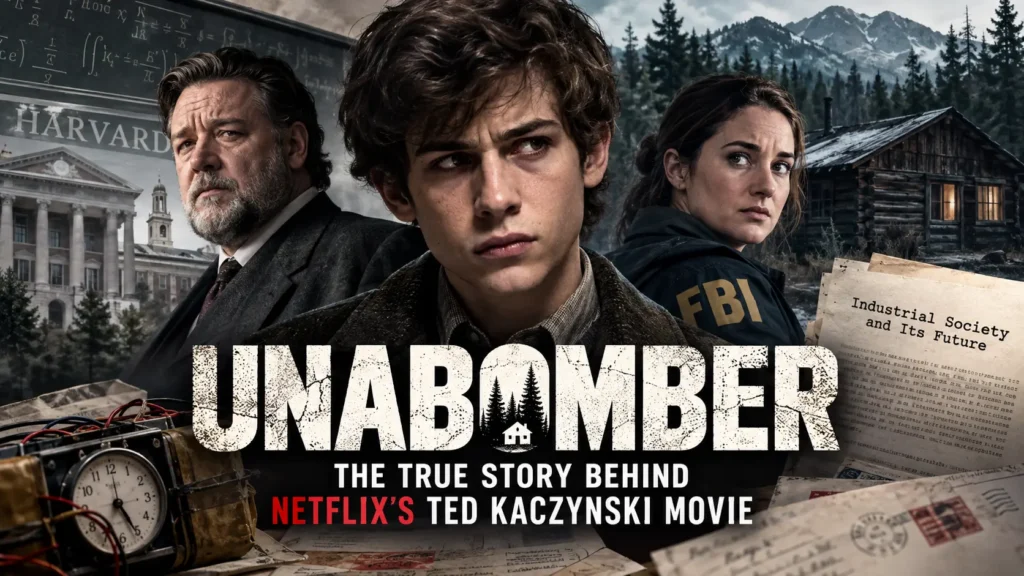
Netflix’s Unabomber revisits one of the most notorious criminal investigations in modern American history. The 2026 drama follows Ted Kaczynski, the mathematician who became known as the Unabomber, while exploring the experiences that the film connects to his later life. Jacob Tremblay plays the young Kaczynski, with Russell Crowe and Shailene Woodley among the principal cast. Netflix describes the film as a drama inspired by true events, not a documentary reconstruction.
The real case unfolded over nearly two decades. Beginning in 1978, Kaczynski carried out a series of bombings involving university-related targets, businesses and other individuals. The FBI eventually assembled a major multi-agency investigation, but identifying the person behind the attacks took years. The breakthrough came after the publication of Kaczynski’s manifesto helped investigators connect his writings to evidence already gathered during the case.
Understanding the Unabomber therefore requires more than watching the movie. The historical record includes Kaczynski’s exceptional academic background, his years at Harvard and Berkeley, his move toward an isolated life in Montana, the bombing campaign and the investigative steps that eventually led authorities to his cabin.
What Is Netflix’s Unabomber Movie About?
Netflix’s Unabomber examines Ted Kaczynski’s transformation from a gifted young mathematician into the fugitive eventually identified as the Unabomber. The film moves between different periods of his life, using his academic years and the later FBI investigation as two connected parts of the story. Netflix says the movie follows Kaczynski from Harvard prodigy to the Unabomber while investigators work to find him.
Janus Metz directed the film from a screenplay by Sam Chalsen and Nelson Greaves. Jacob Tremblay plays young Ted Kaczynski, Russell Crowe portrays Harvard psychologist Henry Murray, and Shailene Woodley plays FBI agent Joanne Miller. Annabelle Wallis also appears as Christiana Morgan, Murray’s academic partner.
The film takes a dramatized approach to a documented criminal case. That distinction matters. A feature film can compress events, combine characters and reshape chronology to create a focused narrative. As a result, viewers should distinguish established facts about Kaczynski and the FBI investigation from elements created or emphasized for dramatic purposes.
Netflix released Unabomber on September 25, 2026. The movie runs approximately 1 hour and 40 minutes and is categorized as a drama, thriller and film based on real life.
Who Plays Ted Kaczynski?
Jacob Tremblay portrays the young Ted Kaczynski in Unabomber. His performance focuses on Kaczynski during his Harvard years, when the future bomber was still a mathematics student rather than the fugitive later pursued by the FBI. Netflix says director Janus Metz wanted Tremblay to anchor the film’s dual timeline because of the actor’s ability to portray both intelligence and vulnerability.
Russell Crowe plays Henry Murray, the Harvard psychologist whose work with Kaczynski becomes an important part of the movie’s earlier timeline. Shailene Woodley portrays FBI agent Joanne Miller, a fictional character created for the film’s investigation storyline.
That casting gives the movie three central perspectives:
- Jacob Tremblay: young Ted Kaczynski
- Russell Crowe: Harvard psychologist Henry Murray
- Shailene Woodley: FBI agent Joanne Miller
The historical investigation involved many real investigators and agencies, so Woodley’s character should not be treated as a one-to-one representation of the entire FBI task force. Instead, the film uses her character to dramatize the later hunt for Kaczynski.
Who Was the Unabomber, Ted Kaczynski?
The man known as the Unabomber was Theodore John Kaczynski, a mathematician whose academic career began with remarkable achievements before he withdrew from conventional professional life. He entered Harvard at 16, later earned a doctorate in mathematics from the University of Michigan and became a mathematics professor at the University of California, Berkeley.
Kaczynski eventually left academia and moved to a remote property near Lincoln, Montana. There, he lived in a small cabin and maintained an isolated existence. The FBI later identified that cabin as the place where investigators found extensive evidence connected to the bombing campaign.
His background made the case particularly difficult to understand and investigate. Kaczynski possessed advanced mathematical training, lived far from major population centers and carefully avoided drawing attention to himself. Meanwhile, the bombs he constructed created a trail of victims across different locations and institutions.
The FBI says Kaczynski carried out 16 bombings between 1978 and 1995. Three people died and 23 were injured during the campaign. Investigators spent nearly two decades trying to identify the person responsible.
The contrast between Kaczynski’s academic accomplishments and his later crimes became one of the defining elements of the case. It also provides the foundation for Netflix’s decision to begin its story with his younger years rather than opening solely with the FBI manhunt.
From Harvard Prodigy to Mathematics Professor
Kaczynski entered Harvard University at just 16 years old, beginning an academic path that would eventually lead to a doctorate in mathematics. He later joined the University of California, Berkeley, as a mathematics professor.
His early academic success is central to Unabomber because the film spends substantial time examining his years at Harvard. Netflix describes Kaczynski as a Harvard prodigy and makes his experiences with psychologist Henry Murray a major part of the story.
After leaving Berkeley, Kaczynski moved toward an increasingly isolated existence. He eventually settled near Lincoln, Montana, where he lived in a small cabin. According to the FBI, investigators later discovered bomb components, journals and a live bomb inside the cabin when they arrested him in April 1996.
The progression from gifted student to isolated mathematician is therefore important historical context, but it does not by itself explain Kaczynski’s later crimes. His life involved many experiences, and the documentary record cannot reduce such a complex history to one event or one relationship.
Netflix, however, deliberately uses the Harvard period as a dramatic foundation. The movie connects Kaczynski’s early experiences with the later investigation, creating the dual timeline that drives its narrative.
What Did the Unabomber Do?
The Unabomber carried out a bombing campaign that lasted from 1978 until 1995. The FBI identifies 16 bombings connected to Kaczynski, beginning with a homemade explosive left near the University of Illinois in Chicago in 1978. The attacks continued for 17 years and targeted people associated with universities, businesses and other institutions.
Kaczynski used homemade explosive devices and employed different methods to deliver them. Some bombs were mailed, while others were left at specific locations. His ability to avoid identification made the investigation exceptionally difficult.
The campaign killed three people and injured 23 others. The FBI also notes that Kaczynski placed a bomb aboard an aircraft and sent devices to university professors, businesses and executives.
The scale of the investigation grew as the attacks continued. In 1979, the FBI established an investigative task force that included the Bureau of Alcohol, Tobacco, Firearms and Explosives and the U.S. Postal Inspection Service. The case became known as UNABOM, a name derived from its focus on university and airline bombings.
Yet investigators still struggled to identify the bomber. Kaczynski lived as a recluse, took steps to avoid detection and left few obvious clues connecting him to the attacks. The investigation eventually required a different approach: examining the bomber’s own words.
That decision would become the turning point in the Unabomber case.
Harvard, Henry Murray and the Story Netflix Is Telling
The Harvard portion of Unabomber is central to the film’s structure. Netflix presents Ted Kaczynski as a 16-year-old mathematical prodigy who enters Harvard and becomes involved in psychological experiments conducted by Professor Henry Murray. The story then jumps forward to the FBI’s hunt for the adult Kaczynski. Netflix describes these two timelines as the making and eventual capture of the Unabomber.
That approach gives the movie a dramatic question: how did an exceptionally young Harvard student eventually become the man investigators identified as the Unabomber?
The historical record, however, requires more nuance. Kaczynski did attend Harvard at 16, later earned a mathematics doctorate at the University of Michigan and taught briefly at the University of California, Berkeley. The FBI also confirms that he eventually moved to Montana and lived in isolation.
The movie goes further by making Kaczynski’s relationship with Murray a major dramatic element. Netflix’s own production material calls Murray’s connection with Kaczynski a key part of the story.
That distinction matters. The fact that an event appears prominently in a dramatized film does not automatically establish that it caused everything that happened later. The documented chronology can be established; the interpretation of that chronology requires greater care.
Who Was Henry Murray?
Henry Murray was a Harvard psychologist whose work with Kaczynski forms one of the most important historical elements in Netflix’s film. Russell Crowe portrays Murray in Unabomber, while Jacob Tremblay plays the young Kaczynski. Netflix identifies Murray as Kaczynski’s psychology professor and makes their relationship a major component of the Harvard storyline.
Murray is particularly important to the movie because the filmmakers use his relationship with the young Kaczynski to explore questions about identity, ambition and alienation. Netflix’s production material describes Kaczynski as becoming the subject of controversial psychological experiments conducted by Murray.
The film therefore does not treat Murray simply as a background academic figure. Instead, it places him near the center of Kaczynski’s formative years and uses their relationship to connect the Harvard timeline with the later FBI investigation.
For historical readers, however, it is useful to separate the documented existence of Kaczynski’s Harvard experiences from the movie’s dramatic interpretation of their meaning. The real Unabomber case cannot be reduced to one professor or one period of his life.
Netflix itself labels the production “inspired by true events.” That wording signals that the film uses historical material while exercising the creative freedom of a dramatic feature.
What Happened to Kaczynski at Harvard?
Kaczynski entered Harvard at only 16, an unusually young age for a college student. His mathematical ability had already distinguished him academically, and he later continued his studies at the University of Michigan, where he earned a doctorate in mathematics. He eventually became a professor at UC Berkeley.
Netflix places special emphasis on what happened during his Harvard years because those experiences provide the film’s starting point. The movie depicts Kaczynski becoming involved in psychological experiments conducted by Henry Murray, and it uses those experiences as part of the story’s explanation of his later development.
The Harvard period is therefore presented through two different lenses.
The historical record establishes:
- Kaczynski entered Harvard at 16.
- He studied mathematics there.
- He later pursued advanced mathematics at Michigan.
- He eventually taught at Berkeley.
- His later life took a dramatically different direction.
The movie adds a dramatic interpretation of how his Harvard experiences affected his identity and worldview.
That difference is important when evaluating a true-crime drama. A film can construct connections between events to explore a character, while historians and investigators generally need stronger evidence before treating those connections as established causation.
The available FBI record confirms Kaczynski’s academic trajectory and later life, but it does not establish a simple claim that his Harvard experience alone caused his subsequent crimes.
Did the Harvard Experiment Cause the Unabomber?
This is one of the most important questions raised by Netflix’s Unabomber, but it does not have a simple historical answer.
The film deliberately places Kaczynski’s Harvard experiences near the beginning of his story and connects them with his later transformation. Netflix’s synopsis specifically describes him as a Harvard prodigy and test subject before following his emergence as the Unabomber.
That creates a compelling dramatic structure, but viewers should distinguish sequence from causation.
Kaczynski’s Harvard years happened long before his bombing campaign began. After Harvard, he continued his mathematical education, earned his doctorate at Michigan and briefly taught at Berkeley. He later left academic life and moved to Montana, where he lived in relative isolation before beginning the bombing campaign.
The historical record therefore contains a long chain of experiences between Harvard and the first bombing. A responsible account should not compress that history into a single cause.
Netflix’s filmmakers have openly framed Murray and Kaczynski’s relationship as a major dramatic centerpiece. Boston Globe reporting on the film likewise describes Murray’s emotional connection with Kaczynski as central to the filmmakers’ interpretation.
So, while the Harvard experiment is an important part of the movie’s narrative, it should be understood as one element of the film’s interpretation, not as a proven explanation for Kaczynski’s later violence.
Why Does Harvard Matter So Much in Unabomber?
Harvard gives Netflix’s story a starting point that contrasts sharply with the later image of Kaczynski as an isolated fugitive. The film begins with a teenager entering one of America’s most prestigious universities and gradually builds toward the manhunt decades later.
That contrast also helps explain the movie’s dual timeline. One storyline follows the young Kaczynski, while the other follows investigators attempting to identify the adult Unabomber. Director Janus Metz has described the structure as moving between the “making” and “capture” of the Unabomber.
The structure allows viewers to see two versions of the same person:
| Earlier Timeline | Later Timeline |
|---|---|
| Young Harvard student | Unidentified bomber |
| Mathematical prodigy | National manhunt |
| Relationship with Murray | FBI investigation |
| Academic environment | Isolated Montana life |
| Questions about identity | Search for the bomber |
This approach also makes the film less like a conventional police procedural. Instead of beginning with the FBI investigation and explaining Kaczynski afterward, the movie places his early life alongside the hunt for him.
That is a storytelling decision rather than a claim that every event shown on screen occurred exactly as depicted.
The historical case itself was much larger than the movie’s central relationships. The FBI-led UNABOM task force eventually involved personnel from multiple agencies and spent nearly two decades pursuing the bomber.
How Did Kaczynski’s Life Change After Harvard?
Kaczynski’s life did not move directly from Harvard to the Unabomber attacks. He continued his education, earned a doctorate in mathematics from the University of Michigan and later taught at Berkeley. The FBI says he eventually bought land near Lincoln, Montana, in 1971 and began living largely off the land.
That transition is significant because it shows how much of Kaczynski’s story unfolded outside Harvard.
After leaving Berkeley, he increasingly rejected conventional academic and professional life. His eventual Montana existence was far removed from the university environment where he had begun his adult life.
The first bombing connected to the Unabomber investigation occurred in 1978, years after his move toward an isolated lifestyle. Over the following 17 years, he mailed or delivered 16 bombs, killing three people and injuring 23.
By then, investigators were dealing with a completely different problem from the one portrayed in the film’s Harvard sections. They were no longer trying to understand a young mathematics student. They were attempting to identify an anonymous bomber who had successfully avoided capture for years.
The contrast between these periods gives Unabomber its central dramatic tension. The film asks viewers to consider how the young man shown at Harvard relates to the fugitive eventually found in Montana.
The historical record, however, leaves that relationship more complicated than a simple cause-and-effect narrative.
The Unabomber Manifesto Changed the Investigation
For years, investigators had little more than bomb fragments, victim profiles and a growing collection of theories about the person behind the attacks. The turning point came when the Unabomber began communicating through his writings.
In 1995, he sent a roughly 35,000-word essay to several publications. The document, titled Industrial Society and Its Future, presented his views about modern industrial society and technology. He also threatened to continue his bombing campaign if his demands were ignored. The FBI and Justice Department faced a difficult decision over whether publishing the document could help identify him.
Authorities ultimately approved publication because investigators believed the manifesto might reveal something distinctive about its author. The document contained unusual ideas, phrasing and spelling choices that could potentially be recognized by someone who knew the writer.
The Washington Post published the manifesto in September 1995, with the New York Times also publishing it. The FBI hoped that readers would recognize the writing and provide a useful lead.
That strategy generated an enormous public response. According to the FBI, more than 50,000 people contacted the UNABOM tip line between publication and February 1996. Almost all of those leads went nowhere.
One, however, changed the case completely.
How the FBI Used the Unabomber’s Own Words
The manifesto gave investigators something they had struggled to obtain for years: a substantial sample of the bomber’s writing.
Before its publication, investigators had already collected letters sent by the Unabomber. Those communications revealed information about his interests, education and worldview. However, the manifesto provided a much larger body of text that could be compared with writings from potential suspects.
FBI investigators paid close attention to details that ordinary readers might overlook. Particular spellings, word choices and recurring expressions could become clues when compared with earlier documents.
One example involved the spelling of “analyse.” Investigators believed such distinctive language could help someone recognize the author. The FBI later reported that similarities in wording and ideas became especially important once investigators received writings connected to Ted Kaczynski.
This represented a major shift in the investigation. For much of the case, investigators had been working outward from physical evidence and the characteristics of the attacks. Now they could work from the bomber’s intellectual and linguistic fingerprints.
The strategy did not identify Kaczynski by itself. Instead, the writing became one part of a larger body of evidence.
The crucial connection came through Kaczynski’s family.
Who Was David Kaczynski?
David Kaczynski was Ted Kaczynski’s younger brother, and his involvement became crucial to the FBI investigation.
After reading the published manifesto, David and his wife, Linda Patrik, recognized ideas and language that appeared familiar. David had already been concerned about his brother Ted and eventually contacted an attorney, who then approached the FBI.
David provided investigators with writings attributed to Ted. One particularly important document was an essay Kaczynski had written years earlier.
The FBI compared those writings with the manifesto. Investigators found similarities in language, ideas and phrasing that they considered highly significant. The FBI later described the linguistic analysis as a critical part of the evidence supporting a search warrant for Kaczynski’s Montana cabin.
The discovery was especially important because investigators could now connect the anonymous Unabomber with a specific person whose background also matched several details developed during the investigation.
Kaczynski had grown up in Chicago, had taught at UC Berkeley and had later lived in Salt Lake City before settling near Lincoln, Montana. Those details aligned with information the task force had gradually developed about the bomber.
David’s decision was deeply consequential. By providing his brother’s writings, he gave investigators material that helped transform a long-running mystery into a focused investigation of one suspect.
How Linguistic Analysis Identified the Unabomber
The comparison between Kaczynski’s earlier writings and the manifesto became one of the defining breakthroughs in the case.
FBI investigators did not rely on a single matching phrase. Instead, they examined broader similarities in vocabulary, spelling, sentence construction and recurring concepts. The writings also reflected similar intellectual themes.
One FBI account highlights the phrase “sphere of human freedom” as an example of the similarities investigators noticed between Kaczynski’s earlier writing and the manifesto. The agency said these similarities, combined with other evidence, increasingly convinced investigators that Ted Kaczynski was the Unabomber.
The linguistic evidence became particularly valuable because the physical evidence from earlier bombings had produced few direct leads. Kaczynski had deliberately constructed devices from materials that were difficult to trace, limiting investigators’ ability to connect the bombs to a particular person.
The writing therefore supplied something the bomb fragments could not: a connection to the author’s identity.
Investigators also examined Kaczynski’s biography, records and family history. As more information accumulated, the writing similarities became part of a much broader evidentiary picture.
By early 1996, investigators believed they had identified their suspect.
They still needed to prove what was inside his Montana cabin.
How Did the FBI Catch the Unabomber?
The FBI arrested Ted Kaczynski on April 3, 1996, at his isolated cabin near Lincoln, Montana. The arrest followed nearly two decades of investigation into the bombing campaign.

The sequence that led to the arrest was remarkably different from a conventional forensic breakthrough.
The investigation had first established a pattern in the attacks. Investigators then analyzed the bomber’s letters and eventually used the 1995 manifesto as a public appeal for identification. David Kaczynski’s tip provided previously unavailable writings, while linguistic analysis connected those writings to the manifesto.
Investigators then combined that evidence with information about Ted Kaczynski’s background and activities.
A search warrant was obtained for his Montana property.
When agents arrived, they initially faced another uncertainty. The FBI knew Kaczynski was extremely careful, so investigators worried that the cabin might contain little evidence connecting him to the crimes.
That concern disappeared quickly.
Agents discovered bomb-making materials, handwritten records and other evidence inside the small cabin. They also found a live bomb that appeared ready to be mailed. The FBI later described the cabin as containing extensive evidence connected to the bombing campaign.
The investigation that had begun with an unidentified bomber had finally reached the person responsible.
What Did the FBI Find in the Unabomber’s Cabin?
The search of Kaczynski’s cabin produced evidence that dramatically strengthened the government’s case.
Investigators found bomb components and containers holding materials that had appeared in previous devices. The cabin also contained thousands of pages of handwritten material. According to the FBI, those writings included bomb-making experiments and descriptions of the crimes.
Among the most significant discoveries was a live bomb located under Kaczynski’s bed. FBI personnel stopped the search after discovering it because of the immediate danger it presented.
The cabin effectively connected several parts of the investigation:
| Evidence | Why It Mattered |
|---|---|
| Bomb components | Connected the location to bomb construction |
| Handwritten journals | Documented Kaczynski’s activities and thoughts |
| Crime descriptions | Provided evidence relating to the bombing campaign |
| Live bomb | Demonstrated that bomb-making activity had continued |
| Earlier writings | Supported the linguistic connection to the manifesto |
The evidence also helped investigators move beyond the question of identity. Before the arrest, the central problem was determining who the Unabomber was. After the cabin search, investigators had extensive physical and documentary evidence linking Kaczynski to the crimes.
The FBI’s historical account says agents recovered approximately 40,000 handwritten pages from the cabin, including material describing bomb-making experiments and the Unabomber crimes.
The long investigation had reached its decisive stage.
Why the Manifesto Was So Important to the Unabomber Case
The manifesto mattered for two different reasons. First, it revealed the ideology Kaczynski wanted the public to understand. Second, it unintentionally gave investigators a large and distinctive sample of his writing.
That second role proved decisive.
The FBI had spent years searching for physical clues, examining bomb components and studying victims. Yet the bomber had carefully limited the evidence he left behind. His decision to communicate at length changed that balance.
The manifesto also gave investigators a way to involve the public without simply releasing another description of the suspect. Instead, they published the bomber’s own words and waited to see whether someone would recognize them.
David Kaczynski eventually did.
The resulting linguistic comparison helped investigators connect the manifesto to Ted Kaczynski. Additional information about his life and activities strengthened the case, leading to the search warrant and eventual arrest.
In that sense, the Unabomber’s attempt to make his ideas public produced the clue investigators had been missing.
His words helped reveal his identity.
Is Netflix’s Unabomber Based on a True Story?
Yes, but Unabomber is a dramatic interpretation of documented events, not a documentary. Netflix officially describes the 2026 film as “inspired by true events” and centers its story on Ted Kaczynski’s path from Harvard student to the Unabomber and the FBI investigation that eventually identified him.
Like other recent films built around real people and controversial public stories, Netflix’s Unabomber raises questions about where documented history ends and cinematic interpretation begins. You Can See Everything takes a similarly real-life approach through its story about Elizabeth Holmes.
The historical foundation is substantial. Kaczynski attended Harvard at 16, later earned a mathematics doctorate, taught at UC Berkeley, moved to Montana and carried out a bombing campaign that killed three people and injured 23. The FBI arrested him at his Montana cabin on April 3, 1996.
However, the movie compresses a complicated history into a character-driven narrative. Netflix’s story places particular emphasis on Kaczynski’s Harvard years, his relationship with psychologist Henry Murray and FBI agent Joanne Miller. Joanne Miller is a fictional character created for the film, while Murray and Kaczynski were real people.
That distinction is essential. The movie can use real people, places and events while still rearranging chronology, combining investigative details or creating fictional scenes to serve its narrative.
What the Movie Gets From Real History
Several of the film’s major elements come directly from the documented Unabomber case. The same distinction between historical events and cinematic storytelling also matters when examining films based on real events, including World Trade Center, which dramatizes a major chapter of recent American history.
Kaczynski really was an exceptionally young Harvard student. He entered the university at 16 and later pursued advanced mathematics at the University of Michigan before becoming a professor at UC Berkeley. He eventually abandoned his academic career and moved to a remote cabin near Lincoln, Montana.
The film’s FBI storyline also rests on a real investigation. The FBI-led UNABOM task force spent nearly two decades trying to identify the bomber. The 1995 manifesto became a crucial turning point, and writings supplied by Kaczynski’s brother David helped investigators connect the manifesto to Ted.
The arrest and cabin search are also firmly documented. Agents found bomb components, approximately 40,000 handwritten pages and a live bomb ready for mailing.
Netflix therefore has a substantial historical framework to work with. The creative element lies primarily in how those facts are connected and dramatized.
What the Movie Dramatizes or Changes
The clearest example is FBI agent Joanne Miller, played by Shailene Woodley. Netflix identifies Miller as the woman leading the manhunt in the film, but she is a fictional character rather than a historical FBI agent who personally led the entire Unabomber investigation.
The film also gives unusual narrative weight to the relationship between young Kaczynski and Henry Murray. Netflix presents the controversial psychological experiments as a major part of Kaczynski’s story.
That does not mean the movie establishes a proven causal explanation for Kaczynski’s later crimes. The real case developed over many years and included his education, professional career, withdrawal from society, ideology and bombing campaign.
The movie’s two timelines are another deliberate storytelling device. Director Janus Metz told Netflix that the film crosscuts between the “making” and “capture” of the Unabomber.
The result is a story built from real history but shaped for dramatic cinema.
Unabomber Movie Reviews: What Critics Are Saying
Early reviews of Netflix’s Unabomber have focused heavily on the film’s performances, structure and decision to concentrate on Kaczynski’s Harvard years alongside the FBI investigation.
Netflix has increasingly used feature films to explore distinctive characters and real-world-inspired stories, making reviews especially useful for readers deciding whether a new release is worth watching. Best of the Best is another Netflix title covered by CLIMAX Magazine.
The reactions are not uniform. Some reviewers have found Jacob Tremblay’s portrayal of the young Kaczynski compelling, while others have questioned whether the film’s competing timelines give the story enough focus.
That disagreement is useful context for viewers because the movie takes a different approach from a straightforward historical procedural. Rather than covering every stage of the Unabomber investigation in equal detail, it concentrates on selected periods and relationships.
The Radio Times described the film as an incomplete but watchable examination of two particular aspects of the Kaczynski story: his years as a Harvard prodigy and the investigation leading to his capture.
Other contemporary reviews have been more critical of the film’s overall structure. TheWrap argued that the movie tries to balance too many elements and found the resulting thriller unfocused.
The difference in these reactions reflects a central feature of the film: viewers are not simply watching a police investigation. They are watching a historical case filtered through a psychological drama.
Praise for the Performances
Jacob Tremblay’s performance as the young Kaczynski has received particular attention. Netflix’s production material says Tremblay deliberately avoided turning Kaczynski into a caricature and instead approached him as a real person.
That approach fits the movie’s structure. Much of the film depends on audiences accepting the young Kaczynski as an intelligent but increasingly isolated student before the story moves into the FBI investigation.
Russell Crowe’s presence also gives the Harvard storyline considerable weight. His portrayal of Henry Murray allows the film to build a dramatic relationship around the controversial psychological experiments that form one of its major themes.
Shailene Woodley’s role serves a different purpose. Because Joanne Miller is fictional, the character provides the filmmakers with a flexible way to represent the investigation without assigning every event to one historical agent.
The performances therefore support the movie’s character-driven approach, even though the historical record remains much broader than the three central perspectives presented on screen.
Criticism of the Two-Timeline Structure
The film’s parallel timelines are both its defining storytelling device and a point of criticism.
One timeline follows Kaczynski as a young Harvard student. The other follows the investigation that eventually leads authorities to him. Netflix says director Janus Metz deliberately structured the film around these two strands.
The advantage is clear: audiences can see the young man and the eventual suspect at the same time, creating a contrast between Kaczynski’s academic beginnings and his later criminal identity.
The limitation is that the structure leaves less room for the broader historical story. The real investigation lasted nearly two decades and involved a large FBI-led task force, while the movie necessarily narrows that process into a feature-length narrative.
TheWrap criticized the film for trying to combine several approaches without fully developing them, while the Radio Times characterized it as a narrower examination of selected parts of the case.
So the film’s structure is best understood as a deliberate dramatic choice rather than a complete reconstruction of the investigation.
What Happened to Ted Kaczynski After His Arrest?
Kaczynski’s arrest ended the 17-year bombing campaign, but the legal case continued. Stories centered on real investigations often continue beyond the moment when authorities identify their central subject, a theme also explored in Primetime, Robert Pattinson’s Chris Hansen movie.
After investigators searched his Montana cabin and recovered extensive evidence, Kaczynski ultimately pleaded guilty in January 1998. The FBI records that his plea brought the criminal case to an end and resulted in life imprisonment.
He spent the remainder of his life in federal custody. His sentence meant he would never return to the isolated Montana life that had become so closely associated with the Unabomber investigation.
The evidence recovered from his cabin played a major role in the prosecution. Investigators had found bomb components, thousands of pages of handwritten material and a live device. Combined with the linguistic evidence and other investigative findings, the material created a substantial evidentiary record.
Kaczynski died in federal custody on June 10, 2023, at age 81. The FBI records that he was found dead in his prison cell at a federal medical center in North Carolina.
His death came more than a quarter-century after his guilty plea and nearly three decades after his arrest.
The Netflix film focuses on the period leading to his capture, but the real story continued through his conviction, imprisonment and eventual death.
Why the Unabomber Case Still Matters to Netflix’s Movie
The enduring interest in the Unabomber case comes partly from the unusual contrast at its center: a highly accomplished mathematician became the subject of one of the FBI’s longest-running domestic investigations.
The case also demonstrates how an investigation can change when traditional forensic methods produce limited results. For years, investigators struggled to connect the bombs to a specific individual. The manifesto eventually supplied a different kind of evidence: the bomber’s own language. David Kaczynski’s recognition of that writing created the connection that investigators needed.
Netflix uses that history as the foundation for a more personal story. The film looks backward at Kaczynski’s Harvard years while moving forward toward the FBI’s eventual breakthrough.
That makes Unabomber less a comprehensive history of every stage of the case and more an interpretation of selected moments within it.
For viewers, the most useful distinction is simple: the bombing campaign, investigation, manifesto, family tip, arrest and conviction belong to the historical record; the way the film connects those events belongs to the filmmakers’ interpretation.
Unabomber Timeline: Key Events From 1942 to 2023
The Unabomber case unfolded across more than seven decades, from Ted Kaczynski’s birth and exceptional academic career to his bombing campaign, arrest, imprisonment and death. The most important events show how a mathematics prodigy eventually became the focus of one of the FBI’s longest-running domestic investigations.
| Year | Key event |
|---|---|
| 1942 | Theodore John Kaczynski is born in Chicago. |
| 1958 | Kaczynski enters Harvard at age 16. |
| 1960s | He continues his mathematical education at the University of Michigan. |
| 1967 | Kaczynski joins UC Berkeley as a mathematics professor. |
| 1969 | He leaves his Berkeley teaching position. |
| 1971 | He settles near Lincoln, Montana. |
| 1978 | The first known Unabomber attack occurs at the University of Illinois at Chicago. |
| 1979 | The FBI-led UNABOM task force is established. |
| 1985 | A bombing kills the owner of a Sacramento computer store. |
| 1987 | An eyewitness sees the bomber leaving a device near a Salt Lake City computer store. |
| 1993–1995 | Several later bombings target academics, executives and other individuals. |
| 1995 | Kaczynski sends his manifesto to media organizations. |
| 1996 | Investigators arrest Kaczynski at his Montana cabin. |
| 1998 | He pleads guilty and receives a life sentence. |
| 2023 | Kaczynski dies in federal custody at age 81. |
The FBI records 16 bombings connected to Kaczynski between 1978 and 1995. Three people died and 23 were injured.
Frequently Asked Questions About the Unabomber
Who Was the Unabomber?
The Unabomber was Theodore John Kaczynski, a mathematician who carried out a 17-year bombing campaign in the United States. The FBI connected him to 16 bombings between 1978 and 1995. The attacks killed three people and injured 23. Investigators arrested Kaczynski at his Montana cabin on April 3, 1996, after a lengthy investigation that eventually connected his writings to the published manifesto.
Was Ted Kaczynski a Harvard Student?
Yes. Kaczynski entered Harvard University at age 16. His academic career continued at the University of Michigan, where he earned a doctorate in mathematics, and later at UC Berkeley, where he became a mathematics professor. Netflix makes his Harvard years an important part of its 2026 Unabomber movie, particularly his relationship with psychologist Henry Murray.
Why Was Ted Kaczynski Called the Unabomber?
“Unabomber” came from the FBI investigation’s code name, UNABOM, which referred to the “UNiversity and Airline BOMbing” case. The name reflected the types of targets investigators were initially examining, including university-related targets and an airline bombing. The nickname eventually became the public name associated with Kaczynski.
How Many People Did the Unabomber Kill?
Kaczynski’s bombing campaign killed three people. The FBI records 23 people injured across the attacks. His first known bombing occurred in 1978, and his final known bombing occurred in 1995, creating a campaign that lasted approximately 17 years.
How Was the Unabomber Caught?
The breakthrough came after Kaczynski’s manifesto was published in 1995. David Kaczynski and his wife recognized similarities between the published writing and material associated with Ted. David contacted an attorney, who passed information to the FBI. Investigators compared the writings and developed evidence supporting a search of Ted’s Montana cabin. Agents arrested Kaczynski on April 3, 1996, and found extensive bomb-making evidence and handwritten material inside the cabin.
Did Ted Kaczynski Write the Unabomber Manifesto?
Yes. The FBI identifies Kaczynski as the author of the approximately 35,000-word document that became known as the Unabomber manifesto. Published in 1995 as Industrial Society and Its Future, the document presented Kaczynski’s arguments about modern industrial society and technology. Its publication also provided investigators with the writing sample that helped lead to his identification.
Is Netflix’s Unabomber Based on a True Story?
Yes, although Netflix describes the 2026 movie as a drama inspired by true events. Its central historical elements include Ted Kaczynski, his Harvard years, Henry Murray, the FBI investigation and the search for the Unabomber. However, the film uses dramatic storytelling, including fictional FBI agent Joanne Miller, so viewers should distinguish documented events from the movie’s creative interpretation.
Who Plays Ted Kaczynski in Unabomber?
Jacob Tremblay plays the young Ted Kaczynski. Russell Crowe portrays Harvard psychologist Henry Murray, while Shailene Woodley plays FBI agent Joanne Miller. Annabelle Wallis also stars as Christiana Morgan. Netflix’s Tudum identifies the movie as a Janus Metz-directed drama inspired by true events.
Who Plays Henry Murray in Unabomber?
Russell Crowe plays Henry Murray in Netflix’s Unabomber. Murray was a real Harvard psychologist whose relationship with the young Kaczynski forms a major part of the film’s Harvard storyline. Netflix uses that relationship as one of the central threads connecting Kaczynski’s early academic life with the later FBI investigation.
Final Takeaway
Netflix’s Unabomber uses the real Ted Kaczynski case as the foundation for a character-driven historical thriller. The movie’s core events are rooted in documented history: Kaczynski’s extraordinary academic background, his Harvard years, the bombing campaign, the manifesto, the FBI investigation and his eventual arrest in Montana.
At the same time, the film is not a documentary. Netflix explicitly describes it as a drama inspired by true events, and its story includes fictionalized elements such as FBI agent Joanne Miller. The movie also gives particular dramatic weight to Kaczynski’s Harvard experiences and his relationship with Henry Murray.
The historical record is broader and more complicated. Kaczynski’s path included years of education, professional mathematics, isolation in Montana and a long bombing campaign before investigators finally connected him to the crimes.
The most important distinction, therefore, is between what happened and how the movie interprets what happened. The Unabomber case itself is firmly documented. Netflix’s version offers one dramatic way of examining that history.