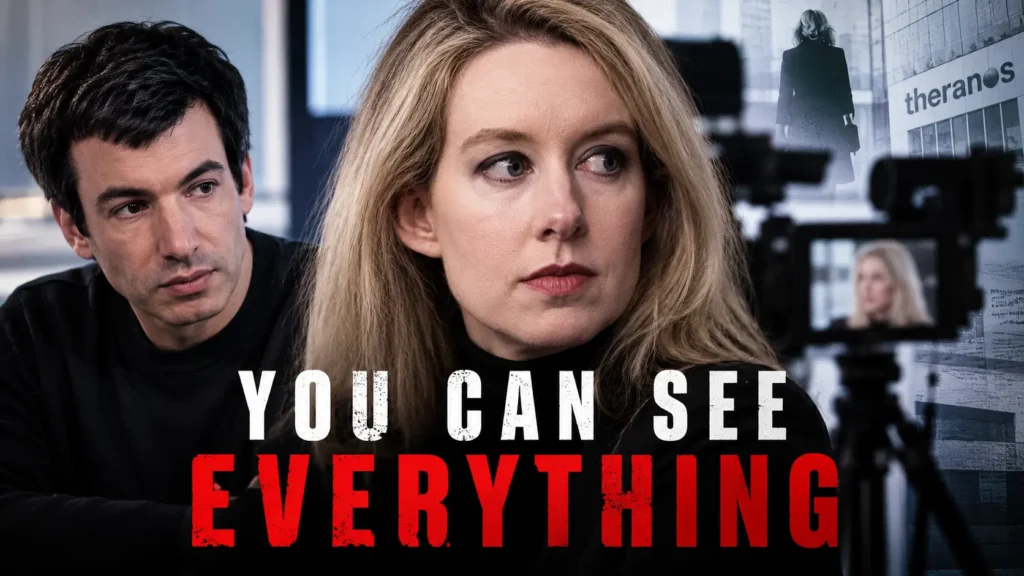
Nathan Fielder’s new documentary brings Elizabeth Holmes back into the spotlight. You Can See Everything follows the former Theranos founder during a major period in her life. It also gives the filmmakers unusual access to her home and personal world.
Holmes became one of the most well-known figures in the Theranos scandal. Her rise, the company’s collapse and her criminal case have already inspired books, documentaries and scripted projects. This film takes a different approach.
Fielder and co-director Lance Oppenheim began filming Holmes shortly before she reported to prison. The project then grew into a much longer production. The filmmakers spent about three years following Holmes and her family.
The film also features Fielder on screen. Billy Evans, Holmes’ partner, plays an important role as well. This makes the documentary more than a simple interview with Holmes.
A24 will release You Can See Everything in U.S. theaters on October 16, 2026. The film first appeared at the Telluride Film Festival in September.
What Is You Can See Everything About?
You Can See Everything follows Elizabeth Holmes during the period around her imprisonment. The filmmakers started recording her life 34 days before she was due to report to prison.
Nathan Fielder and Lance Oppenheim direct the documentary. Fielder also appears on camera. Billy Evans, Holmes’ partner, is another key figure in the film.
The project did not end after those first 34 days. Instead, the filmmakers continued filming for about three years. This gave them time to follow changes in Holmes’ personal life and relationships.
That makes the film different from a standard Theranos documentary. It does not simply review the company’s rise and fall. Instead, it focuses on Holmes as a person and on the way she presents herself to the camera.
The filmmakers also become part of the story. Fielder does not stay completely behind the camera. His conversations and reactions with Holmes help shape the documentary.
The film also explores the line between real life and performance. This gives You Can See Everything a wider focus than the Theranos case alone.
The documentary asks viewers to look at Holmes from a different point in her life. It also shows how difficult it can be to understand a person through a camera.
You Can See Everything Release Date
You Can See Everything will open in U.S. theaters on October 16, 2026. A24 is handling the theatrical release.
The theatrical release follows the film’s surprise debut at the Telluride Film Festival. The project stayed largely secret before the festival screening. That helped the film reach audiences without a long public campaign.
The documentary will also screen at the New York Film Festival before its wider theatrical release. The New York screening is scheduled for September 30, 2026.
Here are the main dates to know:
| Event | Date |
|---|---|
| Telluride Film Festival debut | September 6, 2026 |
| New York Film Festival screening | September 30, 2026 |
| Nationwide ticket availability | October 1, 2026 |
| U.S. theatrical release | October 16, 2026 |
The film has a reported runtime of 174 minutes, or 2 hours and 54 minutes. That makes it a long documentary feature.
When Does You Can See Everything Come Out?
The confirmed U.S. release date for You Can See Everything is October 16, 2026.
A24 will bring the documentary to theaters at launch. Some theaters have already started selling tickets, while wider ticket availability is scheduled for October 1.
The festival screenings will take place before the main theatrical release. However, those events do not replace the wider October release.
At the time of publication, the confirmed release information focuses on the theatrical run. A streaming or digital release date has not been confirmed.
Viewers who want to watch the documentary on the big screen should therefore mark October 16, 2026 on their calendars.
You Can See Everything Festival Premiere
You Can See Everything first reached audiences at the Telluride Film Festival on September 6, 2026. The film arrived as a surprise screening after its production remained mostly secret.
The secret debut fits the documentary’s unusual production history. Fielder and Oppenheim worked on the project for years without revealing its full details to the public.
The film will then appear at the New York Film Festival on September 30, 2026. Fielder and Oppenheim are scheduled to take part in a Q&A.
This festival run gives the documentary an unusual path to theaters. It first appeared without much warning at Telluride. The trailer then gave the wider public a closer look at the project.
After the festival screenings, A24 will release You Can See Everything across U.S. theaters on October 16.
You Can See Everything Trailer
The first major trailer for You Can See Everything arrived on September 23, 2026. It gives viewers a closer look at Nathan Fielder’s documentary about Elizabeth Holmes.
The trailer places Holmes in a more personal setting. It also shows Fielder interacting with her instead of staying completely behind the camera. That detail is important because Fielder serves as both filmmaker and participant.
The footage also points to the unusual nature of the project. Holmes has already spent years under public attention. Her Theranos story became the subject of news reports, books, documentaries and scripted shows.
This film takes a different route. Instead of focusing only on the Theranos scandal, it follows Holmes during a later stage of her life. The trailer gives viewers a look at her daily world and her relationship with Billy Evans.
It also raises questions about the role of the camera. Holmes knows she is being filmed. Fielder knows his presence can affect what happens around him.
That creates an unusual relationship between the subject and the filmmaker. The documentary does not simply record Holmes from a distance. The filmmakers become part of the situation they are documenting.
As a result, the trailer presents You Can See Everything as both a portrait of Holmes and a look at the process of making a documentary about her.
What the Trailer Reveals
The trailer confirms several important details about the film.
First, Elizabeth Holmes remains the central subject. The footage focuses on her personal life instead of rebuilding the entire Theranos story through old news footage.
Nathan Fielder also has a clear presence in the documentary. He directed the film with Lance Oppenheim and appears on screen. His interactions with Holmes become part of the story.
Billy Evans also appears in the trailer. As Holmes’ partner, he provides another view of her life away from the public attention that followed Theranos.
The footage suggests that the filmmakers spent significant time around Holmes. Viewers can see conversations and everyday moments instead of only formal interviews.
However, the trailer does not reveal everything. Some parts of the documentary remain unknown until the full film reaches theaters.
That approach works well for a project built around close access. The less viewers know in advance, the more room the finished documentary has to surprise them.
For viewers who want to avoid spoilers, the trailer provides the basic setup without explaining the entire story.
You Can See Everything Cast and Key Participants
You Can See Everything is a documentary, so it does not have a traditional movie cast. Instead, the film follows a small group of important people.
The main figures include Elizabeth Holmes, Nathan Fielder and Billy Evans. Fielder and Lance Oppenheim direct the documentary.
Each person has a different role.
| Participant | Role |
|---|---|
| Elizabeth Holmes | Main documentary subject |
| Nathan Fielder | Director and on-screen participant |
| Lance Oppenheim | Co-director |
| Billy Evans | Holmes’ partner and featured participant |
Holmes is at the center of the film. Evans gives viewers access to her personal life. Fielder brings the filmmaker into the story itself.
This small group helps create the documentary’s unusual structure. The film does not depend on a large collection of celebrity interviews.
Instead, much of the story develops through the interactions between the people being filmed and the person holding the camera.
That setup also explains why Fielder’s role matters. He is not simply recording events from a distance. His conversations and reactions become part of what viewers see.
Elizabeth Holmes
Elizabeth Holmes is the central subject of You Can See Everything.
She founded Theranos in 2003 and later became one of the most closely watched figures in the Silicon Valley world. The company promised major changes in blood testing before its claims came under intense scrutiny.
Her legal case later resulted in a federal conviction and prison sentence. The documentary begins around the time she prepared to enter prison.
That timing gives the film a different focus from earlier projects about Holmes. Instead of following her during the rise of Theranos, the filmmakers meet her after the company’s collapse and her criminal case.
The documentary can therefore explore a different part of her life.
Holmes also knows that audiences already have strong views about her. That creates an important part of the filmmaking process. Every conversation takes place with her awareness of the camera.
Her participation makes the project more complex. Viewers are not only hearing Holmes speak about her life. They are also watching how she behaves when filmmakers spend an extended period around her.
That access allows the documentary to explore Holmes beyond the public image created during the Theranos years.
Nathan Fielder and Lance Oppenheim
Nathan Fielder and Lance Oppenheim direct You Can See Everything.
Fielder is known for television projects that mix real situations with carefully planned setups. His work often examines how people behave when they know they are part of a larger situation.
Oppenheim comes from a documentary background. His work focuses on real people and personal stories.
Their collaboration brings those approaches together.
Fielder also appears in the documentary. That makes his role different from that of a director who stays completely behind the camera.
His presence creates another relationship for viewers to follow. Holmes is being filmed, but Fielder is also visible and involved in the conversations.
This becomes important because the documentary explores the limits of observation. A filmmaker cannot remain completely separate from a subject when the filmmaker spends years inside that person’s world.
The New York Film Festival describes the film as an exploration of documentary filmmaking, reality and performance.
That focus helps explain why Fielder and Oppenheim are important to the story. The filmmakers are not just recording Holmes. Their own relationship with her becomes part of the documentary.
How You Can See Everything Was Made
The production of You Can See Everything took place over several years.
The project began around the period before Holmes entered prison. The filmmakers then continued working with her instead of ending the project after the initial 34-day period.
This gave Fielder and Oppenheim time to observe changes in Holmes’ personal life. It also allowed their relationship with her to develop.
The film remained largely secret before its Telluride premiere. That secrecy helped keep the project away from the normal publicity cycle that surrounds major documentaries.
The filmmakers could therefore spend more time working with their material before showing it to audiences.
The long production also changed the shape of the documentary. What began with a clear deadline eventually became a much broader project.
Instead of telling one short story about the weeks before Holmes entered prison, the filmmakers followed the people involved for a much longer period.
That extra time gave the documentary more room to explore Holmes, Evans and Fielder himself.
It also made the filmmaking process part of the story. As the filmmakers spent more time with Holmes, their own role became harder to separate from the events they were recording.
This extended approach helps explain why You Can See Everything is much longer and more complex than a standard celebrity documentary.
The 34 Days Before Prison
One of the most important details about the film is how it began.
The filmmakers started recording Holmes 34 days before she was scheduled to report to prison.
That deadline gave the project an immediate focus. Holmes faced a major change in her life, while the filmmakers had a limited period to observe her before that change took place.
However, the project did not stop after those 34 days.
The filmmakers continued working on the documentary for about three years. This changed the original idea into a much larger story.
The first 34 days now serve as the starting point rather than the entire documentary.
That extended timeline also gives viewers a chance to see Holmes outside the immediate pressure of her prison sentence. The film can explore her relationships, home life and interactions with the filmmakers.
Billy Evans becomes important in this part of the story because the documentary does not focus on Holmes alone. The filmmakers also observe the relationship around her.
Meanwhile, Fielder becomes more involved in the environment he is filming.
The result is a documentary that starts with a clear countdown but gradually moves beyond it. The 34-day period gives the story its opening frame, while the years that follow allow the filmmakers to explore a much wider picture of Holmes’ life.
Elizabeth Holmes and the Theranos Story
To understand You Can See Everything, it helps to know why Elizabeth Holmes became so well known.
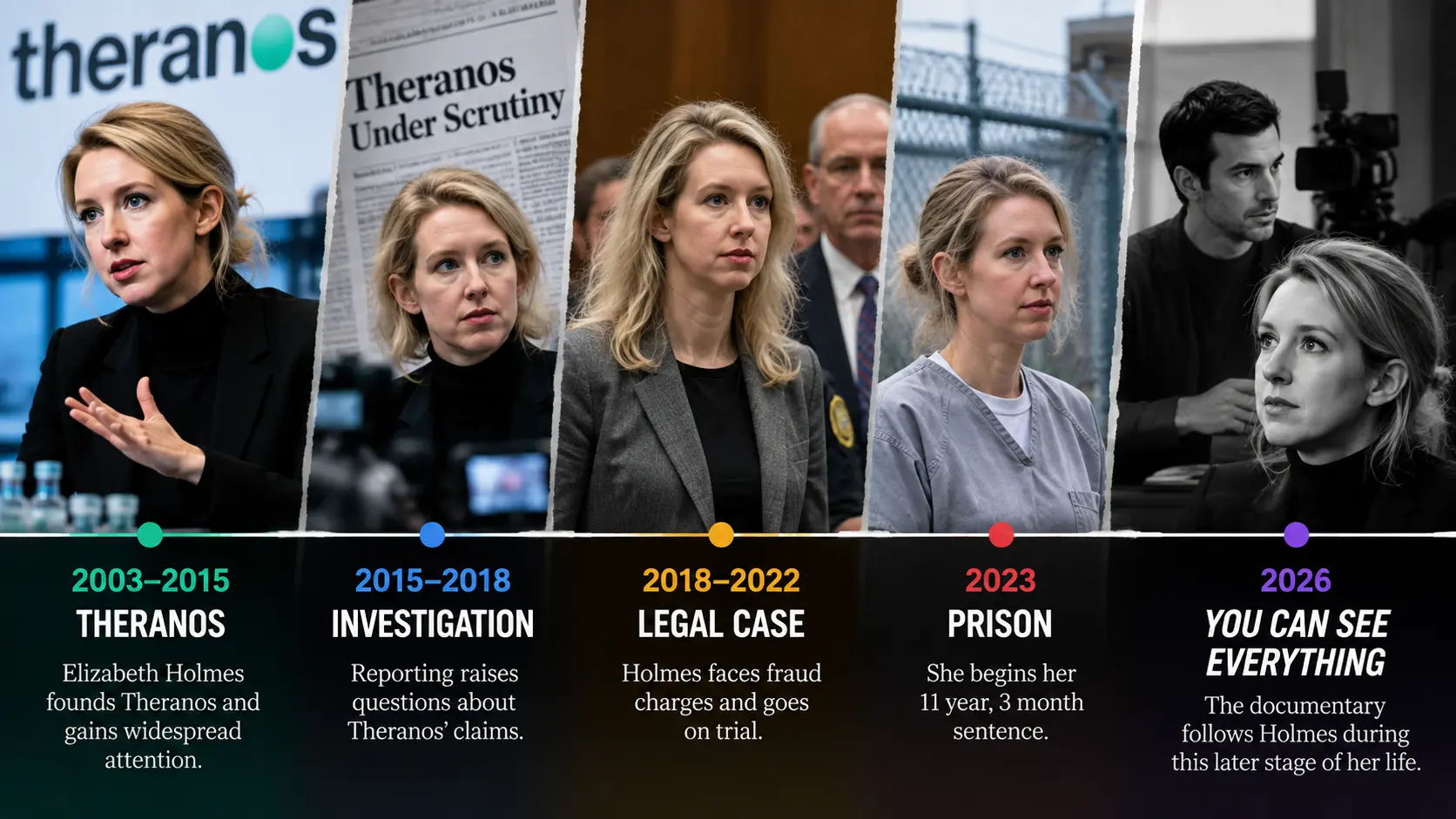
Holmes founded Theranos in 2003. The company promised to change blood testing by using small amounts of blood for many types of tests. The idea attracted investors, business leaders and major media attention.
The company later faced serious questions about its technology and business practices. Those questions led to investigations and a federal criminal case against Holmes.
In January 2022, a federal jury found Holmes guilty of four charges linked to defrauding investors. The jury cleared her on the patient-related charges. It also did not reach a decision on some other charges.
In November 2022, a federal judge sentenced Holmes to 11 years and three months in prison. She had to report to prison in April 2023.
That history explains the public interest in Holmes. However, You Can See Everything does not simply retell the Theranos story.
Instead, the documentary follows Holmes during a later stage of her life. The filmmakers began recording her 34 days before she entered prison. They then continued filming for about three years.
This gives the documentary a different starting point. The Theranos story provides the background, but the film focuses more on Holmes herself, her personal life and her relationship with the filmmakers.
Why Holmes Remains a Major Documentary Subject
Elizabeth Holmes has already appeared in many documentaries, books, news reports and scripted projects. That raises an obvious question: why make another film about her?
Nathan Fielder has explained that he first wondered about the same thing. He felt that much of the Theranos story had already been told.
His interest changed after he learned that Holmes wanted someone to document her life.
That opportunity gave Fielder and Lance Oppenheim access to Holmes at a very different moment. She was no longer leading Theranos or defending the company to investors. She was preparing to enter prison and dealing with major changes in her personal life.
The filmmakers could therefore look beyond the events that made Holmes famous.
The film also gives viewers a chance to see how Holmes behaves during long periods of filming. She knows the cameras are there. She also knows that people already have strong opinions about her.
That creates an unusual situation.
The documentary can show what Holmes says and does. At the same time, it can show how she reacts to Fielder and the filmmaking process.
This makes Holmes more than the subject of another Theranos history. She becomes the center of a much larger story about public image, personal life and the way people present themselves on camera.
What Makes You Can See Everything Different From a Traditional Documentary?
Many documentaries keep a clear line between the filmmaker and the subject. The filmmaker asks questions, records events and later shapes the footage into a story.
You Can See Everything takes a less traditional approach.
Fielder and Oppenheim receive close access to Holmes and Billy Evans. They film inside their home and spend a long period around them.
Fielder also appears on camera. His presence makes him part of the situation instead of keeping him completely outside it.
That changes the relationship between the filmmaker and the subject.
Holmes knows that the camera is recording her. Fielder knows that his own behavior can affect the people he is filming. The audience can watch both sides of that relationship.
The project also continued for about three years. That gave the filmmakers time to capture more than planned interviews or short visits. This long-form approach also connects with other celebrity-focused documentaries, such as our Elon Musk documentary, which explores another major public figure through a documentary format.
As a result, the documentary can show conversations, daily moments and changes in relationships.
The film also moves beyond simple observation. It uses filmmaking techniques that question the difference between real events and constructed scenes.
This approach gives You Can See Everything a wider purpose. The film is not only about Elizabeth Holmes. It also asks what happens when a filmmaker gets extremely close to a subject.
That question becomes one of the documentary’s central ideas.
Reality, Performance and Documentary Filmmaking
One of the most interesting parts of You Can See Everything is its focus on reality and performance.
A documentary camera records real people. However, people often behave differently when they know someone is watching them.
That problem becomes even more important when the subject already has a strong public image.
Holmes knows that millions of people know her name. She also knows why they know her. When cameras enter her home, that history does not disappear.
Fielder faces a similar problem. He wants to observe Holmes, but his presence can change the situation. His questions can affect a conversation. His reactions can affect how people respond.
The film uses that tension as part of its storytelling.
Reports from the film’s Telluride premiere indicate that the documentary moves beyond simple observation and includes reenactments and other techniques that play with the line between reality and performance.
That choice fits Fielder’s style. His previous work often examines what happens when planned situations meet genuine human reactions.
However, You Can See Everything applies that idea to a real person with a highly public past.
The result is not a simple question of whether something is “real” or “fake.” Instead, the film asks viewers to think about how cameras, filmmakers and subjects can shape what audiences see.
How the Documentary Reframes the Theranos Story
The biggest difference between You Can See Everything and earlier Theranos documentaries is where the story begins.
Most Theranos projects focus on the company’s rise, claims, collapse and legal case. You Can See Everything starts much later, as Holmes prepares to enter prison.
This later starting point gives the filmmakers access to a different part of her life. The documentary also follows Holmes and Billy Evans in a more personal setting.
Holmes and Evans control how much access they give the filmmakers. At the same time, the filmmakers decide what to record and how to shape the final film.
That creates an unusual relationship between the subject, the camera and the people behind it.
For another movie based on real events, see our World Trade Center movie guide, covering its cast, story, true story, reviews and where to watch.
The film does not try to retell every part of the Theranos case. Instead, it uses that history as background while focusing on Holmes’ life after the company’s collapse.
As a result, You Can See Everything offers a personal look at Holmes while also showing how years of filming can shape a documentary.
Why the Filmmakers Become Part of the Story
Nathan Fielder’s role makes the documentary unusual.
He is not only one of the directors but also appears on camera and interacts with Holmes. As a result, viewers can see the filmmaker and his subject respond to each other.
Fielder cannot remain a completely neutral observer. His questions can affect Holmes’ responses, while his reactions may change the direction of a conversation. Spending more time with the family can also shape their connection.
Over time, this process becomes part of the documentary.
After spending years with Holmes, Fielder still faced questions about how to understand the experience. This uncertainty helps explain the film’s unusual style.
A standard documentary may try to give viewers a clear explanation of its subject. You Can See Everything takes another path by showing the filmmakers dealing with uncertainty as well.
The result is not only a film about Elizabeth Holmes. It also looks at the challenge of understanding another person through a camera.
In this way, the filmmaking process becomes an important part of the story.
You Can See Everything Runtime, Genre and Movie Details
You Can See Everything is a 2026 documentary directed by Nathan Fielder and Lance Oppenheim. The film centers on Elizabeth Holmes and follows her life through an unusual period of personal change.
The documentary has a reported runtime of 174 minutes, which makes it close to three hours long. That extended runtime gives the filmmakers room to explore Holmes, her relationships and the filmmaking process in greater detail.
A24 is handling the U.S. theatrical release. The film first appeared at the Telluride Film Festival before moving toward its wider theatrical release.
Here are the key details:
| Detail | Information |
|---|---|
| Title | You Can See Everything |
| Release year | 2026 |
| Genre | Documentary |
| Directors | Nathan Fielder, Lance Oppenheim |
| Main subject | Elizabeth Holmes |
| Featured participant | Billy Evans |
| Runtime | 174 minutes |
| Distributor | A24 |
| Telluride debut | September 6, 2026 |
| U.S. theatrical release | October 16, 2026 |
The film’s long runtime also sets it apart from a short celebrity profile. It gives the story enough space to follow personal moments and the changing relationship between the filmmakers and their subject.
For viewers interested in the documentary’s unusual approach, the runtime suggests that the film aims to tell a much broader story than a simple overview of the Theranos scandal.
Where to Watch You Can See Everything
The first confirmed viewing option for You Can See Everything is a movie theater.
A24 will release the documentary in U.S. theaters on October 16, 2026. The film will also have festival screenings before the general theatrical release.
The documentary already premiered at Telluride in September. It is also scheduled for the New York Film Festival on September 30.
For most viewers, however, the October theatrical release will be the main opportunity to see the film.
The best way to find a screening will be through local theater listings and official ticket pages as the release date approaches.
Because the documentary runs for 174 minutes, viewers should also expect a longer theater experience than they would get from many standard documentaries.
The theatrical rollout also gives the film an opportunity to reach audiences together. That matters for a documentary that has already attracted attention because of its secret production and unusual subject.
At the time of publication, the confirmed information centers on the theatrical release. Viewers should check for official updates before assuming that a streaming service will carry the film immediately after its theater run.
Is You Can See Everything Streaming?
A streaming release has not been confirmed in the information available for this article.
The current release plan centers on the U.S. theatrical opening on October 16, 2026. A24 has not announced a specific streaming date for the documentary.
That means viewers should not assume that You Can See Everything will appear on a particular streaming service on the same day as its theatrical release.
The film’s festival run also comes before the wider theater opening. Those screenings are separate from any future digital or streaming release.
For now, audiences who want to watch the documentary should look for theatrical showtimes.
Once A24 announces a digital rental, purchase or streaming date, that information can provide a clearer picture of the film’s home-viewing plans.
Until then, the safest information is simple: You Can See Everything has a confirmed U.S. theatrical release, while its streaming plans remain unannounced.
How to Find Tickets
Viewers can start checking local theater listings as the October release approaches.
A24 has scheduled October 16, 2026 as the U.S. theatrical release date. Wider ticket availability is expected before the release.
Because the film has already received festival attention, some screenings may become available earlier in selected locations.
The easiest approach is to search for You Can See Everything through local cinema websites and ticket services. Availability will depend on the theater and location.
The documentary’s 174-minute runtime may also affect showtime options. Some theaters may offer fewer screenings than they would for a shorter film.
If you plan to see the movie during its opening weekend, checking listings early can help you find a convenient time.
What Critics Are Saying About You Can See Everything
Early reactions to You Can See Everything have drawn attention to its unusual style and subject.
The documentary has already received coverage following its surprise Telluride premiere. Critics have discussed the film’s approach to Elizabeth Holmes and the way Nathan Fielder becomes part of the story.
Early review scores should still be treated as temporary. More reviews can arrive after festival screenings and the wider theatrical release.
At the time of publication, Rotten Tomatoes lists the film with a 100% critics score from 10 reviews. That number can change as the site adds more reviews.
The early response also reflects the film’s unusual structure. Critics have focused not only on Holmes but also on the way Fielder and Oppenheim handle the relationship between filmmaker and subject.
That distinction matters because the documentary does not present itself as another straightforward account of the Theranos scandal.
Instead, it uses Holmes’ personal life and the filmmaking process to explore larger questions about observation and public image.
Readers should therefore separate early festival reactions from a final critical consensus. A small number of reviews can give an early picture, but it does not represent every critic or the full audience response.
Why You Can See Everything Is Generating So Much Attention
Several factors have pushed You Can See Everything into the spotlight.
First, Elizabeth Holmes remains a highly recognizable figure. The Theranos scandal received years of media coverage, and her criminal case added another major chapter to that story.
Second, Nathan Fielder is not simply directing the documentary from behind the camera. He appears in it and develops a direct relationship with Holmes.
Third, the project stayed largely secret for years. Its surprise appearance at Telluride created an unusual introduction for a major documentary.
Fourth, the film does not focus only on Theranos. It follows Holmes during a later stage of her life and examines how she behaves around the filmmakers.
Finally, the documentary plays with the boundary between real events and performance. That approach makes the filmmaking process part of the subject.
These elements create several layers of interest at once:
- Elizabeth Holmes: A familiar public figure seen in a different period of her life.
- Nathan Fielder: A filmmaker who becomes part of the documentary.
- Secret production: A project developed away from the normal publicity cycle.
- Long runtime: A 174-minute film with room for a detailed story.
- Unusual style: A documentary that questions how much audiences can truly know about a subject.
For more movie coverage, check out our Bruce Willis movies guide, featuring 25 films, iconic roles and key career highlights. Together, these elements explain why the film has attracted attention before its wider theatrical release.
You Can See Everything vs. Earlier Elizabeth Holmes Documentaries
You Can See Everything revisits a story audiences already know. Elizabeth Holmes and Theranos have been covered in documentaries, books, podcasts and scripted projects.
Earlier projects often focus on Theranos, its rise, problems, collapse and legal case. This includes films about real public figures, such as Primetime: Robert Pattinson’s Chris Hansen Movie.
You Can See Everything takes a more personal route. It begins shortly before Holmes enters prison and follows her life from that point.
| Feature | You Can See Everything | Earlier Holmes Projects |
|---|---|---|
| Main focus | Holmes and her personal life | Theranos story |
| Starting point | Before prison | Rise and fall of Theranos |
| Style | Close and personal | Varies |
| Nathan Fielder | Director and on-screen participant | Not involved |
| Filming period | About three years | Varies |
| Main theme | Reality and performance | Varies |
Fielder also appears on camera, making his relationship with Holmes part of the documentary.
Rather than repeat the Theranos story, the film focuses on Holmes in a new setting. Its long filming period and close access give the documentary a different perspective on a familiar public figure.
What We Know and What Remains a Mystery
A number of details about You Can See Everything are now confirmed.
The film follows Elizabeth Holmes and features Nathan Fielder and Billy Evans. Fielder and Lance Oppenheim directed the documentary. The project began 34 days before Holmes entered prison and continued for about three years.
The film also has a confirmed U.S. theatrical release date of October 16, 2026. Its reported runtime is 174 minutes.
Other details remain less clear.
The trailer does not reveal the documentary’s full structure. It also does not explain every major turn in the story. That means viewers should be careful with online claims that go beyond the confirmed material.
Some early reports have described unusual scenes and filmmaking choices. However, readers should separate confirmed details from speculation about what those scenes may mean.
The same rule applies to future streaming plans. The theatrical release is confirmed, but a specific streaming date has not been announced. For another upcoming movie update, check our Avengers Endgame Encore guide, covering its new ending, extra scenes and Doomsday connection.
For viewers who want to experience the documentary without spoilers, the limited information may actually be useful. The film’s unusual production has created curiosity, but much of its full story remains inside the feature itself.
At this stage, the safest approach is to focus on the facts that the filmmakers and festival organizers have confirmed.
You Can See Everything FAQ
What is You Can See Everything about?
You Can See Everything is a documentary about Elizabeth Holmes. It follows her during a major period of her life and explores her relationship with the filmmakers.
The project began 34 days before Holmes was due to enter prison. However, filming continued for about three years.
Nathan Fielder and Lance Oppenheim direct the film. Fielder also appears on screen, while Billy Evans, Holmes’ partner, is another key participant.
The documentary does not simply retell the Theranos scandal. Instead, it focuses on Holmes, her personal life and the process of filming her over an extended period.
Who directed You Can See Everything?
Nathan Fielder and Lance Oppenheim directed You Can See Everything.
Fielder also appears in the documentary. His role makes the film different from projects where the director remains completely behind the camera.
Oppenheim brings his documentary background to the project, while Fielder brings an approach that often examines the relationship between real events and constructed situations.
Their collaboration gives the film a strong focus on the filmmaking process itself.
When is You Can See Everything released?
You Can See Everything will open in U.S. theaters on October 16, 2026.
The film first premiered at the Telluride Film Festival on September 6, 2026. It is also scheduled to screen at the New York Film Festival on September 30.
A24 is handling the U.S. theatrical release.
A streaming or digital release date has not been confirmed at the time of publication.
Is Elizabeth Holmes in You Can See Everything?
Yes. Elizabeth Holmes is the central subject of the documentary.
The filmmakers began recording her life shortly before she entered prison. They then continued filming for about three years.
The film gives viewers access to Holmes in a more personal setting than many earlier projects about Theranos.
It also examines her relationship with Billy Evans and her interactions with Nathan Fielder.
Who is in the You Can See Everything cast?
The main participants include Elizabeth Holmes, Nathan Fielder and Billy Evans.
Holmes is the central subject. Fielder serves as a director and appears on screen. Evans, Holmes’ partner, also plays an important role in the documentary.
Lance Oppenheim serves as co-director.
Because this is a documentary, the term “cast” works differently than it does for a fictional movie. The film follows real people rather than actors playing scripted characters.
How long is You Can See Everything?
You Can See Everything has a reported runtime of 174 minutes.
That equals 2 hours and 54 minutes.
The long runtime gives the filmmakers room to explore Holmes and the people around her in greater detail.
It also reflects the documentary’s broader approach. The film does not appear to function as a short overview of the Theranos scandal. Instead, it follows an extended period of Holmes’ life and the filmmakers’ relationship with her.
Where can I watch You Can See Everything?
The confirmed viewing option is the theatrical release.
A24 will release You Can See Everything in U.S. theaters on October 16, 2026.
The film has also screened at festivals, including Telluride, with a New York Film Festival screening scheduled before the theatrical release.
A specific streaming service and home-release date have not been confirmed.
For now, viewers should check local theater listings as the October release approaches.
Is You Can See Everything a documentary?
Yes. You Can See Everything is a documentary directed by Nathan Fielder and Lance Oppenheim.
The film follows Elizabeth Holmes and people in her personal life. It also examines the relationship between the filmmakers and their subject.
The documentary uses real people and real-life situations. At the same time, its filmmaking approach explores the boundary between observation and performance.
That combination gives the film a different structure from a standard interview-based documentary.
Is You Can See Everything about Theranos?
Theranos provides important background, but the documentary is not simply a retelling of the company’s story.
The film focuses on Elizabeth Holmes after the collapse of Theranos. It begins shortly before she enters prison and then follows her life for several years.
The documentary therefore looks at a later chapter in Holmes’ life.
Viewers will still need some knowledge of the Theranos story to understand Holmes’ public image. However, the film’s main focus is the person behind that image and the filmmakers’ attempt to understand her.
Final Takeaway
You Can See Everything takes a familiar public figure and places her in a very different kind of documentary.
Elizabeth Holmes has already been the subject of extensive coverage because of the Theranos scandal and her criminal case. This film does not simply repeat that history.
Instead, Nathan Fielder and Lance Oppenheim follow Holmes during a major transition in her life. They begin filming 34 days before she enters prison and continue working on the project for about three years.
Fielder’s role also makes the documentary unusual. He appears on screen and becomes part of the environment he is filming.
The film’s focus on reality, performance and the role of the camera adds another layer to the story. Viewers are not only watching Holmes. They are also watching the filmmakers try to understand her.
With a 174-minute runtime and a U.S. theatrical release set for October 16, 2026, the documentary offers a substantial look at a subject audiences already know.
What makes You Can See Everything different is not simply the presence of Elizabeth Holmes. It is the unusual access, the long production period and the decision to make the relationship between filmmaker and subject part of the story.