
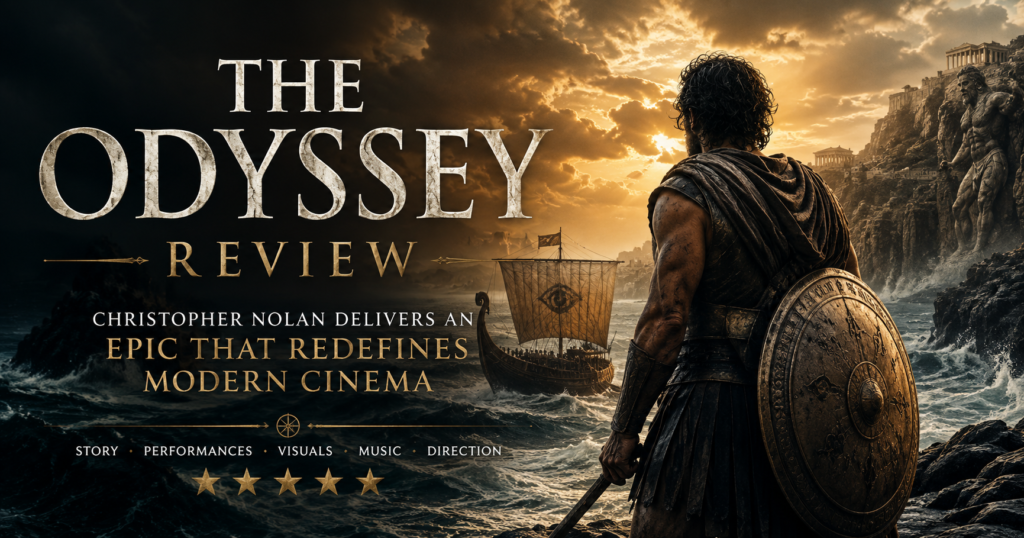
Ancient stories have a unique ability to transcend generations, speaking to audiences across cultures and centuries. Among them, The Odyssey stands as one of the greatest adventure tales ever written, influencing literature, film, television, and modern storytelling in countless ways. Adapting such a legendary work for today’s audiences is an enormous creative challenge, requiring a careful balance between honoring its origins and delivering a fresh cinematic experience.
The Odyssey Review begins with one simple observation: Christopher Nolan doesn’t merely recreate Homer’s epic—he reimagines it through the lens of modern filmmaking while preserving the emotional heart that has made the story timeless. Rather than relying solely on spectacle, the film emphasizes character, resilience, sacrifice, and the universal desire to find one’s way home.
From its opening moments, the movie establishes an atmosphere that feels both grand and deeply personal. Massive landscapes, dangerous seas, and legendary encounters create the scale expected from an epic, yet the narrative never loses sight of the people experiencing these extraordinary events. That balance between visual ambition and emotional storytelling becomes one of the film’s defining strengths.
This The Odyssey Review explores the film’s storytelling, direction, performances, technical achievements, themes, and overall impact while remaining spoiler-free for readers planning to experience the journey themselves.
Christopher Nolan Reimagines a Timeless Epic
Adapting a literary masterpiece that has inspired generations is never easy. Expectations are high, comparisons are unavoidable, and every creative decision invites scrutiny. Christopher Nolan approaches this challenge with confidence, crafting a film that respects its classical roots while embracing the possibilities of modern cinema.
Unlike many mythological adaptations that focus primarily on action and fantasy, this version places equal emphasis on emotional realism. The legendary journey becomes more than an adventure across distant lands—it evolves into a deeply personal exploration of identity, responsibility, and perseverance.
One of the strongest points highlighted throughout The Odyssey Review is how naturally the film connects ancient themes with contemporary audiences. Although the setting belongs to another era, the emotions driving the characters remain familiar and relatable.
The Journey Matters More Than the Destination
Many adventure films focus almost entirely on reaching a final goal. The Odyssey takes a different approach by treating every stage of the journey as equally meaningful.
Each destination introduces new challenges.
Each encounter reveals another layer of the protagonist’s character.
Each obstacle changes the people involved.
Rather than feeling like separate adventures connected only by geography, every chapter contributes to one larger emotional narrative. This structure keeps the audience invested not simply in where Odysseus is going but in who he becomes along the way.
Mythology Is Grounded in Human Emotion
Although mythical creatures, powerful gods, and extraordinary events play important roles, they never overshadow the human story.
Fear, hope, determination, regret, love, and resilience remain at the center of every major decision.
Instead of treating mythology as an excuse for endless spectacle, the film uses these legendary elements to deepen the emotional stakes. As The Odyssey Review demonstrates, the mythical world becomes a reflection of the internal struggles faced by its characters.
More Than a Survival Story
At its core, the narrative is about transformation.
Every hardship teaches a lesson.
Every sacrifice carries emotional weight.
Every victory demands a personal cost.
The story asks timeless questions that remain relevant today:
- What defines true leadership?
- Can people ever return unchanged after years of struggle?
- Is home a destination or a feeling?
- What gives someone the strength to continue when hope begins to fade?
These questions elevate the film beyond a traditional action-adventure epic.
Storytelling That Balances Epic Scale With Emotional Depth
Large-scale blockbusters often struggle to maintain emotional intimacy. Spectacular visuals can easily overshadow meaningful character development.
Fortunately, that isn’t the case here.
One reason The Odyssey Review remains so positive about the film is its commitment to balancing spectacle with sincere human drama. The screenplay consistently reminds audiences that emotional investment matters more than visual excess.
Every Decision Shapes the Story
Characters rarely face simple choices.
Leadership requires sacrifice.
Trust must be earned.
Pride often leads to consequences.
Compassion can become both a strength and a weakness.
These moral dilemmas create genuine tension because there are no easy answers. Every important decision influences not only the immediate situation but also the emotional journey of the characters.
Time Becomes an Invisible Character
One of the film’s most effective storytelling devices is its treatment of time.
Years pass naturally.
Relationships evolve.
Families change.
Kingdoms continue without those who left.
Instead of presenting time merely as a backdrop, the narrative uses it to highlight the emotional cost of prolonged absence. The Odyssey Review recognizes this as one of the film’s most mature and emotionally resonant qualities.
Home Represents More Than a Place
Throughout the story, home symbolizes far more than a physical location.
It represents belonging.
It represents memory.
It represents hope.
The longer the journey continues, the more uncertain the meaning of home becomes. This emotional uncertainty adds depth to nearly every major scene and encourages viewers to reflect on the importance of family, identity, and personal growth.
Christopher Nolan’s Direction Reflects Remarkable Confidence
Christopher Nolan has built a reputation for creating ambitious films that challenge audiences while delivering unforgettable cinematic experiences. With The Odyssey, he applies that same philosophy to one of history’s most celebrated literary works.
Rather than modernizing the story through unnecessary changes, he allows its timeless themes to remain the driving force behind the narrative.
The Odyssey Review praises this restrained approach because it demonstrates confidence in the strength of the original story while still offering a distinctly cinematic interpretation.
Spectacle Always Supports the Narrative
The film contains breathtaking moments of action and visual grandeur, but those sequences never exist purely for excitement.
Every storm carries emotional significance.
Every battle changes the characters.
Every confrontation moves the story forward.
This careful balance prevents the spectacle from overshadowing the narrative.
Practical Filmmaking Creates Authenticity
One of Nolan’s defining strengths has always been his preference for realism whenever possible.
Ancient ships feel functional.
Coastal landscapes appear vast and unforgiving.
Cities possess texture, history, and life.
Natural environments dominate the screen, creating an immersive world that feels tangible despite its mythical setting.
According to The Odyssey Review, this commitment to authenticity strengthens the audience’s emotional connection to the story.
Silence Often Speaks Louder Than Dialogue
Some of the film’s most memorable moments contain very few words.
A thoughtful expression.
A quiet moment of reflection.
An uncertain glance toward the horizon.
These scenes allow emotions to develop naturally without relying on lengthy explanations, proving that effective storytelling often comes from visual language rather than dialogue alone.
Performances Bring Humanity to Legendary Characters
No epic adventure succeeds without convincing performances.
Fortunately, the cast delivers emotionally grounded portrayals that make the legendary figures feel surprisingly human.
A Hero Defined by Intelligence and Resilience
Rather than portraying Odysseus as an invincible warrior, the film presents him as a complex individual shaped by experience.
He is courageous.
He is resourceful.
He is determined.
Yet he also experiences doubt, exhaustion, and regret.
That emotional complexity makes his journey far more compelling. The Odyssey Review highlights this layered characterization as one of the film’s greatest achievements.
Supporting Characters Strengthen the Narrative
The supporting cast contributes significantly to the emotional richness of the story.
Companions challenge the hero’s decisions.
Family members remind him what truly matters.
Unexpected allies and rivals broaden the narrative while reinforcing its central themes.
Each relationship adds another dimension to the protagonist’s journey.
Chemistry Makes Every Relationship Believable
Whether portraying friendship, loyalty, conflict, or reunion, the interactions between characters feel genuine.
Small gestures often communicate more than elaborate speeches, creating moments that remain memorable long after the credits roll.
Visual Storytelling Elevates Every Scene
Visually, the film embraces both grandeur and subtlety.
Sweeping landscapes create a sense of scale, while intimate close-ups capture the emotional struggles of individual characters.
One of the most impressive observations throughout The Odyssey Review is how effectively the cinematography transforms every environment into an active part of the storytelling.
Landscapes Become Living Characters
The sea symbolizes uncertainty and hope.
Towering cliffs evoke danger.
Ancient cities communicate history and civilization.
Remote islands create feelings of isolation and discovery.
Every location possesses its own personality, making the journey feel constantly fresh and visually engaging.
Production Design Enhances Authenticity
Attention to detail is evident throughout the film.
Weathered armor reflects years of conflict.
Ships appear built for demanding voyages.
Architecture feels historically inspired rather than artificially polished.
These carefully crafted details create an immersive world that supports the emotional realism of the narrative.
Christopher Nolan’s Screenplay Gives Every Chapter a Purpose
Adapting an epic poem into a feature film requires more than simply recreating memorable moments. The screenplay must connect individual episodes into a cohesive emotional journey that feels rewarding from beginning to end.
One of the strongest observations in The Odyssey Review is that the screenplay rarely allows spectacle to overshadow storytelling. Instead, every major event contributes to Odysseus’ personal growth, ensuring that each challenge feels meaningful rather than repetitive.
Rather than rushing from one legendary encounter to another, the narrative gives important moments enough room to breathe. Characters are allowed to reflect, relationships evolve naturally, and difficult decisions carry lasting consequences.
A Story Built Around Transformation
Every chapter changes the protagonist in some way.
Each victory increases his wisdom.
Each failure teaches humility.
Each loss deepens the emotional stakes.
Instead of presenting a flawless hero, the screenplay embraces imperfection. Odysseus succeeds because he adapts, learns, and continues moving forward despite overwhelming adversity.
This character-first approach is one of the reasons The Odyssey Review considers the screenplay among the film’s greatest strengths.
Dialogue Feels Natural and Purposeful
The dialogue avoids unnecessary exposition.
Characters speak with intention rather than simply explaining the plot.
Important conversations reveal personality, values, and emotional conflict while maintaining the momentum of the story.
Instead of relying on dramatic speeches, many scenes communicate powerful emotions through concise exchanges and meaningful silence.
Emotional Moments Feel Earned
The screenplay understands that emotional impact cannot be forced.
Relationships develop gradually.
Trust builds over time.
Moments of reunion and separation carry genuine weight because the audience has experienced the journey alongside the characters.
As The Odyssey Review points out, these emotional payoffs become some of the film’s most memorable moments.
Performances Elevate Every Major Character
Strong performances are essential for a story of this scale. Grand visuals may capture attention, but believable characters keep audiences emotionally invested.
Fortunately, the cast delivers performances that match the ambition of the production.
A Compelling Central Performance
The actor portraying Odysseus brings remarkable depth to the role.
Rather than emphasizing physical strength alone, the performance highlights intelligence, resilience, and emotional vulnerability.
Moments of confidence are balanced by uncertainty.
Determination exists alongside exhaustion.
Hope remains visible even during the darkest stages of the journey.
According to The Odyssey Review, this nuanced portrayal transforms a legendary hero into someone audiences can genuinely understand and support.
Supporting Characters Leave Lasting Impressions
Although the narrative centers on Odysseus, the supporting cast plays a crucial role in enriching the story.
Every important character contributes something unique.
Some challenge the hero’s beliefs.
Others reinforce his determination.
Several represent the emotional connections that motivate his journey.
Because these relationships feel authentic, even brief appearances leave a lasting impact.
Chemistry Creates Authentic Relationships
Whether portraying friendship, conflict, loyalty, or reconciliation, the cast consistently creates believable interactions.
Simple expressions.
Quiet conversations.
Shared moments of relief.
These subtle performances often communicate more than elaborate dialogue, adding emotional realism to the film.
Cinematography Creates an Immersive World
Visually, the film delivers breathtaking imagery while maintaining a clear focus on storytelling.
Rather than overwhelming viewers with constant visual spectacle, every frame serves a narrative purpose.
This thoughtful approach is one of the highlights repeatedly mentioned throughout The Odyssey Review.
The Sea Becomes a Powerful Symbol
The ocean functions as far more than a setting.
It represents freedom.
Isolation.
Danger.
Hope.
Its constantly changing appearance mirrors the emotional state of the protagonist, making nature an active participant in the story.
Wide panoramic shots emphasize the immense distance separating Odysseus from home, while intimate close-ups reveal the personal cost of that journey.
Every Location Has Its Own Identity
No destination feels interchangeable.
Ancient cities appear vibrant and historically inspired.
Remote islands create mystery.
Rocky coastlines emphasize survival.
Open waters communicate endless uncertainty.
This variety keeps the visual experience engaging from beginning to end.
Camera Work Supports the Narrative
Action scenes remain exciting without becoming confusing.
During quieter moments, the camera lingers on expressions and body language, allowing performances to carry the emotional weight.
This careful balance helps maintain a consistent rhythm throughout the film.
Production Design Brings the Ancient World to Life
Creating a believable historical setting requires extraordinary attention to detail, and the production team delivers impressive results.
Every environment feels carefully crafted.
Every costume reflects practical use.
Every location appears lived-in rather than artificially designed.
The Odyssey Review highlights the production design as one of the film’s most convincing technical achievements.
Authentic Environments Enhance Immersion
Ships display signs of years at sea.
Buildings show the effects of age and weather.
Villages feel active and believable.
Nothing appears overly polished or unrealistic.
This authenticity helps audiences fully immerse themselves in the world of the story.
Costumes Reflect Character Development
Costume design subtly evolves throughout the narrative.
Armor becomes worn.
Travel clothing accumulates visible signs of hardship.
These details reinforce the passage of time without requiring explicit explanation.
Attention to Detail Strengthens Realism
Small production choices make a significant difference.
Props feel functional.
Weapons appear historically inspired.
Architectural details create a convincing sense of place.
Together, these elements build a world that feels both mythical and believable.
The Musical Score Strengthens the Emotional Journey
Music plays a vital role in shaping the emotional atmosphere of the film.
Rather than dominating every scene, the score understands when to provide energy and when to remain understated.
As The Odyssey Review explains, this balance allows emotional moments to resonate naturally.
Powerful Themes Support the Story
Large orchestral compositions enhance moments of adventure and discovery.
Meanwhile, quieter musical passages accompany scenes of reflection and personal conflict.
This contrast prevents the soundtrack from becoming repetitive while strengthening the emotional impact of the narrative.
Music Enhances Rather Than Distracts
The score never attempts to overwhelm the audience.
Instead, it works alongside the performances and visuals to create a cohesive cinematic experience.
Its greatest strength lies in knowing exactly when silence can be more powerful than music.
Action Sequences Deliver Excitement With Purpose
The action scenes are visually impressive, but their greatest achievement is their emotional significance.
Every confrontation exists because something meaningful is at stake.
Every challenge contributes to character development.
Every victory carries consequences.
According to The Odyssey Review, this focus on storytelling distinguishes the film from many modern action blockbusters.
Spectacle Supports Character Growth
The film never includes action merely for entertainment.
Instead, conflict reveals leadership.
Danger exposes vulnerability.
Success requires intelligence as much as physical courage.
This approach gives every sequence lasting significance.
Mythological Encounters Feel Meaningful
The legendary elements remain faithful to the spirit of epic storytelling while serving the larger emotional narrative.
Rather than appearing as isolated set pieces, these encounters challenge the protagonist’s beliefs, resilience, and determination.
Tension Builds Naturally
Instead of relying solely on sudden surprises, suspense develops through careful pacing.
Audiences understand the risks before each confrontation begins, making every decision feel increasingly important as events unfold.
Pacing Rewards Patient Viewers
Christopher Nolan favors deliberate storytelling over relentless speed.
Some viewers may initially find the pace measured, but it ultimately benefits the emotional depth of the film.
One of the recurring points in The Odyssey Review is that patience allows the strongest character moments to emerge naturally.
Quiet Scenes Have Real Purpose
Moments of reflection provide important emotional context between larger sequences.
These scenes deepen relationships, reveal motivations, and prepare audiences for the challenges ahead.
Rather than slowing the film unnecessarily, they strengthen the overall narrative.
The Runtime Feels Justified
Given the scale of the source material, the film’s length feels appropriate.
Each major sequence contributes to the story, ensuring that the journey remains engaging while allowing important themes to develop fully.
By the end of the second act, The Odyssey Review makes it clear that the film has successfully balanced epic spectacle with thoughtful storytelling, setting the stage for a rewarding conclusion.
Themes and Symbolism Give the Story Lasting Impact
Beyond its breathtaking visuals and ambitious storytelling, the film succeeds because of the ideas it explores. The adventure may unfold across vast oceans and mythical landscapes, but its emotional core is rooted in universal human experiences. The Odyssey Review finds that these themes are what elevate the film from an entertaining spectacle to a memorable cinematic experience.
Home Is More Than a Destination
Throughout the journey, the idea of home evolves into something much deeper than a physical place.
It becomes a symbol of hope.
It represents family.
It reflects identity.
It reminds the protagonist of the life he continues to fight for despite countless setbacks.
The longer the journey lasts, the more meaningful the destination becomes. This emotional progression gives the final stages of the story remarkable weight.
Leadership Comes With Responsibility
The film avoids portraying leadership as a position of unquestioned authority. Instead, it presents leadership as a constant test of judgment, compassion, and sacrifice.
A leader must inspire others during uncertainty.
A leader must accept responsibility for failure.
A leader must continue making difficult decisions even when no perfect solution exists.
As The Odyssey Review explains, these ideas make the protagonist feel relatable despite his legendary status.
Courage Exists in Many Forms
Physical bravery is only one aspect of heroism.
The film also celebrates emotional courage.
The courage to admit mistakes.
The courage to protect others.
The courage to continue despite overwhelming loss.
These quieter moments often leave a stronger impression than the largest action sequences.
What the Film Does Exceptionally Well
Every major production has strengths that define its success. In this case, several qualities consistently stand out.
Storytelling That Respects Its Audience
The screenplay trusts viewers to engage with the narrative without excessive explanation.
Characters develop naturally.
Relationships evolve over time.
Themes emerge through actions rather than lengthy speeches.
This approach creates a more rewarding viewing experience.
Technical Excellence Across Every Department
Few modern films achieve such consistent quality across multiple aspects of filmmaking.
Some of the film’s biggest strengths include:
- Exceptional direction that balances spectacle with emotion.
- Strong performances from both lead and supporting actors.
- Stunning cinematography that enhances every scene.
- Authentic production design that creates an immersive world.
- A memorable musical score that supports the story without overwhelming it.
- Thoughtful pacing that allows emotional moments to resonate.
- Rich themes that remain relevant for modern audiences.
According to The Odyssey Review, these elements work together to create an experience that feels cohesive from beginning to end.
Emotional Storytelling Remains the Greatest Strength
Although audiences will undoubtedly remember the impressive visuals, the emotional journey ultimately leaves the strongest impression.
The relationships.
The sacrifices.
The difficult decisions.
The hope that continues despite impossible circumstances.
These elements ensure the story remains meaningful long after the credits roll.
Minor Weaknesses Worth Considering
No film is completely without flaws, and even ambitious productions invite differing opinions.
The Deliberate Pacing May Not Appeal to Everyone
Christopher Nolan allows important scenes to unfold gradually.
Viewers expecting nonstop action from beginning to end may find parts of the narrative slower than anticipated.
However, this measured pace allows the emotional and thematic elements to develop more naturally.
The Narrative Demands Attention
The story rewards viewers who remain fully engaged.
Rather than explaining every detail directly, it encourages audiences to interpret symbolism, relationships, and character motivations for themselves.
For many viewers, this makes the experience more rewarding.
Others may prefer a more straightforward style of storytelling.
Mythological Elements Require Patience
While the emotional themes remain accessible, some mythological references may be more meaningful to viewers already familiar with Greek mythology.
Fortunately, the central emotional journey remains easy to follow even without prior knowledge of the original epic.
How This Film Fits Within Christopher Nolan’s Career
Christopher Nolan has consistently explored stories centered on time, identity, memory, sacrifice, and human resilience.
Although The Odyssey introduces a mythological setting, many of those familiar themes remain present.
A Natural Evolution of His Storytelling Style
Rather than repeating earlier ideas, the director applies his storytelling philosophy to an entirely different world.
The result feels familiar without becoming repetitive.
Complex characters.
Moral dilemmas.
Large-scale filmmaking.
Emotional depth.
These qualities have become defining characteristics of his work, and they are evident throughout this film.
A Different Kind of Blockbuster
Many blockbuster productions prioritize spectacle above all else.
This film takes a different approach.
Action supports character development.
Visual effects support storytelling.
Emotion remains the foundation of every major sequence.
As The Odyssey Review concludes, this balance is what separates the film from many contemporary epics.
Who Should Watch This Film?
The film appeals to a wide range of audiences, although certain viewers are likely to appreciate it even more.
Recommended For
- Fans of epic adventure films.
- Readers interested in Greek mythology.
- Admirers of Christopher Nolan’s filmmaking.
- Viewers who enjoy thoughtful, character-driven stories.
- Audiences seeking visually ambitious cinema.
- Anyone interested in timeless themes of perseverance and family.
It May Not Be Ideal For
- Viewers expecting nonstop action throughout the entire runtime.
- Those who prefer fast-paced storytelling with minimal character development.
- Audiences looking for a lighthearted fantasy adventure.
Final Verdict
After examining every major aspect of the production, The Odyssey Review concludes that Christopher Nolan has delivered an ambitious adaptation that successfully combines epic scale with genuine emotional depth.
The film respects the legacy of Homer’s timeless story while presenting it in a way that feels fresh for contemporary audiences. Its strongest achievements include confident direction, compelling performances, breathtaking visuals, immersive production design, and a screenplay that consistently prioritizes character over spectacle.
Although its measured pacing and layered storytelling may not appeal equally to everyone, viewers willing to embrace its thoughtful approach will find a rewarding cinematic experience that lingers long after the final scene.
Rather than simply retelling an ancient legend, the film reminds audiences why stories about courage, sacrifice, loyalty, and hope continue to resonate across generations.
Rating
| Category | Rating |
|---|---|
| Story | ⭐⭐⭐⭐⭐ (5/5) |
| Direction | ⭐⭐⭐⭐⭐ (5/5) |
| Performances | ⭐⭐⭐⭐⭐ (5/5) |
| Cinematography | ⭐⭐⭐⭐⭐ (5/5) |
| Music | ⭐⭐⭐⭐☆ (4.5/5) |
| Production Design | ⭐⭐⭐⭐⭐ (5/5) |
| Entertainment Value | ⭐⭐⭐⭐⭐ (5/5) |
| Overall Verdict | ⭐⭐⭐⭐⭐ (4.8/5) |
Frequently Asked Questions
Is The Odyssey worth watching?
Based on The Odyssey Review, the film is highly recommended for viewers who appreciate epic storytelling, emotionally driven characters, and visually stunning filmmaking.
Do I need to read Homer’s The Odyssey before watching the movie?
No. While familiarity with the original poem adds historical context, the film tells a complete and emotionally engaging story that newcomers can easily follow.
Is the film focused more on action or drama?
It balances both effectively. However, character development and emotional storytelling receive just as much attention as the large-scale action sequences.
What makes this adaptation different from other mythological films?
The film prioritizes emotional realism, thoughtful storytelling, and character growth while still delivering the visual spectacle expected from a modern epic.
Is this one of Christopher Nolan’s most ambitious projects?
Many viewers are likely to consider it among his most ambitious works because of its scale, technical craftsmanship, and thematic depth.
Conclusion
Great stories endure because they continue to reveal new meanings with every generation. Homer’s The Odyssey has inspired audiences for centuries, and Christopher Nolan’s adaptation demonstrates why its themes remain just as powerful today.
From its emotionally rich performances to its spectacular visuals and thoughtful direction, the film succeeds in transforming an ancient legend into a compelling modern cinematic experience. It reminds viewers that the greatest journeys are not defined solely by the distance traveled but by the wisdom, resilience, and humanity gained along the way.
Ultimately, The Odyssey Review finds that this adaptation achieves something rare: it honors the spirit of a literary classic while confidently establishing its own cinematic identity. For anyone searching for an epic that combines breathtaking scale with meaningful storytelling, this film deserves a place at the top of the watchlist.