
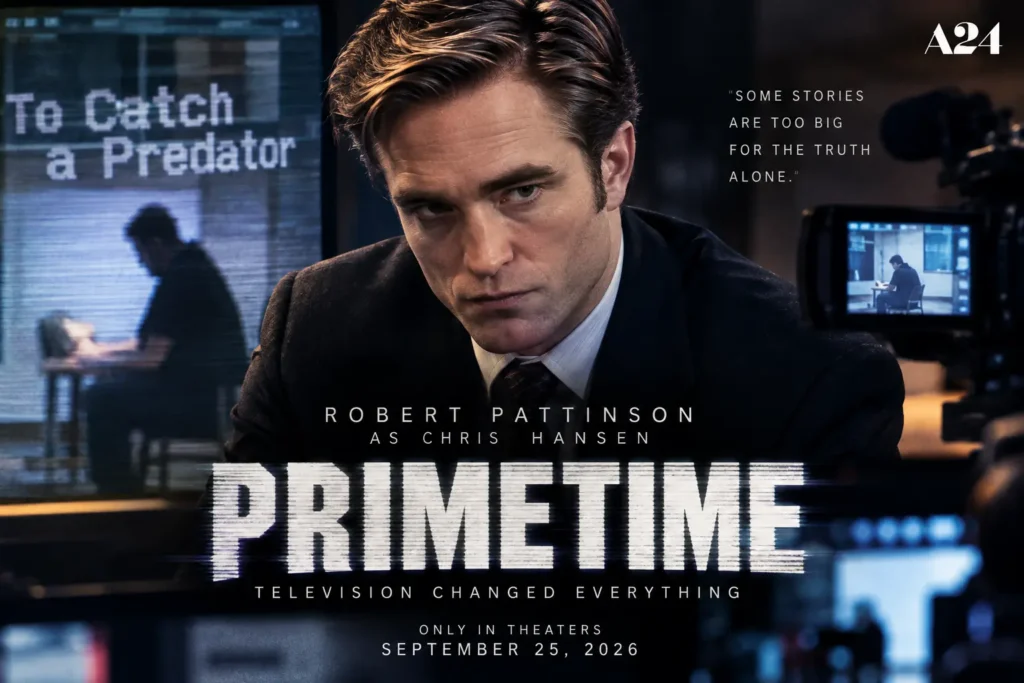
Robert Pattinson takes on one of his most unusual roles in Primetime, a new A24 film inspired by Chris Hansen and the world surrounding To Catch a Predator. Directed by Lance Oppenheim, the movie is set in 2006, when Hansen had become closely associated with the controversial television series.
Rather than presenting a traditional biography, Primetime turns that real-world history into a fictionalized drama about television, ambition and the blurred line between journalism and entertainment.
Pattinson plays Hansen, while Merritt Wever, Skyler Gisondo, Phoebe Bridgers, Matthew Maher and Bokeem Woodbine appear in the principal supporting cast.
With its recognizable real-world inspiration and Pattinson’s transformation into a television personality, Primetime has attracted attention ahead of its theatrical release. Here’s what to know about the movie’s story, release date, cast and connection to To Catch a Predator.
What Is Primetime About?
Primetime is set in 2006 and follows television host Chris Hansen as he works on an investigation that could become a major television event.
The film draws inspiration from To Catch a Predator, the NBC program known for using undercover operations and hidden cameras to confront men suspected of attempting to meet minors for sexual purposes.
However, Primetime is not a documentary about Hansen’s career. Instead, Lance Oppenheim uses the real-world setting as the foundation for a fictionalized story about the people and pressures behind sensational television.
The movie focuses on the ambition involved in producing attention-grabbing television. It also examines what can happen when serious investigations become entertainment for a mass audience.
Pattinson’s performance adds another layer to the story. His portrayal does not simply attempt to reproduce Hansen’s real-life appearance and mannerisms. Instead, the movie presents a heightened version of the television host and explores the difference between his public image and the world behind the camera.
The film therefore works as both a character-driven drama and a broader examination of television culture.
Primetime Release Date and Where to Watch
A24 has scheduled Primetime for a September 25, 2026 theatrical release in the United States.
The movie’s theatrical launch follows its festival premiere and brings Oppenheim’s film to a wider audience beyond the international festival circuit.
When Does Primetime Release?
The confirmed US theatrical release date is September 25, 2026.
A24 is distributing the film, which stars Robert Pattinson as Chris Hansen alongside Merritt Wever, Skyler Gisondo, Phoebe Bridgers, Matthew Maher and Bokeem Woodbine.
For viewers looking specifically for a streaming release, no separate streaming date has been confirmed in the supplied material. Therefore, the September 25 theatrical date remains the key release information currently available.
The movie is also intended for mature audiences. Its R rating reflects disturbing sexual material, graphic nudity, violent content and strong language.
Where Did Primetime Premiere?
Before its US theatrical release, Primetime premiered at the Venice International Film Festival in September 2026.
The festival debut placed the movie in front of international critics and audiences before its wider theatrical rollout.
Pattinson’s transformation into Hansen became one of the major talking points surrounding the premiere. Critics also discussed the film’s unusual combination of media satire, thriller elements and darker subject matter.
The Venice screening therefore served as an important first look at a movie that uses the history of To Catch a Predator as the starting point for a much broader story about television.
Primetime Cast and Characters
The cast of Primetime combines established actors with performers from different creative backgrounds.
| Actor | Character |
|---|---|
| Robert Pattinson | Chris Hansen |
| Merritt Wever | Andie Bender |
| Skyler Gisondo | Dan Plumb |
| Phoebe Bridgers | Del |
| Matthew Maher | Supporting role |
| Bokeem Woodbine | Supporting role |
The ensemble allows the movie to look beyond Hansen and explore the people involved in creating a high-profile television investigation.
Robert Pattinson as Chris Hansen
Robert Pattinson plays Chris Hansen, the television journalist associated with To Catch a Predator.
His performance serves as the center of the movie. Rather than treating Hansen as a straightforward biographical subject, Pattinson portrays a heightened version of the television personality.
The performance emphasizes the contrast between Hansen’s polished on-camera persona and the pressures surrounding the production behind the scenes.
Pattinson’s transformation became one of the film’s biggest discussion points following its festival premiere. His approach makes the character feel deliberately stylized rather than like a conventional impersonation.
That choice fits the movie’s larger approach. Primetime is less interested in simply recreating television history and more interested in examining the culture that developed around sensational investigations.
Merritt Wever, Skyler Gisondo and Supporting Cast
Merritt Wever plays Andie Bender, a producer connected to the television operation.
Skyler Gisondo portrays Dan Plumb, another character involved in the investigation. Their roles broaden the story beyond Hansen and give the audience a view of the production from different perspectives.
Singer-songwriter Phoebe Bridgers also appears as Del, while Matthew Maher and Bokeem Woodbine round out the principal ensemble.
Together, these characters help Primetime function as an ensemble drama rather than a simple Chris Hansen biopic.
Their presence also gives Oppenheim more room to explore the production process, workplace relationships and competing pressures behind a television investigation.
The Story Behind Primetime
Primetime takes viewers back to 2006, when Chris Hansen had become a familiar television figure through To Catch a Predator. The film follows Hansen as he pursues an investigation that he believes could become a defining moment in his television career.
At the center of the story is the pressure to create compelling television. Hansen is not simply trying to complete an investigation. He also wants the resulting program to capture attention and make an impact with viewers.
That focus gives the movie a larger conflict. The investigation deals with serious real-world subject matter, yet the people producing it must also think about cameras, performances, audience interest and the demands of television.
The story therefore moves between the investigation itself and the production environment surrounding it.
Rather than treating Hansen as the only important figure, Primetime introduces fictional characters who represent different sides of the television operation. Their experiences help show how an investigation can change once it becomes part of a major entertainment production.
The film uses this setting to explore ambition and professional pressure. It asks what happens when the desire to create memorable television begins competing with the responsibilities attached to reporting on disturbing events.
That approach makes Primetime more than a recreation of a famous television program. It becomes a fictionalized examination of the people, decisions and incentives operating behind the camera.
How Primetime Connects to To Catch a Predator
The clearest connection between Primetime and To Catch a Predator comes from their shared focus on Chris Hansen and televised undercover investigations.
The original series became known for operations involving adults who communicated online with people posing as minors. The encounters were recorded, and Hansen confronted suspects during the televised investigations.
The format attracted substantial public attention because it combined investigative reporting with the conventions of reality television.

Primetime uses that recognizable television history as the foundation for its own fictional narrative. However, it does not simply recreate individual episodes of the original series.
Instead, the movie looks at the larger production environment surrounding an investigation.
That includes the people working behind the scenes, the planning required for a televised operation and the pressure to turn an investigation into compelling programming.
This distinction is important because Primetime is not structured as a historical account of To Catch a Predator. It uses the program’s cultural legacy to examine television itself.
The movie consequently raises questions about the relationship between:
- Investigative journalism
- Television entertainment
- Audience attention
- Professional ambition
- Ethical responsibility
By focusing on those tensions, Primetime creates distance from the original television format while still drawing heavily from its cultural identity.
Is Primetime Based on a True Story?
Primetime draws from real television history, but the movie should not be treated as a literal biography of Chris Hansen.
The real Hansen and To Catch a Predator provide the foundation for the story. However, the filmmakers use fictionalized characters and situations to construct their narrative.
What Is Real?
Chris Hansen is a real television journalist who became widely recognized through To Catch a Predator, which appeared as part of NBC’s Dateline programming.
The series became known for undercover investigations involving men who believed they were communicating with minors online. Hansen confronted many of the men during televised encounters.
The program became a notable part of 2000s television culture because it combined investigative techniques with a highly dramatic presentation.
That real-world history forms the basis of Primetime.
The movie’s 2006 setting, Hansen’s public identity and the concept of televised predator stings therefore connect directly to documented events and people.
However, those elements provide the historical framework rather than a complete record of everything shown in the film.
What Does Primetime Fictionalize?
The movie builds a fictional story around its real-world inspiration.
Its characters, relationships and specific situations should therefore be understood within the film’s dramatic universe rather than assumed to represent a complete historical account.
Characters such as Dan Plumb and Andie Bender help the movie explore the television operation from perspectives beyond Hansen himself.
The film also interprets Hansen’s motivations and professional relationships through its own dramatic lens.
This distinction becomes especially important because Hansen was not involved in the film’s creative production and has publicly criticized aspects of the project.
As a result, viewers should separate the documented history of To Catch a Predator from the events created for Primetime.
The simplest way to describe the movie is as a fictionalized drama inspired by real people, television history and events, rather than a documentary or conventional biographical film.
Why Chris Hansen Objected to Primetime
Chris Hansen was not involved in the making of Primetime, and his reaction to the film has become an important part of the movie’s public discussion.
Hansen has questioned why Hollywood chose to tell a fictionalized story about his television career without consulting him. He has also criticized the way Robert Pattinson portrays him, describing the interpretation as overly dramatic and objecting to the film’s treatment of his work.
In an interview reported by People, Hansen called the movie an “insult” while making clear that he does not have an issue with Pattinson personally. He has described the real work behind To Catch a Predator as serious investigative journalism and has questioned the film’s darker interpretation of that history.
The disagreement goes beyond casting. Hansen has also raised concerns about the use of his name and likeness and has explored possible legal options.
At the same time, the filmmakers have presented Primetime as a fictionalized interpretation rather than a literal account of Hansen’s life. That distinction forms the central point of disagreement between the real television host and the movie’s creative team.
Hansen’s Concerns About the Movie
One of Hansen’s main objections is that he says he was not consulted during the film’s development.
He told the Los Angeles Times that he walked out of a private screening arranged by A24 after declining to sign a nondisclosure agreement. Hansen believed the agreement could limit his ability to object publicly to the portrayal. A24 characterized the agreement as a standard measure intended to prevent spoilers.
Hansen has also argued that the film should be more clearly identified as fiction rather than being presented as a movie inspired by true events.
His concerns can be summarized around several issues:
- He was not part of the creative process.
- He objects to aspects of Pattinson’s portrayal.
- He questions the filmmakers’ motives.
- He disputes the way the film interprets his investigative work.
- He has raised concerns about the use of his identity and likeness.
Hansen has also purchased advertising that runs before some theatrical screenings of Primetime. Those advertisements promote TruBlu, his current true-crime streaming platform.
Robert Pattinson and Lance Oppenheim Respond
Robert Pattinson has responded to Hansen’s criticism without attacking the real television host.
When asked about Hansen’s reaction at the Venice Film Festival, Pattinson said he hoped Hansen would like the movie. He also explained that Hansen’s television presence was one of the elements that made the role compelling to him.
Director Lance Oppenheim has taken a similar approach to the distinction between the real person and the movie character.
Oppenheim has described Primetime as a “docufantasia,” reflecting his intention to combine real-world material with fictional storytelling. He has said that he became fascinated by the theatrical quality of To Catch a Predator and by the way Hansen had developed a recognizable television persona.
For Oppenheim, the movie is not simply about reproducing Hansen’s career. He wanted to explore what happens when serious investigative subject matter becomes entertainment.
That explains why the filmmakers have embraced a stylized approach instead of presenting the movie as a conventional biography.
What Primetime Is Really Exploring
The controversy surrounding Hansen’s portrayal points toward the larger question at the center of Primetime: where does journalism end and entertainment begin?
To Catch a Predator was built around real investigations and serious allegations, but the television format also relied on dramatic confrontations, recognizable catchphrases and a strong on-camera personality.
Primetime takes that tension and places it at the center of its fictional story.
Journalism vs. Entertainment
The film examines a television environment where investigative work must also compete for audience attention.
Hansen’s character wants to expose wrongdoing, but the production also has to create compelling television. That creates a conflict between the public-interest purpose of an investigation and the commercial pressures of entertainment.
The movie therefore asks questions about presentation as much as journalism:
- How much drama can an investigation contain before it becomes spectacle?
- What happens when ratings become part of the equation?
- Does an important story remain journalism when entertainment becomes the primary attraction?
- Who carries responsibility for the way audiences consume disturbing material?
These questions connect Primetime to a larger history of television news and reality programming.
The film does not simply recreate the original series. Instead, it uses that format to examine the machinery surrounding it.
That approach also explains why the movie has generated disagreement. Some viewers may see its fictionalization as a way to investigate the ethics of the original television phenomenon, while others may view the dramatization as unfair to the people it portrays.
Ratings, Fame and Moral Responsibility
Another major theme is the pressure created when professional success depends on audience attention.
In Primetime, Hansen operates inside a television system where a successful investigation can mean more viewers, greater recognition and increased influence.
That creates a difficult tension. The people behind the production may believe they are exposing serious wrongdoing, yet they also benefit from turning those investigations into compelling television.
The film uses that contradiction to examine ambition.
Its fictionalized characters represent different motivations within the production process. Some are concerned with journalism, some with entertainment and others with the personal opportunities created by appearing on a major television program.
This makes the movie’s central question broader than whether Hansen’s methods were right or wrong.
Instead, Primetime asks what happens when justice, fame and entertainment become difficult to separate.
That theme has also shaped critical discussion of the movie. Reuters described the film as an exploration of the boundary between journalism and show business, while reviews have noted its focus on the ethical complications surrounding televised sting operations.
Primetime Reviews and Early Critical Reaction
Early reviews for Primetime have focused heavily on Robert Pattinson’s performance, while opinions about the film’s overall storytelling have been more divided.
Critics have consistently noted the film’s unusual style and its willingness to treat the To Catch a Predator world as something darker and stranger than a conventional true-crime drama.
For more movie coverage, check out our Practical Magic 2 review and release guide, covering the sequel’s cast, release date and latest details.
At the time of these early reviews, Primetime was receiving substantial attention for Pattinson’s transformation into Chris Hansen. Entertainment Weekly reported that critics were broadly praising the performance, while reactions to the movie’s message and execution varied.
The critical conversation can be summarized through several recurring points:
- Pattinson’s highly committed performance
- Lance Oppenheim’s distinctive direction
- The film’s unusual visual identity
- Its mixture of satire, thriller and horror
- Questions about how effectively its themes come together
Rather than receiving a uniformly straightforward response, Primetime has generated discussion about both its strengths and its narrative choices.
What Critics Are Saying About Robert Pattinson
Robert Pattinson has emerged as one of the clearest focal points of the early response to Primetime.
Critics have highlighted how completely he changes his voice, mannerisms and physical presence for the role. His version of Hansen is not presented as a simple imitation. Instead, Pattinson creates a heightened interpretation of the television host that fits the movie’s deliberately surreal tone.
Vanity Fair described the performance as a major highlight of the Venice premiere, while Rotten Tomatoes‘ early review roundup collected several critics who praised Pattinson’s commitment and range.
His performance also helps establish the movie’s central tension. Hansen appears confident and controlled when facing targets, yet the film increasingly presents that confidence as part of a larger performance.
That makes Pattinson’s portrayal important to the movie’s examination of television personality and spectacle.
The supporting cast has also received attention. Merritt Wever’s performance as producer Andie Bender and Skyler Gisondo’s work as Dan Plumb have been singled out alongside Pattinson in several early reviews.
Primetime Visual Style and Tone
One of the most distinctive aspects of Primetime is its visual presentation.
Director Lance Oppenheim approaches the material with a style that moves away from conventional biographical drama. Critics have described the movie using terms including media satire, thriller and arthouse horror, reflecting how dramatically its tone can shift.
For another look at a visually distinctive genre film, read our Remain movie trailer review, which explores its supernatural romance and cinematic presentation.
The film also recreates the visual atmosphere of early-2000s television. Its imagery uses period-specific textures and a deliberately rough aesthetic rather than presenting the past with a polished modern look.
AwardsWatch noted the film’s use of the Academy ratio, pixelated opening imagery and a tactile early-2000s television aesthetic.
The visual approach becomes increasingly unsettling as the story progresses.
RogerEbert.com described the movie’s images as lurid and expressionistic, noting how the color treatment and camera work contribute to its disturbing atmosphere.
This style serves an important purpose. Television already plays a central role in the story, so Primetime makes the movie itself feel like an extension of that artificial media environment.
Is Primetime a Thriller, Horror Movie or Satire?
Primetime does not fit comfortably into a single genre.
The movie combines several approaches:
| Element | How it appears in the film |
|---|---|
| Thriller | Investigations, escalating pressure and dangerous confrontations |
| Media satire | Television ratings, production culture and celebrity |
| Horror | Disturbing subject matter and increasingly nightmarish imagery |
| Drama | Personal ambitions and relationships within the production |
| True-crime inspiration | Real people and television history provide the foundation |
That combination is part of what makes the film unusual.
RogerEbert.com describes Primetime as a media satire, thriller and horror movie, while Rotten Tomatoes‘ early review roundup notes its movement between thriller pacing and arthouse-horror aesthetics.
The genre mixture also affects the film’s critical reception. Some reviewers have found the heightened style effective, while others have argued that the movie’s ideas do not always develop as clearly as its visual language.
The Guardian, for example, questioned whether the film ultimately knows what it wants to say about media and morality.
That difference in response is useful context for viewers expecting a straightforward true-crime drama.
What Makes Primetime Different From a Conventional True-Crime Movie?
A conventional true-crime film might focus primarily on reconstructing documented events.
Primetime takes a different route.
The movie uses real television history as a starting point, then builds a fictionalized world around it. Its goal is not simply to explain how To Catch a Predator operated. Instead, it examines the culture that made such programming possible.
That distinction becomes especially visible through the film’s treatment of television itself.
The cameras, production rooms, staged environments and on-screen confrontations all become part of the story. The audience is repeatedly reminded that what looks spontaneous on television often depends on a carefully constructed production.
This approach gives the movie a self-conscious quality. It is telling a story about television while also making viewers aware that they are watching a constructed film.
Critics have noticed this aspect of Oppenheim’s direction. Screen Daily described the movie as visually striking but dramatically contrived, while AwardsWatch noted how effectively its early-2000s television recreation establishes the period and its media environment.
Ultimately, Primetime uses the recognizable story of Chris Hansen to explore something broader: what happens when investigation, performance and entertainment occupy the same television screen.
What to Know Before Watching Primetime
Primetime is designed for viewers interested in true-crime-inspired dramas, media satire and stories about the darker side of television.
The movie combines real-world inspiration with fictional storytelling, so audiences should not approach it as a documentary about Chris Hansen or To Catch a Predator.
Here are the key details to know before watching:
| Detail | Information |
|---|---|
| Title | Primetime |
| Release Date | September 25, 2026 |
| Director | Lance Oppenheim |
| Screenwriter | Ajon Singh |
| Distributor | A24 |
| Runtime | 1 hour 50 minutes |
| Rating | R |
| Genre | Drama, Mystery & Thriller |
| Language | English |
| Lead Actor | Robert Pattinson |
The movie also contains disturbing sexual material, graphic nudity, violent content and strong language. Because of that subject matter, it is intended for mature audiences.
The story’s connection to To Catch a Predator is another important point. Viewers familiar with the original program will recognize the inspiration, but Primetime takes substantial creative liberties with its characters and situations.
If you’re also following upcoming genre releases, check out our Resident Evil 2026 guide, covering its release date, cast, story and trailer.
Frequently Asked Questions About Primetime
What is Primetime about?
Primetime follows Chris Hansen in 2006 as he attempts to make television history through another major investigation.
The film draws inspiration from Hansen’s work on To Catch a Predator, but it turns that real-world background into a fictionalized drama.
Rather than focusing only on the investigation, the movie explores the television production surrounding it. It looks at ambition, ratings, performance and the ethical questions that emerge when serious real-world events become entertainment.
Robert Pattinson plays Hansen, with Merritt Wever, Skyler Gisondo and Phoebe Bridgers among the supporting cast.
Who plays Chris Hansen in Primetime?
Robert Pattinson plays Chris Hansen in Primetime.
Pattinson approaches the role as a stylized interpretation rather than a straightforward impersonation. His performance emphasizes Hansen’s television persona and the contrast between his public image and the world behind the camera.
The transformation has become one of the most discussed elements of the movie, particularly because Pattinson is playing a real television personality in a story that deliberately mixes fact and fiction.
When does Primetime release?
Primetime is scheduled to arrive in US theaters on September 25, 2026.
The film premiered at the Venice International Film Festival earlier in September before its wider theatrical release.
A separate streaming release date has not been established in the current theatrical information, so the confirmed date for US audiences is September 25.
Is Primetime based on a true story?
Primetime is inspired by real people and real television history, but it is not a literal retelling of Chris Hansen’s life.
The movie draws from Hansen, To Catch a Predator and the early-2000s television environment. However, it creates fictionalized characters, relationships and situations for its story.
The best description is therefore a fictionalized drama inspired by real events, rather than a documentary or conventional biopic.
That distinction is particularly important when comparing the movie’s version of Hansen with the real television journalist.
Is Primetime about To Catch a Predator?
Yes. Primetime is strongly connected to To Catch a Predator.
The film follows a fictionalized version of Chris Hansen during the period when the television program had become a major cultural phenomenon.
However, it does not simply recreate an episode of the original series. Instead, the movie uses the show’s world to explore television production, ambition, media ethics and the relationship between investigative journalism and entertainment.
Who directed Primetime?
Lance Oppenheim directed Primetime.
Oppenheim approaches the material through a highly stylized visual language influenced by early-2000s network and reality television.
His goal extends beyond recreating the appearance of To Catch a Predator. The film examines the production system surrounding the program and the different ambitions of the people working inside it.
Why did Chris Hansen criticize Primetime?
Chris Hansen criticized the movie because he was not involved in its creative development and objected to aspects of how the film portrays him and his work.
His concerns have become part of the public discussion surrounding the movie.
The filmmakers, meanwhile, have presented Primetime as a fictionalized interpretation rather than a literal account of Hansen’s life.
That distinction explains much of the disagreement surrounding the project.
How long is Primetime?
Primetime has a runtime of 110 minutes, or approximately 1 hour and 50 minutes.
The film uses that runtime to combine its television-industry storyline with thriller elements, character drama and commentary on media culture.
What is Primetime rated?
Primetime is rated R.
The rating reflects the film’s disturbing sexual material, graphic nudity, violent content and language.
Because the movie deals with the world surrounding predator investigations, viewers should expect mature and potentially unsettling subject matter.
Final Takeaway
Primetime takes one of the most recognizable television phenomena of the 2000s and turns it into a fictionalized story about the machinery behind the screen.
Robert Pattinson’s portrayal of Chris Hansen sits at the center of that approach. Rather than offering a conventional biographical performance, he plays a heightened version of the television host within a story that deliberately blurs reality, performance and spectacle.
The movie’s connection to To Catch a Predator gives it a recognizable foundation, but its ambitions extend beyond retelling the show’s history.
At its core, Primetime examines what happens when investigative journalism enters the world of entertainment. The pursuit of a compelling story can attract viewers, create professional opportunities and generate cultural attention. At the same time, that success can raise difficult questions about responsibility, exploitation and the people represented on screen.
The controversy surrounding Chris Hansen adds another layer to that discussion. Hansen has challenged aspects of the film, while Oppenheim and Pattinson have approached the project as a fictionalized interpretation of a fascinating period in television history.
For viewers interested in Robert Pattinson, true-crime-inspired cinema or the complicated relationship between news and entertainment, Primetime offers a story that goes beyond its real-world inspiration.