
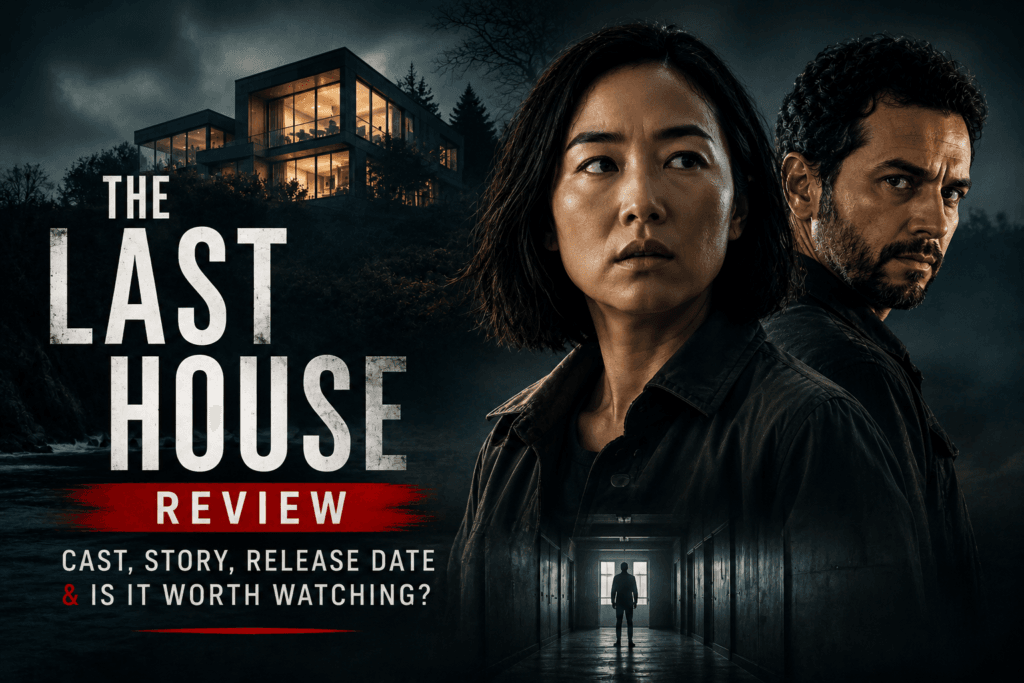
Netflix continues to expand its lineup of original thrillers, and The Last House is one of the latest films aiming to capture viewers with a tense, mystery-driven survival story. Directed by Louis Leterrier and featuring performances from Greta Lee and Wagner Moura, the movie combines psychological suspense, science fiction, and family drama into a single high-stakes narrative. Rather than relying on constant action, it builds intrigue through isolation, uncertainty, and the emotional strain of survival.
At the same time, audiences are also following Kit Connor’s upcoming movie projects, showing continued interest in the next generation of highly anticipated films.
What makes The Last House especially intriguing is its central premise. A family’s home, once their safest place, suddenly becomes an inescapable prison, forcing them to confront impossible choices while searching for answers about the mysterious force surrounding them. As resources dwindle and tensions rise, every decision carries greater consequences, turning ordinary moments into gripping suspense.
This guide explores everything you need to know about The Last House, including its story, cast, release details, themes, performances, and whether it deserves a place on your Netflix watchlist. If you’re looking for a spoiler-free overview before pressing play, you’ll find all the essential information here.
You can also explore our latest Hollywood celebrity stories for more trending entertainment updates and exclusive coverage.
A New Kind of Survival Story Arrives on Netflix
Netflix has built a reputation for releasing high-concept thrillers that hook viewers with a simple but unsettling question. The Last House follows that tradition by taking one of humanity’s most familiar places—a family home—and transforming it into an inescapable prison.
At first glance, the premise sounds straightforward. A family wakes up to discover they cannot leave their house. Doors refuse to open. Windows offer no escape. Communication with the outside world disappears. Supplies begin to run low. Worse still, an unknown force outside turns every attempt to escape into a dangerous gamble. Instead of asking how someone survives in the wilderness, The Last House explores how people survive when their entire world shrinks to four walls.
That idea alone has generated significant interest among thriller fans. It combines elements of psychological suspense, science fiction, supernatural mystery, and survival drama while placing family relationships at the center of the story.
Rather than relying only on jump scares, the film appears more interested in building tension through uncertainty. Every day inside the house becomes another challenge as food, trust, patience, and hope slowly disappear.
For viewers who enjoy movies that raise questions before providing answers, The Last House arrives with an intriguing setup that feels both mysterious and emotionally grounded.
What Is The Last House About?
The central premise of The Last House is refreshingly simple but full of possibilities.
Without warning, a normal family discovers that leaving their home has become impossible. No explanation arrives. Authorities cannot be contacted. Neighbors seem just as trapped. Every attempt to escape fails, while an unknown danger appears to exist beyond the walls of the house.
As the days pass, everyday concerns become life-or-death problems.
The family must answer questions such as:
- How long will the food last?
- Can electricity and water be trusted?
- Is anyone still alive outside?
- Is the danger physical, supernatural, or something else entirely?
- Should they stay together or risk everything trying to escape?
Instead of immediately revealing the mystery, the story allows uncertainty to become part of the suspense.
That slow buildup separates The Last House from many action-heavy thrillers. Rather than racing from one explosion to another, it focuses on how ordinary people react when the rules of everyday life suddenly disappear.
The Last House Release Date
Netflix released The Last House on August 7, 2026, making it one of the platform’s major original thriller releases of the summer. The movie runs for approximately 1 hour and 50 minutes and carries a PG-13 rating.
Basic information includes:
| Detail | Information |
|---|---|
| Title | The Last House |
| Release Date | August 7, 2026 |
| Platform | Netflix |
| Genre | Sci-Fi, Thriller, Horror, Mystery |
| Runtime | 1 hour 50 minutes |
| Rating | PG-13 |
| Director | Louis Leterrier |
| Writer | Matthew Robinson |
These details suggest Netflix positioned the movie as a mainstream thriller that appeals to a broad audience rather than hardcore horror fans alone.
The Last House Cast
One reason The Last House attracted attention before release is its talented cast.
Greta Lee
Greta Lee plays one of the family’s central figures. Over recent years, she has become known for emotionally layered performances that balance vulnerability with resilience.
In a story built around survival and family relationships, that experience becomes particularly valuable.
Wagner Moura
Wagner Moura portrays the family’s father, Jason.
International audiences recognize Moura from acclaimed dramatic roles, and his ability to portray determination under pressure makes him a natural fit for a survival thriller.
Supporting Cast
The movie also features:
- Riley Chung
- Emma Ho
- Noah Alexander Sosnowski
- Gabriel Barbosa
Together, the cast represents a believable family unit forced into extraordinary circumstances rather than larger-than-life action heroes.
Who Made The Last House?
Director: Louis Leterrier
The Last House is directed by Louis Leterrier, a filmmaker known for balancing large-scale spectacle with fast-paced storytelling.
Instead of creating a traditional haunted-house movie, Leterrier approaches the project as a survival thriller where suspense grows from isolation rather than constant action.
The confined setting also presents an interesting filmmaking challenge. Keeping audiences engaged inside a single location requires careful pacing, strong performances, and creative cinematography.
Writer: Matthew Robinson
The screenplay comes from Matthew Robinson, whose previous work includes both adventure and fantasy projects.
For The Last House, Robinson shifts toward psychological suspense while using a simple premise to explore larger questions about family, fear, and survival.
Why The Last House Immediately Grabs Attention
Many survival stories begin with a disaster.
Some feature zombies.
Others involve monsters.
Some focus on natural disasters.
The Last House chooses a different approach.
Instead of forcing characters into an unfamiliar environment, it traps them inside the place where they should feel safest.
That reversal creates immediate tension.
Home normally represents comfort.
Here, it becomes confinement.
The kitchen becomes ration storage.
The living room becomes a planning center.
Every window becomes a reminder that freedom exists only a few feet away—but remains impossible to reach.
This simple reversal is one of the movie’s strongest ideas because nearly everyone can imagine what it would feel like to be unable to leave their own home.
The Last House Blends Multiple Genres
One reason The Last House stands out is that it doesn’t fit neatly into a single category.
Instead, it combines elements from several genres.
Science Fiction
The unexplained force trapping the family introduces speculative elements that push the story beyond a conventional home invasion thriller.
Psychological Thriller
Fear grows not only from external danger but also from uncertainty.
When answers are limited, even small decisions become emotionally exhausting.
Survival Drama
Food, water, power, and emotional endurance become increasingly important as time passes.
The family’s greatest enemy may eventually become desperation itself.
Mystery
The audience keeps asking the same questions as the characters.
Why is this happening?
Who—or what—is responsible?
Can anyone escape?
Each unanswered question keeps viewers invested in discovering what lies beyond the walls.
Why the Premise Feels So Relatable
Although The Last House presents a fictional scenario, its emotional foundation feels surprisingly familiar.
People understand what it means to spend extended time indoors.
They understand uncertainty.
They understand worrying about loved ones.
They understand running out of supplies.
Rather than depending entirely on supernatural elements, the story appears to use these recognizable emotions to make its suspense more effective. Critics have noted that the film echoes the emotional isolation many people experienced during recent global lockdowns, even as it develops its own fictional mystery.
First Impressions of The Last House
Before diving deeper into performances, cinematography, themes, and the movie’s biggest strengths and weaknesses, The Last House succeeds in establishing an immediately compelling premise.
It asks a question that is both simple and unsettling:
What would you do if your home suddenly became the only place you could ever live—and something outside wanted to keep it that way?
That central mystery drives the film forward while giving audiences plenty of reasons to keep watching. Whether viewers come for the survival elements, the family drama, or the science-fiction mystery, the opening act lays a solid foundation for the larger story that unfolds.
The Last House Story Builds Suspense Through Isolation
One of the biggest strengths of The Last House is how it develops tension without revealing too much too soon. Instead of rushing into dramatic twists, the movie gradually introduces its mysterious world and encourages viewers to uncover the truth alongside the characters.
The story begins with an ordinary family living a quiet life before everything changes unexpectedly. What starts as a normal day quickly turns into an unimaginable situation when they realize leaving their home is no longer possible. Every door, every window, and every attempt to escape only raises more questions.
Unlike many survival thrillers that depend on constant action, The Last House focuses on uncertainty. The family has no clear explanation for what is happening, no reliable source of information, and no guarantee that help is coming. As a result, even the smallest choices begin to feel significant.
This slower approach allows suspense to build naturally while keeping the audience invested in the mystery.
The Last House Creates a World Filled With Questions
Although the story takes place primarily in one location, The Last House never feels limited by its setting. Instead, the house becomes the center of a much larger mystery.
The characters constantly face unanswered questions, including:
- Why can’t they leave?
- What exists beyond the property?
- Is the danger real or psychological?
- Are other families experiencing the same situation?
- Can anyone outside help them?
Rather than answering everything immediately, the film carefully reveals new information over time. Each discovery adds another layer to the mystery while encouraging viewers to develop their own theories.
This storytelling style rewards patience and keeps the audience engaged throughout the early portions of the film.
The Last House Characters Feel Like Real People
A survival story succeeds when viewers care about the people involved, and The Last House spends time developing its central family before placing them under extreme pressure.
Instead of presenting perfect heroes, the film introduces individuals with different personalities, fears, and ways of handling stressful situations.
Some characters remain optimistic.
Others become skeptical.
Some focus on finding practical solutions, while others struggle with fear and uncertainty.
These different reactions create believable conflicts that feel emotionally authentic rather than forced.
As conditions become more difficult, relationships evolve naturally, allowing character development to become just as important as the mystery itself.
The Last House Explores Family Dynamics Under Pressure
One of the movie’s most interesting themes is how extraordinary situations affect ordinary relationships.
When resources become limited and every decision matters, family members begin to see one another differently.
Simple disagreements grow into larger conflicts.
Long-hidden fears surface.
Responsibilities shift as circumstances change.
At the same time, moments of compassion, sacrifice, and teamwork remind viewers that survival often depends on cooperation rather than individual strength.
This emotional balance helps The Last House stand out from thrillers that focus only on external danger.
The Last House Uses Isolation as Its Biggest Threat
Many thrillers rely on visible villains to create suspense. The Last House takes a different approach by making isolation itself one of the story’s greatest challenges.
Being unable to communicate with the outside world creates uncertainty that slowly affects every member of the household.
Without reliable information, rumors and assumptions become increasingly dangerous.
The family begins questioning not only their surroundings but also their own judgment.
This psychological pressure grows stronger as time passes, making the unseen threat feel even more unsettling than a visible enemy.
Because viewers experience the mystery alongside the characters, the suspense remains effective throughout much of the story.
The Last House Balances Mystery With Emotional Storytelling
Although mystery drives the plot, The Last House also spends considerable time exploring emotional resilience.
Each character reacts differently to prolonged uncertainty.
Some attempt to maintain normal routines.
Others become determined to solve the mystery at any cost.
Meanwhile, younger family members process fear in their own unique ways, creating moments that feel both realistic and emotionally engaging.
Rather than interrupting the suspense, these quieter scenes give audiences opportunities to understand the characters before the next major development arrives.
The Last House Themes Go Beyond Survival
On the surface, The Last House is a survival thriller. However, the story also explores several broader ideas that resonate beyond its fictional premise.
Fear of the Unknown
The greatest source of tension is not always what the characters can see. Instead, uncertainty becomes the driving force behind many of their decisions.
Without clear answers, imagination often becomes more frightening than reality.
Trust During a Crisis
As pressure increases, trust becomes increasingly valuable.
The family must decide whom to believe, which risks are worth taking, and whether working together offers the best chance of survival.
These questions create emotional conflict alongside the physical challenges.
Hope in Difficult Circumstances
Despite its suspenseful tone, The Last House also examines the importance of hope.
Even when answers remain out of reach, the characters continue searching for solutions instead of giving up.
This determination provides emotional depth while preventing the story from becoming overwhelmingly bleak.
The Last House Cinematography Enhances the Suspense
Visually, The Last House makes effective use of its limited setting.
Instead of relying on elaborate locations, the cinematography transforms familiar spaces into environments filled with uncertainty.
Hallways appear longer.
Dark corners feel more threatening.
Windows become constant reminders of the unreachable world outside.
Camera movement remains controlled, allowing viewers to experience the house from the characters’ perspective.
This restrained visual approach complements the film’s slow-building suspense rather than distracting from it.
The Last House Creates Atmosphere Through Sound Design
Sound plays a major role in maintaining tension throughout the movie.
Instead of overwhelming scenes with loud music, quieter moments often become the most suspenseful.
Small background noises.
Unexpected silence.
Unexplained sounds from outside the house.
These subtle audio choices encourage viewers to pay close attention, increasing the sense of uncertainty.
As a result, the atmosphere remains consistently tense without relying on excessive jump scares.
The Last House Pacing Rewards Patient Viewers
Not every thriller races from one action sequence to another, and The Last House embraces a more deliberate pace.
The opening sections focus on establishing the family’s situation before introducing larger mysteries.
This slower progression allows emotional investment to grow naturally.
Viewers expecting nonstop action may find the film more restrained than traditional survival thrillers.
However, audiences who appreciate gradual suspense and character-driven storytelling are more likely to enjoy the experience.
By allowing tension to build step by step, the movie creates anticipation that carries into its later acts.
Why The Last House Feels Different From Typical Netflix Thrillers
Netflix releases numerous thriller films each year, yet The Last House distinguishes itself through its emphasis on atmosphere instead of spectacle.
Rather than depending on frequent action scenes, the movie focuses on mystery, emotional conflict, and psychological suspense.
Its single-location setting encourages creative storytelling, while the central mystery keeps audiences searching for answers.
The combination of science fiction, survival drama, and family relationships gives the film a distinct identity among recent streaming releases.
While The Last House takes a suspense-driven approach, audiences are also eagerly anticipating other upcoming Hollywood movies that promise ambitious storytelling on a much larger scale.
As the story progresses, these elements continue expanding the mystery, leading viewers toward bigger revelations without abandoning the emotional core established in the opening act.
The Last House Review: Performances Bring the Story to Life
A compelling premise can capture attention, but memorable performances keep audiences emotionally invested. The Last House depends heavily on its cast because much of the story unfolds inside a single location with limited outside interaction. That places greater responsibility on the actors to maintain tension through dialogue, expressions, and believable relationships.
Instead of delivering exaggerated reactions, the performances generally feel grounded. The characters respond to extraordinary circumstances in ways that reflect fear, frustration, hope, and determination. These emotional shifts make the family dynamic more convincing and help viewers connect with their struggle.
As the mystery deepens, each performance contributes to the growing sense of uncertainty, ensuring that the emotional journey remains just as important as the plot itself.
The Last House Cast Delivers Emotional Performances
The chemistry between the central cast plays a significant role in making The Last House believable. Since the story revolves around a family facing an impossible situation, their interactions must feel authentic.
Rather than focusing on dramatic speeches, the film often relies on quieter moments. Simple conversations, shared concerns, and disagreements reveal how each character copes with increasing pressure.
This approach creates emotional realism and prevents the characters from becoming one-dimensional.
Although every viewer may connect with different characters, the ensemble works together effectively to support the film’s central themes of resilience and survival.
The Last House Balances Action With Character Development
Many survival thrillers prioritize constant movement and large action sequences. The Last House chooses a different path by allowing its characters to evolve alongside the mystery.
Each challenge forces the family to make difficult decisions.
Some choices strengthen relationships.
Others create tension within the household.
These developments ensure that the story continues moving forward even during quieter scenes.
Instead of treating character development as a pause between suspenseful moments, the film integrates both elements naturally.
The Last House Direction Focuses on Atmosphere
Director Louis Leterrier approaches The Last House with a clear emphasis on mood and suspense.
Rather than revealing every answer immediately, the direction encourages curiosity. The audience experiences uncertainty at the same pace as the characters, making each discovery feel more meaningful.
The confined setting also requires careful visual planning.
Rooms never feel repetitive.
Different camera angles, lighting choices, and scene composition help familiar spaces appear fresh throughout the film.
As a result, the house itself becomes an active part of the storytelling rather than simply serving as a backdrop.
The Last House Screenplay Builds Mystery Step by Step
The screenplay follows a measured pace that gradually expands the mystery instead of overwhelming viewers with information.
Questions appear early.
Small clues emerge later.
Additional details slowly reshape the audience’s understanding of the situation.
This gradual progression encourages viewers to pay attention to conversations, environmental details, and character decisions.
While some mysteries remain intentionally unexplained for much of the film, the screenplay consistently provides enough information to keep curiosity alive.
That balance between answers and uncertainty helps maintain suspense without making the story feel confusing.
The Last House Strengths
Every film has qualities that leave a lasting impression, and The Last House offers several notable strengths.
A Unique High-Concept Premise
The idea of a family trapped inside their own home immediately creates intrigue.
Instead of relying on traditional survival scenarios, the film transforms an ordinary environment into an unfamiliar challenge.
This fresh concept sets the story apart from many recent thrillers.
Strong Emotional Core
Beyond its mystery, The Last House remains focused on family relationships.
Viewers witness fear, disagreement, compassion, and sacrifice as the characters respond to changing circumstances.
These emotional moments provide balance and make the suspense more meaningful.
Consistent Atmosphere
The film maintains an uneasy tone from beginning to end.
Lighting, sound, and pacing work together to create suspense without depending on constant jump scares.
This restrained approach allows tension to build naturally.
Thought-Provoking Themes
Rather than existing solely as entertainment, The Last House raises questions about trust, resilience, fear, and the meaning of home.
These themes encourage discussion after the credits roll and give the story additional depth.
The Last House Weaknesses
While The Last House succeeds in many areas, it may not satisfy every viewer.
Deliberate Pacing
The movie prioritizes gradual suspense instead of nonstop action.
Audiences expecting frequent action sequences may find the slower rhythm less exciting during certain sections.
Limited Setting
The single-location concept strengthens the atmosphere, but it also limits visual variety.
Although creative cinematography keeps the environment engaging, some viewers may prefer a broader range of locations.
Mystery Over Explanation
The film intentionally protects many of its secrets.
For viewers who enjoy interpreting clues and forming theories, this approach adds excitement.
Others may prefer more direct explanations.
The Last House Appeals to Fans of Psychological Thrillers
The storytelling style makes The Last House especially appealing to audiences who appreciate suspense driven by uncertainty rather than spectacle.
If you enjoy movies that encourage interpretation instead of providing immediate answers, this film offers a rewarding experience.
It also appeals to viewers who prefer emotional storytelling alongside mystery.
Instead of separating character drama from suspense, The Last House blends both elements into a single narrative.
The Last House Compared With Similar Survival Thrillers
Although The Last House shares certain characteristics with other survival and psychological thrillers, it develops its own identity through its unique premise.
| Feature | The Last House | Typical Survival Thriller |
|---|---|---|
| Primary Setting | Single family home | Multiple locations |
| Main Conflict | Isolation and mystery | External danger |
| Emotional Focus | Family relationships | Individual survival |
| Suspense Style | Psychological tension | Action-driven threats |
| Story Progression | Gradual mystery | Continuous action |
These differences help distinguish The Last House from more conventional entries in the genre.
Rather than competing through larger action scenes, the film emphasizes emotional tension and curiosity.
The Last House Keeps Viewers Guessing
One of the movie’s greatest strengths is its ability to encourage speculation.
Throughout the story, viewers naturally begin asking questions.
What caused the family’s situation?
Can the outside world still function normally?
Is the threat physical, scientific, or something beyond explanation?
Instead of answering everything immediately, the film allows audiences to develop their own theories while gradually introducing new clues.
This interactive viewing experience increases engagement and makes discussions after the movie particularly enjoyable.
The Last House Is More Than a Mystery
Although mystery drives much of the narrative, The Last House also explores how people respond when certainty disappears.
Every challenge tests the family’s values.
Every decision reveals something about their personalities.
Every setback forces them to reconsider their priorities.
These emotional developments ensure the story remains meaningful even during quieter scenes.
By combining suspense with character growth, the movie creates a more balanced viewing experience than thrillers that focus exclusively on action.
Is The Last House Worth Watching?
Whether The Last House deserves a place on your watchlist ultimately depends on what you enjoy most in a thriller.
If you’re looking for:
- A fast-paced action movie with constant explosions, this may not be the ideal choice.
However, if you appreciate:
- Psychological suspense
- Family-centered storytelling
- Slow-building mystery
- Science fiction elements
- Strong atmosphere
- Thought-provoking themes
then The Last House offers plenty to enjoy.
Its combination of emotional storytelling, intriguing mystery, and consistent tension creates an experience that stands apart from many traditional survival thrillers.
Rather than relying solely on spectacle, the film invites viewers to think, question, and emotionally invest in its characters from beginning to end.
What Works in The Last House
Every thriller has certain elements that define the overall viewing experience, and The Last House succeeds in several important areas. While opinions may differ from one viewer to another, the movie offers enough strengths to stand out among recent Netflix suspense releases.
The Last House Features an Intriguing Premise
The biggest attraction of The Last House is its central concept. Turning an ordinary family home into a place of uncertainty immediately creates curiosity.
Instead of sending its characters into an unfamiliar environment, the story traps them in a location they know well. That simple idea gives the movie a unique identity and provides a strong foundation for the mystery that follows.
Because the premise is easy to understand, viewers can quickly become invested in the family’s situation.
The Last House Maintains a Suspenseful Atmosphere
Atmosphere plays an essential role throughout The Last House.
Rather than relying on frequent jump scares or loud action sequences, the film creates tension through silence, uncertainty, and careful pacing.
Small sounds, dim lighting, and limited information work together to keep viewers wondering what might happen next.
This restrained approach allows suspense to grow naturally instead of feeling forced.
The Last House Focuses on Human Emotions
Although the movie includes mystery and survival elements, its emotional storytelling remains one of its greatest strengths.
Fear.
Hope.
Frustration.
Trust.
These emotions shape the family’s decisions throughout the story.
Instead of presenting flawless heroes, the film shows ordinary people trying to adapt to extraordinary circumstances. That emotional realism helps audiences connect with the characters on a deeper level.
The Last House Offers Strong Visual Storytelling
The movie makes effective use of its single primary setting.
Camera angles, lighting, and carefully framed shots help transform familiar rooms into spaces filled with tension.
Rather than feeling repetitive, the house evolves alongside the story, reflecting the emotional changes experienced by the family.
This visual consistency strengthens the overall atmosphere without distracting from the narrative.
What Could Have Been Better in The Last House
No film is perfect, and The Last House includes several aspects that may divide audiences.
The Last House Uses a Deliberate Pace
Viewers expecting nonstop action may find parts of the movie slower than anticipated.
The film spends considerable time developing its characters and expanding the mystery before introducing larger developments.
For audiences who enjoy psychological storytelling, this pacing can be rewarding.
However, those seeking continuous excitement may prefer a faster-moving thriller.
The Last House Leaves Room for Interpretation
One characteristic of The Last House is its willingness to let viewers think for themselves.
Instead of explaining every detail immediately, the movie gradually reveals information while allowing audiences to form their own conclusions.
Many viewers appreciate this approach because it encourages discussion.
Others may wish for more direct answers before the credits roll.
The Last House Prioritizes Mood Over Spectacle
Modern thrillers often feature elaborate visual effects and large-scale action.
The Last House takes a more restrained approach.
Its emphasis remains on atmosphere, performances, and emotional conflict rather than explosive set pieces.
Whether this style feels refreshing or understated will depend largely on individual preferences.
Who Should Watch The Last House?
Not every thriller appeals to the same audience, but The Last House fits particularly well for viewers who enjoy suspense driven by mystery and character development.
You may enjoy The Last House if you like:
- Psychological thrillers
- Survival dramas
- Mystery-driven storytelling
- Character-focused narratives
- Science fiction with emotional themes
- Slow-building suspense
- Family-centered stories
On the other hand, viewers looking for nonstop action, graphic horror, or frequent jump scares may find the movie more restrained than expected.
Setting realistic expectations helps create a more satisfying viewing experience.
How The Last House Compares to Similar Thrillers
Without revealing major plot details, The Last House shares certain qualities with other psychological survival stories while maintaining its own identity.
| Feature | The Last House | Traditional Survival Thriller |
|---|---|---|
| Main Setting | Family home | Outdoor or multiple locations |
| Primary Conflict | Isolation and uncertainty | External physical threats |
| Emotional Focus | Family relationships | Individual survival |
| Suspense Style | Psychological tension | Action-oriented danger |
| Story Progression | Mystery-driven | Event-driven |
These differences help explain why The Last House feels distinct despite belonging to a familiar genre.
Instead of trying to become the biggest action movie on Netflix, it focuses on creating emotional investment and long-term suspense.
Is The Last House Worth Watching?
For viewers who appreciate thoughtful thrillers, The Last House offers an engaging combination of mystery, suspense, and emotional storytelling.
The movie succeeds by asking compelling questions rather than rushing toward immediate answers.
Its strongest qualities include:
- An original high-concept premise
- Strong atmosphere
- Character-focused storytelling
- Consistent suspense
- Thought-provoking themes
If you’re exploring Netflix’s latest releases, The Last House is another title worth considering for your watchlist, especially if you enjoy slow-burning psychological thrillers.
Although the deliberate pacing may not satisfy everyone, audiences who enjoy slower psychological mysteries will likely appreciate the film’s approach.
Rather than depending on spectacle, The Last House builds tension through uncertainty and emotional conflict, creating a viewing experience that remains engaging from beginning to end.
Frequently Asked Questions About The Last House
Is The Last House available to stream on Netflix?
Yes. The Last House is available as a Netflix original, making it accessible to subscribers in supported regions. Availability may vary depending on your country, so it’s always a good idea to check your local Netflix library.
What genre is The Last House?
The Last House blends several genres, including psychological thriller, mystery, science fiction, and survival drama. Instead of focusing on traditional horror, the movie emphasizes suspense, emotional storytelling, and an intriguing central mystery.
Who stars in The Last House?
The film features a talented cast led by Greta Lee and Wagner Moura, alongside several supporting actors who contribute to the story’s emotional depth and family dynamics.
Who directed The Last House?
The Last House is directed by Louis Leterrier, a filmmaker known for combining suspense, action, and visually engaging storytelling across a variety of film genres.
Is The Last House based on a true story?
No. The Last House is a fictional story. While some emotional themes may feel realistic, the movie presents an original narrative designed as a suspenseful survival thriller.
Is The Last House a horror movie?
Not in the traditional sense. Although the film contains tense and unsettling moments, it focuses more on psychological suspense, mystery, and survival than graphic horror or frequent jump scares.
Can I watch The Last House with my family?
The answer depends on your family’s viewing preferences and the age of younger viewers. Since the film includes suspenseful situations and intense emotional scenes, parents should review its content rating before watching with children.
Is The Last House suitable for fans of psychological thrillers?
Yes. If you enjoy movies that slowly build tension through mystery, atmosphere, and character development, The Last House is likely to match your interests.
Does The Last House rely on jump scares?
The movie primarily builds suspense through uncertainty, atmosphere, and emotional tension instead of depending on constant jump scares.
How long is The Last House?
The runtime is approximately 1 hour and 50 minutes, making it a feature-length thriller that develops its mystery at a measured pace.
What makes The Last House different from other survival thrillers?
Unlike many survival films that focus on escaping dangerous outdoor environments, The Last House centers its story inside a family home. This unique setting shifts the emphasis toward psychological tension, relationships, and the emotional impact of isolation.
Is The Last House worth watching?
If you enjoy thoughtful mysteries, suspenseful storytelling, and character-driven thrillers, The Last House offers an engaging viewing experience. Viewers looking for nonstop action may prefer a different style of thriller, but those who appreciate gradual suspense are likely to find it rewarding.
For more entertainment news and event coverage, along with the latest movie reviews, keep exploring CLIMAX Magazine.
Key Takeaways About The Last House
Before deciding whether to watch The Last House, here are the most important points to remember:
- The Last House combines psychological suspense, survival drama, and mystery into one story.
- The film focuses on emotional storytelling rather than nonstop action.
- Strong performances and atmospheric direction help maintain tension throughout the movie.
- Family relationships play a central role in the narrative.
- The mystery gradually unfolds, encouraging viewers to stay engaged from beginning to end.
- Fans of slow-burning thrillers are more likely to appreciate the film’s storytelling style.
These qualities help distinguish The Last House from many conventional survival thrillers released in recent years.
Final Thoughts on The Last House
The Last House offers an intriguing blend of mystery, suspense, and emotional storytelling that keeps viewers invested through its unique premise and carefully developed atmosphere. Instead of relying on excessive action or predictable scares, the film focuses on uncertainty, human resilience, and the complex relationships that emerge during extraordinary circumstances.
Its greatest strength lies in transforming an ordinary home into the center of an unforgettable mystery while exploring how people respond when every familiar routine suddenly changes. Although its slower pacing may not appeal to every viewer, those who appreciate thoughtful psychological thrillers are likely to enjoy the experience.
Whether you’re interested in the performances, the suspenseful premise, or the emotional themes, The Last House delivers a distinctive Netflix thriller that invites audiences to think beyond the surface. For fans of character-driven mysteries and survival stories, it’s a film that deserves a place on the watchlist.