
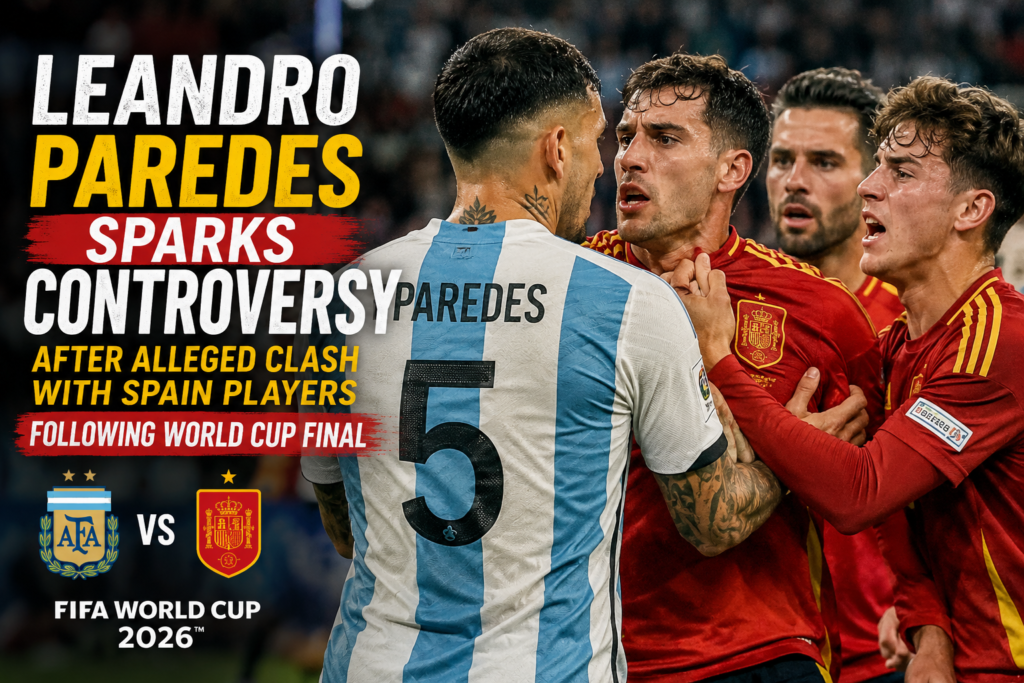
The 2026 FIFA World Cup final delivered everything football fans hoped for—high-level tactics, emotional moments, relentless intensity, and a dramatic finish. Yet, instead of being remembered only for Spain’s historic triumph, the match also became the center of debate because of a heated confrontation involving Argentina midfielder Leandro Paredes after the final whistle. Reports, television footage, and videos circulating online showed Paredes becoming involved in an altercation with multiple Spain players during the post-match celebrations, creating one of the tournament’s most talked-about storylines.
While emotions often run high after a World Cup final, the scenes that unfolded in New Jersey quickly shifted the conversation away from football and toward sportsmanship. Fans, former players, analysts, and media outlets around the world began discussing whether the incident crossed a line and what consequences could follow.
This article examines what reportedly happened, why the incident has generated widespread attention, and how it may affect both Paredes and Argentina moving forward.
A World Cup Final That Had Everything
Few matches carry as much pressure as a FIFA World Cup final. Every tackle, every pass, and every missed opportunity can define careers and shape football history.
Spain entered the final with one of the tournament’s strongest defensive records, while Argentina arrived hoping to successfully defend its world title. The clash featured two technically gifted teams with different tactical identities, making it one of the most anticipated finals in recent memory.
After a tense battle that remained scoreless for much of the contest, Spain eventually broke through in extra time to secure a 1-0 victory and lift another World Cup trophy. The win represented another landmark achievement for Spanish football and completed an impressive tournament campaign.
However, celebrations lasted only moments before attention shifted toward an unexpected confrontation involving players from both teams.
The Spotlight Quickly Shifted Away From Spain’s Victory
Ordinarily, the story after a World Cup final centers on:
- The winning goal
- Tactical brilliance
- Emotional celebrations
- Individual awards
- Historic achievements
Instead, social media feeds became flooded with clips showing players gathering in a tense exchange after the referee’s final whistle.
Within minutes, videos spread across multiple platforms, with many viewers focusing on Leandro Paredes’ involvement in the confrontation rather than Spain’s championship celebration. Several sports broadcasters replayed the incident repeatedly while analysts debated exactly how events unfolded.
Although emotions frequently boil over after major finals, many observers felt this incident overshadowed what should have been a memorable night for the new world champions.
What Allegedly Happened After the Final Whistle?
Based on widely circulated match footage and reports from multiple sports outlets, the confrontation began shortly after Spain secured victory.
Early exchanges reportedly involved several players gathering near midfield before tensions escalated.
According to available reports:
| Reported Sequence | Description |
|---|---|
| Final whistle | Spain players begin celebrating their World Cup victory. |
| Initial disagreement | Players from both teams exchange words near midfield. |
| Escalation | More players arrive as the confrontation grows. |
| Paredes becomes involved | The Argentine midfielder is seen engaging physically with Spain players. |
| Officials intervene | Referees, coaching staff, and teammates separate the players. |
| Discipline | Paredes is reportedly shown a red card after the confrontation. |
Because several players entered the scene simultaneously, different camera angles captured different moments. As a result, discussions continue regarding the exact sequence of events that led to the confrontation.
Why Leandro Paredes Became the Center of Attention
Although numerous players appeared during the confrontation, much of the attention focused on Paredes.
Television footage appeared to show the Argentine midfielder making physical contact with Spain defenders during the post-match chaos. Reports specifically referenced incidents involving Eric García and Gavi, with several outlets describing forceful confrontations that drew immediate reactions from nearby players.
Whether viewed from television broadcasts or fan-recorded clips, Paredes quickly became the central figure in discussions surrounding the incident.
Several football commentators argued that losing a World Cup final brings extraordinary disappointment, but maintaining composure remains an essential part of professional sports.
Understanding the Emotional Context
Before judging any player involved, it is important to recognize the extraordinary emotional environment surrounding a World Cup final.
Players invest years preparing for the tournament.
Many sacrifice club rest periods.
Some know it could be their final appearance on football’s biggest stage.
When defeat arrives after 120 exhausting minutes, emotions can overwhelm even experienced professionals.
That context helps explain why tensions sometimes rise immediately after major finals.
However, football’s biggest occasions also demand discipline. Many observers argued that frustration should never lead to physical confrontations after the match has ended.
Reports Suggest Earlier Tensions During the Match
The post-match incident did not appear to emerge without warning.
Several reports indicated that Paredes had already been involved in heated moments after entering the match as a substitute.
Among the reported incidents:
- Physical challenges
- Heated verbal exchanges
- Contact involving Spanish midfielders
- Referee intervention
- A yellow card during play
These moments suggested that emotions had already been building before the final whistle, making the post-match confrontation less surprising to many analysts.
Social Media Reacts Almost Instantly
Within minutes, clips of the confrontation dominated online football discussions.
Popular football accounts shared slow-motion videos, while supporters debated:
- Who started the confrontation?
- Did the reaction go too far?
- Should additional punishments follow?
- Were officials correct in their decisions?
- Could the incident have been prevented?
As with many viral sporting moments, opinions varied dramatically.
Some supporters defended the emotional reaction after losing football’s biggest match.
Others argued there was no justification for physical conduct after the referee had already ended the game.
Reddit discussions reflected the same divide. While some users questioned how the confrontation began, many others criticized the behavior shown after the match and emphasized the importance of sportsmanship regardless of the result.
Why Sportsmanship Matters on Football’s Biggest Stage
The FIFA World Cup reaches billions of viewers worldwide.
Because of that enormous audience, players are often viewed as ambassadors for their countries and for the sport itself.
Moments such as:
- Respectful handshakes
- Shirt exchanges
- Consoling opponents
- Celebrating responsibly
often become lasting memories alongside the football itself.
Likewise, confrontations can quickly become defining images that overshadow athletic achievements.
That reality explains why incidents involving star players receive such intense global scrutiny.
Spain’s Celebration Became Secondary
For Spain, winning another World Cup represented a historic accomplishment.
The squad displayed consistency throughout the tournament and ultimately lifted football’s biggest prize after a disciplined performance in the final.
Yet much of the immediate post-match coverage centered on the confrontation rather than:
- Spain’s tactical approach
- Individual performances
- Championship celebrations
- Tournament journey
- Historic achievement
Many football fans expressed disappointment that the headlines following the final focused as much on controversy as on Spain’s success.
What Comes Next?
In the hours following the final, discussions shifted toward potential disciplinary reviews and the broader implications of the incident. While post-match red cards and official reports can factor into future decisions, any additional sanctions would depend on the governing body’s review process and the evidence available. Reports indicated that further disciplinary consideration could follow after the match officials submitted their reports.
For Leandro Paredes, the episode has become one of the defining talking points of the 2026 World Cup final. Whether the focus eventually returns to the football itself or remains on the post-match controversy will depend on what unfolds in the days ahead.
The Moments That Led to the Post-Match Altercation
Although the confrontation occurred after the referee blew the final whistle, many observers believe the tension had been building throughout the closing stages of the match.
A World Cup final is unlike any other fixture. Every challenge carries enormous significance, and players often compete at the emotional limit. With Argentina chasing an equalizer and Spain trying to protect a narrow advantage, the intensity increased with every passing minute.
Several physical duels and animated conversations between players reflected just how much was at stake. While the match remained largely under control from a disciplinary standpoint, frustration became increasingly visible as the clock wound down.
When Spain’s victory became official, those emotions did not disappear immediately. Instead, disappointment from one side and celebration from the other created an environment where even a minor disagreement could quickly escalate.
A Reconstructed Timeline of the Incident
Based on widely circulated broadcast footage and multiple reports, the following sequence provides a broad overview of how events appeared to unfold.
| Approximate Stage | What Reportedly Happened |
|---|---|
| Final whistle | Spain players celebrated their World Cup victory while Argentina players reacted to the defeat. |
| Initial interaction | Several players gathered near one another during the celebrations. |
| Verbal exchange | A heated discussion reportedly developed between members of both teams. |
| Escalation | More players joined the group as emotions intensified. |
| Physical confrontation | Paredes was seen making physical contact during the incident, drawing immediate reactions from Spain players. |
| Intervention | Match officials, teammates, and staff members stepped in to separate those involved. |
| Aftermath | The confrontation dispersed, allowing Spain’s trophy ceremony to continue. |
Because television cameras captured the incident from different angles, some details remain open to interpretation. Even so, the overall sequence shows how rapidly emotions can shift after a high-stakes final.
Why Defeat in a World Cup Final Feels Different
Every professional footballer wants to lift the FIFA World Cup trophy, but only one team earns that privilege every four years.
For the losing side, the emotional impact can be overwhelming.
Several factors make a World Cup final uniquely difficult:
- Years of preparation lead to a single match.
- Many players may never reach another final.
- National expectations add enormous pressure.
- Months of sacrifice end in disappointment.
- Every mistake feels magnified on the biggest stage.
This emotional backdrop does not excuse unsporting behavior, but it helps explain why players sometimes struggle to process defeat immediately after the match ends.
Former professionals often describe the minutes following a World Cup final as some of the most emotionally challenging moments in football.
Why Paredes Has a Reputation for Playing With Intensity
Leandro Paredes has built much of his career on determination, competitiveness, and an aggressive midfield style.
Rather than avoiding physical contests, he frequently embraces them.
Throughout his club and international career, he has become known for:
- Strong tackles
- High-energy pressing
- Competitive mentality
- Vocal leadership
- Willingness to confront opponents
Supporters often appreciate those qualities because they demonstrate commitment to winning.
However, critics argue that such intensity can sometimes cross the line when emotions run too high.
The events following the World Cup final have renewed that discussion among football fans.
The Fine Line Between Passion and Discipline
One of football’s oldest debates centers on a simple question:
How much emotion is too much?
Supporters generally admire players who compete with passion.
They celebrate:
- Commitment
- Determination
- Fearlessness
- Leadership
- Competitive spirit
At the same time, football also values respect for opponents.
When emotions result in unnecessary confrontations after the match has ended, public opinion often changes quickly.
The World Cup places players under extraordinary pressure, but it also places them under extraordinary scrutiny.
Every action is replayed repeatedly across television broadcasts and social media platforms.
Spain’s Players Chose Celebration Over Further Escalation
One notable aspect of the incident was how quickly teammates, coaching staff, and officials worked to prevent the confrontation from becoming larger.
Once the initial exchange occurred, several Spain players appeared focused on moving teammates away from the situation so celebrations could continue.
That response likely helped prevent a wider altercation involving more members of both squads.
Large post-match confrontations sometimes involve substitutes, coaches, and technical staff entering the scene. Fortunately, this incident appeared to be contained before reaching that level.
The ability of officials and players to restore order allowed the trophy presentation to proceed without a prolonged delay.
The Role of Match Officials After the Final Whistle
Many casual fans assume a referee’s responsibilities end once the match concludes.
In reality, officials retain authority after the final whistle.
Their responsibilities include:
Monitoring player conduct
Referees continue observing player behavior until teams leave the field.
Recording incidents
Any misconduct occurring after play has ended can still appear in the official match report.
Issuing disciplinary sanctions
Depending on the circumstances, officials may show yellow or red cards for actions occurring after the match.
Supporting future reviews
The referee’s written report becomes one of the primary documents used if governing bodies later examine an incident.
Because of these responsibilities, post-match behavior can carry consequences even though the game itself has ended.
How Football Fans Around the World Responded
The incident generated thousands of discussions across online communities.
Several common viewpoints emerged.
Some defended Paredes
Supporters argued that:
- Losing a World Cup final creates overwhelming emotions.
- Competitive players naturally react strongly.
- Television angles may not show the complete sequence.
- Context matters before assigning blame.
Others criticized the behavior
Critics responded that:
- Physical confrontations have no place after the match.
- World Cup finalists should set an example.
- Spain deserved to celebrate without interruption.
- Professional players must control their emotions.
Neutral observers
Many fans chose a more balanced position, suggesting that:
- Emotions likely influenced everyone involved.
- Complete footage should be reviewed before drawing conclusions.
- Respect between opponents remains essential regardless of the result.
The variety of opinions illustrates how differently supporters interpret emotionally charged sporting moments.
How Media Coverage Amplified the Story
Modern sports coverage moves at remarkable speed.
Within minutes of the incident:
- Television networks replayed video clips.
- Sports websites published breaking updates.
- Journalists shared observations on social media.
- Fans analyzed slow-motion footage.
- Discussion spread internationally.
As additional camera angles emerged, analysts revisited the incident repeatedly.
Unlike previous generations, today’s football moments can reach millions of viewers almost instantly.
That rapid circulation often shapes public opinion before official investigations have concluded.
Why Every Camera Angle Matters
Major international tournaments use dozens of broadcast cameras.
Each angle captures only part of the story.
For example:
- One camera may focus on celebrations.
- Another tracks player reactions.
- A sideline camera captures conversations.
- A tactical view shows player positioning.
- Fan-recorded videos provide additional perspectives.
Because no single angle tells the entire story, investigators often review multiple recordings before reaching conclusions.
This process helps ensure disciplinary decisions rely on the fullest available evidence rather than isolated clips.
Could This Affect Paredes’ Reputation?
High-profile incidents often become lasting parts of an athlete’s public image.
While Leandro Paredes remains respected for his achievements with club and country, controversial moments inevitably attract attention.
Several factors will influence how this episode is remembered:
- Any official disciplinary outcome.
- Public statements from those involved.
- Future performances for club and country.
- Whether similar incidents occur again.
- How supporters interpret the available evidence.
Football history shows that players often recover from controversial moments through consistent professionalism and strong performances.
Others find that certain incidents continue to define public discussions for years.
Only time will determine which category this event ultimately falls into.
Lessons for Future Tournaments
Major football tournaments frequently produce unforgettable emotional moments.
Some become symbols of sportsmanship.
Others serve as reminders of how quickly emotions can take control.
Players, coaches, and governing bodies may draw several lessons from this controversy:
- Emotional management remains a critical part of elite competition.
- Celebrations should not provoke unnecessary conflict.
- Losing teams deserve respect during difficult moments.
- Winning teams deserve the opportunity to celebrate safely.
- Officials must remain alert even after the match has ended.
These lessons extend beyond a single World Cup final and apply across every level of competitive football.
The Bigger Picture
Although headlines have focused on Leandro Paredes, the controversy also highlights broader questions about pressure, professionalism, and player conduct.
World Cup finals represent the pinnacle of international football. They showcase extraordinary skill, resilience, and determination—but they also expose the emotional toll that accompanies competing on the sport’s biggest stage.
For many fans, the hope is that the lasting memory of the 2026 final will eventually be Spain’s achievement rather than the post-match confrontation. At the same time, the incident has sparked valuable conversations about sportsmanship, accountability, and the standards expected from elite athletes.
Reactions From Football Experts and Former Players
Major football incidents rarely remain confined to the pitch. Within hours of the World Cup final, television studios, podcasts, newspapers, and digital platforms began debating the confrontation and what it revealed about the pressures of elite competition.
Although opinions differed, one theme appeared consistently: the emotional intensity of a World Cup final can explain a player’s frustration, but it does not automatically justify physical confrontations after the match has ended.
Many analysts pointed out that football has always balanced two important values:
- Relentless competitiveness
- Respect for opponents
The strongest teams usually demonstrate both.
Former players who have experienced international finals often describe the immediate aftermath of defeat as emotionally overwhelming. However, many also emphasize that accepting victory and defeat gracefully remains one of the defining characteristics of elite professionals.
The Debate Over Sportsmanship
The incident has also reignited a broader discussion about sportsmanship in modern football.
Supporters often celebrate emotional players because they:
- Fight for every ball
- Inspire teammates
- Refuse to give up
- Show visible passion
Yet football’s global popularity also means that millions of young players watch these moments and learn from them.
That creates an important responsibility.
Great competitors are remembered not only for their performances but also for how they behave during victory and defeat.
Sportsmanship includes:
- Respecting officials
- Respecting opponents
- Respecting the result
- Avoiding unnecessary confrontation
- Allowing celebrations to proceed peacefully
Many observers believe these principles become even more important on football’s biggest stage.
How Winning Teams Usually Handle Emotional Moments
Winning a World Cup creates an explosion of emotion.
Players celebrate with:
- Teammates
- Coaches
- Family members
- Supporters
However, experienced squads often receive guidance before major finals about avoiding unnecessary confrontations during celebrations.
Common recommendations include:
Celebrate Together
Players are encouraged to remain with teammates rather than respond to opponents.
Ignore Provocation
Even if tensions exist, avoiding retaliation prevents situations from escalating.
Let Officials Handle Disputes
Referees and tournament staff are responsible for maintaining order.
Focus on the Achievement
Celebrations become more meaningful when the spotlight remains on the victory itself.
Spain’s players largely appeared focused on returning their attention to celebrating once the confrontation had been brought under control.
Why Losing Teams Face a Different Emotional Challenge
The losing side experiences a completely different emotional journey.
Within minutes, players must process:
- Months of preparation ending in defeat.
- The realization that the trophy is out of reach.
- The sight of opponents celebrating.
- Worldwide media attention.
- Questions about missed opportunities.
Sports psychologists often describe this period as emotionally volatile.
Some players cry.
Some sit quietly.
Some congratulate opponents immediately.
Others need additional time before accepting the result.
Each reaction reflects the unique emotional weight of competing for football’s biggest prize.
The Importance of Leadership During Difficult Moments
Incidents like this also highlight the role of experienced leaders.
Senior players and coaching staff often become responsible for calming emotions when tensions rise.
Effective leaders typically:
- Separate teammates from confrontations.
- Encourage players to walk away.
- Speak with match officials.
- Refocus attention on the team’s responsibilities.
- Prevent additional disciplinary problems.
Strong leadership can stop a disagreement from becoming a much larger incident involving dozens of players.
How Governing Bodies Review Post-Match Incidents
When controversy follows a major international match, the review process generally extends beyond what fans immediately see on television.
A governing body’s disciplinary review may consider several sources of information.
Match Officials’ Reports
Referees document significant incidents that occur before, during, and after the match.
Broadcast Footage
Multiple television angles help establish the sequence of events.
Additional Video Evidence
Tournament organizers may review footage from cameras that was not shown during the live broadcast.
Statements From Participants
If necessary, players, coaches, or team officials may provide explanations regarding the incident.
Existing Competition Regulations
Any decision must align with the tournament’s disciplinary rules.
The purpose of this process is to ensure decisions are based on evidence rather than public opinion or isolated video clips.
Possible Outcomes in Similar Cases
Although every disciplinary review is unique, governing bodies generally have several options available depending on the evidence.
| Possible Action | General Purpose |
|---|---|
| No further action | Used when evidence does not support additional sanctions. |
| Warning | Applied in less serious situations. |
| Financial penalty | May accompany disciplinary findings in some competitions. |
| Match suspension | Prevents participation in future official matches if regulations allow. |
| Additional review | Used when further evidence is required before a decision is reached. |
The specific outcome always depends on the governing body’s rules and the facts established during the review.
How One Incident Can Shape Public Perception
Football supporters often remember defining moments more vividly than complete tournaments.
A spectacular goal…
A dramatic save…
A last-minute winner…
Or an unexpected confrontation.
These moments become part of a player’s public story.
For Leandro Paredes, discussions following the final have focused not only on his performance but also on his involvement in the post-match incident.
Public perception is influenced by many factors:
- Television coverage
- Media headlines
- Social media discussion
- Statements from those involved
- Future conduct
Athletes frequently rebuild or strengthen their reputations through consistent professionalism over time.
Argentina’s Tournament Should Not Be Forgotten
While attention has centered on the controversy, Argentina’s overall World Cup campaign deserves recognition.
Reaching a World Cup final remains an extraordinary achievement.
To reach that stage, a team must demonstrate:
- Tactical discipline
- Squad depth
- Mental resilience
- Consistency across multiple matches
- High-quality individual performances
Only two nations reach the final, making the accomplishment significant regardless of the result.
The disappointment of losing should not overshadow the quality shown throughout the tournament.
Spain’s Historic Achievement Deserves Equal Attention
Similarly, Spain’s victory represents far more than a single match.
Winning a World Cup requires excellence over an entire competition.
Successful champions typically excel in several areas:
Tactical Organization
Championship teams remain disciplined both in possession and without the ball.
Defensive Stability
Strong defensive performances often provide the platform for tournament success.
Squad Rotation
Managing player fitness across multiple matches is essential.
Mental Strength
Champions consistently perform under immense pressure.
Spain’s ability to navigate the tournament and ultimately lift the trophy is an accomplishment that stands on its own, regardless of the controversy that followed the final whistle.
Lessons for Young Footballers
Youth coaches frequently use high-profile matches as teaching opportunities.
Several valuable lessons emerge from this incident.
Passion Is Important
Playing with commitment and determination is essential for success.
Self-Control Matters Equally
Managing emotions is a skill that improves decision-making under pressure.
Respect Never Goes Out of Style
Showing respect toward opponents strengthens both individual and team reputations.
Every Action Is Visible
Modern football is played under constant public attention. Small moments can quickly become global headlines.
Reputation Takes Years to Build
A player’s legacy is shaped not only by trophies and statistics but also by professionalism and conduct.
How Social Media Shapes Modern Football Narratives
One major difference between today’s game and previous generations is the speed at which stories spread.
Within minutes of the final whistle:
- Video clips circulated worldwide.
- Fans analyzed individual frames.
- Commentary appeared across multiple platforms.
- Debates developed before official statements were released.
- Headlines shifted rapidly from celebration to controversy.
This environment creates both opportunities and challenges.
While supporters gain instant access to major moments, short clips can also lack context, leading to differing interpretations before all the facts are available.
The Role of Responsible Reporting
When reporting on controversial sporting incidents, responsible journalism requires careful attention to language and evidence.
Good reporting should:
- Clearly distinguish verified facts from allegations.
- Avoid sensational claims that are not supported by evidence.
- Acknowledge when details remain unclear.
- Present context alongside the incident itself.
- Avoid reaching conclusions before official reviews are complete.
This approach helps readers understand events without encouraging unnecessary speculation.
What Happens Next?
In the days following the final, attention will likely shift toward official reports, any statements from the players or national teams, and whether football authorities decide further action is necessary.
Regardless of the outcome, the incident has already become one of the most discussed moments of the 2026 FIFA World Cup. For Leandro Paredes, the coming weeks may prove important in shaping how this episode is remembered—whether as an isolated emotional reaction after a painful defeat or as a controversy that leaves a lasting mark on his career.
At the same time, many supporters hope that history ultimately remembers the final for the quality of football on display and Spain’s championship achievement, rather than the confrontation that followed.
What This Controversy Means for International Football
The discussion surrounding Leandro Paredes extends beyond a single confrontation. It reflects how modern football is consumed, analyzed, and remembered.
Every World Cup creates unforgettable stories. Some revolve around remarkable goals, tactical innovations, or breakthrough stars. Others emerge from moments of controversy that spark debates long after the final whistle.
This incident highlights several realities of today’s game:
- Every major tournament is played under constant global scrutiny.
- High-definition broadcasts capture nearly every moment from multiple angles.
- Social media can transform a brief incident into an international talking point within minutes.
- Public opinion often forms before official reviews are completed.
- Players are judged not only by their performances but also by their conduct.
These factors make emotional control more important than ever at the highest level of football.
The Pressure That Comes With Representing a Nation
Playing for a club is a tremendous honor, but representing a country at the FIFA World Cup carries a different level of responsibility.
International football places athletes under extraordinary pressure because they are competing for millions of supporters who identify with the national team. Every tackle, celebration, and reaction becomes part of a country’s sporting story.
That pressure can produce unforgettable performances, but it can also lead to emotionally charged moments when expectations collide with disappointment.
For experienced professionals, maintaining composure during those difficult moments is one of the greatest challenges of elite sport.
Why Football Continues to Inspire Despite Moments Like This
Although controversial incidents often dominate headlines, they represent only a small part of football’s global appeal.
The 2026 World Cup showcased:
- Exceptional individual talent.
- Tactical innovation.
- Emerging young stars.
- Passionate supporters from around the world.
- Memorable matches that united millions of viewers.
One post-match confrontation should not overshadow weeks of outstanding football or diminish the achievements of either finalist.
Spain earned its place in history through consistent performances, while Argentina demonstrated resilience and quality throughout the tournament to reach another World Cup final.
Key Takeaways From the Incident
The controversy involving Leandro Paredes has generated widespread discussion because it combines several elements that naturally attract attention: a World Cup final, heightened emotions, and a confrontation captured on camera.
Here are the main points readers should remember:
| Topic | Summary |
|---|---|
| Match Result | Spain defeated Argentina to win the 2026 FIFA World Cup. |
| Post-Match Incident | A confrontation occurred shortly after the final whistle involving players from both teams. |
| Paredes’ Role | Leandro Paredes became the primary focus of discussions after appearing to engage in physical exchanges during the incident. |
| Public Reaction | Fans, analysts, and former players expressed a wide range of opinions, from criticism to calls for greater context before judgment. |
| Broader Lesson | Emotional control and sportsmanship remain essential parts of elite competition, especially on football’s biggest stage. |
Looking Ahead
As attention gradually shifts away from the World Cup, several questions remain.
Will the incident affect future perceptions of Leandro Paredes?
Will football authorities introduce additional discussions about post-match conduct?
Will the final ultimately be remembered more for Spain’s triumph or for the controversy that followed?
Only time will answer those questions.
History often remembers tournaments through a combination of unforgettable victories, iconic performances, and defining moments. The 2026 World Cup final appears destined to be remembered for both Spain’s championship success and the debate that emerged after the match had already ended.
For players, coaches, and supporters alike, the episode serves as another reminder that every action on football’s biggest stage can become part of the sport’s lasting history.
Frequently Asked Questions (FAQs)
Who is Leandro Paredes?
Leandro Paredes is an Argentine professional footballer who plays as a midfielder. He has represented Argentina in major international tournaments and has played for several prominent European clubs during his career.
Why is Leandro Paredes trending after the 2026 World Cup final?
Paredes became the focus of widespread discussion after television footage and reports showed him involved in a post-match confrontation with Spain players following Argentina’s defeat in the World Cup final.
What allegedly happened after the final whistle?
Reports and broadcast footage showed a heated exchange involving several players from both teams shortly after Spain secured victory. The situation escalated before teammates and match officials intervened to restore order.
Did the incident happen during the match?
No. The reported confrontation occurred after the referee had already blown the final whistle and Spain had begun celebrating its World Cup victory.
Could Leandro Paredes face disciplinary action?
Post-match incidents can be reviewed by football governing bodies using referee reports and available video evidence. Any further action depends on the applicable competition regulations and the findings of the review process.
Why are World Cup finals so emotionally intense?
A World Cup final represents the highest level of international football. Players spend years preparing for the opportunity, making both victory and defeat emotionally significant.
Did the controversy overshadow Spain’s victory?
Many football fans and commentators felt that the post-match incident became one of the major talking points immediately after the final, although Spain’s achievement as world champion remains the defining sporting result of the tournament.
What can young footballers learn from this incident?
The episode reinforces several important lessons:
- Compete with passion.
- Respect opponents.
- Control emotions under pressure.
- Accept both victory and defeat professionally.
- Remember that actions on the field can influence public perception for years.
How do officials review incidents after a match?
Officials may examine referee reports, broadcast footage, additional video angles, and other available evidence before deciding whether any disciplinary measures are appropriate.
Why did this story receive so much global attention?
The FIFA World Cup is one of the world’s most-watched sporting events. Any controversy involving a World Cup final naturally attracts international media coverage and widespread discussion among supporters.
Final Thoughts
Football has always been a game of emotion. Triumph and heartbreak often exist side by side, especially during a World Cup final where years of preparation are decided in a single evening.
The reported confrontation involving Leandro Paredes serves as a reminder that even experienced professionals can struggle with the emotional weight of defeat. At the same time, it highlights the importance of maintaining composure when the stakes are at their highest.
As the football world reflects on the 2026 FIFA World Cup, Spain’s championship-winning campaign deserves recognition for its consistency, resilience, and quality. Meanwhile, the discussions surrounding the post-match incident offer an opportunity to reinforce the values of respect, discipline, and sportsmanship that continue to define the game’s greatest moments.
Ultimately, the legacy of this final will include both the celebration of a new world champion and the lessons learned from one of its most debated post-match moments.