
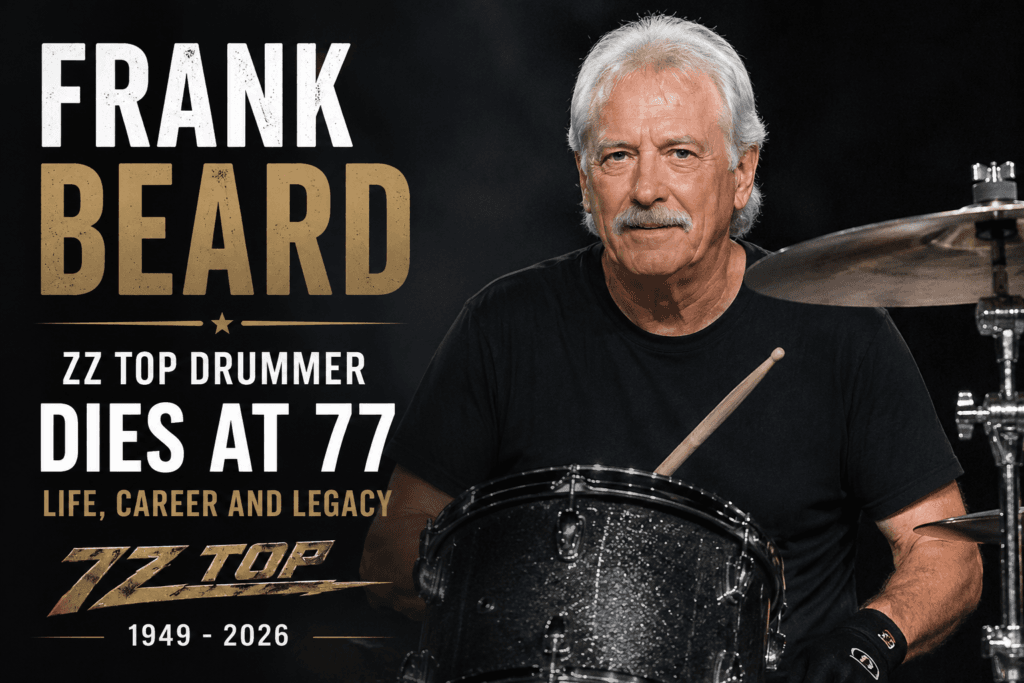
Frank Beard, the longtime drummer whose steady, hard-driving rhythm helped define ZZ Top for more than five decades, has died at 77. Beard died on August 17, 2026, while receiving hospice care at his ranch in Richmond, Texas, with family members by his side. A specific cause of death has not been publicly disclosed.
For many fans, Beard represented something essential about ZZ Top. While Billy Gibbons and Dusty Hill became instantly recognizable for their guitars, sunglasses and famously long beards, Beard stood behind the kit and supplied the groove that kept the band moving. His drumming became a crucial part of the Texas blues-rock sound that carried ZZ Top from small venues to international arenas.
His death also closes another chapter in the story of one of rock music’s most distinctive lineups. Dusty Hill died in 2021, leaving Gibbons and Beard as the remaining members of the classic trio. Beard’s passing now marks another profound loss for ZZ Top and for generations of listeners who grew up with the band’s blues-heavy riffs and unmistakable rhythms.
Frank Beard’s Death and What Is Known About His Final Days
Beard’s death followed a period of health difficulties that had increasingly affected his ability to perform. Earlier in 2026, he was absent from ZZ Top’s touring lineup, with Michael Monahan taking over behind the drums. The band had also canceled its August 5 appearance at the Hollywood Bowl because of what it described at the time as unforeseen personnel matters.
Reports following Beard’s death connected his recent absence from the road with his health. However, the precise medical circumstances surrounding his death remain undisclosed. That distinction matters because public reports have described health struggles without identifying a confirmed cause of death.
ZZ Top confirmed the loss through a statement from Billy Gibbons, who described Beard as both a close friend and collaborator. Gibbons also emphasized the drummer’s musical importance, remembering the signature rhythmic approach that had helped keep the band at the center of rock culture for decades.
The immediate impact was also felt on ZZ Top’s tour schedule. Shows in Salt Lake City and Colorado Springs were canceled following Beard’s death, while the band planned to continue its current tour with scheduled performances in Austin.
Who Was Frank Beard?
Frank Lee Beard was born June 11, 1949, in Frankston, Texas, and grew up in Irving. Long before ZZ Top became a global rock institution, Beard developed his musical career through the Texas club circuit and played in several groups, including the Cellar Dwellers, the Hustlers, the Warlocks and American Blues.
His connection with Dusty Hill proved particularly important. The two musicians had already worked together before Beard joined ZZ Top, and Beard eventually helped bring Hill into the orbit of Billy Gibbons. That connection helped establish the three-piece lineup that would become one of the longest-running partnerships in rock history.
Beard joined Gibbons in the developing ZZ Top lineup in 1969. Although the band’s earliest personnel changed during its formation, the combination of Gibbons, Hill and Beard quickly became the group’s defining identity. They built their sound around blues, boogie and hard rock, drawing heavily from their Texas roots while developing a style that could work equally well in clubs, on radio and in large arenas.
There was also an enduring visual joke surrounding Beard’s name. While Gibbons and Hill became famous for their enormous beards, Beard himself did not wear the facial hair that his surname seemed to promise. Yet his lack of a giant beard never diminished his importance to the band’s identity. Behind the drums, his timing and rhythmic control supplied the foundation for ZZ Top’s sound.
How Frank Beard Helped Build ZZ Top’s Signature Sound
ZZ Top’s music depended on the chemistry between three musicians rather than on any one instrument. Gibbons supplied the distinctive guitar attack, Hill reinforced the low end and vocal presence, while Beard created the rhythmic framework that allowed the band’s blues-rock riffs to hit with unusual force. That combination helped the group develop a sound that remained recognizable across different eras of rock music.
The band’s early records established its Texas blues and boogie foundation. Over time, however, ZZ Top expanded its approach. The group later incorporated more polished production, electronic elements and visual experimentation, particularly during its enormous 1980s breakthrough. Through those changes, Beard remained a consistent rhythmic presence.
His contribution is especially significant because great drumming can sometimes disappear behind a band’s most visible personalities. Beard rarely needed the spotlight to make an impact. Instead, his playing gave ZZ Top’s riffs their momentum and helped create the relaxed but forceful groove that became central to the band’s identity.
That consistency helped ZZ Top maintain its musical character through decades of changing trends. The band’s ability to move from raw blues-rock to MTV-era arena success without losing its core personality remains one of its greatest achievements, and Beard’s drumming was part of that continuity.
ZZ Top’s story also belongs to a wider tradition of musicians whose work continued to shape rock music long after their earliest breakthrough years. That enduring connection between musicianship, history and legacy can also be seen in the story of Bruce Springsteen and Dave Marsh, whose collaboration helped document one of rock’s most influential careers.
Frank Beard’s Early Musical Career
Before ZZ Top became synonymous with Texas blues-rock, Frank Beard spent years developing his musicianship in regional bands. Born June 11, 1949, in Frankston, Texas, Beard grew up in Irving and became involved in the local music scene while rock and blues were rapidly gaining influence.
His early work included groups such as the Cellar Dwellers, the Hustlers and the Warlocks. He later played with American Blues, a band that also featured Dusty Hill. Those experiences gave Beard a strong foundation in the blues-oriented style that would eventually become central to ZZ Top.
The partnership between Beard and Hill became especially important. The two musicians had already developed a working relationship before ZZ Top took shape, and their shared musical background helped create the rhythm section that would support Billy Gibbons’ guitar playing.
Beard’s path was not built around celebrity. Instead, he developed through constant playing and collaboration. That background helped him understand how to support a song without overwhelming it, a quality that became one of his defining strengths as a drummer.
By the end of the 1960s, Beard had accumulated enough experience to become part of a new Texas-based project. His meeting with Billy Gibbons would ultimately lead to the lineup that changed the course of his career.
How Frank Beard Joined ZZ Top
ZZ Top began taking shape in Houston in 1969, with Billy Gibbons at its center. Beard soon became part of the emerging lineup, and he helped connect Gibbons with Dusty Hill, completing the trio that would define the band’s classic era.
The three musicians created a remarkably efficient musical unit. Gibbons could build songs around blues-based guitar riffs, Hill supplied the bass foundation, and Beard gave those arrangements their rhythmic drive. The simplicity of the setup became an advantage rather than a limitation.
Their chemistry allowed ZZ Top to develop a sound that felt rooted in traditional blues while still carrying the weight and volume of contemporary rock. Beard’s drumming played an important role in that balance. He could maintain a steady groove while giving Gibbons’ guitar enough space to dominate the arrangement.
The trio also developed a distinct identity away from the music itself. Gibbons and Hill became known for their enormous beards and matching stage image, while Beard’s clean-shaven appearance created an amusing contrast with his surname. That visual irony became part of the band’s mythology without overshadowing his musical contribution.
More importantly, the lineup proved unusually durable. Beard, Gibbons and Hill remained together for decades, giving ZZ Top a consistency that few major rock groups ever achieved.
ZZ Top’s Rise Through the 1970s
ZZ Top’s first major recordings introduced listeners to a band that combined Texas blues, boogie and hard rock. Their early albums established the musical vocabulary that would remain recognizable throughout their career.
Records such as ZZ Top’s First Album, Rio Grande Mud and Tres Hombres helped build the band’s reputation. The group gradually moved from regional recognition toward a much larger national audience.
Tres Hombres, released in 1973, became a particularly important milestone. Its success helped establish ZZ Top as a major blues-rock act, while songs such as “La Grange” demonstrated how effectively the trio could turn a compact blues structure into a memorable rock hit.
That Texas-rooted approach connects ZZ Top with a broader generation of American musicians who built their reputations through distinctive songwriting, touring and a strong sense of musical identity. Another example is Bonnie Tyler, whose career followed a very different path but ultimately produced a similarly enduring place in rock history.
Beard’s role during this period centered on groove and control. ZZ Top did not need elaborate drum arrangements to make its songs powerful. Instead, Beard’s playing gave the music a steady pulse that allowed the guitar and bass to lock together.
The band’s live reputation grew alongside its recordings. ZZ Top became known for energetic performances that preserved the raw character of its studio material. Beard’s ability to maintain the rhythm through extended performances helped make the trio sound larger than its three-person lineup suggested.
By the middle of the decade, ZZ Top had established itself as one of America’s notable blues-rock groups. The band’s Texas identity remained central, but its audience was beginning to extend far beyond the region.
Frank Beard and the Classic ZZ Top Trio
The strength of ZZ Top came from the interaction among its three members. Beard was not simply the drummer occupying the third position in a famous lineup; he was one part of a tightly integrated musical system.
Gibbons’ guitar often carried the most obvious melodic and sonic signature. Hill provided a deep bass presence that reinforced the riffs. Beard connected those elements through timing, dynamics and repetition, giving the songs their characteristic forward motion.
That relationship became increasingly important as ZZ Top experimented with its production and songwriting. Even when the band’s arrangements became more elaborate, the trio’s underlying chemistry remained intact.
Their longevity also gave them something rare in popular music: decades of shared musical language. Beard knew how Hill and Gibbons approached a groove, when to leave space and when to push the rhythm forward. That familiarity helped the band maintain its identity even as musical fashions changed.
The classic trio also developed a reputation for avoiding unnecessary drama in its public image. Their personalities and visual style became larger than life, but the music remained the foundation.
For Beard, that meant contributing to one of rock’s most recognizable partnerships without constantly seeking individual attention. His value became clearer when listeners considered how difficult it would be to reproduce ZZ Top’s original chemistry with different musicians.
The Road From Texas Blues to Mainstream Rock
During the 1970s, ZZ Top built a loyal audience through relentless touring and a growing catalog. Yet the band’s biggest commercial breakthrough would arrive in the following decade.
The group began embracing new production techniques while retaining its blues-based foundation. That evolution positioned ZZ Top for a remarkable transformation: a traditional Texas power trio could suddenly compete at the center of the MTV-driven pop-rock landscape.
Beard remained a crucial part of that transition. His drumming provided continuity between the band’s earlier, rougher recordings and the polished sound that would soon reach a massive international audience.
That ability to evolve without abandoning the group’s musical roots became one of ZZ Top’s defining characteristics. Beard’s career would ultimately span both sides of that transformation, from intimate blues-rock performances to global arena tours.
ZZ Top’s 1980s Breakthrough
The 1980s transformed ZZ Top from a respected blues-rock trio into an international rock phenomenon. The band’s music became more polished, but its Texas identity remained intact. That balance helped ZZ Top reach listeners who may never have discovered the group through its earlier blues-driven records.
The turning point came with Eliminator, released in 1983. The album introduced a highly stylized sound that blended blues-rock foundations with synthesizers, programmed textures and tight production. Songs such as “Gimme All Your Lovin’,” “Sharp Dressed Man” and “Legs” became defining hits.
Frank Beard remained at the center of the rhythm section throughout that transformation. His drumming helped preserve the band’s groove while the production expanded around the trio. Rather than competing with the new electronic elements, Beard’s playing gave the songs a human rhythmic foundation.
That distinction mattered. ZZ Top’s 1980s sound could feel highly produced, yet the band’s core still depended on the interaction of guitar, bass and drums. Beard helped maintain that connection.
The album’s commercial success also changed the band’s cultural reach. ZZ Top became a major MTV act, and its music videos turned the group’s distinctive image into part of its appeal.
Frank Beard’s Role in ZZ Top’s Biggest Hits
ZZ Top’s biggest songs often sound deceptively simple. Their riffs are memorable, their arrangements are economical and their grooves rarely become cluttered. That simplicity required musicians who understood exactly when to add energy and when to leave space.
Beard’s drumming supplied that discipline. On songs such as “Gimme All Your Lovin’,” the rhythm has to remain forceful without overwhelming the guitar riff. On “Sharp Dressed Man,” the groove supports the song’s repetitive hook and gives the track its swagger.
“Legs” presented a different challenge. Its production leaned heavily into the technological sound of the era, yet the rhythmic foundation still needed to feel cohesive. Beard’s contribution helped connect ZZ Top’s traditional musicianship with its modern production approach.
His work became particularly valuable because the band rarely relied on complicated arrangements. Instead, ZZ Top created impact through repetition, tone and rhythm. Beard understood that formula and helped make it sound natural rather than mechanical.
As a result, his contribution can be easy to overlook when discussing the band’s most famous songs. The guitar riffs and music videos often receive the immediate attention, but the songs depend on a strong rhythmic foundation.
The Music Videos That Made ZZ Top Icons
ZZ Top’s 1980s success was not driven by recordings alone. The band embraced music television at precisely the moment when MTV was changing how audiences discovered artists.
The videos for “Gimme All Your Lovin’,” “Sharp Dressed Man” and “Legs” created a visual world built around humor, cars, attractive characters and the band’s exaggerated appearance. Gibbons and Hill’s long beards became instantly recognizable, while Beard’s clean-shaven face created the running visual joke that the man named Beard had no giant beard.
The videos also gave ZZ Top an identity that extended beyond music. Their style became playful and self-aware rather than overly serious, helping the group stand apart from many contemporary rock acts.
That combination of music, personality and visual identity became increasingly important as rock artists found new ways to connect with audiences beyond traditional album releases. The evolution of rock culture can also be seen through the careers of artists such as Lindsey Buckingham, whose work with Fleetwood Mac helped shape another distinctive chapter in popular music.
Beard did not dominate those videos, but his presence reinforced the trio’s chemistry. The band’s visual identity worked because all three members appeared as parts of the same unusual world.
That image helped introduce ZZ Top to a younger generation. Listeners who discovered the band through MTV could then explore its earlier records, creating a bridge between its blues-rock past and its commercially successful present.
Why ZZ Top’s Sound Survived the 1980s
Many artists who embraced 1980s production struggled to retain their original identity. ZZ Top managed to avoid that problem because its musical foundation remained remarkably consistent.
The group continued to build songs around blues-based guitar, strong bass lines and memorable drum grooves. New technology changed the texture, but it did not completely replace the trio’s musical core.
Beard’s role became especially important in that respect. His playing gave the band’s newer material a rhythmic connection to its earlier work. Even when synthesizers and studio effects became more prominent, the music still moved with the confident pulse associated with ZZ Top.
That continuity helped the group remain commercially relevant without becoming a completely different band.
It also demonstrated Beard’s adaptability. He had started his career in Texas blues and rock settings, then successfully worked within a much more technologically sophisticated production environment. He never needed to turn himself into the most visible member of the group. His strength came from making the entire arrangement work.
Frank Beard’s Place in Rock History
By the end of the 1980s, Frank Beard had become part of one of rock’s most recognizable musical partnerships. ZZ Top had sold millions of records, built an international touring audience and developed an image that remained instantly identifiable.
Yet Beard’s legacy extends beyond the band’s commercial numbers. He helped demonstrate how a drummer could become essential to a band’s identity without constantly occupying the spotlight.
His career also reflects the unusual longevity of ZZ Top. The same three musicians who formed the classic lineup in the late 1960s remained together through multiple changes in popular music, technology and the recording industry.
That stability gave their music a distinctive continuity. Fans could hear the band’s early Texas blues influences alongside its later arena-rock polish and still recognize the same underlying personality.
Beard’s drumming was a major part of that continuity. His work helped connect the band’s earliest records to the songs that introduced ZZ Top to a worldwide audience.
Frank Beard’s Later Career With ZZ Top
ZZ Top’s enormous 1980s success did not mark the end of the band’s story. The group continued recording and touring through the 1990s, 2000s and 2010s, even as mainstream musical trends changed around them.
Beard remained the drummer throughout that period and appeared on all 15 of ZZ Top’s studio albums, from ZZ Top’s First Album in 1971 through La Futura in 2012.
The band’s recording pace eventually slowed, but its live reputation remained strong. ZZ Top continued to tour extensively, drawing audiences who connected with both the classic hits and the band’s blues-rock catalog.
The group’s 2004 induction into the Rock & Roll Hall of Fame represented another major milestone. By then, Beard, Billy Gibbons and Dusty Hill had already established themselves as one of rock’s most durable three-piece lineups.
Beard also continued working through the physical demands of decades on the road. In 2002, he temporarily stepped away after an emergency appendectomy, with longtime associate John Douglas filling in. That experience later became relevant when Beard needed additional time away from touring.
Even as ZZ Top’s commercial peak moved further into the past, Beard remained an essential part of its live identity. His ability to maintain the band’s familiar rhythmic character helped preserve the connection between its early records and later performances.
Frank Beard’s Health Challenges Before 2026
Beard’s final years with ZZ Top included several periods when health concerns affected his touring schedule. In March 2025, the drummer temporarily stepped away from the band’s tour to deal with a health issue that required a medical procedure.
At the time, ZZ Top did not publicly disclose detailed information about his condition. John Douglas again stepped in behind the kit, providing continuity while Beard took time away.
Beard later returned to the band in 2025. However, his health became an increasingly important part of the band’s touring story as the following year unfolded.
In 2026, Beard was absent from the group’s summer North American tour, with Michael Monahan taking over on drums. The change became particularly noticeable after ZZ Top canceled its August 5 performance at the Hollywood Bowl. The band initially described the cancellation in general terms rather than publicly detailing Beard’s condition.
The sequence of events showed how difficult extensive touring had become for the longtime drummer. Beard had spent more than five decades performing with ZZ Top, but the physical demands of maintaining that schedule continued into his late 70s.
His previous health-related absences also demonstrated something important about the band: ZZ Top had repeatedly found ways to keep performing while respecting Beard’s need to step away.
Dusty Hill’s Death Changed ZZ Top Forever
The loss of Dusty Hill in July 2021 marked the first major break in ZZ Top’s classic lineup. Hill died at age 72 after more than five decades alongside Beard and Gibbons.
For Beard, the loss was deeply significant because Hill was more than a bandmate. The two had known each other before ZZ Top and had played together in earlier groups. Beard also helped connect Hill with Gibbons during the formation of ZZ Top.
After Hill’s death, Elwood Francis took over bass duties. Francis had worked with the band as a guitar technician and had already stepped onto the stage when Hill experienced health problems. The decision allowed ZZ Top to continue touring while preserving much of the band’s established musical framework.
Still, the original trio could never be completely replaced. Beard and Gibbons represented the remaining members of the classic lineup, while Francis carried forward Hill’s musical role.
That transition gave the band’s later performances a different emotional weight. Fans were no longer simply watching a legendary trio continue its career; they were watching one of rock’s longest-running partnerships evolve after an irreplaceable loss.
The loss of a longtime musician can also reshape how audiences remember an entire era of a band. That sense of musical remembrance appears across other CLIMAX stories about artists whose careers left a lasting mark, including Glen Hansard, whose work became an important part of modern Irish music.
Frank Beard’s Final Months With ZZ Top
By 2026, Beard’s health had again forced him away from the road. Reports indicated that he had been dealing with serious health problems, although his specific medical condition was not publicly identified. Michael Monahan filled in for him during the band’s summer performances.
The canceled Hollywood Bowl show on August 5 became a major warning sign. ZZ Top cited unforeseen personnel matters, but subsequent reporting connected the disruption to Beard’s health.
Beard died on August 17, 2026, at his ranch in Richmond, Texas, while receiving hospice care and surrounded by family. The Fort Bend County Medical Examiner confirmed his death, while a specific cause was not disclosed.
The loss of a longtime musician can also reshape how audiences remember an entire era of a band. That sense of musical remembrance appears across other CLIMAX stories about artists whose careers left a lasting mark, including Glen Hansard, whose work became an important part of modern Irish music.
Following his death, ZZ Top canceled scheduled performances in Salt Lake City and Colorado Springs. The band indicated that it intended to continue performing afterward, including dates in Austin.
The decision reflects Beard’s own long-standing connection to the band: ZZ Top’s story was always larger than any single performance. His death, however, made clear that an extraordinary chapter in the group’s history had reached its end.
Frank Beard’s Lasting Musical Legacy
Frank Beard’s greatest legacy may be the consistency of his playing. For more than five decades, he helped give ZZ Top a rhythmic identity that remained recognizable through major changes in rock music. The band moved from Texas blues and boogie to arena rock, MTV-era production and later roots-focused material, yet Beard’s drumming remained a steady part of its foundation.
His contribution also shows why a drummer can be central to a band’s identity without becoming its most visible personality. Billy Gibbons’ guitar tone and Dusty Hill’s bass playing often received more attention, but Beard connected those sounds. His grooves created the space that allowed ZZ Top’s riffs to feel powerful without becoming overcrowded.
Beard’s story also fits into a larger tradition of musicians whose careers are remembered not only for individual songs but for the influence they had on an entire musical culture. For another example of a distinctive artist whose work became part of music history, readers can explore the story of Randy Burns, the Greenwich Village folk musician and songwriter.
That approach became particularly important on songs built around repetition. ZZ Top often relied on a memorable riff, a locked-in bass line and a confident rhythmic pulse. Beard understood how to make that formula feel energetic while keeping the arrangement economical.
His longevity was equally remarkable. Beard remained with ZZ Top from 1969 until his death, making him an essential part of the band’s unusually stable history. That continuity helped the group preserve its personality across generations of listeners.
The ZZ Top Songs That Define Frank Beard’s Career
Several ZZ Top recordings provide a useful way to understand Beard’s contribution. “La Grange” captures the band’s early blues-rock identity, while “Tush” demonstrates its ability to turn a compact boogie groove into an enduring rock staple.
The 1980s brought an entirely different challenge. “Gimme All Your Lovin’,” “Sharp Dressed Man” and “Legs” combined the band’s blues foundation with polished production and a visual style designed for MTV. Those songs helped turn ZZ Top into a global cultural phenomenon.
Beard’s role across those eras is what makes his catalog particularly significant. He did not need to reinvent his entire approach whenever the band’s production changed. Instead, he provided rhythmic continuity while Gibbons and the band’s producers explored new sounds.
For listeners revisiting ZZ Top after Beard’s death, the catalog offers a clear reminder of his range. The early records show his blues and boogie foundation, while the band’s 1980s material demonstrates how effectively that rhythmic style could work within a much more modern production environment.
Why Frank Beard Mattered to ZZ Top’s Identity
ZZ Top’s identity depended heavily on chemistry. The classic lineup worked because Gibbons, Hill and Beard developed an intuitive understanding of one another over decades.
That chemistry also helped explain the band’s extraordinary longevity. Three musicians could respond to one another in ways that would be difficult to reproduce with a rotating lineup. Beard’s timing was especially important because the band’s songs often depended on subtle rhythmic relationships rather than complicated arrangements.
His personality also contributed to ZZ Top’s unusual public image. Gibbons and Hill became famous for their long beards, while Beard remained mostly clean-shaven despite his surname. The contrast became one of the band’s favorite running jokes.
Yet the joke also highlights something deeper about his career. Beard never needed to look like the stereotype of a rock drummer to become one of the genre’s enduring figures. His work spoke through the music.
After Dusty Hill died in 2021, the loss of another member of the classic trio made that chemistry even more significant. Beard and Gibbons carried forward the legacy with Elwood Francis handling bass duties.
Tributes to Frank Beard After His Death
News of Beard’s death prompted tributes that focused on both his musicianship and his friendship with his bandmates. Billy Gibbons remembered him as a close collaborator and emphasized the importance of Beard’s distinctive rhythmic approach to ZZ Top.
The reaction reflects the unusual place Beard occupied in rock history. He was not simply a longtime employee of a successful band. He was a founding-era member whose playing helped establish the group’s musical identity from its earliest years.
Beard died August 17, 2026, at his ranch in Richmond, Texas, while receiving hospice care with family members nearby. Reports have said that no specific cause of death was disclosed. His death came after health issues had forced him to step away from ZZ Top’s 2026 touring schedule.
The band canceled several performances following his death, underscoring the immediate impact of losing a musician who had been part of ZZ Top for most of its existence.
For fans, however, Beard’s most lasting tribute remains the music itself.
Frank Beard’s Legacy Beyond the Drums
Frank Beard’s career offers a useful reminder that rock history is not created only by frontmen and guitar heroes. Sometimes its defining character comes from the musician keeping everything locked together behind the scenes.
ZZ Top’s sound depended on that balance. Gibbons could stretch a guitar phrase, Hill could reinforce the low end and Beard could keep the entire arrangement moving. Together, they created a sound that remained identifiable even when the band’s production evolved dramatically.
Beard also became part of a rare story of musical endurance. He played with the same core band for more than half a century, surviving changes in technology, musical fashion, recording practices and the commercial music industry. ZZ Top’s 2004 Rock & Roll Hall of Fame induction recognized the significance of that achievement.
His death therefore represents more than the loss of a drummer. It marks the passing of one of the musicians who helped make ZZ Top unmistakably ZZ Top.
The riffs will continue to play. The videos will remain part of rock history. And underneath those familiar sounds, listeners will continue to hear the steady rhythmic character Frank Beard brought to the band.
Frequently Asked Questions About Frank Beard
Who was Frank Beard?
Frank Beard was the longtime drummer of ZZ Top and a key member of the band’s classic lineup. He joined the group in 1969 and remained its drummer for more than five decades.
How old was Frank Beard when he died?
Frank Beard was 77 years old when he died on August 17, 2026.
What was Frank Beard’s cause of death?
A specific cause of death has not been publicly disclosed. Beard was receiving hospice care at his Texas ranch when he died.
What songs is Frank Beard known for?
Beard performed on ZZ Top classics including “La Grange,” “Tush,” “Gimme All Your Lovin’,” “Sharp Dressed Man” and “Legs.” His drumming helped connect the band’s early blues-rock sound with its later mainstream success.
Was Frank Beard the only member of ZZ Top without a long beard?
Yes. Despite his surname, Beard became famous for generally appearing clean-shaven while Billy Gibbons and Dusty Hill wore their trademark long beards. The contrast became part of ZZ Top’s visual identity.
Remembering Frank Beard
Frank Beard leaves behind a career that few rock drummers can match. He helped build ZZ Top from its Texas roots, remained through its international breakthrough and continued performing with the band for decades afterward.
His playing rarely demanded attention for its own sake. Instead, it made the songs work. That may be the clearest measure of his legacy: when a ZZ Top groove starts, Beard’s contribution is still there in every beat.
For a musician who spent more than 50 years behind the drum kit, that enduring sound is perhaps the most fitting farewell.