
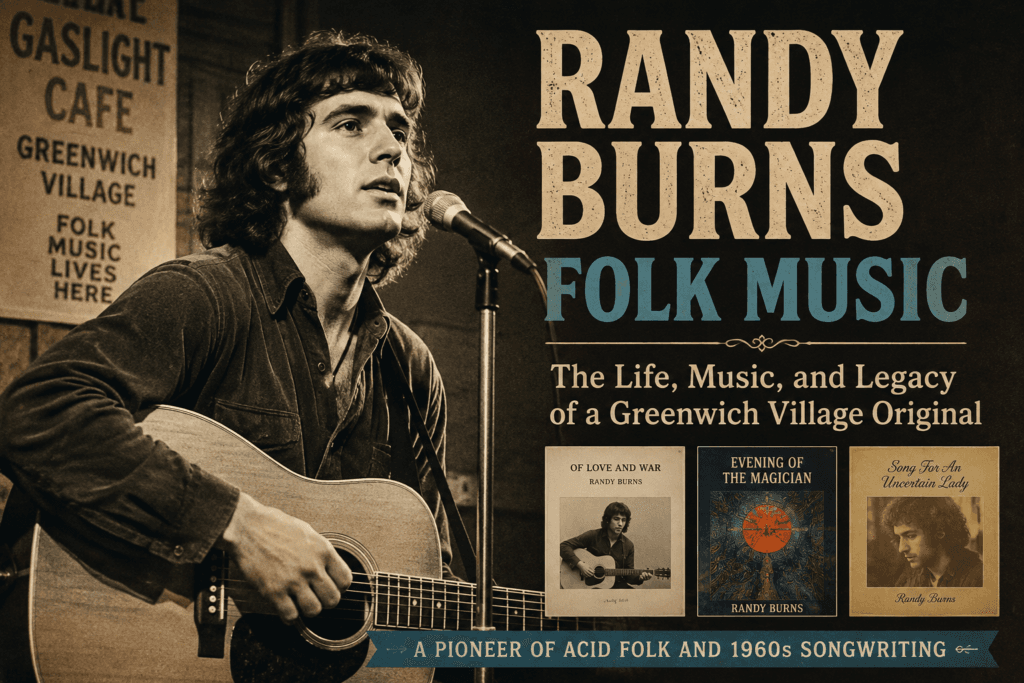
Randy Burns’ Early Life and Musical Beginnings
Burns was born in Manchester, Connecticut, in 1948. According to recent reporting, he began teaching himself guitar at around 14 and was performing publicly only a few years later. His early performances took place at New Haven’s Exit Coffeehouse, a setting that helped introduce him to the local folk community.
The coffeehouse circuit played an important role in the development of many young folk musicians.
Unlike a large concert hall, a coffeehouse placed the performer close to the audience. A singer could perform an original song, hear the immediate response, change the arrangement, and return with a stronger version later. For a developing songwriter, that environment could be as valuable as formal musical training.
Burns soon realized that New Haven alone would not provide the opportunities he wanted.
In 1966, he left high school and headed for New York City. He arrived in Greenwich Village with little more than his guitar and an ambition to become a working musician. Accounts of his early period describe difficult living conditions, including inexpensive lodging and nights spent wherever he could find a place.
However, the struggle came with an important advantage: access to one of America’s most active folk communities.
For Burns, the Village became both a workplace and a musical education.
He was surrounded by performers who treated songwriting as a serious craft. That environment helped shape the artistic identity that would later appear on his recordings.
Randy Burns Folk Music and the Greenwich Village Scene
Greenwich Village gave Burns the opportunity to develop his career at a remarkable moment in American music.
During the 1960s, venues such as Gerdes Folk City, the Gaslight Café, and the Bitter End became important gathering places for singers, songwriters, musicians, and audiences searching for something outside mainstream pop. Burns performed at these venues during his early New York years.
His regular appearances at the Gaslight were especially significant.
The venue placed him alongside established performers from the folk scene, including figures such as Dave Van Ronk, Phil Ochs, Eric Andersen, and Sonny Terry & Brownie McGhee.
That kind of exposure could change a young musician’s career.
Burns was not simply watching the folk revival from the audience. He was participating in it, learning how professional performers constructed sets, introduced songs, handled audiences, and developed a recognizable artistic voice.
The Village also exposed him to different approaches to songwriting.
Traditional folk material remained important, but original compositions were becoming increasingly central to the scene. Artists were writing about relationships, politics, loneliness, identity, social change, and everyday life.
Burns developed within that environment.
His early work retained the stripped-down qualities associated with acoustic folk, but his later recordings showed that he was willing to experiment with broader arrangements.
This makes the Greenwich Village period essential to understanding randy burns folk music. It was the foundation from which the rest of his musical career grew.
From Acoustic Performer to Recording Artist
Burns’ transition from local performer to recording artist came during the second half of the 1960s.
His association with ESP-Disk became particularly important. The label had developed a reputation for releasing unconventional music, and its catalog crossed boundaries between folk, experimental music, jazz, rock, and psychedelic sounds.
Burns’ first recordings for the label captured the acoustic side of his songwriting. His early album Of Love and War belongs to the formative stage of his recording career, before his arrangements became more expansive.
The significance of these recordings goes beyond their individual songs.
They document a musician working at the point where the traditional folk revival was beginning to collide with a rapidly changing rock culture.
Burns was therefore positioned between two musical worlds.
On one side stood the intimate coffeehouse performer with a guitar and a collection of original songs. On the other was the increasingly adventurous studio environment of the late 1960s.
His later work would move further toward that second world.
The change was gradual rather than sudden. Burns did not simply abandon acoustic folk for rock. Instead, he expanded the musical environment around his songwriting.
That approach would become clearer when he began working with the Sky Dog Band.
The result was a body of work that is now often discussed in connection with folk-rock and acid folk, although those labels only partly explain what makes his recordings distinctive.
Randy Burns and the Sky Dog Band
The Sky Dog Band represented an important change in Burns’ musical direction.
Instead of relying primarily on the sparse instrumentation of a solo folk performance, Burns could now work with musicians who expanded the sonic possibilities of his songs.
His 1968 album Evening of the Magician is a key example. ESP-Disk’s catalog identifies the record as ESP 1089 and credits Burns on guitar, with Mat Kastner contributing organ and piano, Bruce Samuels on bass and flute, and John O’Leary on percussion.
Those instruments changed the character of the music.
Keyboard textures could add atmosphere, while bass and percussion gave the songs greater rhythmic depth. Flute added another unusual color, helping separate the recordings from straightforward coffeehouse folk.
Yet Burns remained at the center.
The album’s songs were still built around his songwriting and vocals rather than around instrumental virtuosity. That balance is one reason Evening of the Magician remains an important reference point for listeners exploring late-1960s folk-rock.
The album contains ten tracks, including “Evening Magician,” “Echoes of Mary’s Song,” “Ron’s Song,” “Girl From England,” and “When Daylight Comes In Everything.”
For randy burns folk music, this period represents a crucial turning point.
Burns was no longer simply a Greenwich Village acoustic performer. He was becoming an artist willing to use the studio and a larger ensemble to explore new musical possibilities.
Why Evening of the Magician Is Important
Evening of the Magician occupies an interesting position in Burns’ catalog because it captures his movement toward a more atmospheric form of folk-rock.
The album was released by ESP-Disk in 1968, at a time when psychedelic influences were spreading through American popular music.
However, describing the record simply as psychedelic music misses its foundation.
The songs still revolve around the songwriter.
Burns uses expanded instrumentation to create mood rather than allowing the arrangements to completely dominate the material. That gives the album an unusual balance. The music can feel dreamlike in places, yet it remains recognizable as singer-songwriter material.
This is one reason Burns is frequently associated with the broader acid-folk tradition.
Acid folk was never a perfectly defined genre. Instead, it became a useful way to describe artists who combined folk songwriting with psychedelic atmosphere, unusual instrumentation, or unconventional arrangements.
Burns fits comfortably within that conversation.
His record also benefits from the musical freedom associated with ESP-Disk. The label’s catalog placed folk musicians next to artists working in experimental jazz, free improvisation, psychedelic rock, and other unconventional styles. Burns’ presence in that environment helps explain why his recordings could move beyond conventional folk structures.
For modern listeners, Evening of the Magician can therefore serve as an entry point.
It shows how a young Greenwich Village songwriter could retain the emotional directness of folk while responding to the rapidly changing musical language of the late 1960s.
Randy Burns Folk Music in the Early Album Years
Burns’ early albums reveal a musician who was still searching for the best way to express his ideas.
His first recordings leaned toward the acoustic folk tradition. By the time of Evening of the Magician, the arrangements had become broader. Then, with Song for an Uncertain Lady, released in 1970, Burns continued moving toward folk-rock while maintaining his identity as a songwriter.
That progression is important because it shows that his career cannot be reduced to one sound.
The young Burns was shaped by Greenwich Village. The later Burns was responding to the wider musical landscape around him.
Song for an Uncertain Lady contains “Autumn on Your Mind,” along with songs such as “Sorrow’s Children,” “Let Tomorrow Be,” “Lisa,” “Waiting for an Old Friend,” and “Africa.”
The album also demonstrates Burns’ willingness to vary his arrangements.
Some songs remain relatively restrained, while others move into fuller territory. That contrast creates a sense of an artist exploring what his songwriting could become when placed in different musical settings.
The result is a catalog that rewards listeners who move through the albums chronologically.
Starting with the early acoustic work and then progressing toward the later folk-rock material makes Burns’ artistic development easier to hear.
More importantly, it explains why randy burns folk music remains an intriguing search topic today: his music sits at the intersection of several traditions rather than belonging exclusively to one.
The Importance of “Autumn on Your Mind”
“Autumn on Your Mind” deserves special attention because it has become one of the more recognizable songs associated with Burns’ catalog.
The track appears on Song for an Uncertain Lady, where it sits near the beginning of the album. Music databases credit Burns as both performer and songwriter.
The song also illustrates an important characteristic of his work: emotional reflection without excessive theatricality.
Burns often approached personal material with restraint. Rather than turning every emotion into a dramatic performance, he allowed the songwriting and arrangement to carry much of the feeling.
That quality fits naturally with the intimate traditions of folk music.
At the same time, the surrounding album demonstrates that Burns was no longer operating entirely inside the traditional acoustic format. Contemporary descriptions of the record place him in a folk-rock singer-songwriter setting, showing how far his music had moved from the strict Village folk mold of his earliest recordings.
“Autumn on Your Mind” therefore works as more than an individual song in his discography.
It represents the point where several parts of Burns’ musical identity meet: the young folk performer, the songwriter influenced by the Village scene, and the artist experimenting with broader arrangements.
That combination helps explain why the track continues to attract interest from listeners discovering Burns decades after its original release.
What Made Randy Burns Different From a Typical Folk Singer?
Burns’ importance does not come from having a single revolutionary sound.
Instead, his appeal lies in his willingness to evolve.
He began in an environment where the acoustic guitar and the human voice were enough to hold an audience. Then he entered a recording culture that encouraged musicians to experiment with instrumentation and production.
Rather than choosing one side, Burns moved between them.
His music could remain intimate while becoming more elaborate. A song could retain the basic emotional structure of a folk composition while gaining keyboards, percussion, bass, flute, or electric instrumentation.
That flexibility makes comparisons with other artists useful, but it also explains why Burns can be difficult to categorize.
He was not purely a traditional folk singer.
He was not simply a psychedelic musician.
And he was not exclusively a folk-rock performer.
He was a songwriter whose musical surroundings changed as his career developed.
That distinction matters when looking at randy burns folk music through a modern lens. Genre labels can help new listeners locate his work, but they should not become a substitute for hearing the evolution across his recordings.
His story is ultimately about musical movement.
From Connecticut coffeehouses to Greenwich Village, from solo performances to the Sky Dog Band, and from acoustic folk toward more adventurous arrangements, Burns followed the possibilities available to him.
That willingness to explore became one of the defining features of his career.
Randy Burns Folk Music and Song for an Uncertain Lady
By 1970, Randy Burns had moved considerably beyond the straightforward acoustic style associated with his earliest Greenwich Village performances. Song for an Uncertain Lady became an important snapshot of that transition.
Released by ESP-Disk in 1970, the album contains 11 tracks and runs for roughly 43–45 minutes depending on the edition. The record includes “Autumn on Your Mind,” “Song for an Uncertain Lady,” “Lisa,” “Child for Now,” “Waiting for an Old Friend,” and “Deegan Street,” among other Burns compositions.
The album is especially interesting because Burns did not simply repeat the psychedelic approach of Evening of the Magician. Instead, the music moved toward a broader folk-rock and country-rock vocabulary.
That change gave his songwriting a different setting.
The Sky Dog Band remained part of the project, while the recording sessions involved musicians including Andy “Dog” Merwin, Matt Kastner, Bruce Samuels, John O’Leary, and others.
As a result, the album feels like a musician testing different possibilities.
Some songs are gentle and reflective. Others have stronger rhythmic movement or more pronounced rock elements. The contrast makes the album useful for understanding how Burns’ musical identity continued to develop.
For anyone researching randy burns folk music, this record is arguably one of the best places to begin because it connects several stages of his career: Greenwich Village folk, psychedelic experimentation, country influence, and the emerging singer-songwriter sound of the early 1970s.
The Changing Sound of Randy Burns
The musical shift on Song for an Uncertain Lady was not accidental.
Burns had spent several years moving through different musical environments. He had learned the discipline of solo folk performance, worked with the Sky Dog Band, and experienced the creative freedom of ESP-Disk’s unusual recording culture.
By 1970, those influences were beginning to converge.
The psychedelic character associated with his earlier work became less dominant, while country and folk-rock elements became more noticeable. AllMusic’s retrospective assessment similarly identifies a stronger country influence on the album and describes it as a continuation of the direction established with the Sky Dog Band.
That evolution is worth emphasizing because it shows that Burns was not interested in remaining frozen in the sound of the 1960s.
Many artists become strongly associated with the scene that first makes them visible. Burns followed a different path. He kept moving even when commercial success did not necessarily follow.
His voice remained central, but the musical frame around it changed.
That makes his catalog more interesting when heard chronologically. A listener who begins with the early acoustic material can hear the gradual arrival of keyboards, percussion, electric instruments, country touches, and fuller ensemble arrangements.
In other words, randy burns folk music was never one fixed sound.
It was an evolving musical language shaped by the times, the musicians around him, and Burns’ own willingness to experiment.
“Autumn on Your Mind” and Randy Burns’ Singer-Songwriter Style
“Autumn on Your Mind” offers a useful introduction to Randy Burns as a songwriter. The track appears on his 1970 album Song for an Uncertain Lady, where Burns is credited as both writer and performer.
Rather than aiming for a dramatic pop performance, Burns approaches the song with a more personal and reflective sensibility. That quality fits naturally within the singer-songwriter tradition that was becoming increasingly important around the beginning of the 1970s.
The song is also valuable because it reflects the emotional character found throughout much of his work.
Memory, Change, and Personal Reflection
Seasonal imagery can suggest passing time, while changing relationships and uncertainty give a song an emotional sense of movement. Those ideas work particularly well within folk music, where storytelling often matters more than spectacle.
Burns understood that balance.
His songs could feel intimate without becoming overly theatrical. Instead of relying on a large production to create emotion, he allowed the songwriting and performance to carry much of the weight.
That emphasis on intimate songwriting connects Burns with a much wider singer-songwriter tradition. Decades later, artists such as Glen Hansard would similarly place personal storytelling and emotional performance at the center of their music.
That approach gives “Autumn on Your Mind” a distinctive place within randy burns folk music.
Why the Song Still Attracts Attention
The importance of “Autumn on Your Mind” is not necessarily connected to mainstream chart success. Its value comes from how clearly it represents Burns’ artistic development.
The song sits between two stages of his career. His earlier work was strongly connected to acoustic folk, while his later recordings explored fuller folk-rock and country-influenced arrangements.
That contrast makes the track especially interesting for listeners discovering Burns today.
His music can feel connected to its original era while still sounding personal rather than overly polished. For collectors and listeners exploring overlooked recordings from the late 1960s and early 1970s, that quality is part of the appeal.
Ultimately, “Autumn on Your Mind” shows why Burns’ songwriting deserves attention. He created music that focused on feeling, reflection, and personal experience rather than simply chasing a commercial sound.
The Sky Dog Band’s Role in Randy Burns’ Development
The Sky Dog Band was more than a backing group.
It gave Burns the musical flexibility he needed to move beyond the limitations of a solo performance.
The band’s personnel changed across recording sessions, but its role remained important. ESP-Disk documentation for Song for an Uncertain Lady lists multiple instrumentalists alongside Burns, including guitar, piano, bass, flute, drums, percussion, and background vocals.
That expanded palette helped Burns explore contrasting moods.
A quiet guitar passage could establish intimacy, while percussion or electric instruments could push a song toward rock. Piano and flute could add color without completely changing the folk foundation.
This was particularly valuable during the late 1960s and early 1970s, when genre boundaries were becoming increasingly fluid.
Folk musicians were borrowing from rock. Rock musicians were incorporating country. Psychedelic artists were experimenting with acoustic instruments. Meanwhile, singer-songwriters were becoming more comfortable using full studio arrangements.
Burns occupied that crossroads.
The Sky Dog Band allowed him to participate in the movement without abandoning his identity as a songwriter.
This is one reason his recordings are more rewarding when approached as a sequence rather than as isolated tracks.
Evening of the Magician shows the more psychedelic side of the experiment. Song for an Uncertain Lady moves toward a warmer folk-rock and country-influenced sound. His later major-label albums continue that development.
Together, those records reveal an artist who kept adjusting his musical vocabulary.
For modern listeners, that flexibility may be more important than any single genre label.
Randy Burns Folk Music After ESP-Disk
Burns’ relationship with ESP-Disk eventually came to an end, but his recording career continued into the 1970s. His next major step took him from the independent world of ESP-Disk toward a larger commercial label.
In 1971, Burns and the Sky Dog Band recorded a self-titled album for Mercury Records. The project continued the broader folk-rock and country-rock direction that had developed during his earlier recordings.
Randy Burns and the Move Toward Country-Rock
The shift toward country-rock placed Burns within a wider American roots-music tradition. Folk, country, and rock were increasingly overlapping during this period, giving songwriters more freedom to experiment with arrangements and instrumentation.
That connection can also be seen in the careers of musicians such as Tommy Detamore, whose work represents another important chapter in American roots and country music.
For Burns, however, the Mercury opportunity was about more than changing musical styles.
It gave him the possibility of reaching a larger audience after years of performing in small venues and releasing records through an independent label known for unconventional music.
The Mercury and Polydor Years
The move to Mercury did not produce the mainstream breakthrough the label may have hoped for. Burns never became a major commercial recording star, and his relationship with the company eventually ended.
Nevertheless, another opportunity followed.
Polydor released I’m a Lover, Not a Fool in 1972 and Still on Our Feet in 1973. These albums extended Burns’ recording career and showed that he remained active even without achieving major chart success.
That pattern became an important part of his legacy.
Burns continued creating music despite operating outside the center of mainstream popularity. His influence was therefore felt more strongly among musicians, dedicated listeners, and folk communities than through commercial charts.
His career demonstrates that an artist can contribute meaningfully to music history without becoming a household name.
The Major-Label Opportunity That Never Became Stardom
The Mercury and Polydor years reveal one of the central tensions in Burns’ career.
His music had enough credibility to move from an independent label to major companies. However, credibility and commercial success are not always the same thing.
The 1971 Mercury album placed Burns in a more conventional record-business environment. Instead of being heard primarily by collectors of underground folk and experimental music, he now had the possibility of reaching a broader audience.
That transition came with expectations.
Major labels generally needed records to generate sales, radio attention, touring opportunities, or some combination of the three. Burns’ understated songwriting style did not necessarily fit the commercial trends dominating popular music at the time.
Polydor nevertheless gave him another opportunity.
I’m a Lover, Not a Fool arrived in 1972, followed by Still on Our Feet in 1973. According to AllMusic’s career overview, the latter became Burns’ final release for many years.
The lack of major commercial success did not mean the music lacked value.
In fact, the opposite can happen with artists from this period. Records that receive little attention when originally released can later become fascinating historical documents.
Burns’ catalog offers exactly that kind of discovery.
Today, listeners can approach his recordings without the pressure of contemporary chart expectations. They can hear the songwriting, arrangements, and atmosphere on their own terms.
That distance from the original commercial environment has helped create renewed curiosity around randy burns folk music.
Why Randy Burns Became an Overlooked Singer-Songwriter
Randy Burns had strong connections to one of America’s most influential folk scenes, yet he never reached the mainstream recognition enjoyed by some of his contemporaries. That contrast is one of the most interesting parts of his career.
Burns arrived in Greenwich Village during a period when artists such as Bob Dylan, Joan Baez, Phil Ochs, and Tom Paxton were gaining national attention. He performed in the same broader musical community, but his career developed along a less commercial path.
His music also became increasingly difficult to classify. Burns could move from intimate acoustic folk toward psychedelic textures, folk-rock, and country influences. That flexibility gave his recordings character, but it also made it harder to market him to a specific audience.
A Musician Between Musical Worlds
Burns occupied an unusual position.
Traditional folk listeners could find his later experimentation different from the straightforward acoustic style they expected. Meanwhile, mainstream rock audiences had a growing number of artists competing for their attention.
As a result, Burns remained connected to important musical movements without becoming the defining face of any single one.
His releases through ESP-Disk, Mercury, and Polydor demonstrate that the recording industry continued to see potential in his work, even though he never achieved major commercial success.
That commercial history helps explain why his name is less familiar today than those of some other Greenwich Village performers.
Why His Obscurity Became Part of His Appeal
Being overlooked does not necessarily mean being forgotten.
Modern listeners have access to reissues, streaming services, digital music databases, collector communities, and historical writing that can bring older recordings back into circulation.
Burns’ catalog is particularly suited to rediscovery because it offers more than one musical direction. A listener can start with his early folk recordings and gradually discover his psychedelic, folk-rock, and country-influenced work.
For people exploring randy burns folk music, that journey can be more rewarding than searching for a single famous hit.
Burns’ story also belongs to a wider tradition of overlooked American musicians whose careers deserve a closer look beyond mainstream chart history. Vernon Taylor’s rockabilly career offers another example of how influential performers can leave a lasting mark even without becoming household names.
His relative obscurity gives new listeners the chance to discover an unusual chapter of American folk history on their own terms.
Randy Burns’ Music After the 1970s
Although Still on Our Feet marked the end of a long stretch of album releases, Burns did not stop being a musician.
He continued performing during the 1970s and 1980s, including appearances at folk festivals and coffeehouses. His long association with Matt Kastner also continued, with Kastner later moving from keyboards toward guitar and bass.
That continuity matters.
Some musicians disappear from the public eye after leaving a record label. Burns instead remained connected to live performance and the folk community.
In 1991, Burns and Kastner recorded The Cat’s Pajamas, which Burns released through his own Picket Fence label. According to AllMusic, the cassette was sold largely at performances rather than through a conventional commercial distribution system.
That approach says something about Burns’ priorities.
He continued making music even when the traditional record industry was no longer providing him with a major platform.
Meanwhile, his earlier work began finding new listeners.
The German ZYX label reissued all three of Burns’ ESP-Disk albums on CD during the 1990s, giving a new generation easier access to recordings that had originally appeared in a much different musical environment.
Reissues can dramatically change the life of an old record.
A release that once disappeared from record-store shelves can suddenly become available to collectors, historians, DJs, and younger listeners.
That process helped keep Burns’ early recordings alive.
The Later Randy Burns Catalog
Burns eventually returned to releasing new music.
His later catalog includes The Simple Things, while Hobos and Kings also became part of his later body of work. Recent reporting notes that Burns continued composing and performing after his early recording career, maintaining his connection to music well into later life.
These later releases are important because they prevent his story from becoming trapped in nostalgia.
It would be easy to describe Burns exclusively as a 1960s folk musician. However, his career lasted much longer than that decade.
The later recordings show an artist continuing to engage with songwriting rather than simply reproducing the style that first brought him attention.
That longevity also adds context to his legacy.
Burns experienced several different eras of music firsthand: the folk revival, psychedelic rock, the singer-songwriter movement, the rise of major-label album culture, the decline of the traditional record industry, and eventually the digital rediscovery of older recordings.
Few artists experience that many changes while continuing to perform.
For readers discovering randy burns folk music in 2026, that broader timeline is worth remembering.
His story is not only about a collection of obscure records from the 1960s.
It is about a musician who kept adapting to different musical environments while remaining connected to the basic craft of songwriting.
Randy Burns and the Value of Live Performance
Live performance was central to Burns’ career from the beginning.
His first experiences came in coffeehouses, and later he performed in major Greenwich Village venues. He also continued appearing at festivals and smaller venues after his major-label years had ended.
That consistency helps explain why his career cannot be judged solely by album sales.
For many folk musicians, the stage is the primary connection with an audience.
The intimacy of a small room changes the relationship between performer and listener. A singer does not need elaborate production to create a memorable performance. Instead, the quality of the song, the delivery, and the connection with the audience become central.
Burns developed within that tradition.
Even as his recorded arrangements became more elaborate, his identity remained tied to the singer-songwriter format.
That connection also explains why Burns remained active after his commercial recording period.
The absence of a major label did not remove his reason to perform.
Instead, he returned to the spaces where his career had originally developed: folk festivals, coffeehouses, local music communities, and direct relationships with listeners.
This part of his story is easy to overlook when discussing albums.
However, it may be one of the strongest explanations for his lasting reputation among people who actually knew his work.
Randy Burns folk music was not only something pressed onto vinyl.
It was also something experienced in rooms filled with people listening to a songwriter perform his own material.
Randy Burns’ Connection to Connecticut
Although Greenwich Village became an important chapter in Burns’ story, Connecticut remained a recurring part of his musical identity.
He began performing in New Haven, developed his early reputation there, and later returned to the region after spending time elsewhere. Recent coverage describes him as a continuing presence in Connecticut’s music community.
That connection is meaningful because it gives his career a geographic arc.
He left Connecticut for New York in pursuit of opportunity, but he never completely separated himself from the musical community where he began.
This is common among regional musicians.
A city such as New York can provide exposure, collaborators, and professional opportunities. Yet local music communities often provide something different: familiarity, continuity, and a long-term audience.
Burns experienced both worlds.
His Greenwich Village years gave him access to one of the most influential folk scenes in American history. His Connecticut connections provided a lasting musical home.
The combination shaped his identity.
It also means that his legacy belongs to more than New York’s folk revival history.
He is equally relevant to the story of Connecticut musicians who built careers through small venues, regional festivals, independent releases, and persistent live work.
That broader perspective makes his story more interesting than a simple “1960s folk singer” label.
Burns represents the relationship between local music communities and major cultural centers.
He left home to find the larger scene, became part of it, and eventually carried that experience back into his regional musical life.
How to Listen to Randy Burns Today
For a new listener, the best way to approach Burns is chronologically.
Starting with the early material makes the later changes much easier to recognize.
| Listening Stage | Release | What to Notice |
|---|---|---|
| Early folk | Of Love and War | Acoustic songwriting and early folk-revival roots |
| Psychedelic transition | Evening of the Magician | Fuller arrangements and experimental atmosphere |
| Folk-rock development | Song for an Uncertain Lady | Country touches and broader ensemble sound |
| Major-label era | Randy Burns and the Sky Dog Band | Continued movement toward country-rock |
| Later major-label work | I’m a Lover, Not a Fool | Early-1970s singer-songwriter direction |
| Follow-up period | Still on Our Feet | Final major-label chapter before a long release gap |
The most revealing comparison is between the first three albums.
They form a loose musical progression.
The first establishes Burns as a folk songwriter. The second pushes into psychedelic territory. The third pulls some of that experimentation back while introducing stronger country and folk-rock elements.
That sequence makes his career easier to understand than any single genre description.
Listeners should also resist the temptation to search immediately for a “best song.”
Burns is better approached as an album-oriented artist.
His records show how his ideas changed over time, and the contrasts between songs can be as revealing as the individual performances.
For anyone discovering randy burns folk music for the first time, that makes the listening process part of the story.
Randy Burns’ Legacy After His Death
Burns’ death in August 2026 has brought renewed attention to a career that had remained relatively outside mainstream music history.
He died on August 8 at age 78 in Melbourne, Florida, according to recent reporting.
News of his death has encouraged listeners and music writers to revisit his early recordings and remember his role in the folk revival.
That renewed interest is important because musicians such as Burns can disappear from popular memory even when their work remains historically valuable.
His career connects several important threads.
He was part of the Greenwich Village folk scene. He recorded for ESP-Disk. He worked with the Sky Dog Band. He explored psychedelic and country-rock sounds. He later moved to Mercury and Polydor. And he continued performing after his major-label career ended.
That is a substantial musical life.
His legacy should therefore not depend on whether he achieved mainstream fame.
Instead, it can be measured through the people he performed with, the recordings he left behind, the communities where he continued working, and the listeners who keep discovering his music.
In that sense, his death may become another chapter in the story of his work.
The renewed attention gives unfamiliar listeners an opportunity to hear the records for themselves.
And once they do, they can decide where Randy Burns belongs in the larger story of American folk music.
Why Randy Burns Folk Music Still Deserves Attention
Randy Burns’ importance does not come from becoming a hidden superstar. Instead, his career represents the many musicians who helped shape American music without receiving the same mainstream recognition as the biggest names of their generation.
Burns stood close to several major musical movements while maintaining an individual identity. His career moved from Greenwich Village folk performances to psychedelic experimentation, folk-rock, country influences, major-label releases, and eventually smaller-scale live performances.
That journey makes his catalog valuable as both music and history.
His recordings capture a period when the boundaries between folk, rock, country, and psychedelia were becoming increasingly flexible. An acoustic songwriter could experiment with a full band, while a folk performer could explore sounds that would have seemed unusual only a few years earlier.
For anyone researching randy burns folk music, his career provides a useful way to understand that broader transformation.
An Overlooked Voice From a Changing Era
Burns’ relative lack of mainstream fame does not make his work less interesting. In fact, it gives modern listeners an opportunity to discover a less familiar side of the 1960s folk movement.
His records reflect a specific musical moment, yet the emotional themes remain easy to understand. Love, uncertainty, memory, distance, and personal change are not tied to any particular decade.
That combination of historical character and emotional accessibility gives his music lasting appeal.
Why New Listeners Can Still Connect With His Work
For listeners who enjoy discovering overlooked artists, Burns offers something especially valuable: music that feels connected to its original era without becoming trapped there.
The idea of a musical legacy also extends well beyond a single era or genre. Artists with very different styles can remain relevant because their recordings continue to introduce new listeners to their work, much like the enduring career and catalog of Bonnie Tyler.
His recordings document an artist searching for new sounds while remaining committed to songwriting. That balance helps explain why his work continues to attract curiosity decades later.
Rather than remembering Burns simply as another name from the 1960s, it is more useful to view him as a songwriter whose career followed the changing landscape of American folk music.
His journey is what makes randy burns folk music worth revisiting today.
Frequently Asked Questions About Randy Burns Folk Music
Who was Randy Burns?
Randy Burns was an American folk singer-songwriter who became active in the Greenwich Village folk scene during the 1960s. He performed at venues including the Gaslight Café and Gerdes Folk City and later developed a more expansive folk-rock and psychedelic-influenced sound with the Sky Dog Band.
What is Randy Burns best known for?
Burns is best known for his work during the 1960s and early 1970s, particularly his ESP-Disk albums Of Love and War, Evening of the Magician, and Song for an Uncertain Lady. The latter includes “Autumn on Your Mind.”
Was Randy Burns part of the Greenwich Village folk scene?
Yes. Burns moved to Greenwich Village in 1966 and performed at several important Village venues. His career developed alongside musicians associated with the broader 1960s folk revival.
What is “Autumn on Your Mind” by Randy Burns?
“Autumn on Your Mind” is a Randy Burns song from his 1970 album Song for an Uncertain Lady. It is the second track on the album and is one of the songs most closely associated with that release.
Was Randy Burns an acid-folk artist?
Burns is often discussed in connection with acid folk because parts of his late-1960s work combine folk songwriting with psychedelic and experimental elements. His Evening of the Magician period is particularly associated with that sound.
What happened to Randy Burns?
Randy Burns died on August 8, 2026, at age 78 in Melbourne, Florida. He continued performing and writing music for decades after his best-known 1960s recording period.
Final Thoughts on Randy Burns Folk Music
Randy Burns’ career is a reminder that music history extends far beyond the artists who dominate the charts. His story connects several important chapters of American music, from the Greenwich Village folk revival to the more experimental sounds of the late 1960s and the singer-songwriter movement that followed.
Burns performed in influential Village venues, recorded with the Sky Dog Band, explored psychedelic and country-rock influences, and continued making music long after his earliest recordings appeared.
What makes his career especially interesting is the way his sound developed. He did not remain tied to one musical formula. Instead, his acoustic songwriting gradually expanded into richer arrangements while still retaining the intimacy associated with folk music.
For listeners exploring randy burns folk music, that evolution is perhaps the most valuable part of his story.
From Greenwich Village Folk to a Wider Sound
The young Burns emerged from the coffeehouse culture of the 1960s with an acoustic guitar and a songwriter’s approach. Over time, Evening of the Magician introduced a more atmospheric direction, while Song for an Uncertain Lady moved further toward folk-rock and country influences.
Those changes show an artist responding to the musical world around him without abandoning his own identity.
His career also demonstrates why lesser-known musicians deserve another look. Burns may not have achieved the mainstream recognition of some of his contemporaries, but his recordings preserve a distinctive perspective on a rapidly changing era.
Why Randy Burns’ Music Still Matters
Today, Burns’ catalog gives both longtime folk fans and new listeners a chance to explore a less familiar side of the 1960s folk revival.
His records capture a musician searching for new possibilities while remaining grounded in songwriting. That combination gives the music historical value without making it feel like a museum piece.
Burns’ legacy ultimately rests on the songs he left behind and the musical journey those recordings document. His work deserves to be rediscovered not because he became a forgotten superstar, but because he was an individual artist who followed his own path.
For anyone interested in randy burns folk music, that path is well worth hearing again.