
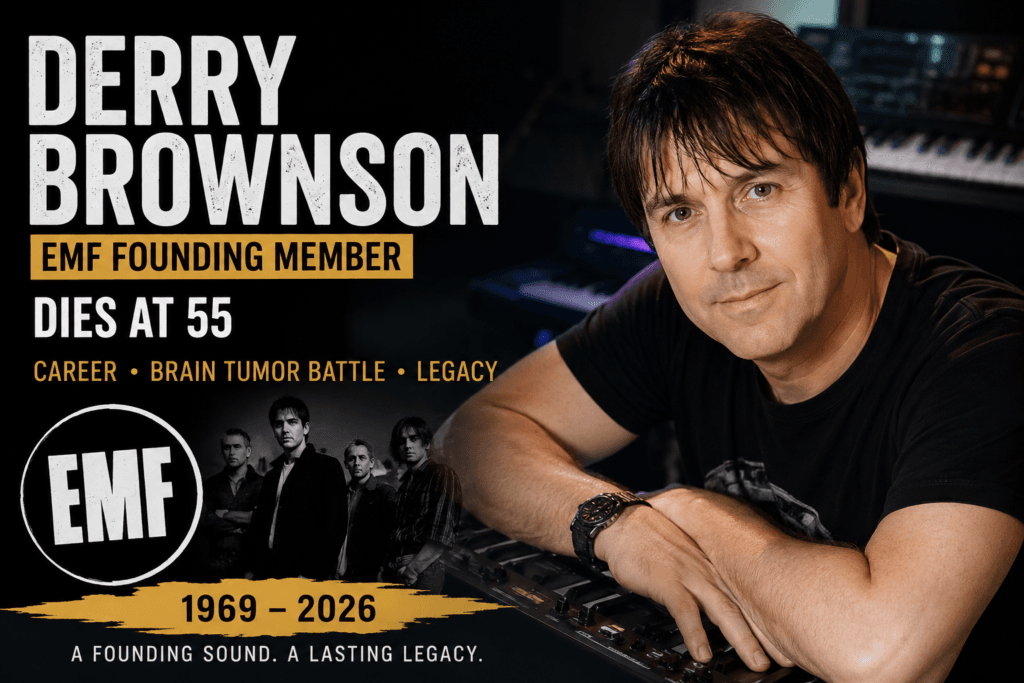
Derry Brownson, the founding member and keyboardist associated with British alternative rock band EMF, died at 55 on August 13, 2026, after a battle with a cancerous brain tumor. His death closes a chapter in the story of a band that helped bring guitar-driven alternative music together with electronic sounds in the early 1990s. Brownson remained connected to EMF long after its initial commercial breakthrough, making his contribution larger than the one song that first introduced the group to millions of listeners.
For many American music fans, EMF is inseparable from “Unbelievable,” the explosive 1990 hit that reached No. 1 on the Billboard Hot 100. Brownson, however, was not simply a musician standing behind the band’s biggest record. He helped establish EMF from its earliest days and contributed to the group’s distinctive use of sampling, keyboards and electronic textures. His name also appears among the songwriters credited on “Unbelievable,” alongside the other core members of the original lineup.
Brownson’s career therefore offers a broader look at EMF’s rise, its influence on 1990s alternative music and the musicians who built the band before its sudden international success. His later return to the stage also gave fans an opportunity to see him perform with EMF again during the final years of his life.
Who Was Derry Brownson?
Derran “Derry” Brownson was an English musician best known as a founding member and keyboardist associated with EMF. Born in Cinderford, Gloucestershire, he became part of the group that emerged from the Forest of Dean music scene in 1989. Brownson helped shape the band’s early identity alongside James Atkin, Zac Foley, Mark De Cloedt and other musicians who became central to EMF’s development.
His musical role extended beyond traditional keyboard playing. Brownson worked with samples and electronic elements, helping EMF create the energetic combination of alternative rock, dance music and electronic experimentation that distinguished the group from many of its early-1990s peers.
That contribution became especially important when EMF broke internationally with “Unbelievable.” Brownson received songwriting credit on the track and performed sampler duties, making him part of the creative foundation behind the band’s signature sound.
Although “Unbelievable” eventually overshadowed much of EMF’s other work in the public imagination, Brownson’s connection to the group lasted far beyond that initial success. He remained part of its history through later reunions, recordings and live performances.
His death in August 2026 brought renewed attention to the musician behind those electronic textures and to the original EMF lineup that helped define one of the most recognizable alternative hits of the 1990s.
Derry Brownson and the Formation of EMF
EMF grew out of the music community around Cinderford and the Forest of Dean in Gloucestershire. The group formed in 1989, bringing together musicians with different influences and a shared interest in creating something that did not fit neatly into one genre.
Brownson was part of the band’s earliest creative group. Before EMF took shape, he had already been involved in local music, while bassist Zac Foley and other future members were also active around the same scene. James Atkin, Mark De Cloedt and DJ Milf became part of the developing lineup, with guitarist Ian Dench joining later and adding further songwriting experience.
The group initially had little reason to expect worldwide success. Instead, the members experimented with different sounds and ideas while developing songs in their hometown. Their music drew from indie rock, dance music, electronic sounds and the energy of club culture. That combination eventually became one of EMF’s defining characteristics.
Brownson’s presence was particularly valuable because he helped bring electronic elements into a lineup otherwise built around the familiar rock combination of vocals, guitar, bass and drums. His work with samples gave the band another layer of sound and helped separate EMF from more conventional guitar bands.
Within a remarkably short period, the local group moved from small-scale performances to a recording deal and international attention. That rapid transformation became the beginning of EMF’s extraordinary early-1990s run.
Derry Brownson’s Role in EMF’s Sound
Brownson’s role in EMF becomes clearer when the band’s music is viewed as more than straightforward alternative rock. The group combined guitars, live drums and bass with samples, keyboards, rhythmic programming and dance-oriented influences. Brownson helped supply much of that electronic character.
On “Unbelievable,” Brownson is credited as a sampler performer and songwriter. The track combines a forceful guitar part, infectious rhythm, electronic textures and memorable vocals. His contribution helped make the song sound different from a conventional rock single.
EMF’s electronic approach also placed Brownson within a wider musical tradition that blurred the boundaries between rock, alternative music and electronic production. This crossover later became important to artists such as Kavinsky, whose work offers another example of these genres influencing one another.
That distinction mattered because EMF arrived when genre boundaries were becoming increasingly flexible. British alternative acts could draw from house, techno, hip-hop and indie rock without treating those influences as separate worlds. EMF embraced that crossover rather than choosing one musical lane.
Brownson therefore occupied an important creative position within the group. He helped turn experimental ideas into a sound capable of reaching mainstream audiences.
His songwriting credit on “Unbelievable” further places him within the creative core of EMF rather than simply identifying him as a supporting musician.
The band’s success showed how effectively its members could combine different influences.
EMF’s “Unbelievable” and the Rise to Global Fame
How “Unbelievable” Changed EMF’s Career
“Unbelievable” transformed EMF from a young British band into an international act. The song emerged from the group’s early period and became the centerpiece of its breakthrough, eventually reaching No. 1 on the U.S. Billboard Hot 100.
The record stood out because it did not sound like a conventional rock song. Its guitar-driven foundation sat alongside dance-oriented rhythms, electronic production and samples. That unusual combination helped it cross between alternative radio, mainstream pop audiences and the emerging crossover culture of the early 1990s.
Brownson played a direct role in that sound. He was credited with sampler work on the recording and shared songwriting credit with the other core members. His contribution helped reinforce the electronic side of a track that depended on several musical styles working together.
The success arrived with remarkable speed. EMF had formed only a short time earlier, yet the band soon found itself playing to audiences far beyond its Forest of Dean roots. The group’s sudden rise also demonstrated how quickly alternative music could move into the mainstream when a distinctive sound connected with listeners.
For Brownson, “Unbelievable” became the song most closely associated with his career. However, reducing his musical legacy to that single hit overlooks his role in creating EMF itself and his continued involvement with the band over subsequent decades.
The song remains the clearest entry point into Brownson’s musical story, but it is only the beginning of it.
Schubert Dip and EMF’s Early Success
“Unbelievable” served as the breakthrough track from EMF’s debut album, Schubert Dip. The album expanded the band’s sound beyond its biggest single and established the group as one of the more distinctive crossover acts of the period.
The record combined alternative rock with dance and electronic influences, reflecting the musical environment in which EMF developed. Songs such as “I Believe” and “Children” demonstrated that the band had more to offer than its breakout hit.
Brownson’s role remained part of that larger formula. His work with samples and keyboards complemented the guitar, bass, drums and vocals, giving the band’s recordings an electronic dimension that helped define its identity.
The success of Schubert Dip also changed the scale of EMF’s career. What began as a group rooted in a small English music scene quickly became an international touring act. Brownson experienced that transformation alongside his bandmates, moving from local performances to the intense attention that followed a global hit.
That early period established the foundation for the rest of his musical career. Even after EMF’s initial commercial peak faded, the band’s distinctive sound—and Brownson’s role within it—remained an important part of the group’s identity.
Derry Brownson’s Career Beyond EMF
EMF’s first run eventually came to an end, but Brownson did not leave music behind. During the band’s years apart, he continued exploring his own creative direction and formed the alternative rock trio Little Killers, also known as LK. The project gave him a chance to work outside the framework of EMF and develop another musical identity.
That period reflected a broader change in the lives of the original EMF members. The musicians who had experienced sudden international fame in the early 1990s moved into different areas of music and everyday life. Some continued performing, while others explored songwriting, production or completely different careers.
Brownson’s post-EMF work matters because it shows that his musical identity did not depend entirely on the band’s biggest hit. His experience with keyboards, samples and alternative sounds remained part of his creative background, even as he pursued projects away from EMF.
At the same time, EMF never completely disappeared from his story. The band’s early catalog continued to attract listeners, and the members periodically returned to the stage. Brownson eventually became part of those reunions, reconnecting with the music and bandmates who had shaped the most important period of his career.
His time away also gave the original group some distance from the intense attention that followed “Unbelievable.” When EMF returned, Brownson was able to approach the band’s legacy from a different point in his life, with decades of experience separating the reunion years from the group’s original breakthrough.
EMF’s Breakup and First Reunion
Why EMF Went Their Separate Ways
EMF’s initial success came with a level of attention that few young bands could sustain indefinitely. After Schubert Dip, the group released Stigma in 1992 and Cha Cha Cha in 1995. The later records showed that the band was willing to evolve, but the commercial momentum of its debut proved difficult to reproduce.
By the middle of the decade, the musical landscape had also changed. Alternative rock was moving in new directions, while Britpop dominated much of the British conversation. EMF’s blend of dance-rock and electronic experimentation no longer occupied the same commercial position it had during the “Unbelievable” era.
The members eventually went their separate ways. Before the original period ended, EMF released its version of The Monkees’ “I’m a Believer,” recorded with British comedy duo Vic Reeves and Bob Mortimer. The single became another notable UK success.
For Brownson, the breakup opened the door to other musical work, including Little Killers. However, the end of EMF did not permanently close the band’s story.
The group’s music continued to retain a loyal audience, and the members remained connected through their shared history. That connection eventually led to a reunion in 2001, giving Brownson and his bandmates an opportunity to revisit EMF’s catalog and perform together again.
The 2001 EMF Reunion
EMF reunited in 2001 around the release of Epsom Mad Funkers: The Best of EMF. Brownson played an active role in the return, and contemporary information from the band’s fan community records his confirmation of the reunion show at London’s Astoria.
The reunion was significant because it brought the original members back together after several years apart. For fans, it offered a chance to hear the songs that had defined EMF’s early career in a live setting once again.
However, the comeback soon became overshadowed by tragedy. Bassist Zac Foley died in January 2002 at the age of 31. His death profoundly affected the band, and EMF played only a small number of additional shows that year before separating again.
Brownson’s connection with EMF therefore entered another uncertain period. The group had demonstrated that its music could still bring people together, but the loss of Foley changed the circumstances surrounding any future reunion.
The later history of EMF would include additional returns to the stage, with different lineups and periods of inactivity. Brownson remained connected to that continuing story, eventually becoming part of the band’s more sustained return in the 2010s and 2020s.
EMF’s Later Reunions and Derry Brownson’s Return
From Occasional Shows to a Lasting Return
EMF did not remain permanently inactive after its second breakup. The band returned for another performance period in 2007 and later reunited again in 2012. Those appearances helped demonstrate that the group’s appeal had survived well beyond its original commercial peak.
The 2012 return was particularly important for longtime fans because EMF performed material from Schubert Dip and Stigma in full during shows connected with the anniversary of the band’s breakthrough era. Brownson’s continued participation helped preserve the connection with the original EMF sound.
The group later marked its history with archival projects and anniversary activity. In 2020, EMF released From Us to You, a career-spanning box set that brought together remastered material and previously unreleased recordings. Rather than simply looking backward, the band soon began creating new music again.
For Brownson, these years represented something different from the intense rush of the early 1990s. EMF was no longer chasing a sudden breakthrough. Instead, the members were reconnecting with longtime listeners while introducing their music to people who had discovered the band years after “Unbelievable” first became a hit.
That renewed relationship eventually produced new studio albums and more touring. Brownson’s presence made those projects especially meaningful because he had been there at the band’s beginning and remained part of its later chapter.
Go Go Sapiens and The Beauty and the Chaos
EMF’s renewed creative period reached a major milestone with Go Go Sapiens, released in 2022. It was the band’s first album of new material in 27 years and marked a substantial return to recording rather than relying solely on nostalgia or anniversary performances.
Brownson was part of that comeback lineup alongside James Atkin, Ian Dench, Stevey Marsh and drummer Aid Todd. The album showed that EMF could still make new music while retaining the experimental energy that had defined its earlier work.
The comeback continued with The Beauty and the Chaos in 2024. The album reinforced the idea that EMF’s later career was more than a reunion tour built around “Unbelievable.” The band was once again recording, performing and developing material as an active group.
For Brownson, this period provided an unusual full-circle moment. He had helped build EMF as a young musician in Cinderford, experienced the band’s worldwide breakthrough, pursued music outside the group and eventually returned to create new material with the same band.
That continuity became one of the most important parts of his later musical legacy. Brownson was not simply revisiting the past; he was participating in a new phase of EMF’s story.
Derry Brownson’s Brain Tumor Diagnosis and Health Battle
Derry Brownson publicly revealed in July 2025 that doctors had diagnosed him with a cancerous brain tumor. He also confirmed that he had undergone surgery as part of his treatment. Despite the difficult diagnosis, Brownson remained focused on returning to music and performing with EMF.
Brownson’s health battle also came amid other recent losses in the rock community involving musicians who faced serious cancer diagnoses. Jennifer Finch’s story offers another example of how illness can become part of a musician’s final chapter and the legacy remembered by fans.
The diagnosis added a new dimension to Brownson’s relationship with EMF. Rather than stepping completely away from the band, he continued working toward performances when his health allowed. His decision reflected how important music remained to him after decades with the group.
Public reporting does not provide enough detail about the tumor’s exact type, stage, treatment plan or prognosis beyond describing it as cancerous. Those details should therefore not be assumed.
What is confirmed is that Brownson underwent surgery and continued treatment afterward. He later returned to the stage with EMF, making those performances especially meaningful in retrospect.
Brownson died on August 13, 2026, at age 55. EMF announced his death the following day, remembering him as a bandmate and friend and expressing gratitude that he had performed with them only months earlier.
Brownson’s Return to the Stage After His Diagnosis
Brownson’s response to his diagnosis was closely tied to his desire to keep performing. In July 2025, he reunited with EMF in Cinderford, the Gloucestershire town where the band had begun its story decades earlier. The hometown performance gave him an opportunity to stand onstage with his bandmates again while dealing with a serious illness.
The timing gave the appearance of a full-circle moment. Brownson had helped form EMF as a young musician in the same area in 1989. More than three decades later, he returned there with the band after publicly revealing his diagnosis.
Brownson’s own comments about getting back to playing showed that music remained a meaningful part of his recovery period. He had already undergone surgery, yet he continued to focus on performing rather than allowing the diagnosis to become the only story surrounding him.
EMF guitarist Ian Dench later recalled the importance of the hometown reunion and Brownson’s determination during the period that followed. According to Dench, Brownson continued playing several shows before his health deteriorated further.
Those appearances now form an important part of Brownson’s final musical chapter. They also help explain why EMF emphasized its gratitude that he had been able to join the band onstage only a few months before his death.
His return was not simply an exercise in nostalgia. It represented a continuation of the musical partnership that had begun when EMF was still a young local band.
Derry Brownson’s Final EMF Performances
Brownson continued performing with EMF after his diagnosis, although the number of appearances became limited as his illness progressed. The band’s own statement confirmed that he had managed to join them onstage “a couple times” only a few months before his death.
His final EMF performance took place in May 2026 in Frome, England, according to reporting that cited guitarist Ian Dench. That appearance came less than three months before Brownson died.
The final performances carried added significance because Brownson had spent more than three decades connected to EMF. He had experienced the band’s explosive rise in the early 1990s, its later separation, several reunions and its return to recording new material. His final shows therefore closed a musical arc that had begun in Cinderford when he was around 18.
Brownson also appeared with EMF during the band’s hometown celebrations in 2025. That return to Cinderford was especially meaningful because it connected the band’s early history with its later years.
Although his health limited his ability to continue touring, Brownson still reached the stage again. For longtime EMF fans, those final appearances offered a last opportunity to see one of the band’s original members performing alongside the musicians with whom he had built its distinctive sound.
The Frome performance now stands as the final documented EMF appearance in Brownson’s career, adding a poignant closing point to his decades-long relationship with the group.
Derry Brownson’s Death at 55
Derry Brownson died on August 13, 2026, at the age of 55, following his battle with a cancerous brain tumor. EMF announced his death on August 14, saying the band had lost its “Brother In Arms” and expressing gratitude that Brownson had been able to join them onstage only a few months earlier.
Brownson had publicly discussed his diagnosis in July 2025 and confirmed that he had undergone surgery. He continued performing with EMF afterward, making his death especially significant for fans who had followed his return to the stage. Reports consistently connect his death with the brain tumor, although public reporting does not establish a more specific immediate medical cause.
His passing also marked the loss of one of the musicians who helped create EMF at the very beginning. Brownson had been with the band since its formation in 1989 and remained connected to it through its major commercial breakthrough, later reunions and its return to recording new music in the 2020s.
For listeners who knew EMF primarily through “Unbelievable,” his death offered a reminder that the band’s story extended far beyond one hit. Brownson helped establish the electronic and sampling elements that became part of EMF’s identity, and he remained part of the group’s story for more than three decades.
Tributes to Derry Brownson
EMF’s tribute focused on Brownson as both a musician and a close friend. The band’s message described him as its “Brother In Arms” and emphasized how grateful the members were that he had managed to perform with them again shortly before his death.
The response from Brownson’s hometown also highlighted the personal connection between the musician and Cinderford. Cinderford Town Council expressed sadness at his passing and recalled welcoming him with EMF during the town’s 2025 Cindyfest celebration. The council described itself as privileged to have shared in the music and memories he helped create.
Tributes also came from musicians and figures connected to the British alternative music scene. Reports noted messages from artists associated with groups including Therapy?, Feeder and Ash, as well as Creation Records founder Alan McGee. Their reactions reflected Brownson’s place within the wider alternative-rock community rather than simply his association with one famous single.
Brownson’s family also remembered him beyond his professional identity. His brother Steve Brownson confirmed the death and described Derry as a much-loved brother, uncle, son and friend. That personal remembrance adds another dimension to a career often viewed primarily through EMF’s commercial achievements.
Together, these tributes portray Brownson as a musician whose importance extended from his bandmates and family to the hometown community where EMF first began.
Derry Brownson’s Connection to Cinderford
Cinderford remained an important part of Brownson’s story throughout his life. The Gloucestershire town was where EMF formed in 1989, and it remained closely associated with the band’s identity even after its music reached audiences around the world.
That hometown connection became particularly visible in 2025, when EMF returned to Cinderford for Cindyfest. Brownson joined the band for the performance despite the serious health challenge he had publicly revealed that year. The appearance gave him an opportunity to perform in the community where his musical journey with EMF had begun.
Cinderford also formally recognized EMF’s contribution to the town. In March 2025, the band received a blue plaque in its hometown, honoring the group’s history and its connection to the Forest of Dean. Brownson’s place in the original lineup made him part of that local legacy.
The recognition matters because EMF’s rise was unusual. The group emerged from a relatively small community before reaching the top of the U.S. singles chart. Brownson therefore represented both sides of the story: the local musician who helped form a band in Cinderford and the international performer who became part of one of the defining alternative hits of the early 1990s.
His return to Cinderford in 2025 brought those two parts of his story together. More than 30 years after EMF began, Brownson was back in the town where it all started, performing alongside the musicians with whom he had built the band’s identity.
Why Derry Brownson’s Death Matters to EMF’s History
Brownson’s death is significant because he was part of EMF from its foundation rather than joining after the band had already achieved success. He helped create the group, contributed to its early recordings and remained involved through multiple stages of its career.
EMF’s history includes several major transitions: its formation in 1989, its international breakthrough with “Unbelievable,” the release of three albums during its initial run, periods of separation, reunions and the eventual return to recording new material in the 2020s. Brownson’s career intersected with nearly all of those chapters.
That continuity makes his contribution easier to understand. He was not simply the keyboardist associated with a successful 1990s band. He was one of the musicians who helped establish EMF’s sound and then returned decades later to participate in its renewed creative period.
His final performances also gave the story a clear closing point. Brownson continued appearing with EMF after his diagnosis, including the band’s 2025 hometown performance, before reportedly playing his final EMF show in Frome in May 2026.
For EMF, his absence changes the band’s original lineup permanently. For listeners, however, the recordings remain. Brownson’s keyboards, samples, songwriting credits and years of performances remain embedded in the band’s catalog.
His legacy is therefore not limited to the circumstances of his death. It lives in the music he helped create, the band he helped build and the influence EMF continues to have on listeners who discovered “Unbelievable” decades after its release.
Derry Brownson’s Lasting Musical Legacy
Derry Brownson’s legacy begins with EMF but does not end with “Unbelievable.” He helped build the band in Cinderford in 1989 and remained connected to its music across multiple eras. His work with keyboards and samples contributed to the hybrid sound that blended alternative rock, dance music and electronic experimentation.
Brownson’s story also reflects how a musician’s importance can extend beyond a band’s biggest commercial period. Veteran artists such as Lindsey Buckingham similarly demonstrate how creative contributions can continue shaping a band’s identity long after its original peak.
His songwriting contribution also deserves recognition. Brownson shared writing credit on “Unbelievable,” alongside James Atkin, Mark de Cloedt, Ian Dench and Zac Foley. The song became a No. 1 hit on the U.S. Billboard Hot 100 and remains EMF’s most recognizable recording.
Brownson stayed involved with EMF through reunions and its later return to recording. Even after undergoing surgery for a cancerous brain tumor, he returned to the stage. His final reported performance came in May 2026, while he had also performed with the band in Cinderford in 2025.
His contribution remains preserved through EMF’s recordings, performances and enduring musical history.
Derry Brownson FAQs
Who was Derry Brownson?
Derry Brownson, also known as Derran Brownson, was a British musician and founding member of EMF. He played keyboards and contributed samples to the band’s distinctive alternative dance-rock sound. Brownson helped form EMF in Cinderford in 1989 and shared songwriting credit on “Unbelievable,” the band’s major international hit. He remained connected to EMF through later reunions, new recordings and live performances before his death in August 2026.
Was Derry Brownson a founding member of EMF?
Yes. Brownson was part of the original group that formed EMF in Cinderford, Gloucestershire, in 1989. He helped establish the band’s musical identity from its earliest period and remained associated with the group across its later reunions and comeback years.
How old was Derry Brownson when he died?
Derry Brownson was 55 years old when he died on August 13, 2026. EMF announced his death the following day, describing him as a bandmate and friend and remembering the recent performances he had shared with the group.
When did Derry Brownson die?
Derry Brownson died on August 13, 2026. News of his death was publicly announced by EMF on August 14. The band said it was devastated by the loss and grateful that Brownson had been able to perform with them only a few months earlier.
What happened to Derry Brownson?
Brownson died at 55 after battling a cancerous brain tumor. He had publicly revealed his diagnosis in 2025 and had undergone surgery. Despite his illness, he returned to performing with EMF, including a hometown appearance in Cinderford. Reports later identified a May 2026 performance in Frome as his final EMF show.
What was Derry Brownson’s role in EMF?
Brownson was a founding member, keyboardist and sampler player in EMF. His electronic contributions helped complement the band’s guitars, drums and vocals. He also shared songwriting credit on several EMF songs, including “Unbelievable,” making him part of the group’s creative core rather than simply a performing musician.
Was Derry Brownson involved with “Unbelievable”?
Yes. Brownson was one of the credited writers of “Unbelievable,” alongside the other core EMF members. He also contributed sampler work to the recording. The song became EMF’s signature hit and reached No. 1 on the U.S. Billboard Hot 100 in 1991.
What was Derry Brownson’s illness?
Brownson revealed in July 2025 that he had a cancerous brain tumor and had undergone surgery. Public reports do not establish additional medical details such as the exact tumor type or stage, so those details should not be assumed. He continued performing with EMF after his diagnosis when his health allowed.
What was Derry Brownson’s final EMF performance?
Brownson’s final reported EMF performance took place in May 2026 in Frome, England. He had also performed with the band in Cinderford during 2025. Those appearances became his final opportunity to perform with the group he had helped create more than three decades earlier.
Derry Brownson’s Lasting Legacy
Derry Brownson leaves behind a musical legacy tied closely to one of the most recognizable alternative hits of the early 1990s. Yet the full story is broader than “Unbelievable.” He helped form EMF, contributed to its distinctive mixture of rock and electronic sounds, shared songwriting credit on its breakthrough single and remained part of the band’s story through later reunions and new music.
His career also demonstrates how a musician can remain important to a band’s identity even when the group’s commercial peak belongs to another era. EMF’s later work showed that Brownson’s connection to the band survived the original 1990s moment. His return to the stage after his brain-tumor diagnosis made that connection even more significant.
For fans, Brownson’s passing is therefore both a personal loss and an important moment in EMF’s history. He was one of the musicians who helped turn a Cinderford band into an international act. More than 30 years later, he was still part of that musical family.
Brownson died at 55, but his work remains available through the recordings he helped create. Every time “Unbelievable” plays, listeners hear one piece of the musical world he helped build. His keyboards, samples, songwriting and long association with EMF ensure that Derry Brownson will remain part of the band’s story for generations to come.