
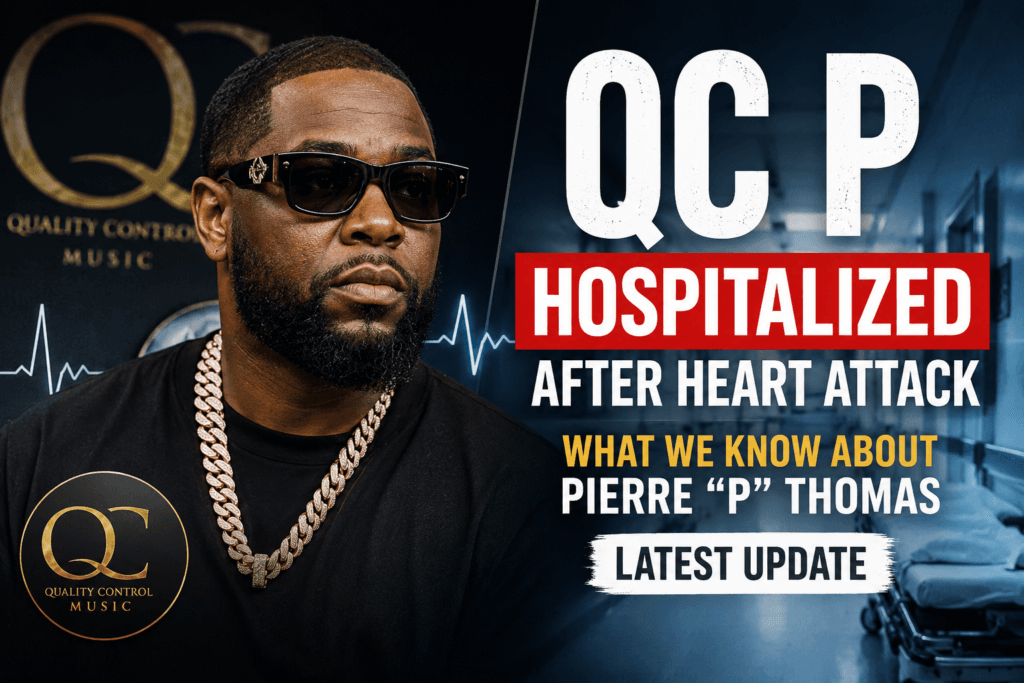
QC P, also known as Pierre “P” Thomas, has been hospitalized after reportedly suffering a heart attack. The news has drawn widespread concern across the hip-hop community. Thomas is the co-founder and CEO of Quality Control Music. He has also helped build the careers of several major artists. Quality Control has confirmed that Thomas is alive and receiving medical care.
Reports indicate that Thomas is being treated at a hospital in Las Vegas. However, his representatives have not released a detailed medical update. They have also not announced a recovery timeline. As a result, several claims circulating online remain unverified.
The situation became more confusing after false reports about Thomas’ death spread across social media. Quality Control addressed those claims directly. The company also asked the public to respect Thomas and his family’s privacy while he receives treatment.
For now, the most important confirmed QC P health update is straightforward. He is alive and receiving medical care. Further information about his condition will depend on updates from his representatives or Quality Control.
QC P Is Hospitalized After a Reported Heart Attack
Pierre “P” Thomas is currently hospitalized following a reported heart attack, according to multiple entertainment and news reports. The initial reports said the Quality Control executive was receiving treatment at a Las Vegas hospital, with some reports identifying the intensive care unit as his current location.
Quality Control later issued a statement confirming that Thomas is alive and hospitalized. The company also asked supporters to keep Thomas and his family in their thoughts and prayers while giving them privacy during the medical situation.
The statement provided an important clarification because unverified reports about Thomas’ death had circulated online. Those claims created confusion at a time when information about his health was still developing.
At this stage, the public does not have a complete picture of Thomas’ condition. His representatives have not announced a prognosis, explained the severity of the heart attack in detail, or provided a timetable for his recovery.
That distinction matters. A reported medical emergency can develop quickly, and early information often comes from sources with limited access to the patient’s medical details. Until Thomas’ representatives provide additional information, readers should treat claims about his condition beyond the confirmed hospitalization with caution.
Thomas’ hospitalization is therefore a developing story. The confirmed information remains that he is alive, hospitalized, and receiving medical care.
What Happened to QC P?
The available reporting says Thomas suffered a heart attack before being hospitalized in Las Vegas. Sources cited by entertainment outlets reported that he was under doctors’ care and that members of his family were with him during the medical emergency.
Beyond those details, however, relatively little has been made public about what happened medically. Neither Quality Control nor Thomas’ representatives have released a detailed account of the incident.
That leaves an important gap between what has been reported and what has been officially disclosed. The heart attack has been widely reported, while information about Thomas’ exact condition, treatment and prognosis remains limited.
What Quality Control Has Confirmed
Quality Control has confirmed that Pierre “P” Thomas is alive and currently receiving medical care. The company also asked fans and members of the music industry to keep Thomas and his family in their thoughts and prayers.
The statement also emphasized privacy. That request is particularly important because Thomas’ hospitalization quickly became a major topic online, leading to an influx of speculation and conflicting claims.
The company’s clarification provides the clearest available update on Thomas’ status. It also counters false reports suggesting that he had died.
For now, supporters can rely on that confirmation while waiting for additional information from Thomas’ representatives or Quality Control.
What Has Not Been Publicly Confirmed
Several details about Thomas’ health remain unknown. There is no publicly confirmed prognosis, recovery timeline or comprehensive medical report describing his condition.
Reports have identified the heart attack as the reason for his hospitalization, but the public should not assume that additional claims about his health are accurate unless his representatives confirm them.
That is especially important during a developing medical story. Social media posts can spread rapidly, even when the original information has not been verified.
At present, the responsible approach is to separate the confirmed facts from speculation: Thomas is alive, he is hospitalized, and he is receiving medical care. Beyond that, more information is still awaited.
Is QC P Alive?
Yes. Pierre “P” Thomas is alive and currently receiving medical care.
That clarification became necessary after false reports about his death circulated online following news of his hospitalization. Quality Control responded directly to the confusion and confirmed Thomas’ status while asking the public to respect his family’s privacy.
The conflicting reports demonstrate how quickly misinformation can spread during a breaking entertainment story. A serious medical emergency can generate intense public interest, particularly when the person involved has longstanding relationships across the music industry. However, online speculation does not establish a person’s medical condition.
For readers searching for the latest information about QC P, the key distinction is between the confirmed hospitalization and unverified claims about his health. Thomas has been reported as suffering a heart attack and remains under medical care, but his representatives have not publicly disclosed a detailed prognosis.
That means questions about when he will leave the hospital, how serious his condition is, or when he will return to work cannot be answered reliably yet.
Thomas’ family and Quality Control have asked for privacy during this period. Until another verified update becomes available, supporters should avoid sharing unconfirmed reports about his condition.
The current status is therefore clear even though the full medical picture is not: QC P is alive, hospitalized and receiving treatment.
Who Is Pierre “P” Thomas?
Pierre “P” Thomas is a prominent music executive best known as the co-founder and CEO of Quality Control Music, the Atlanta-based entertainment company that became one of the most influential names in modern hip-hop.
Thomas launched Quality Control with Kevin “Coach K” Lee in 2013. Their partnership helped transform the company from an emerging Atlanta operation into a major entertainment business connected to some of the biggest names in rap.
Quality Control became closely associated with artists such as Migos, Lil Baby, Lil Yachty and City Girls. Through the company, Thomas helped create an environment where developing artists could build careers, expand their audiences and reach the mainstream.
His influence extends beyond signing artists. Thomas has been involved in the business side of music, including artist development, management and the broader expansion of Quality Control as an entertainment brand.
That background explains why news of his hospitalization has generated such a strong reaction. Thomas is not simply a behind-the-scenes executive attached to a record label. He has played a major role in shaping one of the defining hip-hop businesses of the past decade.
His career is closely tied to Atlanta’s continuing influence on American rap, and Quality Control became an important platform for artists who went on to achieve major commercial success.
Pierre Thomas and Kevin “Coach K” Lee
Thomas built Quality Control alongside Kevin “Coach K” Lee, creating a partnership that became central to the company’s growth.
The two executives combined business strategy, artist development and industry relationships to establish Quality Control as a serious force in Atlanta music. Their early work with Migos helped put the company on the national map, and the label later expanded its roster with artists who became major names in hip-hop.
The partnership also helped Quality Control develop a recognizable identity. Rather than operating only as a traditional record label, the company grew into a broader entertainment organization.
Thomas became particularly associated with the executive leadership behind the company, while Coach K also became a respected figure in music management and business.
Together, their work helped demonstrate how Atlanta-based executives could build a globally recognized entertainment company around emerging talent.
That legacy remains an important part of understanding why the current health news surrounding QC P has attracted so much attention from fans, artists and the wider music industry.
How QC P Built Quality Control Music
Pierre “P” Thomas and Kevin “Coach K” Lee built Quality Control around a simple but ambitious idea: develop artists while creating the business infrastructure needed to support long-term careers. Founded in Atlanta in 2013, Quality Control quickly moved beyond the profile of a small independent label.
The company’s rise closely followed Atlanta’s growing influence on mainstream hip-hop. Thomas and Lee recognized the city’s deep talent pool and developed relationships with artists who could connect local culture with a national audience.
One of the company’s biggest breakthroughs came through Migos. The Atlanta trio became closely associated with Quality Control and helped establish the label as a serious player in the rap industry. Their commercial success gave Thomas and Lee a larger platform to introduce other artists and expand the company’s operations.
Quality Control also developed a reputation for taking a broader approach to artist careers. Instead of treating music releases as the only priority, the company built business operations around management, publishing, marketing and artist development.
That strategy helped turn Quality Control into more than a traditional record label. It became a recognizable entertainment brand with an identity closely connected to Atlanta’s hip-hop culture.
Thomas’ role remained central to that growth. As an executive, he helped shape the company’s business direction while working alongside Lee to identify opportunities for artists and the wider organization.
The result was a company that could compete for major talent while maintaining a strong connection to the Atlanta scene that helped create it.
From Atlanta Label to Hip-Hop Powerhouse
Quality Control’s growth reflected a larger shift in the music business. Atlanta had already become one of hip-hop’s most important creative centers, but companies such as Quality Control showed that local executives could build businesses with national and international reach.
The label’s success did not come from a single artist or release. Instead, it developed through a series of artist relationships and increasingly ambitious business decisions.
Migos became an early foundation for that expansion. Their rise helped introduce Quality Control to a much wider audience, while their success demonstrated the commercial potential of the company’s artist-development strategy.
The label then expanded its presence through artists including Lil Yachty, Lil Baby and City Girls. Each brought a different sound and audience, allowing Quality Control to strengthen its position across multiple areas of contemporary rap.
At the same time, Thomas and Lee continued building the company’s infrastructure. Quality Control’s operations extended into management and other parts of the entertainment business, creating additional opportunities around its artists.
This model gave the company staying power. Rather than relying entirely on one successful act, Quality Control developed a network of talent and business relationships.
That approach also helped establish Thomas as an influential executive. His name became increasingly associated with the business decisions behind some of Atlanta’s most visible hip-hop success stories.
By the time Quality Control became a major industry player, its identity was firmly connected to both Atlanta and the changing economics of modern rap.
The Artists Connected to Quality Control
Quality Control’s influence is closely tied to the artists who helped establish and expand its reputation.
Migos became one of the company’s defining acts. The group’s Atlanta roots, distinctive sound and commercial success helped bring Quality Control into the national spotlight. Their rise also demonstrated how the company could turn regional talent into mainstream stars.
Lil Yachty added another dimension to the roster. His unconventional style and crossover appeal helped Quality Control reach audiences beyond traditional Atlanta rap.
Lil Baby later became one of the company’s most successful artists. His rapid rise strengthened the label’s position during a period when Atlanta artists continued to dominate streaming, radio and popular culture.
City Girls also became an important part of the company’s story. The Miami duo brought a different regional identity and perspective to Quality Control’s roster, showing that the company could expand its reach beyond Atlanta while maintaining its hip-hop foundation.
These artists did more than produce successful records. Together, they helped establish Quality Control as a company capable of identifying distinctive voices and turning them into commercially important acts.
Their careers also demonstrate the range of Thomas’ executive approach. Quality Control was not built around one sound or one type of artist. Instead, its roster developed across different styles, personalities and audiences.
That diversity became one of the company’s strongest competitive advantages.
Why Quality Control Became So Important to Atlanta Hip-Hop
Quality Control’s importance comes partly from Atlanta’s long-standing role in hip-hop.
Atlanta has produced generations of influential artists, producers and executives. However, talent alone does not guarantee long-term success. Artists also need management, financing, marketing, distribution and strong business leadership.
Quality Control helped provide that support.
Building a Strong Atlanta Music Business
Thomas and Lee developed a company that worked with artists from the early stages of their careers. They also helped artists navigate a rapidly changing music industry. This approach became valuable as streaming and social media changed how artists built audiences.
Quality Control’s success strengthened Atlanta’s reputation as a center of music entrepreneurship. The company showed that an Atlanta-based business could identify local talent and develop artists for a much larger audience.
Its influence also reached beyond individual records. Quality Control became part of Atlanta’s wider hip-hop business ecosystem. The company connected artists, executives and commercial opportunities.
For Thomas, that legacy remains significant. His contribution went beyond successful releases. He helped build an organization that gave multiple artists a platform.
QC P’s Impact on Atlanta Hip-Hop
That history helps explain why Thomas’ hospitalization has drawn attention across hip-hop. Fans may know Quality Control through its artists first. However, Thomas represents an important part of the business structure behind their success.
Atlanta’s influence on modern music also extends beyond record labels and hip-hop executives. Artists from the city continue to shape the wider music industry across different genres and audiences. Barclays Center’s Daniel Caesar concert offers another example of how major artists connect with audiences beyond their home markets.
Quality Control’s history shows the importance of strong leadership in modern hip-hop. Executives must understand both culture and business. Thomas’ career reflects that combination and its impact on Atlanta’s music industry.
Quality Control Expanded Beyond Music
Quality Control’s ambitions eventually extended beyond the traditional boundaries of a record label. The company developed interests across entertainment, including management and sports, while continuing to build its position in music.
That expansion reflected the changing economics of entertainment. Artists increasingly operate across several areas at once, from recorded music and touring to brand partnerships, management and other commercial opportunities. A company supporting those artists can therefore create value across multiple parts of the entertainment ecosystem.
Quality Control’s development followed that broader model. Industry reporting described the company as having interests in music, sports, film and television, rather than functioning solely as a label.
This wider strategy also helped explain why the company attracted attention from a global entertainment business such as HYBE. Quality Control had already established a strong cultural identity in American hip-hop, while its expanding business operations created opportunities for international growth.
For Thomas and Lee, the objective was not simply to make Quality Control bigger. The company wanted to preserve the entrepreneurial approach that had helped it succeed while creating new paths for its artists.
That distinction matters when looking at Thomas’ career. His legacy is tied not just to individual hit records but to the creation of an organization capable of supporting talent across different stages of a career.
Quality Control’s expansion showed how a company that began with Atlanta hip-hop could develop into a broader entertainment platform without losing its connection to the culture that gave it its identity.
The HYBE Acquisition Changed Quality Control’s Business Story
One of the biggest milestones in Quality Control’s history came in 2023, when HYBE America acquired QC Media Holdings, the parent company associated with Quality Control.
The transaction represented a major shift for the Atlanta-based company. HYBE was already a global entertainment force, while Quality Control had built a strong reputation in American hip-hop. Bringing the two businesses together created an opportunity to connect Quality Control’s U.S. artist network with HYBE’s international infrastructure.
Contemporary reports valued the transaction at roughly $300 million, although published figures varied depending on how cash and stock components were calculated. Variety reported a $320 million value in stock and cash, while other outlets reported a figure around $300 million.
The deal also mattered because Thomas and Lee were not simply exiting the company they had built. Reporting at the time indicated that the two executives would remain involved with Quality Control under HYBE America.
The acquisition therefore represented an evolution rather than the end of Thomas’ role. Quality Control gained access to a much larger global entertainment network, while HYBE gained a company with deep connections to American hip-hop.
That partnership became one of the clearest signs of how far Thomas and Lee had taken Quality Control since its founding.
What the Deal Meant for Pierre Thomas
For Thomas, the HYBE transaction represented a significant validation of the company he and Lee had built over the previous decade.
Quality Control had started as an Atlanta-focused operation and eventually attracted the attention of one of the world’s largest entertainment companies. The deal demonstrated the commercial value of the company’s artists, brand and business infrastructure.
The partnership also aligned with Quality Control’s ambition to reach audiences beyond the United States. Contemporary reporting quoted Thomas as describing HYBE as a partner that could help the company pursue its global ambitions.
Importantly, the acquisition did not erase Quality Control’s identity. HYBE’s current business materials continue to describe QC Music as an influential U.S. hip-hop label founded by Thomas and Lee, highlighting artists including Migos, Lil Yachty, Lil Baby and City Girls.
That continued recognition places Thomas’ executive legacy in perspective. He helped build a company that moved from Atlanta’s independent music scene into a global entertainment structure.
The significance of the HYBE deal also helps explain why Thomas’ current hospitalization has attracted attention far beyond Quality Control’s immediate circle. His career has become intertwined with one of the most important business stories in modern Atlanta hip-hop.
As the current health situation develops, that professional legacy remains a major part of understanding who QC P is and why his condition matters to so many people across the music industry.
What We Know About the QC P Health Update
The latest confirmed information is that Pierre “P” Thomas remains alive and is receiving medical care after a reported heart attack. Quality Control issued the clarification after reports about his hospitalization began circulating on August 21, 2026.
Reports from TMZ said Thomas was under doctors’ care at a Las Vegas hospital and was in the intensive care unit. Family members were also reportedly with him while doctors evaluated his situation. However, those details come from reporting and sources rather than a detailed medical statement from Thomas’ representatives.
Quality Control’s public statement remains the clearest official update. The company confirmed that Thomas is hospitalized and receiving medical care, while asking supporters to give him and his family privacy.
There has been no publicly released prognosis or detailed explanation of his treatment. That means readers should avoid assuming that his condition has improved, worsened, or reached any particular stage of recovery.
For now, the responsible summary is simple: QC P is alive, hospitalized and receiving medical care. Additional information should come from Quality Control, Thomas’ representatives or his family rather than unverified social-media posts.
Why QC P Fans Should Be Careful With Unverified Reports
The confusion surrounding QC P’s hospitalization shows how quickly an unfolding health story can become distorted online. Shortly after reports of Thomas’ medical emergency appeared, some social-media and entertainment accounts circulated claims that he had died.
Quality Control directly contradicted those claims by confirming that Thomas is alive and remains hospitalized. Multiple outlets subsequently reported the same clarification.
That distinction matters because health information is especially sensitive. A false report about someone’s death can cause unnecessary distress for relatives, friends, artists and fans. It can also spread much faster than a correction, particularly when users share posts without checking where the information originated.
In Thomas’ case, the verified information does not provide a complete picture of his recovery. Reports identify a heart attack and hospitalization, while the official statement confirms that he is receiving medical care. The public does not have enough information to determine his prognosis.
Readers should therefore treat claims about Thomas’ condition beyond those facts with caution. A social-media post, anonymous account or unattributed screenshot should not outweigh an official statement from the company representing him.
Waiting for verified updates may feel slower during a breaking story, but it prevents speculation from becoming mistaken for fact.
What Happens Next for QC P?
The immediate priority is Thomas’ medical care. His family and doctors will determine the next steps, while Quality Control has asked the public to respect the family’s privacy.
Because no detailed prognosis has been released, it would be inappropriate to predict when Thomas might leave the hospital or return to his professional responsibilities. Recovery from a serious medical event can vary widely, and only his medical team can properly assess his situation.
The next public update could come from Quality Control, Thomas’ representatives or his family. Until then, supporters can show concern without turning uncertainty into speculation.
Thomas’ position as Quality Control’s co-founder and CEO means that any prolonged absence could attract additional attention from the music business. Even so, business questions should remain secondary while he receives treatment.
For now, there is no verified timetable for his recovery or return to work. The most appropriate response from the public is to rely on confirmed information and give Thomas and his family the space they have requested.
That approach also protects the integrity of future updates. When new information becomes available, readers will be better able to distinguish a genuine announcement from another wave of online rumor.
Why QC P’s Health Update Matters to Hip-Hop
Thomas’ hospitalization has drawn attention across hip-hop. His career connects him to one of the genre’s most influential modern entertainment companies.
As Quality Control’s co-founder, Thomas helped build a business linked to artists such as Migos, Lil Baby, Lil Yachty and City Girls. He worked with Kevin “Coach K” Lee to turn an Atlanta-based operation into a much larger entertainment business.
The music industry often turns major personal stories into wider public conversations. Recent coverage also shows the strong connection between music news and fan interest. Chris Brown’s London nightclub case is another example of a music story attracting attention beyond an artist’s career.
QC P’s Impact on Atlanta Hip-Hop
Thomas’ career gives the current health update significance beyond celebrity news. He represents the executive side of an Atlanta hip-hop story that has shaped music and artist development for more than a decade.
His career also shows the importance of people working behind the scenes. Fans often associate a label with its biggest artists. However, executives such as Thomas help build the structure behind those careers.
Quality Control became part of Atlanta’s wider cultural influence. Its expansion also showed the commercial potential of artist-focused entertainment companies.
Why the Music Community Is Following His Health
Concern over Thomas’ health now extends across different parts of the music community. Artists, executives and fans are following the situation closely.
Still, his health remains more important than his business legacy. Thomas is currently receiving medical care. His representatives have also asked for privacy.
Until another verified update arrives, readers should focus on confirmed information. They should also avoid sharing unverified claims about his condition.
Frequently Asked Questions About QC P
Who is QC P?
QC P is the nickname of Pierre “P” Thomas. He is the co-founder and CEO of Quality Control Music. Thomas launched the Atlanta-based company with Kevin “Coach K” Lee in 2013. Quality Control later became closely associated with major artists such as Migos, Lil Baby, Lil Yachty and City Girls. Thomas became one of the key executives behind the company’s growth and wider expansion.
Is QC P alive?
Yes. Quality Control has confirmed that Pierre “P” Thomas is alive and receiving medical care. The company issued the clarification after false reports about his death spread online. Major entertainment outlets also reported the company’s confirmation.
What happened to Pierre “P” Thomas?
Thomas reportedly suffered a heart attack in Las Vegas. He then received treatment at a local hospital. Quality Control confirmed that Thomas is receiving medical care. However, the company has not released a detailed prognosis or recovery timeline. Fans should treat additional claims about his condition with caution.
Why was Pierre P Thomas hospitalized?
Current reports say Thomas was hospitalized after suffering a heart attack. Reports also place him at a Las Vegas hospital for treatment. However, his representatives have not released detailed medical information. Quality Control has confirmed his hospitalization and asked the public to respect his privacy.
Who founded Quality Control Music?
Pierre “P” Thomas and Kevin “Coach K” Lee founded Quality Control Music in 2013. Their partnership helped build the Atlanta-based company into a major hip-hop business. The company grew through artist development, music releases and management operations.
What artists are associated with Quality Control?
Quality Control has worked with major artists such as Migos, Lil Baby, Lil Yachty and City Girls. These artists helped strengthen the company’s reputation in hip-hop. They also played an important role in Quality Control’s rise within Atlanta’s music scene.
What to Know About QC P’s Health Update
The latest QC P health update confirms that Pierre “P” Thomas is alive and receiving medical care. Quality Control issued the confirmation after false reports about his death spread online.
Reports say Thomas suffered a heart attack and remains under medical care in Las Vegas. However, the public has limited information about his condition. His representatives have not announced a detailed prognosis or recovery timeline.
For that reason, readers should separate confirmed information from online speculation. There is currently no reliable basis for predicting when Thomas will leave the hospital or return to work. Further medical details should come from his representatives, family or Quality Control.
Quality Control has also asked the public to respect Thomas and his family during this difficult period. That request matters as online discussion continues to grow. Unverified posts can quickly create confusion during a developing health story.
Thomas’ hospitalization has also drawn attention from across the hip-hop community. He helped build Quality Control into a major name in modern rap. He worked alongside Kevin “Coach K” Lee and helped develop careers that strengthened Atlanta’s influence on mainstream hip-hop.
For now, Thomas’ health remains the priority. Fans can follow verified updates while giving his family the privacy they have requested.
As of the latest confirmed reporting, QC P is hospitalized, alive and receiving medical care after a reported heart attack.