
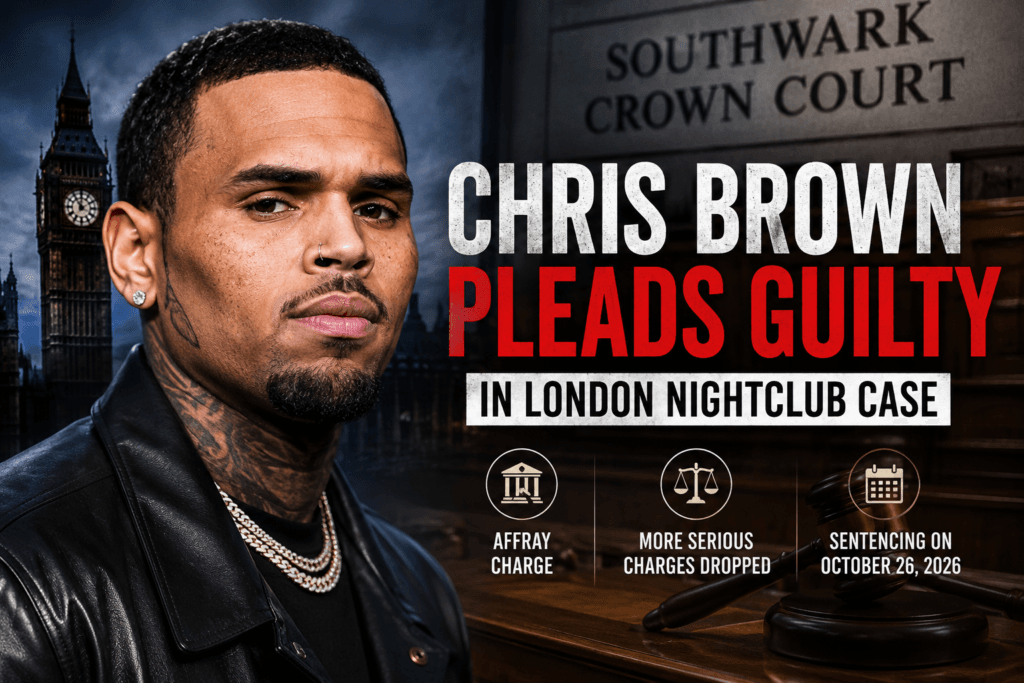
Grammy-winning singer Chris Brown is once again making headlines, but this time the focus is on a courtroom rather than a concert stage. After months of legal proceedings surrounding an alleged altercation at a London nightclub, the artist has officially pleaded guilty to an affray charge in a UK court.
The development has attracted worldwide attention because it changes the direction of a case that initially involved more serious allegations. While prosecutors dropped other charges, the guilty plea means the legal process is not over. Instead, the case has entered its sentencing phase, which could determine the consequences Brown faces later this year.
For longtime fans, critics, and industry observers alike, the news raises several important questions:
- What exactly happened?
- Why did the charges change?
- What does “affray” mean under UK law?
- How could this affect Chris Brown’s career?
- What happens next?
This article answers those questions while separating verified facts from speculation and providing important legal context.
Chris Brown Pleads Guilty: The Latest Development
The biggest update in the case came when Chris Brown pleaded guilty to one count of affray during a hearing at Southwark Crown Court in London.
His co-defendant, Omololu Akinlolu—better known by many fans as HoodyBaby—also entered a guilty plea to the same charge.
Following the plea:
- Prosecutors discontinued several more serious charges.
- Brown remains free on previously approved bail.
- The court scheduled sentencing for October 26, 2026.
- The maximum sentence for affray under UK law is generally three years in prison, although actual penalties depend on numerous legal factors.
The guilty plea does not automatically determine the sentence. Instead, it confirms that Brown accepted criminal responsibility for the affray offense, leaving the judge to decide the appropriate punishment during sentencing.
Chris Brown Case at a Glance
| Topic | Details |
|---|---|
| Person | Chris Brown |
| Country | United Kingdom |
| Court | Southwark Crown Court, London |
| Incident Year | 2023 |
| Guilty Plea | Affray |
| More Serious Charges | Dropped by prosecutors |
| Current Status | Awaiting sentencing |
| Sentencing Date | October 26, 2026 |
| Maximum Penalty for Affray | Up to 3 years imprisonment (depending on court decision) |
Chris Brown: Why This Story Matters
Chris Brown remains one of the most commercially successful R&B artists of the past two decades.
Since debuting in 2005, he has built a global fan base through hit albums, sold-out tours, and chart-topping singles. His influence on modern R&B, hip-hop, and pop music is widely recognized.
However, his career has also been marked by repeated legal controversies that have often received as much media attention as his music.
Because of that history, every new legal development involving Brown becomes international news.
This latest case is significant because it involves:
- criminal proceedings in another country,
- allegations connected to a public venue,
- a guilty plea,
- and an upcoming sentencing hearing that could influence future professional commitments.
Chris Brown Timeline: From Nightclub Incident to Guilty Plea
Understanding the sequence of events helps explain why this case has attracted so much attention.
February 2023: Alleged Incident
According to prosecutors, an altercation occurred inside an upscale nightclub in London’s Mayfair district.
Authorities alleged that music producer Abraham Diaw was injured during the confrontation.
Investigators later reviewed surveillance footage and gathered witness evidence as part of the case.
Investigation Continues
Following the incident, UK authorities continued gathering evidence.
As with many international criminal investigations involving public figures, the legal process took considerable time before formal court proceedings advanced.
Investigators examined:
- witness statements,
- available video footage,
- medical information,
- and other supporting evidence.
Arrest in the United Kingdom
Brown was later arrested after returning to the United Kingdom.
Initially, the case appeared likely to move toward a full criminal trial because prosecutors had brought more serious allegations than the eventual affray charge.
The arrest also briefly created uncertainty surrounding scheduled tour dates before Brown was later released on bail under court-imposed conditions.
Initial Court Hearings
During earlier hearings, Brown denied the more serious allegations.
At that stage, legal observers expected a lengthy trial that could include:
- multiple witnesses,
- surveillance evidence,
- expert testimony,
- and extensive courtroom proceedings.
Instead, the direction of the case changed significantly before trial began.
July 2026: Guilty Plea
Rather than proceeding with a lengthy trial, Brown entered a guilty plea to affray.
Following that plea:
- prosecutors withdrew additional charges,
- the court accepted the plea,
- and attention shifted toward sentencing.
This procedural change shortened what could have been a complex criminal trial.
Chris Brown and the London Nightclub Incident
Public reporting indicates that the incident occurred at an exclusive London nightclub during an evening gathering.
Prosecutors described the confrontation as serious and alleged that the victim sustained injuries requiring medical treatment. They also characterized the alleged violence as unprovoked. Brown’s guilty plea to affray means the case will not proceed to trial on the discontinued charges, but the court will still consider the admitted offense when determining the sentence.
It is important to distinguish between:
- allegations that were made during the investigation,
- charges that were later discontinued,
- and the offense to which Brown actually pleaded guilty.
That distinction is central to understanding the legal outcome.
Chris Brown Case: Understanding the Difference Between Allegations and Convictions
Media coverage often combines allegations with confirmed legal findings.
They are not the same.
Here’s an easy comparison:
| Legal Stage | Meaning |
|---|---|
| Allegation | A claim that has not been proven in court |
| Criminal Charge | A formal accusation filed by prosecutors |
| Guilty Plea | The defendant admits legal responsibility |
| Conviction | The court records guilt after a plea or trial |
| Sentencing | The judge determines the punishment |
Understanding these distinctions helps readers evaluate news reports more accurately.
Chris Brown and Public Interest
Cases involving internationally known entertainers naturally receive widespread media coverage.
Several factors explain why:
- global fan communities closely follow celebrity news,
- international legal systems often differ from U.S. law,
- social media accelerates the spread of courtroom updates,
- and entertainment news frequently intersects with public interest reporting.
The latest court appearance generated extensive coverage across major international news organizations shortly after the hearing concluded.
What Readers Should Know Before Drawing Conclusions
Although Brown has pleaded guilty to affray, sentencing has not yet occurred.
That means several important legal questions remain unanswered, including:
- whether the judge will impose imprisonment,
- whether a suspended sentence is possible,
- whether additional financial penalties could apply,
- and what other conditions the court may impose.
Those decisions will be made during the sentencing hearing after the court considers submissions from both the prosecution and the defense.
For that reason, any prediction about the final outcome would be speculative.
Key Takeaways
- Chris Brown has pleaded guilty to an affray charge in a London criminal case.
- Prosecutors dropped more serious charges before trial.
- Sentencing is scheduled for October 26, 2026.
- The guilty plea ends the need for a lengthy criminal trial.
- The court has not yet decided Brown’s punishment.
What Is Affray Under UK Law?
One of the biggest questions surrounding the Chris Brown case is the meaning of the charge itself. While the term “affray” is common in the United Kingdom, many readers in the United States may be unfamiliar with it.
In simple terms, affray is a criminal offense involving the use or threat of unlawful violence in a public setting. The offense focuses on conduct that would cause a reasonable person present at the scene to fear for their personal safety. It does not necessarily require multiple people to be fighting, and a single individual’s actions can be enough if the legal requirements are met. The offense is defined under the UK’s Public Order Act 1986.
Unlike some assault-related offenses, affray centers on behavior that disturbs public order rather than only the injuries suffered by a specific individual. That distinction explains why it is treated differently from more serious violent crime charges.
Chris Brown and the Affray Charge
In this case, Chris Brown pleaded guilty to affray during proceedings at Southwark Crown Court in London. By entering a guilty plea, Brown accepted legal responsibility for that specific offense, removing the need for a full criminal trial on the affray charge. Prosecutors also discontinued the more serious assault-related charges before the case reached trial.
It is important to understand that Brown pleaded guilty only to the charge that remained before the court. The discontinued charges are no longer part of the criminal proceedings.
Key Elements of Affray
To better understand the offense, consider the main legal elements generally associated with affray under UK law.
| Element | Explanation |
|---|---|
| Violence or Threat | The offense involves unlawful violence or the threat of violence. |
| Public Impact | The behavior would make a reasonable bystander fear for their safety. |
| Intent | The court considers whether the actions were intentional or reckless. |
| Criminal Offense | Affray is prosecuted under the UK’s Public Order Act 1986. |
| Court Decision | Judges consider the facts, evidence, and circumstances before imposing a sentence. |
Chris Brown Case: Why Did Prosecutors Drop the More Serious Charges?
One of the most discussed aspects of the case is the prosecution’s decision to discontinue the more serious allegations before trial.
Although prosecutors have not publicly explained every factor behind that decision, such outcomes are not unusual in criminal proceedings. Cases often evolve as lawyers review the available evidence, witness testimony, and the overall likelihood of securing a conviction on each charge.
A guilty plea to one offense can also influence how prosecutors proceed with related allegations, depending on the legal circumstances of the case. In Brown’s case, prosecutors accepted the guilty plea to affray and withdrew the remaining charges before the scheduled trial.
Common Reasons Charges May Change
Every criminal case is different, but prosecutors may modify or withdraw charges for reasons such as:
- Changes in the available evidence.
- Legal negotiations before trial.
- Witness-related considerations.
- Court efficiency and judicial resources.
- A guilty plea to another charge that adequately reflects the criminal conduct.
These are general legal principles and should not be interpreted as the specific reason for the prosecution’s decision in Brown’s case unless confirmed by the court.
How the UK Criminal Justice Process Works
For readers outside the United Kingdom, the legal process can seem unfamiliar. While every case has unique circumstances, criminal proceedings generally follow a structured path.
1. Investigation
Police investigate the alleged incident by collecting evidence, interviewing witnesses, reviewing available recordings, and preparing reports.
2. Charging Decision
After reviewing the evidence, prosecutors decide whether criminal charges should be filed and, if so, which offenses are appropriate.
3. Court Hearings
The defendant appears before the court, where charges are formally presented and legal procedures begin.
4. Plea
The defendant may plead guilty or not guilty.
- A guilty plea usually avoids the need for a full trial on that charge.
- A not guilty plea generally leads to a trial where prosecutors must prove the case beyond a reasonable doubt.
In Chris Brown’s case, the guilty plea resolved the affray charge without requiring a contested trial.
5. Sentencing
Even after a guilty plea, the court must determine an appropriate sentence.
Judges consider factors such as:
- the seriousness of the offense,
- the circumstances surrounding the incident,
- any aggravating or mitigating factors,
- victim impact,
- and submissions from both the prosecution and the defense.
Chris Brown Sentencing: What Happens Next?
Although Brown has admitted guilt for affray, the legal process is not yet complete.
The sentencing hearing is scheduled for October 26, 2026, when the judge will determine the appropriate penalty after considering all relevant legal factors.
Possible sentencing outcomes may include:
- imprisonment,
- a suspended prison sentence,
- a community order,
- financial penalties,
- or other lawful conditions permitted under UK law.
The court has not indicated which outcome is most likely, so any prediction before sentencing would be speculative.
Factors the Judge May Consider
While sentencing decisions vary from case to case, judges commonly evaluate:
- the nature of the offense,
- whether anyone was injured,
- the defendant’s conduct during the proceedings,
- the timing of a guilty plea,
- mitigating circumstances presented by the defense,
- aggravating circumstances identified by the prosecution,
- and applicable sentencing guidelines.
These considerations help ensure that the sentence reflects both the facts of the case and the requirements of UK law.
Chris Brown Case Compared With U.S. Criminal Law
Many American readers naturally compare this case with the U.S. legal system. Although both countries follow common law traditions, there are notable differences.
| United Kingdom | United States |
|---|---|
| Affray is a specific public order offense. | Similar conduct may be charged under different state laws, such as disorderly conduct or assault-related offenses. |
| Cases are prosecuted under UK criminal statutes. | Criminal laws vary by state and federal jurisdiction. |
| Sentencing follows UK guidelines. | Sentencing depends on the laws of the relevant state or federal court. |
| Public order offenses have their own legal framework. | Equivalent offenses differ across jurisdictions. |
Because legal terminology is different, direct comparisons are not always possible.
Legal Terms Explained
Understanding a few common legal terms can make news coverage easier to follow.
| Term | Meaning |
|---|---|
| Affray | A UK public order offense involving unlawful violence or threats of violence that would cause a reasonable person to fear for their safety. |
| Guilty Plea | A formal admission of legal responsibility for a criminal offense. |
| Prosecutor | A lawyer representing the government in a criminal case. |
| Defendant | The individual accused of committing a criminal offense. |
| Sentencing | The stage where the judge decides the appropriate punishment after a conviction or guilty plea. |
| Mitigation | Information presented to reduce the severity of the sentence. |
| Aggravating Factor | A circumstance that may justify a more severe sentence. |
Why This Legal Development Matters
The guilty plea marks a major turning point in the Chris Brown case.
Instead of a lengthy trial involving extensive witness testimony and courtroom evidence, the legal process now centers on sentencing. The judge’s decision later this year will determine the final legal consequences of Brown’s admitted offense, bringing the case closer to its conclusion.
Chris Brown’s Music Career: A Legacy of Success and Controversy
Regardless of the latest legal developments, Chris Brown remains one of the most recognizable names in contemporary R&B and pop music. Since his debut in the mid-2000s, he has built a career that spans multiple genres, earned industry awards, and attracted a loyal international fan base.
His ability to combine singing, songwriting, dancing, and live performance has made him a prominent figure in modern entertainment. Over the years, Brown has released numerous albums and collaborated with artists across R&B, hip-hop, pop, and rap, helping him remain relevant in an industry that changes rapidly.
At the same time, his professional journey has frequently been accompanied by legal challenges and public scrutiny. As a result, discussions about Chris Brown often extend beyond music to include broader conversations about celebrity accountability, public image, and personal conduct.
Chris Brown Career Highlights
Throughout his career, Chris Brown has achieved several notable milestones.
Early Breakthrough
Brown entered the music industry as a teenager and quickly gained recognition with his debut single. His early success introduced him to audiences around the world and established him as one of the emerging voices in R&B.
Continued Commercial Success
Over the following years, Brown expanded his musical catalog by releasing multiple studio albums and hit singles. His work consistently appeared on major music charts, while streaming platforms helped introduce his songs to new generations of listeners.
His career includes:
- Multiple platinum-certified projects.
- Billboard chart success.
- International concert tours.
- High-profile collaborations.
- Grammy Award recognition.
- Millions of albums sold worldwide.
These accomplishments explain why legal news involving Brown often attracts attention far beyond the courtroom.
A Versatile Performer
In addition to recording music, Brown has earned praise from many fans for his energetic stage performances and choreography. His live shows often feature complex dance routines that have become part of his public identity.
This combination of musical talent and performance ability has contributed significantly to his lasting popularity.
Chris Brown and Previous Legal Challenges
The London case is not the first time Chris Brown has faced legal scrutiny.
Throughout his career, several legal matters have received widespread media coverage. While each case involved different facts and legal circumstances, together they have influenced public discussions about his reputation.
Some incidents resulted in criminal proceedings, while others involved civil disputes or investigations. Because the circumstances varied, each matter should be considered independently rather than as part of a single narrative.
The current UK case relates specifically to the events investigated by British authorities and should not be confused with unrelated legal matters from previous years.
Why Past Cases Still Receive Attention
When a well-known public figure appears in court, journalists often reference previous legal history to provide context.
However, readers should remember an important legal principle:
- Every criminal case is evaluated on its own facts.
- Courts consider the evidence presented in the specific case before them.
- Previous legal matters do not automatically determine the outcome of future proceedings.
This distinction helps ensure fair reporting and avoids drawing conclusions based on unrelated events.
Public Reaction to the Chris Brown Guilty Plea
As news of Brown’s guilty plea spread, reactions quickly appeared across social media platforms, entertainment websites, and fan communities.
The responses reflected a wide range of opinions.
Supportive Fans
Some supporters emphasized Brown’s musical achievements and expressed hope that the legal process would soon reach a conclusion.
Many fans encouraged others to wait until sentencing before making assumptions about the final outcome.
Critical Voices
Others viewed the guilty plea as an important development and argued that public figures should be held accountable for their actions regardless of fame or success.
Some commentators also discussed how repeated legal issues can affect public trust.
Neutral Observers
Legal analysts and news organizations generally focused on the confirmed facts rather than speculation.
Most professional reporting highlighted:
- the guilty plea,
- the charges that were discontinued,
- the upcoming sentencing date,
- and the legal significance of the court proceedings.
How the Entertainment Industry May Respond
Whenever a major artist becomes involved in legal proceedings, industry stakeholders often evaluate potential business implications.
For Chris Brown, these considerations may include:
- concert scheduling,
- promotional appearances,
- endorsement opportunities,
- sponsorship relationships,
- media interviews,
- and future collaborations.
At this stage, however, there is no confirmed indication that the guilty plea has resulted in widespread industry action beyond ongoing media coverage.
Impact on Concert Tours
One area receiving particular attention is Brown’s touring schedule.
Large concert tours involve multiple organizations, including:
- promoters,
- venues,
- sponsors,
- ticketing companies,
- security providers,
- and insurance partners.
Any legal proceedings involving a touring artist can create additional logistical considerations. Whether future performances are affected depends on contractual obligations, scheduling decisions, and other business factors.
Music Streaming and Sales
Historically, high-profile news involving major artists can temporarily increase public interest in their music.
Some listeners revisit older songs, while others discover an artist’s catalog for the first time after seeing headlines.
However, streaming numbers fluctuate for many reasons, including:
- new releases,
- social media trends,
- playlist placements,
- seasonal listening habits,
- and media attention.
Because of these variables, it is difficult to attribute changes in streaming activity to a single event.
Chris Brown and Celebrity Accountability
The latest case has also renewed discussions about accountability for public figures.
Many observers argue that celebrities should be treated like anyone else under the law. Others point out that famous individuals often receive significantly greater public attention than private citizens facing similar legal proceedings.
These conversations frequently focus on broader questions, such as:
- Should an artist’s personal conduct influence public support?
- Can professional success be separated from personal behavior?
- How should fans respond when a favorite performer faces criminal charges?
- What responsibilities do media organizations have when reporting celebrity cases?
There are no universal answers to these questions, which is why public opinion remains divided.
Why Celebrity Court Cases Receive Global Attention
Cases involving internationally known entertainers often become global news stories within hours.
Several factors contribute to this level of interest.
Worldwide Fan Base
Artists like Chris Brown have fans across dozens of countries.
As a result, legal developments receive attention from audiences far beyond the jurisdiction where the case is being heard.
Continuous News Cycle
Modern news organizations publish updates almost immediately after court hearings conclude.
Social media platforms further accelerate the spread of verified information, commentary, and public reactions.
Public Curiosity
People are naturally interested in stories involving well-known personalities.
When those stories involve legal proceedings, courtroom decisions, or significant career implications, public interest often increases.
International Media Coverage
Major news organizations around the world covered Brown’s guilty plea because of his global profile and the legal significance of the case. Coverage largely focused on the court proceedings, the change in charges, and the upcoming sentencing hearing.
Separating Facts From Online Speculation
High-profile legal cases often generate rumors online.
To stay accurately informed, readers should rely on:
- Official court records when available.
- Statements made during court proceedings.
- Reporting from established news organizations.
- Verified information rather than unconfirmed social media posts.
Avoid drawing conclusions based on edited videos, anonymous online claims, or unofficial sources that lack supporting evidence.
Lessons for Public Figures
While every legal case is unique, situations involving well-known personalities often highlight broader lessons.
These include:
- Public actions can receive intense media attention.
- Legal proceedings may have professional consequences.
- Reputation can influence public perception, even before a case concludes.
- Accurate reporting is essential for informed public discussion.
- Courts—not social media—determine criminal responsibility and sentencing.
Looking Ahead for Chris Brown
Although Brown’s guilty plea resolved one important stage of the proceedings, the case has not yet reached its conclusion.
The next major milestone will be the sentencing hearing, where the court will determine the appropriate legal consequences based on the admitted offense and all relevant circumstances.
Until that decision is announced, the full outcome of the case remains unknown. Any predictions about the sentence would be speculative and should be treated with caution.
What Happens Next for Chris Brown?
Although Chris Brown has pleaded guilty to affray, the legal process is not yet complete. The next and most significant step is the sentencing hearing, where the court will determine the appropriate punishment based on the facts of the case and applicable UK sentencing guidelines.
Unlike a trial, the sentencing hearing does not revisit the question of guilt. Instead, the judge evaluates several factors before deciding the final outcome.
These factors may include:
- The seriousness of the offense.
- The circumstances surrounding the incident.
- Any injuries or harm caused.
- The timing of the guilty plea.
- Mitigating arguments presented by the defense.
- Aggravating factors identified by the prosecution.
- Relevant sentencing guidelines under UK law.
The sentencing hearing is currently scheduled for October 26, 2026. Until the judge announces a decision, the exact penalty remains unknown.
Chris Brown Case: Possible Sentencing Outcomes
Because sentencing has not yet occurred, it is impossible to predict the court’s decision with certainty. However, UK courts generally have several options available, depending on the circumstances of the offense.
Possible outcomes may include:
| Possible Outcome | Description |
|---|---|
| Prison Sentence | A custodial sentence if the court considers it appropriate under sentencing guidelines. |
| Suspended Sentence | A prison sentence that is suspended subject to specific conditions. |
| Community Order | A non-custodial sentence requiring the offender to meet court-imposed obligations. |
| Fine | Financial penalties may be imposed where permitted by law. |
| Additional Court Orders | The court may issue other lawful orders depending on the circumstances. |
These possibilities are general examples under UK criminal law and should not be interpreted as predictions regarding Brown’s sentence.
Why the Sentencing Decision Matters
The sentencing hearing represents the final major stage of the criminal proceedings.
Its outcome may influence several areas, including:
- Brown’s legal record.
- Future travel and scheduling commitments.
- Public perception.
- Business partnerships.
- Professional opportunities.
However, the extent of any impact will depend on the sentence ultimately imposed and how future events unfold.
Common Misconceptions About the Chris Brown Case
High-profile celebrity cases often generate confusion online. Understanding a few key points can help separate facts from misinformation.
Misconception 1: A Guilty Plea Means Immediate Sentencing
Reality: A defendant may plead guilty during one hearing and receive a sentence at a later date after the court reviews all relevant information.
Misconception 2: All Original Charges Resulted in Conviction
Reality: Brown pleaded guilty to affray, while prosecutors discontinued the more serious charges before trial. Only the admitted offense remains relevant to sentencing.
Misconception 3: Media Reports Can Predict the Sentence
Reality: Only the judge has the authority to determine the sentence after considering all legal submissions.
Misconception 4: Celebrity Status Changes the Law
Reality: Courts are expected to apply the law regardless of a defendant’s fame or public profile.
Frequently Asked Questions About Chris Brown
Why did Chris Brown plead guilty?
Brown entered a guilty plea to the charge of affray during court proceedings in London, avoiding a trial on that specific offense.
What is affray?
Affray is a criminal offense under UK law involving unlawful violence or threats of violence that would cause a reasonable person to fear for their safety.
Did Chris Brown plead guilty to assault?
No. Brown pleaded guilty to affray. Prosecutors discontinued the more serious assault-related charges before trial.
When will Chris Brown be sentenced?
The sentencing hearing is scheduled for October 26, 2026.
Could Chris Brown receive a prison sentence?
UK law provides several possible sentencing options for affray. The judge will determine the appropriate outcome after considering all relevant factors. Any prediction before sentencing would be speculative.
Where did the incident occur?
According to court proceedings, the case relates to an incident at a nightclub in London’s Mayfair district during 2023.
Is the case officially over?
No. Brown has admitted guilt to the affray charge, but the case will conclude only after the court delivers its sentence.
Why did prosecutors withdraw other charges?
Prosecutors accepted Brown’s guilty plea to affray and discontinued the remaining charges before trial. Public reporting has not provided a detailed explanation for every legal consideration behind that decision.
Can Brown continue performing while awaiting sentencing?
Court reporting indicates that Brown remains on bail while awaiting sentencing. Whether scheduled performances proceed depends on legal conditions, contractual obligations, and decisions made by organizers.
Why has this case attracted worldwide attention?
Brown is an internationally recognized recording artist with a large global fan base. As a result, legal developments involving him receive extensive international media coverage.
Expert Perspective: Why This Case Matters Beyond One Celebrity
The Chris Brown case illustrates how high-profile legal proceedings often become part of a broader public conversation about accountability, media coverage, and the justice system.
Several important lessons emerge:
- A guilty plea can significantly change the direction of a criminal case.
- Legal terminology differs between countries, making context essential.
- Public opinion and legal outcomes are not the same.
- Responsible reporting requires distinguishing allegations from confirmed court findings.
- Final judgments should be based on verified legal outcomes rather than speculation.
For readers in the United States, the case also highlights how legal systems outside the U.S. operate under different statutes and procedures while still following fundamental principles of due process.
Why Accurate Reporting Matters
Celebrity news spreads rapidly, especially on social media, where incomplete or misleading information can circulate within minutes.
To stay informed:
- Read reports from established news organizations.
- Verify information through official court updates when available.
- Distinguish between allegations, charges, guilty pleas, and convictions.
- Avoid relying on rumors or unverified online posts.
Responsible journalism helps readers understand complex legal stories without sensationalism.
Final Thoughts on Chris Brown
The latest courtroom developments mark an important chapter in one of the most closely followed celebrity legal cases of 2026. By pleading guilty to affray, Chris Brown brought an end to the trial phase that many observers expected would be lengthy and closely watched.
Even so, the story is not yet complete. The sentencing hearing will determine the legal consequences of Brown’s admitted offense and officially conclude the proceedings.
Until then, the focus remains on verified court developments rather than speculation. As with any ongoing legal matter, the final outcome should be understood only after the court issues its sentencing decision.
Conclusion
The Chris Brown case serves as a reminder that legal proceedings often evolve over time. Initial allegations, formal charges, plea agreements, and sentencing each represent different stages of the justice process, and understanding those distinctions is essential for accurate reporting.
Brown’s guilty plea to affray has resolved one significant part of the case, while prosecutors’ decision to discontinue the more serious charges changed its legal trajectory before trial. With sentencing scheduled for October 26, 2026, the court will soon decide the final consequences under UK law.
For fans, legal observers, and general readers alike, the most reliable approach is to follow confirmed court decisions rather than speculation. Whatever the final sentence may be, the case highlights the importance of due process, factual reporting, and understanding the legal system before drawing conclusions.