
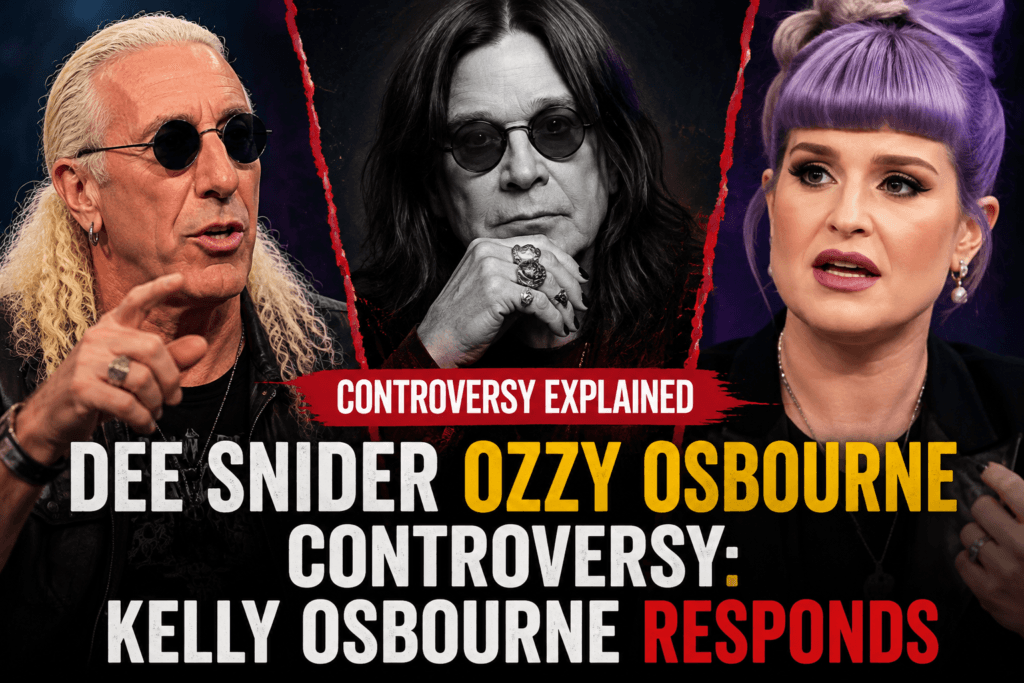
A new dispute over Ozzy Osbourne’s songwriting history has put Dee Snider Ozzy Osbourne back in the spotlight. What began as a discussion about the musicians behind Ozzy’s music quickly became personal after Kelly Osbourne publicly defended her late father.
At the center of the argument is a question that has followed Ozzy’s career for decades: how much of the music associated with him did he actually write? Dee Snider recently highlighted the contributions of musicians such as Bob Daisley, Geezer Butler, and Lemmy Kilmister, renewing attention on Ozzy’s collaborative songwriting history.
Kelly strongly objected to Snider’s remarks. Her response focused on her father’s enormous influence and argued that his legacy cannot be reduced to individual lyrics or songwriting credits.
The timing has also made the story more sensitive. Ozzy died on July 22, 2025, at age 76, after a career that stretched from Black Sabbath’s groundbreaking early years to a hugely successful solo run.
Yet the songwriting debate itself is much older. Musicians who worked with Ozzy have discussed their contributions for years, while fans continue to debate how those contributions should shape his musical legacy.
This article examines the Dee Snider Ozzy Osbourne controversy, the history behind the songwriting dispute, Kelly Osbourne’s response, and what the debate means for Ozzy’s lasting legacy.
What Started the Dee Snider Ozzy Osbourne Controversy?
Dee Snider’s Comments Bring an Old Debate Back
The latest dispute began with Snider’s comments about the songwriting history surrounding Ozzy’s career. The Twisted Sister frontman pointed toward musicians who worked alongside Ozzy and highlighted their contributions to his music.
Bob Daisley became one of the most important names in that discussion. Snider also referenced Geezer Butler and other musicians whose songwriting helped shape music associated with Ozzy and Black Sabbath.
Those comments revived a debate that has existed for decades. Fans have long discussed how much credit a lead singer should receive when other musicians contribute lyrics, riffs, arrangements, or melodies.
Ozzy’s career provides a particularly interesting example because he worked with numerous musicians across different eras. Randy Rhoads, Bob Daisley, Lee Kerslake, Zakk Wylde, Lemmy Kilmister, and others each brought different skills to his music.
Consequently, the current argument involves more than one controversial statement. It raises a larger question about how collaborative music should be credited and remembered.
Why Ozzy’s Songwriting History Matters
Songwriting credits can tell readers who officially contributed to a composition, but they do not always describe every creative decision made during recording.
A musician might create a guitar riff while another person develops lyrics. The vocalist may then shape the melody through phrasing and delivery. Producers can also influence the arrangement before a song reaches its final form.
Ozzy’s records reflect that kind of collaboration.
Bob Daisley, for example, has discussed his songwriting contributions to Ozzy’s early solo material for many years. Those claims form part of the historical background behind the current Dee Snider Ozzy Osbourne controversy.
Still, recognizing another musician’s contribution does not automatically diminish Ozzy.
His voice, stage presence, and performance style became central to the identity of the recordings. Millions of listeners connected those songs with Ozzy because of the way he delivered them.
Therefore, the real question is not whether other musicians contributed. They clearly did.
Instead, the debate asks how those contributions should influence the way fans understand Ozzy’s own creative role.
Why the Dee Snider Ozzy Osbourne Debate Is More Complicated Than It Looks
Songwriting and Performance Are Different Roles
At first glance, the argument may seem straightforward: identify the writer and settle the question.
Music history rarely works that neatly.
A major rock recording can involve several creative layers. One person may develop lyrics, another may create a riff, and a third musician may shape the arrangement. Meanwhile, the vocalist can transform the material through melody, phrasing, emotion, and performance.
Official songwriting credits remain important, but they do not necessarily capture every creative decision made during studio sessions.
Ozzy’s career demonstrates that distinction particularly well.
As Black Sabbath’s lead singer, he became the voice of one of heavy metal’s foundational bands. After leaving Sabbath, he built a successful solo career with a rotating group of highly talented musicians.
Randy Rhoads, Bob Daisley, Lee Kerslake, and later Zakk Wylde all became important parts of different chapters in Ozzy’s musical story.
Their involvement shows that collaboration was not an exception in Ozzy’s career. It was a recurring part of his creative process.
Why Collaboration Does Not Diminish Ozzy
The presence of multiple writers does not automatically make a performer less important.
Popular music contains countless examples of artists who became iconic through interpretation and performance as much as songwriting. A singer can take material created by several people and give it a distinctive identity that audiences remember for decades.
Ozzy did exactly that in different stages of his career.
His voice became instantly recognizable. His stage persona became part of heavy-metal culture. His performances helped turn collaborative recordings into songs that audiences strongly associated with him.
Rock history offers many examples of artists whose careers grew through changing creative partnerships. Lindsey Buckingham’s work with Stevie Nicks and Fleetwood Mac also shows how individual talent can shape a group while collaboration creates a larger musical legacy.
That distinction explains why the Dee Snider Ozzy Osbourne debate has generated such strong reactions.
Two different questions are getting mixed together: Who created specific parts of the music? and What did Ozzy contribute to the finished recordings?
Those questions deserve separate answers.
A songwriter can receive credit for lyrics or music while the vocalist contributes through melody and interpretation. Both forms of creativity can exist within the same recording.
That collaborative perspective offers a more accurate way to understand Ozzy’s catalog without reducing his legacy to a single songwriting statistic.
Bob Daisley and the Long-Running Ozzy Songwriting Dispute
Bob Daisley is central to the historical background behind the current discussion.
The Australian bassist and songwriter worked with Ozzy during the early years of his solo career. Daisley has repeatedly discussed his role in writing lyrics for Ozzy’s early records and has disputed how some of those contributions were credited.
His own account has been particularly detailed over the years. In an interview published on his website, Daisley discussed songs associated with Ozzy’s early solo period and directly addressed questions surrounding his songwriting contributions. He has maintained that he wrote lyrics for several songs, including “Suicide Solution.”
The broader credit dispute also involved drummer Lee Kerslake. Reporting on the history of Ozzy’s early solo albums has noted legal disputes involving Daisley and Kerslake and claims that their contributions were not properly credited.
However, the existence of those disputes does not establish that Ozzy contributed nothing creatively.
That is the distinction readers should keep in mind.
A songwriting credit can tell us who officially received recognition for a composition. It does not necessarily capture every part of a performer’s artistic contribution. Ozzy’s career involved interpretation, vocal performance, collaboration and the ability to turn songs into recognizable pieces of his musical identity.
Consequently, the historical record supports a nuanced view rather than an all-or-nothing argument.
Kelly Osbourne Dee Snider Response: Why She Defended Her Father
Kelly Osbourne responded after Snider’s comments began circulating, and her reaction was considerably more personal than a typical disagreement between musicians.
For Kelly, this was not simply a discussion about publishing credits or studio history. It involved her father’s reputation and the legacy he left behind.
She argued that reducing Ozzy’s career to questions about who wrote particular lyrics misses the larger contribution he made to heavy metal. Her response also challenged Snider’s motives and questioned why he was choosing to make these observations publicly.
Kelly’s reaction quickly became one of the biggest parts of the story.
That is understandable given the circumstances. Ozzy had already completed his career-defining farewell performance in Birmingham in July 2025 before his death later that month. His final concert reunited him with Black Sabbath members Tony Iommi, Geezer Butler and Bill Ward for the “Back to the Beginning” event.
Therefore, the conversation about his legacy is happening at a particularly emotional moment.
Kelly is also not the only person to view Ozzy’s influence as bigger than individual songwriting credits. His impact stretches across multiple generations of metal and rock musicians, while his public identity expanded beyond music through his family’s reality series, The Osbournes. His death prompted tributes from artists across the music industry.
The disagreement, then, is not merely about a few songs. It is about how a six-decade career should be remembered.
Did Ozzy Osbourne Write His Own Songs?
The short answer is more complicated than either side of the online argument suggests.
Ozzy was not a completely isolated songwriter who created every lyric and musical part himself. His career was deeply collaborative, particularly during his early solo years. Musicians around him contributed riffs, arrangements, lyrics and instrumental performances that helped define the records.
However, saying that other musicians contributed does not mean Ozzy had no creative role.
His greatest strength was often his ability to bring material to life. A song can change dramatically depending on the vocalist delivering it. Ozzy’s distinctive voice, phrasing and emotional delivery became so recognizable that many songs became inseparable from his identity.
There is also evidence that Ozzy participated directly in the creative process across different periods of his career. Later interviews about his songwriting describe him working with musicians to develop songs, including sessions in which he contributed vocally to new material.
This is why the debate should not be framed as a choice between “Ozzy wrote everything” and “Ozzy wrote nothing.”
Neither extreme accurately represents the collaborative nature of his career.
The better question is how much each collaborator contributed to each individual song, how those contributions were credited, and how much creative ownership should be attributed to the performer.
That distinction will become increasingly important as the Dee Snider Ozzy Osbourne controversy develops.
Dee Snider Ozzy Osbourne: What Dee Snider Actually Claimed
The Dee Snider Ozzy Osbourne controversy became much more serious when Snider moved beyond a general discussion of songwriting and pointed to specific musicians connected to Ozzy’s career.
On August 12, 2026, Snider responded to questions on X about Ozzy’s songwriting history. His comments focused on the role of bass players and lyricists who worked with Ozzy at different points. He referenced Bob Daisley, Geezer Butler and Lemmy Kilmister while arguing that Ozzy’s lyrics were often created with substantial help from other musicians.
That distinction matters because Snider’s comments did not emerge from nowhere. Several musicians have discussed their creative contributions to Ozzy’s records for decades. Daisley, in particular, has long maintained that he wrote lyrics for a number of Ozzy’s early solo songs.
However, the way those historical contributions are interpreted remains disputed.
Snider’s remarks effectively reopened an old conversation at a moment when Ozzy’s legacy is receiving renewed attention. Because Ozzy died in July 2025, discussions about his career now carry an added emotional weight for his family, former collaborators and fans.
Snider later indicated that he admired Ozzy and did not intend his remarks as disrespect toward the late singer. However, Kelly Osbourne did not view the comments that way.
That disagreement over intent became the next major chapter of the story.
Kelly Osbourne Dee Snider Clash Escalates on Social Media
The Kelly Osbourne Dee Snider confrontation moved from a music-history discussion into a personal public exchange on August 14.
Kelly responded through Instagram Stories, defending her father and challenging Snider’s decision to question Ozzy’s songwriting legacy. Her response was particularly forceful because she believed the comments diminished her father’s achievements after his death.
Kelly emphasized the scale of Ozzy’s career rather than focusing only on individual songwriting credits. From her perspective, his importance to heavy metal cannot be measured simply by asking who wrote a particular lyric.
She also questioned why Snider was discussing the subject at this point in time.
That criticism became a major part of the viral story because Kelly did not offer a restrained industry-style response. Instead, she directly attacked Snider’s comments and suggested that he was attempting to attract attention by talking about her father.
Several outlets reported that Kelly described Snider’s remarks as “spectacularly classless.” She also argued that Ozzy’s career and influence were already established without needing validation from another musician.
The emotional nature of the response is important to understand.
Kelly was not simply defending a songwriting credit. She was defending the public memory of her father, whose career had become part of her family’s identity as well as rock history.
Why Bob Daisley Matters to the Ozzy Songwriting Story
Bob Daisley is one of the most important names in understanding the Dee Snider Ozzy Osbourne debate.
Daisley played bass and contributed songwriting during a crucial period of Ozzy’s solo career. He was part of the creative team behind Blizzard of Ozz, the 1980 album that established Ozzy as a successful solo artist after his departure from Black Sabbath.
The album’s songwriting history was collaborative. Randy Rhoads, Daisley and Ozzy were involved in developing the material, while Lee Kerslake later joined as drummer. Historical accounts of the album credit multiple musicians with different creative contributions.
Daisley’s role became the subject of a much larger dispute, however.
He and Kerslake eventually pursued legal action over royalties and songwriting credits connected to Ozzy’s early solo records. The dispute became especially significant because both musicians argued that their creative contributions deserved recognition. Their legal battle eventually resulted in songwriting credits being awarded on Blizzard of Ozz and Diary of a Madman.
That history gives Snider’s recent comments a factual foundation, even though it does not automatically prove every broader claim being made about Ozzy’s career.
In other words, there really was a longstanding dispute over contributions and credits.
The mistake would be turning that complicated history into a simple statement that Ozzy “did not write his songs.”
The evidence points to a much more collaborative story.
Dee Snider Ozzy Osbourne and the Role of Geezer Butler
Geezer Butler adds another layer to the discussion.
Before Ozzy became a solo artist, he was the vocalist of Black Sabbath, the pioneering heavy metal band he formed alongside Butler, Tony Iommi and Bill Ward. Butler was not merely a bassist. He was also one of Black Sabbath’s principal lyricists.
Therefore, when Snider mentioned Butler while discussing Ozzy’s songwriting history, he was referring to a real and well-established creative relationship.
Many of Black Sabbath’s early songs were created through collaboration. Iommi’s guitar work, Butler’s lyrics, Ward’s drumming and Ozzy’s vocal delivery combined to produce a sound that became enormously influential.
Yet that does not mean Ozzy’s contribution was insignificant.
A band’s identity is often created through the interaction of several personalities. Ozzy’s voice became one of the defining sounds of heavy metal, while Butler’s lyrics and Iommi’s riffs helped establish the musical and thematic foundation around him.
That distinction is essential when evaluating the current controversy.
The Dee Snider Ozzy Osbourne debate becomes misleading if listeners assume that being the lead singer and being the sole songwriter are the same job.
They are not.
Ozzy’s importance to Black Sabbath came from his performance, personality, vocal identity and role within the band. At the same time, other members made substantial writing contributions.
Both facts can exist together.
What About Lemmy Kilmister and Ozzy’s Later Music?
Lemmy Kilmister is another name that frequently appears when discussing Ozzy’s songwriting history.
The Motörhead frontman contributed lyrics to several songs associated with Ozzy, particularly during the No More Tears era. Historical accounts of that album note that Lemmy wrote lyrics for six songs, although only four ultimately appeared on the record.
This is one of the clearest examples of why songwriting in rock music can be collaborative.
A vocalist can perform a song without having written every lyric. A guitarist can create the main musical idea while another musician develops the words. A producer can influence the arrangement. Meanwhile, the singer can shape the final recording through vocal choices and interpretation.
Ozzy’s catalog contains examples of that kind of collaboration.
Therefore, Snider’s reference to Lemmy does point toward a documented part of Ozzy’s creative history. However, it should not automatically be interpreted as evidence that Ozzy made no creative contribution to his own music.
The reality is considerably more interesting.
Ozzy surrounded himself with talented musicians throughout his career. Randy Rhoads, Zakk Wylde, Bob Daisley, Lee Kerslake, Lemmy and many others contributed different elements at different times.
That collaborative model was not a weakness.
In many ways, it was one of the reasons Ozzy’s solo career remained creatively powerful for so long.
Ozzy Osbourne’s Songwriting Legacy Cannot Be Reduced to Credits
The biggest problem with the current debate is that songwriting credits and artistic legacy are being treated as though they are identical measurements.
They are not.
Credits matter. They determine who receives formal recognition for a composition and can have major financial and legal consequences. The Daisley and Kerslake disputes demonstrate exactly why credits matter.
However, a musician’s legacy includes much more.
Ozzy helped define the sound and image of heavy metal across multiple generations. He first became famous with Black Sabbath and then successfully reinvented himself as a solo performer. His collaborations with Rhoads, Wylde and other musicians produced songs that remained culturally relevant decades after their original release.
His voice was also unmistakable.
Even when another musician supplied a lyric or riff, Ozzy’s performance could become the element that audiences remembered most strongly. That does not erase the writer’s contribution. Instead, it demonstrates how several creative roles can combine to create a lasting recording.
This is why Kelly’s defense focuses so heavily on Ozzy’s overall career.
From her perspective, questioning individual credits should not become a reason to diminish the person who performed those songs and helped bring them to millions of listeners.
At the same time, acknowledging collaborators does not diminish Ozzy either.
A more balanced reading is possible: Ozzy was an enormously influential performer and musical figure whose career depended on collaboration with some exceptionally talented writers and musicians.
That interpretation recognizes the contributions of everyone involved without rewriting the history of Ozzy’s career.
The Legal History Behind the Songwriting Questions
The songwriting controversy also has a legal dimension that is often missing from social-media discussions.
Daisley and Kerslake’s disputes with the Osbourne camp were not simply internet arguments. The two musicians pursued legal action over royalties and songwriting recognition connected to Blizzard of Ozz and Diary of a Madman. Their claims eventually resulted in credits being recognized for their contributions.
The story became even more controversial when later editions of the albums changed some of the original instrumental performances.
For the 2002 reissues, the bass and drum parts originally performed by Daisley and Kerslake were replaced with recordings by Robert Trujillo and Mike Bordin. Those changes generated significant criticism from fans. The original performances were restored for later reissues.
This history helps explain why questions about Ozzy’s songwriting can become emotionally charged.
There are real disputes behind the subject, and several musicians have publicly described their experiences differently.
However, those disputes should not be confused with proof that every song in Ozzy’s catalog was written by someone else.
Different albums had different creative teams.
Different songs had different contributors.
And Ozzy’s own creative role changed throughout his career.
That is why any responsible examination of the Dee Snider Ozzy Osbourne controversy needs to separate documented songwriting credits from broader claims about Ozzy’s artistic value.
What Dee Snider’s Follow-Up Means for the Dispute
Snider’s subsequent response added another important detail.
After Kelly’s criticism, Snider indicated that he did not intend to disrespect Ozzy and that he admired the legendary singer. His comments came while he was discussing songwriting history rather than, according to his explanation, attempting to attack Ozzy personally.
That clarification matters because it reveals the central disagreement between the two sides.
Snider appears to be focusing on historical accuracy and the contributions of musicians who worked with Ozzy.
Kelly is focusing on the way those comments affect her father’s reputation.
Both perspectives can exist simultaneously, although they lead to very different conclusions.
A discussion about songwriting credits can be legitimate. So can a family’s objection to the way that discussion is presented publicly.
The question is whether the conversation can continue without turning Ozzy’s entire legacy into a binary argument.
For fans, that may ultimately be the most useful way to approach the controversy.
Ozzy’s music was collaborative. His collaborators deserve recognition. At the same time, his influence as a performer, frontman and cultural figure remains enormous.
Those realities do not cancel each other out.
And that is precisely why the Dee Snider Ozzy Osbourne controversy has become much bigger than one social-media exchange.
Dee Snider Ozzy Osbourne: Why the Timing Matters
The timing of the Dee Snider Ozzy Osbourne controversy has added another emotional layer to the discussion. Snider’s remarks surfaced more than a year after Ozzy Osbourne’s death, so the subject naturally carries extra weight for his family and longtime fans.
Ozzy died on July 22, 2025, at age 76. His family confirmed his death after years of health problems, while his final Black Sabbath performance had taken place only weeks earlier in Birmingham, England.
For Kelly Osbourne, that timing changed the meaning of the conversation. She did not view Snider’s comments as a routine discussion about songwriting credits. Instead, she saw them as criticism of her father’s legacy during a particularly sensitive period.
Snider, however, had discussed similar ideas before. His comments about Ozzy’s songwriting history did not appear for the first time in 2026. He had previously mentioned musicians such as Bob Daisley, Geezer Butler, and Lemmy Kilmister when discussing the people who helped create lyrics for Ozzy’s music.
That background provides useful context.
The latest exchange therefore combines two different subjects: the history of Ozzy’s songwriting collaborations and the question of how people should discuss his legacy after his death.
Those subjects overlap, but they are not identical.
A careful article needs to examine both without turning either one into a personal attack.
Kelly Osbourne Dee Snider: Why Her Response Became Personal
The Kelly Osbourne Dee Snider dispute quickly moved beyond songwriting because Kelly responded as Ozzy’s daughter.
For her, Ozzy’s legacy represents far more than a collection of albums and songwriting credits. His career included Black Sabbath, a successful solo run, major tours, television appearances, and collaborations with some of rock’s most respected musicians.
Kelly therefore focused on the larger picture.
Reports said she strongly criticized Snider after his comments circulated online. Her response argued that questioning her father’s songwriting history could diminish his achievements. She also accused Snider of using Ozzy’s name to attract attention.
That reaction quickly became part of the news story itself.
A technical discussion about lyrics and songwriting credits had turned into a public disagreement between two familiar figures from the heavy-metal community.
Still, Kelly’s argument does not necessarily conflict with historical research.
Other musicians can receive proper credit for their work while Ozzy retains his place as a major performer and cultural figure.
That distinction matters.
Ozzy worked with talented writers and musicians throughout his career. Those collaborators helped create lyrics, riffs, arrangements, and recordings. His distinctive voice and performance style then gave the finished material a recognizable identity.
A balanced account can recognize every part of that process.
Dee Snider Ozzy Osbourne: Was Snider Attacking Ozzy?
Snider later indicated that he did not intend his remarks as a personal attack on Ozzy.
That clarification deserves attention because his comments focused mainly on songwriting history. Snider has also expressed admiration for Ozzy over the years, which suggests that he was discussing musical contributions rather than rejecting Ozzy’s importance.
Intent, however, does not always determine how an audience receives a statement.
Kelly interpreted the remarks as disrespectful, particularly because her father could no longer respond himself. Her reaction shows how differently the same comments can sound to someone with a close personal connection to the subject.
From Snider’s perspective, highlighting the contributions of musicians such as Daisley can provide a more complete version of rock history.
From Kelly’s perspective, reopening those questions after Ozzy’s death can feel like an unnecessary challenge to his reputation.
Neither viewpoint settles the historical question by itself.
A better approach separates the issues.
First, readers can examine the songwriting credits for individual songs. Next, they can look at documented interviews and legal disputes. Finally, they can consider Ozzy’s contribution as a vocalist, performer, and cultural figure.
That method keeps the Dee Snider Ozzy Osbourne story grounded in evidence instead of social-media reactions.
What the Songwriting Credits Actually Tell Us
Songwriting credits offer one of the clearest starting points for understanding the controversy.
Ozzy’s catalog contains many collaborative compositions. Different albums featured different musicians, writers, producers, and creative teams. As a result, no single description can accurately explain every song in his career.
“Crazy Train” provides a useful example.
The song credits Ozzy Osbourne, Randy Rhoads, and Bob Daisley as writers. Each contributor brought a different creative element to the finished recording.
Rhoads created the guitar work that became one of the song’s defining features. Daisley contributed to the writing and lyrics. Ozzy delivered the vocal performance that made the recording instantly recognizable.
Together, those elements created the finished track.
This example also shows why the word “writer” can cause confusion.
One musician may create a riff. Another may develop lyrics. A vocalist can shape the melody through phrasing. A producer might influence the arrangement during recording.
All of those decisions can affect the final song.
Therefore, asking whether Ozzy “wrote” a particular track requires more precision.
Did he write the lyrics? Did he contribute to the music? Did he help develop the melody? Did he shape the arrangement?
The answer can change from one song to another.
That song-by-song approach offers a much more reliable picture of Ozzy’s creative history.
Dee Snider Ozzy Osbourne: Why Bob Daisley Matters
Bob Daisley remains one of the most important names in the songwriting discussion surrounding Ozzy’s early solo career.
Daisley played bass and contributed to the songwriting process during the creation of Ozzy’s early records. Over the years, he has also discussed his work and disagreements involving royalties and songwriting recognition.
Those disagreements eventually reached court.
Daisley and drummer Lee Kerslake challenged the handling of royalties and songwriting credits connected with Ozzy’s early solo albums. Their legal dispute became closely associated with Blizzard of Ozz and Diary of a Madman.
That history gives important context to Snider’s recent remarks.
However, readers should separate documented disputes from broader claims about Ozzy.
Daisley’s contributions deserve recognition. His role in the early solo records forms an important part of their history.
At the same time, Ozzy remained the central vocalist and performer on those recordings. His voice, image, and interpretation helped turn the collaborative material into music that audiences strongly associated with him.
Both realities can exist together.
Giving Daisley credit does not require removing Ozzy from the story. Likewise, defending Ozzy does not require ignoring Daisley’s contribution.
That balanced view offers a stronger explanation than treating the dispute as a contest between two musicians.
Randy Rhoads Helped Shape Ozzy’s Solo Career
Randy Rhoads became a crucial creative partner after Ozzy left Black Sabbath.
His guitar work helped establish the sound of Blizzard of Ozz and Diary of a Madman. More importantly, the partnership gave Ozzy a new musical identity after his departure from Sabbath.
Rhoads brought a distinctive combination of classical influence, technical ability, and heavy-metal aggression. Ozzy contributed his unmistakable voice and a performance style that audiences already knew.
Their partnership produced a new chapter in Ozzy’s career.
Rhoads also demonstrates why songwriting credits cannot measure every creative contribution.
A guitarist can transform a song through a memorable riff. A vocalist can change the emotional impact through delivery. A bassist can add both musical structure and lyrical ideas.
The finished recording reflects all those choices.
Rhoads died in a plane crash in 1982, ending one of heavy metal’s most promising partnerships. His influence on Ozzy’s early solo music nevertheless remains enormous.
Later musicians brought different creative approaches to Ozzy’s work. Zakk Wylde, for example, became one of the most recognizable guitarists associated with Ozzy’s solo career.
Each partnership helped shape a different era.
Ozzy’s ability to work with talented musicians became one of the defining strengths of his career.
Kelly Osbourne Dee Snider: Why Fans Are Divided
The Kelly Osbourne Dee Snider dispute has divided fans because people view Ozzy’s legacy from different perspectives.
Some listeners agree with Snider’s basic point. They believe musicians who wrote lyrics, created riffs, or contributed compositions deserve proper recognition, even when they worked alongside a famous frontman.
Other fans sympathize with Kelly. They see Ozzy’s importance as much larger than songwriting credits and believe the renewed discussion unfairly overshadows his achievements.
A third group takes a more balanced position.
These fans recognize the work of Daisley, Rhoads, Butler, Kerslake, Lemmy, Wylde, and other collaborators. At the same time, they continue to view Ozzy as one of heavy metal’s most influential performers.
That middle ground makes sense because the two ideas do not contradict each other.
A songwriter deserves credit for writing.
A performer deserves recognition for delivering the material and creating a distinctive artistic identity.
The same recording can therefore carry the contributions of several people.
This perspective also explains why the current controversy has attracted so much attention. Fans are not necessarily arguing about the existence of collaboration. Instead, they are debating how much weight those contributions should receive when people discuss Ozzy’s legacy.
Why Ozzy’s Legacy Goes Beyond Songwriting
Songwriting represents only one part of an artist’s career.
Ozzy’s influence extends across performance, vocal style, stage presence, music history, and popular culture. His work with Black Sabbath helped establish the foundations of heavy metal, while his solo career introduced new audiences to his distinctive sound.
His voice became instantly recognizable.
That recognition mattered because Ozzy could take collaborative material and make it feel like his own. Listeners did not simply hear a collection of writers and musicians. They heard Ozzy.
His stage persona added another layer.
Over several decades, he developed an identity that remained recognizable even as his musical collaborators changed. That consistency helped him remain relevant across generations.
Television expanded his cultural reach as well. The Osbournes introduced Ozzy and his family to audiences who might never have followed heavy metal closely.
All of those factors contribute to his legacy.
Consequently, a discussion about who wrote particular lyrics cannot fully measure Ozzy’s importance.
The songwriting history matters.
So does the performance.
So does the cultural impact.
A complete account needs to consider all three.
Dee Snider Ozzy Osbourne: What the Controversy Really Reveals
The biggest lesson from the Dee Snider Ozzy Osbourne controversy may be that musical history rarely fits into simple categories.
Famous performers often receive most of the public attention. Meanwhile, songwriters, instrumentalists, producers, and other collaborators can remain less visible.
Ozzy’s career provides a clear example of that dynamic.
Several musicians made major contributions to his records. Their work deserves recognition and historical credit. At the same time, Ozzy’s voice and performance helped turn those collaborations into recordings that reached millions of listeners.
Neither side needs to erase the other.
The current dispute also demonstrates why social media can distort complicated subjects. A short statement may attract attention, but it cannot explain decades of collaboration, legal disputes, changing band members, and evolving creative roles.
Readers should therefore look beyond the viral headline.
Examine the individual song. Check the official credits. Consider the musicians involved. Then separate documented facts from personal interpretations.
That approach produces a more complete picture of Ozzy’s career.
It also makes room for the people who helped create his music without diminishing the man whose voice became one of heavy metal’s defining sounds.
In the end, the Dee Snider Ozzy Osbourne controversy may tell us less about who “won” an argument and more about how complicated great music can be.
Ozzy’s legacy contains collaboration, controversy, innovation, and performance.
All of those elements belong in the story.
Dee Snider Ozzy Osbourne: What the Historical Record Shows
The historical record gives the Dee Snider Ozzy Osbourne debate more nuance than social media often suggests. Several musicians made significant creative contributions to Ozzy’s music, particularly during his early solo career.
Bob Daisley played bass and contributed to songwriting. Randy Rhoads helped establish the musical foundation of Ozzy’s first solo albums. Later collaborators, including Lemmy Kilmister and Zakk Wylde, shaped different periods of his career.
Official songwriting credits provide another important clue. Several tracks list multiple writers, confirming the collaborative nature of Ozzy’s catalog.
What “Crazy Train” Reveals About Ozzy’s Songwriting
“Crazy Train” offers a clear example. Ozzy Osbourne, Randy Rhoads, and Bob Daisley share writing credit for the song.
Rhoads created the famous guitar work, while Daisley contributed to the lyrics and songwriting. Ozzy delivered the vocal performance that turned the track into one of his signature recordings.
Together, those contributions created the finished song.
Consequently, the debate does not need an all-or-nothing answer. Ozzy did not create every musical element alone, but the record also does not support the idea that he played no creative role.
A song can contain several forms of authorship. One musician might write lyrics, another could create the main riff, and the vocalist might shape the melody through delivery.
Producers and other band members can also influence the final arrangement.
Understanding these different roles makes the Dee Snider Ozzy Osbourne songwriting debate much easier to follow.
Why Individual Contributions Matter
Rock history contains many examples of musicians leaving a lasting mark while working within larger bands or creative teams.
Jennifer Finch’s career and influence in the rock scene offer another example of why individual contributions deserve attention alongside the artists who receive the most public recognition.
That broader perspective applies to Ozzy’s career as well. His music brought together singers, guitarists, bassists, drummers, writers, and producers whose combined efforts shaped different eras.
Recognizing those contributions does not diminish Ozzy’s role.
Instead, it provides a fuller picture of how his music developed and why his catalog continues to attract interest from new generations of listeners.
Why “Crazy Train” Matters to the Dee Snider Ozzy Osbourne Debate
“Crazy Train” remains one of the best examples of Ozzy’s collaborative approach to music.
The song brings together three credited writers: Ozzy Osbourne, Randy Rhoads, and Bob Daisley. Each name represents a different part of the creative process.
Rhoads gave the track its instantly recognizable guitar identity. Daisley contributed to the lyrics and songwriting. Ozzy supplied the vocal performance that audiences immediately connected with the song.
Listeners often associate a recording with its singer. However, the creative work behind that recording can involve several people.
“Crazy Train” demonstrates that difference clearly.
A songwriting credit can also cover more than one creative task. Lyrics, music, melody, and arrangement may develop through collaboration rather than through one person’s work.
For that reason, asking whether Ozzy “wrote” the song without additional context can create confusion.
A more precise question would ask what Ozzy contributed to the composition and recording.
The same method applies to other tracks in his catalog.
Rather than making one statement about every Ozzy song, researchers can examine individual credits and documented accounts. That approach produces a more reliable understanding of his creative partnerships.
Ultimately, “Crazy Train” does not weaken Ozzy’s legacy.
Instead, it shows how several talented artists combined their abilities to create music that became larger than any single contribution.
Dee Snider Ozzy Osbourne: The Debate Over Ozzy’s Lyrics
Lyrics remain one of the most discussed parts of the Dee Snider Ozzy Osbourne controversy.
Ozzy worked with different lyricists throughout his career. Geezer Butler wrote much of Black Sabbath’s lyrical material, while Bob Daisley contributed lyrics during Ozzy’s early solo period. Lemmy Kilmister later wrote lyrics for several songs connected with Ozzy.
Those collaborations are well known among longtime rock fans.
Still, another writer’s contribution does not automatically mean Ozzy had no creative input.
Vocalists can influence the tone and meaning of lyrics through delivery. They can also suggest changes, shape melodies, or alter phrasing during recording.
Studio sessions rarely follow a perfectly fixed plan.
A band may enter the studio with one arrangement and leave with another. Musicians experiment. Producers make suggestions. Singers change melodies. Guitarists adjust riffs.
Those small decisions can transform a recording.
Official credits remain important because they identify recognized songwriters. However, credits do not always describe every creative conversation that occurred during a recording session.
That distinction helps explain why the current debate has become so difficult.
A claim about one lyricist cannot automatically describe every Ozzy album.
Different musicians worked with Ozzy at different times, and each collaboration produced its own creative history.
The most accurate approach therefore examines individual songs rather than treating the entire catalog as one songwriting project.
Bob Daisley and the Long-Running Credit Dispute
Bob Daisley’s name carries particular weight in discussions about Ozzy’s early solo music.
Daisley played bass and contributed songwriting during the creation of Ozzy’s first major solo records. He later spoke publicly about his contributions, royalties, and disagreements over songwriting recognition.
Those disagreements eventually became legal disputes.
Daisley and drummer Lee Kerslake challenged the handling of royalties and songwriting credits connected with Ozzy’s early albums. Their conflict became closely linked with Blizzard of Ozz and Diary of a Madman.
That history matters because it shows that the current controversy did not begin with Dee Snider.
Questions about credit and collaboration have surrounded Ozzy’s music for decades.
Nevertheless, readers should avoid turning the legal history into an overly broad conclusion.
Daisley’s role deserves recognition. His contribution forms an important part of the story behind Ozzy’s early solo records.
Ozzy also remained the central vocalist and performer on those albums. His voice, image, and interpretation gave the recordings a recognizable identity.
Both facts can stand together.
Giving Daisley credit does not require reducing Ozzy’s contribution. Likewise, defending Ozzy does not require overlooking Daisley’s work.
A balanced account can recognize the contributions of both men without turning the history into a personal competition.
Randy Rhoads Helped Build Ozzy’s Solo Identity
Randy Rhoads became one of the most important creative partners in Ozzy’s career after Black Sabbath.
His guitar work helped establish the sound of Blizzard of Ozz and Diary of a Madman. More importantly, his partnership helped Ozzy create a new musical identity after leaving Black Sabbath.
Rhoads brought classical influences, technical precision, and a distinctive approach to heavy-metal guitar. Ozzy brought his recognizable voice and performance style.
Their partnership produced a sound that differed from Black Sabbath while still carrying Ozzy’s unmistakable personality.
Rhoads also demonstrates why songwriting credits cannot measure every form of artistic contribution.
A guitarist can transform a song with one memorable riff. A singer can change its emotional impact through vocal delivery. A bassist can contribute both musical ideas and lyrics.
The finished recording combines those elements.
Rhoads died in a plane crash in 1982, ending a remarkably influential partnership. His work nevertheless remains central to discussions about Ozzy’s early solo career.
Later collaborators brought their own creative identities to Ozzy’s music. Zakk Wylde became especially important during another major period of Ozzy’s career.
Each partnership produced something different.
Ozzy’s ability to work with talented musicians therefore became one of the defining strengths of his career.
Kelly Osbourne Dee Snider: Why Her Defense Matters
The Kelly Osbourne Dee Snider dispute carries a personal dimension because Kelly was defending her father.
She grew up around Ozzy’s career and experienced the intense public attention that surrounded the Osbourne family. Consequently, comments about his legacy can affect her differently than they affect an outside commentator.
Kelly strongly criticized Snider’s remarks and objected to his discussion of Ozzy’s songwriting history. Reports said she considered the comments disrespectful and argued that her father’s achievements should not become secondary to questions about individual lyrics.
Many fans understood her reaction.
Ozzy’s influence extends far beyond songwriting credits. His voice, performances, image, collaborations, and decades of work helped shape heavy metal and popular culture.
Other fans approached the controversy differently.
They argued that musicians such as Daisley deserve proper recognition and that acknowledging their contributions does not diminish Ozzy.
Both positions can coexist.
Kelly can defend her father’s legacy while music historians recognize the people who helped create his recordings.
That distinction matters because the debate becomes unnecessarily divisive when fans treat recognition as a zero-sum game.
One person’s contribution does not automatically reduce another person’s contribution.
Why Social Media Simplifies the Ozzy Songwriting Debate
Social media encourages short statements, while music history usually requires context.
A sentence such as “Ozzy did not write his own songs” can attract attention because it sounds definitive. Yet the statement leaves several questions unanswered.
Which song does it describe?
Who received official writing credit?
Who wrote the lyrics?
Who created the music?
Which musicians performed on the recording?
Did legal disputes affect the credits?
Answers to those questions can significantly change the story.
Ozzy’s catalog contains numerous creative partnerships. Musicians changed from one era to another, and their roles changed with them.
A responsible discussion should therefore begin with individual songs and albums.
Official credits provide one layer of evidence. Interviews and legal records provide additional context. Personal opinions can then enter the discussion without replacing documented information.
That approach prevents one example from becoming a sweeping statement about Ozzy’s entire career.
Daisley may have written important lyrics without becoming the sole creator of every song. Ozzy may have contributed creatively without receiving sole writing credit.
The deeper readers look, the more complicated the picture becomes.
That complexity does not weaken the story.
Instead, it makes the history more accurate.
Dee Snider Ozzy Osbourne: Does the Controversy Change His Legacy?
The current controversy may change how fans discuss certain songs, but it does not erase Ozzy’s broader impact.
His legacy extends well beyond songwriting credits.
Ozzy helped establish Black Sabbath as a foundational heavy-metal band. He later built a successful solo career and worked with musicians who became influential figures in their own right.
His distinctive voice became one of heavy metal’s defining sounds.
Performance also played a major role in his success. Ozzy could take collaborative material and give it a personality that audiences immediately recognized.
His stage presence strengthened that connection.
Television expanded his cultural reach even further. The Osbournes introduced Ozzy and his family to audiences who might never have followed heavy metal closely.
All of those achievements remain part of his history.
A renewed debate about songwriting can add context, but it cannot erase decades of musical influence.
In fact, the controversy may encourage fans to explore the people behind Ozzy’s biggest records.
A listener might discover Daisley’s songwriting, Rhoads’ guitar work, Butler’s lyrics, Lemmy’s contributions, or Wylde’s role in later albums.
Those discoveries enrich the story.
They do not make Ozzy less important.
Instead, they reveal the creative network that helped one of heavy metal’s most recognizable performers build a lasting career.
The Real Meaning of the Dee Snider Ozzy Osbourne Controversy
At its heart, the Dee Snider Ozzy Osbourne controversy raises a larger question about collaborative art.
A famous performer often becomes the public face of a recording. Meanwhile, songwriters, instrumentalists, producers, and other contributors may receive less attention from casual listeners.
Ozzy’s career demonstrates how that dynamic works.
Several musicians made major contributions to his records. Their work deserves proper recognition.
Ozzy’s contribution deserves recognition too.
His voice became instantly recognizable. His stage persona became legendary. His interpretation gave collaborative material a distinctive character. His career helped introduce heavy metal to audiences around the world.
None of those achievements disappears when another musician writes a lyric.
Likewise, acknowledging Ozzy’s importance does not erase the musicians who helped create his music.
That balanced perspective offers the strongest way to understand the current dispute.
Instead of asking who “won,” fans can use the controversy as an opportunity to explore the history behind the records.
Ozzy’s legacy has room for his collaborators.
It also has room for the performer who brought their work to millions of listeners.
Ultimately, that broader view makes the Dee Snider Ozzy Osbourne story more meaningful than a simple social-media argument.
Dee Snider Ozzy Osbourne: What Dee Snider Said After the Backlash
The Dee Snider Ozzy Osbourne controversy did not end with Kelly Osbourne’s Instagram response.
After the criticism spread online, Snider clarified his position and indicated that he did not intend to disrespect Ozzy. His comments focused on the musicians who contributed to Ozzy’s lyrics and songwriting rather than an attempt to deny Ozzy’s importance as a performer.
That distinction matters because the public argument quickly became more personal than the original discussion.
Snider has previously spoken about the same subject. In 2018, he argued that Ozzy benefited from a series of talented bass players who also contributed lyrics, including Geezer Butler, Bob Daisley, and Lemmy Kilmister.
His latest remarks therefore fit into a longer pattern.
Snider appears to believe that fans should recognize the musicians who helped create Ozzy’s music. Kelly, meanwhile, sees those comments as an unfair challenge to her father’s reputation.
Neither position automatically resolves the historical question.
The disagreement mainly concerns emphasis. Snider emphasizes authorship and collaboration. Kelly emphasizes legacy, influence, and Ozzy’s overall artistic contribution.
That difference explains why the argument has continued even after Snider attempted to clarify his intentions.
Kelly Osbourne Dee Snider: Why Kelly Rejected the Explanation
The Kelly Osbourne Dee Snider dispute remained heated even after Snider clarified his position.
Kelly did not appear satisfied with the explanation. Her response continued to focus on what she considered an inappropriate attempt to question Ozzy’s achievements after his death.
People reported that Kelly accused Snider of disrespecting her father and using his name for attention. She also emphasized the enormous length and impact of Ozzy’s career.
Her reaction reflects a broader issue surrounding celebrity legacies.
When an artist dies, public discussion often becomes more protective. Friends, relatives, former bandmates, and fans may feel a stronger responsibility to defend the person’s reputation.
Kelly’s position also comes from personal experience.
She knew Ozzy away from the stage, while Snider knew him primarily through the music industry. That difference does not automatically make either person’s opinion more accurate, but it explains why Kelly reacted so strongly.
At the same time, historical criticism can still have value after an artist’s death.
Researchers can examine songwriting credits without attacking the person who performed the songs. Fans can recognize collaborators without denying Ozzy’s influence.
That distinction could eventually cool the argument.
For now, however, the public disagreement remains one of the most talked-about parts of the story.
Bob Daisley Keeps the Songwriting Debate Alive
Bob Daisley’s continuing comments add another reason the controversy has gained attention in 2026.
Daisley has continued to discuss songwriting recognition connected with Ozzy’s early solo records. In a June 2026 interview reported by Brazilian music publication Igor Miranda, he again criticized the credit history surrounding Diary of a Madman and said he wanted to see proper attribution for his work with drummer Lee Kerslake.
That development provides important context.
Snider did not invent the underlying dispute.
Musicians connected to Ozzy’s early solo career have discussed credit disagreements for decades. Daisley’s recent comments show that the subject remains important to him even now.
However, Daisley’s claims should still remain clearly identified as his position when the available evidence does not independently establish every detail.
That distinction protects the article from turning disputed history into fact.
It also makes the story more useful for readers.
Instead of presenting one side as unquestionably correct, the evidence can show how the disagreement developed and why different people interpret the history differently.
The ongoing debate also demonstrates something important about music publishing.
Songwriting credits can affect royalties, legal recognition, publishing income, and a musician’s place in history. Consequently, disputes over credits can remain emotionally and financially significant for decades.
Ozzy’s catalog provides a particularly prominent example of that reality.
Dee Snider Ozzy Osbourne: Why Old Disputes Keep Returning
Music-industry disputes rarely disappear completely.
A disagreement may become quiet for years and then return when a new interview, documentary, anniversary, reissue, or social-media comment brings the subject back into public discussion.
The Dee Snider Ozzy Osbourne controversy follows that pattern.
Daisley’s claims existed long before Snider’s latest remarks. The legal history surrounding early Ozzy albums also predates the current online debate. Yet a single social-media exchange gave the subject a new audience.
That process can change how people understand old disputes.
Younger listeners who discovered Ozzy through streaming platforms may know the songs without knowing who played bass, wrote lyrics, or developed the guitar arrangements.
A viral controversy can send those listeners back to the original records.
Suddenly, names such as Daisley and Rhoads become part of the conversation.
That outcome can benefit music history.
The danger comes when short social-media statements replace detailed research.
A decades-old dispute rarely has a one-sentence explanation. Contracts, credits, lawsuits, recording sessions, and personal accounts can all influence the final picture.
Readers should therefore treat dramatic claims as starting points rather than final answers.
That approach keeps the focus on evidence while still allowing the human story to remain interesting.
What Ozzy’s Collaborators Added to His Music
Ozzy’s career would look very different without the musicians who worked beside him.
Randy Rhoads helped establish the sound of his early solo records. Bob Daisley contributed bass and songwriting. Lee Kerslake played drums during the classic early period. Later, Zakk Wylde became one of the most recognizable guitarists associated with Ozzy.
Other collaborators also contributed during different eras.
Each musician brought a specific skill set.
Rhoads added technical guitar work and a distinctive musical voice. Daisley combined bass playing with lyric writing. Kerslake provided powerful drumming that helped drive the early records. Wylde later brought a heavier guitar style that suited another phase of Ozzy’s career.
Those partnerships helped Ozzy remain musically relevant while his surrounding lineup changed.
That point matters because the current debate sometimes treats collaboration as evidence against Ozzy’s importance.
A better interpretation sees collaboration as part of his success.
Great bandleaders often know how to bring strong musicians together.
Ozzy repeatedly worked with artists who possessed their own identities and talents. The resulting records carried elements from everyone involved while still maintaining a recognizable Ozzy sound.
That ability to create successful partnerships deserves attention alongside the songwriting-credit disputes.
Kelly Osbourne Dee Snider and the Question of Respect
The Kelly Osbourne Dee Snider dispute also raises a question that goes beyond songwriting: how should musicians criticize one another after a colleague dies?
There is no universal answer.
Music history benefits from honest discussion. Artists should receive credit for their contributions, and disputed claims should not disappear simply because someone has died.
At the same time, timing and tone can influence how audiences receive criticism.
Kelly clearly believed Snider crossed that line.
Her response emphasized respect for Ozzy and objected to what she viewed as an opportunistic discussion of his shortcomings. Reports described her comments as a forceful defense of her father’s legacy.
Snider’s clarification suggested a different intention.
He did not present himself as someone trying to erase Ozzy’s achievements. Instead, he focused on musicians who contributed to the music and songwriting process.
Those competing perspectives explain much of the tension.
One side sees a historical correction.
The other sees an unnecessary insult.
A more constructive approach would acknowledge that both historical credit and personal respect matter.
Music fans do not have to choose between accurate attribution and appreciation for Ozzy.
They can recognize the people who helped write the songs while continuing to celebrate the performer who made those recordings famous.
Why Ozzy’s Performance Still Matters
Songwriting credits cannot measure everything an artist contributes.
Ozzy’s greatest strength often came through performance.
His voice carried an unusual combination of vulnerability, menace, emotion, and theatricality. That quality helped separate his recordings from the musicians who surrounded him.
A lyric can exist on paper.
Ozzy could turn that lyric into a performance.
That transformation matters because listeners experience recorded music through sound rather than through a list of credits.
The same words can produce a completely different effect when different singers perform them. Vocal tone, timing, phrasing, breathing, emotion, and stage presence can all change how audiences understand a song.
Ozzy mastered that side of the process.
His work with Black Sabbath established one identity. His solo career created another. Later collaborations introduced new musical styles without eliminating his recognizable vocal character.
Consequently, questioning his role as a lyricist does not automatically answer the larger question of his artistic importance.
Those are separate issues.
A musician can rely heavily on collaborators and still become the defining voice of an entire genre.
Ozzy’s career provides one of the clearest examples of that possibility.
Dee Snider Ozzy Osbourne: Why the Debate Will Continue
The current controversy is unlikely to disappear quickly.
As fans revisit Ozzy’s music, they will continue to encounter different accounts of who wrote what. Reissues, interviews, documentaries, biographies, and future retrospectives can bring the subject back again.
Daisley’s continued push for recognition could also keep the songwriting question alive. His 2026 comments about Diary of a Madman show that he still wants the historical record to reflect what he believes he contributed.
Meanwhile, Kelly’s defense ensures that Ozzy’s family perspective remains part of the conversation.
Fans will likely continue to divide into several groups.
Some will emphasize official credits and collaborator contributions. Others will focus on Ozzy’s enormous influence and performance. Many listeners will probably accept both sides of the story.
That last position may ultimately prove the most sustainable.
Historical research does not require abandoning admiration.
Likewise, admiration does not require ignoring uncomfortable facts.
The best music writing can hold both ideas together.
What Readers Should Take Away From the Controversy
The most important lesson from the Dee Snider Ozzy Osbourne dispute is simple: collaboration does not equal insignificance.
Ozzy worked with extraordinary musicians throughout his career. Their contributions helped create some of the most recognizable recordings in heavy metal.
Those musicians deserve proper recognition.
Ozzy deserves recognition too.
His voice, performance style, cultural influence, and ability to build successful creative partnerships helped make him an enduring figure in rock music.
The songwriting debate can add detail to that legacy, but it cannot tell the whole story.
Readers should also distinguish between official credits, personal recollections, legal disputes, and opinions expressed during interviews or on social media.
That distinction becomes especially important when a controversial statement goes viral.
A headline may capture the conflict.
Only the wider historical record can explain it.
For fans discovering the story today, the best response may be to return to the music itself. Listen to the original albums. Explore the musicians who created them. Check the songwriting credits. Then decide what each contributor means to you.
That approach turns a social-media dispute into something more valuable: a deeper understanding of how some of heavy metal’s most influential music actually came together.
And in the end, that may be the most fitting way to discuss Ozzy’s legacy.
Dee Snider Ozzy Osbourne: What Happens Next?
The Dee Snider Ozzy Osbourne controversy may eventually fade from daily headlines, but the songwriting questions behind it will remain part of Ozzy’s musical history.
Future documentaries, biographies, interviews, and album retrospectives could bring those questions back. New generations of fans are also discovering Ozzy’s catalog through streaming services, playlists, and classic-rock recommendations.
Those listeners may encounter the debate from a different perspective. Instead of viewing the issue as a fight between Kelly Osbourne and Dee Snider, they may approach it as a question about how collaborative music actually develops.
That approach could lead to a more productive discussion.
How Ozzy’s Musical Legacy Could Be Revisited
Music historians can examine songwriting credits, while fans can explore the musicians who worked with Ozzy. Researchers can also compare interviews, publishing information, and legal records to understand the history more carefully.
Rock and metal bands often face similar questions about identity and continuity when important musicians leave. Sid Wilson’s Slipknot exit offers another example of how a musician’s departure can become part of a band’s larger legacy and future direction.
Meanwhile, Ozzy’s recordings will continue to exist independently of the controversy.
“Crazy Train,” “Mr. Crowley,” “No More Tears,” “Mama, I’m Coming Home,” and Black Sabbath classics remain part of the musical history that made Ozzy famous.
The debate may change how people understand those recordings, but it cannot change their cultural impact.
Why the Debate May Continue
Ozzy’s career already spans multiple generations. His music influenced musicians who later influenced other musicians, creating a chain of influence that extends well beyond the original songwriting disputes.
For that reason, the next chapter of this story may focus less on the social-media clash and more on the musicians who helped build Ozzy’s catalog.
Fans may revisit the albums, examine the songwriting credits, and discover the creative partnerships behind some of his most famous recordings.
Such interest could give greater attention to musicians whose work sometimes remained behind the scenes.
At the same time, Ozzy’s own contribution will remain central to the conversation. His voice, performance style, and cultural impact helped turn those collaborative efforts into music recognized around the world.
The controversy may therefore continue to generate debate, but Ozzy’s broader musical legacy extends far beyond one argument about songwriting.
What the Dee Snider Ozzy Osbourne Debate Gets Right
There is a legitimate point behind Snider’s argument.
Musicians who contribute lyrics, riffs, melodies, arrangements, and performances deserve recognition. Rock history sometimes places too much attention on the person whose name appears most prominently on an album cover.
Ozzy’s career provides several examples of that dynamic.
Bob Daisley played a major role during the early solo period. Randy Rhoads helped create the sound that established Ozzy as a solo artist. Lee Kerslake contributed powerful drumming to the classic early records. Later musicians such as Zakk Wylde helped shape subsequent eras.
Their contributions matter.
Songwriting credits also have practical consequences. They can affect royalties, publishing income, legal recognition, and how future generations remember an artist’s work.
Consequently, discussions about credits should not automatically disappear because they involve a legendary performer.
Historical accuracy benefits everyone.
Recognizing collaborators can give fans a deeper appreciation for the music they already love.
At the same time, acknowledging those collaborators does not require rewriting Ozzy’s role.
His contribution as a vocalist and performer remains fundamental to the identity of the recordings.
The strongest interpretation therefore gives credit where the record supports it while avoiding claims that go beyond the available evidence.
What the Kelly Osbourne Dee Snider Debate Gets Right
Kelly’s position also highlights an important truth.
A musical legacy involves more than songwriting credits.
Ozzy’s career included decades of performances, major albums, collaborations, tours, television appearances, and cultural influence. His voice became one of heavy metal’s most recognizable sounds.
For Kelly, those achievements define her father’s legacy.
Her reaction also reflects a family’s perspective. A historical discussion can look very different when someone discusses a parent who has recently died.
That emotional context does not settle questions about songwriting.
However, it helps explain why Kelly responded so strongly.
The Kelly Osbourne Dee Snider dispute therefore contains two different kinds of arguments.
One concerns historical attribution.
The other concerns respect and legacy.
Keeping those questions separate makes the controversy easier to understand.
Fans can acknowledge Daisley’s contributions without concluding that Ozzy lacked artistic value. They can also celebrate Ozzy without pretending that his collaborators played insignificant roles.
That middle ground avoids the unnecessary “either-or” framing that often dominates social-media discussions.
Dee Snider Ozzy Osbourne: Did Ozzy Write His Own Music?
The most accurate answer depends on the specific song.
Ozzy worked with numerous musicians and songwriters throughout his career. Some songs carry multiple writing credits, while other material involved different combinations of collaborators.
Therefore, saying that Ozzy wrote every song himself would oversimplify his catalog.
Claiming that he contributed nothing would also oversimplify it.
Official credits provide the best starting point for understanding individual compositions. Those credits can identify Ozzy alongside musicians such as Randy Rhoads and Bob Daisley on important songs.
The creative process, however, can involve more than formal credits.
Vocalists may shape melodies and arrangements during recording. Band members can modify ideas during rehearsals. Producers can influence the final structure.
That reality makes songwriting a collaborative process in many successful rock recordings.
Ozzy’s catalog reflects that process.
For readers searching for a definitive answer, the safest conclusion is this: Ozzy’s music involved substantial collaboration, and his exact songwriting role varied from song to song and period to period.
That explanation respects the documented record without turning a complicated history into a misleading headline.
Did Bob Daisley Write Lyrics for Ozzy?
Yes, Bob Daisley has long maintained that he wrote lyrics for songs connected with Ozzy’s early solo career.
Daisley’s contribution forms an important part of the history surrounding Blizzard of Ozz and other early Ozzy recordings. He has discussed his songwriting role and his disagreements over credit and royalties for many years.
The legal disputes involving Daisley and Lee Kerslake also became part of the broader story surrounding the early albums.
However, readers should distinguish Daisley’s documented involvement from broader claims about Ozzy’s entire catalog.
Different musicians contributed to different records.
Ozzy also received songwriting credits on various songs.
As a result, Daisley’s role should neither disappear from the story nor become evidence for a sweeping claim about every Ozzy recording.
His contribution represents one important piece of a much larger creative history.
Was Randy Rhoads a Songwriter for Ozzy?
Yes. Randy Rhoads received songwriting credit on important Ozzy recordings, including material from Blizzard of Ozz.
His importance goes beyond formal credits, however.
Rhoads helped create the musical identity of Ozzy’s early solo career. His guitar playing became a defining part of songs such as “Crazy Train” and helped establish a new direction for Ozzy after Black Sabbath.
The partnership between Rhoads and Ozzy demonstrates how collaborative music can work.
Rhoads brought his guitar style and musical ideas.
Ozzy brought his voice, performance style, and established identity.
Together, they created recordings that remain influential decades later.
Rhoads’ tragic death in 1982 ended the partnership far too early. Nevertheless, his influence continues to shape how fans and musicians view Ozzy’s early solo period.
His story also demonstrates why a songwriter’s contribution can remain important even when another artist becomes the public face of the recording.
Did Lemmy Kilmister Write Songs for Ozzy Osbourne?
Lemmy Kilmister contributed lyrics to several songs associated with Ozzy’s solo career.
His involvement became particularly notable during the No More Tears period. Lemmy’s writing style added another creative voice to Ozzy’s catalog and demonstrated the singer’s willingness to collaborate with musicians from outside his immediate band.
That collaboration also fits a broader pattern.
Ozzy frequently worked with musicians who already had strong identities of their own. Rather than relying on one permanent creative team, he moved through different partnerships during different stages of his career.
Those collaborations helped keep his music evolving.
Lemmy’s contribution therefore strengthens the argument that Ozzy’s catalog contains substantial outside songwriting input.
At the same time, it does not prove that Ozzy simply performed material without contributing anything himself.
The evidence points toward a more collaborative model.
Why Is Kelly Osbourne Defending Ozzy?
Kelly is defending her father’s reputation and legacy after Dee Snider questioned aspects of Ozzy’s songwriting history.
Her response reflects both personal and public concerns.
As Ozzy’s daughter, Kelly has a direct emotional connection to his legacy. She also grew up around his career and witnessed the public attention that followed the Osbourne family for decades.
Reports about her response show that she considered Snider’s comments disrespectful and objected to the way he discussed her father after his death.
Her argument does not necessarily require rejecting the contributions of other musicians.
Instead, Kelly appears to object to what she sees as an attempt to reduce Ozzy’s career to a question of songwriting credits.
That distinction helps explain why her response became so strong.
For Kelly, Ozzy’s legacy includes his voice, performances, influence, cultural impact, and decades of work.
Those elements cannot appear on a songwriting-credit list.
Is Dee Snider Saying Ozzy Had No Talent?
No. That interpretation goes further than the available reporting supports.
Snider’s comments focused on the contributions of musicians who helped write lyrics and create Ozzy’s music. His broader position concerns authorship and collaboration rather than a claim that Ozzy lacked talent.
In fact, Snider has previously expressed admiration for Ozzy.
The disagreement instead centers on how much attention fans should give to collaborators when discussing Ozzy’s music.
That distinction matters because online arguments can quickly turn a nuanced statement into an extreme position.
Readers should therefore separate Snider’s documented comments from interpretations created by social-media users.
His argument can be controversial without automatically meaning that he considers Ozzy an untalented performer.
Likewise, Kelly can reject Snider’s approach without denying that other musicians contributed to her father’s music.
Keeping those distinctions intact makes the discussion more accurate.
Why Does the Dee Snider Ozzy Osbourne Story Matter?
The controversy matters because it raises a broader issue about how popular music remembers its creators.
Fans often associate a song with the singer whose voice appears on the recording. Behind that performance, however, musicians may write lyrics, compose riffs, arrange sections, produce tracks, or shape the final sound.
Those contributions can disappear from public memory over time.
Ozzy’s catalog provides a strong example of that process.
His name became synonymous with the music, but numerous musicians helped create the recordings that built his reputation.
Bringing those musicians back into the conversation can strengthen music history.
At the same time, historical correction should not turn into an attempt to erase the performer.
Ozzy’s contribution remains clear.
His voice helped define heavy metal. His stage presence created an iconic persona. His career introduced generations of listeners to his distinctive interpretation of rock and metal.
The most complete history includes both sides.
Dee Snider Ozzy Osbourne: Final Verdict
The Dee Snider Ozzy Osbourne controversy is unlikely to produce a simple winner.
Snider has raised a legitimate point about the importance of Ozzy’s collaborators and the songwriting contributions that shaped his catalog. Kelly Osbourne has also made a legitimate argument about the danger of reducing her father’s legacy to questions about individual credits.
The historical record supports a collaborative view of Ozzy’s music.
Bob Daisley contributed important songwriting during the early solo period. Randy Rhoads helped establish the sound of Ozzy’s first major solo records. Geezer Butler played a central lyrical role in Black Sabbath. Lemmy later contributed lyrics to Ozzy’s music. Zakk Wylde and numerous other musicians shaped later eras.
Ozzy still stands at the center of that story.
His voice, performance, personality, and cultural influence turned collaborative music into recordings that millions of people recognized as his.
That is why the controversy does not need a winner.
Instead, it offers an opportunity to look more closely at how Ozzy’s music came together.
Fans can recognize the songwriters.
They can celebrate the musicians.
They can acknowledge the disputes.
And they can still appreciate Ozzy Osbourne as one of the defining performers in heavy-metal history.
Key Takeaways
- Dee Snider Ozzy Osbourne controversy centers on Ozzy’s songwriting history and the contributions of other musicians.
- Bob Daisley played an important role in Ozzy’s early solo career and has long discussed songwriting and royalty disputes.
- Randy Rhoads helped establish the sound of Ozzy’s early solo records.
- Geezer Butler and Lemmy Kilmister also contributed lyrics during different periods.
- Kelly Osbourne strongly defended her father’s legacy after Snider’s remarks.
- Official songwriting credits vary from song to song.
- Ozzy’s influence extends far beyond formal writing credits.
- Collaboration played a major role throughout his career.
- Recognizing collaborators does not erase Ozzy’s achievements.
- The most accurate view treats Ozzy’s catalog as a combination of songwriting, performance, collaboration, and cultural influence.
Frequently Asked Questions
What started the Dee Snider Ozzy Osbourne controversy?
The controversy began after Dee Snider discussed Ozzy Osbourne’s songwriting history and highlighted contributions from musicians who worked with him. Kelly Osbourne later responded strongly, defending her father’s legacy and criticizing Snider’s comments.
Why did Kelly Osbourne respond to Dee Snider?
Kelly objected to comments that she believed diminished Ozzy’s achievements. Her response emphasized her father’s broader influence and legacy rather than focusing only on songwriting credits.
Did Bob Daisley write Ozzy Osbourne’s lyrics?
Bob Daisley has long claimed substantial lyric-writing contributions to Ozzy’s early solo material. His role also became part of longstanding disputes involving songwriting recognition and royalties.
Did Randy Rhoads write songs with Ozzy Osbourne?
Yes. Randy Rhoads received songwriting credit on important Ozzy recordings and played a major creative role in shaping the sound of Ozzy’s early solo career.
Did Lemmy write songs for Ozzy Osbourne?
Lemmy Kilmister contributed lyrics to several songs associated with Ozzy’s solo career, particularly during the period surrounding No More Tears.
Did Ozzy Osbourne write all of his songs?
No. Ozzy’s catalog contains extensive collaboration. His exact songwriting role varies by song, album, and creative team.
Does the controversy change Ozzy Osbourne’s legacy?
No. The debate may encourage fans to examine his songwriting credits more closely, but it does not erase his decades of influence as a vocalist, performer, bandleader, and cultural figure.
What is the main lesson from the Dee Snider Ozzy Osbourne debate?
The main lesson is that successful music often comes from collaboration. Recognizing songwriters and musicians can provide a fuller history without diminishing the performer who gave the recordings their public identity.
Final Thoughts on Dee Snider Ozzy Osbourne
The latest Dee Snider Ozzy Osbourne dispute has reopened an old question, but the answer is more complicated than a viral headline suggests.
Ozzy’s music came from collaboration.
Some musicians wrote lyrics. Others created guitar parts, bass lines, arrangements, or drum performances. Ozzy supplied the voice and persona that connected those elements with millions of listeners.
That combination created his legacy.
Kelly Osbourne’s defense reflects the emotional importance of that legacy to his family. Snider’s comments highlight the importance of recognizing musicians who contributed behind the scenes.
A fair reading does not need to choose between those ideas.
Ozzy can remain an icon while his collaborators receive proper credit.
In the end, the most valuable response to this controversy may be curiosity. Listen again to the albums. Look at the credits. Learn about the musicians behind the songs. Then appreciate how many creative voices came together to create the music that made Ozzy Osbourne a lasting name in rock and heavy metal.
His legacy was never the work of one person alone.
Yet the voice that carried that music to the world belonged unmistakably to Ozzy Osbourne.