
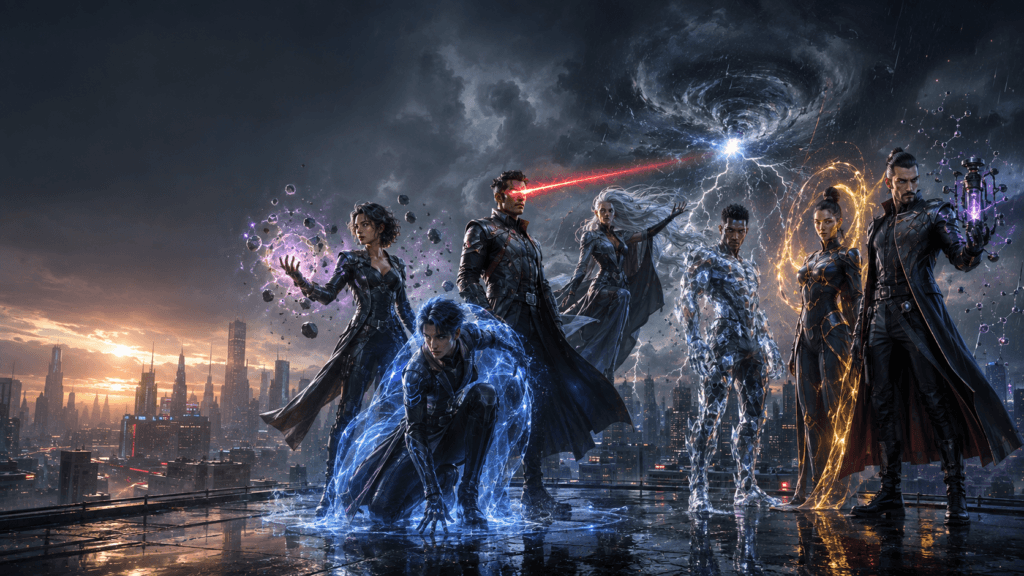
Marvel Studios has finally pulled back the curtain on one of its most closely watched projects: the new X-Men movie. After years of speculation, casting rumors, and questions about how mutants would fit into the Marvel Cinematic Universe, the studio used its 2026 D23 presentation to reveal a substantial portion of the new team.
The announcement gives fans a much clearer picture of Marvel’s direction. Rather than continuing the Fox-era continuity, the studio is building a fresh generation of mutants with a new group of actors. The confirmed lineup includes Sadie Sink as Jean Grey, Kit Connor as Cyclops, Christopher Abbott as Professor Charles Xavier, Samara Weaving as Emma Frost, Inde Navarrette as Rogue, Maya Boyd as Storm, and Adam Driver as Mr. Sinister.
The reveal is especially significant because Marvel has treated the project with unusual secrecy. For months, individual casting reports appeared without a complete picture of the team. Some rumored names eventually changed, while several character assignments remained uncertain. Now, the basic foundation is much easier to understand.
The new X-Men movie is being directed by Jake Schreier, who previously worked with Marvel on Thunderbolts. The screenplay has also gone through another creative stage, with Lee Sung Jin and Joanna Calo developing a new draft alongside Schreier’s vision.
That combination suggests Marvel is not simply trying to recreate the previous movies. Instead, the studio appears to be looking for a more character-focused starting point for its mutants.
And that could be the most important part of this entire reboot.
X-Men Cast: Who Is Playing Which Character?
The newly revealed X-Men cast is a mixture of established performers, rising stars, and actors who are still relatively early in their careers.
| Actor | Character | Why the Casting Matters |
|---|---|---|
| Sadie Sink | Jean Grey | A major young star already connected to the MCU |
| Kit Connor | Cyclops | Brings a younger interpretation to the team’s field leader |
| Christopher Abbott | Professor Charles Xavier | Gives Xavier a more grounded dramatic presence |
| Samara Weaving | Emma Frost | Adds an experienced genre performer to the mutant lineup |
| Inde Navarrette | Rogue | One of the more unexpected casting choices |
| Maya Boyd | Storm | A major breakout opportunity for a new performer |
| Adam Driver | Mr. Sinister | Gives Marvel a heavyweight actor for a major mutant antagonist |
The announcement also makes clear that this is not necessarily the complete roster. Forbes noted that other characters and actors remain unconfirmed, including longstanding speculation surrounding Beast.
That distinction matters. Marvel has a huge library of mutant characters, and the first movie does not need to introduce every familiar face at once.
Instead, the studio can establish a smaller central group and gradually expand the world.
That approach would also give Marvel room to introduce characters such as Beast, Iceman, Mystique, Nightcrawler, Wolverine, or other mutants in later stories without overcrowding the first film.
Sadie Sink as Jean Grey
Sadie Sink may be the most important casting choice in the new X-Men project because Marvel has already used her connection to the mutant world.
Sink plays Jean Grey, one of Marvel’s most recognizable mutants. Her casting also follows her appearance in Spider-Man: Brand New Day, giving the MCU a direct way to introduce audiences to this new generation.
Her involvement in Spider-Man: Brand New Day also gives readers another point of connection between Marvel’s current projects. If you want to explore that movie in greater detail, our Spider-Man: Brand New Day review covers its story, cast, ending, and overall verdict.
The decision is strategically interesting because Jean is not simply another member of the team. Her abilities, relationships, and eventual connection to the Phoenix mythology make her one of the franchise’s most consequential characters.
However, Marvel does not need to immediately make Jean’s story about the Phoenix.
Starting with Jean as a young mutant allows the studio to establish her personality, friendships, fears, and relationship with Xavier before escalating her powers. That could make future developments feel more earned.
Sink has also previously spoken about the appeal of introducing a younger generation of mutants, describing that direction as a smart choice for the franchise.
That youthful approach appears to be one of the defining characteristics of Marvel’s reboot.
Kit Connor as Cyclops
Kit Connor takes on the role of Scott Summers, better known as Cyclops.
That is another particularly important choice because Cyclops is traditionally much more than the character who fires energy beams from his eyes. In many X-Men stories, Scott functions as the team’s disciplined field leader and one of Xavier’s most trusted students.
His relationship with Jean Grey can also become a major emotional thread.
Connor’s casting gives Marvel an opportunity to present Scott as a younger leader who is still learning how to control both his powers and his responsibilities. That creates room for character development instead of immediately presenting him as an already established superhero.
It also fits the broader idea that this version of the X-Men will begin with characters who are still discovering what it means to live as mutants.
X-Men Reboot Has a Different Creative Starting Point
One of the most intriguing aspects of Marvel’s new X-Men movie is the creative philosophy behind it.
The project has already moved through multiple stages of development. Michael Lesslie was previously hired to write the screenplay, but director Jake Schreier later confirmed that Lee Sung Jin and Joanna Calo were working on a new draft.
That writing team is particularly notable because Schreier, Sung Jin, and Calo have already collaborated in the Marvel ecosystem.
Sung Jin created Beef, while Calo is closely associated with The Bear. Their involvement points toward a storytelling approach that can place greater emphasis on character relationships, personal conflict, and emotional consequences.
That could be exactly what the franchise needs.
The X-Men have always been capable of supporting enormous action sequences, but their strongest stories often work because the characters feel different from one another. Their personalities, beliefs, friendships, rivalries, and experiences with discrimination create conflicts that cannot be solved simply by defeating a villain.
Recent comments from Sung Jin have reinforced that philosophy. He has described the new approach as putting the characters first and exploring the experience of feeling different or excluded before building toward larger plot stakes.
That philosophy could make the reboot feel distinct from a conventional superhero origin story.
Why Marvel Is Starting the X-Men Over
Marvel’s decision to recast the X-Men is bigger than simply finding new actors.
The Fox franchise produced several successful films and created iconic performances, particularly through actors such as Patrick Stewart, Ian McKellen, Hugh Jackman, and others. At the same time, the series developed multiple timelines and continuity problems over the years.
Marvel Studios now has the opportunity to establish its own version of mutant history.
The timing is also important. Marvel’s earlier multiverse projects have allowed the studio to bring back performers from the Fox films. Marvel’s own Avengers: Doomsday material has already highlighted the return of classic X-Men characters, including Patrick Stewart’s Professor X, Ian McKellen’s Magneto, and James Marsden’s Cyclops.
However, those appearances do not necessarily mean the old actors will lead Marvel’s long-term X-Men franchise.
Instead, the multiverse can serve as a bridge between eras.
That gives Marvel an unusual advantage. The studio can acknowledge the cultural importance of the previous movies while still creating a completely new continuity for its future mutant stories.
The new X-Men therefore does not have to erase what came before. It can build on the audience’s familiarity while moving the characters into a new phase.
And with a younger core cast, Marvel appears to be planning for the franchise to last well beyond a single movie.
X-Men Cast Adds Christopher Abbott as Professor X
Christopher Abbott’s casting as Charles Xavier may be one of the most consequential decisions in Marvel’s new X-Men lineup. The actor will take over the role previously associated with Patrick Stewart and James McAvoy in the Fox films. Marvel confirmed Abbott as Professor X during its D23 presentation alongside the rest of the initial cast.
Xavier is more than a mentor. He is the philosophical center of most versions of the X-Men. His belief that mutants and humans can coexist peacefully often puts him in conflict with characters who see the world in much harsher terms.
Abbott’s background makes the casting particularly intriguing. Rather than choosing an actor known primarily for traditional blockbuster roles, Marvel has selected a performer with a strong reputation for dramatic and psychologically complex characters.
That could allow this Xavier to feel different from earlier versions.
The new Professor X may begin as someone trying to understand a rapidly changing mutant population rather than as the fully established leader audiences already know. If Marvel follows the younger-generation approach associated with the new cast, Xavier could become a character who is still building his school, refining his philosophy, and learning how much responsibility he should place on young mutants.
His relationship with Jean Grey and Cyclops could therefore become one of the emotional foundations of the movie.
Most importantly, Abbott’s Xavier gives Marvel a clean starting point. The studio can retain the essential qualities of Charles Xavier without being required to repeat Stewart’s interpretation.
Samara Weaving Brings Emma Frost Into the X-Men
Samara Weaving’s Emma Frost adds another layer of complexity to the reboot. Emma is traditionally associated with extraordinary telepathic abilities, a diamond-like transformed body, elite social circles, and the Hellfire Club.
She is also one of the most morally complicated characters connected to the mutant world.
That makes her especially useful for Marvel.
Emma does not always fit comfortably into the hero-or-villain categories. Depending on the story, she can act as an adversary, manipulator, teacher, ally, or reluctant protector. Marvel’s decision to place her in this first wave of characters suggests that the studio may want its mutant world to contain competing factions rather than one simple battle between heroes and villains.
Weaving is also an interesting choice because she can shift between charm and menace without making the character feel one-dimensional.
For readers who want a closer look at the casting reports surrounding the character, our earlier coverage of Samara Weaving’s Emma Frost casting explores what her role could mean for Marvel’s mutant franchise.
The casting could become particularly important if Emma has connections to the Hellfire Club or to Xavier’s young students. However, Marvel has not publicly confirmed the exact extent of her role, so theories about her relationships should remain speculation rather than established plot information.
What is confirmed is enough to make Emma one of the reboot’s most fascinating pieces. She gives the X-Men story a character who can challenge Xavier intellectually while also complicating the team’s understanding of mutant power and privilege.
X-Men Cast Introduces Inde Navarrette as Rogue
Inde Navarrette has been confirmed as Rogue, adding one of the most recognizable mutant characters to Marvel’s new X-Men universe.
Rogue has a particularly unusual power set. Her ability to absorb another person’s powers, memories, and aspects of their physical experience through touch can make ordinary human contact dangerous. That creates an immediate source of emotional conflict that does not depend on a supervillain.
This is where Rogue can become more than a supporting character.
A young Rogue struggling to control her abilities could embody one of the central ideas behind the franchise: what happens when something that makes you extraordinary also prevents you from living normally?
Her powers can also create natural relationships with other members of the team. She could form a strong friendship with Jean or Storm while developing a complicated connection with Xavier, whose school could provide her with a place where she does not have to hide.
At the same time, Rogue’s comic history gives Marvel plenty of material for future stories. Her complicated relationship with Carol Danvers is particularly famous, although there is no confirmation that Marvel will reproduce that storyline in this reboot.
The smart approach would be to let Rogue develop gradually.
Rather than immediately turning her into a fully confident superhero, Marvel can make her journey part of the audience’s introduction to mutant society.
That would fit the broader character-first direction being associated with the new movie.
Maya Boyd Takes on Storm
Maya Boyd will portray Ororo Munroe, better known as Storm. The character is one of the most powerful and recognizable members of the X-Men, with the ability to manipulate weather.
Boyd is a newer name compared with several members of the cast, making the role a major opportunity. Marvel has not yet revealed how much Storm will factor into the first movie’s central storyline, but her inclusion signals that the studio is already thinking beyond a team built around only Jean, Scott, and Xavier.
Storm can also give the MCU a very different kind of mutant hero.
In many comic stories, Ororo develops into a natural leader. She can command attention without needing to be the loudest person in the room, and her powers make her capable of extraordinary visual sequences.
However, the character works best when her personal history receives equal attention.
If Marvel gives Storm time to establish her identity before turning her into a major powerhouse, Boyd could help create a version of Ororo that feels distinct from Halle Berry’s earlier portrayal.
Her presence also strengthens the idea that Marvel is building a long-term ensemble rather than designing the film around one central protagonist.
Adam Driver’s Mr. Sinister Changes the X-Men Villain Equation
Adam Driver’s casting as Nathaniel Essex, better known as Mister Sinister, may be the biggest surprise in Marvel’s new X-Men announcement.
Unlike a villain who simply wants to destroy the team, Mister Sinister is deeply connected to mutation, genetics, experimentation, and the manipulation of mutant biology. Marvel has confirmed Driver for the role and positioned the character as the film’s antagonist.
That choice immediately creates several possibilities.
Sinister could be interested in Jean Grey, Scott Summers, Rogue, or other mutants because of their genetic abilities. However, the exact story has not been revealed, so it would be premature to assume which characters will become his specific targets.
What makes Driver particularly exciting is the actor’s ability to play controlled intensity. Mister Sinister can be theatrical and unsettling, but he can also appear intelligent and calculating. Driver’s performance could therefore avoid making the villain feel like another generic CGI-heavy Marvel antagonist.
His presence also gives the movie a potential scientific dimension.
If Xavier represents one approach to understanding mutation, Sinister could represent another: treating mutants as biological subjects rather than people.
That philosophical contrast could create a stronger conflict than a straightforward hero-versus-villain battle.
It also opens the door to one of the X-Men franchise’s most important themes: whether extraordinary genetic differences should be celebrated, feared, controlled, or exploited.
Why Mister Sinister Could Be a Long-Term Threat
Marvel does not necessarily need to use Mister Sinister as a villain who disappears after one movie.
His comic history gives the studio opportunities to build a larger mystery around him. The character’s interest in genetics can connect naturally with future mutant stories, especially as Marvel introduces more members of its enormous mutant population.
That makes Driver’s casting potentially important beyond the first film.
There is also an interesting contrast between Sinister and Xavier. Xavier wants to guide mutants toward coexistence and community, while Sinister’s obsession with mutant biology can push the story toward experimentation and control.
If Marvel develops that conflict carefully, the movie could make its villain relevant to the same themes that define its heroes.
And because the studio has confirmed only the basic casting information, audiences still do not know exactly how closely this version will follow the comics.
That uncertainty is useful.
It allows Marvel to borrow the character’s core mythology while creating a new cinematic interpretation.
For a franchise that has already gone through multiple versions, that flexibility could be one of the reboot’s biggest advantages.
X-Men Release Date: When Will Marvel’s Reboot Arrive?
The new X-Men movie is currently expected to arrive in theaters in May 2028. That puts the reboot after Marvel’s two major Multiverse Saga event movies, Avengers: Doomsday and Avengers: Secret Wars. Current reporting identifies May 2028 as the target window for the new mutant team’s theatrical debut.
That timing could be extremely important.
Marvel does not appear to be rushing the X-Men into theaters immediately after its casting announcement. Instead, the studio has several major crossover events positioned before the standalone reboot. This gives Marvel room to introduce or develop mutant-related characters without requiring the first X-Men movie to explain everything at once.
For comparison, Avengers: Doomsday is officially scheduled for December 18, 2026, while Marvel’s larger crossover plans continue into Avengers: Secret Wars in 2027. Disney describes Doomsday as a story involving heroes from three distinct universes facing a major existential threat.
That creates an unusual situation for the reboot.
Audiences may meet versions of the X-Men before the new team receives its own movie. However, Marvel can still treat the 2028 film as the beginning of its long-term MCU mutant story.
The result could be a transition between two generations rather than a simple replacement.
Why the 2028 X-Men Timing Makes Sense
A 2028 release gives Marvel enough breathing room to establish its new characters carefully.
The studio also has an opportunity to learn from the audience response to Doomsday and Secret Wars. Those movies can establish what happens to the existing multiverse, while the standalone X-Men movie can focus on what comes afterward.
That distinction matters because Marvel has already shown that it wants the mutant mythology to become part of its future rather than remain a short-term crossover gimmick.
The long development period can also benefit the younger cast.
Actors such as Sadie Sink and Kit Connor could potentially remain connected to the franchise for years. That matters for characters like Jean Grey and Cyclops, whose stories can evolve significantly as the team grows.
Instead of introducing fully developed heroes, Marvel appears to be starting with characters who have room to mature.
That approach could give the new X-Men franchise a natural progression:
- First: introduce mutants and establish the team’s relationships.
- Then: expand the mutant population and political conflict.
- Later: introduce larger threats and deeper comic-book mythology.
- Eventually: connect the team to the wider MCU on an even larger scale.
The studio therefore has the opportunity to build a mutant saga rather than simply make one superhero movie.
X-Men and Avengers: Doomsday Could Connect Two Eras
The relationship between the new X-Men and Avengers: Doomsday is one of the biggest questions surrounding Marvel’s current plans.
The growing importance of Avengers: Doomsday also makes Doctor Doom a key part of the MCU conversation. For more background, our guide to Doctor Doom and Avengers: Doomsday explores the character’s history, powers, and importance to Marvel’s next major crossover.
The connection is complicated because Doomsday includes several actors from the original Fox X-Men films. Marvel’s official cast information lists Patrick Stewart as Professor Charles Xavier, Ian McKellen as Magneto, James Marsden as Cyclops, Kelsey Grammer as Beast, Alan Cumming as Nightcrawler, Rebecca Romijn as Mystique, and Channing Tatum as Gambit.
Meanwhile, Marvel’s new standalone movie introduces completely different actors for several of those characters.
That is not necessarily a contradiction.
The multiverse gives Marvel a way to separate the two groups.
The older actors can represent one universe or version of mutant history, while the new cast establishes the long-term MCU incarnation. Doomsday is explicitly built around heroes from different universes colliding, according to Disney’s official description.
This means Marvel can celebrate its previous X-Men movies without forcing the new franchise to continue their continuity.
It is essentially a bridge between eras.
What Secret Wars Could Change for the X-Men
Avengers: Secret Wars could become even more important.
Marvel has not publicly explained every detail of how its post-Multiverse Saga continuity will work, so specific theories should be treated carefully. Still, the positioning of Doomsday, Secret Wars, and the new X-Men movie creates an obvious narrative possibility.
The multiverse could provide the mechanism for Marvel to reorganize its superhero universe.
If that happens, the new X-Men could emerge into a world where mutants are no longer treated as outsiders to the MCU’s main superhero community.
That would eliminate one of the biggest problems Marvel faces with the franchise: explaining why mutants were largely absent from decades of MCU history.
A post-Secret Wars status quo could make that explanation much easier.
However, Marvel does not need to erase everything.
The studio could preserve selected multiverse events while creating a new reality in which mutants have always existed. Alternatively, it could introduce mutants gradually and explain their growing visibility through the changing MCU.
Either way, the X-Men have an enormous advantage: Marvel can use the multiverse as a storytelling tool without making the new movie dependent on it.
X-Men Story: Marvel Is Putting Characters Before Spectacle
Perhaps the most revealing information about the new X-Men comes from the writers themselves.
Lee Sung Jin has indicated that the creative team wants to approach the reboot with a strong emphasis on characters and the feeling of being different from the world around you. He has also discussed the importance of the team dynamics associated with classic X-Men comics.
That could distinguish the new film from a typical superhero origin story.
The X-Men concept works because its characters do not all agree.
Cyclops may believe in discipline. Jean may struggle with the scale of her abilities. Rogue may fear physical contact. Storm may develop into a natural leader. Emma Frost may question Xavier’s methods. Xavier himself may believe strongly in coexistence while making controversial decisions.
Those differences create drama before the villains even arrive.
The first movie can therefore spend time showing the characters learning how to operate together.
That is particularly useful for a younger team.
A group of inexperienced mutants does not need to immediately function like the Avengers. They can make mistakes, disagree, lose control of their abilities, and gradually develop trust.
This gives the audience a reason to care about the team before the stakes become enormous.
The Human Side of the X-Men Could Matter Most
The mutant metaphor has always been central to the franchise.
Mutants can represent people who feel excluded because of something they cannot change. However, Marvel’s new movie does not need to turn that idea into a simple political lecture.
The stronger approach would be to show the theme through individual experiences.
Rogue’s fear of touching people can communicate isolation without requiring a long explanation.
Jean’s increasing powers can create anxiety about losing control.
Cyclops can struggle with leadership.
Storm can wrestle with belonging.
Xavier can face the responsibility of protecting young people while asking them to participate in dangerous conflicts.
Even Emma Frost can challenge the team’s assumptions about what mutant identity means.
This is why a character-first approach could work so well.
The audience does not have to be told what the characters represent. Their experiences can demonstrate it naturally.
That could make the new X-Men feel emotionally grounded even when the story eventually becomes enormous.
X-Men Villain Mister Sinister Could Tie the Characters Together
Mister Sinister also fits naturally into this character-focused approach.
His interest in mutant genetics gives Marvel a villain who can threaten the team without simply attacking a city. He can target what makes the characters unique.
That distinction is important.
A conventional supervillain might want to conquer the world. Sinister can want something much more personal: the biological potential of mutants.
That makes his conflict with Xavier’s students potentially disturbing on a different level.
Instead of seeing mutants as people, he could see them as material.
This creates a direct thematic clash with Xavier.
Charles wants mutants to understand themselves and find a place in society. Sinister can represent the opposite philosophy, reducing mutation to experimentation and genetic potential.
Jean, Cyclops, Rogue, and Storm could therefore become important to the story for reasons beyond their superhero abilities.
Their individual mutations may be part of what makes them valuable to Sinister.
Marvel has not confirmed the exact plot, so those connections remain possibilities rather than established facts. Still, the character selection makes this kind of story plausible.
Adam Driver’s casting also gives Marvel the chance to make Sinister more than a visual-effects villain.
If the performance emphasizes intelligence, obsession, and manipulation, the character could become a recurring threat rather than a one-film obstacle.
What the New X-Men Cast Says About Marvel’s Long-Term Plans
The biggest takeaway from the casting announcement is not any single actor. It is the structure of the team.
Marvel has chosen a relatively young central group while surrounding them with performers who can bring considerable dramatic experience. That combination gives the studio flexibility.
The broader MCU is also continuing to introduce new versions of familiar Marvel properties. Readers interested in another upcoming Marvel project can explore our coverage of Ghost Rider’s MCU future and Ryan Gosling’s reported role.
The younger characters can grow with the franchise, while actors such as Christopher Abbott, Samara Weaving, and Adam Driver can provide mature counterpoints.
The lineup also avoids relying exclusively on characters audiences already associate with previous movies.
That is important.
The new X-Men should feel like Marvel’s version rather than Fox’s franchise continued under a different logo.
At the same time, Marvel is not abandoning the characters that made the property successful. Jean Grey, Cyclops, Storm, Rogue, Xavier, and Emma Frost are all familiar names, while Mister Sinister gives the reboot a villain who has not previously received the same level of live-action attention.
That balance could be the key to the entire project.
Marvel needs enough familiarity to attract longtime fans.
But it also needs enough change to make the reboot feel necessary.
The current cast suggests the studio understands that distinction.
X-Men and Wolverine: Is Logan Part of the New Team?
One of the biggest questions surrounding the new X-Men movie is also one of the simplest: where is Wolverine?
So far, Marvel has not announced a new actor as Logan for the reboot’s main cast. That omission is important because Wolverine has traditionally been one of the most recognizable faces of the franchise.
However, Marvel does not necessarily need Wolverine in the first movie.
The character already has an enormous cinematic legacy through Hugh Jackman’s portrayal. More importantly, Deadpool & Wolverine demonstrated that Jackman’s version can exist within Marvel’s larger multiverse. The upcoming Avengers: Doomsday also brings back several performers from the original Fox-era X-Men films.
That gives Marvel a good reason to keep Logan separate from the first new team.
If Wolverine appeared immediately, audiences might naturally compare the new X-Men to the previous movies instead of becoming invested in Jean Grey, Cyclops, Storm, Rogue, and the rest of the new group.
Keeping Logan away, at least initially, could actually help the reboot establish its own identity.
Marvel has also shown through recent casting that it wants audiences to recognize the X-Men as a much larger universe rather than a story built around Wolverine alone.
That could make the eventual arrival of a new Logan feel like an event instead of an expectation.
Why Leaving Wolverine Out Could Be Smart
Wolverine has a complicated relationship with the X-Men.
He is often treated as the team’s most popular member, but he was not part of the original comic-book lineup. Characters such as Cyclops, Jean Grey, Beast, Angel, Iceman, and Professor X were central to the earliest team.
Marvel can therefore return to a more ensemble-focused structure.
That would give Cyclops genuine leadership responsibilities instead of making him the supporting character he sometimes became in earlier films.
It would also give Jean, Storm, Rogue, and Emma Frost more space to establish themselves.
A Wolverine-free first movie could ultimately make the character more valuable.
Marvel would have time to introduce Logan later, perhaps through a future sequel, an X-Force storyline, or another mutant-focused project.
Nothing currently confirms that plan, though. For now, the safest conclusion is simply that Wolverine has not been announced as part of the new movie’s confirmed cast.
X-Men Cast Still Leaves Room for Beast and Other Mutants
The confirmed seven-person lineup does not mean Marvel has finished revealing every character.
One of the most frequently discussed omissions is Beast. Previous reporting and rumors connected the character with the reboot, but Marvel’s official D23 announcement did not include an actor for Hank McCoy.
That distinction between confirmed information and speculation is important.
Beast would make sense for the movie because he combines scientific knowledge with a long history inside the X-Men. He could also create an interesting connection between the team’s younger members and Xavier’s more academic approach to mutation.
Yet Marvel may simply be saving additional casting announcements for later.
The same applies to characters such as Magneto, Mystique, Iceman, Angel, Nightcrawler, Gambit, Jubilee, Kitty Pryde, and Colossus. Their importance to the comics does not automatically mean they will appear in this first film.
Marvel has already demonstrated that the mutant universe can contain multiple generations and alternate versions of the same characters. Avengers: Doomsday is bringing several original Fox-era performers into the MCU, including Patrick Stewart, Ian McKellen, James Marsden, Kelsey Grammer, Alan Cumming, Rebecca Romijn, and Channing Tatum.
That makes it even more important for fans to separate confirmed casting from online speculation.
Could Magneto Still Appear?
Magneto is another major question.
The character is inseparable from many versions of the X-Men, and Ian McKellen’s return as Magneto in Avengers: Doomsday has already renewed interest in the character’s future.
However, Marvel has not announced a new Magneto actor for the standalone reboot.
That could mean several things.
The character might be deliberately absent from the first movie. He could appear later. Or Marvel could use the events surrounding Doomsday and Secret Wars to determine how mutant history works in the next phase of the MCU.
There is also a creative reason to delay him.
Mister Sinister already provides the first movie with a major antagonist whose interests are directly connected to mutation. Adding Magneto immediately could create too many competing ideas.
Marvel may therefore want the first X-Men film to establish Xavier’s philosophy before introducing his most famous ideological opponent.
That would allow Magneto’s eventual arrival to carry more weight.
X-Men Reboot vs. Fox: What Will Be Different?
The new X-Men movie faces an unusual challenge because audiences already have decades of live-action mutant stories to compare it with.
The original X-Men arrived in 2000 and helped demonstrate that superhero movies could become major theatrical franchises. The Fox series eventually expanded into sequels, prequels, Wolverine films, Deadpool, and other spin-offs.
However, the franchise also became difficult to follow because of shifting timelines and continuity changes.
Marvel now has the chance to simplify that history.
The new film can establish its own continuity without explaining every previous movie.
That is probably the biggest difference.
The reboot also appears to be starting with a younger central cast. Sadie Sink, Kit Connor, Maya Boyd, and Inde Navarrette can represent a new generation, while Christopher Abbott, Samara Weaving, and Adam Driver bring a more mature dramatic presence to the story.
That combination creates a different dynamic from the earlier films.
Instead of asking audiences to follow established superheroes, Marvel can show them becoming the X-Men.
The New Team Can Be More Than a Superhero Squad
Another major opportunity involves the team’s identity.
The Avengers generally come together because the world needs powerful heroes to stop a major threat. The X-Men can function differently.
Their central problem can exist before the villain appears.
They are mutants.
That means the characters can disagree about whether they should hide, integrate, fight back, educate others, or create their own communities.
Those disagreements can become the foundation of the franchise.
The result would be a team whose biggest conflicts are sometimes internal.
Cyclops may prioritize Xavier’s mission. Emma Frost may challenge his assumptions. Rogue may struggle with trust. Jean may fear her growing abilities. Storm may develop an independent vision of leadership.
That kind of tension can keep the franchise interesting even when no world-ending event is taking place.
X-Men Themes Could Become Marvel’s Biggest Strength
The strongest X-Men stories have rarely depended entirely on spectacle.
The franchise works because mutation creates personal questions.
What does it mean to be different?
Who decides whether a difference is dangerous?
Should mutants conceal their abilities?
Can humans and mutants truly coexist?
Should powerful mutants be regulated?
Should young mutants be trained or protected?
Those questions can create stories that feel larger than a conventional superhero battle.
Marvel’s reported character-first approach gives the new film an opportunity to explore those ideas without forcing every scene to explain the metaphor.
The best version of the reboot would let the themes emerge from the characters.
Rogue should not need a speech about isolation if her powers make physical contact frightening.
Jean should not need to explain the fear of losing control if her abilities gradually become difficult to manage.
Cyclops should not need a monologue about responsibility if leading the team forces him to make decisions that affect people he cares about.
That is how the X-Men can feel human before they feel superhuman.
Why the First Movie Should Stay Focused
Marvel could easily overload the reboot.
The mutant comics contain hundreds of characters, countless villains, several teams, alternate realities, and decades of mythology.
The first movie does not need all of it.
A smaller story could be much more effective.
Xavier could establish his school. The young mutants could discover their abilities. Mister Sinister could investigate their genetics. The team could slowly form while realizing that their existence has consequences beyond their own lives.
Then later movies could expand the mythology.
Magneto could become a major ideological opponent. Wolverine could enter the picture. More students could join Xavier’s school. The Hellfire Club could become important. The franchise could eventually explore Phoenix mythology, Sentinels, Genosha, or other major concepts.
The important thing is progression.
The reboot should make audiences want more X-Men, not attempt to deliver every famous storyline immediately.
What Marvel Needs to Get Right With the X-Men
The casting announcement gives Marvel a strong foundation, but the franchise still has several challenges.
First, the studio needs to make the characters feel distinct. Seven major characters should not become seven variations of the same sarcastic superhero personality.
Second, the movie needs to establish its own identity. Constant comparisons with Hugh Jackman’s Wolverine or Patrick Stewart’s Xavier could overwhelm the new cast.
Third, the villain needs a meaningful purpose. Mister Sinister should not simply provide an excuse for a final battle.
Finally, Marvel needs to trust the mutant concept.
The X-Men already have one of the richest worlds in superhero fiction. The studio does not need to manufacture complexity simply because it has access to the multiverse.
A grounded emotional story can be just as ambitious.
If Marvel succeeds, the new movie could become the foundation of a much larger mutant era.
And that is probably the most significant point about the current casting announcement.
This is not merely another superhero reboot.
It could be the beginning of Marvel’s next major franchise generation.
X-Men FAQ: What We Know So Far
Who is confirmed in the new X-Men movie?
Marvel has confirmed Sadie Sink as Jean Grey, Kit Connor as Cyclops, Christopher Abbott as Professor X, Samara Weaving as Emma Frost, Inde Navarrette as Rogue, Maya Boyd as Storm, and Adam Driver as Mister Sinister.
Who is directing the new X-Men movie?
Jake Schreier is directing the film. He previously directed Thunderbolts for Marvel Studios. The screenplay is being developed by Lee Sung Jin and Joanna Calo, following an earlier draft by Michael Lesslie.
Is Wolverine confirmed for the new X-Men movie?
No. Marvel has not announced a new Wolverine actor as part of the confirmed cast for the standalone reboot. Hugh Jackman’s Wolverine remains connected to Marvel’s multiverse through other projects, but that does not confirm his involvement in the new team.
Is Magneto confirmed?
Not as part of the newly announced standalone X-Men cast. Ian McKellen is, however, returning as Magneto in Avengers: Doomsday, according to Marvel’s announced cast.
Is Beast confirmed?
Marvel’s latest official cast announcement did not identify an actor as Beast. Earlier reports and rumors have discussed the character, but those should not be treated as confirmed casting.
When is the new X-Men movie expected?
The reboot is currently targeting May 2028 for its theatrical release. The exact release date should be treated as subject to change until Marvel or Disney confirms the final schedule.
Will the new X-Men connect to Avengers: Doomsday?
The wider mutant story is clearly connected to Marvel’s multiverse plans, while Avengers: Doomsday includes several returning Fox-era X-Men actors. However, Marvel has not publicly explained every connection between those characters and the new standalone team.
Is this a continuation of the Fox X-Men movies?
The new movie is being developed as Marvel Studios’ own X-Men reboot rather than a direct continuation of the Fox series. The multiverse allows Marvel to bring back previous performers while creating a separate long-term version of the characters.
Final Take: The New X-Men Era Has Finally Begun
Marvel’s D23 casting reveal answers one of the biggest questions surrounding the MCU’s future.
The X-Men are no longer simply a rumored Marvel project. The studio has now established the core of its new team.
Sadie Sink’s Jean Grey, Kit Connor’s Cyclops, Christopher Abbott’s Professor X, Samara Weaving’s Emma Frost, Inde Navarrette’s Rogue, Maya Boyd’s Storm, and Adam Driver’s Mister Sinister give the reboot a surprisingly distinctive foundation.
Just as importantly, Marvel appears to be resisting the temptation to make Wolverine the center of everything.
That could be the smartest decision of all.
The X-Men have always been bigger than one character. Their strength comes from the relationships between mutants who see the world differently but are forced to work together.
If Marvel allows those relationships to drive the story, the reboot could establish a new mutant generation without simply repeating the past.
The road to the 2028 movie is still long, and plenty of details remain unknown. More casting announcements could change the picture. Additional information about the story, Magneto, Beast, Wolverine, and the relationship with Avengers: Secret Wars will likely emerge as production moves forward.
For now, though, the direction is becoming clear.
Marvel is building a younger, character-driven X-Men team designed not merely to revisit an old franchise, but to make mutants a central part of the MCU’s next era.