
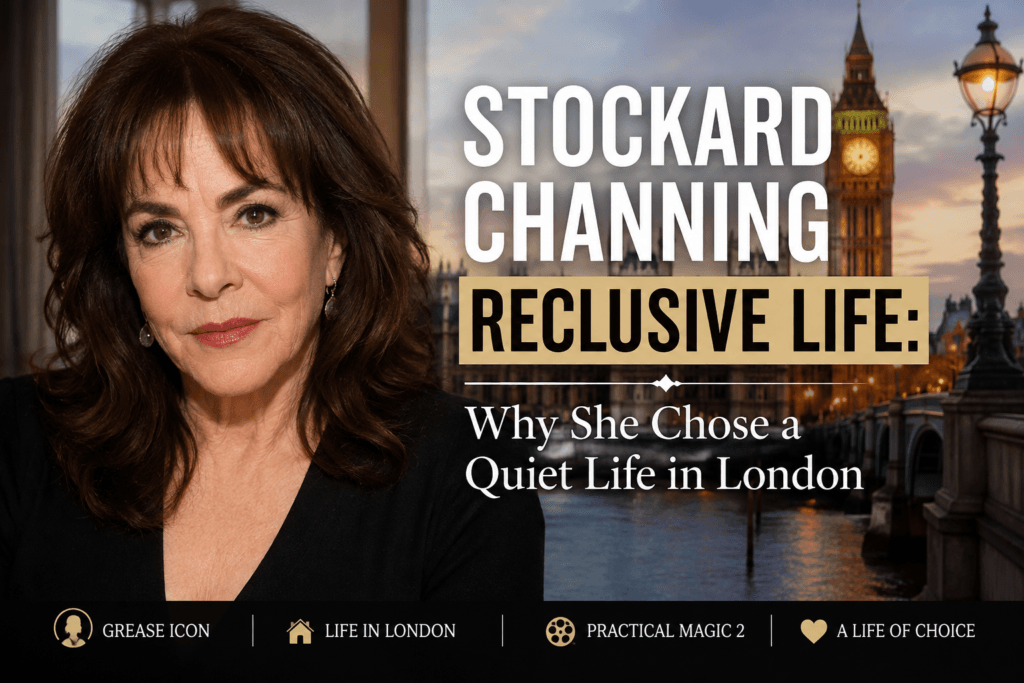
Stockard Channing has spent decades in the public eye. From her unforgettable performance as Rizzo in Grease to her award-winning work on stage and television, she built a career that reached far beyond one famous role. Yet in 2026, many fans are discovering a very different side of the actress.
The phrase Stockard Channing reclusive life has attracted renewed attention after the actress opened up about how she lives today. At 82, Channing has chosen a quieter existence in London, away from the constant attention that often comes with Hollywood fame. However, her private lifestyle does not mean she has completely stepped away from creative work.
In fact, she remains active in theater and is preparing to return as Aunt Frances Owens in Practical Magic 2. She has also taken on a new challenge as a director.
So, why does Channing describe herself as a recluse? And what changed after the death of her longtime partner, Daniel Gillham?
The answer involves grief, personal choice, aging, fame and a desire to live on her own terms.
Stockard Channing reclusive life is quieter, not completely isolated
When people hear the word “reclusive,” they may imagine someone who has disappeared entirely from public life. That description does not fit Channing very well.
She has certainly reduced her exposure to celebrity culture. However, she still works, gives occasional interviews and participates in theater. More importantly, her latest professional choices show that she remains interested in creative projects.
Channing has spoken openly about living alone since the death of Gillham. She has also said that she is happy with a more secluded lifestyle. Recent reporting from The Times describes her current routine in London as deliberately quiet and reflective.
That distinction is important.
A private life is not automatically an unhappy life. Likewise, living alone does not necessarily mean someone has no friends, interests or meaningful relationships.
For Channing, solitude appears to be something she has accepted — and, to some extent, chosen.
After spending much of her professional life surrounded by actors, directors, producers, journalists and audiences, she now seems comfortable with fewer distractions.
That may be one reason her current story has resonated with so many people.
Stockard Channing reclusive life took shape after a devastating loss
A major turning point came with the death of Daniel Gillham in 2014.
Gillham was a cinematographer, and he had been Channing’s longtime partner for more than two decades. Their relationship began in 1990 after they met through their professional lives. His death had a lasting effect on Channing, although she has explained that she did not immediately understand just how deeply it would change her life.
Grief can change a person’s relationship with familiar places and routines.
That appears to have happened to Channing.
She eventually left Maine and moved to London. The relocation came several years after Gillham’s death and represented more than a change of address. It marked a new phase in her life.
Channing has described the loss as having a delayed impact. Rather than making one dramatic decision immediately, she gradually realized that the life she had been living no longer felt the same.
As a result, she changed her surroundings too.
That is an important part of understanding Stockard Channing reclusive life today. Her privacy did not appear out of nowhere. It developed alongside a major personal transition.
The move also gave her distance from the environment in which much of her earlier life had unfolded.
Why Stockard Channing moved from Maine to London
Channing has lived in London since 2019, according to recent reporting. Her decision to relocate was connected to the changes in her personal life after Gillham’s death. At the same time, the move roughly coincided with a period of political change in the United States that also influenced how she viewed her surroundings.
However, it would be too simple to describe London as an escape. The city also makes sense professionally.
Channing’s move also reflects how some celebrities choose to leave familiar surroundings and embrace a new chapter, much like Diane Farr’s decision to leave Los Angeles after 30 years.
Channing has always maintained a strong connection to theater. London offers an enormous theatrical culture, with actors, directors and productions operating across the city and beyond. That gives her an opportunity to remain connected to the arts without living inside the Hollywood publicity machine.
In other words, London provides an interesting balance.
She can maintain a private daily life while remaining close to the kind of creative work she has valued throughout her career.
That balance appears particularly important now.
Channing no longer needs constant exposure to remain relevant. Her career has already established her place in entertainment history.
She can therefore approach work selectively.
Stockard Channing reclusive life does not mean she has stopped working
One of the biggest misconceptions surrounding Channing’s current lifestyle is the idea that she has completely retired.
Her recent activities tell a different story.
In 2026, she is involved with Krapp’s Last Tape at the Edinburgh Festival Fringe, where she is making her directorial debut. The project gives her a chance to explore theater from behind the scenes rather than simply performing in front of an audience.
That is a significant detail.
Someone who had truly abandoned creative work would not necessarily be taking on a new artistic role at this stage of life.
Channing is doing something different instead.
She is becoming more selective about how she spends her time.
She is also returning to one of her most recognizable film worlds.
In Practical Magic 2, she reprises her role as Aunt Frances Owens alongside Dianne Wiest, Sandra Bullock and Nicole Kidman. The sequel is scheduled for a September 11, 2026, U.S. release.
That makes her current situation more complicated — and more interesting — than a simple retirement story.
She has stepped away from the spotlight without stepping away from creativity.
The difference between being private and being “reclusive”
The growing interest in Stockard Channing reclusive life also raises a larger question: what does “reclusive” actually mean when it comes to a celebrity?
For Channing, the term seems to describe her lifestyle more than her entire existence.
She is not constantly attending Hollywood events.
She does not appear interested in maintaining a celebrity persona.
She spends much of her time away from public attention.
Yet she can still take on a play, direct a production or return to a beloved movie franchise.
Those things are not contradictory.
In fact, they may reflect a deliberate boundary between Channing the performer and Channing the private person.
That boundary can be difficult for modern celebrities to maintain. Social media has made public figures far more accessible than previous generations of actors ever were.
Channing belongs to an earlier Hollywood era, when an actor could finish an interview and then disappear from public view until the next project.
Her current lifestyle may therefore feel unusual today, but it is not necessarily mysterious.
She appears to have reached a point where being famous does not mean being constantly available.
And perhaps that is the most revealing part of her story.
After decades of performing for audiences, Stockard Channing seems comfortable deciding when the audience gets to see her — and when it does not.
Stockard Channing Reclusive Life: The Career Behind the Quiet Years
To understand Stockard Channing reclusive life, it helps to look beyond the headlines about privacy.
Channing’s decision to live quietly today becomes much easier to understand when her entire career is considered. She was never an actress who depended on one medium. Instead, she moved between theater, film and television for decades.
That flexibility became one of her defining strengths.
While millions of viewers remember her as Betty Rizzo from Grease, her professional identity extends far beyond the 1978 musical. She built a serious stage career, earned major recognition for Six Degrees of Separation, and later became a familiar television presence through The West Wing.
In fact, the variety of her work may explain why she can now afford to be selective.
She has already experienced the different sides of the profession. She knows what it means to become famous, to receive critical recognition, to work on Broadway and to become part of a major television series.
As a result, she does not need to chase visibility simply to prove that she still belongs in the entertainment industry.
Her career has already made that case.
Stockard Channing Reclusive Life Began With a Career Built on Theater
Long before audiences knew her as Rizzo, Channing was developing her skills on stage.
Theater became an important foundation for her career. She performed in productions before establishing herself as a major film and television actress, and that stage experience remained part of her professional identity throughout the decades that followed.
That background is important because it explains something about Channing’s acting style.
She was never simply a movie star.
She was a performer who could move between different forms of storytelling.
The stage demanded discipline, timing and concentration. Film required a different level of subtlety. Television added another challenge because performers had to develop characters across longer narratives.
Channing worked in all three environments.
Therefore, her career cannot easily be reduced to the success of Grease.
Her theater work continued to give her opportunities to play complicated characters, while film and television introduced her to much larger audiences.
That balance remained visible throughout her career.
The Role of Rizzo Changed Stockard Channing’s Public Image
Then came Grease.
Released in 1978, the musical became a cultural phenomenon, and Channing’s portrayal of Betty Rizzo turned her into one of its most recognizable faces.
Rizzo was not a straightforward heroine.
She was sarcastic, defensive and confident on the surface. At the same time, the character had moments of vulnerability that gave her more emotional depth.
That complexity helped Channing stand out.
However, the success also created a problem familiar to many actors: audiences began associating the performer with one character.
For Channing, that character happened to be one of the most recognizable teenagers in movie history.
There was another unusual detail. Channing was already in her thirties when she played the high-school student, something that made the casting particularly distinctive in retrospect.
Yet she did not allow Rizzo to become the end of her story.
Instead, she kept moving.
That decision became one of the most important choices of her career.
Stockard Channing Reclusive Life Makes More Sense After Her Theater Comeback
After Grease, Channing continued working in film and television. However, the stage remained a place where she could escape the expectations created by her movie fame.
That proved especially valuable.
Rather than repeatedly trying to recreate the popularity of Grease, she pursued challenging dramatic material.
One of the biggest examples came with A Day in the Death of Joe Egg.
Her Broadway performance earned her the Tony Award for Best Actress in a Play in 1985.
The achievement mattered because it reinforced her credibility as a serious theater performer.
She was no longer simply the actress audiences remembered from a hit musical.
She was an award-winning stage performer with a career that could stand on its own.
That distinction followed her for years.
Theater Gave Her a Different Kind of Creative Freedom
There is a reason Channing repeatedly returned to theater.
The stage allowed her to work on material that could be more demanding than the roles offered to a commercially successful movie actress.
She could experiment.
She could take risks.
She could perform a character night after night and discover new details along the way.
That process requires patience.
It also creates a different relationship between actor and audience.
A film performance becomes fixed once the movie is completed. A stage performance remains alive.
Each night can feel slightly different.
For an actress with Channing’s background, that kind of unpredictability has obvious appeal.
It also helps explain why theater remains part of her professional life even now.
Stockard Channing Reclusive Life and Six Degrees of Separation
If Grease made Channing famous, Six Degrees of Separation demonstrated just how far she could go as a dramatic performer.
The play, written by John Guare, gave Channing the role of Ouisa Kittredge.
Ouisa was very different from Rizzo.
She belonged to a wealthy New York world and became involved in a strange encounter with a young man who claimed connections to the famous actor Sidney Poitier.
The story explored class, identity, privilege and deception.
Channing’s performance attracted significant critical attention.
The original stage production opened in 1990, and Channing received an Obie Award for her work. She later reprised Ouisa for the 1993 film adaptation.
That transition from stage to screen was particularly important.
She was not simply adapting a familiar character.
She was bringing a complex theatrical performance to a different medium.
The result earned her an Academy Award nomination for Best Actress.
That recognition changed how many people viewed her career.
Suddenly, the actress known internationally for a musical comedy had also become an Oscar-nominated dramatic performer.
Why Ouisa Remains One of Her Most Important Roles
Ouisa demonstrated Channing’s ability to make complicated people feel believable.
The character could be privileged without becoming completely unsympathetic.
She could be humorous while also revealing uncomfortable truths about herself.
That balance is one of Channing’s strongest acting qualities.
She rarely plays characters as simply good or bad.
Instead, she tends to find the contradictions.
That approach became particularly effective in Six Degrees of Separation.
It also became useful later when she moved into television.
Stockard Channing Reclusive Life and The West Wing
By the end of the 1990s, Channing had already established herself across several generations of entertainment.
Then television gave her another defining role.
In 1999, she joined The West Wing as Abigail “Abbey” Bartlet, the wife of President Jed Bartlet, played by Martin Sheen.
The series became one of the most acclaimed political dramas of its era.
Channing’s character initially appeared in a smaller capacity. However, Abbey Bartlet quickly became important to the show’s larger story, and Channing became a regular presence.
This was another major transformation.
Rizzo had been rebellious and sharp.
Ouisa had been sophisticated and emotionally complicated.
Abbey Bartlet was intelligent, politically aware and deeply connected to the personal side of the presidency.
The character required authority without losing warmth.
Channing handled that balance extremely well.
The Role Introduced Her to a New Generation
One reason The West Wing matters so much to Channing’s legacy is its audience.
Someone who had grown up watching Grease already knew her.
But younger television viewers encountered her through Abbey Bartlet.
That meant Channing continued creating new audiences rather than relying only on nostalgia.
Her performance earned multiple Emmy nominations, and she won the award in 2002.
The achievement further strengthened her reputation as an actress capable of moving comfortably between genres.
It also demonstrated that her career was not stuck in the past.
She could enter a new medium, join an established ensemble and create a character that became essential to the show’s identity.
Stockard Channing Reclusive Life Is Built on More Than One Famous Role
Looking at these roles together reveals a clear pattern.
Rizzo made her famous.
Ouisa showed her dramatic range.
Abbey Bartlet introduced her to another generation.
Frances Owens in Practical Magic gave her a place in a beloved supernatural family story.
None of these characters is identical.
That is the point.
Channing repeatedly changed the way audiences saw her.
Her career therefore resembles a collection of chapters rather than one long attempt to repeat an earlier success.
That may be one reason her current private life feels so natural.
She has never needed to remain trapped inside the image created by her biggest hit.
Her Film Career Continued Between Major Stage Roles
Channing also remained active on screen throughout the 1990s and 2000s.
She appeared in films including To Wong Foo, Thanks for Everything! Julie Newmar, Smoke, Up Close & Personal, Moll Flanders and Practical Magic. She continued appearing in television as well.
This variety is easy to overlook because Grease remains so culturally dominant.
However, her filmography shows that she consistently accepted different kinds of roles.
She could appear in a major studio production one year and return to theater the next.
She could play comedy and then take on serious drama.
She could work as part of an ensemble without needing to be the central star.
That versatility became the foundation of her longevity.
Stockard Channing Reclusive Life and a Career Without a Single Formula
Channing’s professional history also offers an important clue about her personality.
She never followed one fixed formula.
Some actors build careers around a specific genre.
Others become associated with one type of character.
Channing repeatedly moved in another direction.
That does not mean every project became a major success.
No actor has a perfect filmography.
Instead, her strength came from continuing to work and finding new challenges.
Theater gave her demanding material.
Film gave her broader exposure.
Television allowed her to develop characters over time.
Together, those experiences created a career that could survive changing trends.
And that is perhaps the strongest reason her current quieter chapter should not be mistaken for disappearance.
She has already demonstrated that she can step away from one phase and enter another.
Now, decades after Rizzo first made her famous, she is doing it again.
The difference is that this time, she appears to be choosing the pace herself.
Stockard Channing Reclusive Life: Why She Is Still Working at 82
The phrase Stockard Channing reclusive life might suggest that the actress has stepped completely away from entertainment. Her professional activities in 2026 tell a different story.
Channing has certainly embraced a more private existence. However, she has not stopped creating.
Instead, her career has entered a more selective phase.
Rather than appearing everywhere or taking every available role, she is choosing projects that interest her. That approach can be seen clearly in two very different 2026 projects: her work behind the scenes on Krapp’s Last Tape and her return to the big screen in Practical Magic 2.
The combination is fascinating.
One project allows Channing to explore directing. The other reconnects her with a character she first played almost three decades ago.
Together, they show that her quieter lifestyle has not reduced her creative curiosity.
Stockard Channing Reclusive Life and Her New Role as a Director
One of the most unexpected developments in Channing’s 2026 career is her move into directing.
She is directing Samuel Beckett’s Krapp’s Last Tape, a production associated with actor David Westhead and presented during the Edinburgh Festival Fringe. Recent coverage has described the project as a low-budget theatrical undertaking with a charitable purpose.
For Channing, this is more than simply another theater credit.
It gives her a chance to approach performance from the other side of the rehearsal room.
As an actor, she has spent decades interpreting characters created by writers and shaped by directors. Directing changes that relationship.
Now she has to consider the complete production.
She must think about rhythm.
She must understand the actor’s interpretation.
She must consider how the audience will experience the material.
She also has to make decisions about the overall tone of the performance.
That makes the project an intriguing next step for someone with such extensive acting experience.
Why Krapp’s Last Tape Is an Interesting Choice
Channing did not choose an obvious commercial project for her directing debut.
Instead, she selected a work by Samuel Beckett.
Krapp’s Last Tape is a demanding piece centered on an aging man reflecting on his past while listening to recordings made by his younger self.
That subject carries an obvious emotional resonance for a performer who has spent decades reflecting on different stages of her own career.
However, it would be too simplistic to assume that Channing chose the play because it directly mirrors her personal life.
The stronger point is artistic.
The play gives a director room to explore memory, aging, performance and identity.
Those themes have remained central to theater for generations.
Channing’s experience makes her well suited to that environment.
She understands how actors use silence.
She understands timing.
She understands the importance of small emotional changes.
After decades in front of the camera and on stage, she now gets to shape those elements from behind the scenes.
Stockard Channing Reclusive Life Takes a New Direction Through Theater
The directing project also reinforces something important about Channing’s relationship with theater.
She has never treated acting as simply a route to fame.
The stage has remained part of her professional identity even after she became a major film and television star.
That history makes directing feel less like a random career experiment and more like an extension of her existing work.
She already knows the demands of rehearsal.
She already understands actors.
She already knows how a production changes once it moves from a script into performance.
Now she can combine that knowledge with her own creative decisions.
This is one reason her 2026 career is more interesting than a simple comeback narrative.
She is not merely returning to an old role.
She is also trying something new.
A Different Kind of Visibility
Directing also offers a different relationship with celebrity.
When Channing acts in a major movie, audiences naturally focus on her appearance.
When she directs a play, the attention shifts toward the production itself.
That may suit someone who has become increasingly comfortable outside the spotlight.
She can remain creatively involved without making her personal life the center of the story.
In that sense, directing fits surprisingly well with the broader pattern of Stockard Channing reclusive life.
She can participate deeply while remaining personally private.
That distinction may become increasingly important as she moves through the later stages of her career.
Stockard Channing Reclusive Life and the Return of Aunt Frances
Channing’s other major 2026 project is much more familiar to movie audiences.
She is returning as Aunt Frances Owens in Practical Magic 2.
The official movie site confirms that Channing and Dianne Wiest are returning alongside Sandra Bullock and Nicole Kidman. The film is scheduled to open in North American theaters on September 11, 2026.
For fans of the original movie, that is a significant development.
The first Practical Magic was released in 1998.
Channing played Frances, one of the eccentric Owens sisters’ aunts. Wiest played Jet, her sister.
Together, the two characters helped define the unusual household where Sally and Gillian Owens grew up.
Their presence gave the original film much of its personality.
The aunts were not conventional guardians.
They belonged to a family with a long history of magic, unusual traditions and complicated relationships.
That made Frances memorable even though the film centered primarily on Sally and Gillian.
Why Frances Still Matters
Frances is important because she represents one of the film’s strongest themes: family.
The original movie was not simply about witches.
It was also about inherited relationships.
The Owens family carried traditions from one generation to another.
That made the aunts essential to the story.
Without Frances and Jet, Sally and Gillian’s childhood would have looked very different.
Their return therefore provides more than nostalgia.
It reconnects the new film with the family history established in the original.
For Channing, it also means revisiting a character that has remained recognizable to audiences long after the first movie left theaters.
Stockard Channing Reclusive Life Meets a New Generation of Fans
The timing of Practical Magic 2 is especially interesting because the original film has developed a stronger cultural following over time.
When the 1998 movie was released, it did not immediately become the massive phenomenon that its later reputation might suggest.
Over the years, however, audiences rediscovered it.
Its combination of supernatural fantasy, romance, family relationships and distinctive visual style helped the movie develop a devoted following. Recent coverage from The Times has highlighted the film’s cult status and its renewed popularity with younger viewers.
That means Channing is returning to a movie that has found a second life.
A viewer who was too young to see Practical Magic in theaters can now discover Frances through streaming, television broadcasts, social media discussions and renewed theatrical screenings.
The sequel therefore connects several generations of viewers.
Some remember the original release.
Others discovered the film years later.
And a new audience will encounter the Owens family for the first time through the sequel.
Nostalgia Without a Full Hollywood Return
Channing’s involvement is also interesting because it does not necessarily signal a permanent return to mainstream Hollywood.
One film can exist as a special project.
She does not need to follow it with five more movies.
That distinction fits her current approach.
She can revisit Frances.
She can participate in a major production.
She can reconnect with familiar colleagues.
Then she can return to her private life.
The arrangement gives her the best of both worlds.
She can enjoy the creative experience without surrendering the privacy she has built around herself.
Stockard Channing Reclusive Life and Her Connection to Sandra Bullock and Nicole Kidman
The return of Channing, Dianne Wiest, Sandra Bullock and Nicole Kidman gives Practical Magic 2 an important connection to the original.
Bullock returns as Sally Owens.
Kidman returns as Gillian Owens.
Wiest returns as Aunt Jet.
And Channing returns as Aunt Frances.
That continuity matters.
Sequels often introduce an entirely new cast and leave older characters behind.
Here, the filmmakers have chosen to bring several central performers back.
For longtime fans, that creates an immediate emotional connection.
The movie does not have to rebuild the entire Owens family from scratch.
The returning actors carry decades of shared history.
A Rare Reunion After Nearly Three Decades
Almost 30 years have passed since the first Practical Magic.
That is a remarkable gap between installments.
During that period, the cast members built completely different careers.
Bullock became one of Hollywood’s biggest stars.
Kidman became an award-winning actress and producer with a wide-ranging film and television career.
Wiest continued her celebrated acting career.
Channing continued moving among film, television and theater.
Their reunion therefore has value beyond the fictional story.
It is also a reunion of performers who have spent decades changing professionally.
That makes Channing’s participation particularly meaningful.
She is not returning to the same entertainment industry that existed in 1998.
The movie business has changed dramatically.
Audiences have changed.
Distribution has changed.
Celebrity culture has changed.
Yet the characters remain recognizable.
Stockard Channing Reclusive Life and the Story of Practical Magic 2
The sequel returns audiences to the Owens family while introducing a new generation.
According to the official movie site, the story again centers on the supernatural family and a dark curse that threatens to affect them. The cast also includes Joey King, Maisie Williams, Lee Pace, Xolo Maridueña and Solly McLeod.
This younger cast is important.
It means the sequel is not simply recreating the original.
The filmmakers are expanding the family story.
That gives Channing’s Frances a different context.
She is no longer part of a story focused entirely on Sally and Gillian as young women.
The Owens family has moved forward.
New characters have entered the picture.
New conflicts have emerged.
And the older generation now exists alongside younger members.
That setup naturally gives Frances and Jet a different role.
The Importance of Passing the Story Forward
Family stories become more interesting when generations overlap.
The older characters carry history.
The younger characters create change.
That tension can drive a sequel.
In Practical Magic 2, the returning aunts therefore represent the connection to the past.
They remind viewers that the Owens family’s problems did not begin with the new generation.
The family has been dealing with magic, love and curses for a very long time.
Channing’s return strengthens that sense of continuity.
She does not need to dominate the story.
Her presence itself carries meaning.
Stockard Channing Reclusive Life and the Question of Retirement
Her return to Practical Magic 2 has also raised questions about whether Channing is officially retired.
Recent reporting suggests that she has considered the possibility of doing little or no further acting after her current projects. At the same time, she has not presented a conventional retirement announcement.
That distinction is important.
There is a difference between saying, “I am retiring,” and saying, “I don’t know if I will do another project.”
The first is a firm decision.
The second leaves room for possibility.
Channing’s recent career suggests that she prefers the second approach.
She does not appear to be planning an aggressive final chapter.
Instead, she is taking things one project at a time.
Why Retirement Looks Different at 82
For a performer who has worked for more than five decades, retirement does not have to mean stopping completely.
It can mean changing the pace.
It can mean taking fewer roles.
It can mean choosing theater over commercial film.
It can mean directing instead of acting.
It can mean working only when a project feels worthwhile.
That appears to be closer to Channing’s current approach.
She has already achieved professional milestones that many performers never reach.
Therefore, she has little reason to measure her life by the number of credits she can accumulate before a certain date.
The question is no longer how much she can do.
It is what she wants to do.
Stockard Channing Reclusive Life Shows Why Selective Work Can Be Powerful
There is a common assumption that an actor must remain constantly visible to remain relevant.
Channing’s career challenges that idea.
She can spend significant periods away from the entertainment news cycle.
Then one major project can bring her back into public conversation.
That is exactly what is happening now.
Her recent interviews have generated attention.
Her directing project has created another reason to discuss her work.
And Practical Magic 2 is bringing her back to a character remembered by millions.
None of that required her to maintain a constant celebrity presence.
Her work created the foundation.
Now the projects speak for themselves.
The Value of Choosing the Right Project
Selective work can also protect an actor’s creative identity.
If someone accepts every available role, audiences may eventually stop noticing individual performances.
When an actor appears less frequently, each project can feel more significant.
Channing’s return as Frances works in that way.
It is not simply another routine credit.
It is a character audiences already know.
It is part of a franchise with a loyal following.
And it arrives at a particularly interesting moment in her life.
That combination makes the project more meaningful than an ordinary supporting role.
Stockard Channing Reclusive Life Is Still Evolving
Perhaps the most important thing to understand about Channing’s current chapter is that it is not finished.
Her life may be quieter.
Her professional choices may be fewer.
But she is still evolving.
Directing is new territory.
Returning to Frances brings her back to a familiar character.
Theater continues to provide creative challenges.
And her willingness to discuss aging, solitude and work shows that she remains reflective about where she is now.
That makes the idea of a “final chapter” premature.
A person can slow down without reaching an ending.
A performer can become less visible without becoming inactive.
And an actress can step away from Hollywood while continuing to participate in the arts.
That is exactly what makes Stockard Channing reclusive life such a compelling story in 2026.
Her quieter lifestyle is not the opposite of her creative life.
It may actually be what allows that creative life to continue on her own terms.
Stockard Channing Reclusive Life: When Privacy Becomes a Choice
The public image of a famous actor can make ordinary privacy seem unusual.
For decades, Stockard Channing was recognized almost everywhere she went. Her face was connected to Grease, The West Wing, Six Degrees of Separation and many other projects. Yet her current lifestyle is almost the opposite of that kind of constant visibility.
That contrast sits at the heart of Stockard Channing reclusive life.
Channing has described herself as happy living a more secluded life. She has also explained that she has lived alone since losing her longtime partner, Daniel Gillham, in 2014.
However, solitude does not automatically equal loneliness.
That distinction matters.
A person can enjoy quiet surroundings while still having friendships, professional relationships and meaningful interests. Channing’s continuing involvement in theater demonstrates that her private lifestyle has not cut her off from creative communities.
Instead, she appears to have created a boundary.
Her work can remain public.
Her personal life can remain private.
That separation may be increasingly valuable after decades in entertainment.
Stockard Channing Reclusive Life Is Not the Same as Loneliness
The word “reclusive” can sound negative.
It can suggest isolation, sadness or withdrawal. Yet Channing’s own comments point toward something more deliberate.
She has said that she is happy being a recluse.
That wording changes the story.
If someone chooses solitude and feels comfortable with it, the experience can be completely different from unwanted isolation.
For Channing, a quieter routine may simply provide fewer demands.
There are no expectations to attend every industry event.
There is no need to maintain a constant public image.
There is less pressure to explain every personal decision.
Instead, she can decide when she wants to participate.
That freedom becomes particularly significant for someone who has spent most of her adult life working in front of audiences.
In many ways, privacy can become its own form of independence.
Stockard Channing Reclusive Life and the Experience of Aging
Channing’s current situation also raises a broader question about aging in Hollywood.
Entertainment culture often focuses heavily on youth.
Actors are expected to remain visible, energetic and constantly active. As performers grow older, however, their relationship with the industry can change.
Some continue working at the same pace.
Others reduce their workload.
Some move toward different creative roles.
Channing appears to have taken the selective route.
She continues to act when a project interests her. At the same time, she has explored directing and has become comfortable with uncertainty about what comes next. Recent reporting from The Times portrays an actress who is reflective about aging and more interested in living according to her own rhythm than maintaining a conventional celebrity lifestyle.
That attitude is significant.
She does not appear to be treating age as a deadline.
Instead, she seems to regard it as another stage of life.
A Career Does Not Have to Move at One Speed
For younger performers, career momentum can feel essential.
One project leads to another.
Publicity leads to publicity.
A successful role can create pressure to immediately find the next one.
Later in life, however, the calculation can change.
An actor with a long career may have the freedom to ask a different question:
“Is this project worth doing?”
That is very different from:
“How do I stay visible?”
Channing’s current choices suggest that she is increasingly guided by the first question.
That may explain why her professional activities appear selective rather than constant.
She does not need to prove that she belongs in entertainment.
Her decades of work have already established that.
Stockard Channing Reclusive Life and Her Relationship With Celebrity
Channing’s attitude toward celebrity has always been somewhat unconventional. The Times’ recent profile captures that attitude particularly well. Rather than embracing the traditional celebrity identity, Channing has expressed a preference for being herself rather than performing the role of a celebrity.
This growing desire for privacy is not unique to Channing, as other major stars have also chosen to step back from constant public attention, including Ariana Grande’s decision to take a quieter approach to public life.
That distinction is easy to overlook.
An actor can enjoy acting without enjoying fame.
Those are two completely different experiences.
Acting involves creativity.
Celebrity involves attention.
The first can be rewarding.
The second can become exhausting.
Channing’s career suggests that she has always been more interested in the first.
Her stage work, in particular, allowed her to focus on characters and stories instead of constantly maintaining a public persona.
Now that she is older, that preference appears even clearer.
Why Fame May Feel Less Important Now
Fame is often presented as the ultimate reward for success.
Yet fame also removes privacy.
A recognizable actor can become a subject of public curiosity even when doing something completely ordinary.
For someone who has spent decades in that environment, a quiet home can become valuable.
Channing’s current lifestyle demonstrates that public recognition does not necessarily determine personal satisfaction.
She can be one of the most recognizable actresses of her generation while still preferring a private daily existence.
Those identities can coexist.
Stockard Channing Reclusive Life and Her Move to London
London has become an important part of this quieter chapter.
Channing moved there in 2019 after living in Maine. Recent reports connect the move with the period following Gillham’s death, while also noting that political developments in the United States influenced her decision.
However, London offers more than distance from America.
It also places Channing near a major theater culture.
That matters because theater remains central to her professional identity.
She can live quietly while still being close to performances, rehearsals and creative collaborators.
In that sense, London provides a useful middle ground.
She does not need to live inside Hollywood to remain an artist.
She can maintain a quieter personal life while continuing to participate in theater when the right opportunity appears.
A New City, A Different Routine
Moving countries can change more than an address.
It can change social routines, familiar habits and a person’s relationship with their own history.
For Channing, London became part of a broader reset.
Instead of trying to recreate her previous life, she appears to have built something different.
The city gives her anonymity that can be difficult to achieve in Hollywood.
At the same time, it keeps her connected to the arts.
That combination seems particularly well suited to her current priorities.
Stockard Channing Reclusive Life and the Importance of Daily Routine
Recent reporting has offered unusually personal details about Channing’s day-to-day existence.
The Times describes a slower routine that includes time at home and a strong preference for quiet. She also lives with her elderly dog, Benny.
These details may seem small.
They are actually useful because they reveal the difference between a celebrity’s public image and ordinary life.
For decades, audiences saw Channing through characters.
They saw Rizzo.
They saw Abbey Bartlet.
They saw Frances Owens.
They saw Ouisa Kittredge.
Those characters occupied dramatic worlds.
Her current life is much less theatrical.
A morning can simply be a morning.
A quiet day can simply be a quiet day.
That normality may be one of the things she values most.
Why Ordinary Life Can Become Valuable
When someone spends years surrounded by cameras and audiences, ordinary routines can become surprisingly meaningful.
There is comfort in repetition.
There is freedom in not having to perform.
There is also relief in knowing that nobody needs anything from you at every moment.
For Channing, that may be one of the benefits of her current lifestyle.
Her public career remains part of who she is.
But it does not have to occupy every hour.
Stockard Channing Reclusive Life and Her Four Marriages
Channing’s personal history also helps explain why relationships remain an important part of the discussion surrounding her current life. Celebrity relationships often attract similar interest, as seen in the story of Anna Osceola and Jon Hamm’s marriage and family life.
She has been married four times.
Her marriages were to Walter Channing Jr., Paul Schmidt, writer-producer David Debin and businessman David Rawle. She later entered a long-term relationship with cinematographer Daniel Gillham, which lasted from 1990 until his death in 2014.
That history covers several decades.
Each relationship belonged to a different stage of her life.
By the time Gillham died, the relationship had lasted more than 20 years.
That length is important.
Losing someone after such a long partnership can alter everyday life in profound ways.
The person is not simply a romantic partner.
They are part of routines, memories, decisions and shared experiences.
When that person disappears, the shape of daily life can change as well.
Grief Does Not Always Follow a Straight Line
One reason Channing’s story stands out is that her response to loss was not presented as an immediate transformation.
Instead, she has described how the full impact of Gillham’s death became clearer over time.
That is a reminder that grief does not follow a fixed timetable.
Someone may appear to be functioning normally while still processing a major loss.
Years later, they may make decisions that reflect what they have gradually learned about themselves.
Channing’s move to London appears within that broader process.
Her quieter lifestyle can therefore be understood not as a sudden disappearance, but as part of a longer personal adjustment.
Stockard Channing Reclusive Life and Her Decision Not to Have Children
Another part of Channing’s personal story concerns her decision not to have children. Questions about family and privacy also remain common in celebrity coverage, as shown by Gisele Bündchen’s rare glimpse into her family life.
She has no children, and recent interviews have revisited how she feels about that choice later in life.
Her reflections are interesting because they show that a decision can remain emotionally complicated without necessarily becoming a regret.
Life changes the way people think.
A decision that feels completely natural at one stage can look different decades later.
That does not mean the earlier choice was wrong.
It simply means people continue to imagine alternative versions of their lives.
For Channing, the subject has particular relevance because she now lives alone.
The Question of Who Cares for Us Later in Life
Growing older can make family questions feel different.
When people are young, they often think about family in terms of children, partners and shared responsibilities.
Later, practical questions can become more visible.
Who will be there?
Who will help?
Who will share everyday experiences?
Those questions can arise regardless of whether someone has children.
Channing’s comments provide a glimpse into that complicated reality.
However, it is important not to treat her reflections as evidence that she regrets her life choices.
The more accurate interpretation is that she recognizes the realities of aging and understands that every life path has trade-offs.
That is a much more nuanced perspective.
Stockard Channing Reclusive Life Shows That There Is No Single Model of Family
Channing’s life also challenges a common assumption that adulthood must follow a predictable sequence.
Marriage.
Children.
Career.
Retirement.
Grandchildren.
That sequence describes one possible life.
It does not describe everyone’s life.
Channing’s path has been different.
She married several times.
She had a long-term partnership.
She did not have children.
She built an extensive career.
She moved internationally.
She later chose a more private lifestyle.
None of those choices automatically makes her life incomplete.
In fact, her story demonstrates why celebrity biographies should avoid measuring people against a single template.
A successful life can take many forms.
Privacy Can Exist Alongside Connection
Living alone also does not mean living without relationships.
Channing continues to have professional collaborators.
Her theater projects require close cooperation with other artists.
Her return to Practical Magic 2 reconnects her with a cast and creative team from another stage of her career.
Therefore, her privacy should not be confused with complete social withdrawal.
She appears to have reduced unnecessary public exposure rather than eliminated meaningful human connection.
Stockard Channing Reclusive Life and Her View of Uncertainty
Perhaps the most revealing aspect of Channing’s current outlook is her willingness to admit that she does not know what happens next.
That may sound unusual for a successful actor.
However, uncertainty can become easier to accept after a long career.
She has already experienced major success.
She has also experienced disappointment, personal loss and professional change.
There is little reason to pretend that everything can be planned.
Instead, she appears willing to see what opportunities arrive.
That attitude is reflected in her current work.
She is directing.
She is returning to a beloved film.
Yet she is not presenting a rigid list of future projects.
Why Not Knowing Can Be Liberating
Modern culture often rewards constant planning.
People are expected to know what they want next.
Career plans are discussed years in advance.
Retirement is planned.
Travel is planned.
Even leisure can become scheduled.
Channing’s current approach offers an alternative.
She can leave some space for uncertainty.
If an interesting role arrives, she can consider it.
If nothing appealing appears, she can remain at home.
Neither outcome represents failure.
That freedom may be one of the greatest advantages of reaching this stage of her career.
Stockard Channing Reclusive Life Is About Control, Not Disappearance
When all these pieces are considered together, the meaning of Stockard Channing reclusive life becomes clearer.
She is not simply an actress who vanished.
She is a veteran performer who has changed the terms of her relationship with public life.
She controls when she works.
She controls how much of her personal life she shares.
She can choose theater.
She can choose film.
She can choose directing.
She can also choose a quiet day at home.
That level of control may be difficult to achieve earlier in a career.
Younger actors often depend on producers, casting directors and studios for opportunities.
An established performer has more freedom.
Channing has earned that freedom through decades of work.
The Public Actress and the Private Person
Perhaps this is the best way to understand her current identity.
There is Stockard Channing, the actress.
And there is Stockard Channing, the private individual.
The actress can still appear on stage.
She can still return to a familiar film.
She can still direct.
The private individual can remain largely outside the entertainment cycle.
Those two sides do not need to compete.
They can coexist.
And that may be the real reason her story has attracted so much attention in 2026.
After spending a lifetime being watched, Stockard Channing appears to have discovered something many celebrities rarely get to enjoy:
the freedom to decide when she wants to be seen.
Stockard Channing Reclusive Life: What She Is Doing Now
The story of Stockard Channing reclusive life becomes even more interesting when her current professional situation is considered.
At 82, Channing is not following the usual Hollywood pattern of constant appearances and back-to-back projects. Instead, she has created a quieter routine while continuing to accept work that genuinely interests her.
That approach has brought her back into the spotlight in 2026.
Her return as Aunt Frances in Practical Magic 2 is perhaps the biggest reason audiences are talking about her again. At the same time, her theater work shows that she remains interested in creative challenges beyond film.
The combination says a lot about where she is now.
She has not disappeared.
She has simply become selective.
Stockard Channing Reclusive Life and Her 2026 Career
Channing’s professional calendar in 2026 contains two very different kinds of work.
First, she is connected to the theater through Krapp’s Last Tape, where she has taken on directing duties.
Second, she returns to the screen in Practical Magic 2.
The two projects demonstrate the range of her current interests.
One is an intimate theatrical production built around a demanding dramatic text. The other is a large-scale studio sequel connected to a beloved 1990s movie.
That contrast is revealing.
Channing does not appear interested in limiting herself to one type of work. She can still participate in a major commercial production while also exploring a smaller artistic project.
Her choices therefore seem to be driven less by visibility and more by the quality of the opportunity.
That may be the clearest description of her current career.
Stockard Channing Reclusive Life and Practical Magic 2
The upcoming Practical Magic 2 gives audiences one of their biggest opportunities to see Channing on screen again.
The official film site confirms that she returns as Aunt Frances alongside Dianne Wiest as Aunt Jet. Sandra Bullock and Nicole Kidman also reprise their roles as sisters Sally and Gillian Owens. The film is scheduled to arrive in North American theaters on September 11, 2026.
The sequel brings together original cast members with a younger generation of performers, including Joey King, Maisie Williams, Xolo Maridueña and Solly McLeod.
That makes the film more than a simple nostalgia project.
It connects the original characters with a new chapter of the Owens family story.
For Channing, that means returning to a role that audiences first saw in 1998.
Why Aunt Frances Matters to the Sequel
Frances is part of the family history at the heart of Practical Magic.
She and Jet helped raise Sally and Gillian after the sisters lost their parents. Their eccentric personalities also gave the original movie much of its distinctive atmosphere.
Now, nearly three decades later, Channing returns to that world.
The reunion is particularly meaningful because Practical Magic has developed a strong cult following over the years. The Times recently noted how the original movie gained renewed popularity, particularly among younger audiences who discovered it long after its initial release.
Therefore, Channing is returning at an interesting moment.
She is not simply revisiting a forgotten movie.
She is returning to a film that has become more culturally significant with time.
Stockard Channing Reclusive Life and a New Generation of Fans
The audience waiting for Practical Magic 2 is not identical to the audience that watched the original in 1998.
Some viewers remember seeing the first movie when it was released.
Others discovered it years later.
Younger fans have also embraced its distinctive mixture of supernatural fantasy, romance, family drama and visual style.
That gives Channing’s return another dimension.
Some fans will recognize her immediately as Rizzo from Grease.
Others will know her primarily from The West Wing.
A different group may recognize her first as Aunt Frances.
All of those identities now exist at the same time.
That is a remarkable achievement for an actor.
A Legacy That Crosses Generations
Channing’s career has lasted long enough for several generations of audiences to claim a different favorite role.
Older viewers may remember her early film work.
Grease fans remember Rizzo.
Television audiences remember Abbey Bartlet.
Theater followers remember her stage performances.
And Practical Magic fans remember Frances.
Her current return therefore does not depend on one generation.
It brings several audiences together.
That is one reason her 2026 appearance has generated so much interest.
Stockard Channing Reclusive Life: Is She Retiring?
This is one of the biggest questions surrounding Channing’s current career.
Recent reporting indicates that she has expressed uncertainty about whether she will continue acting after her current projects. However, that is not the same as announcing a formal retirement.
The distinction matters.
A formal retirement would suggest a clear decision to stop.
Channing’s comments instead leave the future open.
That fits her current philosophy.
She does not appear to need a detailed career plan.
If a worthwhile project appears, she can consider it.
If nothing appeals to her, she can remain away from the spotlight.
Either choice is possible.
Why Her Age Changes the Conversation
At 82, Channing’s relationship with work is naturally different from what it was earlier in her career.
She has already achieved major professional milestones.
She has won a Tony Award.
She has won an Emmy.
She has received an Academy Award nomination.
She has played characters that became part of American popular culture.
She has worked across stage, film and television.
There is no unfinished professional checklist she needs to complete.
That gives her a rare kind of freedom.
She can work because she wants to.
Not because she needs another credit to establish herself.
Stockard Channing Reclusive Life: A Career Timeline
Channing’s career becomes easier to understand when viewed as a series of turning points.
| Period | Major milestone |
|---|---|
| Early career | Built experience in theater and television |
| 1978 | Played Betty Rizzo in Grease |
| 1985 | Won a Tony Award for A Day in the Death of Joe Egg |
| 1990 | Originated Ouisa Kittredge in Six Degrees of Separation |
| 1993 | Reprised Ouisa for the film adaptation and received an Oscar nomination |
| 1998 | Played Aunt Frances in Practical Magic |
| 1999 | Joined The West Wing as Abbey Bartlet |
| 2002 | Won an Emmy for her work on The West Wing |
| 2014 | Lost longtime partner Daniel Gillham |
| 2019 | Moved from Maine to London |
| 2024 | Appeared in Knuckles |
| 2026 | Took on directing work and returned as Aunt Frances in Practical Magic 2 |
The timeline shows why the word “reclusive” can be misleading.
Channing’s current privacy represents only one stage of a much larger life.
Stockard Channing Reclusive Life: What Her Story Really Means
After looking at her career, personal choices and current projects together, a clearer picture emerges. Channing’s quieter life is not evidence that her career has failed. Other established actresses have also shown how personal choices and lifestyle can shape life beyond the spotlight, including Halle Berry’s approach to confidence, wellness and life outside Hollywood.
It is not proof that she has disappeared.
And it does not automatically mean that she is unhappy.
Instead, her current lifestyle appears to reflect a deliberate change in priorities.
She has spent decades performing for other people.
Now she seems increasingly interested in deciding how much of herself she wants to give to the public.
That is a meaningful distinction.
Privacy Can Be a Form of Freedom
For a celebrity, privacy is not always easy to achieve.
Public attention can follow an actor for decades.
Even ordinary decisions can become entertainment stories.
Channing’s current approach offers another possibility.
She can remain an actress without remaining constantly visible.
She can work without living entirely inside Hollywood.
She can return to a major movie without making celebrity culture the center of her life.
She can spend quiet days away from cameras.
That is not necessarily withdrawal.
It can be independence.
Stockard Channing Reclusive Life: Frequently Asked Questions
Is Stockard Channing living a reclusive life?
Yes. Channing has recently described herself as happy living a more secluded life in London. However, she has not completely withdrawn from professional activity. She continues to participate in creative projects and is returning in Practical Magic 2.
Where does Stockard Channing live now?
Channing lives in London. Recent reporting says she moved there after leaving Maine, several years after the death of her longtime partner Daniel Gillham.
What happened to Stockard Channing’s longtime partner?
Daniel Gillham, Channing’s longtime partner, died in 2014. His death became an important turning point in her personal life and was followed by significant changes in where and how she lived.
Is Stockard Channing retired?
Not officially. Recent comments suggest that she is uncertain about whether she will continue acting after her current work. However, she remains professionally active in 2026.
What is Stockard Channing doing in 2026?
Channing remains involved in theater and is returning to the screen in Practical Magic 2. She is also associated with a directing project involving Krapp’s Last Tape.
Is Stockard Channing returning for Practical Magic 2?
Yes. She reprises Aunt Frances, while Dianne Wiest returns as Aunt Jet. Sandra Bullock and Nicole Kidman also return as Sally and Gillian Owens.
When does Practical Magic 2 come out?
Practical Magic 2 is scheduled for a North American theatrical release on September 11, 2026. The official movie site lists international releases beginning September 9.
Who does Stockard Channing play in Practical Magic?
Channing plays Aunt Frances Owens, one of the eccentric aunts who help raise Sally and Gillian Owens.
What is Stockard Channing best known for?
She is best known for Rizzo in Grease, Abbey Bartlet in The West Wing, Ouisa Kittredge in Six Degrees of Separation, and Aunt Frances in Practical Magic.
Does Stockard Channing still act?
Yes. Her return in Practical Magic 2 confirms that she remains willing to act when the right project comes along. Her recent comments, however, suggest that she may be increasingly selective about future work.
Why did Stockard Channing become more private?
Her increasing privacy developed alongside major personal changes, particularly after the death of Daniel Gillham. She has also expressed comfort with living a quieter life away from constant celebrity attention.
Stockard Channing Reclusive Life: The Final Takeaway
The phrase Stockard Channing reclusive life may suggest that the actress has disappeared from public life. However, her story is more nuanced.
Channing became famous as Rizzo in Grease, yet she built a much broader career across theater, film and television. Her work in Six Degrees of Separation and The West Wing further established her versatility.
After the death of her longtime partner, Daniel Gillham, her life changed. She eventually moved to London and embraced a quieter routine. Still, she never completely left the creative world.
In 2026, Channing remains connected to theater, explores directing and returns as Aunt Frances in Practical Magic 2. Her current choices show that privacy does not mean retirement.
Today, she can step away from Hollywood without stepping away from acting. She can choose theater, accept a film role or simply enjoy a peaceful day at home.
Ultimately, Stockard Channing reclusive life is less about disappearing and more about choosing how she wants to live.
After decades in the spotlight, she now has the freedom to decide when the curtain rises — and when it stays down.