
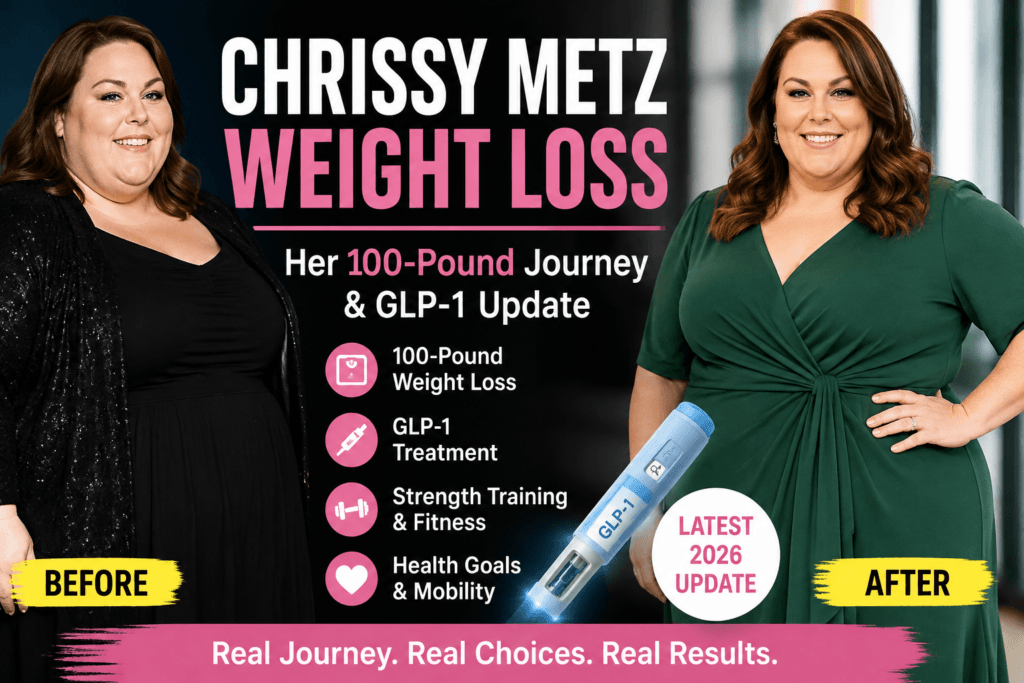
Chrissy Metz weight loss has become a major topic as the This Is Us star continues to discuss her changing approach to health, fitness, body image, and medical treatment. From her earlier 100-pound weight loss to her recent decision to use a GLP-1 medication, Metz’s journey has developed over many years. Her story also includes walking, strength training, changing attitudes toward food, and a growing focus on mobility and overall well-being.
Her personal health journey has developed over many years. She has previously spoken about making major lifestyle changes, including adjusting her eating habits and becoming more active. At one stage, she reported losing around 100 pounds. Later, she added strength training to her routine and began placing greater emphasis on feeling physically capable rather than simply watching the number on the scale.
Now, her story has entered another chapter.
In 2026, Metz revealed that she is using a GLP-1 medication. The disclosure drew considerable attention because she had previously been skeptical about these treatments. Her decision also comes during a period when she has discussed perimenopause, family history, mobility, and her broader health goals.
That makes the latest conversation about chrissy metz weight loss more complicated than a typical celebrity transformation story.
It is not simply about how much weight she has lost.
It is about how her priorities have changed, why she reconsidered medical treatment, and what she says about feeling stronger and healthier.
Chrissy Metz Weight Loss: What We Know About Her Latest Journey
Metz’s newest weight-loss update centers on her decision to use a GLP-1 medication.
In her recent comments, she explained that she had once viewed these medications with skepticism. Over time, however, her own circumstances led her to reconsider that position.
She has connected her decision with several aspects of her health. Perimenopause has become part of the conversation, as has her family history of obesity. She has also talked about physical changes that matter in everyday life, including mobility and joint comfort.
Another change she has described involves her relationship with food.
Metz has said that she experiences less of what she calls “food noise.” The phrase is commonly used to describe persistent thoughts about eating, cravings, or constantly thinking about what food might come next.
For her, reducing that mental distraction has been one of the noticeable differences since beginning treatment.
However, there is an important detail that should not get lost in the headlines.
Metz has not publicly confirmed the exact GLP-1 medication she is taking.
That means readers should not automatically assume she is using Ozempic, Wegovy, Zepbound, or another specific brand. Those medications are often discussed together online, but they contain different active ingredients and have different approved uses.
A careful account of her health journey should therefore stick to what Metz has actually confirmed.
She is using a GLP-1 medication.
The specific product has not been publicly established.
That distinction may seem small, but it matters when discussing prescription treatments.
Her Transformation Started Long Before GLP-1 Medication
Although the newest headlines focus on GLP-1 treatment, medication was not the beginning of Metz’s weight-loss story.
She has discussed struggles with weight and body image since childhood. Those experiences shaped her relationship with food and influenced how she viewed herself as she grew older.
One significant turning point came around age 30.
Metz has previously described making substantial lifestyle changes after experiencing a panic attack. Her approach included changing how she ate and incorporating regular walking. During that period, she reported losing approximately 100 pounds.
The details matter because they show that her health journey was already well underway before GLP-1 medications became a major part of the public conversation.
Her experience also demonstrates why celebrity weight loss rarely has one simple explanation.
A dramatic change in appearance can make it seem as though something happened suddenly.
Usually, that is not the reality.
Behind a visible transformation are months or years of changing habits, dealing with setbacks, adjusting routines, and learning what works for an individual body.
Metz’s story follows that more complicated pattern.
She has tried lifestyle changes.
She has increased physical activity.
She has worked on strength.
And she has now incorporated medical treatment.
Those stages do not necessarily contradict one another.
Instead, they show how a person’s approach to health can evolve.
How Chrissy Metz Previously Lost Around 100 Pounds
Before her GLP-1 disclosure, Metz had already experienced significant weight loss.
Her earlier approach focused on relatively straightforward lifestyle changes.
Walking became an important form of physical activity. She also discussed following a calorie-controlled eating pattern during that period.
The result was a reported loss of around 100 pounds.
However, it is important not to turn that history into a rigid diet plan.
There is no evidence that Metz’s earlier routine represents a universally effective formula. Individual nutritional needs differ, and a strategy that works for one person may not produce the same outcome for someone else.
The more useful lesson is that Metz’s earlier transformation involved consistency.
She made changes over time rather than relying on one dramatic intervention.
That is worth remembering because celebrity transformations are often presented in a way that makes them look effortless.
A photograph can show the difference between two points in time.
It cannot show everything that happened between them.
It cannot show difficult days, changes in motivation, adjustments to eating habits, or the ordinary routines that eventually add up.
Metz’s earlier weight loss therefore deserves to be viewed as a long-term process rather than a quick Hollywood makeover.
Chrissy Metz Weight Loss and Her Relationship With Food
Food has been an important part of Metz’s personal story.
For many people, eating is not purely about physical hunger. Emotions, stress, social situations, habits, fatigue, and personal experiences can all influence food choices.
Metz has spoken openly about her own complicated relationship with food.
That background makes her recent comments about “food noise” particularly interesting.
The phrase is not a formal medical diagnosis. Instead, people often use it to describe the persistent mental attention they give to food.
Someone experiencing this may think repeatedly about their next meal, cravings, snacks, or what they should eat later.
Metz has said that GLP-1 treatment has helped quiet that experience for her.
That does not mean every person taking a GLP-1 medication will experience the same change.
Her comments describe her personal response.
Still, they help explain why she considers the treatment meaningful.
Her motivation is not simply about seeing a lower number on a scale.
She has described wanting a healthier relationship with food and greater freedom from constant thoughts about eating.
That is a different way of looking at weight management.
Why Her Current Approach Is Different
The biggest change in Metz’s current story is the way she talks about her goals.
Earlier discussions around celebrity weight loss often centered on appearance.
How much weight was lost?
What size did the celebrity become?
What did they eat?
How many calories did they consume?
What exercise did they perform?
Metz’s recent comments point toward a broader definition of health.
She has talked about strength.
She has discussed mobility.
She has mentioned joint comfort.
She has described changes in her relationship with food.
Those outcomes cannot be fully captured by a scale.
A person can weigh less without becoming stronger.
Someone can also maintain a similar weight while becoming fitter and more capable.
That is why strength training has become such an important part of Metz’s current approach.
Her goal appears to be about building a body that feels capable rather than simply pursuing the smallest possible number.
Why Strength Training Matters in Her Story
Metz has increasingly discussed resistance training and working with a trainer.
That adds another layer to her weight-loss journey.
Strength training focuses on challenging muscles through resistance. It can support strength, physical function, and overall fitness.
For someone managing weight, that can be particularly useful because the goal is not simply to reduce body weight.
Maintaining physical capability matters too.
Metz’s emphasis on strength also fits her professional life.
She continues to perform on Broadway, where physical stamina and movement are important parts of the job. A stronger body can support everyday activities as well as demanding professional schedules.
That does not mean her medication directly caused any particular professional result.
It simply provides context for why strength and mobility have become meaningful goals for her.
The broader lesson is straightforward.
Exercise does not have to exist only to burn calories.
It can also help people become stronger, more mobile, and more confident in what their bodies can do.
For Metz, that appears to be an increasingly important part of the conversation.
The Bigger Meaning Behind Chrissy Metz’s Journey
Looking at Metz’s story as a simple before-and-after transformation misses the most interesting part.
Her approach has changed over time.
She previously relied on lifestyle changes.
She later became more focused on strength training.
Now she has added medical treatment.
That progression does not mean her earlier efforts failed.
Health needs can change.
Bodies change with age.
Hormonal transitions can affect how someone feels.
Family history can influence health risks.
And treatments that a person once rejected may eventually become reasonable options after circumstances change.
Metz’s story therefore offers a more nuanced view of weight management.
There does not have to be one permanent strategy.
Instead, people may use different tools at different points in their lives.
For Metz, the current priority appears to be broader than weight alone.
She wants to feel stronger.
She wants to move more comfortably.
She wants less mental preoccupation with food.
And she wants to support her health while continuing to live and work actively.
That makes her latest transformation less about chasing an ideal body and more about deciding what kind of health she wants for the next stage of her life.
Why Chrissy Metz Changed Her Mind About GLP-1 Treatment
One of the most interesting developments in Chrissy Metz’s health journey is not simply that she started a GLP-1 medication.
It is that she changed her mind about it.
Metz has acknowledged that she was skeptical about GLP-1 drugs before deciding to try one herself. That shift is significant because public conversations around these medications are often divided into two extremes.
Some people describe them as revolutionary.
Others dismiss them as an easy way out.
Metz’s experience sits somewhere in between.
Her decision appears to have come from evaluating her own circumstances rather than following a celebrity trend. She has discussed several factors that influenced her thinking, including perimenopause, family history, mobility, and her broader health goals.
That distinction is important.
A medication decision should not be based on whether something is fashionable. It should be based on whether a qualified healthcare professional believes the treatment is appropriate for a particular person.
In Metz’s case, she ultimately decided that medical support made sense for her.
That does not mean she believes everyone should make the same decision.
Chrissy Metz Weight Loss and Perimenopause
Perimenopause has become an important part of the latest conversation surrounding Metz’s health.
Perimenopause is the transitional stage before menopause. During this period, hormonal fluctuations can occur alongside changes in sleep, mood, energy, appetite, and body composition.
For some women, managing weight during midlife can feel different from managing it earlier in adulthood.
That does not mean weight gain is inevitable.
It also does not mean every change in weight during perimenopause requires medication.
Instead, the transition can create new challenges that may require a different approach.
Metz has identified perimenopause as one of the reasons she reconsidered GLP-1 treatment.
Her comments highlight an important reality about long-term health: a strategy that worked at one stage of life may not always feel equally effective later.
Age, hormones, activity levels, sleep, stress, and other factors can change.
Therefore, adjusting a health plan does not automatically mean someone has failed.
Sometimes it simply means the circumstances have changed.
Why Midlife Can Change the Weight-Loss Conversation
Weight management during midlife involves more than calories.
Muscle mass can change with age.
Daily activity can decrease because of work, family responsibilities, injuries, or lifestyle changes.
Sleep may become less consistent.
Hormonal changes can also affect how someone experiences hunger, energy, and body composition.
These factors do not make weight management impossible.
However, they can make simplistic advice less useful.
Telling someone to “just eat less” ignores the biological and practical factors that can influence their experience.
Metz’s story illustrates why a more individualized approach can be valuable.
Family History Is Another Piece of Metz’s Story
Metz has also discussed a family history of obesity.
That detail matters because body weight is influenced by more than personal choices.
Genetics can affect appetite, energy regulation, fat storage, and the body’s response to environmental factors.
This does not mean that someone’s genes determine exactly how much they will weigh.
Instead, genetics can influence susceptibility.
Two people can follow similar eating and activity patterns and still experience different outcomes.
That is one reason the old idea that weight is purely a test of willpower has become increasingly difficult to defend.
Lifestyle remains important.
Nutrition matters.
Physical activity matters.
Sleep matters.
But biology matters too.
Metz’s family history helps explain why she sees weight management as a health issue rather than simply an appearance issue.
What Are GLP-1 Medications?
GLP-1 stands for glucagon-like peptide-1.
It is a hormone involved in several processes within the body, including appetite regulation, digestion, and blood glucose control.
Medications that act on the GLP-1 pathway can influence these processes.
Some medications in this category are primarily associated with diabetes treatment, while others have specific FDA approvals for chronic weight management in eligible patients.
The term “GLP-1” has become a common phrase in popular culture because several highly visible medications work through related metabolic pathways.
However, these drugs are not interchangeable.
They can contain different active ingredients.
They can have different dosing schedules.
They can have different approved indications.
They can also have different safety considerations.
That is why simply calling every weight-loss injection a “GLP-1” can create confusion.
Is Chrissy Metz Taking Ozempic?
There is an important distinction between what has been reported and what people assume online.
Metz has confirmed that she is using a GLP-1 medication.
She has not publicly identified the exact medication in the latest reporting.
Therefore, it would be inaccurate to state as fact that she is taking Ozempic.
Ozempic contains semaglutide and is an FDA-approved prescription medication with specific indications. The fact that it belongs to the GLP-1 category does not mean that every person who reports taking a GLP-1 is using Ozempic.
The same principle applies to other well-known medications.
Readers should therefore be cautious when social-media posts confidently attach a brand name to Metz’s treatment without a direct source.
For a health-related article, precision matters more than a catchy headline.
Is Chrissy Metz Taking Wegovy?
There is also no confirmed public information establishing that Metz is taking Wegovy.
Wegovy contains semaglutide and has an FDA-approved indication for chronic weight management in certain eligible patients.
Because Wegovy and Ozempic contain the same active ingredient, people sometimes use the names interchangeably in casual conversation.
They should not be treated as identical products, however.
Their approved uses and labeling differ.
Most importantly for this article, Metz has not publicly confirmed that Wegovy is the medication she uses.
Therefore, the responsible description remains “GLP-1 medication.”
Is Chrissy Metz Taking Zepbound?
The latest public information does not confirm that Metz is taking Zepbound either.
Zepbound contains tirzepatide, which works on both GIP and GLP-1 receptors.
That makes it different from medications that act only through the GLP-1 receptor.
The distinction matters because online conversations often place semaglutide and tirzepatide products under one broad label.
For general discussion, that can be understandable.
For medical reporting, it is better to be precise.
Until Metz publicly identifies her medication, readers should not assume a specific product.
How GLP-1 Treatment Can Affect Appetite
One reason GLP-1-based medications have attracted so much attention is their effect on appetite.
These medications can influence signals involved in hunger and fullness.
Some patients report feeling satisfied sooner.
Others notice that cravings become less intense.
Some describe thinking about food less frequently.
That last experience is particularly relevant to Metz.
She has described a reduction in what she calls “food noise.”
For her, that change appears to be one of the meaningful benefits of treatment.
However, individual responses can vary considerably.
A medication does not affect every person in exactly the same way.
Some people may experience significant appetite changes.
Others may experience a smaller effect.
Some may discontinue treatment because of side effects or other concerns.
That is why a celebrity’s experience cannot predict another person’s result.
What Does “Food Noise” Mean?
“Food noise” is an informal expression rather than a formal medical diagnosis.
People use it to describe persistent mental attention toward food.
For example, someone might constantly think about what they will eat next.
They may think about snacks shortly after finishing a meal.
They may experience frequent cravings.
They may spend a significant amount of mental energy planning food.
The experience differs from ordinary hunger.
Everyone thinks about food sometimes.
The distinction is the amount of mental attention it occupies.
Metz has said that GLP-1 treatment helped reduce this experience for her.
That personal description helps explain why she sees her treatment as more than a cosmetic intervention.
If someone spends less mental energy thinking about food, they may feel that they have greater freedom to focus on other parts of life.
Still, “food noise” should not be treated as proof that GLP-1 medication will produce the same psychological experience for everyone.
Does GLP-1 Medication Replace Diet and Exercise?
No.
That is one of the biggest misconceptions surrounding modern weight-loss medication.
Prescription treatment can be one component of a broader health strategy.
Nutrition still matters.
Physical activity still matters.
Strength still matters.
Sleep and stress management can matter too.
In fact, FDA-approved weight-management medications are generally used alongside reduced-calorie eating and increased physical activity for eligible patients.
That broader approach is consistent with Metz’s own public story.
She had already changed her eating habits and incorporated walking before GLP-1 treatment entered her journey.
She later added strength training.
Now medication has become another tool.
The sequence is important because it challenges the idea that medication automatically means abandoning healthy habits.
A more accurate description is that medical treatment can complement lifestyle changes when clinically appropriate.
What Are the Common Side Effects?
GLP-1-based medications can cause side effects, and gastrointestinal symptoms are among the most commonly reported.
Depending on the specific medication, people may experience:
- Nausea
- Vomiting
- Diarrhea
- Constipation
- Abdominal discomfort
- Reduced appetite
Some people experience mild symptoms.
Others may find them more difficult to manage.
That is why medical supervision matters.
The correct medication, dose, and treatment schedule depend on the individual.
People should also discuss their complete medical history with their healthcare professional before beginning prescription treatment.
A celebrity’s positive experience does not eliminate the possibility of risks for someone else.
Why the FDA Matters in the GLP-1 Conversation
The popularity of GLP-1 medications has created a huge market.
That has also created opportunities for misinformation and unsafe purchasing.
The FDA has warned consumers about unapproved compounded versions of GLP-1 drugs and has raised concerns about products obtained through questionable sources.
This is an important part of the conversation because online demand can make people vulnerable to misleading advertisements.
Consumers may encounter websites promising unusually fast results.
They may see products marketed without appropriate medical evaluation.
They may also encounter counterfeit or improperly handled medications.
The safer approach is to work with a qualified healthcare professional and obtain prescription medication through legitimate channels.
Metz’s story should therefore be understood as a medical journey, not an invitation to purchase a similar product online.
Why Her Change of Opinion Matters
Metz’s willingness to talk about changing her mind is perhaps one of the most relatable parts of her story.
People often feel pressure to remain consistent with opinions they expressed years earlier.
Health does not always work that way.
New information can change someone’s perspective.
Aging can change someone’s needs.
Hormonal changes can change someone’s experience.
A treatment that once seemed unnecessary may later become worth considering.
Changing your mind after learning more is not hypocrisy.
It can be evidence of reassessment.
Metz’s decision demonstrates that health choices can evolve without invalidating earlier decisions.
She previously relied on lifestyle changes.
Those efforts remain part of her story.
Now she has decided that medical treatment can play a role too.
Why Her Story Should Not Become a Prescription for Everyone
There is a major difference between inspiration and imitation.
Readers can find inspiration in Metz’s commitment to becoming stronger.
They can appreciate her openness about body image.
They can learn from her willingness to reconsider a treatment after changing circumstances.
However, they should not copy her prescription medication.
They should not assume her dosage.
They should not assume her medical eligibility.
They should not assume that her response will be their response.
A medication decision requires individual assessment.
That is particularly important because health conditions, other medications, allergies, age, and medical history can change the risk-benefit calculation.
The best lesson from Metz’s experience is therefore not “take the same medication.”
It is “find an approach that is appropriate for your own health.”
The Real Meaning Behind Her GLP-1 Decision
When the headlines are stripped away, Metz’s decision represents a broader change in how she approaches health.
She is no longer discussing weight only as an appearance issue.
She is talking about mobility.
She is talking about strength.
She is talking about food-related thoughts.
She is talking about aging and hormonal changes.
She is talking about long-term health.
That broader context makes her latest decision easier to understand.
The GLP-1 medication is one piece of a much larger story.
It does not erase the work she did before it.
It does not make her earlier lifestyle changes irrelevant.
And it does not define her entire identity.
Instead, it represents another tool she has chosen to explore as her health needs have evolved.
For Metz, that appears to be the most important distinction.
Her goal is not simply to become smaller.
She wants to feel better in her body, remain active, build strength, and continue living the life she wants.
That is ultimately what makes her current weight-loss journey more complicated—and more interesting—than a typical celebrity transformation headline.
Chrissy Metz Weight Loss, Exercise, Strength and Mobility
Chrissy Metz’s current health journey is not centered on medication alone. Exercise has remained an important part of how she thinks about her body, particularly as she has shifted her attention toward strength, mobility, and everyday function.
That change adds useful context to the latest chrissy metz weight loss conversation.
Rather than focusing only on becoming lighter, Metz has increasingly discussed what her body can do. That includes working with a trainer, lifting weights, staying active, and feeling more comfortable while moving.
For someone who has spent years under public scrutiny because of her size, that is a meaningful change in perspective.
Why Strength Became a Bigger Goal
Strength training offers a different way to measure progress.
A scale can tell you how much you weigh. It cannot tell you how easily you can climb stairs, carry something, stand for a long performance, or complete a workout.
Metz has spoken about becoming stronger and incorporating weight training into her routine. That approach fits naturally with her broader focus on health rather than appearance alone.
Resistance training can challenge muscles and improve physical capacity when performed appropriately. It can also complement other activities, including walking and cardiovascular exercise.
That does not mean everyone needs to follow the same training program.
The useful takeaway is simply that exercise can serve a purpose beyond burning calories.
It can help build a body that feels capable.
Chrissy Metz Weight Loss and Her Earlier Walking Routine
Walking was one of the activities Metz previously discussed as part of her chrissy metz weight loss journey.
Its simplicity is worth noting.
People sometimes assume that meaningful weight loss requires extremely difficult workouts. In reality, regular movement can play an important role in an overall health routine.
Walking can be easier to maintain than highly demanding exercise. It can also fit into everyday life without requiring specialized equipment.
For someone beginning to become more active, that accessibility can make a difference.
Metz’s earlier experience therefore provides a useful contrast with the way celebrity fitness routines are often portrayed online.
There is no need to begin with an extreme workout.
Consistency can matter more than intensity.
A person who walks regularly may build a stronger foundation than someone who attempts an exhausting routine for a few days and then stops.
Why Strength Training Matters During Weight Management
Weight loss can involve changes in more than body fat.
Muscle mass can also change, particularly when someone loses a significant amount of weight.
That is one reason resistance training can be useful during a weight-management program.
Strength exercises give muscles a reason to adapt.
Combined with appropriate nutrition and recovery, they can support physical strength and function.
This becomes especially relevant when someone is using medication that reduces appetite.
Eating less may contribute to weight loss, but overall nutrition still matters. A person’s diet needs to provide the nutrients necessary to support health and physical activity.
That is why the broader approach matters more than the medication itself.
Metz’s story includes treatment, but it also includes movement.
Those pieces should not be separated when discussing her current health goals.
Mobility Has Become an Important Part of Her Story
One of the most interesting aspects of Metz’s recent comments is her emphasis on mobility.
She has described feeling more mobile and experiencing less joint discomfort.
That is significant because movement affects nearly every part of daily life.
Walking around a city can be easier.
Standing for longer periods can become more comfortable.
Exercise may feel less intimidating.
Travel can become more enjoyable.
Professional activities can become easier to manage.
These changes may not receive as much attention as a dramatic number on the scale, but they can have a direct effect on quality of life.
For Metz, mobility also has a professional dimension.
Her work requires her to remain active and perform in demanding environments.
Therefore, becoming stronger and more comfortable in her body can have practical value beyond appearance.
Chrissy Metz Weight Loss and Broadway
Metz’s current professional work adds another interesting dimension to her health journey.
She is performing in the Broadway musical & Juliet, which requires stamina, movement, and the ability to maintain energy through repeated performances.
A demanding performance schedule can make physical conditioning particularly valuable.
That does not mean her GLP-1 treatment directly caused a change in her Broadway performance.
There is no reason to make that claim.
Instead, her work helps explain why strength and mobility are meaningful goals.
For an actor and performer, feeling physically capable can affect how confidently they approach demanding work.
Metz’s current focus therefore appears connected to her lifestyle.
She is not simply preparing for a photograph.
She is preparing herself for real activities.
Does Exercise Still Matter After Starting a GLP-1?
Yes.
GLP-1 medication does not make physical activity irrelevant.
Medication can influence appetite and metabolic pathways, while exercise offers its own benefits.
Physical activity can support:
- Cardiovascular health
- Muscle strength
- Mobility
- Balance
- Endurance
- Mood
- Functional fitness
These benefits remain valuable regardless of whether someone takes weight-management medication.
That is why it would be misleading to describe Metz’s current journey as medication replacing exercise.
Her story suggests the opposite.
She has continued to focus on physical strength while using medical treatment.
Why Muscle Strength Matters More Than the Scale
Weight can be a useful measurement, but it does not tell the whole story.
Imagine two people who weigh exactly the same.
One may have greater muscle strength, better cardiovascular fitness, and stronger mobility.
The other may struggle with everyday physical tasks.
Their scale numbers are identical.
Their health experiences are not.
That example illustrates why Metz’s emphasis on strength is significant.
A health journey can involve several measurements at once.
Someone may track body weight while also paying attention to how their clothes fit, how they move, how much they can lift, how energetic they feel, and what their healthcare provider says about their health markers.
The scale is one tool.
It should not become the entire definition of success.
Chrissy Metz Weight Loss Is Not About Chasing a Perfect Number
Metz has indicated that she is not focused on reaching a specific goal weight.
That approach stands out in an industry where celebrity transformations are frequently reduced to numbers.
A headline might say that someone lost a certain amount.
Another might announce a new dress size.
But a specific target does not automatically equal better health.
Healthy body weight varies between individuals.
Body composition also matters.
So do strength, blood pressure, blood glucose, sleep, mobility, and overall well-being.
Metz’s emphasis on feeling strong suggests that she is thinking about these broader outcomes.
That can make the conversation less about perfection and more about function.
Why Her Exercise Approach Has Evolved
People often assume that an exercise routine should remain unchanged.
In reality, training can evolve as goals change.
Earlier in her journey, Metz emphasized walking.
Later, she became more interested in strength training.
That progression makes sense.
Walking can provide accessible daily movement.
Resistance training can provide a different stimulus and help develop strength.
Neither has to replace the other.
They can exist within the same overall routine.
The same principle applies to nutrition and medical treatment.
A person does not have to choose one health tool and reject every other option.
The right combination depends on individual needs.
How Weight Loss Can Affect Physical Activity
Significant weight changes can sometimes make movement feel different.
For some people, reduced body weight may make certain activities more comfortable.
At the same time, rapid changes can require attention to nutrition, recovery, and physical conditioning.
That is another reason strength training can be useful.
Building physical capacity can help someone adapt to a changing body.
However, exercise programs should still be appropriate for the person’s current fitness level.
Someone who has been inactive for years should not immediately copy an experienced athlete’s workout.
A gradual approach is generally more practical.
Why Celebrity Workout Claims Need Caution
The internet is full of articles claiming to reveal a celebrity’s exact workout.
Some provide highly specific schedules, exercises, sets, repetitions, and diets.
Readers should be cautious.
Unless the celebrity or a credible source has actually confirmed those details, such claims may be exaggerated.
That is particularly important with Metz.
Her publicly discussed commitment to strength training does not mean we know every exercise she performs.
It does not tell us her exact training schedule.
It does not tell us how many days she lifts weights.
And it does not provide enough information to create a personalized routine for someone else.
A responsible article should not fill those gaps with speculation.
Chrissy Metz Weight Loss and the Importance of Sustainable Habits
One of the strongest lessons from Metz’s journey is the value of sustainability.
Extreme diets can produce dramatic short-term results.
Extreme workouts can also produce rapid changes.
But maintaining health over years requires habits that fit into real life.
Walking is sustainable for many people.
Strength training can be adapted to different fitness levels.
Nutrition can be adjusted without eliminating every enjoyable food.
Medical treatment can be considered when appropriate.
The goal is not to create the most dramatic transformation possible.
The goal is to create a health strategy that someone can realistically maintain.
Metz’s evolving approach illustrates that principle.
What Her Strength Training Focus Says About Body Image
Strength training also changes the conversation around appearance.
When someone trains to become stronger, the goal becomes performance.
How much can I lift?
How stable do I feel?
Can I move more easily?
Can I recover between activities?
Those questions are different from simply asking whether a body looks smaller.
That shift can be particularly meaningful for someone who has experienced years of public commentary about her appearance.
Instead of allowing other people to define what her body should look like, Metz can focus on what she wants her body to do.
That is a powerful distinction.
Chrissy Metz Weight Loss and Quality of Life
Ultimately, weight management is not just about numbers.
It is about living.
If someone can move more comfortably, participate in activities they enjoy, feel stronger, experience less physical discomfort, or spend less time worrying about food, those changes can matter enormously.
Metz’s recent comments point toward this broader idea of quality of life.
Her goals appear connected to being active, continuing her career, and feeling better physically.
That makes her current journey more relatable than a simple celebrity transformation headline.
Most people are not trying to become a Hollywood ideal.
They want to feel comfortable in their own bodies.
They want enough energy to work.
They want to move without unnecessary discomfort.
They want to enjoy their lives.
Weight may be part of that equation, but it is not the entire equation.
What Readers Can Learn From Her Approach
There are several practical lessons worth taking from Metz’s public journey without attempting to copy her medical treatment.
First, movement does not need to be extreme to be useful.
Second, strength deserves attention, especially when weight management is part of a broader health plan.
Third, progress can be measured in ways other than pounds.
Fourth, health strategies can change over time.
Finally, medical treatment and healthy habits do not have to be treated as opposing ideas.
A person may use prescription treatment while continuing to exercise and make thoughtful nutrition choices.
The key is personalization.
The Bigger Picture
Chrissy Metz’s current health story is ultimately less about a single weight-loss method and more about evolution.
She began with lifestyle changes.
She incorporated walking.
She later embraced strength training.
Now she has added a GLP-1 medication after reconsidering her earlier skepticism.
Through each stage, her goals appear to have become more focused on health and physical function.
That progression is worth remembering when discussing celebrity weight loss.
There is rarely one secret.
There is rarely one perfect routine.
And there is rarely one number that tells the whole story.
Metz’s journey shows how a person’s priorities can change as life changes.
Her current focus on strength and mobility may be just as important as the weight she has lost.
In that sense, the most meaningful part of her transformation may not be how different she looks.
It may be how differently she thinks about what her body is capable of doing.
Chrissy Metz Weight Loss and the Changing Meaning of Body Image
Chrissy Metz’s weight-loss journey cannot be separated from the way society talks about larger bodies.
For years, her appearance was part of public discussion. Her role as Kate Pearson also placed body image at the center of many conversations surrounding This Is Us.
That experience gave Metz a unique position.
She could talk about body acceptance while also acknowledging that she wanted to improve her health.
Those ideas do not have to conflict.
Accepting yourself does not mean refusing to make changes.
Likewise, wanting to lose weight does not automatically mean someone dislikes their body.
A person can appreciate where they are today while still working toward better health tomorrow. Celebrity conversations around wellness and body confidence have also become an important part of how Hollywood figures discuss their health and personal image. That distinction is especially important when discussing chrissy metz weight loss because public conversations often turn personal health decisions into judgments about appearance.
Body Acceptance Does Not Mean Avoiding Health Changes
Body acceptance is sometimes misunderstood. Some people interpret it as saying that a person should never want to lose weight. That is not necessarily what body acceptance means. Mental health and self-acceptance can also influence how people approach their bodies and long-term health.
At its core, accepting your body can mean recognizing your value without making your size the measure of your worth. That perspective can coexist with medical care. Someone may decide to exercise because they want to become stronger. They may change their eating habits because they want better energy. They may take medication because a doctor believes it could improve their health.
None of those decisions automatically mean they have rejected themselves. Metz’s public journey demonstrates this distinction. Her earlier work around body image did not prevent her from pursuing physical changes later. Instead, her goals appear to have evolved. She is now talking more about strength, mobility, comfort, and long-term health.
Why Celebrity Weight Loss Creates So Much Debate
The latest chrissy metz weight loss discussion has attracted attention because people can see the difference. A new photograph appears, fans notice, social media reacts, and speculation begins. People start guessing about diets, medications, surgery, exercise routines, and even exact weights.
A new photograph appears.
Fans notice.
Social media reacts.
Then speculation begins.
People start guessing about diets, medications, surgery, exercise routines, and even exact weights.
The problem is that appearance cannot reveal someone’s complete medical history. Celebrity life beyond the spotlight can also shape how audiences interpret personal choices, family moments, and changes in a public figure’s life.
A photograph cannot tell you what medication a person takes.
It cannot tell you whether they had surgery.
It cannot tell you what their blood tests show.
It cannot tell you how they feel.
It cannot even reliably tell you how much weight they have lost.
Lighting, clothing, posing, camera angles, styling, and photography can all change the way someone appears.
That is why credible reporting should rely on confirmed statements rather than visual speculation.
Chrissy Metz Weight Loss Is Not Proof of a Specific Treatment
One of the biggest problems in celebrity health coverage is the assumption that a dramatic transformation automatically reveals the treatment behind it.
That is not how medical reporting works.
Someone may lose weight through lifestyle changes.
They may use prescription medication.
They may have surgery.
They may combine several approaches.
They may also experience natural changes in body composition over time.
Without confirmation, there is no responsible way to determine the exact cause simply by looking at photographs.
In Metz’s case, there is at least one confirmed piece of information: she has publicly discussed using a GLP-1 medication.
That gives readers something concrete to work with.
There is no need to add unverified claims about a specific drug, dose, procedure, or diet.
Why Her Exact Weight Is Difficult to Confirm
Another common question involves Metz’s current weight.
Various numbers have appeared across entertainment websites over the years.
However, readers should be cautious with those figures.
Unless Metz personally confirms a current weight, an article should not present an online estimate as a verified fact.
Body weight can also fluctuate.
A person’s weight on one day does not necessarily represent their long-term average.
For that reason, exact numbers can create a false sense of precision.
It is more useful to focus on the information Metz has actually shared.
She has discussed significant previous weight loss.
She has described changes in her physical health.
She has discussed strength training.
And she has now disclosed GLP-1 treatment.
Those facts tell a more complete story than an unverified number.
Why “Before and After” Photos Do Not Tell Everything
Before-and-after photographs are popular because they create an immediate visual comparison.
But health is not a photograph.
A picture can show that someone’s appearance has changed.
It cannot show whether they sleep better.
It cannot show whether they have more energy.
It cannot show whether their blood pressure has improved.
It cannot show whether they feel less pain.
It cannot show whether they are stronger.
Those differences matter.
Metz’s current comments suggest that physical function has become an important part of how she evaluates her progress.
That approach is broader than the traditional celebrity makeover narrative.
Chrissy Metz Weight Loss and the Pressure of Hollywood
Hollywood has long placed unusual pressure on actors to maintain particular appearances.
For women especially, expectations around body size can be intense.
Actors may face questions about their appearance during interviews.
They may encounter criticism on social media.
They may be photographed constantly.
They may also feel pressure to change their bodies for professional opportunities.
Metz’s career has challenged some of those expectations.
Her success as a plus-size actress helped demonstrate that audiences could connect deeply with characters who did not fit traditional Hollywood body standards.
That makes her current health journey particularly nuanced.
Her decision to lose weight should not erase the importance of her earlier representation.
Nor should her earlier body-positive work prevent her from making personal health decisions now.
Both parts of her story can exist together.
Why Her Health Goals May Matter More Than Her Appearance
A person can look different without necessarily feeling different.
Conversely, someone can feel significantly healthier without undergoing a dramatic visual transformation.
That is why Metz’s focus on strength and mobility is worth paying attention to.
If she can move more comfortably, perform more confidently, train consistently, and experience less discomfort, those outcomes may have greater value than a particular dress size.
The same principle applies outside Hollywood.
Someone beginning a health journey might initially focus on weight.
Later, they may realize that climbing stairs without becoming exhausted matters more.
Another person may care about reducing joint discomfort.
Someone else may want enough strength to play with their children.
Health goals can be personal.
There is no requirement that every person measure success in exactly the same way.
Perimenopause Adds Another Layer to Her Story
Metz’s discussion of perimenopause also changes the context around her current health decisions.
Midlife can bring physical changes that were not present earlier.
Hormonal fluctuations may occur alongside changes in sleep, mood, energy, appetite, and body composition.
These changes can make an existing health routine feel different.
That does not mean every symptom is caused by perimenopause.
It also does not mean every woman needs weight-loss medication.
Instead, it reinforces the importance of individualized healthcare.
A person should be evaluated based on their own symptoms, medical history, risk factors, and goals.
Metz has explained that perimenopause was part of the reason she reconsidered her options.
That is her experience.
It should not become a blanket recommendation for everyone going through the same life stage.
The Role of Genetics in Weight Management
Metz has also mentioned family history.
That provides another reason to avoid simplistic explanations about weight.
Genetics can influence appetite, metabolism, fat storage, and the body’s response to environmental factors.
Environment matters too.
Food availability, stress, sleep, activity, income, work schedules, and access to healthcare can all influence health.
This means two people can make similar lifestyle choices and still experience different results.
That does not make healthy habits irrelevant.
It simply means that weight is influenced by more than one variable.
Modern obesity treatment increasingly recognizes this complexity.
Is Chrissy Metz Promoting a Weight-Loss Shortcut?
It would be unfair to describe Metz’s current approach as simply looking for an easy shortcut.
Her public history shows years of lifestyle changes and physical activity.
She has also continued discussing strength training.
The addition of a prescription medication does not erase those efforts.
Medical treatment can be another tool.
The important question is whether that tool is appropriate for the individual using it.
This distinction is important because the public debate around GLP-1 medications often becomes moralistic.
Some critics describe medication users as lacking discipline.
Some supporters portray the drugs as effortless solutions.
Neither description captures the full reality.
Weight management can be difficult even when someone is highly motivated.
Medication can help some people.
It can also create side effects and other challenges.
Why GLP-1 Treatment Should Be Personalized
Prescription medication is not a one-size-fits-all decision.
A healthcare professional may consider several factors before recommending treatment.
These can include:
- Medical history
- Current medications
- Weight-related health risks
- Previous treatment attempts
- Potential side effects
- Other health conditions
- Treatment goals
- Long-term management plans
That is why Metz’s experience should not be converted into a personal prescription for readers.
Knowing that a celebrity benefited from a medication does not establish that another person should take it.
The correct starting point is an individual medical evaluation.
What Readers Should Know About Online GLP-1 Claims
The popularity of GLP-1 medications has created an enormous amount of online content.
Some of it is informative.
Some of it is promotional.
Some of it is simply wrong.
Readers may encounter claims promising instant results.
Others may see advertisements for products that do not have the same regulatory status as FDA-approved medications.
The FDA has warned consumers about unapproved compounded GLP-1 products and concerns involving products obtained outside appropriate medical and pharmacy channels.
That makes source quality particularly important.
A celebrity story can generate interest.
It should not replace professional medical advice.
Chrissy Metz Weight Loss and the Problem With Exact Promises
Another common mistake is assuming that a particular medication guarantees a specific amount of weight loss.
It does not.
Clinical studies can show average results across groups of patients.
Individual outcomes can vary.
One person may lose substantial weight.
Another may experience a smaller change.
Someone else may discontinue treatment because of side effects.
Lifestyle, medical history, medication choice, adherence, and biological differences can all affect outcomes.
Therefore, readers should be skeptical of statements such as:
“Take this medication and lose exactly X pounds.”
Real-world treatment is more complicated.
Why Sustainable Progress Matters
The most useful health changes are often the ones a person can maintain.
Extreme restrictions may be difficult to continue.
Extremely intense workouts can also become unsustainable.
A long-term approach usually needs to fit into ordinary life.
That could involve regular walking.
It could include strength training.
It could involve practical nutrition changes.
For some people, prescription treatment may also become part of the plan.
The specific combination can differ.
What matters is whether the approach supports health over time.
Metz’s journey demonstrates that sustainability may require adjustment.
She has not followed exactly the same strategy throughout her life.
Instead, she has adapted.
What Her Story Says About Setbacks
Weight management is rarely perfectly linear.
People can lose weight.
They can regain some.
They can lose again.
They can change their goals.
They can discover that an old strategy no longer works.
None of those experiences automatically represents failure.
Metz’s story is useful partly because it has multiple chapters.
Her current treatment does not erase her earlier efforts.
It represents a new stage.
That is a healthier way to think about long-term weight management.
Instead of asking whether someone has followed one plan perfectly, it may be more useful to ask whether they are finding strategies that support their health now.
Chrissy Metz Weight Loss and Quality of Life
Ultimately, the most meaningful measure of any health journey is how it affects real life.
Can a person move more easily?
Can they participate in activities they enjoy?
Do they have enough energy for work and family?
Do they feel stronger?
Do they experience less discomfort?
Do they have a healthier relationship with food?
Those questions can matter just as much as body weight.
Metz has discussed several of these areas.
Her comments about mobility and food-related thoughts suggest that she sees health as something broader than appearance.
That perspective may be the most valuable part of her story.
Why Readers Should Avoid Comparing Their Bodies With Hers
Celebrity comparison can be especially misleading.
Metz has access to resources that many people do not.
She may have professional support, trainers, healthcare providers, and other resources available through her career.
Her biology is also different.
Her schedule is different.
Her medical history is different.
Her goals are different.
Therefore, her results should not become someone else’s deadline.
A healthier approach is to compare yourself with your own previous condition.
Can you walk farther?
Are you stronger?
Do you feel better?
Are your health markers improving?
Are your habits becoming more consistent?
Those questions provide more useful information than comparing your body with a celebrity’s.
The Bigger Lesson From Her Transformation
The most interesting part of Metz’s story may be the fact that her definition of health continues to evolve.
She has moved from a focus on weight alone toward a broader interest in physical capability.
Walking played a role.
Strength training became important.
Medical treatment has now entered the picture.
Through all of those stages, her goals have continued to change.
That is not a contradiction.
It is part of being human.
Health is not a fixed project with one final deadline.
People age.
Circumstances change.
New medical information becomes available.
Personal priorities shift.
A successful long-term approach needs room for those changes.
Metz’s journey illustrates that reality in a very public way.
What Chrissy Metz’s Story Does Not Prove
Her experience does not prove that GLP-1 medication is right for everyone.
It does not prove that everyone should lose weight.
It does not prove that a particular diet is superior.
It does not prove that strength training alone produces dramatic weight loss.
It does not establish which specific medication she takes.
And it does not provide enough information to recreate her medical treatment.
What it does provide is a personal example of someone adjusting her health strategy after years of experience.
That distinction should remain at the center of the conversation.
A More Balanced Way to Discuss Celebrity Weight Loss
Celebrity health stories can be useful when they encourage thoughtful conversations.
They become less useful when they turn into competitions.
Instead of asking only, “How much weight did Chrissy Metz lose?” readers can ask broader questions.
What motivated her?
How has her approach changed?
Why did she reconsider GLP-1 medication?
What role does strength training play?
How does she describe her relationship with food?
What does she mean when she talks about mobility?
Those questions reveal much more than a number.
They also make the story more relevant to people who are navigating their own health journeys.
Looking Beyond the Transformation
Metz’s physical changes may be what initially attracts attention.
Her mindset may ultimately be more significant.
She has spoken about wanting to feel stronger.
She has discussed mobility.
She has described less mental focus on food.
She has reconsidered a treatment category she once questioned.
And she has continued working toward an active life.
Taken together, those details suggest that her current goals are not limited to appearance.
They are connected to how she wants to live.
That distinction gives her story a deeper meaning.
A transformation is visible.
Health is experienced.
For Metz, the second appears to be becoming increasingly important.
What Chrissy Metz’s Weight Loss Journey Can Teach Readers
Chrissy Metz’s experience offers a broader lesson about how people can approach health without turning the process into a punishment. Like other celebrities navigating new chapters in life, Metz has also shown how personal priorities can evolve as circumstances change.
Her journey has never followed one perfectly predictable path.
She made lifestyle changes.
She became more active.
She lost a significant amount of weight.
She later became more interested in strength training.
Now, she has added a GLP-1 medication to her health strategy.
That progression shows why long-term weight management can require flexibility.
A strategy that works during one period of life may not remain the best option forever.
People’s bodies change.
Their circumstances change.
Their priorities change.
Their medical needs can change too.
The important point is not to find one perfect method and follow it forever.
Instead, it is to understand what supports your health at each stage.
Progress Does Not Always Look Like Weight Loss
One of the most valuable ideas in Metz’s current story is that progress can have several definitions.
Weight loss may be one measure.
But it is not the only one.
Someone may become stronger without seeing a dramatic change on the scale.
Another person may improve their mobility.
Someone else may experience better energy or fewer physical limitations.
These outcomes can have a meaningful impact on everyday life.
Metz’s emphasis on strength and mobility reflects this broader view.
For her, becoming healthier appears to involve more than simply reaching a smaller number.
That perspective can help shift the conversation away from appearance and toward function.
Chrissy Metz Weight Loss and the Importance of Long-Term Thinking
Short-term transformations often dominate social media.
People see dramatic photographs and assume that rapid change is the ultimate goal.
But sustainable health is usually more complicated.
A person needs habits that fit into real life.
That might mean choosing manageable forms of exercise.
It might involve learning how to eat in a way that feels sustainable.
It could involve professional support.
For some people, prescription medication may become part of long-term treatment.
The important thing is that the approach should be realistic.
Metz’s story demonstrates this because her strategy has changed over time.
She has not relied on one intervention throughout her life.
Instead, she has adapted as her circumstances changed.
That is a useful lesson for anyone who feels discouraged because an old routine no longer produces the same results.
Changing the strategy does not automatically mean giving up.
Sometimes it means becoming more informed.
Why the Number on the Scale Is Only One Measurement
Weight is easy to measure.
That is one reason it dominates weight-loss conversations.
A scale provides an immediate number.
However, health is multidimensional.
A scale cannot measure muscle strength.
It cannot measure mobility.
It cannot measure cardiovascular fitness.
It cannot measure sleep quality.
It cannot measure how comfortable someone feels while performing everyday activities.
It cannot measure every aspect of mental well-being.
That does not make weight irrelevant.
Weight can be clinically meaningful, especially when considered alongside other health factors.
The point is simply that it should not become the sole definition of success.
Metz’s current approach illustrates this broader perspective.
What We Know About Her Current GLP-1 Treatment
The confirmed information is relatively straightforward.
Metz has publicly discussed using a GLP-1 medication.
She has said that she was previously skeptical about this type of treatment.
She later reconsidered that position.
She has connected her decision with personal health factors, including perimenopause and family history.
She has also described changes in her relationship with food and physical comfort.
However, the exact medication she is using has not been publicly confirmed in the latest reporting.
That means readers should be careful with articles or social-media posts that identify a specific drug without direct confirmation.
The distinction between confirmed information and speculation is especially important when prescription medication is involved.
What We Do Not Know
There are still several details about Metz’s health that remain private.
For example, the public does not have a complete picture of:
- Her exact current weight
- Her exact starting weight
- Her complete daily diet
- Her complete workout schedule
- Her medication dose
- Her long-term medication plans
- Her complete medical history
- Her private health measurements
That is normal.
Public figures are entitled to medical privacy.
Sharing some information does not mean they are required to disclose everything.
A responsible article should respect those boundaries.
Frequently Asked Questions About Chrissy Metz Weight Loss
How much weight has Chrissy Metz lost?
Chrissy Metz previously discussed losing approximately 100 pounds during an earlier stage of her health journey. More recent reporting has discussed additional changes while she is using a GLP-1 medication.
Those figures should not automatically be added together because they refer to different stages of her broader transformation.
How did Chrissy Metz lose 100 pounds?
Her earlier weight-loss journey included changes to her eating habits and regular walking. She later incorporated strength training and worked with a trainer.
Her current approach also includes GLP-1 treatment.
Is Chrissy Metz taking a GLP-1?
Yes. Metz has publicly disclosed that she is using a GLP-1 medication.
However, she has not publicly confirmed the exact medication in the latest reporting.
Is Chrissy Metz taking Ozempic?
There is no confirmed public information establishing Ozempic as the specific medication Metz is taking.
She has confirmed GLP-1 use, but that does not identify a particular brand.
Is Chrissy Metz taking Wegovy?
The latest public information does not confirm that Metz is taking Wegovy.
Wegovy is one medication in the broader GLP-1-related weight-management category, but it should not automatically be associated with every celebrity who mentions GLP-1 treatment.
Is Chrissy Metz taking Zepbound?
There is also no confirmed public information establishing Zepbound as Metz’s medication.
Zepbound contains tirzepatide, while some other well-known medications in this category contain semaglutide.
Did Chrissy Metz have weight-loss surgery?
There is no confirmed evidence in the latest reporting that Metz underwent weight-loss surgery.
Her publicly discussed journey has included lifestyle changes, physical activity, strength training, and GLP-1 treatment.
Does Chrissy Metz exercise?
Yes.
Metz has previously discussed walking and has more recently spoken about strength training.
She has also worked with a trainer.
Does Chrissy Metz lift weights?
Yes.
Strength training has become an important part of her more recent approach to physical health.
Why did Chrissy Metz start taking a GLP-1?
Metz has linked her decision to her changing health circumstances.
She has discussed perimenopause, family history, mobility, and her desire to feel healthier and stronger.
What does Chrissy Metz mean by “food noise”?
“Food noise” is an informal expression for persistent thoughts or mental attention surrounding food.
Metz has said that GLP-1 treatment has helped reduce that experience for her.
It is important to remember that individual responses to medication can differ.
Does Chrissy Metz have a goal weight?
Recent comments indicate that she is more focused on strength, health, and how she feels than on reaching one specific number.
Is Chrissy Metz’s diet available?
There is no complete, officially confirmed daily meal plan that should be treated as her current diet.
Online articles may provide detailed claims, but readers should distinguish between confirmed information and speculation.
What exercise did Chrissy Metz use before GLP-1 treatment?
Earlier reports discussed walking as part of her lifestyle changes.
She later incorporated strength training into her routine.
Can people copy Chrissy Metz’s weight-loss routine?
People can take general inspiration from healthy habits such as regular movement and strength training.
However, they should not copy her prescription medication, dosage, diet, or medical decisions without professional guidance.
Is GLP-1 treatment right for everyone?
No.
GLP-1-based medications have specific indications, potential side effects, and safety considerations.
A qualified healthcare professional should determine whether a particular medication is appropriate for an individual.
Quick Facts About Chrissy Metz’s Health Journey
| Topic | What Is Publicly Known |
|---|---|
| Earlier weight loss | Metz previously discussed losing around 100 pounds |
| Earlier activity | Walking was part of her lifestyle changes |
| Strength training | She has more recently emphasized lifting and strength |
| GLP-1 treatment | She has publicly confirmed using a GLP-1 medication |
| Specific drug | Not publicly confirmed in the latest reporting |
| Perimenopause | Metz has discussed it as part of her current health context |
| Family history | She has discussed a family history of obesity |
| Food noise | She has reported less mental preoccupation with food |
| Mobility | She has described feeling more mobile |
| Goal weight | She has emphasized health and strength rather than one final number |
Why Her Story Is More Complicated Than a Celebrity Transformation
A typical celebrity weight-loss headline often follows a predictable formula.
A famous person looks different.
A number appears.
People want to know the secret.
Then the internet tries to identify one diet, one medication, or one workout responsible for the change.
Metz’s story does not fit neatly into that formula.
Her health journey stretches across many years.
It includes lifestyle changes.
It includes walking.
It includes strength training.
It includes changing attitudes toward food.
It includes body-image conversations.
And now it includes prescription treatment.
There is no single event that explains everything.
That complexity is exactly what makes her story worth examining.
The Importance of Not Turning Her Experience Into Medical Advice
Celebrity health stories can encourage useful conversations, but they should never replace professional medical guidance.
Metz’s experience belongs to her.
Her medical history is unique.
Her response to treatment is unique.
Her goals are unique.
Another person’s situation may be completely different.
Someone considering weight-management medication should discuss the decision with a qualified healthcare professional.
That conversation can take into account personal medical history, existing medications, potential risks, treatment goals, and available options.
The same principle applies to exercise and nutrition.
There is no reason to assume that what worked for Metz will work in exactly the same way for someone else.
What Makes Her Story Relevant Beyond Celebrity News
The interest in Metz’s journey is not simply about Hollywood. Readers are often interested in celebrity stories beyond their professional careers, especially when public figures share more about their personal lives and changing priorities.
Her experience reflects a much larger shift in how Americans discuss weight management.
For decades, many people were encouraged to think about weight primarily through diet and exercise.
Today, there is greater public awareness of the biological factors involved in appetite and obesity.
GLP-1 medications have become a major part of that conversation.
At the same time, body acceptance has become an important cultural topic.
Metz sits at the intersection of these discussions.
She has advocated for greater acceptance while also making personal decisions about her health.
That combination challenges the idea that people have to choose one side.
Someone can support body acceptance and still pursue weight management.
Someone can use medication without believing that smaller automatically means better.
Someone can value strength more than appearance.
Those distinctions make the conversation more thoughtful.
Chrissy Metz Weight Loss and a Healthier Definition of Success
Perhaps the strongest lesson from Metz’s journey is that success does not have to mean reaching a perfect body.
It can mean feeling stronger.
It can mean moving with less discomfort.
It can mean having more energy.
It can mean reducing the mental burden surrounding food.
It can mean being able to work, travel, exercise, and enjoy everyday activities more comfortably.
Those goals are personal.
They also tend to be more meaningful than trying to satisfy strangers on social media.
Metz’s current focus appears to be moving in that direction.
Her weight may continue to change.
It may eventually stabilize.
Her exercise routine may evolve again.
Her medical treatment may also change.
Those possibilities do not make the journey unsuccessful.
They are part of long-term health management.
The Bigger Picture Behind Chrissy Metz’s Journey
When the headlines around chrissy metz weight loss are stripped away, the story is relatively simple. Chrissy Metz has spent years working through questions about weight, food, body image, and health.
Chrissy Metz has spent years working through questions about weight, food, body image, and health.
She previously made significant lifestyle changes and reported losing around 100 pounds.
She later became more focused on strength training.
In 2026, she disclosed that she is using a GLP-1 medication after previously being skeptical about these treatments.
Her decision was influenced by the circumstances of her life and health, including perimenopause and family history.
She has also described benefits involving appetite-related thoughts, mobility, and physical comfort.
At the same time, she has not publicly confirmed the exact GLP-1 medication she uses.
That means readers should avoid turning speculation into fact.
Final Takeaway: What Chrissy Metz Weight Loss Really Means
The latest chrissy metz weight loss story is about more than losing pounds. It reflects a health journey that has changed as her priorities and circumstances have evolved.
Metz previously focused on nutrition changes and walking. Later, she added strength training. Now, she has incorporated GLP-1 treatment after reconsidering her earlier doubts about these medications.
Each stage represents a different part of her experience.
Her story also shows why weight should not be the only measure of health. Strength, mobility, energy, comfort, and quality of life can matter just as much.
For Metz, those goals appear increasingly important. Instead of focusing only on how her body looks, she has discussed how she feels and what she wants to be able to do.
There is no universal weight-loss formula. A strategy that works for one person may not produce the same results for another. Lifestyle changes, physical activity, strength training, medical treatment, or a combination of these approaches may all play a role, depending on individual needs.
That is why readers should view Metz’s experience as a personal health story rather than a prescription to follow.
Her journey began long before GLP-1 medications became a major part of popular culture. It has included different approaches, changing priorities, and a willingness to reconsider what works for her.
Ultimately, Chrissy Metz’s weight-loss journey is less about becoming a different person and more about becoming stronger, more mobile, and more comfortable in the life she wants to live.
Medical Disclaimer
This article is for informational and entertainment purposes only. Chrissy Metz’s personal health experience should not be considered medical advice or a recommendation for prescription medication. GLP-1 medications can have specific indications, risks, side effects, and contraindications. Anyone considering weight-management medication should speak with a qualified healthcare professional and use medication through appropriate medical and pharmacy channels.