
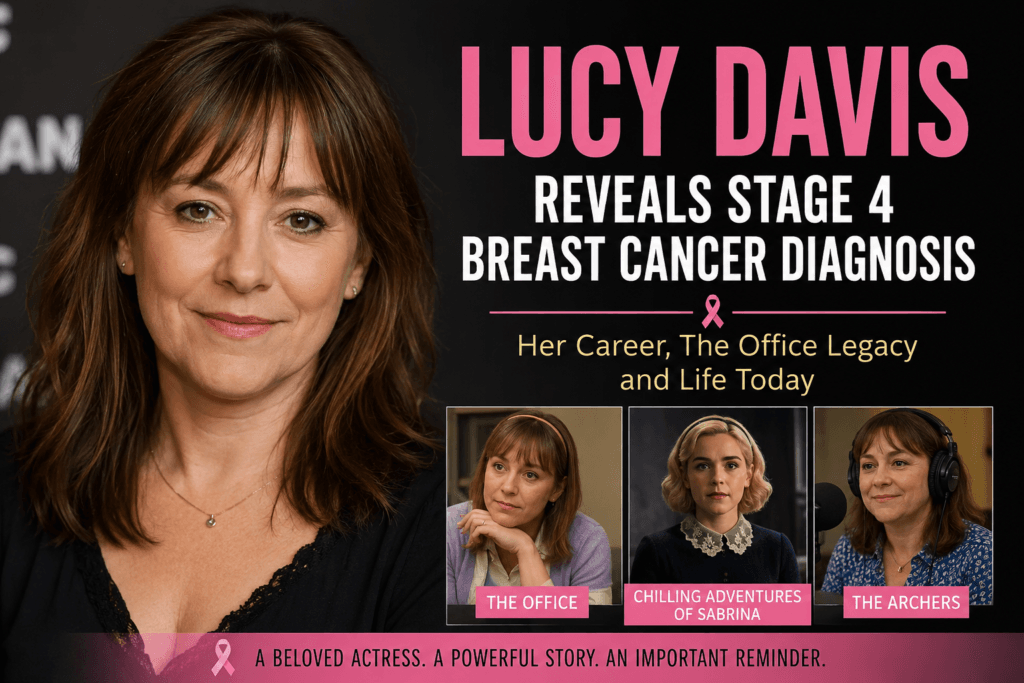
Lucy Davis has spent more than two decades building a career across British television, film, radio and international productions. For many viewers, she remains closely associated with Dawn Tinsley, the quietly funny receptionist she played in the original UK version of The Office. However, her work has extended far beyond the Wernham Hogg paper office.
In August 2026, Davis became the subject of widespread attention for a deeply personal reason. The actress revealed that she has been living with stage four breast cancer, which has spread to her bones. She said the diagnosis came around a year and a half earlier and explained that her illness is now considered incurable.
Her announcement has prompted fans to revisit her career while also focusing attention on the message she chose to share. Rather than presenting herself only through the lens of illness, Davis spoke about humor, independence, family, acting and the importance of continuing to find meaning in everyday life.
That distinction matters. Lucy Davis is not simply a familiar face from The Office. She is an established performer whose career includes comedy, drama, radio and genre television. Her latest public statement has added a difficult new chapter to that story, but it does not erase everything that came before it.
Who Is Lucy Davis?
Lucy Davis is a British actress best known internationally for playing Dawn Tinsley in the original UK version of The Office. Born in 1973, she is the daughter of comedian Jasper Carrott, and entertainment was therefore part of her family background from an early age. However, Davis established her own identity as a performer through a range of screen and radio roles.
Her breakthrough came with The Office, the BBC mockumentary created by Ricky Gervais and Stephen Merchant. The series followed employees at the fictional Wernham Hogg paper company in Slough. Davis played Dawn, a receptionist whose understated personality contrasted with the exaggerated behavior around her.
The role became especially memorable because of Dawn’s relationship with Tim Canterbury, played by Martin Freeman. Their slow-moving connection became one of the emotional threads running through the series. Even though The Office relied heavily on awkward comedy, Dawn’s story gave the show moments of genuine tenderness.
However, Davis did not remain tied to one sitcom. She later appeared in movies such as Shaun of the Dead and took on television roles that introduced her to audiences outside Britain. Her credits eventually included Netflix’s Chilling Adventures of Sabrina, where she played Hilda Spellman.
She also spent years working in radio drama. Davis played Hayley Jordan on BBC Radio 4’s The Archers for nearly a decade, demonstrating the breadth of her work beyond television.
Lucy Davis and the Lasting Impact of The Office
The popularity of The Office has ensured that Lucy Davis remains connected to the series more than 20 years after its original run.
The British sitcom first aired in 2001 and quickly became influential because of its mockumentary approach, uncomfortable humor and unusually natural performances. Davis was part of the central ensemble from the beginning, playing Dawn alongside Ricky Gervais, Martin Freeman and Mackenzie Crook.
Dawn’s character worked because she rarely needed to dominate a scene. Her reactions, expressions and quiet exchanges with colleagues often communicated more than a traditional sitcom speech might have done.
That subtle style also helped make the Dawn-Tim storyline memorable. Their relationship was built gradually rather than through constant dramatic declarations. As a result, viewers could recognize the uncertainty, frustration and hope in their situation.
The show’s 25th anniversary in 2026 has also brought renewed attention to its original cast. BBC programming celebrating the milestone has revisited the series and its lasting cultural influence, once again placing Davis among the performers who helped make the sitcom distinctive.
For longtime fans, that timing makes the news about Davis especially emotional. The actress had recently been part of renewed discussion around a series that remains important to television history. Yet her current story is ultimately about her life rather than simply her most famous character.
Lucy Davis’ Career Beyond The Office
One reason Lucy Davis continues to attract interest is the variety of her work after The Office. A performer can become strongly identified with a breakthrough role, especially when that role belongs to a culturally important television series. Davis, however, continued to explore different characters and formats.
Lucy Davis is also an example of how an actor’s public identity can evolve beyond one recognizable role. Anna Osceola’s career and growing public profile provide another example of how audiences can become interested in performers through different projects and personal milestones.
Her film credits include Shaun of the Dead, the Edgar Wright-directed horror comedy starring Simon Pegg and Nick Frost. The movie became a major part of modern British comedy and helped further establish Davis within the country’s comedy scene.
She later moved into more genre-focused television. International viewers may recognize her from Chilling Adventures of Sabrina, the Netflix series inspired by the Archie Comics character. Davis played Hilda Spellman, one of the show’s central adult characters.
Lucy Davis’ Work Across Different Formats
Her role as Hilda allowed Davis to demonstrate a different side of her performance style. While Dawn Tinsley depended heavily on restrained reactions and observational humor, Hilda belonged to a supernatural world filled with witches, monsters and dark comedy.
Davis has also worked in radio, including her lengthy association with The Archers. Radio acting requires a different skill set because performers cannot rely on facial expressions, costumes or visual settings to communicate character.
Together, these roles show why it would be limiting to describe Davis only as the actress who played Dawn. Her career has moved across several forms of storytelling, and acting itself has remained an important part of her identity.
Lucy Davis in Film, Television and Radio
Davis’ career can be understood through three major areas: television comedy, film and radio drama.
| Area | Notable work | Why it matters |
|---|---|---|
| Television | The Office | Established her as Dawn Tinsley |
| Film | Shaun of the Dead | Expanded her comedy film profile |
| Television | Chilling Adventures of Sabrina | Introduced her to a global Netflix audience |
| Radio | The Archers | Showcased her long-form voice acting |
| Television and film | Other supporting roles | Demonstrated her range beyond one signature character |
This variety also helps explain why news about Davis has reached audiences who may know her from completely different projects.
Someone might remember her from The Office. Another viewer might know her from Sabrina. A film fan might recognize her from Shaun of the Dead. Radio listeners may associate her with The Archers.
That broad audience has given her recent announcement a reach that extends well beyond fans of one television show.
Lucy Davis Reveals Her Stage Four Breast Cancer Diagnosis
In August 2026, Lucy Davis publicly revealed that she had been diagnosed with stage four breast cancer approximately a year and a half earlier.
She said the cancer had spread to her bones, including her spine, right hip and ribs. Davis also explained that her condition had reached a point where chemotherapy was no longer an option.
The revelation came through a personal social media message rather than through a traditional entertainment interview. That choice gave Davis control over how she wanted to communicate something intensely private.
Her announcement was striking not only because of the diagnosis but also because of the way she discussed it. She acknowledged pain and mobility difficulties while making clear that she did not want her identity reduced to being a patient.
Davis explained that standing or walking for extended periods can be difficult and that she sometimes uses a wheelchair. At the same time, she described herself as focused on making the most of the life she has ahead of her.
Her comments have since been reported widely by international entertainment and news organizations.
However, it is important to distinguish between reporting her diagnosis and speculating about her future. Davis has shared her own understanding of her condition. Her medical situation should not be turned into predictions that she has not made herself.
What Lucy Davis Said About Living With Cancer
The most notable part of Davis’ announcement was arguably not the medical information. It was her perspective on how she wants to live.
She described humor as an important part of coping with what she is experiencing. She also said that she wants friends and family to continue treating her as a person rather than constantly treating her as someone who is ill.
That perspective gives her announcement a different emotional tone from a conventional celebrity health statement.
Davis did not suggest that cancer is easy. On the contrary, she acknowledged significant physical pain. Yet she also made space for humor, gratitude and ordinary human connection.
She has said that she wants to continue working when possible. She also intends to remain involved in animal-rights causes. Acting, she explained, remains one of the greatest joys of her life.
Her approach is therefore not about pretending that the diagnosis does not exist. Instead, it is about refusing to let the diagnosis become the only story people tell about her.
That distinction may be one reason the announcement has resonated so strongly with audiences.
Why Lucy Davis’ Message Has Resonated With Fans
Celebrity health news often becomes focused on medical details. In Davis’ case, however, public attention has also centered on her attitude.
Fans have responded to the contrast between the seriousness of her diagnosis and her determination to preserve humor and independence. Her message reflects a desire to remain recognizable to the people who have known and loved her work, rather than becoming defined entirely by sympathy.
That does not mean audiences should ignore the seriousness of stage four cancer. Instead, it shows that compassion can coexist with respect for someone’s personality.
For Davis, humor appears to be part of that personality.
Her approach also highlights an important point about celebrity reporting. Public figures may share deeply personal information, but they remain people with boundaries. A diagnosis can generate legitimate public interest, yet it does not make every detail of someone’s private life public property.
In Davis’ case, she chose to share enough information to explain what she has been experiencing. She also communicated how she would like others to respond.
That makes her own words particularly important when discussing the story.
A Reminder Not to Ignore Changes in Your Health
Davis also used her announcement to encourage people to take changes in their bodies seriously.
She described the initial breast change she noticed as small and easy to dismiss. According to reports on her statement, she almost decided not to have it checked.
That detail has become an important part of the wider conversation surrounding her diagnosis.
It should not, however, be interpreted as medical advice specific to one person’s experience. Breast changes can have many causes, and only a qualified healthcare professional can determine what an individual symptom means.
The broader lesson is simpler: people should not routinely ignore unexplained changes in their bodies.
For anyone who notices a new or unusual breast change, seeking professional medical advice is a sensible step. Early evaluation can help doctors understand what is happening and determine whether further testing is necessary.
Davis’ experience has therefore prompted a conversation that extends beyond celebrity news. It has also encouraged people to pay closer attention to their health while recognizing that every person’s medical circumstances are different.
Lucy Davis’ Approach to Humor, Family and the Future
Perhaps the most personal aspect of Davis’ announcement is her description of the role humor has played in her life.
She has spoken about wanting friends and family to continue joking with her instead of constantly behaving as though she is fragile. That request reflects something larger than a preference for comedy. It suggests that normality can become meaningful when serious illness changes everyday life.
Davis has also spoken openly about the emotional impact her diagnosis has on the people around her.
She described herself as being at peace with what may come next, while recognizing that her family may experience grief differently. She also mentioned her late dog, Gracie, in a deeply personal reflection about death and what she believes follows it.
Those comments reveal a perspective that is more philosophical than sensational.
Instead of focusing only on fear, Davis has chosen to talk about acceptance, relationships and the value of the time that remains.
That does not make her situation less difficult. Rather, it shows how differently people can respond to life-changing news.
For audiences who have followed Davis since The Office, the message offers a reminder that the person behind a beloved character has a life, history and perspective of her own.
Lucy Davis and the Dawn Tinsley Legacy
For many viewers, Lucy Davis will always be connected to Dawn Tinsley. The character was introduced as the receptionist at Wernham Hogg, the fictional paper company at the center of The Office. Yet Dawn was never simply a background employee.
She represented one of the show’s quieter emotional stories. While David Brent’s behavior created much of the comedy and Gareth Keenan supplied another layer of awkwardness, Dawn often reacted to the strange world around her with a mixture of patience, frustration and dry humor.
That restraint made her memorable.
Dawn was also living a life that did not quite match the future she imagined for herself. She had artistic ambitions, but her circumstances kept her tied to a job she did not particularly love. Her relationship with Lee added another complication, because the stability of that relationship did not necessarily mean she felt completely fulfilled.
Against that background, her connection with Tim Canterbury became one of the show’s most recognizable storylines.
Lucy Davis played the character without turning Dawn into a conventional romantic lead. Instead, her feelings emerged through small reactions and understated moments. That approach suited the mockumentary format because viewers were often left to interpret what a character was thinking rather than having every emotion explained.
More than two decades later, that subtle performance remains an important part of Davis’ screen legacy.
Why Dawn Tinsley Still Matters
The popularity of Dawn Tinsley also says something about the lasting appeal of The Office.
The series did not depend entirely on traditional sitcom formulas. It found comedy in uncomfortable conversations, workplace boredom, social insecurity and the strange relationships people develop with colleagues.
Dawn fit naturally into that environment.
She was not the loudest person in the room. In fact, her quietness often made her scenes more effective. Her expressions could communicate irritation, embarrassment or affection without lengthy dialogue.
That style also helped audiences connect with her situation. Many people understand the feeling of being stuck in a job while wondering whether life should be moving in another direction.
Her relationship with Tim added another layer because it was built around possibility rather than certainty. Tim clearly had feelings for Dawn, but circumstances kept getting in the way. Dawn’s engagement to Lee created a barrier, while her own uncertainty made the situation even more complicated.
The eventual resolution became one of the most satisfying elements of the show’s Christmas specials.
For Davis, that means one of her earliest major television performances remains one of the roles most strongly associated with her name.
Lucy Davis and Tim Canterbury’s Story
The relationship between Dawn and Tim became memorable because The Office allowed it to develop slowly.
Tim Canterbury, played by Martin Freeman, was one of the few employees who seemed fully aware of how strange the Wernham Hogg environment could be. His humor often served as a defense mechanism, particularly when dealing with Gareth.
Dawn, meanwhile, understood Tim’s personality and seemed comfortable around him. Their friendship carried an emotional undercurrent that viewers could notice even when neither character openly discussed it.
However, the situation was complicated. Dawn was engaged to Lee, and she had built a life around that relationship. At the same time, she had artistic interests that had been placed on hold.
This created a story about more than romance.
It was also about choosing between security and personal happiness.
By the time the Christmas specials arrived, the emotional tension had built naturally. Dawn’s eventual decision gave the series an ending that felt personal rather than artificially dramatic.
That is one reason the storyline has remained part of discussions about the best television romances.
The performances also deserve credit. Davis and Freeman did not need exaggerated scenes to communicate what their characters felt. Their chemistry depended heavily on pauses, glances and awkward conversations.
For Davis, the role demonstrated that comedy could contain genuine emotional depth.
Lucy Davis’ Work After The Office
Although The Office became Davis’ defining early television role, her career did not stop when the sitcom ended.
She continued taking roles across film and television, gradually moving into different genres and styles. That career path matters because it shows how easily an actor can become trapped by the popularity of one character.
Davis avoided that problem by continuing to work.
One of her notable film appearances came in Shaun of the Dead, Edgar Wright’s 2004 horror-comedy. The movie combined British humor with a zombie story and became a major part of the modern British comedy landscape.
Davis later reached another international audience through Netflix’s Chilling Adventures of Sabrina. She played Hilda Spellman, one of the Spellman sisters and a recurring presence throughout the supernatural series.
The contrast between Dawn and Hilda is particularly interesting.
Dawn belonged to a realistic workplace comedy. Hilda existed in a supernatural world involving witches, dark magic and monsters. The roles required very different tones, yet Davis was able to bring warmth and comic timing to both.
Her work also extended into radio. She spent years playing Hayley Jordan in BBC Radio 4’s long-running drama The Archers, giving her another platform beyond screen acting.
Together, these projects demonstrate that Davis’ career cannot be reduced to one sitcom.
From British Comedy to International Television
Davis’ career illustrates how performers from British television can build surprisingly broad international profiles.
The Office gave her early recognition, but later projects introduced her to audiences who might never have watched the original BBC sitcom.
Shaun of the Dead reached a global film audience. Chilling Adventures of Sabrina benefited from Netflix’s international distribution. Meanwhile, radio allowed Davis to remain part of a long-running British storytelling tradition.
That variety is significant when considering her public profile today.
A younger audience may know Davis primarily as Hilda Spellman. Film fans may remember her from Shaun of the Dead. Fans of British television may immediately think of Dawn Tinsley.
These different connections demonstrate the longevity of her work.
They also make her recent health announcement more complicated than a simple celebrity headline. People are responding not only to a diagnosis but also to the news about an actress whose performances have been part of their lives at different stages.
That emotional connection is particularly strong when a performer has appeared in projects that audiences return to repeatedly.
In Davis’ case, The Office continues to attract new viewers, while her later work remains available to international audiences through streaming and other platforms.
Her career therefore continues to introduce her to people who may discover her work years after the original productions were released.
Lucy Davis’ Role in Chilling Adventures of Sabrina
One of Davis’ most recognizable later roles was Hilda Spellman in Chilling Adventures of Sabrina.
The Netflix series presented a much darker interpretation of the famous Sabrina character than earlier television adaptations. Davis played Hilda as a warm, compassionate and often humorous witch whose relationship with her family provided an important emotional counterpoint to the show’s darker material.
The role also gave Davis an opportunity to work within an ensemble that included Kiernan Shipka, Miranda Otto and Michelle Gomez.
For audiences who discovered her through the series, Davis was not primarily Dawn from The Office. She was Hilda.
That difference highlights how an actor’s public identity can change across generations.
Davis’ performance brought a gentle quality to a show that frequently dealt with death, danger and supernatural conflict. Hilda could be eccentric, but she was also protective and affectionate.
The character became an important part of the show’s family dynamic.
That role helped establish Davis’ continued relevance outside traditional British comedy. It also demonstrated her ability to fit naturally into a stylized genre production without losing the warmth that had characterized many of her earlier performances.
In retrospect, Hilda represents another stage in a career built around adapting to very different kinds of storytelling.
Lucy Davis and Her Long Radio Career
Television and film often receive the most attention when actors are discussed, but Davis’ radio work deserves recognition as well.
Her involvement with The Archers gave her a long-running role in one of Britain’s best-known radio dramas. Davis played Hayley Jordan for almost a decade, according to reporting following her recent announcement.
Radio requires performers to communicate character without visual cues.
There is no costume for the audience to see. There is no facial expression to convey uncertainty. There is no camera close-up to emphasize a reaction.
Instead, voice, timing and delivery carry much of the emotional responsibility.
Davis’ experience across television and radio therefore demonstrates a useful aspect of her career: she has never been dependent on one particular medium.
Her work has moved between scripted comedy, feature films, fantasy television and audio drama.
That breadth is easy to overlook when one role becomes culturally dominant.
For Davis, however, the wider body of work provides a more complete picture.
Dawn Tinsley may be the character that first comes to mind for many viewers, but it is only one chapter in a career that has continued for decades.
What Lucy Davis’ Cancer Announcement Means for Her Career
Davis’ cancer announcement has inevitably changed the public conversation surrounding her.
Before August 2026, discussions about her career largely centered on The Office, Chilling Adventures of Sabrina, Shaun of the Dead and other performances.
Now, her health has become part of the public story.
However, there is a danger in allowing a medical diagnosis to replace the rest of a person’s identity.
Davis herself has pushed against that idea. She has spoken about wanting to remain connected to humor, friendship, acting and the causes that matter to her. She has also said that she wants people close to her to treat her normally rather than constantly seeing her through the lens of illness.
That perspective is important.
Her announcement does not erase the actress audiences have known for years. Instead, it adds another dimension to an already substantial life and career.
Davis has also indicated that she hopes to continue acting when she can. She has described performing as one of the things she loves most, suggesting that creative work remains meaningful to her even while she deals with serious physical challenges.
For fans, that may be one of the most significant parts of her message.
They are not simply being asked to remember an actress for what happened to her. They are being reminded to appreciate the work she has already created while respecting her wishes about how she wants to live now.
Why Her Story Goes Beyond Celebrity News
The reaction to Davis’ diagnosis has also demonstrated how quickly entertainment stories can become human stories.
People who watched The Office may remember Dawn’s quiet humor. Others may remember Hilda from Sabrina. Some may know Davis from her film work or radio performances.
Those memories can make a difficult announcement feel surprisingly personal.
Yet the most respectful response is not to turn that emotion into speculation.
Davis has shared information about her diagnosis because she wanted to. She has also explained how she would like to approach the time ahead.
That gives audiences a clear framework: listen to what she has actually said, recognize the seriousness of her condition, and allow her to remain the person she has always been.
Her story is therefore not simply about cancer.
It is about an actress reflecting on her life, finding humor during an extraordinarily difficult period, and continuing to value the things that have given her purpose.
That is a much fuller story than a headline alone can convey.
Lucy Davis’ Message About Not Ignoring Health Changes
Another important element of Davis’ announcement concerns the physical change she initially noticed.
According to reports about her statement, she described the original breast abnormality as a small hard area rather than the kind of obvious lump people might expect. She said she nearly decided not to have it investigated.
That experience led her to encourage others not to dismiss unusual changes. Her story should not be used to diagnose symptoms or predict what another person may be experiencing. Breast changes can have many possible explanations, and professional medical assessment is necessary to determine the cause.
Still, the broader message is valuable. People sometimes delay appointments because a symptom seems too minor to matter. They may wait because they feel healthy otherwise, because they are busy, or because they hope the change will disappear.
Davis’ experience illustrates why paying attention to unexpected changes can matter. At the same time, health awareness should not automatically create fear.
Celebrity Health Stories and Public Awareness
Celebrity health stories can also lead to wider conversations about body image, physical changes and personal choices. Chrissy Metz’s weight-loss journey and GLP-1 update offers another example of how an actor’s health-related experiences can become part of a much broader public discussion.
Being attentive to your body does not mean assuming every change is cancer. Instead, it means giving unexplained changes enough attention to discuss them with an appropriate healthcare professional.
That distinction is important because awareness and anxiety are not the same thing. Davis’ experience can encourage readers to take unusual changes seriously without suggesting that every physical difference has the same explanation.
Her decision to speak publicly about that part of her experience may therefore have an impact beyond entertainment coverage. For many readers, the most useful takeaway may simply be a reminder to take their own health concerns seriously.
Lucy Davis’ Personal Outlook After Her Diagnosis
Lucy Davis’ recent public comments have attracted attention because they reveal a perspective that goes beyond the medical facts of her diagnosis.
She has acknowledged that stage four cancer has changed her physical life. However, she has also made it clear that she does not want every conversation about her to revolve around illness.
That distinction appears throughout the way she has spoken about the future.
Davis has described continuing to value friendship, family, humor, animals and acting. Those interests may sound ordinary, but their importance becomes clearer when someone is facing a serious and potentially life-shortening illness.
Instead of presenting her future entirely in terms of medical treatment, Davis has talked about how she wants to spend her time.
That approach gives her announcement a deeply personal quality.
She is not offering a universal formula for dealing with cancer. Rather, she is describing what matters to her.
For Davis, that includes remaining connected with people who know her well and preserving the parts of her personality that existed long before her diagnosis.
Her comments also challenge the tendency to separate illness from everyday life. Someone can experience pain and uncertainty while still enjoying a joke, wanting to work, caring about animals or looking forward to seeing friends.
Those realities can exist at the same time.
That may be one of the most important aspects of Davis’ message. She has not suggested that her diagnosis is insignificant. Instead, she has resisted allowing it to become her entire identity.
Lucy Davis on Humor During a Difficult Period
Humor has been an important part of Davis’ public image throughout her career.
From Dawn Tinsley’s understated reactions in The Office to her work in comedy films and later television, she has repeatedly been associated with performances that depend on timing, warmth and wit.
It is therefore unsurprising that humor also appears in the way she talks about her current circumstances.
Davis has explained that she wants people around her to continue joking with her rather than constantly treating her as someone who needs to be protected from normal conversation.
That request is revealing.
When someone becomes seriously ill, friends and relatives may become uncertain about what they should say. They can become overly cautious because they fear causing offense or making the person uncomfortable.
Davis appears to prefer something different.
She wants room for ordinary interaction.
That does not mean making light of cancer itself. Instead, it means allowing humor to remain part of a relationship.
For someone whose career has been built partly on comedy, that can be particularly meaningful.
Humor does not remove pain. It can, however, provide moments of normality and connection.
Davis’ comments suggest that she values those moments.
Lucy Davis and Her Family’s Experience
Davis has also spoken about how her illness affects the people close to her.
A serious diagnosis rarely affects only one individual emotionally. Family members and close friends may experience fear, sadness and uncertainty while trying to remain supportive.
Davis has recognized that reality in her own comments.
She has described herself as having reached a degree of acceptance about what lies ahead, while acknowledging that people who love her may not experience the situation in exactly the same way.
That difference is important.
Acceptance does not mean that everyone around a person will immediately feel the same way. Families can process difficult news at very different speeds.
Davis’ reflections suggest that she understands this emotional divide.
Her comments about her late dog, Gracie, also provided insight into how she thinks about death and what may come afterward. Rather than turning the subject into something sensational, she spoke about it through a deeply personal memory. (theguardian.com)
That detail gives her statement an unusually intimate quality.
It shows that her thoughts about mortality are not limited to fear. They are also connected to memories, relationships and ideas about what happens after life.
For readers, those reflections may be moving precisely because they are personal rather than performative.
Why Family Support Matters in Davis’ Story
Davis’ comments also highlight how support can take different forms.
Some people may want constant reassurance. Others may prefer practical help. Some may want serious conversations, while others may need opportunities to laugh and discuss completely ordinary subjects.
There is no single correct emotional response.
Davis appears to have communicated her own preference clearly: she wants to remain herself.
That means continuing to have conversations that are not about cancer. It means maintaining relationships based on affection and familiarity rather than sympathy alone.
This is particularly relevant for someone who has spent decades in public life.
Audiences often see celebrities through carefully selected photographs, interviews and performances. Family members, however, know the person behind those public images.
They understand the ordinary habits and private jokes that existed long before a diagnosis became public.
Davis’ wish to preserve those ordinary connections therefore makes sense.
Her story reminds readers that serious illness can change circumstances without necessarily changing every part of a person’s personality.
People can still want laughter, companionship and normal conversations even when their physical circumstances have become extraordinarily difficult.
Lucy Davis Wants to Keep Acting
One of the clearest indications that acting remains important to Davis is her stated desire to continue working when possible.
She has described acting as one of the things she loves most. Reports following her announcement have noted that she hopes to keep acting and remain involved in creative work.
That desire fits naturally with the career she has built.
Davis has worked consistently across television, film and radio. Acting has not simply been a short chapter in her life; it has been a major part of her identity for decades.
Her wish to continue is therefore about more than employment.
Creative work can provide purpose, routine and connection. For performers, it can also offer the chance to inhabit someone else’s perspective for a while, temporarily shifting attention away from personal circumstances.
Davis has not suggested that she knows exactly what work will look like in the future.
Her physical condition has affected her mobility, and she has explained that prolonged standing or walking can be difficult.
However, modern productions can accommodate performers in many different ways.
The important point is that Davis still wants to create.
That desire offers another reason not to view her career only in the past tense.
The Meaning of Work for Lucy Davis
For Davis, acting appears to represent both creativity and identity.
Audiences often think about an actor’s work in terms of entertainment. For the performer, however, a role can involve preparation, collaboration, friendship and a sense of belonging.
Film and television sets bring together large groups of people. Rehearsals create routines. Characters provide creative challenges. Even small roles can become meaningful experiences.
Davis’ long career has likely included many such relationships.
Her desire to continue acting therefore suggests that she does not see creativity as something that belongs only to the period before her diagnosis.
Instead, it remains part of the life she wants to lead now.
That perspective also explains why fans have responded emotionally to her announcement.
People who discovered Davis through The Office may remember her as Dawn. Those who watched Sabrina may picture Hilda. Others may associate her with different performances.
All of those roles represent different moments in her professional life.
Her hope to continue working means there may still be opportunities for audiences to see new performances from her, depending on her health and circumstances.
Lucy Davis and Her Love of Animals
Another part of Davis’ public comments concerns her connection to animals.
She has spoken about animal-rights work as something she wants to continue. That interest adds another dimension to the way she has described her priorities.
Public figures sometimes become associated with charitable causes through formal campaigns or major organizations. Davis’ comments suggest something more personal: animal welfare is among the subjects she genuinely cares about.
Her late dog Gracie also featured in her reflections about death and what may come afterward. (theguardian.com)
For many pet owners, animals become part of the emotional structure of everyday life. They provide companionship without asking people to explain themselves.
That can be particularly meaningful during difficult periods.
Davis’ mention of Gracie therefore gives readers another glimpse of the person behind the actress.
It also reinforces a broader theme in her announcement: she continues to think about relationships and the things that bring meaning to life.
Her priorities are not limited to career achievements.
They include the people and animals she has loved, the causes she supports, and the everyday experiences she still wants to enjoy.
How Fans Are Remembering Lucy Davis’ Career
Following Davis’ announcement, public discussion has naturally returned to her most memorable performances.
For The Office fans, Dawn Tinsley has become the center of many conversations. The series has remained popular long after its original broadcast, and new generations continue to discover the British version.
That means Davis’ work is still being encountered by viewers who were not necessarily alive when the show first aired.
The timing is also notable because 2026 marks the 25th anniversary of The Office. Anniversary coverage has brought renewed attention to the original series and its cast.
As a result, conversations about Davis are occurring within a wider moment of nostalgia.
Fans are revisiting old episodes while learning new information about the actors who created them.
That can create a strange emotional experience.
A familiar comedy may suddenly feel different when viewers know more about the life of one of its performers.
Yet Davis’ work remains what it always was.
Dawn is still the same character. The jokes remain the same. The performances continue to exist independently of the circumstances of the actors’ lives.
At the same time, knowing more about Davis can make audiences appreciate the human being behind the performance.
Why The Office Continues to Introduce Lucy Davis to New Audiences
Streaming has changed the lifespan of television shows.
A series no longer disappears when its original broadcast ends. Older programs can return to public attention whenever they become available on a major platform or receive anniversary coverage.
The Office is a strong example.
The British series influenced later workplace comedies and inspired the highly successful American adaptation. Its characters and scenes remain part of television discussions years after the original episodes aired.
Davis benefits from that continuing cultural presence.
Someone discovering The Office today can encounter Dawn Tinsley without having any connection to early-2000s British television.
That means her performance continues to find new viewers.
The same principle applies to her later work.
Chilling Adventures of Sabrina remains available to audiences who may have no particular connection to The Office. As a result, Davis’ career exists across several generations of television viewers.
Her current public profile therefore comes from a combination of nostalgia and continued accessibility.
The Difference Between Sympathy and Respect
Davis’ announcement also raises an important question about how audiences should respond when a public figure shares serious health news.
Sympathy is natural.
Fans may feel sadness, shock or concern when they learn that an actor they admire is living with an incurable illness.
However, Davis’ own comments suggest that she wants something beyond sympathy.
She wants people to remember that she remains a complete person.
That means respect matters just as much as compassion.
Respect involves listening to what she has actually chosen to share rather than filling gaps with speculation. It means avoiding assumptions about her treatment, prognosis or private life.
It also means recognizing that public disclosure does not eliminate personal boundaries.
Davis has made her diagnosis public. That does not mean every detail surrounding it is automatically available for public discussion.
The distinction is especially important in the age of social media, where personal news can spread within minutes.
A thoughtful response focuses on the information she has provided and the values she has emphasized.
In Davis’ case, those values include humor, relationships, creativity and living as fully as possible.
Why Her Own Words Matter
Health stories involving celebrities can quickly become distorted as they move across social media.
A short headline may omit important context. A social post may be summarized inaccurately. A comment from one interview may be presented as though it represents someone’s entire outlook.
That is why Davis’ own statement remains the most important source for understanding how she feels.
News organizations can provide context and report verified information. However, personal statements can explain emotions and intentions that a headline cannot capture.
In Davis’ case, her message communicates both the seriousness of her condition and the way she wants to approach life.
Those two elements should be kept together.
Reporting only the diagnosis creates a bleak and incomplete picture. Focusing only on her positive attitude can also minimize the seriousness of what she is experiencing.
A balanced account recognizes both realities.
She is living with advanced cancer, and she is also continuing to value humor, relationships, creativity and the possibility of working.
That complexity is what makes her story human.
What Lucy Davis’ Story Says About Living With Serious Illness
Davis’ experience should not be turned into a universal lesson about how everyone should respond to serious illness.
People cope differently.
Some want to talk openly. Others prefer privacy. Some find humor helpful. Others do not. Some continue working, while others need to step away completely.
There is no single correct response.
What makes Davis’ story meaningful is that she has articulated what works for her.
She wants to maintain a sense of normality. She wants to laugh. She wants to remain connected to people she loves. She wants to act when she can. She wants to support causes that matter to her.
Those priorities provide a picture of how one person is navigating an extraordinarily difficult period.
They also explain why the story has resonated beyond the entertainment industry.
The public may have first encountered Davis through comedy, but her latest message is not really about celebrity.
It is about identity.
A diagnosis can become the first thing people think about when they hear someone’s name. Davis’ comments push back against that tendency.
She is still an actress.
She is still a friend and family member.
She is still someone who enjoys humor.
She is still connected to the causes she cares about.
And she is still the performer whose work has given audiences memorable characters over the course of her career.
Lucy Davis’ Legacy Is Larger Than One Diagnosis
The most useful way to understand Lucy Davis’ story is to view her recent diagnosis as one part of a much larger life.
Her career began long before the current headlines.
She became known to millions through The Office. She appeared in successful films. She took on television roles in completely different genres. She worked in radio. She developed an international audience.
Dawn Tinsley remains an especially important part of that legacy, but it is not the whole story.
Her role as Hilda Spellman introduced her to another generation. Her film work gave her a place in British comedy. Her radio career demonstrated another side of her acting ability.
Now, her public comments have added a deeply personal chapter.
That chapter is painful, but it does not need to define everything that came before it.
Davis’ own approach suggests that she wants to be remembered for living rather than simply for being ill.
That means continuing to laugh, work, care about animals, spend time with loved ones and appreciate the experiences that remain possible.
For audiences, the best response may be to honor that perspective.
Remember Dawn.
Remember Hilda.
Remember the films and radio work.
But also remember the person who has made it clear that she wants to remain herself.
That may ultimately be the most fitting way to understand Lucy Davis in 2026.
Lucy Davis in 2026: What We Know Now
Lucy Davis’ public announcement in August 2026 has added a new and deeply personal chapter to the story of an actress whose career has already lasted for decades.
Davis revealed that she has been living with stage four breast cancer for around 18 months. She said the cancer has spread to her bones, including areas of her spine, hip and ribs. She also explained that chemotherapy is no longer an option for her.
The seriousness of that information is clear. However, Davis’ own comments have also made another point clear: she does not want her diagnosis to become the only way people see her.
She continues to value acting, humor, family, friendships and animal-rights work. She has also spoken about wanting to keep working when possible.
That combination of vulnerability and determination has shaped much of the public response.
For fans, the news can feel especially emotional because Davis has spent years creating characters associated with warmth and comedy. Yet the actress herself has approached the subject without presenting a false sense of certainty.
Instead, she has talked openly about pain, mobility challenges and the reality of her diagnosis while also focusing on the time and experiences that remain.
That balance is important when considering her story.
Lucy Davis’ Health Story Should Be Viewed With Care
Celebrity health stories can quickly become distorted when headlines, social posts and online discussions move faster than verified reporting.
In Davis’ case, the core facts come from her own public disclosure and reporting based on that statement. She has said that her breast cancer is stage four and incurable, and that it has metastasized to her bones.
Celebrity health stories often become part of a larger conversation about how performers navigate major changes in their personal lives. Phil Collins’ health and recovery journey is another example of how audiences can become interested in the personal challenges behind a long and influential entertainment career.
Those details should not be expanded into assumptions about her exact prognosis.
Stage four cancer is a serious medical condition, but individual experiences can differ substantially. Treatment decisions depend on factors such as the cancer’s characteristics, previous treatments, overall health and a person’s medical team.
Therefore, Davis’ experience should not be used to predict what will happen to another patient.
It is also important to avoid turning her story into medical advice.
What her announcement can provide is awareness. She has encouraged people to pay attention to changes in their bodies and has spoken about nearly dismissing an unusual breast change before seeking medical attention.
That message is valuable without requiring anyone to assume that a particular symptom means cancer.
For readers, the sensible lesson is straightforward: unexplained or unusual changes deserve appropriate medical attention rather than automatic dismissal.
Why Early Attention Matters Without Creating Fear
Health awareness works best when it encourages action without creating unnecessary panic.
A breast change can have many causes. Not every lump or abnormality indicates cancer. At the same time, people should not assume that something unusual is harmless simply because it seems small.
Davis’ experience illustrates why that distinction matters.
She has described noticing a change that initially seemed easy to overlook. Her decision to discuss it publicly has now encouraged conversations about paying attention to symptoms.
The appropriate response is not fear.
Instead, people can use such stories as reminders to understand their own health, follow recommended screening guidance and speak with healthcare professionals when something unusual appears.
Medical professionals can determine whether testing is necessary and what steps should follow.
Davis’ experience is ultimately one person’s story. It cannot establish a medical rule for everyone.
Still, public figures sharing health experiences can sometimes help people recognize that seeking medical advice is worth doing even when a change initially seems minor.
Lucy Davis’ Legacy as Dawn Tinsley
Even as the conversation around her health continues, Lucy Davis’ professional legacy remains firmly connected to The Office.
Dawn Tinsley was one of the show’s most understated characters, yet her storyline became central to its emotional appeal.
The character’s relationship with Tim Canterbury gave the series a romantic thread that developed without overwhelming the show’s workplace setting.
Dawn also represented something familiar to many viewers: someone who had ambitions outside her job but struggled to move toward them.
That made her more than a romantic character.
She was a person trying to figure out what she wanted from life.
Davis’ performance worked because she rarely overplayed the emotion. Instead, she relied on subtle reactions and natural chemistry with the rest of the cast.
That style remains one reason the original The Office still feels distinctive.
The show has now been part of television culture for more than two decades. Its continued availability has also introduced Davis’ performance to viewers who were not part of its original audience.
As a result, Dawn Tinsley remains an important part of Davis’ legacy.
The Office Is Only One Part of Her Career
Although Dawn is the role most commonly associated with Davis, her career demonstrates considerable variety.
She appeared in Shaun of the Dead, worked in radio drama and later became internationally recognizable as Hilda Spellman in Chilling Adventures of Sabrina.
Each project reached a somewhat different audience.
That matters because it prevents her career from being reduced to nostalgia.
A viewer might know her from British comedy. Another might know her from Netflix fantasy television. Someone else may have encountered her through radio.
Those different audiences have one thing in common: they recognize a performer whose work has crossed formats and genres.
Her career therefore provides a useful reminder of how long an actor’s professional life can extend beyond a single breakthrough role.
Lucy Davis’ Career in Perspective
Looking at Davis’ career as a whole reveals several distinct stages.
First came her rise through British television, culminating in The Office. Then came film and television opportunities that allowed her to move beyond Dawn Tinsley.
Her appearance in Shaun of the Dead connected her to one of the most recognizable British comedy films of its era.
Later, Chilling Adventures of Sabrina introduced her to a new international audience. Her work on The Archers also demonstrated her ability to sustain a character through long-form radio storytelling.
These experiences created a career that is broader than her most famous role suggests.
That is particularly worth remembering now.
When a public figure faces a major personal challenge, audiences can unintentionally begin viewing their entire life through the latest news story.
Davis’ career provides a much richer picture.
She has been a television actress, film performer and radio actor. She has played comedy, drama and fantasy. She has worked with different ensembles and reached different generations.
Her current health situation is an important part of her present story, but it is not the beginning or end of her professional identity.
What Lucy Davis’ Story Means to The Office Fans
For longtime The Office viewers, Davis’ announcement can create an emotional connection that goes beyond celebrity news.
The series is built around ordinary people in an ordinary workplace. Its humor often comes from situations that feel awkwardly recognizable.
Dawn’s story, in particular, deals with uncertainty, relationships and the desire to make a different life.
Those themes can feel more poignant when viewers learn about Davis’ real-life circumstances decades after the show was filmed.
However, there is also value in remembering the joy associated with the character.
Dawn was funny. She was awkward. She was hopeful. She was sometimes frustrated. Her relationship with Tim became one of the show’s most memorable emotional threads.
Those qualities remain part of television history.
Fans do not need to reinterpret every scene through the lens of Davis’ current health.
Instead, they can appreciate the performance while respecting the person who created it.
That distinction allows nostalgia to remain positive rather than becoming intrusive.
Why Dawn Tinsley Remains So Memorable
Dawn’s appeal comes partly from her ordinariness.
She was not a superhero or an extraordinary celebrity character. She was an employee trying to navigate work, relationships and personal ambitions.
That realism helped audiences identify with her.
The character also benefited from Davis’ understated acting style. She could communicate uncertainty without lengthy explanations, which suited the mockumentary format.
As a result, Dawn’s story felt less like a conventional television romance and more like something that might happen between two coworkers.
That realism helped the character endure.
Even years after The Office ended, viewers continue to debate and remember the Dawn-Tim storyline.
For Davis, it remains perhaps the clearest example of how a relatively quiet performance can leave a lasting cultural impression.
Frequently Asked Questions About Lucy Davis
Who is Lucy Davis?
Lucy Davis is a British actress best known for playing Dawn Tinsley in the original UK version of The Office. She has also appeared in Shaun of the Dead, Chilling Adventures of Sabrina and BBC Radio 4’s The Archers.
How old is Lucy Davis?
Lucy Davis is 53 years old as of August 2026. She was born in 1973 and is the daughter of British comedian Jasper Carrott.
What character did Lucy Davis play in The Office?
Davis played Dawn Tinsley, the receptionist at Wernham Hogg in the original British version of The Office. Her character became particularly well known because of her relationship with Tim Canterbury, played by Martin Freeman.
Does Lucy Davis have cancer?
Yes. In August 2026, Davis publicly revealed that she has stage four breast cancer. She said the cancer has spread to her bones and described the condition as incurable.
When was Lucy Davis diagnosed with cancer?
Davis said she had been living with the diagnosis for approximately 18 months when she publicly revealed it in August 2026.
Has Lucy Davis’ cancer spread?
Yes. Davis said her cancer has spread to her bones, including her spine, right hip and ribs.
Is Lucy Davis still acting?
Davis has indicated that she wants to continue acting when she is able. She has described acting as one of the things she loves most.
What other shows has Lucy Davis appeared in?
Beyond The Office, Davis has appeared in projects including Chilling Adventures of Sabrina. She also had a role in Shaun of the Dead and spent years performing as Hayley Jordan in The Archers.
Who played Hilda Spellman in Chilling Adventures of Sabrina?
Lucy Davis played Hilda Spellman in Netflix’s Chilling Adventures of Sabrina. The role introduced her to another large international audience beyond fans of The Office.
Who was Lucy Davis’ character in The Office in love with?
Dawn Tinsley developed a close relationship with Tim Canterbury, played by Martin Freeman. Their slow-building romance became one of the most memorable storylines in the original series.
What did Lucy Davis say about her diagnosis?
Davis spoke about her stage four breast cancer diagnosis while also emphasizing her desire to continue living with humor, maintaining relationships and pursuing the things she loves. She has said she does not want people close to her to treat her solely as a sick person.
Why is Lucy Davis’ cancer announcement receiving so much attention?
Davis is widely recognized because of her role as Dawn in The Office. The announcement therefore reached a large audience of longtime fans, while her candid comments about humor, mortality and continuing to live meaningfully added a strong human-interest dimension to the story.
The Broader Lesson From Lucy Davis’ Story
Lucy Davis’ story ultimately reaches beyond television.
Her career demonstrates the lasting power of a well-played character. Dawn Tinsley remains memorable because Davis brought an understated authenticity to the role.
Her later work demonstrates that a successful career can continue evolving after a breakthrough performance. From film to Netflix television and radio, Davis continued exploring different forms of acting.
Now, her personal story has brought attention to another side of her life.
Her decision to speak openly about stage four breast cancer has encouraged conversations about health, mortality, relationships and the importance of not ignoring unusual physical changes.
At the same time, her approach offers a reminder that serious illness does not erase personality.
Davis still wants to laugh.
She still wants to act.
She still cares about animals.
She still values her relationships.
Those details matter because they show the difference between describing someone’s medical condition and describing the person who happens to be living with it.
For fans, that may be the most meaningful way to approach her story.
Why Lucy Davis’ Story Is About More Than Cancer
It would be easy to write about Davis only in terms of her diagnosis.
But doing so would leave out most of the life and career that made audiences care about her in the first place.
She has spent years entertaining viewers.
She helped create one of the most memorable workplace sitcom characters in British television.
She appeared in major comedy films.
She became part of a globally watched fantasy series.
She worked in radio.
She built a career across multiple formats and generations.
Her cancer diagnosis is now an important part of her public story because she chose to share it. Yet it should not erase those accomplishments.
Davis herself appears to understand that distinction.
Her comments have focused not only on what has happened to her but also on what she still wants from life.
That includes humor, companionship, creativity and the opportunity to keep doing meaningful work.
There is something powerful in that perspective without needing to turn it into an inspirational cliché.
Sometimes the most human response to a difficult situation is simply to acknowledge that life can contain pain and joy at the same time.
Final Thoughts on Lucy Davis
Lucy Davis has built a career that reaches far beyond her best-known role in The Office. As Dawn Tinsley, she became part of a television series that remains popular more than two decades later. Her work in Shaun of the Dead, Chilling Adventures of Sabrina, The Archers and other projects further established her range as a performer.
In 2026, Davis shared deeply personal news about living with stage four breast cancer. She has spoken openly about the physical challenges she faces while also discussing humor, family, acting and the things that continue to give her life meaning.
That perspective is important because Lucy Davis is more than a cancer diagnosis.
She is an actress whose performances have reached different generations of viewers. She is also someone who has chosen to speak honestly about a difficult period while maintaining her sense of personality and independence.
Her story is painful, but it is not defined only by illness. Davis continues to value creativity, relationships, humor and the causes that matter to her.
For fans, remembering her work while respecting her privacy may be the most meaningful response.
Remember the performances. Respect the person. Let Lucy Davis tell her own story.