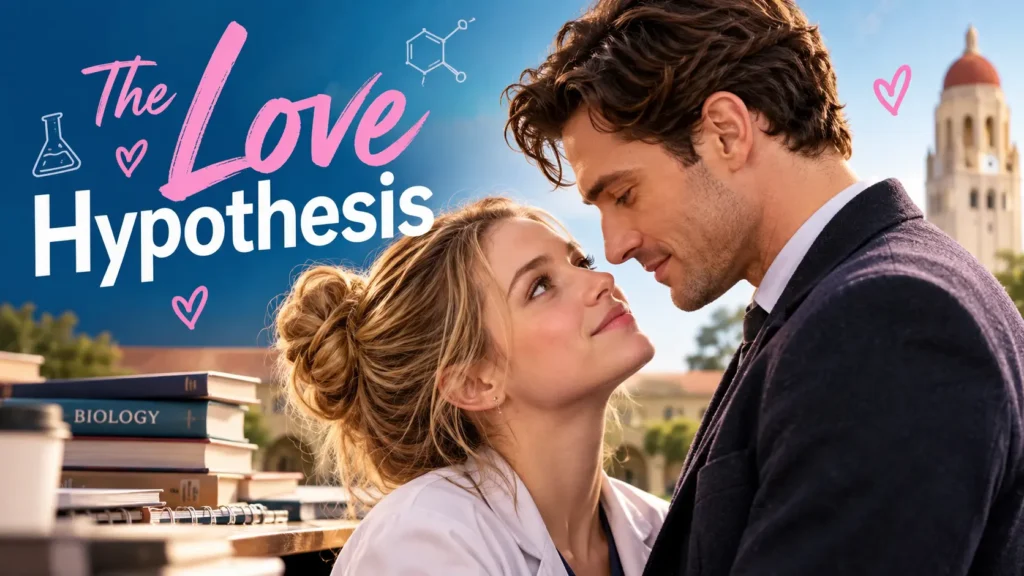
The Love Hypothesis has officially moved from the page to the screen, bringing Ali Hazelwood’s bestselling STEM romance to Prime Video. The 2026 romantic comedy stars Lili Reinhart as Olive Smith and Tom Bateman as Dr. Adam Carlsen, pairing an ambitious biology PhD student with the professor known for his intimidating reputation.
Directed by Claire Scanlon and written by Sarah Rothschild, the movie centers on a fake relationship that gradually becomes much more complicated. Olive never expects her carefully arranged pretend romance with Adam to develop into something real, but their growing connection creates problems neither of them planned for.
For readers familiar with Hazelwood’s novel, the adaptation offers a chance to see one of contemporary romance’s most recognizable couples brought to life. For newcomers, it works as a campus-set romantic comedy built around friendship, ambition, scientific research and unexpected attraction.
However, turning a detailed romance novel into a feature film inevitably requires changes. Characters receive less screen time, storylines become more compact, and some emotional development has to happen faster.
That makes The Love Hypothesis more than a straightforward romance. It is also an adaptation worth examining for how it transforms Olive and Adam’s story from a popular novel into a roughly two-hour movie.
The Love Hypothesis Movie: Quick Overview
The Love Hypothesis follows Olive Smith, a biology PhD student whose academic ambitions become entangled with an unexpected fake relationship. After an impulsive decision involving her best friend, Olive finds herself pretending to date Dr. Adam Carlsen, a professor whose reputation makes him one of the least obvious people for her to choose.
The film is directed by Claire Scanlon, with Sarah Rothschild handling the screenplay. Lili Reinhart leads the cast as Olive, while Tom Bateman plays Adam. Rachel Marsh, Jaboukie Young-White, Nicholas Duvernay and Arty Froushan appear in supporting roles.
The central premise remains recognizable to fans of Hazelwood’s novel: Olive needs a convincing romantic explanation, Adam agrees to help, and their arrangement slowly begins to blur the line between pretending and genuine affection.
The movie also retains the STEM-focused identity that distinguishes Hazelwood’s romance from a conventional campus rom-com. Olive’s scientific career matters to her character, while the academic environment creates additional pressure around the relationship.
At the same time, the adaptation has to condense a much longer novel into a feature-length story. That means viewers can expect the familiar romantic foundation while also encountering changes to supporting characters, pacing and individual story elements.
For first-time viewers, the movie offers a self-contained romantic comedy. For readers, it provides a new interpretation of characters they already know.
If you enjoy romantic stories that blend relationships with a distinctive genre setup, our Practical Magic 2 review also explores how a modern movie sequel balances romance, characters and its larger fantasy world.
What Is The Love Hypothesis About?
At the center of The Love Hypothesis is Olive Smith, a young scientist focused on her research and future career. Romance is not supposed to be her priority, but an awkward situation involving her best friend, Anh, pushes her into an unexpected decision.
Olive needs Anh to believe that she has moved on from a complicated romantic situation. Instead of explaining everything, Olive impulsively creates the impression that she is already dating someone.
That someone becomes Adam Carlsen.
Adam is a professor with a reputation for being demanding, intimidating and difficult to approach. He seems like an especially strange choice for Olive’s pretend relationship, which is exactly what makes the setup work as a romantic-comedy premise.
Adam agrees to the arrangement, and the two establish a relationship that looks genuine from the outside. At first, the arrangement serves a practical purpose for both of them. Neither expects it to become emotionally complicated.
Naturally, things do not remain that simple.
As Olive and Adam spend more time together, their assumptions about each other begin to change. Olive discovers that Adam is very different from the intimidating professor described by everyone around him. Adam, meanwhile, begins to see the intelligence, loyalty and determination behind Olive’s awkward exterior.
The academic setting adds another dimension to their relationship. Olive is not simply searching for romance; she is also trying to establish herself as a scientist and protect the future she has worked toward.
That combination of professional ambition, friendship and fake dating gives The Love Hypothesis its central identity.
The Love Hypothesis Cast and Characters
The movie’s central relationship depends on the contrast between its two leads. Lili Reinhart plays Olive Smith, while Tom Bateman portrays Dr. Adam Carlsen.
Around them, the supporting cast helps build the academic and personal world that surrounds the romance.
| Actor | Character |
|---|---|
| Lili Reinhart | Olive Smith |
| Tom Bateman | Dr. Adam Carlsen |
| Rachel Marsh | Anh Pham |
| Jaboukie Young-White | Malcolm Browne |
| Nicholas Duvernay | Jeremy Langley |
| Arty Froushan | Dr. Thomas Benton |
The supporting characters also matter because Olive’s relationship with her friends is one of the main reasons the fake-dating arrangement begins in the first place.
Rather than treating the romance as a story completely separate from Olive’s professional life, the movie connects her relationships, friendships and academic ambitions.
Lili Reinhart as Olive Smith
Lili Reinhart plays Olive as an ambitious young scientist trying to balance her research, friendships and increasingly complicated personal life.
Olive is intelligent and determined, but she does not always feel confident when dealing with situations outside her academic comfort zone. That contrast becomes an important part of the character. She can be confident when discussing her work yet awkward when dealing with her own emotions.
Her scientific ambitions also give the character a purpose beyond the central romance. Olive wants to build a career in research, and the challenges surrounding that goal affect many of her decisions.
Her friendship with Anh is equally important. The relationship helps explain why Olive agrees to the fake-dating arrangement in the first place. Olive wants to protect someone she cares about, even when that means making her own life more complicated.
Reinhart’s performance has to balance several sides of Olive at once: the serious scientist, loyal friend, awkward romantic lead and woman gradually becoming more confident in herself.
That combination keeps Olive from feeling like a character whose entire purpose is to fall in love. Her professional ambitions remain part of her identity throughout the story.
Tom Bateman as Adam Carlsen
Tom Bateman plays Dr. Adam Carlsen, a professor whose intimidating reputation makes him an unlikely romantic partner for Olive.
Adam initially appears controlled, serious and difficult to approach. His reputation among students creates a sharp contrast with Olive’s more awkward and approachable personality.
That contrast drives much of the movie’s romantic comedy. Olive does not initially see Adam as the obvious choice for a relationship, while Adam seems equally unlikely to fit into her carefully planned life.
The fake relationship gradually changes that perception.
As Olive spends more time with Adam, she begins to discover the person behind his reputation. His relationship with her also reveals a softer and more supportive side that other people may not see.
Bateman therefore has to balance two versions of Adam: the intimidating academic everyone knows and the more vulnerable person Olive gradually gets to know.
That distinction is important to the romance. If Adam remained cold throughout the story, the relationship would be difficult to believe. Instead, the movie uses the contrast between his public image and private personality to create the attraction between the two leads.
The result is a familiar romantic-comedy dynamic: two people who appear completely mismatched slowly discover that their differences may be exactly what brings them together.
The Love Hypothesis Romance: From Fake Dating to Real Feelings
The central appeal of The Love Hypothesis comes from a romantic setup audiences already understand: two people agree to pretend they are together, only to discover that the arrangement may not remain pretend for long.

For Olive and Adam, the arrangement begins as a practical solution. Olive wants Anh to believe she has moved on from Jeremy, while Adam has his own reasons for making the relationship appear genuine. Their agreement gives both characters something they need without requiring either of them to make a real emotional commitment.
That changes as they spend more time together.
The movie uses familiar romantic-comedy beats, including forced proximity, awkward public appearances and moments when the characters reveal more than they intended. Yet the relationship also develops through smaller interactions rather than only major romantic scenes.
Adam gradually becomes less severe around Olive, while Olive becomes more comfortable challenging him. Their conversations give the relationship its playful edge, especially when their academic personalities influence how they understand attraction.
The science-based framing also becomes part of the joke. Olive and Adam are accustomed to analyzing problems logically, but their feelings do not follow the same rules. The more they try to control the experiment, the harder it becomes to separate the planned relationship from genuine emotion.
That tension provides the film with its most familiar romantic-comedy engine: both characters know what they agreed to, but neither can completely predict what happens next.
For another recent romance built around an unusual genre premise, see our Remain movie trailer review, which looks at the supernatural relationship at the center of Jake Gyllenhaal and Phoebe Dynevor’s film.
Why the Fake-Dating Setup Works
The fake-dating premise works because it places Olive and Adam in situations where they must behave like a couple before they actually understand one another.
That creates an unusual shortcut to intimacy. Instead of slowly deciding whether they should talk to each other, the characters have a reason to spend time together from the beginning.
The arrangement also gives the movie room for humor. Olive has to convince other people that Adam is her boyfriend, while Adam has to maintain an image that does not always match his normally reserved personality.
More importantly, the setup creates dramatic irony. Viewers understand that a fake relationship in a romantic comedy rarely stays fake forever. The tension therefore comes less from wondering whether Olive and Adam will fall for each other and more from watching them recognize what is happening.
The movie also connects the romance to Olive’s friendship with Anh. Olive does not enter the arrangement simply because she wants a relationship. She makes the decision while trying to protect someone close to her.
Adam’s motivation adds another layer. His agreement is connected to his academic career and research, giving both leads practical reasons to participate before romance enters the equation.
Still, some critics have questioned whether the initial setup receives enough development. Tom’s Guide, for example, described the premise as charming but found Olive’s motivation somewhat forced, while The Guardian similarly argued that the fake-dating plot feels rushed.
How Lili Reinhart and Tom Bateman Handle the Romance
The success of a fake-dating movie depends heavily on whether its two leads can make the relationship feel convincing. Current reactions to The Love Hypothesis have highlighted that chemistry as one of the film’s most discussed elements.
Several contemporary reviews and audience reactions have responded positively to Reinhart and Bateman together. Tom’s Guide described their chemistry as strong enough to carry the romance despite some weaknesses in the setup, while Collider also highlighted the pair’s chemistry as a major strength.
The performances work best when the characters are allowed to relax around each other. Olive’s nervous energy contrasts with Adam’s reserved manner, creating opportunities for comic timing as well as romantic tension.
Reinhart brings a particularly expressive quality to Olive. Her reactions often communicate uncertainty before the dialogue does, which helps sell the character’s awkwardness without making her seem passive.
Bateman approaches Adam differently. His performance starts from restraint, allowing small changes in expression and behavior to signal the character’s gradual softening.
That difference creates the basic rhythm of their relationship: Olive reacts openly, while Adam tends to conceal what he is thinking.
Not every reviewer has found the chemistry equally convincing. The Guardian took a more skeptical view, arguing that Bateman’s performance shifts between the intimidating professor and romantic lead without always creating enough heat between the characters.
The contrasting reactions suggest that the leads’ chemistry is central to how viewers experience the adaptation.
The Performances
Lili Reinhart emerges as an important anchor for the movie because Olive has to carry several different tones at once.
She needs to appear academically serious while also handling the awkwardness that drives much of the comedy. She also has to make Olive’s emotional development believable without turning the character’s transformation into an abrupt personality change.
Current reviews have particularly emphasized Reinhart’s ability to sell moments that might otherwise feel overly constructed. The Guardian, despite its broader criticism of the film, singled out her performance as a major asset.
Tom Bateman faces a different challenge. Adam begins the story with an intentionally intimidating reputation, but the movie eventually needs audiences to see him as a romantic partner.
That transition can be difficult because too much softness too early would weaken the character’s initial contrast with Olive. Bateman therefore spends much of the first part of the story working through restraint before allowing Adam’s warmer side to become more visible.
Their supporting cast also helps maintain the film’s social world. Rachel Marsh’s Anh is particularly important because Olive’s friendship with her provides the emotional reason behind the fake-dating arrangement.
Jaboukie Young-White, Nicholas Duvernay and Arty Froushan add further personalities to the academic environment, giving the story more than just its central pairing.
The Romance and Comedy
The film combines romance with the lighter conventions of a modern campus comedy. Much of its humor comes from the mismatch between Olive and Adam’s personalities and from their attempts to behave naturally while knowing that their relationship began as an arrangement.
The academic setting provides another source of comedy. Olive and Adam approach problems with the vocabulary of scientists, which allows the movie to turn ideas such as experiments, variables and hypotheses into romantic jokes.
That approach also reinforces the film’s identity. Instead of placing a generic romance inside a university backdrop, The Love Hypothesis makes science part of the characters’ everyday language.
The humor becomes especially effective when Olive’s awkwardness collides with Adam’s seriousness. Reinhart’s expressive reactions give many of these moments energy, while Bateman’s restraint creates a useful contrast.
However, the tone can occasionally shift quickly. The Guardian criticized the film for moving between different emotional registers without always making those transitions feel smooth.
Other reviewers have been more receptive to the formula. Film Focus Online praised the adaptation for retaining the central essence of Olive and Adam’s relationship while making changes to the timeline.
The result is a movie that clearly embraces familiar rom-com conventions while trying to give them a STEM-focused identity.
The Love Hypothesis Review: What Works and What Doesn’t
The early critical response to The Love Hypothesis shows a noticeable difference in how reviewers interpret the same ingredients.
Some critics have praised the movie as a charming and accessible romantic comedy, particularly because Reinhart and Bateman provide enough chemistry to make the familiar fake-dating formula entertaining. Others have argued that the adaptation moves too quickly and does not reproduce the emotional spark of the novel as effectively as it could.
That difference matters because the movie has two audiences to satisfy.
Viewers who approach it simply as a new Prime Video rom-com can judge the performances, humor and romantic progression on their own terms. Readers of Hazelwood’s novel, however, already have a detailed version of Olive and Adam in their minds.
The film also faces the normal limitations of adaptation. A novel can spend far more time inside a character’s thoughts, while a movie has to communicate emotional changes through performance, dialogue and visual storytelling.
The strongest parts of the adaptation appear when the actors carry that missing internal detail themselves. The weaker moments arrive when major emotional developments feel compressed.
The movie therefore works best when it trusts its central characters rather than rushing from one plot point to another.
Where the Adaptation Feels Compressed
The biggest structural challenge is the amount of material the film has to fit into its feature-length runtime.
The novel gives readers significantly more space to understand Olive’s inner thoughts, relationships and academic ambitions. The movie must communicate many of those details through dialogue and visual shorthand.
That compression affects the fake-dating setup in particular. The relationship has to move from an unusual agreement to genuine emotional attachment within a relatively short period.
Tom’s Guide noted that some of the emotional anticipation from the novel gets compressed, while The Guardian described the film’s central fake-dating plot as rushed and underdeveloped.
This does not mean the adaptation abandons the novel’s core. Instead, it changes the amount of time viewers spend with individual story elements.
Some supporting characters and subplots naturally receive less room. Other moments become more direct because the movie cannot reproduce every internal conversation from the book.
That trade-off creates two possible viewing experiences. A newcomer may find the movie straightforward and easy to follow, while a longtime reader may notice how quickly certain relationships or emotional developments arrive.
The adaptation’s challenge, then, is not simply whether it includes the right events. It is whether those events have enough space to create the same emotional impact.
That question becomes even more important when comparing the film with Hazelwood’s original novel.
The Love Hypothesis Book vs. Movie
The Prime Video adaptation keeps the central architecture of Ali Hazelwood’s novel: Olive Smith is a Stanford PhD student, Adam Carlsen is the intimidating professor she unexpectedly begins fake dating, and the arrangement eventually develops into a genuine relationship.
However, the movie does not attempt to reproduce the novel scene for scene. That would be difficult within a feature-length runtime, especially because Hazelwood’s book spends considerable time inside Olive’s thoughts. The novel can explain her assumptions, anxieties and misunderstandings directly, while the movie has to communicate those emotions through performances, dialogue and visual storytelling.
The filmmakers therefore made several structural changes.
Some familiar moments remain, including the initial fake-dating premise and recognizable romantic beats. Other material has been condensed, rearranged or replaced with new scenes created specifically for the screen. Current adaptation comparisons identify changes involving Holden Rodriguez, Adam and Olive’s earlier connection, the Tom Benton conflict, Olive and Adam’s breakup and the story’s final time jump.
The result is an adaptation that remains recognizable to readers while developing its own version of the story.
For longtime fans, that means some important moments may arrive differently than expected. For newcomers, however, the changes help the film function as a streamlined romantic comedy rather than requiring viewers to know the novel beforehand.

What the Movie Keeps From the Book
The movie preserves the elements that define The Love Hypothesis most clearly.
Olive remains a biology PhD student whose personal life becomes complicated after she impulsively kisses Adam. Adam remains the demanding professor whose reputation initially makes him seem completely unsuitable as Olive’s fake boyfriend.
The fake-dating arrangement also remains the foundation of the romance. Olive and Adam agree to appear together publicly, creating a relationship that begins as an arrangement but gradually develops into something genuine.
The academic setting survives as well. Olive’s research and professional ambitions continue to influence the story, while Adam remains connected to the university environment that brought the characters together.
Several recognizable romantic moments also make the transition from page to screen. Director Claire Scanlon has specifically discussed preserving moments such as the kiss, sunscreen scene and unicorn socks because they were important parts of the source material.
The movie also keeps the emotional destination of the story. Olive and Adam’s relationship remains the central romance, and the adaptation ultimately gives their story a romantic resolution.
So, while readers will notice substantial changes around the edges, the film does not abandon the foundation that made Hazelwood’s novel recognizable in the first place.
What the Movie Changes
The most noticeable changes involve supporting characters and the way information moves between them.
The clearest example is Holden Rodriguez. Holden, who plays an important role in the novel as Adam’s friend and eventually becomes connected romantically with Malcolm, does not appear in the movie. His removal means that several functions he performed in the book have to move to other characters.
The movie also changes how Olive and Adam’s earlier connection is handled. The book establishes that Adam had developed feelings for Olive before their fake relationship began, while the film approaches that history differently and does not rely on the same hidden motivation.
Another significant adjustment involves Anh. In the movie, her friendship with Olive receives greater emphasis, and she becomes more directly involved in the later conflict.
These changes demonstrate the basic challenge of adaptation: removing one character does not simply remove that character’s scenes. It forces the filmmakers to redistribute information, relationships and emotional functions throughout the remaining cast.
The movie therefore changes not only what happens, but also who carries the story’s important information.
Holden Rodriguez Is Missing From The Love Hypothesis Movie
Book readers quickly notice one major absence: Holden Rodriguez is not part of the movie adaptation.
In Hazelwood’s novel, Holden is one of Adam’s close friends and eventually becomes romantically connected with Malcolm. His presence gives Adam a social circle outside Olive and provides additional humor around Adam’s otherwise serious personality.
His removal has several consequences.
First, Malcolm’s storyline changes because the relationship between Malcolm and Holden cannot happen without Holden. Second, Adam loses one of the characters who helps reveal his personality away from Olive. Third, some information that Holden provides in the book has to reach the audience through other characters or situations.
The decision also simplifies the movie’s cast. A feature film has considerably less time than a novel to establish multiple secondary relationships, and removing a supporting character can allow the adaptation to keep its attention on Olive, Adam and Anh.
Current reporting has identified Holden’s absence as one of the most significant book-to-movie changes.
Director Claire Scanlon has also explained that the adaptation deliberately increased Anh’s importance. With Holden removed, Anh becomes more central to the emotional structure of the film, particularly during the later stages of Olive and Adam’s story.
For readers, the omission changes the texture of the story. For the film itself, it creates a more concentrated cast and shifts more attention toward Olive’s friendship with Anh.
How Anh’s Role Changes in the Movie
Anh Pham is important in both versions, but the movie gives her a more prominent role in the emotional architecture of the ending.
In the novel, Olive’s friendship with Anh helps establish the original reason for the fake relationship. The movie keeps that foundation but develops Anh’s involvement further.
Director Claire Scanlon explained that the film places particular emphasis on Olive and Anh’s friendship. The filmmakers wanted the relationship to establish important context before Olive’s first interaction with Adam, because a movie cannot rely on the same internal narration that a novel provides.
That choice becomes especially important later.
Because Holden has been removed, Anh takes on additional narrative responsibilities. She becomes the person who understands more about Olive’s situation and eventually tells Adam about Tom’s behavior toward Olive.
This changes the emotional balance of the climax. Instead of making the final conflict depend entirely on Olive and Adam solving the problem themselves, the film allows Anh to act as a friend who refuses to let Olive handle everything alone.
The adjustment also strengthens one of the movie’s broader themes: Olive’s relationships are not limited to romance.
Her friendship with Anh gives her another source of support, while Adam’s eventual response to what happened reinforces the importance of trust between the romantic leads.
In that sense, expanding Anh’s role does more than compensate for Holden’s absence. It gives the movie a stronger friendship thread alongside the central romance.
The Love Hypothesis Changes Olive and Adam’s Relationship
One of the more important adaptation changes involves why Olive and Adam enter, continue and eventually end their fake relationship.
The novel gives readers access to motivations that the film handles more directly. Adam’s feelings for Olive exist before the fake-dating arrangement, and that hidden emotional context affects how readers interpret his actions.
The movie handles that history differently. While it retains the idea that Olive and Adam have a prior connection, it does not rely on exactly the same secret motivation from the novel.
The breakup also changes.
In the book, Olive’s experience with Tom becomes central to the eventual separation between Olive and Adam. The movie instead gives Adam a more active role in ending their arrangement, framing his decision around Olive’s career and the need to protect her future.
That change affects the emotional shape of the story.
The book places greater emphasis on misunderstanding and delayed communication. The film moves more quickly toward direct confrontation and resolution.
This is a practical adaptation choice, but it also changes how Adam’s character is perceived. Rather than simply reacting to Olive’s decision, the movie gives him an active reason for stepping away.
The underlying romantic conflict remains recognizable, but the path between the conflict and the resolution becomes more direct.
The Tom Benton Storyline Is Restructured
Tom Benton remains an important source of conflict in the movie, but the way the story exposes his behavior differs from the novel.
In Hazelwood’s book, Tom’s actions toward Olive lead to a more private chain of events involving Olive’s recording and her attempt to deal with what happened. The film changes the mechanics of that storyline and gives the confrontation a more public dimension.
Anh also becomes the person who tells Adam what happened.
That change matters because Adam does not discover the situation in exactly the same way as he does in the novel. Instead, the movie uses Anh’s decision to tell him as another demonstration of the friendship at the center of its adaptation.
Adam’s response then becomes more immediate.
The film’s approach also suits the visual nature of cinema. A public confrontation can communicate the seriousness of the conflict quickly, while the novel has more space to explore Olive’s private thoughts, hesitation and fear.
The Tom storyline therefore illustrates one of the adaptation’s larger patterns: the movie tends to convert internal or private developments into more visible dramatic events.
The basic conflict remains intact, but the mechanism changes.
A Different Ending Path for Olive and Adam
The movie’s final stretch makes another significant adjustment to the novel.
Rather than reproducing every detail of the book’s ending, the film reorganizes the final conflict and gives greater importance to Olive’s professional future.
This becomes particularly clear in the time jump. The movie moves forward two years and shows Olive in a much more established position within academia. Current comparisons note that the film’s epilogue places Olive in a professorial role at Stanford, giving her career a more visible conclusion.
That choice changes the emphasis of the final moments.
The novel is primarily a romance, so its ending naturally centers on Olive and Adam’s relationship. The movie still delivers that romantic resolution, but it also wants to show what happens to Olive as a scientist.
That distinction matters because Olive’s career has been part of her character from the beginning. Giving it a visible payoff prevents the romance from becoming the only measure of her success.
The final time jump therefore works as more than an epilogue. It shows that Olive’s professional identity continues developing after the romantic conflict ends.
For viewers who have only seen the movie, the ending provides a clearer sense of where Olive’s life is heading. For book readers, it represents one of the adaptation’s more noticeable departures from the source material.
The Love Hypothesis Ending Explained
Spoilers ahead.
The final act of The Love Hypothesis brings Olive and Adam’s fake relationship to its most difficult point. What began as a convenient arrangement has already developed into genuine feelings, but Olive’s academic future becomes entangled with the behavior of Harvard professor Tom Benton.
Tom offers Olive an opportunity to work in his lab, creating a potentially important step for her research career. However, his interest comes with unacceptable conditions. When Olive refuses him, his behavior becomes threatening and creates a professional crisis that reaches far beyond the original fake-dating arrangement.
Adam eventually learns what happened through Anh. His response forces the story’s central conflict into the open. He makes it clear that he believes Olive and does not accept Tom’s version of events.
The confrontation also gives Olive and Adam an opportunity to address their own relationship. By this point, the fake relationship has already become real, but neither character has handled that transition perfectly.
Adam admits that his feelings for Olive have been genuine. Olive eventually acknowledges that she feels the same way.
Their reconciliation confirms the romantic payoff that the entire movie has been building toward: the relationship is no longer an experiment or arrangement. Olive and Adam choose each other openly.
The ending also avoids making Adam the solution to Olive’s professional problems. Olive continues pursuing her scientific career, while her relationship with Adam becomes part of her life rather than a replacement for her ambitions.
Do Olive and Adam End Up Together?
Yes. Olive and Adam ultimately remain together.
Their relationship begins as fake dating, but the arrangement gradually develops into genuine love. The final conflict forces them to acknowledge feelings that they had both been avoiding.
Adam tells Olive that his feelings for her became real long before their relationship officially changed. Olive eventually returns that honesty and tells him that she loves him as well.
The film then reinforces their reconciliation with a romantic kiss before moving into an epilogue set two years later.
That time jump provides the clearest confirmation that their relationship survives beyond the immediate conflict. Olive and Adam are still part of each other’s lives, while Olive has continued developing professionally.
The ending therefore answers the movie’s central romantic question directly. The fake relationship has become a real one, and neither character returns to the arrangement they had at the beginning.
The resolution also gives Olive an independent future. She does not abandon her academic ambitions after finding love. Instead, the final section shows that her career and personal life can continue alongside one another.
That distinction is important to the character. Olive began the story as a scientist determined to build a future for herself, and the ending allows that ambition to remain intact.
Director Claire Scanlon has also emphasized that Olive’s personal growth is central to the film. Her journey is not simply about finding Adam; it is about becoming more confident in making decisions for herself.
What Happens to Tom Benton?
Tom Benton becomes the major source of conflict in the movie’s final act.
His connection to Olive initially appears professional. He offers her an opportunity related to her research, potentially giving her career an important boost. The situation changes when his behavior crosses professional boundaries and he pressures Olive after she refuses his conditions.
Olive’s decision to reject him becomes important because the movie does not frame her career as something she should obtain by compromising herself.
Anh eventually tells Adam what happened. Adam then confronts Tom and makes it clear that he believes Olive.
The confrontation provides the movie with its clearest external conflict. Until this point, most of Olive and Adam’s problems have involved misunderstandings, professional pressures or uncertainty about their relationship. Tom’s behavior creates a more direct threat to Olive’s academic future.
The film consequently shifts from romantic uncertainty to personal and professional accountability.
Tom’s role also helps reinforce one of the movie’s central ideas: Olive’s scientific ambitions belong to her. She does not need to accept inappropriate conditions to prove that she deserves success.
That makes the resolution more significant than simply defeating an antagonist. Olive continues pursuing her research on her own terms, while Adam supports her without taking control of her career.
The storyline also explains why Anh becomes particularly important near the end. Her decision to tell Adam what happened demonstrates that the movie’s friendship storyline has consequences beyond the opening fake-dating setup.
The Two-Year Time Jump Explained
After Olive and Adam reconcile, The Love Hypothesis jumps forward two years.
The epilogue shows that Olive and Anh have completed their doctorates and are now leading their own laboratories. That development gives the movie’s academic storyline a clear payoff.
Olive has not abandoned science for romance. Instead, she has progressed toward the professional future she wanted at the beginning of the story.
The time jump also provides a humorous reversal. Olive, who spent much of the movie dealing with Adam’s intimidating reputation, has developed a reputation of her own as a demanding academic.
Adam remains part of her life, confirming that their relationship continued after the events of the main story. The ending therefore avoids suggesting that their reconciliation was only a temporary romantic victory.
The epilogue also returns the movie to its academic setting. Stanford remains an important part of Olive’s identity, but she now occupies a different position within that world.
Director Claire Scanlon has described the film as beginning and ending with Olive, emphasizing her personal development rather than making the romance the only measure of her journey.
The final scenes therefore serve two purposes. They provide the expected romantic-comedy payoff while also showing that Olive has grown professionally and personally.
Her relationship with Adam survives, but the ending makes clear that Olive’s success does not depend on him.
The Love Hypothesis Release Date, Runtime and Streaming
The Love Hypothesis premiered on September 23, 2026, exclusively on Prime Video.
The movie is directed by Claire Scanlon and written by Sarah Rothschild. Lili Reinhart stars as Olive Smith, with Tom Bateman as Adam Carlsen. The supporting cast includes Rachel Marsh, Jaboukie Young-White, Nicholas Duvernay and Arty Froushan.
The film has a reported runtime of approximately 1 hour and 52 minutes.
| Detail | Information |
|---|---|
| Movie | The Love Hypothesis |
| Release date | September 23, 2026 |
| Streaming platform | Prime Video |
| Runtime | Approximately 1 hour 52 minutes |
| Director | Claire Scanlon |
| Screenplay | Sarah Rothschild |
| Olive Smith | Lili Reinhart |
| Adam Carlsen | Tom Bateman |
| Based on | Ali Hazelwood’s 2021 novel |
Looking for more movies to watch after The Love Hypothesis? Check out our guide to new movies streaming this weekend for more recent picks available across streaming platforms.
The film is positioned as a Prime Video original adaptation rather than a theatrical release followed by streaming. Current streaming information lists Prime Video as the platform where viewers can watch the movie.
For viewers discovering the story through the film, the streaming release also makes the adaptation accessible without requiring previous knowledge of the novel.
Do You Need to Read The Love Hypothesis Before Watching the Movie?
No. The movie is designed to work as a standalone romantic comedy.
Viewers who have never read Ali Hazelwood’s novel can understand Olive’s situation, her friendship with Anh, the fake relationship with Adam and the central professional conflict without knowing the book beforehand.
However, reading the novel first changes the experience.
Book readers already know the characters’ internal motivations and have more context for relationships and supporting characters that the film either compresses or removes. That makes the differences easier to notice, particularly when the movie changes Holden’s role, restructures Tom Benton’s storyline or modifies the final time jump.
The film’s shorter format also means that some emotional developments move more quickly than they do on the page.
For someone primarily interested in the romance, watching the movie first provides a straightforward introduction to Olive and Adam. Readers who want to examine the adaptation closely may prefer to know the novel beforehand because they will recognize which scenes and relationships have been transformed.
The two versions can therefore be approached independently.
The book offers more space for Olive’s internal perspective and supporting storylines, while the movie focuses on the visual chemistry between Reinhart and Bateman and the major events required to complete the romantic arc.
Either way, the central story remains accessible: two people enter a relationship that is supposed to be fake and gradually discover that their feelings are anything but pretend.
If you are exploring more recent film releases beyond romantic comedies, You Can See Everything offers a very different kind of movie experience, centered on the Elizabeth Holmes story.
The Love Hypothesis FAQ
What is The Love Hypothesis movie about?
The Love Hypothesis follows Olive Smith, a biology PhD student who enters a fake relationship with Stanford professor Adam Carlsen. What begins as an arrangement gradually develops into a genuine romance while Olive deals with academic pressures, friendship and career challenges.
Who plays Olive Smith in The Love Hypothesis?
Lili Reinhart plays Olive Smith. Olive is a biology PhD student whose scientific ambitions remain an important part of her character throughout the movie. Reinhart’s performance combines Olive’s academic determination with the awkwardness and vulnerability that drive much of the romantic comedy.
Who plays Adam Carlsen in The Love Hypothesis?
Tom Bateman plays Dr. Adam Carlsen, the demanding professor who becomes Olive’s fake boyfriend. Adam initially has an intimidating reputation, but his relationship with Olive gradually reveals a more vulnerable and supportive side.
When did The Love Hypothesis movie release?
The Love Hypothesis premiered on September 23, 2026. The movie was released as a Prime Video title, making it available to subscribers through the streaming service.
Where can you watch The Love Hypothesis?
The 2026 movie is available to stream on Prime Video. It was released directly through the platform rather than following a conventional theatrical-first release.
Is The Love Hypothesis based on a book?
Yes. The movie is based on Ali Hazelwood’s bestselling 2021 romance novel The Love Hypothesis. The book follows Olive Smith and Adam Carlsen through the same central fake-dating premise, although the film changes and condenses several story elements.
Is The Love Hypothesis movie different from the book?
Yes. The movie keeps the core relationship between Olive and Adam but changes several supporting characters and story developments. Holden Rodriguez, for example, does not appear in the film. The movie also restructures the Tom Benton conflict, changes aspects of Olive and Adam’s breakup and uses a different approach to the story’s final time jump.
Does The Love Hypothesis have a happy ending?
Yes. Olive and Adam ultimately acknowledge their feelings and remain together. The movie then jumps forward two years, showing Olive continuing her academic career while her relationship with Adam remains intact.
Final Takeaway on The Love Hypothesis
The Love Hypothesis brings Ali Hazelwood’s popular fake-dating romance into a feature-film format while making several changes to the source material.
The movie keeps the elements that define the story: Olive’s scientific ambitions, Adam’s intimidating reputation, the fake relationship and the gradual shift from pretending to genuine love. Lili Reinhart and Tom Bateman remain at the center of the adaptation, with their contrasting performances shaping much of the film’s romantic and comedic rhythm.
At the same time, readers should not approach the movie expecting a scene-for-scene recreation of the novel. The adaptation removes Holden, expands Anh’s importance, restructures the Tom Benton conflict and changes parts of the final act. Those decisions allow the filmmakers to concentrate the story within a feature-length runtime while giving Olive’s professional development more visibility.
For viewers unfamiliar with the book, the movie works as a standalone romantic comedy about ambition, friendship and unexpected love. For longtime Hazelwood readers, the biggest appeal may be seeing familiar characters and moments reinterpreted on screen.
Ultimately, The Love Hypothesis is best understood as its own version of Olive and Adam’s story: recognizably connected to the novel, but shaped by the demands and possibilities of a modern romantic-comedy film.