
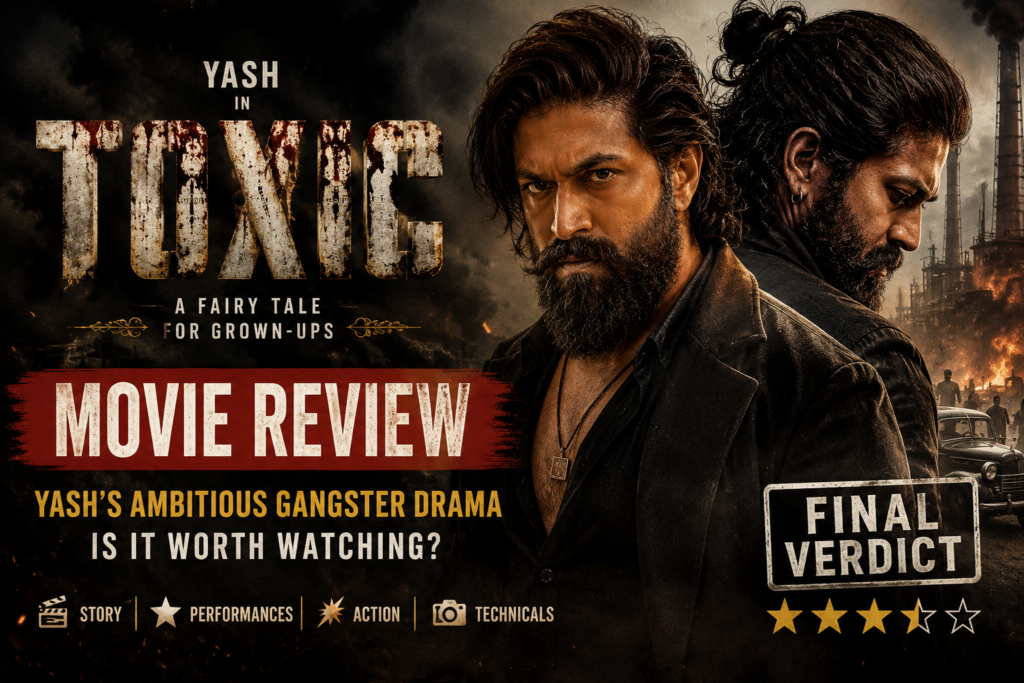
Toxic Movie Review: Yash’s return to the big screen comes with enormous expectations. Toxic: A Fairy Tale for Grown-Ups, directed by Geetu Mohandas, aims to be much more than a conventional gangster film. The movie blends crime, family conflict, romance, violence and fantasy-inspired visual design into a stylized world built around Yash’s commanding screen presence. Released in theaters on August 26, 2026, Toxic has already sparked one of the year’s most divided early reactions.
This Toxic movie review looks at what works, what does not, and whether the film’s ambition translates into a satisfying theatrical experience. Supporters have praised its scale, action, cinematography and Yash’s performance, while critics and disappointed viewers have raised concerns about the screenplay, pacing, editing and emotional depth. The result is an intriguing contrast: Toxic can look spectacular on screen while still leaving some viewers unconvinced by the story holding everything together.
The central question is not whether Toxic looks ambitious—it clearly does. The bigger question is whether that ambition delivers a compelling gangster drama. For viewers coming primarily for Yash, large-scale action and striking visuals, the film offers plenty to enjoy. However, audiences expecting a tightly written and emotionally consistent crime story may find the experience considerably more uneven.
The debate surrounding Toxic also reflects how audiences increasingly judge major theatrical releases through story, performances, pacing and overall execution rather than spectacle alone. That makes comparisons with other big-screen releases particularly interesting, especially when a film is expected to satisfy both dedicated fans and general movie audiences.
Toxic Movie Review: A Quick Verdict
Toxic is an ambitious, visually driven gangster drama that places Yash at the center of an unusually stylized world. The actor plays two roles, Raya and his estranged son Ticket, giving the film a built-in contrast between its older gangster figure and the younger character connected to him. The story combines the criminal underworld with family relationships, romance and personal conflict rather than following a straightforward rise-and-fall gangster formula.
Its strongest weapon remains Yash. His screen presence gives the larger-than-life sequences the weight audiences expect from the star behind KGF. The action and production design also provide genuine theatrical scale. Even viewers who disliked the screenplay have frequently singled out Yash’s presence and the film’s visual presentation as positives.
The biggest weakness is the storytelling. Early reactions repeatedly point to an overloaded screenplay, uneven pacing and difficulty following the film’s many characters and ideas. The lengthy runtime makes those problems more noticeable when individual sequences fail to maintain momentum.
So, is Toxic worth watching? For fans of Yash and theatrical action, there is a strong case for seeing it on the big screen. For viewers who place story clarity and emotional depth above spectacle, expectations should be more measured.
What Is Toxic About?
Toxic builds its story around a dangerous criminal world and the complicated relationship between Raya and Ticket. Yash’s dual role is central to the film’s structure, with the two characters representing different sides of the narrative and its family conflict. The film does not remain limited to gangster politics, though. Family, loyalty, romance, desire and personal history become increasingly important as the story develops.
That combination explains why the film can feel difficult to categorize. It has the machinery of a gangster movie, but it also wants to function as a family drama and an emotionally charged character study. At the same time, Mohandas gives the production a highly stylized visual identity that pushes it away from realism.
The result is a film that asks viewers to accept a heightened version of its world. Characters can behave in extreme ways, violence can become theatrical, and the presentation often takes priority over everyday realism. That approach may appeal to viewers looking for something visually distinctive, but it can also make the story harder to connect with when the emotional motivations are not equally clear.
Importantly, Toxic does not appear interested in giving audiences a simple hero-versus-villain narrative. Its central conflict is tied to identity, family and power. That makes the film more ambitious than a conventional action vehicle, even if the execution does not always make those ambitions easy to follow.
Raya, Power and the World of the Film
Raya sits at the heart of Toxic and represents the film’s fascination with power. Yash approaches the character with the kind of confidence that immediately establishes authority, making Raya feel larger than the people surrounding him.
The gangster environment around him is equally important. Rather than using crime merely as background, the film builds an elaborate world of rivalries, relationships and shifting loyalties. The setting gives the story room to explore how violence affects family and personal identity.
This is also where Geetu Mohandas’ visual approach becomes apparent. The film does not present its criminal world as a plain, documentary-style environment. Instead, it uses heightened production design and a deliberately stylized atmosphere to create a fairy-tale quality for adults.
That choice gives Toxic an identity of its own, but it also creates a challenge. The more extravagant the world becomes, the more important the screenplay must be in explaining its emotional rules. When the writing keeps pace, the unusual setting can feel immersive. When it does not, the spectacle risks becoming disconnected from the characters.
The Story’s Family and Revenge Thread
Beneath the gangster machinery, Toxic depends heavily on family relationships. The conflict between Raya and Ticket gives the film an emotional foundation that distinguishes it from a purely action-focused story. Their relationship creates questions of legacy, loyalty and personal history that extend beyond the criminal world.
This family dimension also gives Yash’s dual performance a practical purpose. The two characters are not simply an excuse for the actor to appear twice. Their contrasting identities help shape the film’s central dramatic tension.
However, the film’s emotional impact depends on how effectively viewers connect those relationships with the larger story. Some early reactions have praised the emotional elements, while others have argued that the spectacle and violence overwhelm the drama.
That divide is important because Toxic clearly wants its characters to matter beyond the action scenes. The family conflict is supposed to give the violence consequences. Whether every viewer feels that connection will depend largely on how well the film’s layered storytelling works for them.
Yash in Toxic: Does His Performance Carry the Film?
Yash remains the easiest element of Toxic to identify as a major strength. After the enormous success of KGF: Chapter 2, expectations surrounding his next film were always going to be difficult to manage. Toxic leans into that star power while also asking him to perform two characters with different dramatic functions.
As Raya, Yash brings the confidence and physical authority associated with his mass-action image. The character commands attention whenever he enters a scene, and that charisma helps the film’s larger sequences land with greater force.
At the same time, Ticket allows Yash to explore a different emotional register. The contrast between the two roles gives the actor more room than a single-character action performance would provide. It also makes the family conflict more personal because the central dramatic tension exists within the same performer’s dual presence.
Early audience reactions have been remarkably consistent in one respect: even viewers who criticized the screenplay often praised Yash. His appearance, action sequences and screen presence repeatedly emerge as highlights in social-media reactions.
That does not automatically solve the film’s writing problems. A star can hold attention, but a complex story still needs structure and emotional clarity. In Toxic, Yash often provides the immediate energy that keeps the film moving, particularly when the narrative itself becomes less focused.
The result is a performance that strengthens the movie considerably, even while raising a difficult question: is Yash supporting the story, or is the story increasingly being built around Yash?
Raya vs. Ticket
The dual-role setup gives Toxic one of its most interesting dramatic ideas. Raya and Ticket are connected by family, yet the film uses their differences to explore contrasting personalities, motivations and approaches to power.
Raya represents the established force of the criminal world. His presence is built around authority and intimidation, making him a natural fit for the larger-than-life tone of the movie.
Ticket brings a different energy. His connection to Raya gives the character an emotional dimension that helps shift the film beyond pure gangster spectacle. Their relationship also creates the foundation for the movie’s deeper questions about family and legacy.
Yash handles the contrast through changes in attitude, physicality and screen presence rather than relying only on obvious visual differences. That makes the dual performance one of the film’s more engaging elements.
Still, the success of the concept ultimately depends on the writing. If the audience understands why the two characters behave as they do, their conflict becomes emotionally meaningful. If the narrative becomes too complicated, the dual-role structure can instead feel like another layer competing for attention.
For Toxic, the idea is strong. The bigger debate is whether the screenplay gives both sides of Yash’s performance enough dramatic space to fully resonate.
Toxic Movie Review: Screenplay, Pacing and Runtime
The biggest challenge in Toxic is not its ambition. It is the amount of material the film tries to carry at once. Geetu Mohandas combines a period gangster story with family conflict, violence, romance, shifting loyalties and a highly stylized visual language. That gives the movie plenty of ideas, but it also creates pressure on the screenplay to keep every thread understandable and emotionally relevant.
At 3 hours and 14 minutes, the runtime makes that balance even more important. Early audience reactions have repeatedly identified pacing, editing and narrative clarity as weak points, while other viewers have found enough action and star power to remain engaged.
The result is an uneven viewing experience. Toxic often feels like a movie with several different ambitions competing for attention. One sequence may emphasize gangster politics, another family drama, and another pure spectacle. That variety can make the film unpredictable, but it can also reduce the emotional momentum between major events.
For a movie this long, individual scenes need to justify their place in the larger structure. When they do, the scale feels rewarding. When they do not, the runtime becomes noticeable.
Where the Screenplay Works
The screenplay works best when it connects the gangster world with the personal relationships at its center. Raya is not simply another criminal protagonist chasing power. His family history and relationship with Ticket give the story a personal dimension, allowing the film to explore questions of legacy, loyalty and identity alongside crime and violence.
That combination gives Toxic more dramatic ambition than a straightforward action vehicle. The period setting also provides room for the film to create a distinctive criminal ecosystem rather than relying entirely on familiar contemporary locations and conflicts. NDTV describes the movie as a period gangster action drama set in Portuguese-ruled Goa, which helps establish the historical atmosphere behind the story.
The screenplay also benefits from its willingness to embrace a heightened tone. Toxic does not seem interested in presenting its world as ordinary or restrained. Its larger-than-life characters and unusual visual choices are part of the film’s identity.
However, ambition only becomes an advantage when the audience can follow the emotional logic underneath it. The strongest sections are therefore those where the spectacle remains connected to character motivation.
Where Toxic Loses Momentum
The film’s length becomes harder to ignore when the screenplay moves between too many characters, ideas and tonal shifts without giving each development enough breathing room. Several early reactions specifically criticized the editing, pacing and storytelling, suggesting that the narrative can become difficult to follow.
That criticism matters because fast editing does not automatically create momentum. If viewers have not fully understood a character or conflict, moving quickly between scenes can create confusion rather than excitement.
The large ensemble adds to the problem. Toxic features Yash alongside Nayanthara, Kiara Advani, Huma Qureshi, Tara Sutaria and Rukmini Vasanth, giving the movie considerable star power but also increasing the storytelling burden.
Some viewers have therefore felt that the film spends too much time establishing or moving between different elements instead of allowing its strongest emotional conflicts to develop naturally. Others have responded more positively to the same ambition.
That divide captures the screenplay’s central weakness: Toxic has plenty happening, but not every development carries equal dramatic weight.
Action, Cinematography and Production Design
If the screenplay creates the biggest debate, the technical presentation gives Toxic much of its immediate appeal. The film has been designed for the theatrical environment, with large sets, elaborate period styling, aggressive action and a visual approach that frequently turns ordinary locations into heightened cinematic spaces.
Early audience reactions consistently mention the visuals and action among the film’s strengths. That praise is important because the movie clearly wants its scale to be experienced rather than merely described. The production is not trying to disappear behind the story; it wants the visual world itself to become part of the attraction.
The Visual World of Toxic
The period setting gives Geetu Mohandas considerable room to build an atmosphere that feels different from a conventional modern gangster film. The story begins in Goa against a historical backdrop, allowing costumes, locations and production design to contribute to the sense of time and place.
The result is a world that often feels deliberately exaggerated. The film’s title and fairy-tale framing suggest that realism is not its only goal. Instead, the production design helps create a dark fantasy version of the criminal underworld.
That approach works particularly well when the visual choices reinforce character. Raya’s world needs to feel powerful, dangerous and excessive, and the production frequently gives him an environment that matches his personality.
The downside is that visual richness can sometimes draw attention away from narrative simplicity. A beautifully constructed sequence can still feel dramatically thin if the story has not established enough emotional reason for the audience to care about what happens next.
Still, on a purely visual level, Toxic demonstrates considerable ambition. Even critical early reactions have generally acknowledged its production scale and presentation.
Action and Big-Screen Spectacle
Action is one of the film’s clearest attempts to deliver the kind of theatrical experience associated with Yash’s recent career. The sequences are designed around physical impact, attitude and spectacle rather than restrained realism.
Several early viewers singled out the action as a major positive, with the film’s larger set pieces receiving stronger reactions than some of its narrative passages.
That distinction matters. Toxic can sometimes communicate its ideas more effectively through an action sequence than through exposition. Yash’s physical presence gives those moments an immediate sense of authority, while the production design makes them visually memorable.
Yet action alone cannot solve structural problems. When the surrounding story has momentum, a major set piece feels like a payoff. When the narrative has slowed down or become confusing, spectacle can feel like a temporary interruption rather than progression.
The best action scenes therefore work because they combine Yash’s star power with the film’s visual identity. They are not simply loud moments; they demonstrate what Toxic does best when its filmmaking ambition and entertainment instincts align.
Toxic Cast Performances
Yash naturally dominates the discussion, but Toxic has assembled a substantial ensemble around him. Nayanthara, Kiara Advani, Huma Qureshi, Tara Sutaria and Rukmini Vasanth all contribute to a film that depends heavily on relationships and competing personalities.
Ensemble casting has also become an increasingly important part of modern franchise cinema, with recognizable performers often generating significant attention before their films even arrive in theaters. Casting announcements can sometimes become stories of their own, particularly when an established or rising actor is linked to a major comic-book property.
That casting creates both an advantage and a problem. A crowded ensemble can make a fictional world feel expansive, but every major character also needs enough narrative purpose to justify the attention they receive.
Nayanthara as Ganga
Nayanthara brings a strong screen presence to Ganga, helping the film maintain emotional weight when the story moves away from pure gangster spectacle.
Her presence is particularly valuable because Toxic needs characters who can challenge or humanize its central male figures. Without that contrast, the movie could become dominated by violence and swagger.
Early reactions have generally recognized the strength of the performances, even when viewers disagreed about the screenplay itself.
The larger issue is not whether Nayanthara can command attention. It is whether the screenplay gives her character enough space to become fully developed. Like several members of the ensemble, Ganga’s effectiveness ultimately depends on how much narrative weight the film allows her.
Kiara Advani, Huma Qureshi and Tara Sutaria
Kiara Advani, Huma Qureshi and Tara Sutaria add three recognizable faces to an already crowded ensemble. Their characters operate within the film’s broader web of relationships, crime and personal ambition.
Kiara’s presence provides one of the film’s more commercially familiar pairings, particularly for audiences following Yash’s return after KGF: Chapter 2. Huma Qureshi and Tara Sutaria, meanwhile, contribute to the wider ensemble that gives the criminal world additional layers.
However, early audience reactions have questioned whether the film makes sufficient use of all its female characters. That criticism is less about the performers themselves and more about narrative allocation.
A large cast only becomes an advantage when each important character changes the story. If several characters mainly exist to decorate the world or support the protagonist, their presence can make the screenplay feel even more crowded.
Rukmini Vasanth and the Supporting Cast
Rukmini Vasanth is part of an ensemble that helps expand Toxic beyond a single-character action vehicle. Her presence, alongside the other supporting performers, gives the story additional relationships and points of tension.
The challenge, again, is proportion. With Yash carrying the central narrative, supporting characters have limited space to establish independent emotional arcs.
That does not make the ensemble ineffective. Instead, it highlights one of the film’s recurring trade-offs: Toxic wants the scale of a large crime saga, but its emotional storytelling sometimes needs the intimacy of a smaller character drama.
The supporting cast contributes to the movie’s sense of scope, even if not every character receives the depth viewers might expect from such a star-heavy production.
Music, Background Score and Technical Craft
Music and sound play an important role in shaping Yash’s larger-than-life presence. Early audience reactions have specifically praised the background music, particularly during the actor’s major scenes.
That makes sense within the film’s broader design. Toxic frequently builds scenes around attitude and anticipation, and a strong background score can turn a character entrance or action beat into a theatrical event.
The technical craft also supports the movie’s heightened atmosphere. Cinematography, production design, costumes and editing work together to create a period world that feels more stylized than naturalistic.
Editing, however, becomes a complicated part of the experience. Some viewers have praised the energy, while others have argued that the rapid transitions and large number of characters make the story harder to follow.
That contrast shows why technical quality cannot be judged only by polish. A film can be technically elaborate while still making narrative comprehension difficult.
In Toxic, the strongest technical elements are those that amplify character and atmosphere. The background score elevates Yash, the production design establishes the world, and the action choreography gives the film theatrical force. The weaker moments occur when technical intensity replaces rather than supports emotional progression.
Ultimately, the craft is rarely the reason viewers are struggling with Toxic. The larger debate remains whether all that craft has been organized into a story that consistently earns its scale.
Toxic Movie Review: What the Film Gets Right
For all the criticism surrounding its screenplay, Toxic has several qualities that make it difficult to dismiss as a simple misfire. The film understands the appeal of the theatrical experience and repeatedly uses scale, performance and visual design to create moments that demand attention.
Yash remains the biggest advantage. His confidence, physicality and ability to command a frame give the film an immediate center of gravity. Even when the narrative becomes complicated, his presence helps maintain momentum.
The film also deserves credit for attempting something more visually distinctive than a conventional gangster action movie. Its period setting, heightened production design and dark fairy-tale atmosphere give it a recognizable identity. Rather than treating the criminal world as a realistic backdrop, Geetu Mohandas builds a stylized universe around it.
The action contributes to that identity as well. Large set pieces provide the kind of spectacle that benefits from a theatrical screen, while the background score adds energy to Yash’s entrances and confrontational moments.
Perhaps the most important strength is ambition itself. Toxic does not appear content to repeat a familiar formula from beginning to end. It attempts to combine gangster drama, family conflict, romance, violence and visual experimentation.
That ambition does not always produce a coherent result, but it does make the film more interesting to analyze. The movie has a clear personality. Its problem is not a lack of ideas; it is deciding how effectively those ideas work together.
Toxic Movie Review: Where the Film Falls Short
The weaknesses of Toxic largely come from the same ambition that creates its strengths. The film tries to accommodate a substantial cast, multiple relationships, criminal politics, family drama and large-scale action within an unusually long runtime.
That creates a recurring problem of proportion. Some elements receive considerable attention without developing enough emotional payoff, while other relationships that could have strengthened the story sometimes feel secondary to the spectacle.
An Overloaded Story
The screenplay has several moving pieces, and early reactions have repeatedly described the narrative as difficult to follow. Some viewers have praised the film’s ambition, while others have criticized its structure, editing and pacing.
The issue is not simply that the story is complicated. Complicated films can work extremely well when each storyline clearly connects to the central conflict. Toxic sometimes struggles to establish that hierarchy.
As a result, the audience can move rapidly from one character or conflict to another without always receiving enough time to understand why a particular development matters.
The film’s length magnifies this problem. A long runtime gives filmmakers room to develop a complex world, but it also requires stronger control over pacing. When the narrative slows, viewers have more time to notice structural weaknesses.
Uneven Emotional Connection
The emotional side of Toxic is more divisive than its visual presentation. The film clearly wants the relationship between Raya and Ticket, along with its broader family conflicts, to give the gangster story emotional weight.
However, spectacle often dominates the experience. Violence, action and stylized imagery can be so prominent that quieter character moments struggle to carry the same impact.
This creates a gap between what the film appears to want emotionally and what some viewers may actually feel. The characters have dramatic histories, but the screenplay does not always allow those histories to breathe.
For viewers who connect strongly with Yash’s characters, that may not be a major problem. Others may find themselves admiring the filmmaking without becoming equally invested in the people inside it.
The KGF Shadow
The comparison with KGF is almost unavoidable because Yash’s previous franchise established such a powerful mass-action identity. Early social-media reactions have specifically described a perceived “KGF hangover,” with some viewers feeling that Toxic continues elements of the star persona that made those films successful.
That comparison can be both fair and limiting.
Toxic is not simply another KGF chapter. Its visual world, family dynamics and directorial approach attempt something different. At the same time, Yash’s screen persona naturally brings memories of Rocky into the theater.
When Toxic delivers a swaggering entrance, powerful dialogue moment or explosive action sequence, audiences are likely to compare that energy with KGF. That makes it harder for the new film to establish a completely separate identity.
The irony is that Yash’s biggest strength also becomes a challenge. His established image guarantees attention, but it also gives audiences a benchmark that Toxic must constantly escape.
Toxic Movie Review vs. Audience Reaction
The divided response to Toxic becomes clearer when critical opinions and audience reactions are considered separately. Early social-media discussion has ranged from enthusiastic praise for Yash and the film’s spectacle to strong criticism of the screenplay and overall execution.
That split suggests that audiences are not necessarily disagreeing about what the movie contains. Instead, they are responding differently to the balance between spectacle and storytelling.
Viewers who prioritize theatrical energy have found plenty to appreciate. Yash’s screen presence, action sequences, visuals and background score provide obvious crowd-pleasing elements. For those audiences, the film’s excess may feel intentional and entertaining.
On the other hand, viewers who expect a tightly structured narrative have been more critical. Complaints about pacing, editing, character development and story clarity point toward a different viewing experience.
The commercial response adds another layer. Reports indicated that Toxic crossed the ₹50 crore mark in India on its opening day by the afternoon, while reviews and online reactions remained mixed.
That distinction matters. Strong box-office demand reflects audience interest and Yash’s drawing power, but it does not automatically settle the question of whether the film succeeds artistically.
Toxic therefore occupies an interesting position: its theatrical appeal appears strong enough to attract large audiences, while its storytelling has generated enough disagreement to prevent an easy critical consensus.
Is Toxic Better Than KGF?
Comparing Toxic with KGF is useful, but only if the two films are judged according to what they attempt to accomplish. Both depend heavily on Yash’s commanding screen presence and both place him inside heightened criminal worlds. However, their storytelling ambitions are not identical.
Similarities
The most obvious similarity is the central star. Yash’s ability to project authority, confidence and physical intensity remains a defining feature of both films.
Both also embrace larger-than-life action and a heightened visual language. Their protagonists occupy worlds where power, violence and reputation shape nearly every major conflict.
That common ground makes comparisons inevitable, especially for audiences who discovered or embraced Yash through KGF.
Toxic also shares the broader appeal of presenting its protagonist as someone who can dominate a room without needing constant exposition. The character’s image becomes part of the storytelling.
However, those similarities should not obscure the differences.
Key Differences
Toxic places considerably more emphasis on family relationships and a multi-layered ensemble. Its dual-role structure also gives Yash a different dramatic challenge.
Geetu Mohandas approaches the material with a more stylized sensibility, while the story moves through several emotional and thematic areas beyond straightforward gangster ambition.
That makes Toxic less dependent on a single rise-to-power narrative. It wants to explore relationships, identity and personal history alongside crime and action.
The trade-off is that this broader scope can make the film feel less focused. KGF benefited from a relatively direct central drive, while Toxic has more narrative material competing for attention.
Which Film Better Uses Yash’s Star Persona?
The answer depends on what the viewer expects from Yash.
KGF used his screen presence as the engine of a focused mass-action story. Toxic uses that same charisma within a more complicated and stylistically ambitious framework.
For pure narrative momentum, KGF may feel more immediately accessible. For viewers interested in a more experimental visual identity and a broader ensemble, Toxic offers something different.
The comparison ultimately reveals the film’s central challenge. Yash has already established what his mass-action image can accomplish. Toxic needed to show audiences what else that image could become.
Whether it fully succeeds remains the most debatable part of the film.
Toxic and the KGF Shadow: Can Yash Escape His Biggest Hit?
The KGF comparison has become one of the defining conversations around Toxic, and that comparison says as much about audience expectations as it does about the new film. Yash’s return comes after KGF: Chapter 2, so viewers naturally entered theaters expecting another commanding mass-action performance. Early reactions quickly reflected that expectation, with some viewers praising the familiar swagger while others criticized what they saw as a lingering KGF influence.
That does not mean Toxic simply repeats KGF. The new film has a different family structure, a different directorial sensibility and a more deliberately stylized world. Geetu Mohandas also gives the story a dual-role framework through Yash’s Raya and Ticket, creating a personal conflict that goes beyond the straightforward power journey associated with Rocky.
Still, the similarities are difficult to ignore. Yash’s entrances, attitude, physicality and action-driven moments can immediately remind viewers of his earlier blockbuster image. That creates a difficult situation for Toxic: the very qualities that make Yash a major attraction also make it harder for the audience to see him without comparing him with Rocky.
What the KGF Comparison Reveals
The comparison ultimately reveals a larger expectation problem. KGF established Yash as a major pan-Indian action star, which means his next projects cannot be judged in isolation from that success.
That expectation is not limited to Yash. Modern franchise-driven cinema increasingly asks audiences to follow established stars, characters and cinematic worlds from one major project to the next. The success of a new film can therefore depend not only on its individual story but also on the expectations created by the larger franchise culture surrounding it.
Some viewers want him to reinvent himself, while others primarily want the qualities that made KGF successful. Toxic attempts to satisfy both groups, but that balance is difficult.
When the film embraces spectacle, fans can recognize the Yash they came to see. When it moves toward family drama and stylistic experimentation, it asks those same viewers to adjust their expectations.
That tension helps explain the divided reaction. Toxic is not necessarily failing because it resembles KGF; rather, it is struggling to convince every viewer that it has moved far enough beyond the earlier formula.
Toxic’s Commercial Momentum Tells a Different Story
The critical conversation around Toxic and its commercial performance are telling two different stories. While early reactions have criticized the screenplay, editing and emotional connection, the film opened with substantial audience demand. Trade reports noted strong advance bookings before release, while opening-day reporting showed the film moving past the ₹50 crore mark in India by the afternoon.
That performance should not be interpreted as proof that the movie has received universal approval. A major opening reflects several factors, including Yash’s popularity, the four-year wait since his previous major release, extensive promotional buildup and the curiosity surrounding Geetu Mohandas’ collaboration with him.
It also demonstrates the strength of Yash’s theatrical appeal. Even before audiences knew whether the screenplay would satisfy them, advance demand was already substantial. That kind of pre-release confidence is difficult to build and represents a significant commercial asset for both the actor and the production.
At the same time, mixed word of mouth can become important after the opening day. A film can attract an enormous first-day audience because of anticipation and then face a different challenge: convincing those viewers to recommend it to others.
For Toxic, that distinction matters more than the opening figure itself. Its long-term performance will depend on whether the spectacle and Yash’s performance outweigh the concerns surrounding the story.
Star Power vs. Word of Mouth
Yash’s star power gives Toxic a strong commercial foundation. His return after KGF: Chapter 2 created an event-like atmosphere around the release, and the film’s large cast and expensive production added to that anticipation.
However, star power cannot completely control audience response after the first show. Viewers who enjoyed the film can turn excitement into positive word of mouth, while disappointed audiences can quickly amplify criticism through social media.
That is exactly what happened during the film’s early release period. Social-media reactions praised Yash, the visuals and action while simultaneously attacking the writing, pacing and editing.
This creates an unusual situation for Toxic. The film has enough obvious spectacle to generate enthusiastic reactions, but enough structural weaknesses to generate equally strong disappointment.
The eventual commercial verdict therefore depends on which side becomes more influential: the audience looking for a major Yash spectacle or the audience expecting a tightly constructed gangster drama.
Toxic Movie Review: Why Audiences Are Divided
The divided response is not simply a disagreement over whether the film is entertaining. It reflects two different ways of evaluating a large-scale Indian action movie.
One group appears willing to accept a complicated or excessive narrative if the movie delivers scale, style and star-driven moments. Another group expects the screenplay to control that spectacle and give every major character and sequence a clear purpose.
Early reactions capture both sides. Some viewers called the film visually spectacular and praised its action, production design and performances. Others described the writing as chaotic and questioned the emotional connection and pacing.
The difference becomes particularly noticeable in discussions of the first and second halves. Some viewers found the opening portion slow or repetitive, while others felt the later sections provided stronger action and emotional material.
That means there is no single criticism that completely explains the reaction to Toxic. The film’s weaknesses are interconnected. A complicated screenplay makes the runtime feel longer. A crowded cast makes character development more difficult. A highly stylized presentation can make the story feel less grounded. And Yash’s enormous screen presence can make supporting characters seem smaller by comparison.
Yet those same qualities also explain why some viewers are enjoying the film. Its excess is part of its identity.
The Audience That May Enjoy Toxic Most
The film is likely to work best for viewers who approach it as a large-scale theatrical spectacle rather than a tightly controlled crime drama.
Yash fans have obvious reasons to be interested. His performance remains one of the most consistently praised aspects of the early response, while the action and visual presentation provide additional reasons to see the film on a large screen.
Viewers who enjoy stylized gangster stories may also appreciate the film’s unusual atmosphere. Its ambition gives it a distinctive personality even when the storytelling becomes uneven.
However, audiences who prefer restrained crime dramas, concise editing or strongly developed supporting characters may find the experience frustrating.
That does not make either response objectively correct. It means Toxic is a film whose strengths depend heavily on what the viewer expects from it.
Toxic Movie Review: Yash’s Career After KGF
Toxic occupies an important position in Yash’s career because it represents his first major theatrical release after the KGF phenomenon. That automatically gives the film more significance than an ordinary follow-up project.
The challenge is that Yash is no longer simply an actor trying to establish himself as a major star. He is now carrying expectations created by one of India’s most recognizable modern action franchises.
That changes how every performance is received. A powerful entrance is no longer just a powerful entrance; audiences compare it with Rocky. A gangster character is no longer judged only on its own terms; viewers ask whether Yash is repeating his previous success.
Toxic attempts to respond by giving him a dual role and placing him inside a different cinematic world. The project also carries a stronger auteur-driven identity through Geetu Mohandas, whose filmmaking approach differs from the established KGF formula.
The film therefore represents an important experiment. Yash is using the power he built through mass cinema while working inside a project that aims for a more distinctive and unconventional identity.
Whether that experiment fully succeeds is debatable. However, it does show that Yash is not simply standing still. The bigger question is whether audiences will allow him the space to evolve while still delivering the larger-than-life moments they expect.
For now, Toxic looks less like a definitive reinvention and more like an ambitious transition point in Yash’s career.
Toxic Movie Review: Is the Film Worth Watching?
The answer depends heavily on what you want from the movie.
If you are watching primarily for Yash, Toxic has a strong case. His performance, screen presence and action sequences provide the film with its most reliable source of energy. The visual scale also benefits from theatrical presentation, particularly during the major action sequences.
If you enjoy ambitious production design and stylized gangster worlds, the film offers plenty to examine. Its period setting and heightened atmosphere give it a personality that separates it from a conventional crime thriller.
However, viewers who place screenplay and emotional depth above spectacle should approach it with more caution. Early reactions repeatedly identify writing, pacing, editing and character development as the film’s most significant weaknesses.
The safest recommendation is therefore straightforward: Yash fans and big-screen action audiences have the strongest reason to watch Toxic, while viewers looking for a tightly written gangster drama may find the experience uneven.
The film is not short on ambition. The real debate is whether that ambition has been shaped into a story strong enough to support everything happening around it.
Toxic Movie Review: Final Verdict
Toxic: A Fairy Tale for Grown-Ups is a film caught between two ambitions. It wants to deliver the scale and intensity of a major Yash action movie while also building a layered gangster drama around family, identity and personal history. At its best, that combination gives the film a distinctive visual personality and several entertaining theatrical moments.
Yash remains the strongest reason to watch. His dual-role performance gives the story a useful dramatic contrast, while his physical presence carries many of the film’s biggest sequences. The production design, action and background score also contribute to the feeling that Toxic was made for the big screen rather than casual viewing at home.
The weaknesses are mostly structural. The long runtime, crowded ensemble and complicated narrative can make the film feel less focused than its ambition demands. The movie frequently moves between action, family drama, crime and personal conflict, and those shifts do not always receive enough space to develop naturally.
That makes this Toxic movie review neither an outright celebration nor a dismissal. The film has clear strengths, but those strengths do not completely overcome its storytelling problems.
For Yash fans, action audiences and viewers willing to embrace an extravagant gangster fantasy, Toxic offers enough spectacle to justify a theatrical watch. For viewers who prioritize tight writing and carefully paced character drama, it is a more difficult recommendation.
Ultimately, Toxic feels like an ambitious experiment that does not always control its own excess. It may not deliver the same narrative focus associated with Yash’s biggest earlier success, but it does show a willingness to take his star image into a more unusual cinematic world.
Frequently Asked Questions About Toxic
Is Toxic a good movie?
Toxic is best described as an ambitious but uneven movie. Its major strengths include Yash’s screen presence, large-scale action, production design, cinematography and theatrical presentation. Its main weaknesses involve screenplay structure, pacing, editing and the handling of its large ensemble.
Whether it works for you will depend on what you expect. If spectacle and Yash’s performance are your priorities, the film has plenty to offer. If you expect a tightly constructed gangster drama, its structural issues may be more noticeable.
What is Toxic about?
Toxic: A Fairy Tale for Grown-Ups is a gangster action drama centered on Raya and Ticket, both played by Yash. The story combines crime, family relationships, personal conflict and action within a stylized world.
The film uses its central family relationships to explore questions of loyalty, identity and legacy while also delivering large-scale action and visual spectacle. It is therefore more than a straightforward gangster story.
The movie combines several genres and dramatic ideas, which is also one reason its reception has been divided.
Who stars in Toxic?
Yash leads Toxic in a dual role as Raya and Ticket. The ensemble also includes Nayanthara, Kiara Advani, Huma Qureshi, Tara Sutaria and Rukmini Vasanth.
The large cast gives the movie a broad character base and helps create a bigger criminal world around the central story. However, the number of characters also places additional pressure on the screenplay to give each important role enough development.
Who directed Toxic?
Geetu Mohandas directed Toxic: A Fairy Tale for Grown-Ups.
Her involvement gives the film an interesting creative identity because the movie combines her filmmaking sensibility with Yash’s established mass-action image. The result is a visually ambitious gangster drama that attempts to balance spectacle with family conflict and character-driven storytelling.
That combination is one of the most distinctive aspects of the film.
How long is Toxic?
Toxic has a runtime of approximately 3 hours and 14 minutes.
The length is important when considering the overall experience because pacing becomes especially significant in a movie of this scale. Viewers who remain engaged by the action, characters and visual spectacle may find the runtime manageable.
However, audiences who feel disconnected from the screenplay may notice the duration more strongly. The film’s length therefore works better when its individual storylines maintain momentum.
Is Toxic connected to KGF?
No. Toxic is not a continuation of the KGF story, and it features different characters and a separate narrative.
However, comparisons between the two films are understandable because Yash’s KGF movies established the mass-action persona that audiences now strongly associate with him.
Toxic attempts to distinguish itself through its dual-role structure, family drama, period setting and different visual approach. Still, Yash’s screen presence naturally invites comparisons with Rocky, particularly during action-heavy and larger-than-life moments.
Is Toxic worth watching in theaters?
For Yash fans and audiences who enjoy large-scale action, Toxic makes a stronger theatrical recommendation. Its visual design, action sequences, background score and Yash’s screen presence are best experienced on a large screen with strong sound.
Viewers who primarily want a tightly written crime drama should approach it with more measured expectations. The movie’s ambition is clear, but its complicated storytelling and long runtime may not work equally well for everyone.
In short, watch Toxic if you want spectacle, action and Yash’s star power. If story efficiency matters more to you than scale, the film may feel uneven.
Toxic Movie Review: Final Takeaway
Toxic is not an easy film to categorize. It is too ambitious to dismiss as a routine action vehicle, yet too structurally uneven to call a completely successful gangster drama. Its best qualities are immediately visible: Yash has undeniable screen presence, the film looks distinctive, and its action is designed to create a genuine theatrical experience.
Its weaknesses are equally clear. The long runtime, crowded narrative and uneven pacing can reduce the impact of the emotional material. Instead of allowing every major relationship to develop naturally, the film sometimes moves toward another spectacle before the previous dramatic beat has fully settled.
That makes the final Toxic movie review a qualified recommendation rather than a universal one. Yash fans, action lovers and audiences looking for visual spectacle have good reasons to give it a chance. Viewers seeking a tightly written, emotionally consistent gangster story should expect a more uneven experience.
The most interesting aspect of Toxic, however, may be what it represents for Yash. After KGF transformed his position as a pan-Indian star, he could have chosen the safest possible follow-up. Instead, he entered a different creative collaboration and attempted to combine mass entertainment with a distinctive directorial vision.
That willingness to enter a new phase is increasingly important for major stars working within franchise-driven entertainment. Audiences often want familiar star power while also expecting each new project to offer something different, creating a difficult balance between established identity and creative evolution.
The result does not completely resolve that experiment. However, it makes one thing clear: Yash’s next chapter does not have to look exactly like KGF to command attention.
Final verdict: Toxic is worth watching for Yash, spectacle and ambition, but viewers should not expect a perfectly controlled gangster drama.