
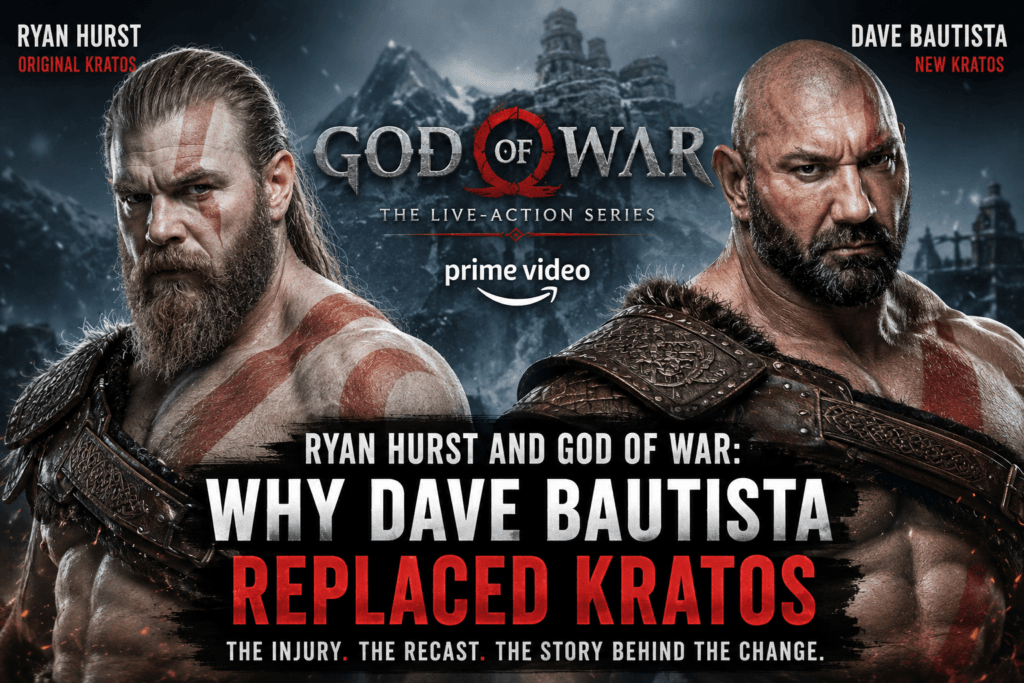
Ryan Hurst became one of the most talked-about names linked to Amazon’s God of War adaptation. Amazon announced him as Kratos in early 2026. The casting seemed like a natural fit because Hurst already had a connection to the PlayStation franchise. He voiced Thor in God of War Ragnarök and earned a BAFTA Games Award nomination for the performance. Amazon later introduced him as the live-action Kratos when production began in Vancouver.
That plan has now changed. Hurst suffered a serious bicep injury while filming. He underwent surgery and had to leave the role. His recovery timeline conflicted with the production schedule. Dave Bautista has since taken over as Kratos. The change became one of the biggest developments in the show’s production.
This story goes beyond a simple recasting. Hurst already had a strong connection with the God of War universe. The series had also started filming with him as its central character. His casting, injury, and replacement help explain why the change has attracted so much attention.
Who Is Ryan Hurst?
Ryan Hurst is an American actor whose career spans television, film, and video games. He gained early screen experience before building a stronger profile through roles in films such as Remember the Titans, Saving Private Ryan, We Were Soldiers, and The Ladykillers. His television work eventually became an even bigger part of his career.
Hurst became especially well known for playing Opie Winston on FX’s Sons of Anarchy. The role gave him a chance to combine physical intensity with a more vulnerable dramatic performance, qualities that later became relevant to his casting as Kratos. He subsequently appeared in series including Outsiders, Bates Motel, and AMC’s The Walking Dead, where he played Beta.
His work has not been limited to acting, either. AMC describes Hurst as a writer, director, producer, and editor, highlighting a broader creative background behind his on-screen career. That range has helped make him a recognizable character actor capable of moving between action, drama, and genre projects.
By the time Amazon selected him for God of War, Hurst already had the physical presence and dramatic experience associated with demanding action roles. More importantly, however, he had something few potential Kratos actors could claim: direct experience performing inside the God of War universe.
Ryan Hurst Was Originally Cast as Kratos
Amazon announced Ryan Hurst as Kratos for its live-action God of War series, placing him at the center of an adaptation built around the relationship between Kratos and his son, Atreus. Amazon’s official series overview identified Hurst as the show’s Kratos and described the production as a two-season order from Amazon MGM Studios and Sony Pictures Television.
The role represented a major opportunity for Hurst. Kratos is not simply an action protagonist; the character carries decades of mythology, violence, grief, and complicated family relationships across the game franchise. The live-action story focuses on an older Kratos attempting to guide his young son through a dangerous world after the death of Atreus’s mother, making the emotional side of the character as important as the physical one.
Hurst’s previous performances made the choice understandable. His work as Opie Winston demonstrated that he could play a hardened character without reducing him to brute force. His role as Beta also showed that he could command the screen through physical presence and a restrained performance.
At the time, the casting also carried an unusual franchise connection. Hurst was not approaching God of War as an outsider who had never interacted with the property. He had already helped bring one of its major characters to life.
Ryan Hurst Already Had a God of War Connection
Before becoming Kratos, Ryan Hurst played Thor in God of War Ragnarök, the 2022 PlayStation game. He provided the character’s voice and performance work, giving him firsthand experience with the franchise’s version of Norse mythology. Amazon specifically highlighted this connection when introducing Hurst as Kratos.
That history made his live-action casting particularly interesting. Hurst had already worked with the tone, mythology, and character-driven storytelling of God of War. He understood how the franchise treated its Norse gods as more than simple fantasy villains, with personal conflicts and complicated relationships driving much of the drama.
His portrayal of Thor also earned recognition beyond the game’s fan base. Hurst received a BAFTA Games Award nomination for the performance, reinforcing the idea that he had already demonstrated an ability to handle the franchise’s distinctive dramatic style.
From Thor to Kratos
Moving from Thor to Kratos was an unusual progression. In the game, Thor stands as one of the major figures opposing Kratos and Atreus, while Kratos represents the central perspective of the story. Hurst therefore moved from portraying one side of the franchise’s conflict to becoming its principal live-action character.
That connection did not guarantee that Hurst would remain Kratos, but it gave the original casting an extra layer of significance. Fans were not simply watching a familiar television actor enter the franchise. They were watching an actor with established experience in its world take on its most recognizable character.
His casting also meant the production could draw on an actor already familiar with the physical and emotional demands of a mythology-heavy God of War performance.
What Happened to Ryan Hurst on the God of War Set?
Ryan Hurst’s departure from God of War came after an injury during production rather than a reported creative disagreement. The actor tore his bicep while performing a stunt in late June 2026. The injury required surgery, and production subsequently went on hiatus while the studios assessed how to continue.
The timing created a serious problem for the series. Hurst had already spent months preparing for the role and had reportedly added about 40 pounds of muscle to achieve the physical presence required for Kratos. He had also filmed scenes before the injury occurred. As a result, the production had already invested substantial work in his version of the character.
However, Kratos is an unusually physical television role. The character requires combat sequences, stunt work, demanding action scenes, and a sustained physical transformation. Simply returning after surgery would not necessarily mean that Hurst could immediately perform at the level the production required.
The studios therefore faced a difficult scheduling decision. Rather than wait for Hurst’s full recovery and risk pushing the production much further into the future, Amazon MGM Studios and Sony Pictures Television chose to recast Kratos. The decision was reported in July, several weeks before Dave Bautista ultimately became the replacement.
The Bicep Injury and Recovery Timeline
The injury reportedly occurred during a stunt in late June, after God of War had been filming in Vancouver since February. Hurst underwent surgery to repair the torn bicep and began the recovery process soon afterward.
Early reporting indicated that a significant bicep tear could require several months of recovery. One report estimated roughly four to six months for the initial recovery period, while returning to the strength and conditioning needed for Kratos could take considerably longer.
That distinction matters. Recovering from surgery and being ready to perform as Kratos are not necessarily the same milestone. Hurst would need to regain strength, rebuild his physical conditioning, and safely handle the demanding action work associated with the character.
Production plans added further pressure. Reports indicated that filming was expected to resume in the fall, with October emerging as the target for restarting production. Waiting for Hurst could therefore have pushed the schedule substantially beyond the planned window.
The situation was especially unfortunate because Hurst had already completed months of preparation. His physical transformation showed how seriously he had approached the role, making the sudden departure a production setback as well as a personal one.
Why Ryan Hurst Was Replaced as Kratos
The decision to replace Ryan Hurst appears to have been driven primarily by production logistics and the length of his recovery. The available reporting does not indicate that Amazon or Sony removed him because they disliked his performance or changed their creative vision for Kratos. Instead, the central issue was whether the series could continue on its planned schedule while waiting for him to become physically ready.
That distinction is important because Hurst had already been selected, had transformed his physique for the character, and had filmed scenes. His exit therefore represents a forced recasting rather than a conventional casting change made before production began.
For a television production, delaying the lead actor can affect far more than one person’s schedule. Other performers, crew members, locations, sets, visual-effects work, and episode timelines all depend on coordinated production dates. A prolonged delay can create additional costs and scheduling conflicts across the entire project.
Why Amazon Could Not Simply Wait
Waiting for Hurst could have delayed production for several months. The actor needed time to recover from surgery. He would also need to rebuild his strength before returning to demanding action scenes. Reports suggested that the production might have needed to wait until 2027 for his full return.
That option carried major risks. The show had already started filming. Its two-season plan also created additional scheduling demands. Amazon MGM Studios and Sony Pictures Television therefore decided to find another actor. A replacement could help the production move forward.
The decision created another challenge. The production had already filmed material featuring Hurst. The team would need to reshoot those scenes or make other production changes. Later reports confirmed that four episodes had already been filmed. The recasting would therefore require significant resho
In other words, replacing Hurst did not provide an easy solution. It simply offered the studios a way to keep the larger production moving instead of waiting indefinitely for the original Kratos actor.
Ryan Hurst’s God of War Exit Explained
The basic timeline is straightforward. Hurst was announced as Kratos, began filming in Vancouver, and spent months preparing physically for the demanding role. In late June, he suffered a torn bicep while performing a stunt. He underwent surgery, but his recovery timeline conflicted with the production schedule. Amazon MGM Studios and Sony Pictures Television consequently decided to recast the role.
At first, the identity of Hurst’s replacement remained unknown. Reports later linked Dave Bautista to the role, initially describing negotiations. By August 21, however, Bautista had officially closed the deal and was confirmed as the new Kratos.
So, Ryan Hurst did not leave God of War because the character was removed or because the series abandoned its original plans. His injury created a production problem that the studios ultimately solved through recasting.
That makes Hurst’s exit one of the more unusual casting changes in a major television adaptation: the original actor had already filmed substantial material and had a genuine connection to the franchise, yet an unexpected physical setback forced the production to move forward without him.
Dave Bautista Replaces Ryan Hurst as Kratos
The biggest question following Ryan Hurst’s injury has now been answered: Dave Bautista will play Kratos in Amazon’s live-action God of War series. Earlier reports described Bautista as being in talks for the role, but the latest development is definitive. Deadline reports that Bautista has closed his deal to take over the character, while Variety likewise confirms that he is officially set as Kratos.
The change gives the series a very different leading man. Hurst had already filmed material and had a unique connection to the franchise through his performance as Thor in God of War Ragnarök. Bautista, by contrast, brings a long film career built around action, science fiction, fantasy, and physically demanding characters.
That does not mean the series is abandoning its original approach to Kratos. The character remains the center of a story about a father and son traveling through a dangerous Norse world. Amazon’s official description says the series follows Kratos and Atreus as they attempt to spread the ashes of Faye, Atreus’ mother and Kratos’ wife.
For viewers, the immediate change is therefore the actor rather than the character’s fundamental role in the story. Bautista inherits a part that had already been shaped through months of preparation and filming by Hurst.
Why Dave Bautista Fits the Role
Dave Bautista brings an obvious advantage to Kratos: physical credibility. Before becoming a major Hollywood actor, Bautista built a career as a professional wrestler, and his screen roles have repeatedly required him to project strength and physical authority.
His filmography also shows a transition from primarily physical performances toward more character-focused acting. He gained international recognition as Drax in Marvel’s Guardians of the Galaxy films, then took increasingly varied roles in projects such as Blade Runner 2049, Dune, Army of the Dead, and Glass Onion: A Knives Out Mystery.
That range matters because Kratos demands more than muscle. The live-action version of the character has to communicate exhaustion, grief, anger, restraint, and the complicated relationship between a father and his son. Amazon’s description emphasizes Kratos’ attempt to teach Atreus how to become a better god while Atreus pushes his father toward becoming a better human.
Bautista’s recent career suggests that he can approach that quieter side of a physically imposing character. His success in dramatic roles has gradually separated him from the idea that he is simply an action performer.
There is also a practical consideration. Kratos requires an actor who can convincingly inhabit a physically imposing warrior while handling extensive action work. Bautista’s background makes that requirement less of an unknown.
Ryan Hurst vs. Dave Bautista as Kratos
Comparing Ryan Hurst and Dave Bautista is useful, but the two actors bring very different strengths to the role.
Hurst’s strongest advantage was his direct relationship with the God of War franchise. He had already voiced Thor in God of War Ragnarök, and Amazon specifically highlighted that experience when announcing him as Kratos. His television career also gave him extensive experience with emotionally intense characters, particularly in Sons of Anarchy and The Walking Dead.
Bautista enters with a different résumé. His strongest connection comes from large-scale film and franchise productions rather than the God of War games themselves. His physical presence is well established, but his more recent work has also demonstrated a willingness to take on quieter and more dramatic characters.
| Factor | Ryan Hurst | Dave Bautista |
|---|---|---|
| God of War connection | Voiced Thor in Ragnarök | No previous major role in the franchise |
| Physical presence | Strong action and television background | Professional wrestling and major action-film experience |
| Dramatic profile | Extensive television character work | Increasingly prominent dramatic film roles |
| Original status | Originally cast as Kratos | Confirmed replacement |
| Production position | Filmed before injury | Taking over after recasting |
Neither actor represents an obvious mismatch for Kratos. Instead, they offer different interpretations of what the character can be. Hurst brought familiarity with the franchise and a television-driven dramatic style, while Bautista brings blockbuster experience and an imposing physical presence.
What Makes Bautista’s Casting Different
Bautista’s casting changes expectations for the series. Viewers had already seen Hurst as Kratos in official promotional material. Amazon previously released first-look images of Hurst alongside Callum Vinson as Atreus. This made Hurst’s casting a public part of the production.
The situation differs from a normal recasting before filming begins. Viewers already had an image of Hurst as Kratos. Some fans also connected his casting to his earlier role as Thor.
Bautista must now create his own version of Kratos. He does not need to imitate Hurst’s performance. Instead, he can bring a fresh interpretation to the character. This approach could ultimately benefit the adaptation.
The change also shows how quickly major television productions can shift. Studios may finalize their lead actors months before release. However, injuries and scheduling problems can still force major changes after filming begins.
For God of War, the question is no longer whether Hurst will return as Kratos. His chapter with the role has ended. The bigger question is what Bautista will bring to the character. Kratos needs the presence of a powerful warrior. He also needs the emotional restraint of a father trying to understand his son.
What Happens to the Episodes Ryan Hurst Already Filmed?
The recasting creates another major production issue: Hurst had already filmed substantial material before his injury. Reports indicate that four episodes had been filmed with the original Kratos, meaning Bautista’s arrival requires the production to revisit material that had already been completed.
That does not simply mean changing an actor in a few scenes. Kratos is present throughout the central story, so replacing him can affect scenes with Atreus, Faye, and the various gods and characters surrounding the family.
The production therefore faces the expensive and time-consuming process of reshooting affected material. The goal is to make Bautista’s performance fit seamlessly into the story without making the final series feel as though two different versions of Kratos were assembled together.
Reshoots and Production Restart
The need for reshoots is one reason Hurst’s injury became such a significant production event. The show had already moved beyond development and into active filming in Vancouver. Amazon had previously described the project as a two-season production, with Ronald D. Moore serving as showrunner, executive producer, and writer.
Now, Bautista must step into material that was originally designed around Hurst. That means the production has to rebuild portions of the filmed story around a new lead while preserving continuity with the performances that remain.
The situation also illustrates why recasting a lead actor after filming starts can have consequences far beyond casting. It can alter shooting schedules, require additional work from returning actors, and create new post-production demands.
Still, the alternative would have been to keep the project waiting for Hurst’s recovery. With Bautista now officially attached, Amazon and Sony have chosen the more practical route: move forward with a new Kratos and rebuild the affected material around him.
The result will be one of the most unusual transitions in the history of a major video-game adaptation. Ryan Hurst’s version of Kratos began filming, but Dave Bautista will ultimately be the face audiences see when the live-action series reaches Prime Video.
What We Know About Amazon’s God of War Series
Amazon’s God of War series is designed as a live-action adaptation of the modern era of the video-game franchise, beginning with the story introduced in God of War (2018). The series has received a two-season order from Amazon MGM Studios and Sony Pictures Television, with production taking place in Vancouver. A premiere date has not yet been announced.
Rather than focusing on Kratos’ earlier adventures in ancient Greece, the television story centers on the character’s life in the Norse world. That distinction matters because the series starts with Kratos as an older warrior and father instead of presenting his entire history from the beginning.
The official premise follows Kratos and his young son Atreus as they leave their home to spread the ashes of Faye, Kratos’ wife and Atreus’ mother. Their journey places them in direct contact with the gods and dangers of the Norse world while forcing the two characters to confront their complicated relationship.
The adaptation therefore has two major elements to balance. On one side, it needs the scale, mythology, monsters, and action audiences expect from God of War. On the other, it needs the emotional story that made the 2018 game especially successful.
That balance will remain central regardless of whether Kratos is played by Ryan Hurst or Dave Bautista.
Story and Main Characters
The heart of the television adaptation is the relationship between Kratos and Atreus. Atreus is only 10 years old when the story begins, while Kratos is already carrying the consequences of his violent past. The boy wants his father’s approval, but Kratos struggles to express his emotions and protect his son without repeating the mistakes of his own life.
Callum Vinson plays Atreus, while the supporting cast includes major figures from Norse mythology. Mandy Patinkin plays Odin, Ólafur Darri Ólafsson plays Thor, Max Parker plays Heimdall, and Ed Skrein plays Baldur. Alastair Duncan also joins the series as Mimir, a role that gives the adaptation another direct connection to the games because Duncan voiced Mimir in the original franchise.
Other announced cast members include Danny Woodburn as Brok and Jeff Gulka as Sindri. Teresa Palmer has also been cast as Sif, Thor’s wife.
This ensemble gives the series room to expand beyond Kratos and Atreus. The Norse gods are not simply background characters; they form the larger world through which the father and son must navigate.
How Kratos and Atreus Drive the Story
The relationship between Kratos and Atreus is more important to the adaptation than simply recreating the game’s action sequences. Amazon’s official description emphasizes a two-way transformation: Kratos tries to teach Atreus how to become a better god, while Atreus pushes his father toward becoming a better human.
That dynamic gives the series a natural emotional structure. Kratos has enormous physical power, but his greatest difficulty comes from communication. He knows how to fight gods and monsters; understanding his son is much harder.
Atreus provides the opposite perspective. He is curious, energetic, and eager to understand the world outside his isolated childhood home. His relationship with Kratos becomes a way for the story to explore identity, responsibility, grief, and the consequences of inherited violence.
This is also why the recasting matters beyond appearance. The actor playing Kratos needs to create believable chemistry with Vinson. Every major emotional beat depends on the audience accepting these two characters as father and son.
The physical side of Kratos will attract attention, especially after Bautista’s casting. However, the long-term success of the series will likely depend just as much on whether the new actor can communicate Kratos’ quieter emotions.
Ronald D. Moore’s involvement reinforces that emphasis. Moore has described the adaptation as an emotional journey centered on the father-son relationship, while Amazon’s official description similarly places that relationship at the center of the story.
Who Is Making the God of War Series?
Ronald D. Moore serves as the show’s writer, executive producer, and showrunner. He is best known for major television projects including Battlestar Galactica and Outlander. His involvement gives the adaptation a television-focused creative leader with experience handling large-scale worlds and character-driven stories.
Frederick E.O. Toye is directing the first two episodes. His previous television work includes Shōgun, The Boys, and Fallout, making him another important connection to large-scale genre television.
The production also includes several people connected to the original God of War games. Cory Barlog, the creative director of the 2018 game, is among the executive producers. Naren Shankar, Matthew Graham, Asad Qizilbash, Jeff Ketcham, Hermen Hulst, Roy Lee, Brad Van Arragon, and others are also involved in executive or co-executive producing roles.
Sony Pictures Television and Amazon MGM Studios are producing the series in association with PlayStation Productions and Tall Ship Productions.
That combination is significant because the adaptation sits between two worlds. Amazon brings the streaming platform and television infrastructure, Sony brings its television and PlayStation connections, while members of the game’s creative ecosystem help maintain a link to the source material.
What the Recasting Could Mean for God of War
Replacing the lead actor after filming creates an obvious challenge, but it does not necessarily mean the entire creative direction has changed. The show’s central premise, supporting cast, and production leadership remain in place. What changes most visibly is the performer carrying Kratos through the story.
The timing makes the transition more complicated. Ryan Hurst had already filmed material before his injury, and reports said scenes would need to be reshot after the recasting. Variety confirmed that the production would have to revisit scenes following Hurst’s departure.
For the audience, that creates a strange situation: the series was already far enough along for Amazon to release first-look images of Hurst as Kratos, yet those images now represent a version of the show that will not ultimately appear in the finished series.
Kratos and the Audience’s Expectations
Hurst’s casting had generated interest partly because of his previous connection to God of War Ragnarök. His departure therefore removes a layer of continuity that some fans may have found exciting. Bautista must now establish his own interpretation without relying on that history.
At the same time, Bautista arrives with qualities that make the transition understandable. His physical presence suits the role, while his recent film career has demonstrated a broader dramatic range than his early action-oriented reputation suggested.
The audience will inevitably compare the two actors. However, the finished series will ultimately be judged on whether Bautista makes Kratos feel like the same character within the show’s world.
Will the Story Change?
There is no confirmed indication that the recasting will change Amazon’s announced story. The central premise remains the journey of Kratos and Atreus after Faye’s death. The previously announced creative team also remains attached to the series.
The change is best viewed as a production and performance adjustment. It does not indicate a completely different God of War series.
The biggest practical consequence involves reshoots. The production must revisit material that originally featured Hurst. The story can remain intact while Bautista takes over as the live-action Kratos.
For now, the distinction is clear. Ryan Hurst’s version of Kratos became part of the show’s production history. Dave Bautista’s version will define the finished adaptation.
Ryan Hurst’s Future After God of War
Ryan Hurst’s departure from God of War does not mark the end of his acting career. It closes his involvement with this project under difficult circumstances. Hurst had already prepared extensively for Kratos. He also underwent a major physical transformation for the role before his injury changed the production.
Reports later showed Hurst’s physical preparation for Kratos. The images highlighted the effort he had invested in the role.
There is currently no confirmed announcement that Hurst will return to God of War in another role. There is also no reliable indication that Amazon will use his previously filmed performance in the finished series. The production is moving forward with Dave Bautista as Kratos. The team also plans to reshoot material featuring Hurst.
Speculation about Hurst’s future in the franchise therefore remains unconfirmed. His connection to God of War is still notable. He previously portrayed Thor in God of War Ragnarök. However, his live-action Kratos chapter has now ended.
The recasting followed Hurst’s injury and the resulting production schedule. There is no reported dispute over his performance. His departure is best understood as an unfortunate professional setback. It does not suggest that the studio rejected his interpretation of Kratos.
Ryan Hurst and the God of War Casting Change: The Bigger Picture
The Ryan Hurst story illustrates how quickly a major television production can change once filming begins. Hurst entered the series with several advantages: he had a strong television résumé, extensive experience with physically demanding characters, and a direct connection to the franchise through his portrayal of Thor.
He also spent months preparing to play Kratos. However, an on-set bicep injury changed the situation. Because his recovery would have pushed his return too far beyond the production’s schedule, Amazon MGM Studios and Sony Pictures Television chose to recast the role.
Dave Bautista is now officially attached as Kratos, ending the period of uncertainty that followed Hurst’s departure. Production preparations are expected to continue in Vancouver, with filming targeted for the fall.
The change will inevitably invite comparisons between the two actors. Hurst had franchise familiarity, while Bautista brings extensive blockbuster experience and a physical profile that naturally suits Kratos. Yet the final judgment will depend on the completed series rather than promotional images or early fan reactions.
For viewers, the most important takeaway is simple: Ryan Hurst was the original live-action Kratos, but Dave Bautista will now define the character for Amazon’s adaptation.
Frequently Asked Questions About Ryan Hurst and God of War
Why did Ryan Hurst leave God of War?
Ryan Hurst left the series after suffering a torn bicep while performing a stunt during production. He required surgery and faced a lengthy recovery. Because waiting for his return would have significantly disrupted the production schedule, Amazon MGM Studios and Sony Pictures Television decided to recast Kratos.
Was Ryan Hurst originally playing Kratos?
Yes. Amazon announced Hurst as Kratos in January 2026, and he began filming the series in Vancouver. He had already completed substantial production work before his injury forced the recasting.
Who replaced Ryan Hurst as Kratos?
Dave Bautista officially replaced Ryan Hurst as Kratos. Reports initially described Bautista as being in talks for the role, but the deal has since been confirmed.
What injury did Ryan Hurst suffer?
Hurst suffered a torn bicep while performing a stunt on the God of War set. The injury required surgery and created a recovery timeline that conflicted with the production’s plans.
Did Ryan Hurst play a character in the God of War games?
Yes. Hurst provided the performance for Thor in God of War Ragnarök, released in 2022. Amazon highlighted that previous franchise connection when announcing him as Kratos.
Is Dave Bautista officially playing Kratos?
Yes. Bautista is now officially confirmed as the new Kratos for Amazon’s God of War series. His casting follows the departure of Hurst after the latter’s on-set injury.
Will Ryan Hurst return to God of War?
There is currently no confirmed announcement that Hurst will return to the series. The production is moving ahead with Bautista as Kratos, and scenes previously filmed with Hurst are expected to be reshot.
When will God of War return to production?
Current reporting indicates that production is preparing to resume in Vancouver, with filming targeted for October 2026. A firm release date for the series has not been announced.
What happens to the episodes filmed with Ryan Hurst?
Reports indicate that four episodes had already been filmed before Hurst’s injury. Those scenes will require significant reshooting with Bautista as the new Kratos.