
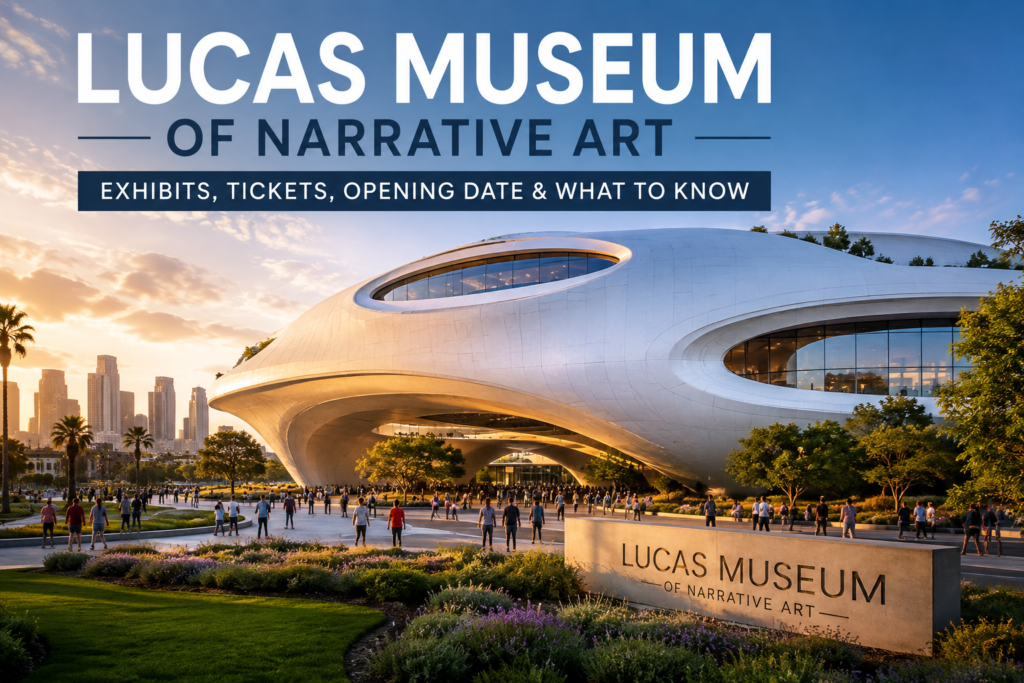
Los Angeles is preparing to welcome one of its most ambitious new cultural attractions. The Lucas Museum of Narrative Art opens to the public on September 22, 2026, bringing together painting, illustration, comics, photography, film materials and other forms of visual storytelling at Exposition Park. Founded by George Lucas and Mellody Hobson, the museum explores how people use images to communicate stories, ideas and experiences across different cultures and generations.
The name immediately connects the museum with Star Wars. However, the Lucas Museum is much broader than a celebration of George Lucas’s filmmaking career. Its collection examines narrative art across centuries and creative disciplines, creating connections between traditional fine art, illustration, popular culture and cinema.
The building is equally distinctive. Designed by Ma Yansong of MAD Architects with Stantec, the structure rises above a new landscape in Exposition Park. The museum includes more than 100,000 square feet of gallery space, while the wider campus adds gardens, public areas and other visitor facilities. Together, they create a destination built around a simple idea: stories can take many visual forms.
What Is the Lucas Museum of Narrative Art?
The Lucas Museum of Narrative Art is a Los Angeles museum dedicated to visual storytelling. Instead of limiting its collection to one artistic medium, it brings together works that communicate stories, characters, ideas and cultural experiences through images.
That approach sets the museum apart from many traditional art institutions. Paintings, illustrations, comics, photographs and cinematic materials can appear in the same broader conversation. The goal is to show how visual storytelling has developed across different periods and cultures.
The inaugural presentation features more than 1,300 works across more than 30 galleries. The subjects range widely, including mythology, heroes, adventure, fantasy, childhood, sports, romance and community.
Key Facts About the Lucas Museum
| Detail | Information |
|---|---|
| Official name | Lucas Museum of Narrative Art |
| Location | Exposition Park, Los Angeles |
| Founders | George Lucas and Mellody Hobson |
| Public opening | September 22, 2026 |
| Primary focus | Narrative art and visual storytelling |
| Gallery space | More than 100,000 square feet |
| Opening presentation | 1,300+ works |
| Opening galleries | 30+ |
The collection includes artists and creators from different eras and traditions. Names associated with the inaugural presentation include Norman Rockwell, Artemisia Gentileschi, Frida Kahlo, Charles White, Frank Frazetta and Robert Crumb.
As a result, visitors should expect a museum that moves between familiar and unexpected territory. A trip may involve classical painting, American illustration, comic art, photography and movie-related material within the same overall experience.
The museum’s founders also emphasize accessibility. Rather than treating narrative art as a narrow academic category, the institution presents storytelling as something that connects with everyday audiences.
Why Is the Lucas Museum Opening in Los Angeles?
Los Angeles provides an especially fitting home for a museum centered on visual storytelling. The city has played a major role in film, television, animation, photography, illustration and other visual industries for generations.
Its location in Exposition Park also places the museum within an established cultural district. The area already attracts visitors to major museums, educational institutions and public spaces, giving the Lucas Museum a broader environment in which to operate.
The museum adds a major new architectural landmark to that setting. Its campus replaces a large area of asphalt with a combination of cultural space and landscaped public areas.
According to the museum, the approximately 13-acre landscape includes hundreds of newly planted trees, gardens, an amphitheater, a meadow, a hanging garden and a fountain. The landscape therefore serves more than a decorative purpose. It creates additional public space around the museum itself.
From an Ambitious Idea to Exposition Park
The Lucas Museum’s arrival in Los Angeles represents the completion of a long-running effort by George Lucas and Mellody Hobson to establish a permanent institution dedicated to narrative art.
The final concept goes well beyond material connected to Lucas’s own films. The museum’s permanent collection contains more than 40,000 works, while its opening exhibitions draw from a much wider history of visual storytelling.
That distinction is important for visitors deciding what the museum actually offers. Someone may arrive because of Star Wars, but the experience extends into illustration, comics, fine art, photography, murals and cinema.
The museum consequently occupies an unusual position in Los Angeles. It connects Hollywood’s storytelling tradition with artistic forms that existed long before modern filmmaking.
Its purpose is not simply to preserve famous images. Instead, it asks visitors to consider why certain images become powerful stories and how artists use visual language to shape the way people understand the world.
That broader mission is what gives the Lucas Museum its identity beyond the Lucas name.
Inside the Lucas Museum: What Will Visitors See?
The Lucas Museum experience goes far beyond a traditional collection of paintings. Its inaugural exhibitions use more than 1,300 works across more than 30 galleries to explore how artists have used images to tell stories, communicate beliefs and shape cultural memory. The galleries occupy more than 100,000 square feet of the museum.
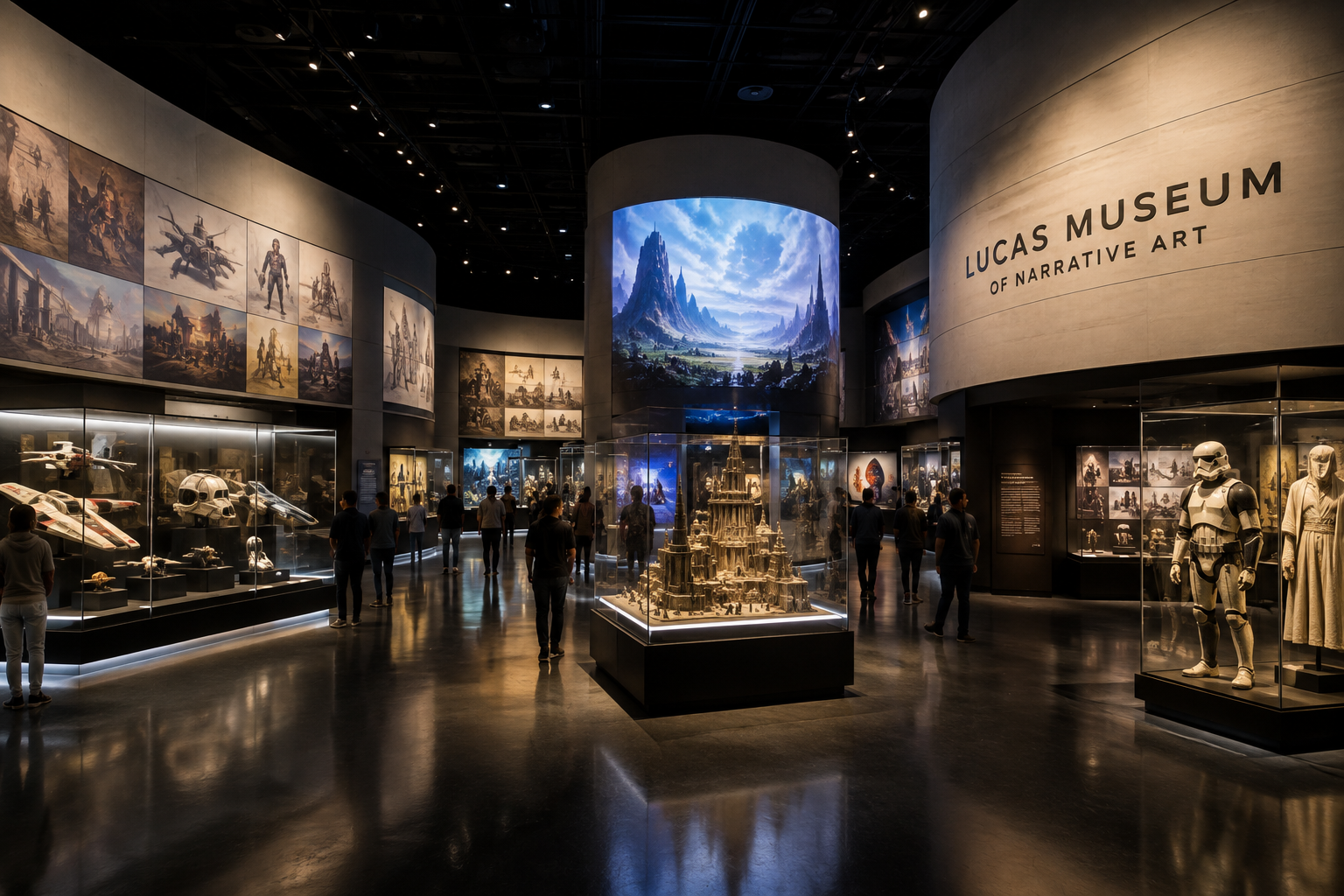
The journey begins with The History of Narrative Art: Heroes • Myths • The Sacred. This opening presentation looks at visual storytelling across thousands of years, connecting ancient religious imagery, mythology and monumental works with the broader development of narrative art.
The museum has also created highly detailed reproductions of important works and archaeological sites that visitors might otherwise need to travel around the world to experience. These include material connected with the Vatican Museums, the Louvre, the Altamira cave paintings and Mexico’s Aztec Sun Stone.
As visitors move through the building, the exhibitions shift toward themes, artistic genres and individual creators. This makes the collection feel less like a chronological art-history lesson and more like a series of interconnected stories.
Major Themes and Gallery Experiences
A major strength of the Lucas Museum is the way it organizes art around subjects that people already recognize from everyday life.
Instead of relying only on traditional artistic categories, several galleries explore themes such as:
- Childhood and children’s stories
- Family and motherhood
- Love and romance
- Community
- School and work
- Sports and recreation
- Adventure and danger
- Fantasy and science fiction
- Civic life and history
- The American West
This thematic approach allows very different artists and mediums to sit alongside one another. A painting, comic, illustration or photograph can communicate a similar human experience even when the creators worked centuries apart.
The museum also dedicates exhibitions to specific forms of narrative art. Visitors will find galleries focused on comic books, graphic stories, manga, photography and murals, alongside presentations devoted to genres such as adventure, fantasy and romance.
That variety is central to the museum’s identity. The goal is not simply to decide which works qualify as “fine art.” Instead, the Lucas Museum asks visitors to consider how visual storytelling works across different creative traditions.
That broader approach also connects with the evolution of comic-book characters and visual worlds in modern popular culture.
Artists and Narrative Art Across Generations
The inaugural exhibitions bring together artists who rarely appear within the same museum experience.
American illustration receives particular attention. Dedicated galleries highlight influential figures including Norman Rockwell, N.C. Wyeth, Jessie Willcox Smith, Maxfield Parrish, Frank Frazetta and Thomas Hart Benton. Their work demonstrates how illustrations shaped the way generations of readers imagined characters, places and stories.
Other galleries broaden the picture further. Visitors can encounter works associated with Vincent van Gogh, George Bellows, Jacob Lawrence, Beatrix Potter, Charles White and Ernie Barnes, among many others.
The museum also embraces creators from comics, manga, photography and public art. Names represented across the inaugural exhibitions include George Herriman, Charles Schulz, Jim Lee, Frank Miller, Takashi Murakami, Robert Capa, Gordon Parks, Diego Rivera and Judith F. Baca.
This broader interest in comics also reflects how modern superhero storytelling has become an important part of visual culture.
This range reveals the museum’s larger argument: storytelling does not belong to one medium or artistic tradition. A children’s illustration, a comic-book panel, a documentary photograph and a monumental mural can all shape the way audiences understand a story.
Is the Lucas Museum a Star Wars Museum?
No. Star Wars is an important part of the Lucas Museum, but it is only one part of a much larger collection.
The connection is understandable. George Lucas founded the museum, and the institution holds extensive materials from Lucasfilm productions. The Lucas Archives include production artwork, props, costumes and other artifacts spanning decades of filmmaking.
However, the inaugural museum program places Star Wars within a much broader exploration of narrative art. More than 30 installations examine visual storytelling across history, cultures and creative mediums, while the dedicated cinema exhibition focuses specifically on the visual development of Lucas’s saga.
That distinction could surprise visitors who expect a building centered entirely on the franchise.
Instead, the museum treats Star Wars as one particularly influential example of how artists, designers, filmmakers and storytellers can create worlds that audiences remember for generations.
That same connection between characters, visual design and audience memory continues in modern superhero cinema, including contemporary superhero storytelling.
What Star Wars Exhibits Are Included?
The opening cinema exhibition, Star Wars in Motion, draws from the Lucas Archives and focuses on vehicles from the first six Star Wars films.
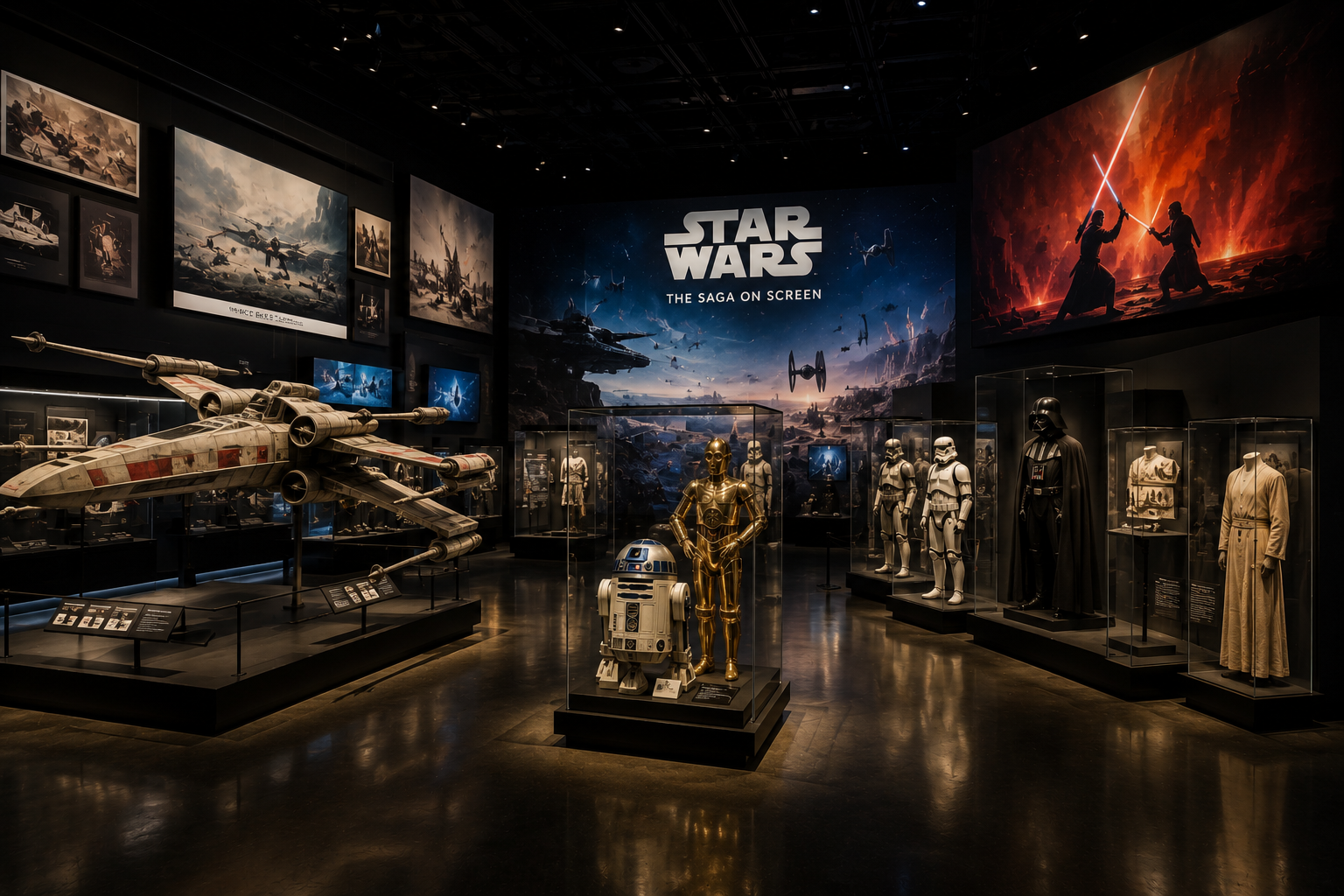
Visitors will see concept designs, props, costumes and illustrations connected with the saga’s racers, transport vehicles and spacecraft. Among the featured objects are Luke Skywalker’s Landspeeder from A New Hope and the first physical build of General Grievous’s Wheel Bike from Revenge of the Sith.
The exhibition therefore emphasizes the creative process behind the films rather than simply displaying recognizable memorabilia.
That focus fits the museum’s wider philosophy. Star Wars becomes a case study in visual storytelling: artists first imagine vehicles, characters and environments on paper, then filmmakers and production teams transform those ideas into physical objects and moving images.
For longtime fans, that behind-the-scenes perspective offers a different way to experience familiar films. For everyone else, it provides a clear example of how an idea can travel from an illustration into a fully realized cinematic world.
Lucas Museum Architecture: Why Does It Look Like a Spaceship?
The Lucas Museum is designed to make an impression before visitors enter a gallery. Architect Ma Yansong, founder of MAD Architects, created the building as an organic sculptural form that rises above Exposition Park. Stantec served as executive architect. The five-story structure covers about 300,000 square feet and contains more than 100,000 square feet of gallery space.
Its flowing shape explains why many early descriptions compared the building to a spaceship or futuristic vessel. The exterior avoids the rigid geometry associated with conventional museums. Instead, curved surfaces, elevated sections and large openings create a structure that appears to hover over the landscape.
One of its most dramatic features is the central arch, which spans about 185 feet. Above the public plaza, an elliptical oculus opens the building toward the sky, creating a striking view from below.
The exterior uses more than 1,200 individually shaped fiberglass-reinforced polymer panels. The lightweight material allows the architects to create the building’s smooth curves while keeping the structure visually fluid.
The architecture also reflects the museum’s subject. Just as narrative art encourages visitors to move from one visual idea to another, the building creates a sense of movement between its indoor and outdoor spaces.
A Building Designed Around Movement
The museum does not present itself as a conventional rectangular gallery block. Its elevated form creates sheltered gathering areas beneath the building, while curved walls guide visitors through the interior.
Inside the lobby, the architecture continues the same visual language. Curved surfaces and unusual vertical circulation elements make the entrance feel more like an immersive environment than a simple reception area.
The building’s design also connects directly with Exposition Park. Ma Yansong drew inspiration from the large trees surrounding the site, imagining the museum as an extension of the park’s natural canopy.
That relationship becomes especially important because visitors do not experience the museum as an isolated object. Paths, gardens, plazas and views continually connect the architecture with its surroundings.
For a museum devoted to imagination, that approach makes sense. The building itself becomes part of the visitor’s story before the first artwork comes into view.
The Park, Gardens and Outdoor Spaces
The Lucas Museum extends beyond its galleries through a major landscaped campus surrounding the building. The museum describes the site as a new public landscape designed by Mia Lehrer of Studio-MLA, transforming an area that previously included an asphalt parking lot into green space for visitors and the surrounding South Los Angeles community.
The landscape includes native and drought-tolerant plantings, hundreds of new trees, walking paths, gathering areas, gardens, a meadow, an amphitheater and a dramatic fountain.
These outdoor spaces serve several purposes. Visitors can use them for relaxation, community activities and public programming, while the landscape also creates a softer transition between the busy urban surroundings and the museum’s sculptural architecture.
A Public Space Beyond the Galleries
The park is particularly important because visitors do not need a museum admission ticket to access the Park & Gardens. The museum’s current visitor information also states that the café, store and Skywalker Grill can be accessed without a museum ticket.
That makes the campus more than an entrance area. Someone can visit Exposition Park, explore the landscape and experience the building from outside without committing to a full museum visit.
The landscape also incorporates environmental features. The museum says its design captures rainwater for irrigation, while a waterfall-like fountain contributes to cooling and rooftop solar panels provide clean energy.
Together, the gardens and architecture create an unusual museum setting. The experience can begin outdoors, continue through the building and return to the landscape without feeling like separate destinations.
What Else Is Inside the Lucas Museum?
The museum is designed as a destination that can occupy much of a visitor’s day. Alongside its galleries, the five-story building contains cinemas, learning spaces, a research library, retail areas, a café and a rooftop restaurant.
This mix reinforces the institution’s broader mission. The Lucas Museum is not only a place to look at artworks. It also provides spaces for watching films, researching visual culture, learning, eating and gathering.
Two state-of-the-art theaters form an important part of the experience. Their programming expands the museum’s definition of narrative art from still images into moving pictures, sound and editing.
The building also includes flexible educational facilities, including studios and classrooms. These spaces support programs intended to connect visitors with the ideas explored in the galleries.
Cinemas, Library and Research Center
The museum’s research library provides another major layer of the institution. Its collections cover subjects connected with art history, illustration, cinema, folklore, anthropology, literature, photography, children’s literature and popular culture.
The library also contains rare books, archives and a collection of more than 30,000 comic books, with significant holdings from the Silver Age of comics.
Its setting is designed to encourage both research and exploration. Floor-to-ceiling windows overlook the surrounding gardens, while the collection provides deeper context for many of the themes explored inside the museum.
The library is open to visitors, although its research collections and non-circulating materials follow specific access rules.
This makes the Lucas Museum unusual among major entertainment-focused attractions. Its connection to popular culture does not stop at displays. The institution also creates a serious research environment for understanding the history behind those visual stories.
Dining, Shopping and Skywalker Grill
Food and retail are integrated into the museum experience rather than treated as afterthoughts.
The campus includes a café and museum shop, while Skywalker Grill occupies the top of the building. The restaurant takes inspiration from the hospitality associated with Skywalker Ranch and is open to both museum visitors and the general public.
Its menu focuses on modern American dining, with classic dishes, seasonal ingredients and options designed for families.
The restaurant also offers panoramic views of Los Angeles, making it a potential destination even for people who are not visiting the galleries.
That broader accessibility fits the museum’s overall design philosophy: art, food, research, cinema and public space can coexist within one destination rather than operating as separate experiences.
Lucas Museum Opening Date and Tickets
The Lucas Museum of Narrative Art opens to the public on Tuesday, September 22, 2026. That date marks the museum’s transition from a long-awaited cultural project into a permanent public destination in Los Angeles.
Before the public opening, the museum will hold special preview events. Founding members have access to member preview days from September 5 through September 11, while a neighborhood preview on September 13 will welcome local community members and partners.
General admission is straightforward, although every museum visitor must reserve a timed-entry ticket in advance. That requirement applies even to members and children accompanying them.
When Does the Lucas Museum Open?
The public opening date is September 22, 2026.
The museum is located at One Lucas Plaza, Los Angeles, California 90037, within Exposition Park. Its regular hours vary by day, with later closing times on Friday and Saturday. The Park & Gardens open earlier and remain accessible until sunset.
| Visitor | Admission |
|---|---|
| Adults | $25 |
| Seniors 65+ | $21 |
| Children 17 and under | Free |
| Museum members | Free |
| Active-duty military | Free |
| LM37 passholders | Free |
The museum currently lists tickets for visits beginning September 22, 2026, with availability extending through February 28, 2027. Visitors should check the official ticketing information before planning a trip because availability, programs and visitor policies can change.
Who Can Visit the Lucas Museum for Free?
The Lucas Museum has built several free-admission opportunities into its visitor program. Children aged 17 and under can enter without paying the standard admission price, while museum members and active-duty military personnel also receive free general admission.
California EBT cardholders can also receive free general admission, although they still need a ticket and must present their EBT card when checking in. The museum’s current ticket information also lists personal aides or attendants among those eligible for free admission.
The most locally focused program is the LM37 pass.
What Is the LM37 Pass?
The LM37 pass is designed specifically for people who live in the 90037 ZIP code, where the museum is located.
Eligible residents can register for the pass and receive free museum admission for themselves and one guest. The benefit includes access to exhibitions, gardens and public spaces, along with invitations to selected special events and programs.
The program reflects an important part of the museum’s community strategy. Rather than positioning the institution as a destination only for tourists, the museum wants nearby residents to view it as a place they can return to regularly.
First-time LM37 visitors must provide proof of their address. Acceptable documentation can include identification, a utility bill or certain school documents.
That approach gives the museum a direct connection with its South Los Angeles neighborhood while making its cultural and public spaces more accessible to the people who live closest to it.
Why the Lucas Museum Matters to Los Angeles
The Lucas Museum arrives at a moment when Los Angeles continues to strengthen its position as a global center for culture, entertainment and visual media.
Its importance, however, goes beyond adding another major attraction. The institution brings together artistic traditions that museums have often treated separately. Painting can appear alongside illustration, comics, photography, murals and cinema, allowing visitors to see connections between forms that developed in very different contexts.
That approach could make the museum particularly accessible to audiences who do not normally consider themselves art-museum visitors.
A New Cultural Destination in Exposition Park
The museum also expands the cultural identity of Exposition Park. Its 13-acre campus adds public green space, outdoor sculptures and gathering areas while connecting the building to the surrounding park.
Ten monumental sculptures are installed along accessible outdoor walkways, creating an experience that begins before visitors enter the galleries. The Park & Gardens are free and open to the public, further expanding the museum’s role as a community space.
The museum’s cinema program adds another layer. Two theaters will offer continuous, drop-in film experiences, covering everything from early silent cinema and experimental filmmaking to animation and documentary work.
Together, these elements give the Lucas Museum a broader purpose than simply displaying a private collection.
It creates a place where art, film, architecture, research, public space and popular culture meet.
That combination may ultimately become the museum’s most important contribution to Los Angeles. Its biggest attraction may be Star Wars, its architecture may draw the first photographs, and its opening may generate global attention. Yet its lasting value will depend on whether visitors leave seeing visual storytelling itself in a new way.