
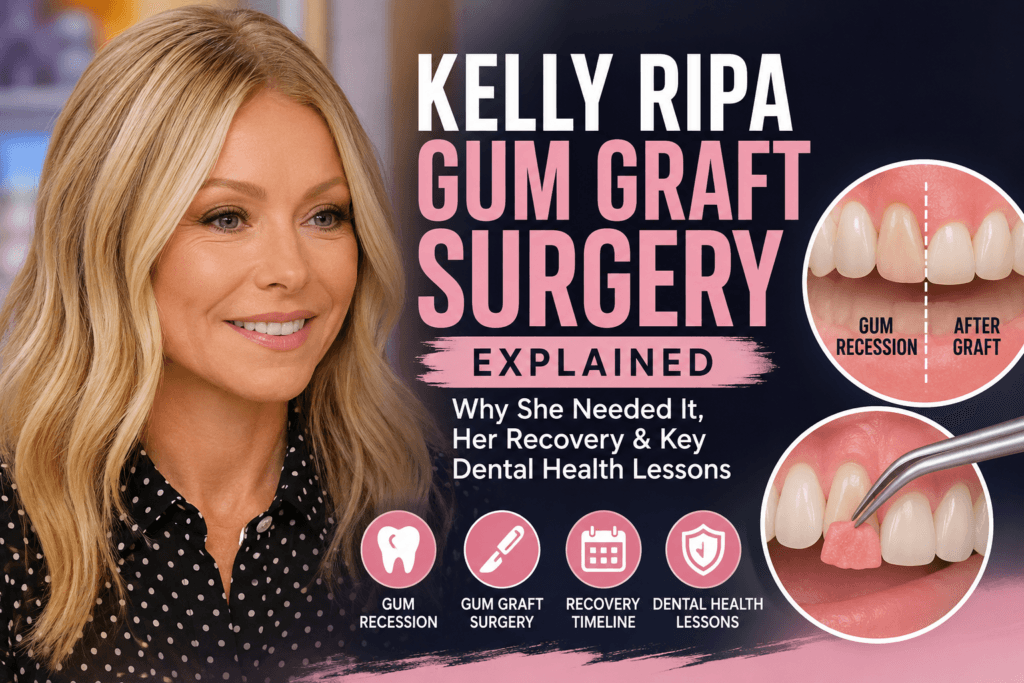
Kelly Ripa is accustomed to discussing television, family life, celebrity guests and everyday experiences in front of a large audience. However, her recent absence from Live With Kelly and Mark attracted attention for a much more personal reason: kelly ripa gum graft surgery.
The procedure was not simply a routine dental appointment. Ripa needed a period of recovery that temporarily prevented her from doing one of the most basic things required for her job — talking. Her husband and co-host, Mark Consuelos, explained that doctors had given her strict instructions while the surgical area healed, including avoiding speech and sticking with soft foods.
The story became even more interesting when Ripa later explained why she needed the procedure. She connected her gum problem to a long-standing habit of brushing her teeth very thoroughly. In her description, something she considered part of good dental hygiene had eventually contributed to gum recession.
That detail has made her experience relatable to people who may wonder whether they can actually brush their teeth too aggressively.
Still, there is an important distinction. Ripa’s experience should not be interpreted as meaning that hard brushing is the only reason someone can develop receding gums. Gum recession can have several causes, including periodontal disease, genetics, tooth positioning, previous orthodontic treatment, trauma and tobacco use. Aggressive brushing is one recognized risk factor, but it is not the complete explanation for every patient.
That broader context is what makes this story worth examining.
What Happened With Kelly Ripa’s Gum Health?
Ripa’s dental problem involved gum recession, a condition in which gum tissue gradually moves away from its normal position around a tooth. As the tissue recedes, more of the tooth can become exposed, and in some cases the root may become visible.
This can create several problems. The exposed portion of a tooth root is more vulnerable than the enamel-covered crown. Patients may notice increased sensitivity to cold, heat or sweet foods. In more advanced cases, recession can also contribute to additional dental complications.
Ripa has indicated that she had known about the problem for years before eventually undergoing surgery. According to PEOPLE’s report on her comments, she had previously been told that she would need the procedure but delayed it for roughly five years before her doctors advised that she should no longer put it off.
That part of her story is particularly relevant because gum recession is not necessarily something that suddenly appears overnight.
A person may notice a subtle change in the gumline and assume it is harmless. Another person may discover the issue during a routine dental examination. Sometimes sensitivity is what prompts an evaluation.
Because recession can progress differently from one person to another, the appropriate response depends on its cause and severity. A dentist or periodontist can examine the gum tissue, evaluate the surrounding teeth and determine whether monitoring, changes in oral care or treatment are appropriate.
In Ripa’s case, that evaluation ultimately led to gum graft surgery.
Why Kelly Ripa Gum Graft Surgery Was Recommended
Gum graft surgery is designed to restore or reinforce tissue around areas affected by gum recession. It is generally performed by a periodontist, a dental specialist who focuses on the gums and other structures that support the teeth.
The procedure can involve taking a small amount of healthy tissue from another part of the patient’s mouth and positioning it over the area where gum tissue has been lost. The roof of the mouth is one possible source. In other situations, a surgeon may use processed donor tissue instead. The technique depends on the patient’s condition and the treatment plan developed by the periodontist.
The purpose is not simply to make the gumline look different.
Adding tissue can help cover an exposed root, protect vulnerable areas and create a stronger layer of gum around the tooth. Gum grafting can therefore have both functional and appearance-related benefits.
However, not everyone with recession automatically needs surgery.
A periodontist may first determine how extensive the recession is, whether it is progressing and whether the exposed area creates a meaningful risk. Factors such as gum thickness, periodontal health and the position of the affected tooth can influence the recommendation.
This is an important point when discussing kelly ripa gum graft surgery online. Celebrity coverage can make a medical procedure seem like a universal solution, but treatment decisions are highly individual.
Someone with mild, stable recession may receive very different advice from someone whose gum tissue has continued to recede or whose tooth root has become exposed.
How Brushing Too Hard Can Affect Gum Tissue
One of the biggest talking points surrounding Ripa’s story is her description of over-brushing.
Brushing your teeth is essential. However, dental hygiene is not a contest to see how much pressure you can apply.
The gums are soft tissue. Repeated mechanical irritation can contribute to recession in some people, particularly when aggressive brushing is combined with other risk factors. Cleveland Clinic lists brushing too hard among the possible causes of gum recession.
That does not mean people should stop brushing or become afraid of using a toothbrush.
Instead, the lesson is about technique.
Effective brushing removes plaque from the teeth and gumline without requiring excessive force. A person may believe that pressing harder produces a deeper clean, yet pressure alone does not guarantee better plaque removal.
There is also a difference between brushing thoroughly and brushing aggressively.
Someone who regularly scrubs the same area with substantial force may gradually irritate the gumline. Over time, that can become a concern, especially if the person already has naturally thin gum tissue or another underlying risk factor.
For this reason, dental professionals can be helpful when a patient is unsure about brushing technique. A dentist or hygienist can observe how someone brushes and suggest adjustments when necessary.
Ripa’s experience therefore offers a useful reminder: good oral hygiene is about consistency and proper technique, not maximum pressure.
Is Over-Brushing the Only Cause of Receding Gums?
No. This is one of the most important points to understand.
Although Ripa has publicly connected her situation with aggressive brushing, gum recession can develop for multiple reasons. Cleveland Clinic lists periodontal disease, genetics, trauma, abnormal tooth positioning, smoking or chewing tobacco, orthodontic treatment and aggressive brushing among potential contributors.
Some people may also have naturally thin gum tissue that makes recession more likely.
That means two people can have very different dental histories and still develop a similar-looking change around their teeth.
This distinction matters because oversimplifying Ripa’s story could lead someone to believe that changing toothbrush pressure will automatically solve an existing gum problem. It may help prevent additional irritation, but it cannot replace a professional evaluation.
Gum recession also cannot simply be assumed to have one cause based on appearance alone.
A dental professional can examine the gumline and surrounding structures and consider the patient’s history. They may also assess whether periodontal disease or another condition is involved.
In practical terms, someone who notices that a tooth appears longer, experiences unusual sensitivity or sees a change around the gumline should not rely solely on online celebrity stories for an answer.
Instead, the useful lesson from kelly ripa gum graft surgery is to pay attention to changes in oral health early.
Early evaluation can help identify what is happening before a minor concern becomes a larger problem.
What Gum Recession Can Feel Like
Gum recession does not always cause obvious pain.
In fact, some people may discover it during a dental appointment before they notice anything unusual themselves. Others may experience sensitivity when drinking something cold, eating sweets or brushing near the affected tooth.
According to Cleveland Clinic, tooth-root exposure, discomfort near the gumline and sensitivity to heat, cold or sweets can be warning signs associated with recession.
A visible change in the gumline can also be an important clue.
For example, one tooth may appear longer than neighboring teeth because the gum has moved downward or upward, depending on the location in the mouth. The difference can be subtle, particularly when recession develops gradually.
However, not every unusual sensation means that gum recession is present.
Tooth sensitivity can have several possible causes, including enamel wear and other dental conditions. Likewise, bleeding gums can have different explanations and should not automatically be attributed to recession.
That is why professional evaluation matters.
The earlier a dentist identifies a developing gum problem, the more clearly they can explain the likely cause and available options. Depending on the situation, treatment may involve improved oral-hygiene techniques, management of gum disease, monitoring or referral to a periodontist.
For people who became curious about their own gums after hearing about kelly ripa gum graft surgery, the most useful response is not panic.
Instead, pay attention to persistent changes, maintain routine dental visits and ask questions when something looks or feels different.
Why Ripa’s Recovery Required More Than a Typical Dental Visit
The recovery period is another reason the story attracted so much attention.
Ripa works in a profession where speaking is central to almost everything she does. A temporary restriction on talking therefore creates an obvious challenge.
Consuelos explained on Live With Kelly and Mark that Ripa had been instructed not to speak during an important portion of her recovery. He also described other restrictions, including soft foods, avoiding straws and not pulling on the lip to inspect the surgical area.
Those instructions make sense in the context of protecting healing tissue.
After gum graft surgery, the treated area needs time to stabilize. Cleveland Clinic advises patients to follow their surgeon’s postoperative instructions carefully and notes that brushing or flossing directly around the graft too soon can interfere with healing.
Recovery can also involve swelling, bleeding and discomfort, especially during the early stages.
Cleveland Clinic says many patients recover over approximately one to two weeks, although the timeline varies according to the procedure, the number of areas treated and individual healing.
Ripa’s situation demonstrates why recovery cannot be judged solely by how small a procedure sounds.
A gum graft may involve a relatively limited surgical area, but the mouth is constantly involved in speaking, eating and swallowing. Consequently, protecting the graft can affect normal daily activities.
For a television personality, those restrictions become even more noticeable because the recovery directly affects the ability to appear on camera.
And that is exactly what happened with Ripa’s temporary break from Live.
Kelly Ripa Gum Graft Surgery Recovery Explained
The most unusual part of kelly ripa gum graft surgery was not necessarily the operation itself. It was the effect the recovery had on her daily routine and professional life.
For someone who spends hours speaking on television, being told not to talk is a major restriction. Yet that was reportedly one of the central instructions Ripa received after her procedure. Her husband and Live With Kelly and Mark co-host, Mark Consuelos, explained that she had to avoid speaking while the surgical area healed.
The restriction also helps explain why Ripa was away from the program for an extended period. Her recovery involved more than simply taking a day off after a dental appointment.
According to reports, she was expected to avoid talking for about 10 days. She also followed a soft-food diet and was told not to use a straw or pull on her lip to inspect the treated area.
Those instructions may sound surprisingly strict to someone who has never undergone periodontal surgery. However, the mouth is constantly moving throughout the day. Eating, speaking, chewing and even certain facial movements can place stress on healing tissue.
Therefore, protecting the graft becomes an important part of recovery.
Ripa’s experience also illustrates why the recovery period should not be judged simply by the size of the procedure. A relatively focused dental surgery can still interfere with ordinary activities when the affected area is inside the mouth.
Why Kelly Ripa Could Not Simply Return to Live TV
A daytime talk show depends heavily on spontaneous conversation.
That makes Ripa’s recovery particularly challenging. She could not simply sit quietly for part of an episode and then resume normal hosting. Her role requires continuous interaction with Consuelos, guests and the studio audience.
Consuelos explained the situation to viewers while Ripa was absent. He also emphasized that the surgery had been painful for her, which was notable because he described her as someone who normally has a very high tolerance for pain.
Several guest hosts subsequently filled in during her absence.
Kevin Jonas, Mila Kunis, Pamela Adlon, Scott Foley and other guests appeared alongside Consuelos while Ripa recovered.
The rotating lineup helped the program continue while Ripa followed her doctor’s instructions. Celebrity health and recovery stories can also show how medical issues can temporarily reshape a person’s career and everyday life.
More importantly, it showed that her absence was connected to a genuine recovery period rather than a simple scheduling change.
For viewers, the situation may have seemed unusual because Ripa is such a familiar presence on the show. However, avoiding speech was a medical restriction, and following it was more important than maintaining her normal television schedule.
That is one reason the story surrounding kelly ripa gum graft surgery became much bigger than a routine celebrity health update.
How the Gum Graft Procedure Works
A gum graft is designed to replace or reinforce gum tissue that has become too thin or has moved away from the tooth.
The exact technique can vary. According to Cleveland Clinic, periodontists commonly use tissue from the roof of the patient’s mouth, although substitute donor materials may also be used in some cases.
Before surgery, the periodontist examines the gums and measures the recession. They also assess the health of the tissue around the affected teeth.
Once the treatment plan is established, local anesthesia is used to numb the area. Sedation may also be available depending on the patient and procedure.
The surgeon then prepares the area affected by recession. If the patient’s own tissue is being used, a small amount is obtained from the palate. That graft is then positioned over the area requiring additional gum tissue.
Finally, the graft and surrounding tissue are secured with sutures or another appropriate method.
The goal is to allow the transplanted tissue to heal and integrate with the surrounding gum.
Cleveland Clinic notes that the length of the procedure depends on how many teeth require treatment. A single graft can take around an hour, while treatment involving several areas may take longer.
So, although kelly ripa gum graft surgery sounds like one specific operation, gum grafting is actually a category of periodontal procedures. The exact technique depends on the patient’s anatomy, the amount of recession and the treatment goals.
Why Tissue May Come From the Roof of the Mouth
The roof of the mouth can provide suitable tissue for certain types of gum grafting.
That is why descriptions of Ripa’s surgery have attracted attention. She discussed the procedure in graphic terms, explaining that tissue was taken from the roof of her mouth and moved to her gums.
For someone unfamiliar with gum grafting, this can sound alarming.
However, using tissue from another part of the mouth is an established approach in periodontal treatment. The surgeon selects tissue that can help reinforce the area affected by recession.
There is also a practical reason this matters during recovery: the patient may have more than one healing area.
If tissue is harvested from the palate, that location also needs time to recover. Consequently, postoperative discomfort may not be limited to the tooth where the recession occurred.
Cleveland Clinic explains that graft material can also come from a licensed tissue bank in certain situations. Therefore, not every gum graft requires harvesting tissue from the patient’s palate.
The choice depends on the individual treatment plan.
This is another reason it is difficult to compare one person’s recovery directly with another’s. Different techniques can involve different surgical sites, and the number of teeth treated can also change the experience.
Ripa’s description provides insight into one patient’s procedure, but it does not establish a standard approach for everyone.
For people researching kelly ripa gum graft surgery, that distinction is important because online celebrity coverage often compresses a complex medical procedure into a few simple sentences.
What Happens Immediately After Gum Graft Surgery?
The first stage of recovery is focused on protecting the surgical site.
Cleveland Clinic says patients can experience bleeding, swelling and discomfort during the early period. Doctors may provide medication and specific instructions for caring for the mouth.
Rest is generally important immediately after surgery.
Patients are also commonly instructed to avoid strenuous activity during the initial recovery period. Raising the heart rate can increase the risk of bleeding and swelling, so returning to workouts too quickly may not be advisable.
Food becomes another important consideration.
Soft, cool foods are often easier to eat immediately after the procedure. Examples can include yogurt, pudding and other foods that do not require significant chewing.
As healing progresses, patients can gradually add more foods. However, hard, crunchy or spicy foods may need to remain off the menu until the surgeon considers them safe.
Oral hygiene also changes temporarily.
This can seem strange because brushing is normally encouraged for good oral health. Yet brushing directly over a fresh graft can disturb the healing tissue. Cleveland Clinic advises patients not to brush or floss directly around the graft until their surgeon says it is safe.
That creates an interesting contrast with Ripa’s story.
Her original problem was reportedly associated with over-brushing, while her recovery required her to be extremely careful about how she treated the surgical area.
The broader lesson is that dental care needs to change according to the situation. What is appropriate for healthy gums may not be appropriate immediately after surgery.
Kelly Ripa Gum Graft Surgery and the No-Talking Rule
The no-talking requirement is perhaps the detail that most clearly separates Ripa’s recovery from an ordinary dental appointment.
Speaking involves repeated movement of the lips, tongue and surrounding tissues. For a patient recovering from gum surgery, limiting that movement can help protect the treated area.
Ripa reportedly had to avoid speaking for approximately 10 days. She even discussed the restriction before the procedure, expressing concern about how difficult it would be for someone whose everyday life revolves around communication.
That makes the situation particularly understandable for television viewers.
Ripa is not simply someone who occasionally speaks in public. Hosting Live requires constant conversation. She also records interviews, participates in promotional activities and communicates with people throughout a normal workday.
Therefore, the recovery instruction affected a fundamental part of her professional routine.
Consuelos became the person explaining her absence to viewers.
Rather than trying to conceal the situation, the program addressed it directly. He provided updates and helped viewers understand why Ripa was not sitting beside him as usual.
The story also demonstrated why following postoperative instructions matters.
Feeling better does not necessarily mean that a surgical site has completely healed. Gum tissue continues to recover after the most uncomfortable symptoms begin to fade.
For that reason, a patient should follow the specific timeline provided by their surgeon rather than deciding independently when normal activities can resume.
In Ripa’s case, that meant temporarily stepping away from the microphone and allowing her mouth time to heal.
How Long Does Gum Graft Recovery Take?
There is no single recovery timeline that applies to every patient.
Cleveland Clinic says gum graft recovery commonly takes around one to two weeks, although healing can take longer depending on the procedure, the number of treated areas and individual circumstances.
The first several days can be the most uncomfortable.
Swelling may increase during the early part of recovery before gradually improving. Some bruising can also occur. Bleeding generally becomes less of a concern as the initial healing period passes.
During the first week, patients usually continue following dietary and oral-care restrictions. Soft foods are commonly easier to tolerate, while the surgical site must be protected from unnecessary pressure.
By the second week, many people are more comfortable and can gradually return to a broader range of activities.
However, the visible improvement in symptoms does not necessarily mean the tissue has finished healing.
That is why follow-up appointments matter.
A periodontist may examine the graft, check how the tissue is healing and provide instructions for gradually returning to normal brushing and flossing.
The timeline can also be different when multiple teeth are treated.
Consequently, someone researching kelly ripa gum graft surgery should avoid assuming that Ripa’s reported recovery period represents the exact amount of time another patient will need.
The best estimate comes from the surgeon who performed the procedure.
Why Soft Foods Matter During Recovery
Eating may seem unrelated to gum healing, but food can place direct stress on the mouth.
Hard or crunchy foods require more chewing. That movement can be uncomfortable after surgery and may put unwanted pressure near the treated area.
Soft foods reduce the amount of work required from the mouth.
Cleveland Clinic recommends soft foods during the early recovery period and gives examples such as yogurt, pudding, pasta, eggs, fish and cooked vegetables as patients progress.
The exact diet, however, should follow the patient’s surgical instructions.
Temperature can matter as well. Cool foods may feel more comfortable during the initial period, while very hot foods may be unpleasant when the mouth is swollen or sensitive.
Ripa’s reported restrictions included soft foods, which fits with the broader postoperative approach used after gum grafting.
Avoiding straws was another notable instruction.
Patients should follow their own surgeon’s specific guidance because different procedures can require different precautions. The purpose of such restrictions is generally to minimize unnecessary disturbance around the healing tissues.
For someone who normally eats a wide variety of foods, the temporary change can be frustrating.
Yet dietary restrictions are short-term compared with the longer-term goal of protecting the graft.
In other words, the soft-food phase is not about changing someone’s permanent diet. It is about giving the mouth a safer environment while the surgical tissue establishes itself.
That temporary inconvenience is one of the less glamorous but important realities behind kelly ripa gum graft surgery.
Why Ripa Appeared on Live During Her Recovery
Ripa’s eventual appearance on Live With Kelly and Mark created another layer of confusion.
Viewers saw her back on screen, which could easily lead to the assumption that she had already returned to normal hosting duties. However, the episodes airing during the end-of-summer period included previously recorded material.
That distinction is significant.
Television programs do not always operate in real time. Shows can record segments in advance and broadcast them later, particularly during seasonal programming periods.
Entertainment Weekly reported that Ripa appeared alongside Consuelos in pre-recorded footage even while she was still recovering. A notice indicating that the material had been previously recorded appeared during the broadcast.
Therefore, her presence on television did not necessarily mean that she had returned to the studio for a normal live episode.
This also explains why the program could show Ripa while guest hosts had previously filled in during her absence.
For viewers following the kelly ripa gum graft surgery story, the situation is easier to understand once the difference between recorded and live television is clear.
Her recovery and the show’s production schedule could overlap.
The result was that audiences could see Ripa on screen without her necessarily being physically present for that day’s live production.
That approach allowed the show to continue while giving Ripa time to follow her medical team’s recovery instructions.
What Ripa’s Delayed Surgery Reveals
Perhaps the most significant detail in Ripa’s story is that she reportedly knew about the recommended procedure years before actually having it.
According to her comments reported by PEOPLE and Entertainment Weekly, she had been advised to undergo the gum graft about five years earlier but eventually reached a point where her doctor told her that waiting was no longer a good option.
That does not mean every patient should immediately agree to every recommended dental procedure.
Instead, it highlights the value of understanding why a dentist or periodontist is recommending treatment.
If a patient is told that gum recession is progressing, useful questions might include:
- What is causing the recession?
- Is it getting worse?
- What happens if it is monitored?
- Are there nonsurgical options?
- Why is grafting being recommended?
- What type of graft would be used?
- How long should recovery take?
- What activities need to be avoided?
- What symptoms would require an urgent call?
These questions can turn a confusing recommendation into a clearer decision.
Ripa’s experience also demonstrates that delaying a procedure can eventually make the decision more urgent. The appropriate timing, however, depends on the individual patient.
Ultimately, the important lesson is not that everyone with gum recession needs surgery.
It is that persistent dental concerns deserve attention.
A professional can explain whether a condition is stable, whether preventive changes are enough or whether treatment has become necessary.
And that is one of the most useful lessons hidden inside the story of kelly ripa gum graft surgery.
What Kelly Ripa’s Experience Can Teach About Gum Recession
The story behind kelly ripa gum graft surgery raises a broader question that has little to do with celebrity culture: how can someone recognize a gum problem before it becomes serious?
Gum recession can be easy to overlook because it may develop slowly. A person might notice that one tooth looks slightly longer than before, or they may suddenly experience sensitivity while drinking a cold beverage. In other cases, there may be no obvious symptoms at all.
The American Academy of Periodontology lists receding gums, bleeding, red or swollen gums, persistent bad breath, loose teeth and changes in the way teeth fit together as possible warning signs of gum disease.
However, recession does not automatically mean that someone has advanced gum disease.
There are several possible causes, including periodontal disease, aggressive brushing, naturally thin gum tissue, tooth position and other forms of physical trauma. Therefore, the appearance of a receding gumline cannot tell someone exactly why it happened.
That is where a professional dental examination becomes important.
Why Gum Recession Can Be Easy to Miss
Teeth do not necessarily become noticeably different overnight.
Instead, gum tissue may gradually change over months or years. Because the process is slow, people can become accustomed to the appearance of their own smile.
A small amount of recession may also affect only one or a few teeth. Unless someone regularly examines their gumline, the change can go unnoticed.
Sensitivity can provide another clue.
When gum tissue moves away from the tooth, more vulnerable tooth structure may become exposed. The American Academy of Periodontology explains that gum graft surgery can cover exposed roots and may help reduce sensitivity.
Still, sensitivity alone does not prove that recession is present.
Cold sensitivity, for example, can have several causes. A dental professional can determine whether the problem involves recession, tooth wear, decay or another condition.
The important lesson is therefore not to diagnose yourself from a celebrity’s experience.
Instead, Ripa’s story can encourage people to pay closer attention to changes they might otherwise dismiss.
Kelly Ripa Gum Graft Surgery and the Difference Between Recession and Gum Disease
One of the easiest mistakes to make when discussing kelly ripa gum graft surgery is treating gum recession and gum disease as exactly the same thing.
They are related, but they are not interchangeable terms.
Gum recession describes the movement or loss of gum tissue that exposes more of the tooth. Gum disease, particularly periodontitis, involves inflammation and destruction of the tissues supporting the teeth.
Periodontitis can cause gums to pull away from teeth and can eventually damage the bone supporting them. The American Academy of Periodontology describes receding gums as one possible warning sign of gum disease.
However, recession can also occur without advanced periodontal disease.
For example, repeated mechanical trauma from aggressive brushing may contribute to recession in some people. Tooth position can also affect how vulnerable a particular area is.
That distinction matters because the treatment approach depends on the underlying problem.
Why Finding the Cause Matters
Suppose a patient has recession caused partly by brushing technique.
A graft may address the lost or weakened tissue, but changing the brushing habit can also be important for protecting the area in the future.
On the other hand, if active periodontal disease is contributing to tissue destruction, treating the underlying infection and inflammation becomes an important part of the overall dental plan.
The American Academy of Periodontology notes that nonsurgical periodontal treatments such as scaling and root planing may be appropriate in some cases, while surgical treatment can become necessary when nonsurgical care does not produce the desired periodontal health.
Therefore, gum grafting should not be viewed as a universal treatment for every person with receding gums.
The first step is understanding why the tissue changed.
That is also why a celebrity’s medical story should be used as general information rather than as a personal treatment guide.
How to Brush Without Damaging Your Gums
Ripa’s experience has prompted many people to rethink how they brush.
The answer is not to brush less carefully. Instead, the goal is to brush effectively while using gentle pressure.
The American Dental Association recommends brushing twice a day for two minutes with fluoride toothpaste and a soft-bristled toothbrush. It also recommends gentle pressure and short back-and-forth movements around the gumline.
That advice offers a useful contrast to the idea that harder brushing produces cleaner teeth.
Gentle Does Not Mean Ineffective
A common misconception is that a soft brushing technique cannot remove enough plaque.
In reality, proper positioning and consistent movement matter greatly.
The ADA recommends holding the toothbrush at roughly a 45-degree angle toward the gumline and cleaning the inner, outer and chewing surfaces of the teeth.
The objective is to reach plaque without repeatedly scraping the gums.
A person who notices flattened or frayed toothbrush bristles may also want to reconsider how much pressure they are applying.
Toothbrush choice can make a difference as well. Soft bristles are generally recommended, and both manual and powered toothbrushes can be effective when used correctly.
A powered toothbrush can be particularly useful for people who tend to press too hard because some models provide feedback when excessive pressure is applied. However, the device itself does not eliminate the need for proper technique.
Ultimately, the best routine is one that removes plaque consistently without causing unnecessary irritation. That focus on balanced self-care also fits into the wider conversation around celebrity wellness and healthy living.
That is perhaps the simplest practical lesson people can take from kelly ripa gum graft surgery.
Can Toothpaste Also Affect Gum and Tooth Wear?
Brushing pressure is only one part of the equation.
The type of toothpaste a person uses can also influence how much mechanical wear occurs on exposed tooth surfaces. The American Dental Association uses a measurement called Relative Dentin Abrasivity, or RDA, to describe the abrasiveness of toothpaste.
This becomes particularly relevant when gum recession has exposed dentin.
Dentin is softer than enamel. Consequently, exposed areas can be more vulnerable to wear.
The ADA notes that toothpastes meeting its established abrasivity criteria can be used safely and effectively when combined with proper brushing technique.
That means consumers do not necessarily need to search for the least abrasive toothpaste available.
Instead, they should consider the overall oral-care routine.
Why Whitening Products Deserve Attention
People with sensitive or exposed areas may also want to discuss whitening products with their dentist.
Some whitening products can contribute to temporary sensitivity, and aggressive brushing immediately around sensitive areas may make the experience more uncomfortable.
The ADA recommends soft-bristle brushing and fluoride toothpaste as part of routine dental care.
Therefore, someone experiencing sensitivity after gum recession should not simply increase brushing pressure in an attempt to keep the teeth extra clean.
A better approach is to identify the source of the sensitivity and adjust the oral-care routine accordingly.
This is particularly important because the goal of dental hygiene is long-term protection, not an immediate feeling of extreme cleanliness.
Why Flossing Still Matters After Learning About Ripa’s Surgery
Someone who hears about aggressive brushing might focus so heavily on brushing pressure that they forget another essential part of oral hygiene: cleaning between the teeth.
The American Dental Association explains that toothbrush bristles cannot effectively reach every tight space between teeth. Interdental cleaning helps remove plaque and trapped debris from those areas.
Floss is one option, but it is not the only one.
Depending on the spacing between teeth and individual dental needs, a person may use traditional floss, interdental brushes or another cleaning device.
Avoid Turning Flossing Into Another Aggressive Habit
The same basic principle applies here: more force is not necessarily better.
Interdental brushes should fit the space appropriately rather than being forced between teeth. ADA guidance notes that using the wrong size or pushing an interdental brush into a tight space can damage the gums.
That reinforces a larger theme in the kelly ripa gum graft surgery discussion.
Oral hygiene works best when it is precise rather than aggressive.
Brushing, flossing and other cleaning methods should remove plaque without repeatedly traumatizing healthy tissue.
For people who are uncertain about technique, asking a dental hygienist to demonstrate the appropriate method can be far more useful than experimenting based on social media advice.
What Happens If Gum Recession Is Left Alone?
The answer depends on the cause and severity.
Some cases may remain stable, while others can progress. That is why monitoring matters.
The American Academy of Periodontology explains that gum graft surgery can cover exposed tooth roots and help prevent additional recession and bone loss. It may also reduce sensitivity and improve the appearance of the gumline.
This does not mean every person with mild recession needs surgery.
Instead, it shows why a dentist or periodontist may recommend monitoring a particular area over time.
If the recession is worsening, the root becomes increasingly exposed or the surrounding tissue is vulnerable, treatment may become more important.
Why Exposed Roots Can Become a Concern
The visible crown of a tooth is protected by enamel, while the root is covered by a different, less protective surface.
When recession exposes the root, the area may become more sensitive and vulnerable.
The American Academy of Periodontology specifically describes gum grafting as a way to cover exposed roots and help protect them from further problems.
That is why gum graft surgery can have a preventive purpose, rather than being purely cosmetic.
A patient may choose treatment not because the gumline looks unattractive, but because protecting the tooth and surrounding tissue has become the more important goal.
This distinction is central to understanding why Ripa’s doctors ultimately recommended surgery after years of monitoring her condition.
Kelly Ripa Gum Graft Surgery Was More Than a Cosmetic Procedure
Celebrity stories often become associated with appearance.
That is especially true when the subject involves teeth, smiles or facial procedures. However, the clinical purpose of gum grafting can extend well beyond aesthetics.
The American Academy of Periodontology explains that root-coverage procedures can protect vulnerable tooth roots, reduce the risk of additional recession and improve the appearance of the smile.
So, when discussing kelly ripa gum graft surgery, it would be misleading to describe it simply as a cosmetic dental treatment.
The procedure addressed a structural problem involving gum tissue.
Functional Reasons for Gum Grafting
There are several reasons a periodontist may consider grafting.
A patient might have:
- An exposed tooth root
- Progressive gum recession
- Persistent sensitivity
- Thin or fragile gum tissue
- Concern about protecting a vulnerable tooth
- A gumline that has changed significantly
The exact reason varies from patient to patient.
In some cases, appearance is also part of the discussion. An uneven gumline or exposed roots can alter the appearance of a smile. However, functional protection can be the more important objective.
This helps explain why Ripa’s procedure required a genuine recovery period.
The goal was not simply to change the appearance of her smile before returning to television.
The treatment involved surgical manipulation of gum tissue, followed by a healing process that temporarily affected eating, speaking and normal oral care.
What Patients Should Know Before Considering Gum Graft Surgery
Anyone researching gum grafting because of Ripa’s story should begin with a professional evaluation rather than jumping directly to treatment.
A dentist can first determine whether recession is actually present. If necessary, the patient can then be referred to a periodontist for a more detailed assessment.
Questions Worth Asking a Periodontist
A consultation can be much more productive when the patient knows what to ask.
Useful questions include:
| Question | Why it matters |
|---|---|
| What caused my gum recession? | Helps identify the underlying problem |
| Is the recession progressing? | Determines whether monitoring may be reasonable |
| Do I need a graft now? | Clarifies the urgency of treatment |
| Which graft technique is appropriate? | Different procedures suit different cases |
| Where will the graft tissue come from? | Explains the surgical sites involved |
| How long will recovery take? | Helps with work and lifestyle planning |
| What foods should I avoid? | Helps protect the healing tissue |
| When can I brush normally again? | Prevents accidental irritation |
| What symptoms should concern me? | Helps identify possible complications |
These questions can also make the experience less intimidating.
A patient who understands why the procedure is being recommended is generally in a better position to make an informed decision with their dental team.
Ripa’s experience may have brought gum grafting into the spotlight, but the underlying lesson is much broader: gum health deserves the same attention as the teeth themselves.
And as the next part explores, understanding the recovery process is just as important as understanding the surgery itself.
Kelly Ripa Gum Graft Surgery Recovery, Risks, Results, and What Patients Should Know
After the initial discomfort of kelly ripa gum graft surgery, the next stage is about protecting the graft and allowing the tissue to heal properly. That period can be frustrating because many normal habits have to change temporarily.
Ripa’s recovery became especially noticeable because her profession depends on speaking. However, the basic principles of healing apply to anyone undergoing gum grafting.
Cleveland Clinic says most people recover from gum graft surgery within about one to two weeks, although the exact timeline depends on the number of areas treated, the grafting technique and individual healing.
That does not mean the mouth is completely finished healing after two weeks. Instead, it means many patients are significantly more comfortable and can gradually return to their normal routines.
The First Few Days After Surgery
The first few days are generally the most sensitive part of recovery.
Patients can experience swelling, bleeding and soreness. Cleveland Clinic recommends resting after the procedure and avoiding strenuous activity because increased heart rate and physical exertion can contribute to more bleeding, swelling or discomfort.
Food also needs attention.
Soft and cool foods can make eating easier while the surgical area is tender. As healing progresses, patients can gradually introduce additional foods according to their periodontist’s instructions.
Most importantly, the graft itself needs protection.
Patients should not repeatedly touch, pull or inspect the surgical area. Similarly, brushing directly over the graft too soon can disturb the tissue.
That is why postoperative instructions can seem unusually strict. The restrictions are temporary, but the healing tissue is vulnerable during this stage.
Kelly Ripa Gum Graft Surgery and the Second Week of Recovery
By the second week, many patients begin noticing a meaningful improvement.
Cleveland Clinic says swelling and bruising should generally start to fade during this period, while comfort gradually improves. Patients may also begin returning to more solid foods when their surgeon considers it appropriate.
However, recovery should still be gradual.
A patient may feel substantially better while the graft remains in an important stage of healing. Therefore, feeling comfortable does not automatically mean every restriction can be removed.
When Can Normal Brushing Resume?
This is one of the most important questions after kelly ripa gum graft surgery.
Ordinary brushing is essential for long-term oral health, but brushing directly over a fresh graft can damage the healing tissue.
Cleveland Clinic advises patients not to brush or floss directly around the graft until their surgeon says it is safe.
The timing can vary.
Some patients may receive a special cleaning method or antimicrobial mouthwash during the early period. Others may receive different instructions based on the exact surgical technique.
Therefore, copying another patient’s routine is not a good idea.
The safest approach is to follow the instructions given by the periodontist who performed the procedure. Once the surgeon confirms that the graft is stable enough, normal oral hygiene can gradually resume.
This is particularly relevant to Ripa’s story because the procedure was reportedly connected to aggressive brushing. Her recovery therefore required a temporary shift from carefully cleaning the affected area to deliberately avoiding direct irritation.
How Successful Is Gum Graft Surgery?
For people researching kelly ripa gum graft surgery, one obvious question is whether the procedure actually works.
Gum grafting generally has a strong track record when appropriately planned and performed. Cleveland Clinic describes gum grafting as having a high success rate and notes that the procedure can help protect exposed tooth roots, reduce sensitivity and improve the appearance of the gumline.
The result, however, depends on several factors.
The underlying cause of recession matters. So does the condition of the surrounding gums, the type of graft, the location being treated and how carefully the patient follows postoperative instructions.
Why Aftercare Affects the Result
A technically successful procedure still needs proper healing.
Repeatedly touching the graft, eating foods that damage the surgical site or returning to strenuous activity too quickly can interfere with recovery.
That is why periodontists provide detailed instructions rather than simply completing the surgery and sending the patient home.
Follow-up appointments are also important. Cleveland Clinic says the surgeon will generally check the graft about a week after surgery and continue monitoring the area as needed.
The goal is not merely to get through the first few painful days.
The longer-term objective is to establish healthy tissue around the tooth and reduce the likelihood of additional problems.
What Are the Risks of Gum Graft Surgery?
Although gum graft surgery is generally considered safe, no surgical procedure is completely risk-free.
Cleveland Clinic identifies possible complications including infection, excessive bleeding and graft failure.
That does not mean these problems are expected.
Most patients do not experience serious complications. Nevertheless, knowing what to watch for can make recovery safer.
Signs That Need Professional Attention
Patients should contact their dental surgeon if something appears significantly different from the expected recovery pattern.
Potential warning signs can include heavy bleeding that does not stop, pus around the surgical area, fever or severe symptoms that are not improving.
Cleveland Clinic specifically advises patients to contact their surgeon if they develop signs such as heavy bleeding, pus or a fever above 101°F.
The important point is not to panic over every uncomfortable sensation.
Some swelling, soreness and bruising can occur during normal healing. The concern is when symptoms are severe, worsening or clearly outside the instructions provided by the surgical team.
That is why patients should keep their periodontist’s contact information available after surgery.
What Gum Graft Failure Can Look Like
Graft failure is uncommon, but understanding the possibility is still useful.
A gum graft needs a healthy blood supply to survive. If the graft loses that blood supply, the tissue may not heal as intended.
Cleveland Clinic notes that a large white patch of tissue that has come away from the tooth can be a sign that a graft has lost its blood supply.
That kind of change should not be diagnosed independently.
Instead, the surgeon should examine the area.
Why Patients Should Not Inspect the Graft Constantly
Interestingly, one of the instructions reported during Ripa’s recovery was that she should not pull on her lip to look at the surgical site.
That may sound unusual, but repeatedly manipulating healing tissue can create unnecessary irritation.
Patients are naturally curious after surgery. They may want to check whether the graft looks normal or whether the tissue is changing.
However, looking should not become touching.
If something seems unusual, the safest option is to contact the dental professional rather than repeatedly disturbing the area.
This is another reason postoperative instructions are so specific.
Kelly Ripa’s Recovery Shows Why Dental Surgery Can Affect Everyday Life
The kelly ripa gum graft surgery story also offers a useful reminder that oral surgery can temporarily affect much more than eating.
Ripa’s recovery affected her ability to speak, which directly interfered with her television work. Mark Consuelos explained that she was under instructions not to talk, while guest hosts appeared alongside him during her absence.
For most patients, the professional consequences may be less dramatic.
Even so, someone who works in sales, teaching, customer service, broadcasting, public speaking or another communication-heavy role may need to plan around recovery.
Planning Time Away From Work
Cleveland Clinic says many people can return to work or school within one or two days after gum graft surgery, although recovery varies.
That does not necessarily mean every job is suitable after two days.
A person with a physically demanding job may need more time. Someone who talks continuously for work may also require different planning from someone who works quietly at a computer.
Therefore, the recovery estimate should be treated as a general guide rather than a promise.
Patients should ask their periodontist how the planned procedure might affect their specific job.
For Ripa, the answer was particularly straightforward: her job required talking, while her recovery required silence.
That unusual conflict is what made her dental procedure such a prominent entertainment story.
Why Kelly Ripa’s Story Should Not Be Used to Diagnose Your Own Gums
Celebrity health stories can be useful because they introduce everyday medical and dental topics to a large audience.
However, they can also encourage people to make assumptions about themselves.
Someone who brushes aggressively may immediately conclude that they have the same condition Ripa had. Another person with sensitive teeth may assume that gum recession is responsible.
Neither conclusion is necessarily correct.
A Dentist Can Identify the Actual Cause
Gum recession can result from multiple factors, including periodontal disease, naturally thin gum tissue, aggressive brushing and other forms of trauma.
A dental professional can examine the gumline and determine whether recession is present.
If necessary, a periodontist can then measure the affected areas and evaluate whether treatment is needed.
This matters because the appropriate solution depends on the cause.
Someone with mild, stable recession may only need monitoring and changes to their oral-care habits. Another patient may require periodontal treatment or gum grafting.
Therefore, the correct takeaway from kelly ripa gum graft surgery is not that everyone should worry about their gums.
It is that persistent changes deserve professional attention.
A Simple Gum-Health Checklist
People who want to protect their gums can focus on a few basic habits.
| Gum-health habit | Why it matters |
|---|---|
| Brush twice daily | Helps control plaque |
| Use a soft-bristled toothbrush | Reduces unnecessary irritation |
| Use gentle pressure | Helps avoid aggressive brushing |
| Clean between teeth | Removes plaque a toothbrush cannot reach |
| Attend regular dental visits | Allows problems to be detected early |
| Avoid tobacco | Reduces important oral-health risks |
| Report persistent sensitivity | May help identify an underlying issue |
| Follow postoperative instructions | Protects healing tissue after treatment |
The American Dental Association recommends brushing twice daily with fluoride toothpaste and a soft-bristled toothbrush, while interdental cleaning helps remove plaque between teeth.
These habits are not complicated.
The challenge is consistency.
Good gum health generally comes from small actions repeated over a long period rather than extreme cleaning sessions.
And that may be the most useful lesson to take from Ripa’s experience: taking care of your gums does not mean attacking them.
The Bigger Lesson Behind Kelly Ripa Gum Graft Surgery
The public conversation around kelly ripa gum graft surgery began with a celebrity’s absence from television.
Yet the underlying issue is surprisingly ordinary.
Gum recession can affect people who take dental care seriously. Someone may even believe they are being especially responsible by brushing harder and longer.
Ripa’s story demonstrates why that assumption deserves a second look.
Effective oral hygiene requires balance. The teeth need regular cleaning, but the gums also need protection. Professional examinations matter because recession can have several causes, and the correct treatment depends on what is actually happening.
Her recovery also shows that gum grafting is a real surgical procedure, not merely a cosmetic dental touch-up. It can temporarily affect speaking, eating, brushing and normal daily activities.
At the same time, modern gum grafting can offer meaningful benefits for appropriate patients, including protection for exposed roots and improvement in gum health.
The most responsible way to view the story is therefore not as a warning to fear brushing.
Instead, it is a reminder to brush correctly, pay attention to changes in your gums and seek professional advice when something does not look or feel right.
Kelly Ripa Gum Graft Surgery — Final Takeaways, FAQs, and What Her Story Really Means
By now, the story behind kelly ripa gum graft surgery is much clearer.
Ripa underwent a gum graft after years of dealing with gum recession. She later explained that she considered herself an over-brusher and described the habit as something that was both good and bad. According to her comments, she had been advised to undergo the procedure about five years earlier but eventually reached a point where her doctor said she could no longer delay it.
The procedure temporarily removed her from Live With Kelly and Mark. Her recovery required her to avoid speaking, eat soft foods, avoid straws and protect the surgical area. Mark Consuelos also told viewers that the procedure had been particularly painful for her.
However, the biggest lesson is not simply that gum graft surgery can be painful.
It is that gum health deserves attention long before a person reaches the point of needing surgery.
Why Early Dental Attention Matters
Gum recession can develop gradually. Consequently, people may ignore small changes because they do not cause immediate discomfort.
A dentist can identify recession during a routine examination and determine whether it is stable or progressing.
That distinction is important. Mild recession does not automatically mean that surgery is necessary. Instead, the appropriate response depends on its cause, severity and risk of further progression.
Ripa’s experience therefore provides a useful reminder: do not wait for a dental problem to become painful before asking about it.
Kelly Ripa Gum Graft Surgery: What Was the Main Cause?
Ripa specifically attributed her gum recession to over-brushing. She explained that she brushed her teeth too much and had created recession in a particular area of her gums.
However, that should not be interpreted as a universal explanation for gum recession.
Gum tissue can recede for several reasons. These include periodontal disease, genetics, aggressive brushing, tooth positioning, trauma and other factors.
Is Brushing Your Teeth Too Hard Bad?
Yes, excessive pressure can contribute to gum irritation and recession in some people.
But the answer is not to stop brushing.
The American Dental Association recommends brushing twice daily with fluoride toothpaste and a soft-bristled toothbrush. Gentle pressure is preferable to aggressive scrubbing. (ada.org)
The goal is to remove plaque effectively without repeatedly traumatizing the gumline.
Therefore, someone who has always believed that harder brushing means cleaner teeth may want to rethink that approach.
Thorough cleaning and excessive force are not the same thing.
What Are the Main Benefits of Gum Graft Surgery?
Gum grafting can serve several purposes.
According to the American Academy of Periodontology, gum graft procedures can cover exposed roots, reduce sensitivity and help protect against additional gum recession. The treatment can also improve the appearance of the gumline. (perio.org)
That means the procedure can have both health-related and cosmetic benefits.
Protecting an Exposed Tooth Root
One important purpose is covering an exposed root.
When gum tissue recedes, more of the tooth can become exposed. Root surfaces are more vulnerable than enamel-covered areas, so protecting them can be an important part of periodontal care.
Reducing Tooth Sensitivity
Exposed roots can also contribute to sensitivity.
Patients may notice discomfort when consuming cold drinks, hot foods or sweet foods. Covering the exposed area can sometimes reduce this problem.
Improving the Gumline
There can also be an aesthetic benefit.
A receding gumline can make individual teeth appear longer or create an uneven appearance. Restoring tissue can produce a more balanced gumline in appropriate cases.
Still, appearance should not be assumed to be the main reason for surgery.
For many patients, protecting the tooth and surrounding tissues is the more important goal.
Kelly Ripa Gum Graft Surgery and the Importance of Following Instructions
One of the clearest lessons from Ripa’s recovery is that postoperative instructions matter.
Her husband explained that she was supposed to avoid talking and follow restrictions involving food, straws and touching the surgical area.
These instructions may seem inconvenient, especially for someone who normally talks throughout the day.
However, the graft needs time to heal.
Why Patients Should Not Experiment During Recovery
A patient may feel better after several days and assume that the healing process is finished.
That can be misleading.
The absence of severe pain does not necessarily mean that the graft is ready for normal pressure. Healing continues after the initial discomfort begins to improve.
Therefore, patients should follow their periodontist’s instructions rather than copying another person’s recovery routine.
The same applies to brushing.
A person should not decide independently that it is safe to brush directly over a graft simply because the area feels better.
Follow-Up Appointments Matter
Follow-up visits allow the dental team to examine the graft and make sure healing is progressing appropriately.
If the surgeon notices a problem, treatment can be adjusted early.
That is much safer than trying to diagnose a complication from photographs or social-media discussions.
What Should You Eat After Gum Graft Surgery?
Food becomes an important part of recovery because chewing can place pressure on the mouth.
Ripa’s recovery reportedly involved soft foods, and Consuelos also mentioned that she was avoiding straws.
Foods That May Be Easier to Manage
Depending on the instructions from the surgeon, softer foods can include:
- Yogurt
- Pudding
- Eggs
- Soft pasta
- Mashed vegetables
- Smooth soups at an appropriate temperature
- Soft fish
- Other foods that require minimal chewing
The exact diet should always follow the patient’s medical instructions.
Very hard, crunchy or sticky foods can be difficult during the early healing period.
Why Straws May Be Restricted
Patients may also be instructed to avoid straws.
The reason is that certain types of suction can place unnecessary stress on healing tissues. The exact restrictions depend on the procedure and the surgeon’s instructions.
Therefore, patients should not assume that something is safe simply because it does not physically touch the graft.
During recovery, the safest approach is usually the simplest one: follow the instructions provided by the surgical team.
Kelly Ripa’s Return to Live Was Not as Simple as It Looked
Another interesting part of the kelly ripa gum graft surgery story involved her apparent return to television.
Viewers saw Ripa on Live With Kelly and Mark even though she had been away recovering. That initially created confusion.
Entertainment Weekly explained that the episodes airing during the show’s end-of-summer period included previously recorded material. Ripa therefore appeared on screen without necessarily returning to the studio for a normal live broadcast.
Why Pre-Recorded Episodes Created Confusion
Television audiences naturally assume that a daytime talk show is being filmed and broadcast in real time.
However, programs can record segments in advance.
In Ripa’s case, previously recorded host conversations allowed her to appear during the summer programming period while she was recovering.
This distinction was important because her actual live return was scheduled separately.
PEOPLE reported that Ripa’s first live appearance following the surgery was expected with the premiere of the show’s 39th season on September 8, 2026.
So, seeing Ripa on television did not necessarily mean she had resumed her normal work schedule.
That detail helps explain why viewers could see her while guest co-hosts were still appearing alongside Consuelos.
Frequently Asked Questions About Kelly Ripa Gum Graft Surgery
Why did Kelly Ripa need gum graft surgery?
Ripa said that she had developed gum recession and attributed it to her habit of over-brushing her teeth. She also revealed that her dentist had recommended the procedure years earlier, but she delayed it until the problem could no longer comfortably be postponed.
Was Kelly Ripa’s gum graft surgery painful?
Yes. Her husband, Mark Consuelos, described the recovery as painful and said that this was unusual for Ripa because she generally has a high tolerance for dental discomfort.
However, individual experiences vary. One person’s pain level should not be treated as a prediction for another patient’s recovery.
Why couldn’t Kelly Ripa talk after surgery?
Ripa said she was instructed not to speak for about 10 days. The restriction was part of protecting the healing surgical area.
Because her job involves constant conversation, the restriction made it impossible for her to perform her normal hosting duties.
How long was Kelly Ripa away from Live?
Ripa was absent for approximately two weeks while recovering, according to PEOPLE’s reporting.
The show used guest co-hosts during the recovery period, while later summer broadcasts included pre-recorded material.
Did Kelly Ripa have gum disease?
The available reports specifically discuss gum recession and the gum graft procedure. They do not establish that she had periodontal disease.
Therefore, it would be inaccurate to assume that her surgery proves she had gum disease.
Can brushing too hard cause gum recession?
Aggressive brushing can contribute to gum recession, but it is only one possible factor.
Other causes can include periodontal disease, genetics, tooth position and trauma.
Does everyone with receding gums need a gum graft?
No.
Treatment depends on the cause, severity and progression of the recession. Some people may simply need monitoring or changes to their oral-care habits, while others may benefit from periodontal treatment or grafting.
How long does gum graft surgery take to heal?
Cleveland Clinic says many patients recover within roughly one to two weeks, although individual healing varies. (my.clevelandclinic.org)
The exact timeline depends on the procedure and the patient’s circumstances.
Can gum recession grow back naturally?
Receded gum tissue generally does not simply grow back on its own.
However, treatment can sometimes cover exposed roots and restore protective tissue. A periodontist can determine which options are appropriate.
What is the biggest lesson from Kelly Ripa’s dental surgery?
The biggest lesson is that more aggressive brushing does not necessarily mean better oral hygiene.
Good dental care requires consistency, proper technique and professional monitoring.
Common Misconceptions About Gum Graft Surgery
Celebrity medical stories can generate useful conversations, but they can also create misconceptions.
Myth: Everyone With Gum Recession Needs Surgery
Not necessarily.
A dentist or periodontist needs to evaluate the cause and severity first.
Myth: Brushing Harder Makes Teeth Cleaner
More pressure does not automatically produce better plaque removal.
The American Dental Association recommends soft-bristled brushes and gentle brushing. (ada.org)
Myth: Gum Grafting Is Only Cosmetic
It can improve appearance, but it can also protect exposed roots and address sensitivity.
Myth: Recovery Is the Same for Everyone
It is not.
The surgical technique, number of treated areas, tissue source and individual healing response can all affect recovery.
Myth: Feeling Better Means the Graft Is Completely Healed
Not necessarily.
A patient can feel significantly better while the tissue is still healing.
That is why professional follow-up remains important.
What Readers Can Take Away From Kelly Ripa’s Experience
The story surrounding kelly ripa gum graft surgery started as a celebrity-health headline, but its most useful lessons are surprisingly practical. Celebrity experiences often become broader conversations about the pressures and realities of living in the public eye.
First, gum health matters just as much as tooth health.
Second, aggressive brushing is not a substitute for proper technique.
Third, gum recession can have several causes, so people should not automatically blame one habit without professional evaluation.
Fourth, recommended dental treatment should be discussed rather than ignored. Ripa reportedly postponed her procedure for years, eventually reaching a point where her doctor told her that waiting was no longer advisable.
Finally, recovery instructions should be taken seriously.
Ripa’s temporary inability to speak demonstrates how much healing gum tissue can affect normal activities. Her experience also shows why a dental procedure can require meaningful time away from work even when it does not involve hospitalization.
For everyday dental care, the approach is much simpler.
Brush twice a day with a soft-bristled toothbrush. Use fluoride toothpaste. Clean between the teeth. Avoid excessive pressure. Attend regular dental appointments. And if the gumline changes, sensitivity persists or something looks unusual, ask a dental professional about it.
Those habits are far more valuable than trying to copy a celebrity’s exact routine.
Final Thoughts on Kelly Ripa Gum Graft Surgery
Kelly Ripa gum graft surgery became a major topic because it temporarily took one of daytime television’s most recognizable hosts away from her usual position.
Yet behind the entertainment headline was a familiar dental issue: gum recession.
Ripa’s explanation that over-brushing contributed to her problem offers an important reminder about balance. Dental hygiene should be thorough, but it should not involve unnecessary force.
Her recovery also provided an unusually clear look at what gum grafting can involve. She had to follow strict instructions, avoid speaking for a period of time, change what she ate and protect the surgical area while the tissue healed.
At the same time, her experience should not be treated as a medical template.
Every patient’s gums, teeth, risk factors and treatment needs are different. Gum recession can have multiple causes, and only a qualified dental professional can determine whether someone needs monitoring, nonsurgical care or a procedure such as grafting.
The broader lesson is simple. Stories about celebrities dealing openly with health issues can also remind readers that medical concerns deserve attention rather than avoidance.
Healthy gums are not about brushing harder. They are about brushing correctly, recognizing changes early and getting professional guidance when something does not look or feel right.
Ripa’s story may have started with a television absence, but it ultimately highlights something much more useful: taking care of your gums is an important part of taking care of your overall oral health.