
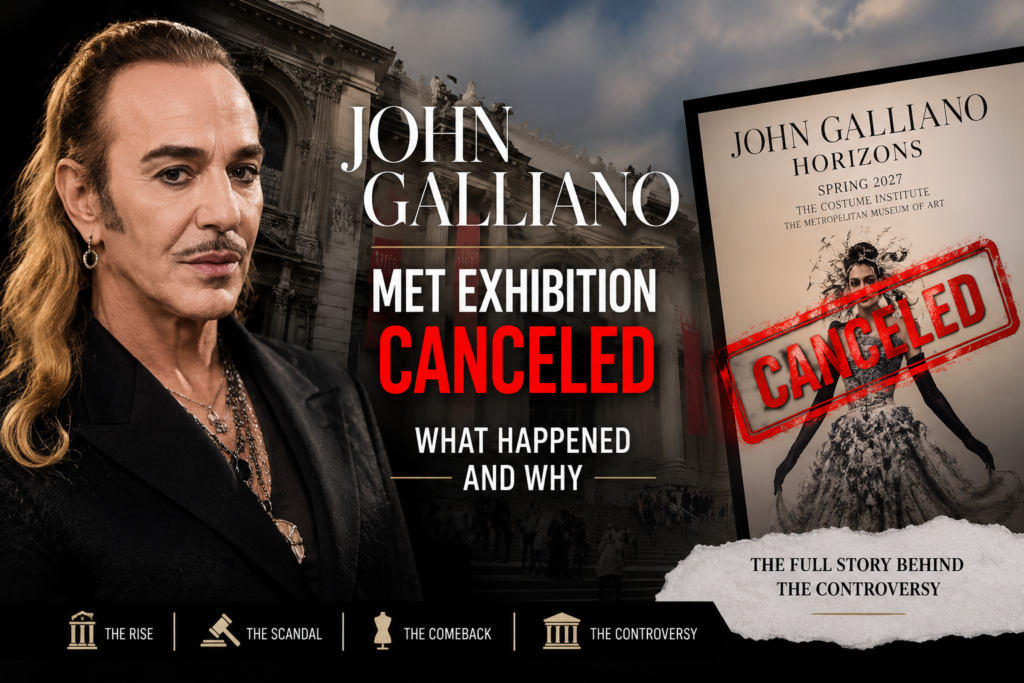
John Galliano has spent more than four decades at the center of fashion’s most dramatic transformations. His career includes landmark work at Givenchy, Christian Dior and Maison Margiela, along with a reputation for elaborate storytelling, historical references and highly theatrical collections. Yet his legacy has always carried another dimension: the serious consequences of his antisemitic, racist and anti-Asian conduct in 2010 and 2011.
That complicated history returned to the spotlight in 2026 when The Metropolitan Museum of Art announced a major exhibition devoted to his work. The planned exhibition, John Galliano: Horizons, was scheduled to open in May 2027 and was intended to become the first major museum exhibition examining the full scope of his creative career.
On August 31, however, the Met and Galliano announced that the exhibition would not proceed as planned. The decision followed discussions between the designer and the museum, with both sides acknowledging the pain and concerns surrounding the proposed retrospective. The Met also said that information about a new Spring 2027 Costume Institute exhibition and the 2027 Met Gala would come later.
The decision makes Galliano’s story more complicated than a simple tale of success or scandal. His creative achievements remain influential, while his past conduct continues to shape how institutions, designers and audiences evaluate his work.
Who Is John Galliano?
John Galliano is a British fashion designer born in Gibraltar in 1960. He became one of the defining creative figures of late-20th- and early-21st-century fashion, building a career around dramatic silhouettes, historical inspiration, elaborate narratives and theatrical runway presentations. The Met described him in its original 2026 exhibition announcement as one of the most inventive and influential designers of the previous four decades.
Galliano first gained major attention after graduating from Central Saint Martins in London in 1984. His graduate collection quickly established him as a designer with an unusually strong ability to combine research, fantasy and clothing. From there, he developed his own label before moving into the highest levels of the Paris fashion industry.
His career eventually took him to Givenchy and then Christian Dior, where he became one of the industry’s most recognizable creative forces. Years later, he rebuilt his professional career at Maison Margiela, where he continued experimenting with construction, storytelling and unconventional references.
Today, however, Galliano cannot be discussed solely through his creative accomplishments. His 2010–2011 conduct resulted in his dismissal from Dior and his eponymous label, as well as a Paris court conviction over public insults based on race, religion, ethnicity or origin. The Met’s original exhibition plan explicitly intended to address that rupture rather than omit it.
John Galliano’s Early Life and Education
Galliano was born in Gibraltar in 1960 and later moved with his family to England. His education at Central Saint Martins proved decisive in shaping his future career.
In 1984, he graduated with a collection inspired by the French Revolution. The work attracted attention for its historical references and theatrical presentation, helping establish Galliano as a young designer with a distinctive creative identity.
Rather than approaching fashion simply as a method of producing wearable clothes, Galliano treated garments as part of a larger visual story. Historical research, characters, cultural references and performance became recurring elements of his work.
That approach became increasingly important as his career developed. Galliano’s early collections demonstrated an ability to transform research into dramatic fashion narratives, a quality that later became central to his reputation in Paris.
The Met’s planned Horizons exhibition was designed in part around this creative process. Its proposed galleries were expected to include garments, accessories, sketches, toiles, research books and archival material, allowing visitors to see how Galliano developed ideas from initial research through finished designs.
How Galliano Built His Fashion Reputation
After establishing his own label, Galliano moved increasingly into the international fashion spotlight. His work attracted attention for its combination of craftsmanship, historical imagination and theatrical presentation.
His career took a major step forward when he became associated with Givenchy in Paris. He then moved to Christian Dior, where his influence expanded dramatically.
His influence also reflects the broader relationship between fashion and personal style, a connection that continues to shape how modern fashion figures are presented to global audiences.
At Dior, Galliano had access to the resources of one of fashion’s most famous houses while retaining the creative freedom that had distinguished his earlier work. His collections often turned runway shows into elaborate performances, connecting clothing with characters, periods of history and imagined worlds.
That approach helped make Galliano more than a successful designer. He became a major figure in fashion culture, influencing how designers and audiences understood the relationship between clothing, performance and storytelling.
The Met’s 2026 exhibition proposal reflected that broad view of his career. It planned to connect his work from his 1984 graduation collection through his independent label, Givenchy, Dior and later Maison Margiela collections.
John Galliano’s Rise Through Givenchy and Dior
Galliano’s move into Parisian haute couture marked a turning point. His appointment at Givenchy placed a British designer at one of France’s most prestigious fashion houses, while his subsequent move to Christian Dior gave him an even larger platform.
His Dior years became particularly important to his reputation because they combined the traditions of an established luxury house with his highly individual creative language. Galliano could draw from Dior’s heritage while building collections around his own fascination with history, performance and visual spectacle.
The scale of the Dior platform also allowed his ideas to reach a global audience. His work became closely associated with elaborate runway productions and strong visual concepts, helping reinforce the idea that a fashion collection could function as a complete artistic narrative.
At the same time, the enormous attention surrounding Galliano’s work meant that his personal conduct became inseparable from his professional legacy when controversy emerged later in his career.
His Givenchy Appointment
Galliano’s Givenchy period represented an important step in his transition from celebrated independent designer to major Paris fashion figure.
The appointment demonstrated that his unconventional approach had gained recognition at the highest levels of the industry. Givenchy gave him a prestigious institutional setting in which to develop his ideas while working within the traditions of an established couture house.
His time there was relatively brief, but it helped establish the trajectory that eventually led to Dior.
Rather than abandoning the characteristics that had made his own label distinctive, Galliano continued to work through historical references, dramatic silhouettes and theatrical presentation. His ability to reinterpret the past became one of the most recognizable elements of his design identity.
The move also mattered symbolically. Galliano’s rise showed that a designer from Britain’s fashion scene could move into the upper ranks of Parisian luxury fashion and compete creatively on an international stage.
That trajectory eventually brought him to Christian Dior, where his influence became considerably larger.
The Dior Years
Galliano joined Christian Dior in 1996, beginning the period most closely associated with his rise to global fashion prominence.
At Dior, he combined the house’s established identity with his own fascination with history, character and spectacle. His collections could reference different periods and cultures while transforming those influences into highly stylized runway worlds.
The result was a distinctive form of fashion storytelling. A Galliano collection was often presented as more than a group of individual garments; it became a visual narrative in which clothing, models, styling, set design and presentation worked together.
His Dior tenure also demonstrated his technical ability. Beneath the theatrical concepts were complex garments that required extensive craftsmanship and construction.
The Met’s original Horizons proposal planned to examine this entire creative development, including his work at Dior alongside his earlier and later collections. The museum specifically intended to explore how Galliano connected history, geography, art, storytelling and performance to create new fashion worlds.
That combination of imagination and craftsmanship explains why Galliano remains such an important figure in discussions of modern fashion, even as his personal history continues to complicate his legacy.
What Made John Galliano So Influential in Fashion?
John Galliano’s influence comes from his ability to turn fashion into storytelling. His collections often drew on history, art, characters and cultural references, then transformed those ideas into dramatic garments and elaborate runway presentations.
This approach helped change how audiences viewed a fashion show. Galliano did not always present clothing as a simple sequence of looks. Instead, he created complete visual worlds in which the garments, styling, music, setting and models worked together.
His technical ability also played a major role. Behind the spectacle were detailed construction, tailoring, fabric manipulation and an understanding of couture techniques. That combination allowed Galliano to translate ambitious concepts into highly crafted clothing.
The proposed John Galliano: Horizons exhibition reflected this aspect of his career. The planned retrospective was designed to examine his creative process across more than four decades, including the research, sketches and development behind his finished designs.
However, Galliano’s influence cannot be separated completely from the controversy that transformed his career. His creative achievements explain why he became such an important designer, but they do not erase the consequences of his conduct.
That tension is central to understanding his legacy today.
Drama, Storytelling and Theatrical Fashion
Galliano became particularly famous for making fashion presentations feel theatrical.
His collections could begin with a historical period, character or visual idea and then develop into an entire narrative. The clothes became part of a larger experience rather than existing independently from the runway presentation.
His fascination with history was especially important. Instead of simply reproducing historical clothing, he often reinterpreted references through exaggerated silhouettes, unusual materials, styling and presentation.
This gave his collections a strong visual identity. Audiences could recognize the atmosphere and characters of a Galliano show even before examining individual garments in detail.
The theatrical approach also strengthened the relationship between fashion and other creative disciplines. Theater, cinema, painting, costume design and historical research could all influence the way a collection was conceived.
For Galliano, fashion could therefore communicate ideas through more than fabric and construction. It could create a mood, suggest a character or transport an audience into another period.
That method became one of the most recognizable features of his career and helped establish his reputation as a designer who viewed the runway as a form of creative performance.
Galliano’s Influence on Modern Fashion
Galliano helped strengthen the idea that a fashion collection could function as a complete artistic statement.
His work showed how a strong concept could influence not only clothing but also the environment surrounding a collection. Runway sets, styling, casting, music and presentation became important parts of the overall creative message.
His influence also came from his ability to work within very different fashion houses. At Christian Dior, he interpreted the heritage of one of the world’s most established luxury brands through his own theatrical approach. Later, at Maison Margiela, he worked within a label known for experimentation and unconventional construction.
That connection between fashion and celebrity image can also be seen in how major Hollywood figures use personal style and fashion to shape their public presence.
Those experiences demonstrated that his creative language could adapt to different environments while retaining its emphasis on research, transformation and visual storytelling.
Yet his career also illustrates the limits of separating artistic achievement from personal conduct. His public reputation changed dramatically after the events of 2011.
Before that controversy, conversations about Galliano largely focused on his creativity and influence. Afterwards, questions about responsibility, rehabilitation and accountability became inseparable from discussions of his work.
That complicated legacy would eventually become a major issue when a prestigious museum proposed honoring his career.
Why John Galliano Became a Controversial Figure
The most damaging chapter of Galliano’s career began with incidents in Paris between 2010 and 2011.
In February 2011, video footage emerged showing Galliano making antisemitic remarks during an argument at a Paris café. Another incident involving offensive remarks also came under scrutiny.
The controversy quickly became much larger than a dispute involving a famous designer. His comments targeted people based on religion and ethnicity, prompting widespread condemnation from the fashion industry and the public.
Christian Dior suspended Galliano and later dismissed him. His professional reputation suffered an enormous setback, and his own fashion label also lost its creative leader.
Galliano later apologized for his behavior and entered treatment for alcohol and substance-related problems. He subsequently began working to rebuild both his personal life and professional career.
The episode remains important because it created a permanent dividing line in discussions of his legacy. His earlier achievements did not disappear, but they could no longer be discussed without acknowledging what happened.
That distinction became especially significant when the Metropolitan Museum of Art planned a retrospective of his work more than a decade later.
The proposed exhibition raised a difficult question for the fashion world: can an institution recognize a person’s artistic contribution while also confronting the serious harm connected to that person’s past?
The 2011 Antisemitic and Racist Remarks
The 2011 scandal followed a confrontation at a Paris café and the emergence of video footage showing Galliano making offensive statements.
The remarks generated immediate backlash because they involved attacks based on religion and ethnicity. The response extended beyond criticism from individuals and fashion commentators. Galliano’s position at Dior was placed under review, and the future of his career became uncertain.
French authorities pursued the matter through the legal system. In September 2011, a Paris court found Galliano guilty of public insults based on race, religion, ethnicity or origin and imposed a suspended fine.
Galliano subsequently apologized for his conduct and acknowledged the seriousness of the situation. He also entered treatment and began addressing the personal problems that had contributed to the circumstances surrounding the controversy.
Those later steps became part of his eventual professional rehabilitation, but they did not erase the harm caused by his remarks.
That distinction matters when examining what happened years later. Rehabilitation can explain how a person returns to professional life, but it does not require the public to forget earlier actions.
For Galliano, the question of accountability remained part of his story even after he returned to major fashion work.
It also became central to the debate surrounding the proposed Met exhibition, because the retrospective would have placed his entire career within one of the world’s most prominent cultural institutions.
Dior’s Response and the End of His Tenure
Christian Dior responded quickly after the controversy became public.
The fashion house suspended Galliano and subsequently ended his position as creative director. The decision brought his highly successful Dior chapter to an abrupt close.
The consequences extended beyond his position at Dior. His namesake label also faced a major disruption, leaving Galliano outside the central fashion system that he had helped shape for years.
The fallout represented a dramatic reversal. Galliano had reached one of the highest positions available to a fashion designer, yet within a short period his professional standing changed completely.
However, the Dior dismissal did not end his career permanently.
Over the following years, Galliano worked to rebuild his life and reputation. He gradually returned to the fashion industry and eventually secured another major creative leadership position.
That comeback would become an important part of the later debate surrounding his legacy.
His story was no longer simply about a celebrated designer who had fallen from the top. It had become a story about professional rehabilitation, personal accountability and whether the fashion industry could separate recognition of creative work from condemnation of harmful behavior.
Those questions would follow Galliano into the next major chapter of his career at Maison Margiela.
John Galliano’s Attempted Career Comeback
After leaving Dior, John Galliano entered one of the most difficult periods of his career. His reputation had collapsed, and returning to the center of the fashion industry required more than simply producing another successful collection.
Galliano spent time addressing his personal struggles and rebuilding his relationship with the fashion community. His return was gradual rather than immediate. The industry watched closely as he attempted to demonstrate that his career could continue without ignoring the events that had caused such widespread condemnation.
His first significant steps back into high fashion included a period working alongside Oscar de la Renta. That experience gave Galliano an opportunity to return to the creative environment while remaining outside the leadership of a major luxury house.
The more important turning point came several years later when Maison Margiela appointed him as its creative director. The role gave him a major international platform again, but it also placed his work under a different creative framework.
Galliano’s comeback did not erase the controversy surrounding him. Instead, it created a new phase in which his professional work and personal accountability continued to exist side by side.
Oscar de la Renta and the Road Back
Galliano’s collaboration with Oscar de la Renta in 2013 represented an important step in his return to fashion.
The arrangement was relatively short, but its significance went beyond the number of collections involved. De la Renta provided Galliano with an environment in which he could work again while continuing the process of rebuilding his professional identity.
The move also suggested that parts of the fashion establishment were willing to give Galliano another opportunity. However, his return remained closely watched because the memory of the 2011 controversy was still fresh.
Galliano’s situation was unusual. He did not need to prove that he could design at a high level; his earlier career had already established that. Instead, he needed to show that he could return responsibly and maintain professional standards after such a serious public failure.
The period helped create a bridge between his collapse at Dior and his later appointment at Maison Margiela.
It also demonstrated that his comeback would not simply involve returning to the same position he had occupied before. His later career would develop under greater scrutiny, with questions about accountability remaining part of the conversation.
Maison Margiela and a New Creative Chapter
In 2014, Maison Margiela appointed Galliano as its creative director. The decision marked one of the most significant moments in his professional comeback.
Margiela offered a particularly interesting setting because the house had built its identity around experimentation, deconstruction and challenging conventional ideas about fashion. Galliano’s interest in transformation and unconventional construction could therefore operate within a creative environment very different from Dior.
During his decade at the house, Galliano continued to experiment with silhouettes, materials and garment construction. His work demonstrated that he could adapt his approach to another established fashion identity rather than simply reproduce the formula associated with his Dior years.
His tenure also played an important role in changing the conversation around his career. Attention gradually returned to his design work, while his recovery and efforts toward accountability remained part of his public story.
Galliano eventually left Maison Margiela in 2024 after roughly a decade with the house. By then, he had once again established himself as a major creative figure in contemporary fashion.
That professional rehabilitation helps explain why the possibility of a major museum retrospective became realistic. Yet it also made the proposed exhibition more complicated: celebrating his creative contribution meant revisiting both the extraordinary work and the serious controversy that had reshaped his career.
What Was John Galliano: Horizons?
John Galliano: Horizons was planned as a major retrospective examining the designer’s career from his early work through his years at the world’s leading fashion houses.
The Metropolitan Museum of Art announced the exhibition as the Costume Institute’s Spring 2027 presentation. It was intended to bring together more than four decades of Galliano’s work and examine the ideas behind his distinctive approach to fashion.
The planned exhibition was notable because it was not designed simply as a display of famous garments. The concept aimed to explore how Galliano developed ideas through research, references, sketches, experimentation and construction.
The exhibition therefore had the potential to place his career within a broader history of modern fashion.
However, the project also carried obvious controversy. Any comprehensive examination of Galliano’s career would have had to confront the 2011 scandal rather than treat his professional achievements in isolation.
The Met’s original announcement acknowledged that the exhibition would address the major rupture in Galliano’s career and his subsequent efforts toward recovery and accountability.
That made the project more ambitious than a conventional designer retrospective. It would have asked visitors to consider both the creative importance of Galliano’s work and the difficult circumstances surrounding his fall and return.
The Met’s Planned Galliano Exhibition
The planned Met exhibition was scheduled to open at The Metropolitan Museum of Art in May 2027 as part of the Costume Institute’s spring program.
The exhibition was intended to span Galliano’s career from his 1984 Central Saint Martins graduation collection through his independent work and appointments at Givenchy, Christian Dior and Maison Margiela.
The museum planned to show finished garments alongside material that could reveal how Galliano developed his ideas. Sketches, research books, toiles and archival objects were expected to help visitors understand the creative process behind the collections.
The exhibition’s structure would therefore have focused on more than celebrity or spectacle. It would have examined the relationship between research, imagination, craftsmanship and presentation that defined much of Galliano’s career.
Importantly, the proposed retrospective was also expected to acknowledge the crisis that interrupted his career in 2011. That inclusion reflected the museum’s intention to present a complex portrait rather than an uncomplicated celebration.
For the fashion world, the project represented significant institutional recognition. A major retrospective at the Met can influence how a designer’s work enters the historical record, shaping how future audiences understand that person’s contribution.
That symbolic importance also helps explain why the exhibition attracted intense attention before it could even open.
Why the Exhibition Mattered to Fashion History
A major Costume Institute exhibition carries considerable cultural weight because it places fashion within a museum and historical context.
For Galliano, such an exhibition would have represented a remarkable transformation in public perception. Fifteen years after the controversy that ended his Dior career, one of the world’s leading museums was preparing to examine his complete creative journey.
The proposed retrospective could have helped future audiences understand why Galliano became such an influential designer. His work connects couture craftsmanship with historical research, theatrical presentation and visual storytelling, making his career particularly suitable for a museum setting.
At the same time, the exhibition raised difficult questions about institutional recognition.
A museum retrospective does more than display clothing. It can contribute to the cultural reputation of the person being examined. That distinction matters when the subject has a documented history of harmful public conduct.
The proposed Galliano exhibition therefore existed at the intersection of two competing ideas. One was the importance of preserving and studying significant fashion history. The other was the responsibility of cultural institutions to consider how they honor individuals whose past actions caused serious harm.
Those tensions became increasingly visible as criticism of the project grew.
Ultimately, the exhibition’s significance came not only from the work it planned to display, but also from the debate over whether Galliano’s creative legacy should receive that level of institutional recognition.
Why Was the John Galliano Met Exhibition Canceled?
The planned John Galliano: Horizons exhibition was canceled on August 31, 2026, after weeks of criticism surrounding the decision to honor Galliano at the Metropolitan Museum of Art.
The Met and Galliano announced the decision jointly after discussions about whether the exhibition should continue. The museum said the project would not proceed as planned, while Galliano said he believed canceling the exhibition was the appropriate decision at this time.
The controversy centered largely on Galliano’s history of antisemitic and racist remarks, which had already resulted in his dismissal from Dior and a criminal conviction in France.
The planned retrospective would have placed his creative career at the center of the Met’s spring 2027 Costume Institute program. That made the decision especially sensitive because the exhibition would not simply have displayed his work; it would have represented a major institutional recognition of his legacy.
Galliano acknowledged that an exhibition devoted to his work could cause pain for people affected by his past conduct. He also emphasized that accountability and atonement cannot be reduced to a single public gesture.
The Met ultimately accepted that the exhibition should not proceed.
Backlash Over Galliano’s Past
The announcement of the retrospective generated immediate criticism because Galliano’s 2011 controversy remains a significant part of his public history.
Critics argued that giving him a major platform at the Met risked presenting his career primarily through artistic achievement while minimizing the harm associated with his past remarks.
The debate became particularly significant because the Costume Institute exhibition would have been connected to one of fashion’s most visible annual events. The Met Gala attracts global media attention, celebrities, designers and influential figures from the fashion and entertainment industries.
As criticism intensified, questions also emerged about whether the timing and setting were appropriate for an exhibition honoring Galliano.
The issue was not simply whether Galliano had rebuilt his career. He had already spent years working toward professional rehabilitation, including his decade at Maison Margiela. Instead, the debate focused on whether institutional recognition at the Met represented a different level of public honor.
The controversy demonstrated that professional redemption and institutional celebration are not necessarily the same thing.
Galliano’s creative influence could remain historically important while audiences and communities continued to object to the idea of celebrating him through a major museum retrospective.
That distinction ultimately shaped the decision to abandon the planned exhibition.
John Galliano and the Met Decide Not to Proceed
On August 31, Galliano announced that, after reflection and discussions with the Met and others involved in the project, he believed the exhibition should not take place at that time.
He expressed gratitude toward the museum and the people who had worked on the proposed retrospective. At the same time, he accepted responsibility for the pain caused by his past words and recognized that an exhibition honoring his work could be painful for some people.
The Met supported the decision.
Costume Institute curator Andrew Bolton said museums have a responsibility to examine difficult histories carefully, while also acknowledging the pain and concerns generated by the project. Met trustee Anna Wintour described Galliano’s decision as courageous and said she supported it.
The joint decision therefore did not present the cancellation as a simple rejection of Galliano’s creative work. Instead, it reflected a recognition that the proposed exhibition had become inseparable from the controversy surrounding its subject.
For Galliano, the decision meant giving up an extraordinary opportunity for institutional recognition. For the Met, it meant abandoning a major exhibition after months of preparation.
The cancellation also created an immediate question about what would replace John Galliano: Horizons in the spring 2027 Costume Institute schedule.
John Galliano’s Legacy After the Met Controversy
The cancellation of John Galliano: Horizons does not erase Galliano’s influence on fashion. His work across his own label, Givenchy, Christian Dior and Maison Margiela remains part of modern fashion history.
At the same time, the cancellation shows why his legacy cannot be discussed only through his creative achievements. The 2011 controversy remains a defining part of his public story, and the debate surrounding the Met exhibition demonstrated that professional rehabilitation does not automatically lead to universal acceptance.
Galliano’s career therefore presents two realities that need to be considered together. He was an exceptionally influential designer whose approach to historical research, craftsmanship and theatrical presentation shaped fashion. He also made deeply offensive remarks that caused serious harm and led to major professional consequences.
The Met’s decision highlights the difficulty cultural institutions face when presenting controversial creative figures. A retrospective can preserve important historical work and encourage serious examination, but it can also be interpreted as an endorsement or celebration of the person behind that work.
Can Artistic Influence and Personal Accountability Coexist?
Artistic influence and personal accountability can coexist, but they should not be treated as interchangeable ideas.
A designer’s contribution to fashion can remain historically important even when their personal conduct deserves strong criticism. Studying that contribution does not require audiences to excuse harmful behavior.
The challenge becomes greater when a museum moves from studying a figure to celebrating that figure. A major retrospective carries cultural authority, so the decision to stage one involves questions beyond artistic merit.
Galliano’s proposed Met exhibition brought those questions into sharp focus. Supporters could argue that his work deserved serious historical examination, while critics could question whether a prestigious institutional platform gave too much weight to his creative achievements.
The cancellation suggests that the Met ultimately recognized the importance of that distinction.
Rather than reducing Galliano to either a celebrated genius or a disgraced designer, a more complete historical assessment requires both parts of his story. His creative methods, achievements and influence deserve examination, while the consequences of his conduct should remain visible within that history.
Why Galliano Remains Important to Fashion History
Galliano remains significant because of the breadth of his creative impact.
His career connected British fashion education with the Paris couture system and later with one of the most experimental fashion houses in the world. Across those environments, he consistently used research, transformation and presentation to create distinctive fashion narratives.
His story also highlights the important role of people working behind the scenes in entertainment, from creative professionals to industry figures who help shape public careers.
His work also illustrates how runway shows evolved into increasingly elaborate forms of visual communication. Designers today operate in an environment where fashion, entertainment, photography, social media and performance frequently overlap. Galliano was an important figure in developing that theatrical approach.
However, historical importance should not become historical immunity.
His legacy is best understood through the full arc of his career: extraordinary creative success, a devastating public controversy, professional collapse, recovery, a second major creative chapter and renewed institutional debate.
The cancellation of Horizons adds another chapter to that story. It shows that even after years of professional rehabilitation, questions about accountability can remain central when a cultural institution considers honoring a controversial figure.
John Galliano Career Timeline
Galliano’s career can be understood through several major turning points:
| Period | Career milestone |
|---|---|
| 1984 | Graduated from Central Saint Martins and attracted attention with his graduate collection |
| 1980s | Developed his independent label and established a reputation in London fashion |
| 1990s | Expanded his career in Paris and became associated with Givenchy |
| 1996 | Became creative director of Christian Dior |
| 1996–2011 | Led Dior through a highly influential period of fashion experimentation and theatrical presentation |
| 2011 | Left Dior following the controversy surrounding his offensive remarks |
| 2013 | Worked with Oscar de la Renta as part of his professional comeback |
| 2014 | Became creative director of Maison Margiela |
| 2014–2024 | Led Maison Margiela through another major phase of his career |
| 2026 | Proposed Met retrospective John Galliano: Horizons was canceled |
| 2027 | The Met is expected to present a different Spring Costume Institute exhibition |
This timeline shows why Galliano’s career is difficult to summarize through a single period. His story stretches from London’s emerging fashion scene to the world’s major luxury houses and eventually into museum-level debates about artistic legacy and accountability.
Frequently Asked Questions About John Galliano
Who is John Galliano?
John Galliano is a British fashion designer. He became internationally known for his work at Givenchy, Christian Dior and Maison Margiela. He also built a successful independent label.
Galliano became known for theatrical runway shows, historical references and elaborate fashion storytelling.
His career also includes a major controversy in 2011. The incident led to his departure from Dior and a period away from the fashion industry.
Why is John Galliano famous?
John Galliano is famous for his theatrical approach to fashion. He often combines historical research with dramatic design.
His years at Christian Dior established him as a leading creative figure in fashion. Later, his work at Maison Margiela showed his ability to reinvent his creative approach.
What happened to John Galliano at Dior?
John Galliano left Christian Dior in 2011. Video footage had emerged showing him making antisemitic remarks during a confrontation in Paris.
Dior suspended him and later ended his tenure as creative director.
A French court later convicted Galliano of public insults based on race, religion, ethnicity or origin.
Why was the John Galliano Met exhibition canceled?
The planned John Galliano: Horizons exhibition was canceled on August 31, 2026.
The decision followed discussions between Galliano and the Metropolitan Museum of Art. Renewed debate over his past conduct also surrounded the planned retrospective.
What was John Galliano: Horizons?
John Galliano: Horizons was a planned Spring 2027 Costume Institute exhibition at the Metropolitan Museum of Art.
The exhibition would have examined more than four decades of Galliano’s work. It would have covered his independent career and his work at Givenchy, Christian Dior and Maison Margiela.
Is the 2027 Met Gala canceled?
No. The cancellation of John Galliano: Horizons does not mean the 2027 Met Gala is canceled.
The Met has said it will announce details about a new Spring 2027 Costume Institute exhibition and the 2027 Met Gala later.
What did John Galliano say about the cancellation?
Galliano said canceling the planned exhibition was the appropriate decision at this time.
He also acknowledged the pain connected to his past conduct. He expressed appreciation for those who worked on the proposed exhibition.
The decision reflects the continuing tension between his professional rehabilitation and the impact of his earlier actions.
John Galliano’s Place in Fashion History
John Galliano’s career remains one of the most complicated stories in modern fashion.
His creative achievements are substantial. He helped redefine theatrical runway presentation, brought historical storytelling into contemporary fashion in distinctive ways and produced influential work at some of the industry’s most important houses.
Yet his 2011 controversy remains equally important to an honest account of his career. The consequences were serious, and the passage of time did not make the underlying harm disappear.
The cancellation of John Galliano: Horizons demonstrates how those two parts of his story continue to intersect. Galliano can remain an important subject for fashion history without every form of institutional recognition being considered appropriate.
That distinction may ultimately be the most important lesson from the 2026 controversy.
Fashion history is not only a record of beautiful garments or successful careers. It also reflects the values, decisions and conflicts surrounding the people who create those garments.
For Galliano, the story now includes both extraordinary creative influence and a lasting debate over accountability. His work will continue to be studied, discussed and evaluated. However, the Met’s decision makes clear that recognition is not automatic, even for a designer whose influence on fashion is difficult to ignore.