
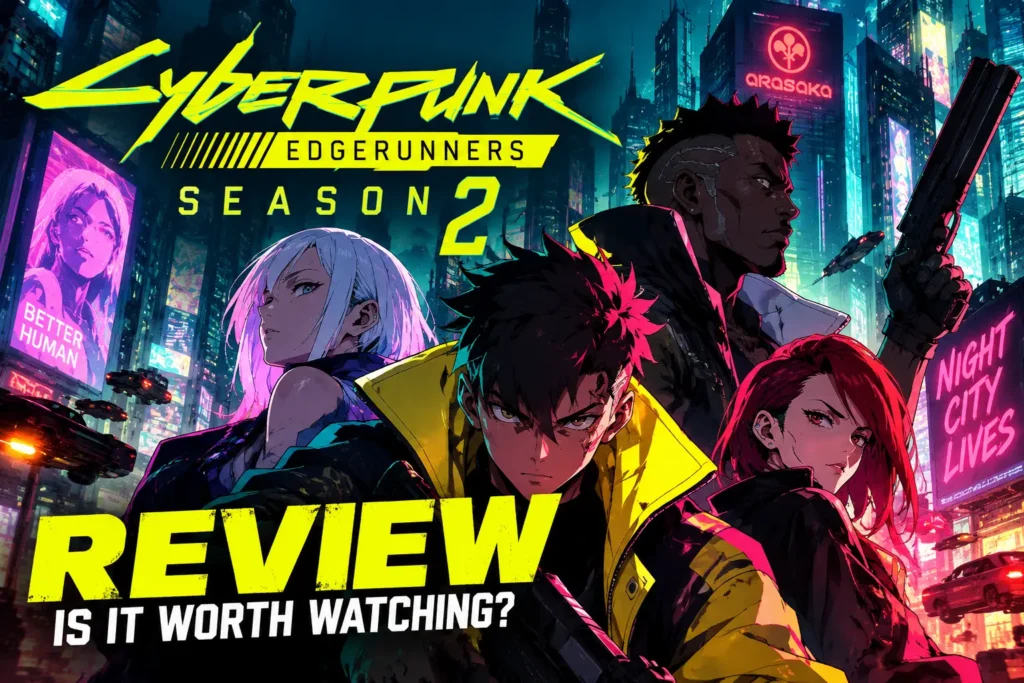
Cyberpunk: Edgerunners Season 2 arrives on Netflix on October 20, 2026, bringing viewers back to Night City with a new cast and a different story. Rather than continuing David Martinez’s journey, the anime explores another group of people struggling to survive in a city shaped by violence, technology, and corporate power.
The 10-episode series reunites CD PROJEKT RED and Studio TRIGGER, with Kai Ikarashi taking the director’s chair. However, following the original anime’s powerful emotional impact, the sequel faces a difficult challenge: it must give viewers a compelling reason to return without relying too heavily on familiar characters.
The new season has plenty of visual ambition, intense action, and ideas about revenge and redemption. Yet its larger cast and interconnected storylines also raise questions about pacing and character development. Here’s what makes Cyberpunk: Edgerunners Season 2 worth exploring, where it faces challenges, and what viewers should know before watching.
Is Cyberpunk: Edgerunners Season 2 Worth Watching?
Cyberpunk: Edgerunners Season 2 is worth considering for fans who want another intense journey through Night City, particularly those who enjoy bold animation, mature themes, and stories about people pushed to their limits. Studio TRIGGER returns with a fresh visual approach, while the new cast allows the series to explore different sides of the Cyberpunk universe.
One of the sequel’s biggest strengths is its willingness to move beyond David Martinez’s story. Instead of repeating the same character arc, it brings several personalities together and examines how their choices collide in a dangerous city. This broader approach gives the series room to explore revenge, redemption, identity, and the need to leave a mark on the world.
However, the expanded cast also creates a challenge. When several characters compete for attention, their individual journeys do not always feel equally developed. Early critical coverage has highlighted the anime’s visual ambition while questioning whether its interconnected stories achieve the same emotional focus as the original.
That distinction matters. A sequel does not need to recreate Season 1 to succeed, but it does need characters whose struggles feel meaningful. The new installment offers a different perspective on Night City, although viewers expecting the same tightly focused emotional journey may find its approach less effective.
Cyberpunk: Edgerunners Season 2 Release Date and Streaming Details
Cyberpunk: Edgerunners Season 2 premiered on October 20, 2026, exclusively on Netflix. The release brings a new standalone anime story to the same universe introduced in the original series and the Cyberpunk 2077 video game.
The season contains 10 episodes, allowing viewers to experience the complete story through one release rather than wait for weekly installments. Netflix is the main destination for watching the series, although a limited promotional screening of the opening episode offers another option for viewers who want a preview.
| Detail | Information |
|---|---|
| Release date | October 20, 2026 |
| Streaming platform | Netflix |
| Episode count | 10 |
| Animation studio | Studio TRIGGER |
| Production company | CD PROJEKT RED |
| Director | Kai Ikarashi |
| Story format | Standalone story in the Cyberpunk universe |
The series is designed to introduce a new group of characters rather than directly continue the original protagonist’s journey. Therefore, returning viewers can expect familiar elements of Night City alongside a different central conflict.
How Many Episodes Does Season 2 Have?
Cyberpunk: Edgerunners Season 2 contains 10 episodes. The complete season follows a standalone narrative that brings together several characters with different backgrounds and motivations.
This format gives the creative team room to develop the new cast while building toward the consequences of their choices. It also allows viewers to follow the story at their own pace on Netflix.
However, a 10-episode structure does not automatically guarantee that every character receives equal development. The effectiveness of the season depends on how well its individual storylines connect and whether those connections create a satisfying overall narrative.
Can You Watch Episode 1 for Free?
CD PROJEKT RED arranged a limited free screening of the first episode through its official Twitch channel to celebrate the anime’s launch. The company also planned additional broadcasts and co-streams with selected creators.
The promotion gives viewers an opportunity to sample the new season without a Netflix subscription. However, it covers Episode 1 only, not the entire 10-episode series.
The reported screening schedule also specified that video-on-demand replays would not be available after the broadcasts. Consequently, viewers should not assume the free preview remains accessible indefinitely. For the complete season, Netflix remains the official streaming destination.
What Is Cyberpunk: Edgerunners Season 2 About?
The new season returns to Night City, a futuristic metropolis where advanced technology offers extraordinary possibilities but rarely guarantees a better life. Corporations hold enormous power, cybernetic enhancements can transform human bodies, and people struggling to survive often face choices with devastating consequences.
This time, the story follows a fresh group of characters whose lives become intertwined through their ambitions, personal conflicts, and attempts to find meaning in a violent environment. Their motivations differ, but each faces the challenge of navigating a world that rewards spectacle and power while leaving little room for vulnerability.
Revenge and redemption sit at the heart of the narrative. Rather than presenting Night City solely as a backdrop for spectacular fights, the series explores how its inhabitants respond to loss, responsibility, and the desire to make their lives matter.
The new cast also creates opportunities to examine the Cyberpunk universe from different perspectives. Some characters have experience with the dangerous world of mercenaries, while others approach it with their own ambitions and expectations.
This shift gives Season 2 an identity separate from the original anime. Its central question is not simply whether another group can survive Night City, but what people are willing to sacrifice to pursue their goals. The strength of that premise ultimately depends on how convincingly the season develops its characters and brings their stories together.
Does Season 2 Continue David Martinez’s Story?
No. Cyberpunk: Edgerunners Season 2 takes a standalone approach, introducing a new cast rather than continuing David Martinez’s story as its central narrative. The series remains part of the same fictional universe, but its focus shifts to different people and conflicts.
That decision carries both creative opportunities and risks. David’s journey gave the original anime a clear emotional center, allowing viewers to follow one character as his ambitions and circumstances changed. A new ensemble must establish that same sense of investment through several individual journeys.
The benefit is greater storytelling freedom. The sequel can explore unfamiliar characters, different motivations, and other consequences of life in Night City without repeating the original’s structure. It can also expand the fictional world beyond the people viewers already know.
At the same time, the change may disappoint fans who primarily want another chapter in David and Lucy’s relationship. Familiar references can provide continuity, but they cannot replace strong character development.
Ultimately, the standalone format gives Season 2 a chance to prove that the Cyberpunk universe can support more than one memorable story. Its success depends on whether the new characters earn the audience’s attention through their own decisions, conflicts, and emotional journeys.
Meet the New Cyberpunk: Edgerunners 2 Characters
Cyberpunk: Edgerunners Season 2 introduces four central characters whose lives intersect in unexpected ways. Each has a different view of Night City and its dangers. Together, they explore identity, ambition, and the cost of survival.
Weak Kingsley is a veteran edgerunner trying to find purpose after losing the abilities that once defined him. Roman Carax, meanwhile, wants to document real human experiences through filmmaking. His interest in traditional cinema contrasts with a society increasingly drawn to digital entertainment.
D follows a more violent path. Driven by revenge, he searches for answers connected to the destruction of his clan and the secrets surrounding powerful corporations. Talia represents another side of Night City’s culture. She embraces cybernetic enhancement while becoming increasingly involved with the city’s violent underworld.
These characters do not share the same priorities. Their intersecting lives reveal several sides of ambition, technology, and survival. However, this broader approach also challenges the storytelling. Each character needs enough development to make their connections feel meaningful.
The new ensemble gives the sequel room to explore Night City from different perspectives. Its success ultimately depends on how well these individual journeys come together.
Weak Kingsley and the Weight of a Past Life
Weak Kingsley offers an interesting contrast with the original series’ protagonist. Once known as King, he earned a reputation as a formidable edgerunner. Now, however, he struggles to find purpose after losing the abilities that once defined him.
His circumstances challenge the idea that personal worth depends on physical strength. Cybernetic enhancements can make someone faster, stronger, and more dangerous. Yet losing those advantages can leave a former legend struggling to recognize himself. Weak must decide what remains when his reputation and abilities no longer define him.
This creates an opportunity for a different kind of character development. Instead of pursuing greater power, he must confront his changed identity. His experience also forces him to reconsider what gives life meaning. His relationship with Talia provides another reason to look beyond his own disappointments.
Weak’s journey reflects a harsh reality of Night City. The city constantly creates new legends but rarely cares about their futures. Through his struggles, the anime explores what happens when fame fades and physical strength disappears.
His story also raises an important question: can someone build a meaningful future after losing the identity they once depended on? Weak’s answer may depend less on his former reputation and more on the choices he makes next.
Roman Carax and the Power of Observation
Roman Carax approaches Night City differently from those who fight to control it. A young film enthusiast, he wants to capture genuine experiences with a camera. His interest in traditional filmmaking stands out in a society where braindances let people experience recorded memories directly.
Roman values the act of observing and preserving real events. That perspective contrasts with a culture that often turns suffering into entertainment. His camera offers a way to document experiences that might otherwise disappear beneath the city’s endless stream of digital distractions.
However, recording someone else’s life also raises ethical questions. A camera can preserve the truth, but it can turn another person’s pain into a product. As Roman becomes involved with D and the wider conflict, he must confront the difference between observing a story and participating in it.
His role gives the audience another way to understand Night City. Through Roman, the anime can explore its contradictions without relying entirely on the perspectives of fighters and mercenaries. Ordinary human moments can carry as much meaning as spectacular battles.
His interest in filmmaking therefore means more than a preference for old technology. It reflects a desire to preserve genuine experiences in a world that increasingly treats them as disposable entertainment.
D and Talia: Conflicting Motives in Night City
D and Talia represent two different responses to Night City’s dangerous culture. Both seek greater control over their lives, but their motivations lead them down different paths.
D is a nomad and skilled netrunner whose pursuit of revenge follows the destruction of his clan. His investigation draws him toward corporate secrets and powerful enemies. Revenge gives him a clear objective, yet it also threatens to narrow his understanding of everything beyond that mission.
Talia embraces cybernetic enhancement and the violent culture associated with the Maelstrom gang. Her choices reflect a desire for strength and independence. However, they also create tension with people who want to protect her.
Their circumstances differ, but both characters raise the same question: how much can someone sacrifice before the pursuit of power begins to control them?
D risks allowing vengeance to dictate every decision. Talia risks confusing greater physical capability with genuine freedom. Neither struggle offers an easy solution in a city where vulnerability can invite exploitation.
Their stories also explore different responses to trauma. Some people seek control through retaliation, while others try to change themselves to avoid feeling powerless. Alongside Roman’s curiosity and Weak’s search for purpose, these conflicts create a broader portrait of survival.
How the New Story Differs From Season 1
The first season of Cyberpunk: Edgerunners centered on David Martinez and his transformation from an ambitious young man into someone trapped in Night City’s brutal cycle of violence. His relationships, particularly his connection with Lucy, gave the story a clear emotional foundation.
Season 2 takes a different route. Instead of focusing on one protagonist, the sequel follows several characters with separate goals and conflicts. Roman wants to preserve real stories, D pursues revenge, Talia seeks strength, and Weak tries to rediscover his purpose.
This ensemble structure allows the anime to explore more aspects of Night City. Each character brings a different background and relationship with technology. Their experiences can reveal how personal choices affect people who do not share the same priorities.
However, a wider cast creates new challenges. Season 1 devoted much of its attention to David’s emotional development. The sequel must distribute that attention across several individual journeys. Some viewers may appreciate the broader perspective, while others may miss the original’s concentrated focus.
The difference goes beyond the change in characters. Season 1 follows a central rise and fall. Season 2 examines how multiple lives collide in a city that rarely allows anyone to escape the consequences of their decisions.
Ultimately, the new structure gives the sequel a chance to expand the franchise. Its effectiveness depends on whether the different storylines form a cohesive and emotionally satisfying whole.
Does the Season 2 Story Feel Emotionally Compelling?
The sequel’s emotional impact depends on how well its character arcs connect. D seeks revenge, while Weak struggles with a fading identity. Roman and Talia bring different perspectives on technology, authenticity, and personal strength. Together, their motivations give the story several emotional layers.
These differences help the series explore the human cost of living in Night City. Still, an interesting premise does not automatically produce a cohesive story. Viewers need time to understand each character’s choices and see how those decisions affect others.
That is where the ensemble structure can become a weakness. Frequent shifts between storylines may interrupt the development of individual relationships. When the narrative moves on too quickly, important moments can lose some of their emotional impact.
The original anime benefited from its concentrated focus on David’s transformation. Season 2 aims for a broader emotional picture, but its success depends on whether the different perspectives reinforce one another rather than compete for attention.
Even so, the approach offers considerable potential. Weak’s search for purpose, Roman’s desire to document the truth, D’s anger, and Talia’s pursuit of strength all reflect different ways people try to maintain control over their lives.
When these themes connect through meaningful interactions, the story becomes more than a collection of separate struggles. The challenge is making every character’s journey feel necessary to the larger narrative.
Revenge, Redemption, and Survival in Night City
Revenge and redemption provide a thematic foundation for Cyberpunk: Edgerunners Season 2. Night City encourages people to pursue power, reputation, and financial success. Yet those ambitions often carry consequences that extend beyond the individual.
D’s revenge mission illustrates the danger of letting past suffering dictate every future decision. His search for answers may expose wrongdoing, but retaliation can also consume the person seeking justice. The distinction between holding others accountable and becoming trapped in violence remains central to his journey.
Weak represents another possibility. His past has left him with fewer abilities and less influence, but his experience still has value. His story suggests that redemption does not always require a dramatic victory. Sometimes, it begins with accepting a changed identity and choosing to help someone else.
Roman offers a quieter form of resistance. His commitment to documenting genuine experiences challenges a culture that turns disturbing events into disposable entertainment. Meanwhile, Talia’s relationship with cybernetic enhancement raises questions about control and the desire for greater strength.
Together, these perspectives expand the series’ exploration of survival. In Night City, staying alive is only part of the struggle. The characters must also decide what they value and what they are willing to sacrifice.
Their choices reveal the central tension of the Cyberpunk universe: a person can gain power and still lose control of their life. Whether the characters can retain their humanity in such an environment becomes one of the story’s most important questions.
Studio TRIGGER’s Animation Is a Major Strength
Studio TRIGGER gives Cyberpunk: Edgerunners Season 2 a striking visual identity. The animation feels raw, energetic, and deliberately rough around the edges. This approach suits a story about people struggling to survive in a city where violence often becomes entertainment.
The studio also varies its visual techniques to match different scenes. Some sequences use sharp outlines and dramatic shifts in color. Others adopt a grainier appearance that reflects Roman’s interest in documentary filmmaking. These changes help the anime move between brutal action and quieter human moments.
Rather than relying on spectacle alone, the animation supports the story’s darker themes. Character movements, facial expressions, and sudden bursts of violence reveal the tension beneath Night City’s glamorous surface. Even brief scenes can communicate fear, desperation, or fleeting happiness.
TRIGGER’s experience with bold animation remains one of the sequel’s biggest advantages. The studio understands how to make a futuristic world feel distinctive without losing the characters inside it.
However, impressive visuals cannot solve every storytelling problem. Some scenes move so quickly that the emotional weight struggles to match the action. The sequel’s strongest moments occur when its visual ambition serves a clear dramatic purpose.
Overall, the animation gives Season 2 a personality of its own. It respects the original series’ visual energy while exploring different techniques to support the new cast and their interconnected stories.
Anime fans following other upcoming releases can also explore our guide to Black Clover Season 2: Release Date, Schedule, and Where to Watch.
How Season 2 Reimagines Night City’s Visual Identity
Night City remains central to the identity of Cyberpunk: Edgerunners Season 2. Its towering buildings, crowded streets, corporate power, and underground violence create an environment where personal ambition can quickly turn into desperation.
This time, the city receives greater attention as a living environment rather than simply a backdrop for the protagonists. Different characters experience its dangers from their own perspectives. Their encounters reveal a society shaped by wealth, technology, criminal networks, and the constant struggle for recognition.
The production also draws on the world of Cyberpunk 2077. According to reporting on the creative process, the team explored the game using a virtual camera to identify locations suitable for the anime. This approach helps connect the animated story to the game’s recognizable geography.
That connection adds value for longtime fans. Familiar environments can make the city feel more tangible, while the new cast introduces viewers to different corners of its fictional society.
Yet Night City’s visual appeal also carries a warning. Bright signs, advanced technology, and spectacular architecture conceal a world where ordinary people struggle to retain control over their lives.
The result is a setting that feels both fascinating and hostile. Its visual richness attracts attention, but the human consequences of living there give the environment its deeper meaning.
Action Sequences, Cyberware, and Brutal Combat
Violent confrontations remain an important part of the Cyberpunk universe. Season 2 uses cybernetic enhancements, advanced weapons, and rapid movement to create battles that feel dangerous rather than clean or predictable.
Studio TRIGGER’s animation allows these encounters to shift between precise movements and sudden bursts of chaos. Characters can appear overwhelmingly powerful one moment and dangerously vulnerable the next. This contrast reinforces the idea that technological advantages do not guarantee survival.
The action also reflects the personalities involved. A confrontation driven by revenge carries a different emotional weight from one motivated by fear or self-preservation. When the animation connects these motives to the physical struggle, the violence becomes part of the storytelling.
However, brutality alone cannot sustain audience interest. Repeated confrontations risk losing their impact if the characters’ decisions do not change the situation around them.
The strongest action scenes therefore need more than impressive choreography. They must reveal something about the people involved or push the narrative toward a meaningful consequence.
Season 2 benefits from the creative freedom of animation, which allows its battles to become visually extreme. Still, the emotional stakes matter just as much as the spectacle. Without them, even the most elaborate fight can feel disconnected from the larger story.
Music, Sound, and the Anime’s Atmosphere
Music helps establish the mood of a Cyberpunk story before the characters even begin speaking. The sequel continues to draw on the contrast between Night City’s aggressive energy and the more vulnerable moments hidden beneath its surface.
The second season also introduces a different opening theme. Its opening uses The Cure’s “10:15 Saturday Night,” replacing the original season’s association with Franz Ferdinand’s “This Fffire.” That change immediately signals a fresh identity rather than an attempt to reproduce every detail of the first installment.
Sound design plays an equally important role in a world filled with machinery, cybernetic enhancements, weapons, and digital technology. These sounds help make Night City feel crowded and unpredictable.
Quieter passages matter, too. Moments of silence or restrained music can create space for a character’s fear, regret, or uncertainty to register. That contrast prevents the series from becoming a constant stream of noise and action.
Ultimately, the soundtrack works best when it supports the emotional direction of a scene. Music can intensify a confrontation, but it can also reveal the loneliness behind a character’s public confidence.
The sequel’s atmosphere depends on this balance between spectacle and vulnerability. When sound, animation, and character development work together, Night City becomes more than an impressive visual environment.
Cyberpunk: Edgerunners Season 2 Pacing and Direction
Director Kai Ikarashi approaches Season 2 with a broader narrative than the original anime. Instead of following one central protagonist, the story moves between several characters whose motivations overlap and sometimes conflict.
This structure gives the sequel room to explore different experiences of Night City. However, it also demands careful pacing. Each storyline needs enough time to establish its emotional stakes before the narrative shifts to another character.
The season’s use of montages and time jumps can make events feel energetic and unpredictable. At times, though, these techniques move the story forward before certain motivations receive enough attention. Viewers may understand what a character does without fully feeling why that decision matters.
The challenge becomes more noticeable as the different storylines converge. The narrative needs to show how each character influences the others, rather than simply placing their separate journeys alongside one another.
Ikarashi’s direction supports the anime’s visual ambition, but the larger structure does not always deliver the same clarity as the animation. Some transitions feel purposeful, while others leave the emotional connections underdeveloped.
Even so, the approach reflects a willingness to take creative risks. Season 2 does not simply repeat David Martinez’s journey. It attempts to tell a wider story about Night City and the people shaped by its culture.
The result is ambitious, although its pacing occasionally prevents that ambition from reaching its full potential.
What Works Best—and What Holds the Anime Back?
The sequel’s greatest strength is its willingness to explore Night City through a different group of characters. Weak’s struggle with his past, Roman’s interest in documenting reality, D’s pursuit of revenge, and Talia’s relationship with cybernetic enhancement create several paths into the same troubled world.
Studio TRIGGER also delivers a visually distinctive experience. The animation, shifting styles, and intense action help the series establish an identity beyond its connection to the original anime. Meanwhile, the expanded focus on Night City gives the setting a stronger role in the narrative.
Nevertheless, the ensemble structure creates its biggest weakness. The characters have interesting individual motivations, but their storylines do not always connect with enough depth. Some relationships feel more important to moving the plot forward than to developing the people involved.
Pacing adds to the problem. Montages and time jumps can create momentum, yet they sometimes leave important emotional developments feeling rushed. As a result, the story’s larger ambitions occasionally exceed the time it gives its characters.
This does not make the sequel unsuccessful. Rather, it highlights the difficulty of balancing four central perspectives within one season. The original benefited from a tightly focused protagonist, while the follow-up tries to capture a much wider picture.
Ultimately, Cyberpunk: Edgerunners Season 2 offers compelling ideas, memorable visuals, and a fresh perspective on Night City. Its main limitation is not a lack of ambition, but the challenge of turning that ambition into one consistently cohesive emotional journey.
How Season 2 Connects to Cyberpunk 2077
Cyberpunk: Edgerunners Season 2 takes place in the same dystopian world as Cyberpunk 2077. Both explore a society where advanced technology, corporate influence, and extreme inequality shape everyday life. However, the anime tells its own story rather than adapting the game’s main plot.
Night City remains the central link between the two experiences. Its streets, buildings, criminal networks, and corporate environments help establish a shared sense of place. Fans who know the game may recognize familiar locations, while newcomers can understand the anime without playing it first.
The production team also explored the game world when selecting locations for the new season. This approach helps connect the animated series to the environments players already know. At the same time, the new characters provide fresh perspectives on the city’s different communities.
These connections add depth without making the sequel dependent on familiar faces. The anime can explore the consequences of corporate power and cybernetic enhancement through people whose lives differ from those of the game’s protagonists.
For fans, the result offers another way to experience Night City. For newcomers, it provides an independent entry point into the franchise. Either way, the shared setting strengthens the story without requiring viewers to understand every detail of the game’s history.
Are David Martinez and Lucy in Season 2?
David Martinez is not the central character of Cyberpunk: Edgerunners Season 2. The new installment follows a different group of protagonists, allowing the creators to explore another story in Night City.
David’s original journey reached its tragic conclusion in Season 1. Bringing him back as the main protagonist would risk weakening the impact of that ending. The creative team has instead chosen to build the sequel around new characters and conflicts.
Lucy presents a separate question. She remains an important figure in the original anime, but the new season’s standalone premise does not establish her as a central character. Viewers should distinguish confirmed story information from speculation about possible appearances.
The shift may disappoint fans who hoped to see the original crew reunite. Nevertheless, a new cast gives the franchise room to grow beyond its first story. It also allows returning viewers to discover unfamiliar parts of Night City without repeating David’s arc.
The most useful expectation is straightforward: approach Season 2 as a new story in a familiar universe. Its value rests on the strength of its new characters, not on whether it recreates the relationships that made the original memorable.
Cyberpunk: Edgerunners Season 1 vs. Season 2
Both seasons explore the dangers of Night City, but they approach the setting through different narrative structures.
Season 1 follows David Martinez as he enters the world of edgerunners and struggles with the consequences of his ambitions. His relationships provide a clear emotional center. The story builds toward a tragic conclusion shaped by his choices and the city’s unforgiving culture.
Season 2 takes a broader approach. Its new cast includes characters with separate goals, from revenge to artistic expression and the search for personal purpose. Their stories intersect, allowing the anime to explore several responses to life in Night City.
| Element | Season 1 | Season 2 |
|---|---|---|
| Central cast | David and his crew | A new ensemble |
| Narrative focus | One protagonist’s rise and fall | Interconnected character journeys |
| Main themes | Ambition, love, loss, and survival | Revenge, redemption, identity, and legacy |
| Setting | Night City | Night City, explored through new perspectives |
| Main challenge | David’s increasingly destructive choices | Balancing several character arcs |
The difference also affects the emotional experience. Season 1 benefits from a concentrated story that builds around David’s fate. Season 2 has greater scope, but its wider cast requires more careful pacing.
Neither approach automatically makes one season superior. The sequel must earn its emotional impact through the development of its new characters rather than rely on nostalgia.
Which Season Has the Stronger Story?
Season 1 has the advantage of a more focused narrative. David’s ambitions, relationships, and increasingly dangerous decisions form a clear progression. This structure allows the anime to build toward an ending that feels closely tied to his character.
Season 2 attempts something different. Its interconnected storylines examine Night City through several perspectives, giving the fictional world more room to develop. The approach creates opportunities for fresh conflicts and unexpected character connections.
However, a larger cast also makes consistency harder to achieve. Some relationships need more time to develop, and shifts between storylines can reduce the impact of important moments.
The original season therefore has an advantage in emotional focus, while the sequel offers a broader exploration of its setting. Viewers who value a tightly structured character tragedy may prefer Season 1. Those who enjoy ensemble storytelling may appreciate the new installment’s ambitions.
Ultimately, the stronger season depends on what matters most to each viewer. The important distinction is that Season 2 does not need to repeat David’s journey to justify its existence. It needs to make its own characters equally compelling.
Can New Viewers Start With Season 2?
Yes. Cyberpunk: Edgerunners Season 2 is a standalone story, so newcomers can follow its central conflict without watching the original anime first. The new cast and separate narrative make it an accessible entry point into the Cyberpunk universe.
Watching Season 1 beforehand can still add useful context. Familiarity with Night City helps explain the social conditions that shape the characters’ lives. It also gives returning viewers a stronger understanding of the franchise’s recurring themes.
However, the original season is not essential background for understanding the sequel’s main premise. Season 2 introduces different protagonists and their personal struggles, allowing the story to establish its own emotional foundation.
For viewers deciding where to begin, the choice depends on their preferences. Watching Season 1 first provides a clearer introduction to the anime’s tone and history. Starting with Season 2 offers a fresh entry point for those more interested in the new cast.
Both approaches can work. The original series provides valuable context, but newcomers should not feel obligated to complete it before exploring the sequel.
For more updates on upcoming animated releases, check out our guide to Disney’s Hexed (2026): Release Date, Cast, Trailer & Story.
What Season 2 Adds to the Cyberpunk Universe
The most significant contribution of Cyberpunk: Edgerunners Season 2 is its exploration of stories beyond David Martinez. Night City contains countless people with different ambitions, relationships, and reasons to take dangerous risks. A new cast allows the anime to examine those experiences without repeating the original’s central tragedy.
Weak’s search for purpose, D’s pursuit of revenge, Roman’s interest in documenting reality, and Talia’s relationship with cybernetic enhancement offer different perspectives on the same society. Their conflicts help reveal how Night City’s culture affects people who do not share the same goals.
The sequel also reinforces the value of standalone storytelling within an established franchise. Familiar settings can provide continuity, but new characters prevent the world from becoming dependent on a single storyline.
That approach offers room for future stories, too. Other corners of Night City could support different genres, character types, and conflicts while preserving the franchise’s central concerns about technology, power, and human identity.
Still, expanding the universe only matters when the individual stories remain compelling. Recognizable locations and familiar themes cannot replace strong writing.
Season 2’s long-term value therefore depends on the characters it introduces and the questions their experiences leave behind. If their journeys feel meaningful, the sequel can strengthen the Cyberpunk universe without diminishing the original anime’s legacy.
For more animation news, explore our guide to Coco 2: Release Date, Story, Cast, and Everything We Know.
Who Should Watch Cyberpunk: Edgerunners Season 2?
Cyberpunk: Edgerunners Season 2 is a strong option for viewers who enjoy mature science-fiction anime, intense action, and stories about people struggling against powerful systems. Its new cast also makes it appealing to fans who want to explore Night City beyond David Martinez’s journey.
Viewers who appreciate Studio TRIGGER’s bold animation may find plenty to enjoy. The series combines striking visuals with cybernetic combat, corporate intrigue, and questions about identity and survival.
However, the sequel’s broader cast may not appeal to everyone. Some viewers prefer a tightly focused story with one central protagonist. Others may find that the different character arcs compete for attention.
The new season is best suited to audiences who enjoy morally complicated characters and dystopian settings. Fans of Cyberpunk 2077 may also appreciate the familiar world, although playing the game is not necessary to follow the anime.
Ultimately, viewers should approach the sequel as a new story rather than an attempt to recreate the original. That expectation makes it easier to appreciate its different characters, themes, and storytelling choices.
Final Verdict on Cyberpunk: Edgerunners Season 2
Cyberpunk: Edgerunners Season 2 takes an ambitious approach to expanding the franchise. By introducing a new cast, it explores different experiences of Night City while retaining the technology, violence, and corporate power that define the Cyberpunk universe.
Studio TRIGGER’s animation gives the sequel a distinctive visual identity. Its characters also introduce worthwhile themes, including revenge, redemption, and the search for purpose. These elements help the anime establish an identity beyond its connection to the original series.
However, the larger ensemble creates challenges. Some character relationships need more development, while shifts between storylines can affect the emotional momentum. The sequel’s ambition sometimes exceeds its ability to connect every individual journey into one cohesive narrative.
Season 1 remains the more focused story, particularly for viewers who value a central protagonist and a tightly structured emotional arc. Season 2 offers a broader perspective instead, giving Night City room to reveal different sides of its society.
The final judgment depends on what viewers want from the franchise. Those seeking another story in this world will find plenty to explore, while fans expecting the same emotional focus as the original may have reservations.
Ultimately, the sequel’s greatest strength is its willingness to expand the Cyberpunk universe rather than repeat its past. Its new characters and visual ambition make the journey worthwhile, even when the storytelling does not always reach its full potential.
Frequently Asked Questions
When Did Cyberpunk: Edgerunners Season 2 Release?
Cyberpunk: Edgerunners Season 2 premiered on October 20, 2026. The season introduces a new cast and a standalone story set in Night City. Viewers can check Netflix for the series and its current availability in their region.
Where Can You Watch Cyberpunk: Edgerunners Season 2?
Netflix is the official streaming platform for Cyberpunk: Edgerunners Season 2. CD PROJEKT RED also arranged a limited promotional screening of Episode 1 through Twitch. That special screening did not provide free access to the entire season.
How Many Episodes Are in Season 2?
Season 2 contains 10 episodes. The series follows a standalone narrative featuring new characters and interconnected conflicts. This format allows viewers to explore another part of Night City without requiring a direct continuation of the original protagonist’s story.
Is Season 2 a Direct Sequel to Season 1?
Season 2 continues the wider Cyberpunk: Edgerunners franchise but follows a new cast and a separate central story. It retains Night City as its setting while exploring different characters and motivations. Watching Season 1 first provides additional context, but newcomers can follow the new narrative independently.
Does David Martinez Return in Season 2?
David Martinez is not the central protagonist of Season 2. The new installment focuses on different characters rather than continuing his original journey. Any claims about additional appearances should be checked against official episode information rather than assumed from speculation.
Can You Watch Episode 1 for Free?
CD PROJEKT RED organized a limited free screening of Episode 1 through its official Twitch channel. The promotion offered a preview rather than free access to all 10 episodes. Its reported schedule also excluded video-on-demand replays, so availability may depend on whether an official broadcast remains accessible.
Is Season 2 Better Than Season 1?
The answer depends on personal preference. Season 1 offers a more concentrated story centered on David Martinez, while Season 2 explores Night City through several new characters. The sequel has visual ambition and a wider scope, but its pacing and character development may feel less consistent. Viewers who prefer ensemble storytelling may appreciate its approach, while others may favor the original’s emotional focus.