The Diplomat Season 4 cast featuring Keri Russell and Rufus Sewell

The Diplomat Season 4: Release Date, Cast, Plot, Trailer and Everything We Know

The Diplomat is returning to Netflix with another chapter of diplomatic maneuvering, political power struggles, and personal conflict. The Diplomat Season 4 is officially scheduled to premiere on October 15, 2026, with Keri Russell returning as US Ambassador Kate Wyler. The new season follows the political upheaval and relationship tensions established in Season 3. This time, the story centers on four key characters: Kate Wyler, Hal Wyler, President Grace Penn, and First Gentleman Todd Penn. Their professional responsibilities increasingly collide with their private lives. As a result, personal decisions could have serious international consequences. Netflix has already released official Season 4 promotional material. The footage gives viewers a clearer idea of the conflicts ahead. The new season explores Grace’s presidency, Hal’s growing political influence, and Kate’s struggle to protect both her diplomatic goals and her marriage. The Diplomat Season 4: What We Know So Far Netflix has officially confirmed The Diplomat for a fourth season. The political thriller will continue after the dramatic events of Season 3. Keri Russell returns as Kate Wyler, who now faces an even more complicated political landscape. Rufus Sewell also returns as Hal Wyler. His marriage to Kate remains one of the show’s central storylines. However, Hal’s growing political influence adds another layer of tension to their relationship. Allison Janney returns as Grace Penn, who enters Season 4 as president. Bradley Whitford plays Todd Penn, while Nana Mensah returns as White House Chief of Staff Billie Appiah. Netflix has promoted Janney, Whitford, and Mensah to series regulars for the new season. The expanded ensemble reflects how much the political landscape has changed. Kate is no longer dealing with pressure from outside the White House alone. Hal now holds a powerful position, Grace controls the administration, and Todd has a growing role in the political conflict. Netflix’s official Season 4 synopsis also points toward a major international crisis. The fragile relationship between the United States and United Kingdom faces another serious threat. Meanwhile, events inside the White House could trigger an even larger confrontation. The Diplomat Season 4 Release Date The Diplomat Season 4 premieres on October 15, 2026, exclusively on Netflix. The streaming service has officially confirmed the date. That gives fans a clear timetable for the show’s return. The fourth season follows the dramatic conclusion of Season 3. Several major political relationships have changed. Kate and Hal also enter the new season under intense personal pressure. Viewers who want to catch up can watch the first three seasons on Netflix. A rewatch can help explain Kate’s diplomatic journey and the political developments that led to Grace Penn’s presidency. The October 15 premiere also marks a major transition for the story. Kate now operates in a very different political environment. Grace controls the White House, while Hal has gained a powerful position within the administration. Those changes directly affect Kate’s work. They also complicate her relationship with Hal. Her professional responsibilities can no longer remain separate from the political choices made by people closest to her. Netflix’s current Season 4 materials confirm the October 15 premiere date. The platform has also released promotional footage for the upcoming season. For longtime viewers, the return continues Kate and Hal’s complicated story. At the same time, Grace and Todd receive greater attention as the White House conflict expands. What Is The Diplomat Season 4 About? Season 4 brings international diplomacy and personal relationships even closer together. Kate must deal with a crisis that threatens the fragile peace between the United States and United Kingdom. Netflix’s official storyline also highlights problems within Kate’s marriage to Hal. Their relationship remains complicated even as both become more deeply connected to American politics. The political stakes rise when President Grace Penn and Vice President Hal Wyler become involved in a conspiracy surrounding Russia’s most powerful weapon. Netflix indicates that the situation could push the United States toward war. That development puts Kate in an unusually difficult position. She must respond to an international crisis while also confronting decisions made by people inside her own political circle. Todd Penn becomes important to that struggle. Kate and Todd form an uneasy partnership as they attempt to counter the growing alliance between Grace and Hal. The arrangement creates another layer of tension. Kate and Todd are connected to the two people they are trying to challenge. At the same time, both have personal reasons to question the direction of the White House. The result is a Season 4 storyline built around two marriages and competing centers of power. Kate and Hal’s relationship becomes tied to Grace and Todd’s marriage. Meanwhile, decisions made inside the White House could affect international stability. Rather than separating its political thriller and relationship drama, Season 4 brings both elements together. Kate must manage the diplomatic crisis while dealing with the people closest to her. The Diplomat Season 4 Cast and Characters The fourth season brings back the core ensemble while giving several characters greater importance. Keri Russell and Rufus Sewell remain central as Kate and Hal Wyler. Allison Janney and Bradley Whitford also return as President Grace Penn and First Gentleman Todd Penn. Nana Mensah returns as White House Chief of Staff Billie Appiah. Netflix has promoted Janney, Whitford, and Mensah to series regulars for Season 4. The returning cast includes: Keri Russell as Kate Wyler Rufus Sewell as Hal Wyler Allison Janney as President Grace Penn Bradley Whitford as Todd Penn Nana Mensah as Billie Appiah Ato Essandoh as Stuart Hayford Ali Ahn as Eidra Park The Season 4 story places particular emphasis on Kate, Hal, Grace, and Todd. Netflix describes these characters as the central figures in the new political and personal conflict. Their professional positions also create new pressure inside their marriages. Kate works within the diplomatic system. Hal now holds the vice presidency. Grace leads the administration, while Todd occupies a unique position beside the president. As a result, Season 4 expands beyond Kate’s diplomatic assignment. The White House becomes an even more important part

The Diplomat Season 4: Release Date, Cast, Plot, Trailer and Everything We Know Read More »

Patricia Richardson as Jill Taylor from Home Improvement

Patricia Richardson: Why She Left Home Improvement and What Happened to Jill Taylor

Patricia Richardson became a familiar face to millions of television viewers through her role as Jill Taylor on Home Improvement. The ABC sitcom, which ran from 1991 to 1999, centered on Tim Taylor, his family, and his often chaotic attempts to balance work, marriage, and fatherhood. Richardson’s Jill gave the family dynamic a grounded perspective and became one of the show’s defining characters. However, Richardson’s connection to Home Improvement goes beyond playing the mother in a successful sitcom. Her decision not to return for a potential ninth season became a major factor in the show’s ending. Over time, several explanations have emerged for that decision, including contract negotiations, creative concerns, and Richardson’s desire to devote more time to her family. That history has gained renewed attention because former co-star Taran Noah Smith recently discussed Richardson’s experience on the series. His recollections add another perspective to a story that Richardson herself has addressed in earlier interviews. Who Is Patricia Richardson? Patricia Richardson is an American actress whose career spans television, film, and theater. Although she worked professionally before Home Improvement, the sitcom became the role most closely associated with her name. Richardson’s career included stage work and television appearances before she landed the part of Jill Taylor. That experience helped her bring a more developed acting style to a character who could easily have become a conventional sitcom mother. Jill was married to Tim Taylor, played by Tim Allen, and the character frequently served as a counterbalance to her husband’s personality. Tim often approached everyday problems with excessive confidence, enthusiasm, and a tendency to create new problems while trying to solve old ones. Jill, meanwhile, could challenge him, question his decisions, and push the family toward a more practical solution. That balance became central to the show’s family dynamic. Richardson did not simply function as a supporting character beside Tim. Jill had her own opinions, frustrations, ambitions, and imperfections. Her performance also earned significant industry recognition. Richardson received four Primetime Emmy Award nominations for her work on Home Improvement, demonstrating how strongly the role resonated beyond the sitcom’s popularity. The success of Jill Taylor ultimately gave Richardson a defining television role. At the same time, the experience of playing that character helped shape her later views about how sitcom characters should develop. Patricia Richardson Became Jill Taylor on Home Improvement When Home Improvement premiered in 1991, Patricia Richardson stepped into the role of Jill Taylor, the wife of Tim Taylor and mother of their three sons. The series used the Taylor household as the center of its comedy, with Tim’s personality frequently creating situations that Jill then had to navigate. Jill’s role went beyond reacting to Tim’s mistakes. She could disagree with him, make decisions of her own, and challenge his assumptions about family life. That made the character an important part of the show’s emotional structure. Richardson also approached Jill as a person rather than simply a sitcom archetype. Her portrayal allowed Jill to have flaws and disagreements while still maintaining a strong relationship with her family. This distinction mattered because Home Improvement mixed domestic comedy with stories about marriage and parenting. Tim’s television show, his Tool Time persona, and his obsession with tools provided the broader comic framework, but Jill often brought the consequences of his behavior back into focus. As the series developed, viewers became familiar with the Taylor family’s routines and conflicts. Jill could support Tim, criticize him, or simply refuse to let him escape responsibility when his latest idea went wrong. The character therefore became closely connected to the show’s identity. Richardson’s performance helped establish Jill as a recognizable sitcom mother without reducing her to a single personality trait. Why Jill Taylor Was Different From the Typical Sitcom Mom Jill Taylor worked because she felt more complicated than a standard television mother whose main purpose was to support the protagonist. She could be patient one moment and frustrated the next. She could make mistakes, disagree with her husband, and pursue interests outside the family’s immediate problems. Richardson has discussed her desire to keep Jill from becoming unrealistically perfect. That approach gave the character room to behave like an actual person rather than an idealized television parent. The difference became particularly important as Home Improvement continued. A long-running sitcom needs recurring characters to remain recognizable, but they also need enough flexibility to develop. Richardson’s performance helped Jill maintain that balance. Jill’s relationship with Tim also provided much of the show’s interpersonal comedy. Tim’s confidence often pushed him toward increasingly complicated situations, while Jill could see the practical consequences before he did. Their disagreements were therefore not simply obstacles for the episode’s plot. They helped define the marriage at the heart of the series. The result was a character who could participate in comedy while also carrying more realistic family and relationship storylines. That combination became an important part of Richardson’s contribution to Home Improvement. How Successful Was Home Improvement? Home Improvement became one of the major American sitcoms of the 1990s. The series premiered on ABC in 1991 and ran for eight seasons before ending in 1999. Tim Allen’s Tim Taylor remained at the center of the show. However, the ensemble cast gave the series its family identity. Patricia Richardson’s Jill Taylor was especially important. She balanced Tim’s exaggerated personality with the everyday realities of marriage and parenting. The show’s format also gave Richardson room to develop Jill. Stories explored parenting, marriage, work, friendship, personal goals, and the problems caused by Tim’s latest project. Richardson earned four Primetime Emmy nominations during the series’ run. That recognition reflected the strength of her performance and Jill’s importance to the sitcom. Over time, Home Improvement became more than a successful comedy. Its long run made the Taylor family familiar to audiences across the United States. The mix of family stories and workplace comedy also became a defining part of the show’s identity. However, its success raised an important question near the end of its run: could Home Improvement continue

Patricia Richardson: Why She Left Home Improvement and What Happened to Jill Taylor Read More »

East of Eden Netflix series starring Florence Pugh, Christopher Abbott and Mike Faist

East of Eden: Netflix Series Release Date, Cast, Story & Everything We Know

East of Eden is coming to Netflix as a new limited series based on John Steinbeck’s acclaimed 1952 novel. Adapted by Zoe Kazan, the drama stars Florence Pugh as Cathy Ames, with Christopher Abbott as Adam Trask and Mike Faist as Charles Trask. The story explores family, ambition, identity, love, and the difficult struggle between good and evil across generations. The Netflix adaptation gives Steinbeck’s story room to unfold across seven episodes. Set in early 20th-century California, the series follows the Trask and Hamilton families while placing renewed attention on Cathy Ames and her influence on the people around her. Rather than simply retelling the novel, the series offers a new screen interpretation of Steinbeck’s material. Its large ensemble, period setting, and multigenerational family drama make it one of Netflix’s major literary adaptations for 2026. Here’s everything to know about East of Eden, including its Netflix release date, story, episode count, cast, characters, creative team, and connection to Steinbeck’s original novel. What Is East of Eden About? Netflix’s East of Eden follows Cathy Ames, an ambitious and independent woman whose life becomes intertwined with the Trask family. Her presence contributes to the growing conflict between brothers Adam and Charles Trask, creating a family drama that continues across generations. The story takes place in early 20th-century California, where the Trask and Hamilton families become connected through relationships, rivalries, and personal choices. As their lives intersect, the series examines how family dynamics can shape the people who come after them. Adam and Charles sit at the center of the story. Their contrasting personalities create tension within the Trask family, while Cathy adds another layer of complexity to their relationship. Other members of both families expand the story beyond the central trio and help establish its wider generational scope. At its core, East of Eden explores questions about identity, morality, family, and whether people must repeat the patterns established by previous generations. These themes remain central to Steinbeck’s original work while giving the Netflix adaptation a foundation for its own interpretation. The series is structured as a seven-episode limited drama, with Cathy receiving particular attention in this new adaptation. If you enjoy complex family dramas on Netflix, you can also explore our guide to the Ozark TV series, another character-driven drama built around family, conflict, and difficult choices. East of Eden Netflix Release Date and Streaming Details Netflix has confirmed that East of Eden will premiere globally on October 1, 2026. The complete seven-episode limited series will arrive on the platform on the same day, allowing viewers to watch the story at their own pace. Netflix classifies the series as a drama and period piece, while also identifying it as a dysfunctional-family story and a book adaptation. The U.S. listing carries a TV-MA rating. For viewers searching for East of Eden Netflix, the series will be available exclusively through Netflix when it premieres. Its release brings a new television interpretation of one of John Steinbeck’s best-known novels to a worldwide streaming audience. For another upcoming Netflix series, readers can also check our guide to Wednesday Season 3, including its storyline, cast, release information, and latest updates. The October release also places the series among Netflix’s major scripted offerings for fall 2026. With its literary source material and high-profile cast, the adaptation combines a classic American story with a modern streaming format. The seven-episode structure gives the creative team significantly more room to develop its characters and family relationships than a traditional feature-length adaptation would provide. When Does East of Eden Premiere on Netflix? East of Eden premieres on Thursday, October 1, 2026, on Netflix. All seven episodes are scheduled to become available globally on the same date. That means viewers will not have to wait for a new episode each week to follow the Trask family saga. For anyone searching specifically for the East of Eden Netflix release date, October 1, 2026 is the key date to remember. The series will arrive as a complete limited-series release, giving viewers the option to watch the story gradually or move through all seven episodes after launch. How Many Episodes Does East of Eden Have? The Netflix adaptation consists of seven episodes. Zoe Kazan developed the adaptation and serves as a writer and executive producer, while Jeb Stuart joins her as co-showrunner and executive producer. The directing responsibilities are divided between Garth Davis and Laure de Clermont-Tonnerre. Davis directs the first four episodes, while de Clermont-Tonnerre directs the final three. This structure allows the seven-part series to maintain a continuous story while bringing two directing perspectives to different portions of the narrative. Netflix will release all seven episodes globally on October 1, 2026. The complete-season format gives viewers immediate access to the full limited series rather than requiring a weekly viewing schedule. With the release details established, the next major question is who brings Steinbeck’s characters to life. Florence Pugh leads the cast as Cathy Ames, while Christopher Abbott and Mike Faist portray the brothers Adam and Charles Trask at the center of the family conflict. East of Eden Cast and Characters Florence Pugh leads the East of Eden cast as Cathy Ames, the fiercely independent woman whose story becomes intertwined with the Trask family. Christopher Abbott plays Adam Trask, while Mike Faist portrays his brother Charles. Together, the three characters form the central dramatic triangle of the adaptation. The wider ensemble expands the story across multiple generations. Ciarán Hinds plays Samuel Hamilton, while Tracy Letts portrays Cyrus Trask, the father of Adam and Charles. Martha Plimpton appears as Faye, and Hoon Lee plays Lee. The younger generation includes Joseph Zada as Cal Trask and Joe Anders as Aron Trask. Their presence helps the series move beyond the original conflict between the brothers and into the next generation of the Trask family. Netflix’s official cast listing confirms the nine principal performers, while IMDb currently credits the same actors with their respective roles across the seven-episode series. Florence Pugh as Cathy Ames Florence Pugh takes on

East of Eden: Netflix Series Release Date, Cast, Story & Everything We Know Read More »

S.W.A.T. Exiles cast featuring Shemar Moore as Hondo

S.W.A.T. Exiles: Cast, Story, Episodes, Reviews & Where to Watch

S.W.A.T. Exiles brings Shemar Moore back as Daniel “Hondo” Harrelson for a new chapter in the S.W.A.T. universe. The Starz spinoff premiered in the U.S. on September 25, 2026, moving the franchise into a shorter, more serialized format while placing Hondo at the center of a completely new tactical unit. Rather than returning to the established 20-David squad, Exiles puts Hondo in charge of a group of young, inexperienced officers who must learn how to work together under pressure. His challenge goes beyond leading missions. He must build trust, establish discipline and determine whether his unconventional recruits can become a functioning S.W.A.T. team. The series also gives the franchise a different television identity. With STARZ as its U.S. home and a 10-episode first season, S.W.A.T. Exiles combines familiar characters with a new ensemble and a season-long storyline. At the center of it all is Hondo, whose return to active duty becomes an opportunity to rebuild both his career and a team of his own. What Is S.W.A.T. Exiles About? S.W.A.T. Exiles follows Hondo after a fatal decision changes the direction of his career. Following his forced retirement, he receives an opportunity to return to S.W.A.T. work by building an experimental unit from overlooked personnel in Los Angeles. The assignment immediately presents a problem: Hondo does not inherit an experienced squad. Instead, he receives a collection of young and largely untested officers who have different personalities, backgrounds and approaches to police work. Before they can operate as an elite tactical unit, they have to learn how to trust one another. That setup creates the show’s central generational conflict. Hondo represents years of experience within the S.W.A.T. system, while his recruits represent a younger generation that must find its own way under his leadership. The team’s development therefore becomes just as important as the missions themselves. Hondo has to decide when to impose his experience and when to allow his recruits to grow through their own decisions. At the same time, Exiles retains the action, crime and tactical elements associated with the franchise. The premiere, “Clean Entry,” introduces Hondo’s new assignment and establishes the foundation for the team’s first season. How S.W.A.T. Exiles Connects to the Original Series S.W.A.T. Exiles remains closely connected to the CBS S.W.A.T. series through its central character, Daniel “Hondo” Harrelson. Shemar Moore reprises the role, carrying the character into a new stage of his professional life. The original series established Hondo as the leader of an elite Los Angeles S.W.A.T. team and built much of its story around the relationships within 20-David. Characters such as David “Deacon” Kay, Victor Tan and Commander Robert Hicks became important parts of that established team. Exiles changes that structure. Instead of placing Hondo back with his former squad, the series gives him responsibility for creating and leading a new experimental unit. This allows the story to maintain continuity while introducing a different group dynamic. The connection also extends beyond Hondo. Jay Harrington returns as Deacon, while Patrick St. Esprit reprises Commander Robert Hicks. David Lim also returns as Victor Tan later in the season. These returning characters give longtime viewers familiar points of connection, but the new recruits remain central to the spinoff’s identity. The series therefore operates between two worlds: the established S.W.A.T. legacy Hondo carries with him and the new team he must now build. S.W.A.T. Exiles Cast and Characters The main cast of S.W.A.T. Exiles combines Shemar Moore with a younger ensemble representing the new S.W.A.T. unit. The principal cast includes Lucy Barrett, Adain Bradley, Zyra Gorecki, Freddy Miyares and Ronen Rubinstein alongside Moore. Each recruit contributes to the larger challenge facing Hondo: transforming a group of inexperienced officers into a coordinated tactical team. Shemar Moore as Daniel “Hondo” Harrelson Shemar Moore returns as Daniel “Hondo” Harrelson, the character who provides the strongest link between S.W.A.T. Exiles and the original series. Hondo enters this new chapter in a very different position from the experienced squad leader audiences previously knew. After a fatal decision costs him his career, he receives an opportunity to rebuild his professional standing by taking charge of a new S.W.A.T. unit. His challenge is not simply tactical. The recruits assigned to him do not have the shared history, experience or discipline of his former team. Hondo must therefore establish trust while teaching them how to function together in situations where mistakes can have serious consequences. That gives Hondo a stronger mentorship role in Exiles. He is no longer simply leading an established squad; he is responsible for creating one. The change also gives Moore’s character a different relationship with the people around him. Hondo’s experience remains his greatest asset, but the new series tests how effectively he can transfer that experience to a younger generation. Lucy Barrett as Sammy “Sam” Bishop Lucy Barrett plays Sammy “Sam” Bishop, one of the recruits assigned to Hondo’s experimental S.W.A.T. unit. Sammy is part of the younger group that must adapt to Hondo’s demanding leadership style while learning how to operate as a coordinated tactical team. Unlike the experienced officers surrounding Hondo in the original series, these recruits begin without the same established trust or professional rhythm. That distinction is important to the show’s broader character structure. Hondo can teach procedures and tactics, but he cannot simply recreate the old 20-David team with a new group of officers. Instead, the recruits have to establish their own relationships and prove that they can function under pressure. Sammy’s role contributes to that larger ensemble dynamic as the team begins to take shape. Barrett’s character is therefore part of the generational shift at the heart of Exiles: Hondo brings established S.W.A.T. experience, while the new officers must learn how to turn that experience into something that works for their own team. Adain Bradley as Malik Henderson Adain Bradley plays Malik Henderson, one of the young officers recruited into Hondo’s new unit. Malik initially forms part of the inexperienced group Hondo must develop into a functioning S.W.A.T. team. However, the character quickly

S.W.A.T. Exiles: Cast, Story, Episodes, Reviews & Where to Watch Read More »

Nigella Lawson as a judge on The Great British Baking Show 2026

Nigella Lawson: Career, TV Shows, Baking Style & Latest Updates

Nigella Lawson is one of the most recognizable figures in modern food television, but her career began long before she became a familiar face in kitchens around the world. She first established herself as a writer, bringing a distinctly personal approach to food that focused on enjoyment, practicality, and the pleasures of home cooking. That perspective later became central to her television career. In 2026, Lawson entered a new chapter when she joined The Great British Bake Off as a judge alongside Paul Hollywood. Channel 4 announced her appointment in January following Prue Leith’s departure after nine series. For U.S. audiences, the program is known as The Great British Baking Show, making Lawson’s arrival particularly relevant as the new season reaches Netflix viewers. However, her Bake Off role represents only one part of a much longer career. Lawson has worked across journalism, food writing, publishing, and television, building a body of work that includes bestselling cookbooks and numerous cooking programs. Her career also has a strong connection to baking, making her latest television role a natural extension of her work rather than an isolated career move. Who Is Nigella Lawson? Nigella Lawson is a British food writer, cookbook author, and television personality known for combining cooking with storytelling. Her work often treats food as part of everyday life rather than simply a collection of recipes or technical instructions. Her first major cookbook, How to Eat, was published in 1998. On her official website, Lawson explains that she approached the book from the perspective of someone who loves food rather than as a formally trained chef. That viewpoint helped establish the tone that would remain important throughout her career. Instead of presenting cooking as something reserved for experts, Lawson developed a style centered on confidence, pleasure, and accessible home cooking. Her recipes and television appearances frequently connect food with comfort, routine, family, and personal experience. Over time, that approach turned Lawson into more than a cookbook author. She became a recognizable television personality with an international audience, while continuing to publish books and develop recipes. Her 2026 appointment to The Great British Bake Off adds another dimension to that career. As a judge, she now brings decades of experience in food writing and television to one of Britain’s most recognizable baking competitions. Nigella Lawson’s Early Career and Rise to Fame Lawson’s professional journey began in journalism rather than television cooking. Before becoming widely known for her food programs, she worked as a writer and later spent years as a restaurant critic. That experience gave her an opportunity to examine food from both a cultural and everyday perspective. Her background in writing became particularly important when she moved into cookbook publishing. Instead of approaching recipes solely through measurements and instructions, Lawson developed a more conversational way of discussing food. Her writing considered not only how something should be cooked, but also why people might want to make and eat it. That approach became especially visible with How to Eat, her 1998 cookbook. The book helped establish Lawson as a distinctive voice in food publishing and created the foundation for the television career that followed. Her interest in baking also developed significantly during this period. While working on baking recipes for How to Eat, Lawson began to view baking differently. She later discussed how that experience changed her perception of baking and contributed to How to Be a Domestic Goddess, published in 2000. The book strengthened her reputation and expanded her association with home baking. It also helped establish an important theme in Lawson’s career: cooking does not have to be presented as an intimidating professional skill. It can instead become an enjoyable and achievable part of everyday life. From Food Writing to Television Television gave Lawson a new way to bring her writing and ideas about food to a wider audience. Her programs combined recipes with narration, personal observations, and an emphasis on the experience of cooking. That combination helped create a television identity that differed from the highly technical presentation often associated with professional chefs. Lawson’s background as a writer allowed her to discuss food through stories and experiences while still providing practical cooking guidance. Her television career also strengthened the connection between her books and her screen work. Viewers could discover a recipe through one of her programs and then explore her wider approach through her cookbooks. Later publications continued to develop those themes. Simply Nigella explored relaxed approaches to everyday cooking, while Cook, Eat, Repeat combined recipes with essays and reflections on food. Her official bibliography shows how consistently writing has remained part of her work. This combination of food writing, publishing, and television provides important context for Lawson’s move into The Great British Bake Off. She enters the judging role with decades of experience discussing food, recipes, flavor, and home cooking in both written and televised formats. Nigella Lawson’s Most Important Cookbooks Nigella Lawson’s cookbook career is central to her identity as a food personality. Her books do more than collect recipes; they explain how she thinks about cooking, eating, and the role food plays in everyday life. Her official bibliography currently lists 14 major books, beginning with How to Eat in 1998 and continuing through Cook, Eat, Repeat in 2020. Across those books, Lawson repeatedly returns to the home kitchen. Her recipes range from quick meals and comfort food to elaborate desserts and baking projects. That broad approach helped her reach readers who wanted practical cooking ideas without treating the kitchen like a professional culinary school. Her publishing career also provides useful context for her television work. The conversational style that appears on screen is closely connected to the way she writes about food. Rather than separating recipes from personal experience, Lawson often uses food as a way to explore memories, routines, celebrations, and everyday pleasures. Several books stand out as important milestones, particularly How to Eat, How to Be a Domestic Goddess, Kitchen, Simply Nigella, At My Table, and Cook, Eat, Repeat. Together, they show

Nigella Lawson: Career, TV Shows, Baking Style & Latest Updates Read More »

The Wire cast and characters in a cinematic Baltimore crime drama setting

The Wire: Cast, Story, Seasons, Characters and Why It Still Matters

The Wire is a crime drama that uses Baltimore as the foundation for a much larger story about people, institutions and power. Created by David Simon, the HBO series premiered in 2002 and concluded in 2008 after five seasons. Instead of focusing only on police officers and drug dealers, the show gradually expands its view to include politics, labor, education and journalism. The story begins with a Baltimore police investigation into a major drug organization. However, the investigation soon reveals a complicated network involving detectives, prosecutors, politicians, street-level dealers and residents. As the series develops, each season adds another part of the city’s social and institutional structure. That approach makes The Wire different from a conventional police procedural. The show does not depend on one hero or one central villain. Instead, it follows a large ensemble of characters whose decisions affect one another. For new viewers, understanding this broad structure is important. The series asks viewers to pay attention not only to what individual characters do, but also to the systems surrounding them. What Is The Wire About? The Wire follows a Baltimore police investigation into a powerful drug organization. Detectives attempt to understand how the organization operates, identify its leadership and build cases against the people responsible. At the same time, the people involved in the drug trade work to protect their territory, money and positions. However, the investigation provides only the starting point. The series gradually examines how Baltimore’s institutions function and how their priorities influence the people working inside them. Police commanders may care about crime statistics and departmental politics, while detectives may want the time and resources required to build complicated cases. Drug organizations have their own hierarchy, economic interests and internal conflicts. Meanwhile, residents experience the consequences of decisions made by people far beyond their immediate neighborhoods. David Simon created The Wire, drawing on his experience as a journalist covering Baltimore. Former Baltimore police detective and teacher Ed Burns also became an important creative force behind the series. As a result, the show combines crime storytelling with a broader examination of urban life. Its central question is not simply who committed a crime. Instead, it repeatedly asks how the surrounding system shapes what people can do. The Wire Cast and Main Characters The cast of The Wire represents the many worlds that overlap throughout the series. Police officers, drug dealers, informants, politicians, teachers, students, journalists and residents all become part of the larger narrative. Dominic West plays Detective Jimmy McNulty, while Wendell Pierce portrays Detective William “Bunk” Moreland. Lance Reddick plays Lieutenant Cedric Daniels, and Sonja Sohn portrays Detective Kima Greggs. Clarke Peters appears as Detective Lester Freamon, while Andre Royo plays Reginald “Bubbles.” The criminal side includes Idris Elba as Stringer Bell, Wood Harris as Avon Barksdale and Michael Kenneth Williams as Omar Little. One of the show’s strengths comes from the way these characters rarely fit into simple categories. Police officers can disagree with their own department. Criminal organizations can contain competing personalities and priorities. Ordinary residents can become deeply affected by conflicts they did not create. Readers interested in character-driven crime stories can also explore Ozark, which follows another group of characters navigating organized crime, power and personal consequences. The ensemble structure also allows the story to move between different perspectives. A decision made by a police commander can affect a detective, while a decision inside a drug organization can affect an entire neighborhood. This interconnected approach becomes increasingly important as the five seasons expand the story beyond its original police investigation. Jimmy McNulty Jimmy McNulty, played by Dominic West, is one of the most recognizable characters in The Wire. He works as a Baltimore detective and becomes closely involved with the investigation into the city’s drug organizations. McNulty is highly motivated when a case captures his attention. However, his determination can also bring him into conflict with supervisors and colleagues. He often prioritizes investigative work over the institutional expectations placed on him. That conflict becomes a recurring element of his character. McNulty wants to pursue difficult cases, while the department has its own priorities, procedures and political pressures. His character therefore introduces one of the show’s central tensions: the difference between doing police work that an individual considers meaningful and doing the work an institution rewards. McNulty also provides an entry point into the series’ police world. Through his investigations and relationships with other detectives, viewers encounter the department’s internal structure and the challenges involved in pursuing organized criminal networks. Rather than presenting him as a perfect detective, The Wire gives McNulty significant personal and professional flaws. Those contradictions help establish the show’s broader approach to characterization. Stringer Bell and Avon Barksdale Avon Barksdale and Stringer Bell lead one of the most important drug organizations in the early story. Wood Harris plays Avon, while Idris Elba portrays Stringer. The two men share power, but they approach the criminal world differently. Avon places considerable importance on territory, reputation and street authority. Stringer takes a more business-oriented approach and shows interest in organization, money and expansion. Their differences create tension within the Barksdale organization. The conflict is not simply about individual personalities. It reflects different ideas about how a criminal organization should operate and what kind of power matters most. Through Avon and Stringer, The Wire also shows that the drug trade contains its own economic and organizational structure. The people at the top must manage territory, distribution, money, competition and loyalty. Their story also connects the street-level economy with the larger institutions surrounding it. Police investigations, political decisions and neighborhood conditions can all influence the organization’s operations. That interconnectedness becomes one of the defining characteristics of the series. Omar Little Michael Kenneth Williams plays Omar Little, a distinctive figure within Baltimore’s criminal landscape. Omar does not operate like a conventional drug kingpin. Instead, he exists outside the major organizations while understanding the rules and dangers of the street economy. His reputation gives him influence, but his independence also separates him from

The Wire: Cast, Story, Seasons, Characters and Why It Still Matters Read More »

Locked Up Spanish TV series featuring Macarena Ferreiro inside a prison

Locked Up: Story, Cast, Characters, Seasons and Everything to Know About the Spanish TV Series

Locked Up is a Spanish prison crime thriller originally known as Vis a vis. The series centers on Macarena Ferreiro, a young woman whose life changes after she becomes involved in financial wrongdoing and receives a prison sentence. What begins as Macarena’s frightening introduction to prison gradually becomes a much larger story about survival, power, loyalty, crime and personal transformation. The series premiered in 2015 and continued through 2020, building an ensemble of inmates and other characters around its central protagonist. For viewers discovering the show through its English-language title, one detail is especially important: Locked Up and Vis a vis are the same television series. The latter is the original Spanish title. Detail Information Original title Vis a vis English title Locked Up Genre Prison drama, crime, thriller Original language Spanish Premiere 2015 Main protagonist Macarena Ferreiro Key character Zulema Zahir Main setting A women’s prison The show’s central prison setting allows the story to explore much more than incarceration itself. As Macarena encounters established inmates and complicated power structures, her personal struggle becomes connected to criminal schemes, investigations and conflicts inside and outside the prison. What Is Locked Up About? At the center of Locked Up is Macarena Ferreiro, a woman who never expected to become a prisoner. Her involvement in financial wrongdoing leads to her incarceration and forces her into an environment she does not understand. Netflix describes Macarena as a young woman manipulated into embezzling money for her boyfriend. Once she enters prison, she must quickly learn how to deal with people who have very different experiences and motives. Macarena initially lacks the knowledge needed to navigate prison life. She has to understand its informal rules, recognize potential threats and figure out whom she can trust. At the same time, her family continues dealing with the consequences of her imprisonment outside the prison. However, Locked Up soon expands beyond Macarena’s original predicament. Other inmates bring their own histories, relationships and conflicts into the story. Their interests often collide, creating alliances that can change as quickly as the circumstances around them. This focus on crime, shifting alliances and characters caught in increasingly dangerous situations also connects with Money Heist, another Spanish-language crime series explored by CLIMAX Magazine. The prison therefore becomes more than a backdrop. It shapes the decisions characters make and creates a constant tension between institutional authority and the informal power structures among inmates. As the story develops, Macarena’s personal transformation becomes one of its central threads. Her experiences force her to reconsider who she is, what she values and how far she is willing to go to protect herself. Macarena Ferreiro’s Life Before Prison Macarena enters prison as an inexperienced offender rather than someone who understands the criminal world around her. Her situation begins with financial wrongdoing connected to her relationship with her boyfriend. That distinction helps establish her early character. Before entering prison, Macarena has a life built around ordinary relationships and expectations. She does not initially approach incarceration with the experience or confidence of the inmates she encounters. Her imprisonment quickly disrupts those assumptions. Macarena must now deal with consequences that extend beyond the original financial crime. She enters an environment where information can have value, relationships can carry risks and seemingly small decisions can create serious problems. Her family also becomes part of the wider story. While Macarena faces prison life from the inside, people close to her attempt to understand what happened and deal with the consequences outside. This creates two connected sides to her story: Inside: Macarena learns how to survive and understand prison society. Outside: Her family deals with the consequences of her incarceration. Between both worlds: New information increasingly connects Macarena’s situation to larger criminal conflicts. As Macarena gains experience, the gap between her former identity and her prison identity becomes increasingly important. The person who enters prison is not necessarily the same person who learns to survive there. Macarena’s First Days Inside Macarena’s arrival introduces viewers to the environment that defines Locked Up. She enters a prison where established inmates already understand its social hierarchy, while she must quickly learn how everything works. Her lack of experience makes her vulnerable. She cannot assume that every friendly interaction represents genuine trust, and she struggles to understand the motives behind the conflicts around her. The series soon places Macarena close to major criminal and personal tensions. Her situation becomes connected to other inmates, investigations and valuable information, making her problems increasingly complicated. Macarena is no longer dealing only with the consequences of her own actions. The people around her have their own interests, and those interests can directly affect her safety. The prison’s ensemble also becomes important. Zulema emerges as a major rival, while Saray, Sole, Tere and Rizos introduce different personalities and experiences into Macarena’s new world. According to IMDb, Maggie Civantos plays Macarena, Najwa Nimri plays Zulema, Alba Flores plays Saray, María Isabel Díaz Lago plays Sole, Marta Aledo plays Tere and Berta Vázquez plays Rizos. Macarena’s first days therefore do more than introduce prison life. They establish the relationships, rivalries and criminal tensions that allow Locked Up to develop into a broader thriller. For another series centered on prison life, escape plans and criminal conflicts, read our complete guide to Prison Break, including its cast, seasons and story. Who Are the Main Locked Up Characters? One of the strengths of Locked Up is its ensemble of characters. Although Macarena begins as the central focus, the story gradually gives greater importance to the women around her. Their different backgrounds, personalities and relationships create much of the tension inside Cruz del Sur prison. Character Actor Key role Macarena Ferreiro Maggie Civantos Central protagonist Zulema Zahir Najwa Nimri Powerful inmate and major rival Rizos Berta Vázquez Young inmate and Macarena’s ally Saray Vargas Alba Flores Inmate closely connected to Zulema and Rizos Sole María Isabel Díaz Lago Experienced inmate and mentor Tere Marta Aledo Member of the inmate ensemble The characters do not fit into simple categories

Locked Up: Story, Cast, Characters, Seasons and Everything to Know About the Spanish TV Series Read More »

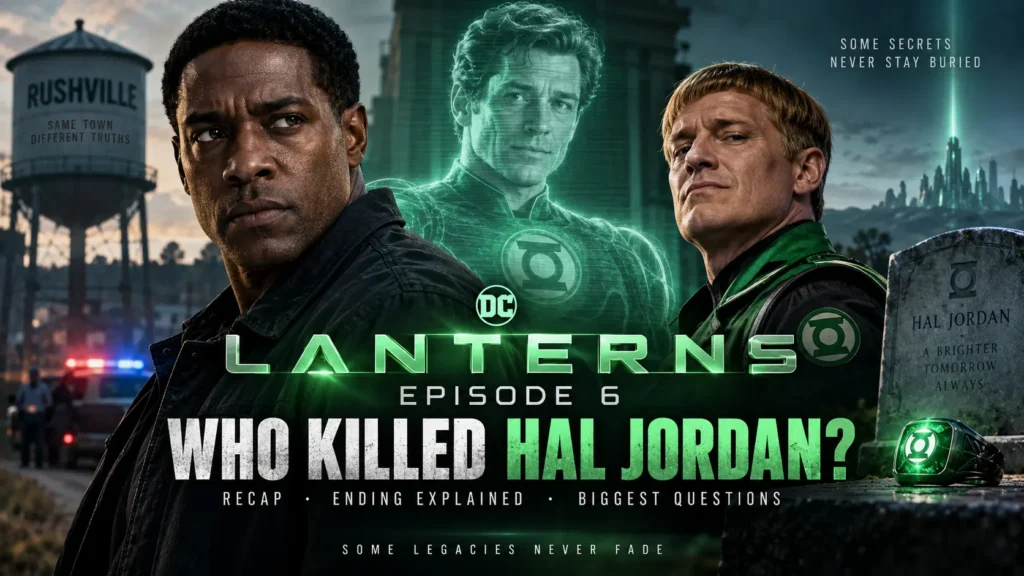
Lanterns Episode 6 recap featuring John Stewart, Hal Jordan and Guy Gardner

Lanterns Episode 6 Recap: Who Killed Hal Jordan and What the Ending Reveals

Ten years after the tragedy that changed Rushville, Lanterns Episode 6 returns to 2026 and puts Hal Jordan’s death at the center of the story. Titled “Bad Optics,” the episode follows John Stewart after he has walked away from the Green Lantern Corps. John has built a new life with his brother Marcus, working on emergency shelters designed to protect communities from major disasters. However, that life changes when John learns that Hal has returned to Rushville and wants to make amends. Their reunion quickly turns hostile. Hal believes he has already paid for his past mistakes, while John still blames him for the consequences of the Rushville disaster. Their confrontation becomes even more significant when Hal is later found dead. His death brings John back into the mystery surrounding the events of the series premiere. Why did Hal return to Rushville? Who wanted him dead? And what was he hiding before his death? Episode 6 also introduces Nathan Fillion’s Guy Gardner, the Green Lantern currently operating on Earth. His arrival gives John access to technology that could help uncover Hal’s final secrets. By the ending, John takes a major risk to investigate Hal’s past. Instead of solving the murder, however, his discovery creates an even bigger mystery surrounding Hal’s final moments. Why Lanterns Episode 6 Jumps Back to 2026 The first five episodes spend much of their time exploring the events surrounding the 2016 Rushville disaster. Episode 6 changes direction by moving the story into 2026 and showing what happened to the characters after a decade of consequences. That time jump matters because John Stewart is no longer living as a Green Lantern. John now works alongside his brother Marcus, designing large emergency shelters for communities preparing for potential disasters. His career reflects the lessons he took from Rushville. Rather than depending on extraordinary heroes, he focuses on creating practical protection for ordinary people. Hal’s return disrupts that carefully constructed life. After serving time in prison, Hal has returned to Rushville and attempted to repair some of the relationships damaged by the past. However, his presence also brings old resentment back to the surface. The 2026 setting allows the series to explore several important developments: John has rejected the Green Lantern identity. Hal has returned to the community connected to his greatest failure. The Rushville tragedy still affects the people involved. A new Green Lantern now operates on Earth. Hal’s death creates a new investigation around an old mystery. The episode also begins expanding the show’s connections to the wider DC Universe through characters and references that were largely absent from the earlier timeline. John Stewart’s Life After the Green Lantern Corps John’s life in 2026 looks almost completely disconnected from his former identity. He no longer carries a Green Lantern ring and has no obvious intention of returning to the Corps. Instead, he has turned his experience with disaster into a practical career. Working with Marcus, John helps develop massive emergency shelters designed to protect people when conventional infrastructure cannot. That decision reveals something important about John’s character. He has not forgotten what happened in Rushville. He has simply chosen to respond to it differently. His separation from the Lanterns also appears deliberate. John does not treat his former life as something he wants to reclaim. The emotional damage from Rushville remains too significant. That changes when John’s mother tells him that Hal has returned and wants to apologize. John’s reaction makes it clear that the past remains unresolved. He travels back to Rushville, but he does not arrive looking for reconciliation. Instead, his meeting with Hal quickly becomes heated. Lanterns Episode 6 shows that Hal’s return forces John to confront a part of his past he has spent years trying to leave behind. Hal argues that he served his prison sentence and accepted responsibility for what happened. John refuses to see the matter as settled. For him, the consequences extend far beyond Hal’s punishment. Their confrontation ends badly, but its importance becomes clear later. John is among the last people known to have confronted Hal before his death, placing him uncomfortably close to the murder investigation. What Happened Between Hal Jordan and John Stewart? Hal and John’s reunion exposes the unresolved conflict at the heart of their relationship. Hal believes that his prison sentence should allow him to move forward. After years of punishment, he appears ready to repair damaged relationships and rebuild his life in Rushville. John does not share that view. For him, the Rushville disaster cannot be reduced to a sentence that Hal already completed. People died, the community suffered, and John’s own relationship with the Green Lantern Corps was permanently damaged. Hal also challenges John’s decision to walk away from the ring. His comments suggest that he believes John abandoned a responsibility that should never have been left behind. The argument reveals two completely different interpretations of their shared history: Hal Jordan’s perspective John Stewart’s perspective He served his sentence and paid for his mistakes. The consequences of Rushville never truly ended. He wants to repair damaged relationships. Forgiveness cannot erase what happened. He believes John can move forward. John still carries resentment toward Hal. He has returned to Rushville. John’s return is triggered by Hal’s presence. Yet Hal’s behavior suggests that his return is more complicated than simple redemption. Before John leaves, Hal asks him to keep his presence in Rushville secret. That request becomes significant after Hal’s death. If Hal was deliberately keeping a low profile, the reason could provide an important clue to the events leading up to his murder. Why Hal Wanted to Make Amends Hal’s return to Rushville appears connected to his attempt to repair relationships damaged by the events of the past. After spending years in prison, he wants to reconnect with people from the community rather than simply disappear from their lives. His relationship with Sheriff Kerry Kane becomes particularly important because she knows Hal personally and understands what he was trying to do after

Lanterns Episode 6 Recap: Who Killed Hal Jordan and What the Ending Reveals Read More »

Breaking Bad inspired crime drama scene with an anonymous man, desert landscape and laboratory equipment

Breaking Bad: Cast, Story, Seasons, Episodes, Characters and Why It Still Matters

Breaking Bad is a crime drama built around one of television’s most compelling character transformations. The series follows Walter White, a high school chemistry teacher whose life changes after a devastating cancer diagnosis. Concerned about his family’s financial future, Walter turns to an unlikely solution: using his chemistry expertise to produce illegal drugs with former student Jesse Pinkman. Created by Vince Gilligan, the series premiered on January 20, 2008, and concluded in 2013. Across five seasons and 62 episodes, Breaking Bad follows Walter’s expanding criminal operation, changing relationships, and the consequences of his decisions. Bryan Cranston stars as Walter, with Aaron Paul as Jesse Pinkman and Anna Gunn as Skyler White. However, the series is about more than drugs and crime. At its center is a study of identity, ambition, pride, fear, and personal responsibility. Walter’s initial motivations gradually become more complicated, creating the foundation for the show’s long-running conflict. What Is Breaking Bad About? Breaking Bad begins with Walter White living an ordinary life. He teaches chemistry at a high school, supports his family, and works an additional job to supplement his income. After doctors diagnose him with inoperable lung cancer, Walter decides to use his scientific knowledge to manufacture methamphetamine. To enter the drug business, Walter reconnects with Jesse Pinkman, a former student who already has experience in the local drug trade. Their partnership combines Walter’s chemistry expertise with Jesse’s knowledge of the criminal market. At first, Walter presents his actions as a way to secure his family’s financial future. Yet the consequences quickly extend beyond that original goal. His decisions affect Jesse, Skyler, Hank Schrader, and people connected to the increasingly dangerous criminal world. That progression gives Breaking Bad its central dramatic engine. Walter repeatedly makes choices that create new problems, and those problems force him to make even more consequential decisions. The series therefore works on two levels. On the surface, it is a crime thriller involving drugs, money, and dangerous alliances. Beneath that story, it examines how ambition and personal choices can gradually reshape a person’s identity. This crime-drama approach also connects with other television stories centered on the drug trade, including The Snowfall Spinoff: The Drop: A Snowfall Saga. Rather than presenting Walter’s transformation as one sudden change, the series builds it through a long chain of decisions and consequences. Breaking Bad at a Glance Breaking Bad ran from 2008 to 2013 and consists of five seasons and 62 episodes. Vince Gilligan created the series, while Bryan Cranston, Aaron Paul, and Anna Gunn lead the principal cast. Detail Information Series Breaking Bad Creator Vince Gilligan U.S. Premiere January 20, 2008 Finale September 29, 2013 Seasons 5 Episodes 62 Genre Crime drama / thriller Central Character Walter White Walter White Bryan Cranston Jesse Pinkman Aaron Paul Skyler White Anna Gunn Primary Setting Albuquerque, New Mexico The series uses Albuquerque as more than a backdrop. The city provides the environment in which Walter’s personal, professional, and criminal lives gradually collide. The five-season structure also gives the story room to develop naturally. Walter’s decisions do not produce immediate, isolated consequences. Instead, events from earlier episodes continue to influence later relationships and conflicts. That long-form approach becomes particularly important as Walter’s world expands. What starts as a partnership between a chemistry teacher and a former student eventually connects them to a much larger network of criminals, investigators, family members, and business associates. Who Created Breaking Bad? Vince Gilligan created Breaking Bad and played a major role in shaping its creative direction. IMDb credits Gilligan as the series creator and identifies him as a writer and executive producer/showrunner during the show’s run. The concept stands out because it begins with an ordinary person rather than an established criminal. Walter White starts as a teacher with a scientific background and gradually enters a world that operates far outside his previous life. That setup allows the series to focus heavily on transformation. Walter’s chemistry knowledge gives him a valuable advantage, but his lack of experience in the criminal world creates new vulnerabilities. The show’s storytelling also relies on cause and effect. Decisions made early in the story continue to influence later events, while seemingly manageable problems can develop into much larger conflicts. Gilligan’s role connects the show’s central concept with its long-form storytelling. The series does not treat Walter’s transformation as a simple switch from one identity to another. Instead, it builds that change through repeated decisions, relationships, and consequences. This approach creates one of the show’s defining questions: what happens when someone who believes they have a legitimate reason to break one rule continues finding reasons to cross another boundary? The World Around Walter White The world of Breaking Bad brings together three major parts of Walter’s life: Family: His relationship with Skyler and the rest of his family becomes increasingly complicated as he hides his activities. Professional knowledge: His chemistry expertise provides the foundation for his entry into the drug business. Criminal connections: His partnership with Jesse gradually exposes him to a much wider and more dangerous network. Walter’s chemistry skills give him an important advantage, but his lack of experience in the drug trade creates immediate risks. Jesse helps bridge that gap because he already understands parts of the local criminal market. At home, Walter’s choices create another source of tension. Skyler becomes increasingly affected by his secrecy, while Hank’s career in law enforcement creates a direct connection between Walter’s private life and the investigation surrounding the drug trade. Albuquerque also helps connect these different worlds. The series moves between family homes, workplaces, public locations, and places associated with the criminal business. This contrast reinforces how difficult it becomes for Walter to keep his two lives separate. As the story expands, additional characters become central to the world around Walter and Jesse. Saul Goodman, Mike Ehrmantraut, and Gus Fring each represent different parts of the criminal and professional network surrounding them. That expanding world allows Breaking Bad to move beyond Walter’s original plan and develop into a

Breaking Bad: Cast, Story, Seasons, Episodes, Characters and Why It Still Matters Read More »

Prison Break cast and characters from the TV series

Prison Break: Cast, Seasons, Story, Episodes & Latest Updates

Prison Break remains one of television’s most recognizable escape dramas, built around a simple but high-stakes idea: what if someone deliberately entered prison to rescue a family member facing execution? The series turns that question into a tense story of planning, loyalty, deception, and survival. At the center of the story are brothers Michael Scofield and Lincoln Burrows. Lincoln sits on death row after authorities convict him of murdering the Vice President’s brother. Michael refuses to accept that his brother committed the crime. Instead of trying to help from the outside, he creates a plan that puts him inside Fox River State Penitentiary alongside Lincoln. The original series eventually expanded beyond the prison walls, moving through manhunts, international conspiracies, new prisons, and dangerous missions. That larger story eventually produced five seasons, including the 2017 revival. Now, the franchise is moving toward another chapter with a new Hulu series set in the same fictional universe. What Is Prison Break About? Prison Break follows Michael Scofield, a highly intelligent structural engineer who believes his brother Lincoln Burrows was framed for a murder he did not commit. Lincoln’s conviction places him on death row at Fox River State Penitentiary, leaving Michael with little time to find another way to save him. Michael chooses an extreme solution. He deliberately commits a bank robbery so authorities will send him to Fox River. Once inside, he begins putting a carefully prepared escape plan into action. His knowledge of the prison’s structure gives him an advantage, but escaping is only part of the challenge. Michael must also deal with inmates, prison officials, security restrictions, shifting alliances, and people whose motives he cannot fully trust. The story also introduces Sara Tancredi, the prison doctor, whose connection with Michael becomes increasingly important. Meanwhile, Lincoln’s case leads to a much larger conspiracy involving powerful people outside the prison. What makes the premise effective is the contrast between Michael’s preparation and the unpredictable environment around him. He may understand the building, but he cannot control every person inside it. As a result, the series combines prison drama with mystery, crime, action, and serialized suspense. Prison Break Cast and Main Characters The central cast gives the series its emotional foundation. Michael’s plan drives the plot, but the people surrounding the brothers constantly change the risks they face. Character Actor Role Michael Scofield Wentworth Miller Engineer who creates the escape plan Lincoln Burrows Dominic Purcell Michael’s brother and death-row inmate Sara Tancredi Sarah Wayne Callies Fox River doctor Fernando Sucre Amaury Nolasco Michael’s cellmate and trusted ally Theodore “T-Bag” Bagwell Robert Knepper Manipulative and dangerous inmate The supporting characters become just as important as the brothers because Michael cannot execute his plan alone. Each alliance brings a different advantage, while every conflict creates another obstacle. The cast also helps Prison Break move beyond a simple escape story. Michael and Lincoln provide the emotional core, while characters such as Sucre and T-Bag introduce loyalty, betrayal, danger, and unpredictability. Wentworth Miller as Michael Scofield Michael Scofield approaches the prison problem differently from everyone around him. Rather than relying primarily on physical strength, he uses engineering knowledge, observation, preparation, and strategic thinking. His decision to enter Fox River comes from his determination to save Lincoln. That choice immediately creates a difficult contradiction: Michael must become an inmate to help someone he believes should never have been imprisoned. Inside Fox River, he gradually brings different people into his plans. Some cooperate because they trust him, while others become involved because Michael can offer something they desperately need. His relationship with Lincoln gives the character an emotional motivation beneath his carefully controlled exterior. Michael’s intelligence may help him anticipate many obstacles, but the prison constantly introduces situations that no blueprint can completely predict. Dominic Purcell as Lincoln Burrows Lincoln Burrows begins the story in the most desperate position imaginable. He faces execution for a crime he insists he did not commit, while the people around him struggle to prove the truth before time runs out. Unlike Michael, Lincoln does not enter the prison voluntarily. His immediate goal is survival, but Michael’s arrival changes everything. The brothers complement each other throughout the story. Michael brings planning and calculation, while Lincoln often relies on determination and physical courage. Lincoln’s case also drives the conspiracy element of the series. As Michael investigates what happened, the story expands beyond one man’s imprisonment and begins connecting Lincoln’s conviction to a much larger network of people and hidden interests. Prison Break Season 1 Explained The first season establishes the formula that makes Prison Break distinctive. Michael enters Fox River with a plan, but the prison’s complicated social structure quickly becomes as important as its physical layout. Michael needs cooperation from several inmates while keeping his real objective hidden from prison authorities. That creates a constant balancing act. Every conversation can reveal information, create an alliance, or expose part of his strategy. Fernando Sucre becomes one of Michael’s closest allies, while other inmates bring very different motivations into the escape effort. Theodore “T-Bag” Bagwell, for example, introduces a major source of danger because his interests rarely align with Michael’s. Outside the prison, Veronica Donovan investigates Lincoln’s conviction. Her efforts help reveal that the case contains more than the evidence presented at trial suggests. Sara Tancredi also becomes important to Michael’s plan because her position as a prison doctor gives him access to areas and situations that would otherwise remain difficult to reach. As the season progresses, the escape plan becomes increasingly complicated. Michael must adapt when circumstances change, people become suspicious, and the timetable becomes tighter. The result is a season that combines a detailed escape strategy with a growing conspiracy, making the prison itself only one part of a much larger mystery. Prison Break Season 2: The Manhunt Season 2 changes the structure of the story almost immediately. The focus moves from preparing an escape to dealing with the consequences of one. After leaving Fox River, Michael, Lincoln, and the other escapees become

Prison Break: Cast, Seasons, Story, Episodes & Latest Updates Read More »