
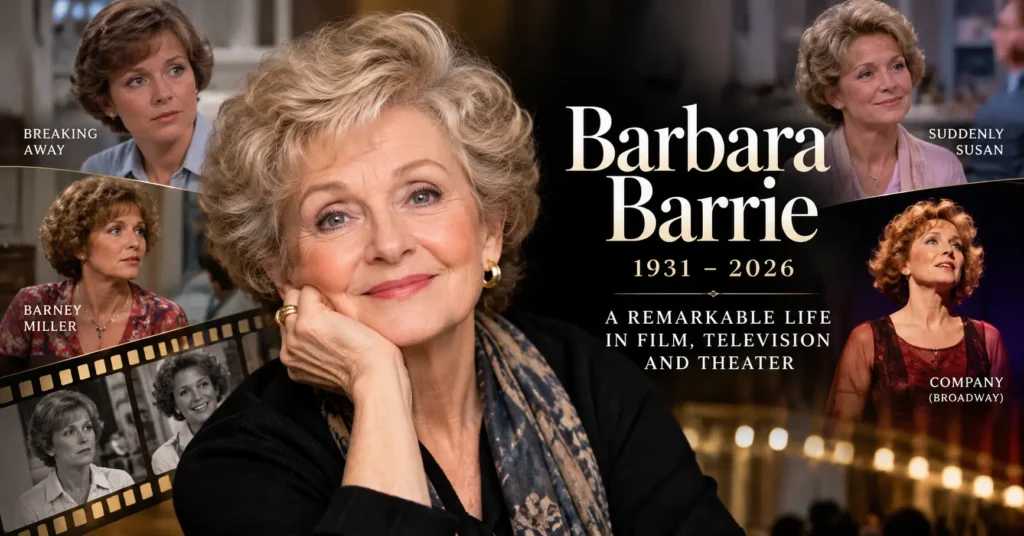
Barbara Barrie built a remarkable career across film, television, and theater, earning respect for her thoughtful performances and versatility as an actress. Best known to many movie fans for Breaking Away, she also appeared in popular television series and acclaimed stage productions. Her career spanned several decades, allowing her to connect with audiences through dramatic and comedic roles.
News of Barbara Barrie’s death at 95 has renewed interest in her life, achievements, and lasting contribution to American entertainment. Beyond her best-known screen performances, she developed a distinguished theater career, received major award nominations, and shared aspects of her personal journey through writing. Her story offers a look at an actress whose influence extended well beyond a single film or television role.
Barbara Barrie Dies at 95: What We Know
Barbara Barrie died at the age of 95, according to reports published on October 28, 2026. The news brought renewed attention to an acting career that included acclaimed performances in film, television, and theater.
Reports stated that Barrie had received a terminal cancer diagnosis and chose medically assisted death. This aspect of her story calls for sensitive, factual reporting. Her personal medical decisions should be understood through information publicly confirmed by her family and reputable news organizations, rather than speculation about her final days.
Barrie’s death marks the end of a long career that connected several generations of entertainment audiences. Film fans remember her especially for her role in Breaking Away (1979), while television viewers may recognize her from Barney Miller and Suddenly Susan. Theater audiences also knew her for her Broadway work, including the original production of Stephen Sondheim’s musical Company.
Although the circumstances of her death brought her back into the headlines, her professional achievements remain central to her story. Her performances demonstrated an ability to portray believable, emotionally grounded characters across different formats. Looking back at her life means examining not only the recent news but also the work that established her reputation.
Who Was Barbara Barrie?
Barbara Barrie was an American actress and author whose work reached audiences through independent films, major Hollywood productions, television sitcoms, and Broadway theater. Born Barbara Ann Berman on May 23, 1931, she developed a reputation for bringing warmth and emotional depth to her characters.
Unlike performers known primarily for one type of role, Barrie moved comfortably between different genres. She played complex dramatic characters in films such as One Potato, Two Potato and Breaking Away, while her television work introduced her to viewers who followed long-running series and family comedies.
Her achievements also extended beyond the screen. Barrie earned recognition at the Cannes Film Festival and received nominations for an Academy Award, a Tony Award, and several Emmy Awards. These honors reflected the breadth of her work across different areas of the entertainment industry.
Barrie also explored writing, drawing on her personal experiences to discuss illness, recovery, and the challenges of living with cancer. Her willingness to discuss those experiences added another dimension to a career already distinguished by its longevity.
For audiences discovering her work today, Barrie’s career offers more than a collection of familiar credits. It illustrates how a dedicated character actress could build a lasting reputation through thoughtful performances, professional versatility, and a willingness to take on roles with emotional and social significance.
Barbara Barrie’s Early Life and Education
Barbara Barrie was born in Chicago, Illinois, on May 23, 1931. Her family later moved to Corpus Christi, Texas, where she spent much of her childhood. Growing up in Texas became an important part of her early story before she pursued professional acting in New York.
After finishing high school, Barrie attended Del Mar College before transferring to the University of Texas at Austin. Although she initially explored journalism, her interest in performance led her toward drama. She studied theater and earned recognition for her work as a student, including drama scholarships and performance awards.
Her university experience helped her develop the foundation for a professional career. Rather than entering Hollywood immediately, she pursued formal training and gained experience performing onstage. That preparation proved valuable as she began competing for roles in New York’s demanding theater scene.
Barrie’s education also distinguished her early career from the path of performers who entered entertainment without extensive academic or stage preparation. She developed her craft through study and practical experience, building the skills she would later apply to dramatic films, television productions, and musical theater.
After graduating in the early 1950s, Barrie moved to New York City to pursue acting professionally. The move marked a decisive transition from student performances to a career in one of America’s principal theater centers.
From Texas to New York
Barrie’s move to New York opened the door to professional stage work. In 1955, she made her Broadway debut in The Wooden Dish, beginning a theater career that would continue for decades.
The production gave her an early opportunity to work within the professional theater industry. Broadway demanded discipline, consistency, and the ability to develop a character through repeated live performances. Those skills remained valuable as Barrie expanded into television and film.
Her early stage experience also established a pattern that defined much of her career: she continued working across entertainment formats instead of limiting herself to one medium. While some viewers later came to know her through television, theater remained an important part of her professional identity.
Barrie’s Broadway debut began a long relationship with the stage, eventually leading to acclaimed productions and a Tony Award nomination.
Her First Film and Television Roles
Barrie began appearing on television in 1955, the same year as her Broadway debut. Her early television work included Kraft Television Theater, an anthology program that featured different stories and casts across episodes.
In 1956, she appeared in the film Giant, although her role went uncredited. The production marked an early step into cinema, giving her experience in a medium that would later bring some of her most significant recognition.
Throughout the late 1950s and 1960s, Barrie continued taking roles in television dramas and other productions. These appearances helped her gain experience with different characters, directors, and storytelling styles.
Her first major film breakthrough arrived in 1964 with One Potato, Two Potato. The drama placed her at the center of a socially significant story and earned her the Best Actress award at the Cannes Film Festival. That achievement established an important milestone in a career that would later include her Oscar-nominated performance in Breaking Away.
Barbara Barrie’s Breakthrough With One Potato, Two Potato
Barbara Barrie reached a career milestone in 1964 with One Potato, Two Potato. The drama explored interracial marriage and racial prejudice in the United States, challenging the social attitudes of its time.
Barrie played Julie Cullen Richards, a divorced white woman who marries an African American man. Their relationship faces a serious challenge when her former husband contests custody of their daughter, citing the interracial marriage as grounds for his objection.
Through Julie’s struggle, the film examines discrimination, family relationships, and the personal consequences of racial intolerance. Its focus on a family’s experience made these social issues deeply personal for audiences.
Cannes Award and Critical Recognition
Released during a period of significant racial and social tension, One Potato, Two Potato addressed the barriers faced by interracial couples in American society. The film remains a notable example of cinema confronting prejudice through family drama.
Barrie’s performance earned international recognition. She won the Best Actress award at the 1964 Cannes Film Festival, marking a defining achievement in her early career.
Her portrayal of Julie demonstrated her ability to convey vulnerability, determination, and emotional complexity without exaggeration. She made the character’s struggle feel personal and believable.
One Potato, Two Potato remains an important part of Barrie’s legacy. It established her reputation as a powerful dramatic performer, years before her Oscar-nominated role in Breaking Away (1979).
Breaking Away: The Role That Earned Her an Oscar Nomination
Barbara Barrie delivered one of her best-known film performances in Breaking Away (1979), a coming-of-age drama directed by Peter Yates. The film follows four young men in Bloomington, Indiana, as they face friendship, class differences, family expectations, and adulthood.
Barrie played Evelyn Stohler, the mother of Dave Stohler, portrayed by Dennis Christopher. Dave develops a passion for Italian cycling and embraces Italian culture while planning his future. His ambitions sometimes create tension with his father, who struggles to understand his choices.
As Evelyn, Barrie brings warmth and emotional depth to the Stohler family. Her character balances concern for Dave with patience and affection. This helps show the challenges parents face as their children seek independence.
Oscar Recognition and Lasting Impact
Breaking Away received critical acclaim for its humor, youthful ambition, and realistic family relationships. The film also introduced Barrie’s performance to a wider audience.
At the 1980 Academy Awards, she earned a nomination for Best Supporting Actress. This recognition became a major milestone in her career, following the international attention she received for One Potato, Two Potato.
The film remains memorable for its relatable themes of growing up and finding independence. Barrie’s portrayal of Evelyn strengthens its emotional core, showing how a supporting character can make a story more authentic and meaningful.
Revisiting the Role on Television
Following the success of Breaking Away, television producers adapted the film into a series that continued the story of its central characters. Barrie returned as Evelyn Stohler, bringing continuity between the original movie and its small-screen adaptation.
The series allowed viewers to spend more time with the family and explore the characters beyond the events of the film. Barrie’s return also demonstrated how effectively she could carry a character from a feature-length story into an episodic format.
Her work on the television adaptation earned her an Emmy nomination for Outstanding Supporting Actress in a Drama Series in 1981. The recognition added another important achievement to her career and reinforced the strength of her performance in the original film.
Although the series did not achieve the same lasting popularity as the movie, it extended the life of the story and gave Barrie another opportunity to portray Evelyn. Her continued involvement also reflected her ability to move between theatrical films and television without losing the qualities that made her performances distinctive.
The connection between the movie and the series remains an important part of Barrie’s career because it brought together two of her strongest professional areas: dramatic acting and television performance.
Barbara Barrie in Private Benjamin and Other Films
After Breaking Away, Barbara Barrie continued building a diverse film career. In Private Benjamin (1980), the comedy starring Goldie Hawn, she played Harriet Benjamin, the mother of a young woman who joins the U.S. Army after unexpected changes in her personal life.
Barrie later appeared in films such as Real Men (1987), End of the Line (1987), and Judy Berlin (1999). These projects showcased her versatility across different genres.
Notable Roles and Recognition
In Judy Berlin, Barrie portrayed Sue Berlin, the title character’s mother. Her performance earned an Independent Spirit Award nomination for Best Supporting Female.
She also voiced Alcmene, the mother of Hercules, in Disney’s animated film Hercules (1997). This role introduced her voice acting to audiences beyond her live-action performances.
Her Later Film Projects
Barrie continued working in independent cinema later in her career. Her credits included Twelve Thirty and Harvest, both released in 2011.
Across these productions, Barrie brought experience and authenticity to a variety of characters. Her filmography reflects a career built on thoughtful performances and a willingness to explore both major studio productions and independent films.
Her Range Beyond Maternal Roles
Barbara Barrie often portrayed mothers, wives, and older women, but reducing her career to those character types overlooks the range of her work. She played emotionally complex dramatic leads, contributed to comedies, performed on Broadway, and appeared in television dramas and animated films.
Her role in One Potato, Two Potato required her to carry a challenging story about prejudice and family conflict. In contrast, Private Benjamin placed her in a comedy that examined personal independence and military life. Her voice performance in Hercules further demonstrated her adaptability.
Barrie’s stage work also gave her opportunities to explore characters outside the familiar family roles associated with her screen career. She approached each medium with the skills developed through years of professional training and performance.
Ultimately, her career shows how a character actress can make a lasting contribution without always occupying the leading position. Through distinctive supporting roles and acclaimed dramatic performances, Barrie helped shape stories that audiences continued to remember decades after their release.
Barbara Barrie on Television
Barbara Barrie developed a strong television career alongside her work in film and theater. She appeared in numerous series across several decades, demonstrating her ability to adapt to different storytelling styles and character types. Her television credits included Barney Miller, Suddenly Susan, Thirtysomething, Family Ties, Nurse Jackie, and Law & Order.
Her performances often featured intelligent, warm, and relatable characters. Although many viewers remember her as a mother or grandmother, Barrie brought individual personalities and emotional depth to those roles. She could contribute to a comedy without losing its dramatic credibility, making her a dependable presence in ensemble casts.
Television also gave Barrie opportunities to revisit characters from successful films. After starring in Breaking Away, she returned as Evelyn Stohler in the television adaptation. The performance earned her an Emmy nomination, adding to the recognition she had already received for the original movie.
Her later television appearances demonstrated that she remained active across different stages of her career. Rather than relying exclusively on her earlier successes, Barrie continued taking on guest roles and supporting parts in established series.
The Television Academy lists three Emmy nominations for Barrie: one for Breaking Away in 1981, another for Law & Order in 1992, and a third for Law & Order: Special Victims Unit in 2003. These nominations reflect the consistency of her television work over more than two decades.
Barney Miller and Elizabeth Miller
One of Barbara Barrie’s most recognizable television roles was Elizabeth Miller, the wife of Captain Barney Miller in the ABC sitcom Barney Miller. The series followed the daily experiences of police officers working at a New York City precinct, combining workplace comedy with stories about crime and human behavior.
Barrie appeared as Elizabeth, offering viewers a glimpse into Barney’s personal life beyond the police station. Her character helped establish the family dimension of the series and provided a contrast to the unusual cases and personalities Barney encountered at work.
The show’s humor often came from understated dialogue and believable character interactions rather than exaggerated situations. Barrie’s performance suited that approach, bringing warmth and a subtle comic sensibility to her scenes.
After the first season, the series concentrated more heavily on the precinct setting, which limited Elizabeth’s appearances. Nevertheless, the role remains an important part of Barrie’s television legacy because it connected her with a popular sitcom and introduced her to audiences who might not have seen her films or stage performances.
Her work on Barney Miller illustrates how a recurring supporting character can contribute to the emotional background of a series, even when that character does not appear in every episode.
Suddenly Susan and Her Later Television Roles
Barbara Barrie reached another generation of television viewers through Suddenly Susan, the NBC sitcom that starred Brooke Shields as Susan Keane, a woman adjusting to life after leaving her fiancé at the altar.
Barrie played Helen, also known as Nana, Susan’s grandmother. Her character offered affection, perspective, and occasional humor as Susan navigated relationships and changes in her personal life.
The role drew on qualities that had served Barrie throughout her career: natural dialogue delivery, understated comedy, and an ability to make family relationships feel believable. Her performance helped establish a connection between Susan’s adult experiences and her family background.
Beyond Suddenly Susan, Barrie continued appearing in television dramas and guest roles. Her credits included Thirtysomething, Nurse Jackie, and Law & Order: Special Victims Unit. She earned Emmy recognition for her appearances in Law & Order and Law & Order: Special Victims Unit, demonstrating that her work extended beyond sitcoms.
Her television career was not defined by a single hit. Instead, it developed through a broad range of appearances that allowed her to work in comedy, drama, and adaptations of existing stories. That variety helped sustain her professional presence over many years.
Barbara Barrie’s Broadway Career
Barbara Barrie’s theater career began before many of her best-known screen performances and remained an important part of her professional identity. She made her Broadway debut in The Wooden Dish in 1955 and later appeared in productions that included The Selling of the President, The Prisoner of Second Avenue, California Suite, and Torch Song Trilogy.
Her stage work required a different kind of discipline from film and television. Actors must sustain a character throughout a live performance, respond to fellow performers in real time, and maintain consistency across repeated shows. Barrie’s extensive stage experience helped her develop the control and timing that also benefited her screen performances.
In addition to Broadway, she worked in Off-Broadway productions and Shakespeare performances. Her role in The Killdeer earned her Obie and Drama Desk recognition in 1974, demonstrating that her theater achievements extended beyond major commercial productions.
Barrie returned to Broadway in 2004 as Yente in the revival of Fiddler on the Roof. In 2017, she appeared as Helene Berman in the original Broadway production of Significant Other. That production marked her final Broadway appearance.
Her long association with the stage reflects the breadth of her artistic interests. While audiences may primarily associate her with Breaking Away or television sitcoms, theater remained a central part of her career for more than six decades.
For another look at a performer’s career journey, explore Britt Stewart’s work as a professional dancer on Dancing with the Stars.
Company and Her Tony Award Nomination
One of Barbara Barrie’s most significant stage achievements came with Company, Stephen Sondheim and George Furth’s musical about relationships, marriage, and the uncertainties of modern life. The original Broadway production opened in 1970 under the direction of Harold Prince.
Barrie played Sarah, one of the married friends surrounding the central character, Robert. The musical examines relationships through a series of interconnected scenes and songs, using humor and personal conflict to explore the difficulties of commitment.
Her performance earned a 1971 Tony Award nomination for Best Featured Actress in a Musical. The nomination recognized her contribution to a production that became an important work in American musical theater.
Company differed from many traditional musicals because it did not rely on a straightforward romantic storyline. Instead, it explored adult relationships through fragmented encounters, conversations, and moments of self-reflection. Barrie’s experience with character-driven drama made her a natural fit for the production.
Her work in the musical demonstrated that her talents extended beyond dramatic films and television comedy. It also established a lasting connection between her name and one of Sondheim’s most celebrated stage works.
Later Stage Work and Significant Other
Following Company, Barrie continued to build a varied theater career. She appeared in Neil Simon’s The Prisoner of Second Avenue and California Suite, productions that combined humor with observations about everyday relationships and personal frustrations.
She also appeared in Torch Song Trilogy, the play by Harvey Fierstein that explores identity, family, love, and acceptance. Her stage work across different genres showed her willingness to engage with stories that reflected changing social attitudes.
In 2004, Barrie joined the Broadway revival of Fiddler on the Roof as Yente, the village matchmaker. The role connected her with a musical that had remained popular across generations.
Her final Broadway appearance came in Joshua Harmon’s Significant Other in 2017, when she played Helene Berman. The play examines friendship, loneliness, and the changing relationships that can accompany adulthood.
Barrie’s stage career demonstrated remarkable longevity. Even after achieving major screen recognition, she continued returning to live theater, taking on new roles and contributing to productions with different themes and styles.
Barbara Barrie’s Awards and Nominations
Barbara Barrie earned recognition across film, television, and theater. Her achievements reflected her versatility and dedication to acting.
Major Film and Television Awards
In 1964, Barrie won the Best Actress award at the Cannes Film Festival for One Potato, Two Potato. The drama explored interracial marriage and racial prejudice. In 1980, she received an Academy Award nomination for Best Supporting Actress for playing Evelyn Stohler in Breaking Away (1979).
Barrie also received a Tony Award nomination for Best Featured Actress in a Musical for her performance as Sarah in the original Broadway production of Stephen Sondheim’s Company. Her television work earned three Primetime Emmy nominations.
Barbara Barrie’s Major Award Recognitions
| Award | Production | Recognition |
|---|---|---|
| Cannes Film Festival (1964) | One Potato, Two Potato | Best Actress winner |
| Academy Awards (1980) | Breaking Away | Best Supporting Actress nominee |
| Tony Awards (1971) | Company | Featured Actress in a Musical nominee |
| Primetime Emmy Awards (1981) | Breaking Away | Supporting Actress nominee |
| Primetime Emmy Awards (1992) | Law & Order | Guest actress nominee |
| Primetime Emmy Awards (2003) | Law & Order: Special Victims Unit | Guest actress nominee |
| Independent Spirit Awards | Judy Berlin (1999) | Best Supporting Female nominee |
Barrie also received an Obie Award and a Drama Desk Award for her theater work in The Killdeer. These achievements demonstrate her range across different entertainment formats and her lasting contribution to American acting.
Barbara Barrie’s Personal Life and Family
Barbara Barrie maintained a family life alongside her demanding career in entertainment. In 1964, she married Jay Harnick, a theater professional who worked as a director and producer. Their marriage lasted more than four decades, until his death in 2007.
The couple had two children, Jane and Aaron Harnick. Barrie also became a grandmother to three granddaughters. Although her professional achievements often placed her in the public eye, she generally kept the focus on her work rather than turning her family life into a major part of her public identity.
Her long career required her to balance stage productions, film schedules, television appearances, and personal responsibilities. The variety of her work meant that she remained connected to different parts of the entertainment industry throughout her adult life.
Barrie’s family also became part of the public story surrounding her death in October 2026. Her daughter, Jane Harnick, confirmed the news and provided information about the circumstances of her mother’s passing to the press.
Despite her recognition as an actress, Barrie’s identity extended beyond her performances. Her experiences as a wife, mother, and grandmother formed an important part of her life away from the stage and screen.
Her family’s connection to theater also reflected the professional world in which she spent much of her life. Through her marriage and her own work, Barrie maintained close ties to the performing arts while continuing to pursue opportunities across film, television, and Broadway.
Barbara Barrie’s Memoirs and Cancer Advocacy
Barbara Barrie’s influence extended beyond acting through her decision to speak publicly about her experience with rectal cancer. Diagnosed in 1994, she underwent treatment that included a colostomy. Rather than keeping the experience entirely private, she later used writing to discuss the practical and emotional challenges associated with the disease.
At the time, many people found conversations about colorectal cancer uncomfortable. Barrie recognized that embarrassment and a lack of awareness could prevent people from discussing symptoms or seeking medical advice. By sharing her experience, she helped bring greater attention to a subject that often remained hidden from public conversation.
Her writing gave readers a personal perspective on diagnosis, treatment, recovery, and adjusting to changes in everyday life. Instead of presenting cancer solely as a medical issue, she addressed the emotional and social difficulties that can accompany a serious illness.
Barrie’s advocacy became an important part of her public identity alongside her acting career. Her openness demonstrated how people in the entertainment industry can use personal experiences to encourage discussion and reduce stigma around health conditions.
Second Act and Don’t Die of Embarrassment
Barrie explored her experience with cancer and its aftermath in two books: Second Act, published in 1997, and Don’t Die of Embarrassment: Life After Colostomy and Other Adventures, published in 1999.
Second Act reflected on the experience of facing illness and continuing to build a meaningful life. The book offered readers insight into the personal adjustments that can follow a major health diagnosis.
Her later book, Don’t Die of Embarrassment, addressed life after a colostomy and the emotional challenges that can accompany changes in bodily function. Its title directly confronted the embarrassment that often surrounds colorectal conditions and related medical procedures.
Both books reflected Barrie’s willingness to discuss subjects that people might otherwise avoid. Her approach encouraged readers to view health challenges as matters that deserve understanding, practical information, and open conversation rather than shame.
These publications also revealed a different side of Barrie’s creativity. As an author, she could communicate directly with readers about experiences that differed from the fictional characters she portrayed onstage and on screen.
Her Later Years and Continued Work
Barrie continued to pursue professional opportunities well into the later stages of her career. Her credits included television appearances and film roles that extended beyond the period associated with Breaking Away and Barney Miller.
In 2014, she publicly disclosed that she had idiopathic pulmonary fibrosis, a progressive lung disease. She spoke about continuing to live actively despite uncertainty about the future. Her openness added another dimension to her long-standing willingness to discuss difficult health experiences.
Barrie’s later work included independent film projects and television appearances, demonstrating her continued commitment to acting. She also returned to Broadway in Significant Other in 2017, taking on the role of Helene Berman.
Her later years brought together several defining aspects of her life: continued artistic work, a willingness to speak openly about illness, and a career that had crossed multiple generations of entertainment.
Following her death at 95 on October 28, 2026, her professional achievements and public advocacy remain important parts of her legacy.
Barbara Barrie’s Legacy in Film, Television and Theater
Barbara Barrie built a remarkable career across film, television, and theater spanning more than six decades. Her performances earned critical recognition and introduced her to generations of audiences.
Her Most Memorable Performances
For many movie fans, Breaking Away remains Barrie’s defining screen performance. Her portrayal of Evelyn Stohler earned an Academy Award nomination. Earlier, she won the Best Actress award at the Cannes Film Festival for One Potato, Two Potato, a drama exploring racial prejudice.
On television, Barrie gained recognition for Barney Miller, Suddenly Susan, and Law & Order. Her performances combined warmth, humor, and emotional depth. Meanwhile, her Broadway work, particularly the original production of Company, established her reputation as a respected stage actress.
Her Influence Beyond Acting
Barrie’s contributions extended beyond entertainment. Through her books and public discussions of rectal cancer, she encouraged more open conversations about a difficult health condition.
Her career highlights include:
- Film: Breaking Away, One Potato, Two Potato, and Private Benjamin.
- Television: Barney Miller, Suddenly Susan, and Law & Order.
- Theater: Company, California Suite, and Significant Other.
- Writing and advocacy: Second Act and Don’t Die of Embarrassment.
Barbara Barrie’s legacy reflects her versatility, dedication, and ability to bring authenticity to diverse characters. Her work continues to hold a place in American entertainment history.
For more celebrity remembrance stories, explore our coverage of Reggie McFadden’s life and career.
Barbara Barrie Filmography and Career Highlights
Barbara Barrie’s filmography includes acclaimed dramas, popular comedies, animated features, and television productions. The following table highlights selected projects from her career.
| Year | Production | Role or achievement |
|---|---|---|
| 1956 | Giant | Early film appearance; uncredited |
| 1964 | One Potato, Two Potato | Julie Cullen Richards; Cannes Best Actress winner |
| 1979 | Breaking Away | Evelyn Stohler; Oscar nominee |
| 1980 | Private Benjamin | Harriet Benjamin |
| 1980–1981 | Breaking Away (TV series) | Reprised Evelyn Stohler; Emmy nominee |
| 1970 | Company | Sarah in the original Broadway production; Tony nominee |
| 1975–1982 | Barney Miller | Elizabeth Miller |
| 1997 | Hercules | Alcmene, voice role |
| 1999 | Judy Berlin | Sue Berlin; Independent Spirit Award nominee |
| 1996–2000 | Suddenly Susan | Helen, also known as Nana |
| 2017 | Significant Other | Helene Berman; final Broadway appearance |
Barrie’s career included many additional film, television, and stage credits. This selection highlights the roles and productions most closely associated with her professional achievements.
Frequently Asked Questions About Barbara Barrie
How old was Barbara Barrie when she died?
Barbara Barrie was 95 years old when she died on October 28, 2026, at her home in Manhattan, New York. Her death followed a terminal cancer diagnosis, according to published reports.
What was Barbara Barrie best known for?
Barrie was best known for playing Evelyn Stohler in Breaking Away, a performance that earned her an Academy Award nomination. She was also recognized for One Potato, Two Potato, Barney Miller, Suddenly Susan, and the original Broadway production of Company.
Which movie earned Barbara Barrie an Oscar nomination?
Barrie received an Academy Award nomination for Best Supporting Actress for her portrayal of Evelyn Stohler in Breaking Away (1979). The coming-of-age film follows four young men in Bloomington, Indiana, as they navigate friendship, family expectations, and adulthood.
What role did Barbara Barrie play in Barney Miller?
Barrie played Elizabeth Miller, the wife of Captain Barney Miller, in the ABC sitcom Barney Miller. Her character offered viewers a glimpse into the police captain’s family life outside the precinct.
Was Barbara Barrie in Suddenly Susan?
Yes. Barrie played Helen, also called Nana, in Suddenly Susan, the NBC sitcom starring Brooke Shields. Her character was Susan Keane’s grandmother and provided affection and humor throughout the series.
Was Barbara Barrie married, and did she have children?
Barrie married theater professional Jay Harnick in 1964. They had two children, Jane and Aaron Harnick. Her husband died in 2007, and Barrie is survived by her children and three granddaughters.
Remembering Barbara Barrie
Barbara Barrie’s career reflected a lifelong commitment to acting, storytelling, and meaningful character work. From her acclaimed performance in One Potato, Two Potato to her Oscar-nominated role in Breaking Away, she created performances that remained memorable long after their original release.
Her television appearances and Broadway achievements further demonstrated her versatility, while her books and cancer advocacy revealed a willingness to discuss difficult personal experiences openly.
As audiences revisit her films, television roles, and stage performances, Barbara Barrie’s legacy continues through the stories she helped bring to life and the conversations she encouraged beyond the entertainment industry.

