
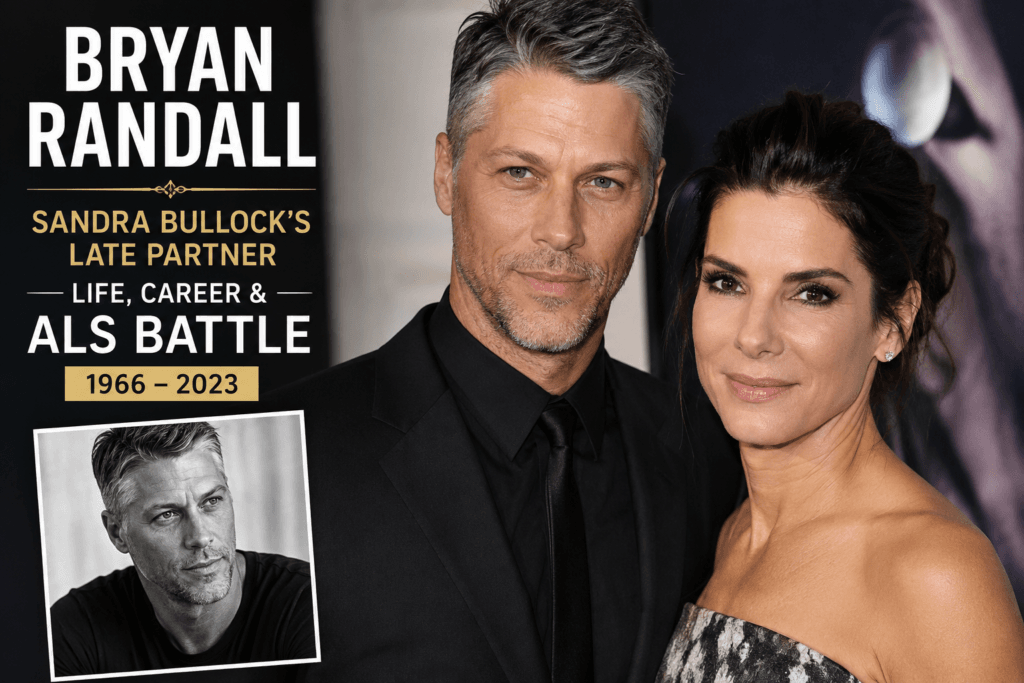
Bryan Randall became widely known through his relationship with Sandra Bullock, but his life extended well beyond Hollywood’s spotlight. A former model who later built a career as a photographer, Randall maintained a relatively private profile even as his relationship with one of America’s most recognizable actors attracted public attention. He and Bullock began dating in 2015 and remained together until his death in August 2023.
Randall’s name has returned to public attention in August 2026 after Bullock spoke openly about the final years of their relationship on the SmartLess podcast. She described the experience of watching his health deteriorate after an ALS diagnosis and explained how his decision to keep the illness private affected her emotionally. Until that interview, Bullock had largely respected his wishes and avoided discussing the details publicly.
That new perspective adds important context to Randall’s story. He was not simply a celebrity partner whose private life occasionally appeared in entertainment coverage. He had his own professional identity, his own family, and a relationship with Bullock that developed largely away from cameras. His final years, meanwhile, became defined by a serious illness that he deliberately chose to keep out of the public conversation.
Who Was Bryan Randall?
Bryan Randall was an American photographer and former model who spent much of his professional life outside the conventional Hollywood celebrity system. Although his relationship with Bullock eventually made him a familiar name to entertainment audiences, Randall had already established himself professionally before their romance became public. He had worked as a model and appeared in fashion publications before moving more fully into photography.
Photography became an important part of Randall’s later career. His work included portrait photography, with his professional identity increasingly centered on the camera rather than standing in front of it. That transition gave him a career separate from Bullock’s acting work and helped explain why he could maintain a degree of independence despite being connected to a major Hollywood star.
Randall was born in Portland, Oregon, and his modeling career included appearances in international fashion publications. His professional history included work associated with major fashion names, although he generally avoided turning his career into a highly public celebrity persona.
That distinction matters when looking back at his life. Public interest in Randall grew sharply after he became Bullock’s partner, yet much of his earlier career had developed away from the entertainment industry’s constant attention. Even during his years with Bullock, the couple generally chose a private approach to their relationship.
Bryan Randall’s Career Before Sandra Bullock
His Years as a Model
Before photography became his main professional identity, Bryan Randall worked as a model. His appearance in fashion publications helped establish him within the modeling world, including international work that brought him into contact with recognizable names in the industry. One documented example was a 2011 appearance in Harper’s Bazaar Singapore connected to fashion figure Cindy Crawford.
Randall’s modeling background is significant because it shows that his connection to the fashion and entertainment worlds existed long before he met Bullock. However, modeling did not remain the defining feature of his professional life. Over time, he shifted his attention toward photography and developed a career behind the camera.
That move reflected a broader change in how Randall presented himself professionally. Rather than building a public identity around celebrity appearances, he increasingly worked through photography and maintained a comparatively low-key profile.
His Photography Career
Photography became Randall’s more enduring professional path. He operated as a photographer and developed work centered in part on portraits and outdoor imagery. Unlike Bullock, whose career required constant public visibility, Randall’s profession allowed him to work with clients and subjects without making his own personal life part of the product.
His photography career also helps explain why the story of Randall can easily become reduced to his relationship with Bullock. Once the two became a couple, entertainment coverage naturally focused on the actress. Yet Randall had already built a professional identity of his own.
That quieter career remained consistent with the private approach he and Bullock later took toward their relationship. Even as photographers captured them at occasional public events, they generally kept their family life away from the level of exposure associated with Bullock’s film career.
Bryan Randall and Sandra Bullock’s Relationship
Bryan Randall and Sandra Bullock began their relationship in 2015 after Randall photographed a birthday celebration for Bullock’s son, Louis. Their romance soon became public, although they did not turn their relationship into a regular feature of the celebrity spotlight.
The couple occasionally appeared together at major events, including the 2015 premiere of Our Brand Is Crisis and the 2018 world premiere of Ocean’s 8. They also attended social events with other Hollywood figures. Still, these appearances represented only a small part of their life together.
Bullock later offered rare insight into what made the relationship meaningful to her. In a 2021 appearance on Red Table Talk, she discussed Randall in the context of family, commitment and parenting. She made clear that she viewed their partnership through the responsibilities they shared rather than through traditional expectations surrounding marriage.
The couple’s private approach became even more important as their family life developed. Randall was not simply Bullock’s romantic partner; he became part of a household that included children from both sides of the relationship. Their lives therefore became intertwined around parenting and family responsibilities as much as romance.
By the time Randall’s health began to deteriorate, the relationship had already become a long-term partnership built around that shared family life. His illness would later transform nearly every aspect of that private world.
Bryan Randall’s Role in Sandra Bullock’s Family
Randall’s relationship with Bullock also placed him in an important role within their blended family. Bullock was already a mother to Louis and later adopted her daughter Laila. Randall had a daughter, Skylar, from a previous relationship. Together, the adults formed a family structure that brought three children into their shared lives.
Bullock spoke positively about Randall’s approach to parenting before his death. Her comments suggested that she valued the way he embraced the responsibilities of family life rather than treating his role as secondary to their romantic relationship. In her 2021 discussion, she emphasized the importance of considering what kind of parents two people could be together and putting the children’s needs first.
That family dimension became especially significant during Randall’s illness. As his condition progressed, Bullock was not dealing only with the loss of a partner she loved. She was also trying to protect and care for a family while confronting a serious, progressive disease.
The children therefore form an important part of understanding Randall’s legacy. Public coverage often centered on his relationship with Bullock, but the family’s private life was much broader. Randall became part of a household in which parenting, caregiving and emotional support were closely connected.
His place within that family helps explain why Bullock’s recent reflections carry a different weight from a conventional celebrity interview. She was discussing not only the death of a partner, but also the long process of watching someone important to their family gradually become seriously ill.
When Did Bryan Randall Receive His ALS Diagnosis?
Bryan Randall received an ALS diagnosis in the years before his death, beginning a private health battle that lasted about three years. His family chose not to make the diagnosis a public story while he was alive. As a result, details about the progression of his illness remained limited during those years.
Amyotrophic lateral sclerosis, commonly known as ALS, is a progressive neurological disease that affects nerve cells responsible for voluntary muscle movement. Over time, the condition can interfere with movement, speech, swallowing and breathing. However, ALS can progress differently from one person to another, so public reports about Randall’s illness do not provide enough information to reconstruct every stage of his condition.
What is clear is that the diagnosis changed the family’s circumstances significantly. Bullock’s recent comments have offered a rare glimpse into the emotional demands of living alongside a terminal illness while trying to preserve a normal family environment.
Randall’s decision to keep the diagnosis private also meant that the public learned very little about his treatment or day-to-day health. His family did not provide a detailed medical timeline, and respecting that boundary remains important when discussing his final years.
For Bullock, however, the experience continued long after the diagnosis itself. Her recent reflections show that the emotional impact of Randall’s illness began well before his death. That distinction is central to understanding why she has described the period as one of the most difficult experiences of her life.
Why Bryan Randall Kept His Illness Private
Randall’s privacy surrounding ALS was deliberate. His family confirmed after his death that he had lived with the disease for approximately three years, but they did not turn his diagnosis into a public campaign or ongoing series of updates. His relatives and Bullock instead respected his wishes during the illness.
That choice was consistent with how Randall had generally approached public attention. Although his relationship with Bullock made him recognizable to entertainment audiences, he did not pursue the same level of exposure as his partner. His professional life as a photographer also existed largely outside the celebrity-news cycle.
Keeping the diagnosis private also prevented the family’s most difficult period from becoming a source of constant media scrutiny. ALS can involve major changes in physical ability and family responsibilities, and public disclosure could have brought additional pressure at a time when the family was already adjusting to Randall’s condition.
The decision had consequences, however. Because few details were publicly available, people outside the family could not easily understand what Bullock and Randall were experiencing. Even Bullock rarely discussed the situation publicly while Randall was alive.
Her silence was not evidence that the illness had little effect on her. Instead, it reflected a commitment to protecting Randall’s wishes. Only after his death did she begin to discuss aspects of the experience more openly.
That distinction matters when interpreting her 2026 comments. She is not suddenly revealing a previously public story. Rather, she is sharing pieces of a deeply personal experience that she had intentionally kept private for years.
How Randall’s Diagnosis Changed Family Life
An ALS diagnosis can affect an entire household, and Randall’s illness placed new responsibilities on Bullock and the people closest to him. His condition unfolded within a blended family that had already developed its own routines and responsibilities.
Bullock had previously described their relationship in terms of partnership and parenting. Once Randall became seriously ill, those everyday responsibilities existed alongside the practical and emotional demands of caregiving. The family had to navigate a reality that was increasingly shaped by Randall’s health.
Bullock’s recent reflections suggest that the experience also changed her understanding of time. A terminal illness can create a painful awareness that ordinary moments may become limited. Instead of experiencing grief only after a death, family members can begin confronting loss while their loved one is still alive.
That experience helps explain why Bullock’s account of Randall’s final years focuses as much on the emotional process as on the medical diagnosis itself. The illness affected the household before Randall died, and the family had to adapt while continuing to live day to day.
Importantly, the public still does not know every detail of that period. Bullock has spoken about her experience, but neither she nor Randall’s family has provided a complete account of his medical care or private final months.
For that reason, Randall’s story should be approached with a clear distinction between confirmed information and speculation. His ALS diagnosis, the approximate length of his illness and his death are established. Many more intimate details remain part of the family’s private life.
What Is Known About Bryan Randall’s ALS Battle?
The publicly confirmed timeline is relatively straightforward. Randall lived with ALS for roughly three years before his death on August 5, 2023. His family confirmed the diagnosis after his death and asked for privacy as they mourned him.
His illness did not become a regular subject of entertainment coverage while he was alive. Instead, the public mostly knew that Randall and Bullock had maintained a long-term relationship and shared a family life. The seriousness of his condition remained largely outside public view.
That limited information makes it especially important not to speculate about symptoms, treatments or the exact progression of his disease. ALS affects people differently, and a celebrity’s diagnosis does not provide enough evidence to determine what happened medically in a specific case.
What can be understood more clearly is the human impact. Bullock’s later comments have shown that caring for Randall involved a prolonged period of uncertainty and emotional strain. The experience was not confined to the moment of his death; it unfolded gradually as the disease changed their lives.
The family’s decision to protect Randall’s privacy also shaped the way the public understood his story. Rather than documenting every stage of his illness, they allowed him to remain a person first and a public figure second.
That approach is consistent with the broader picture of Randall’s life. He spent much of his career outside the center of celebrity culture, and even his relationship with one of Hollywood’s biggest stars did not erase his preference for privacy.
Sandra Bullock’s Experience Caring for Bryan Randall
Bullock’s role during Randall’s illness became one of the most emotionally difficult parts of their relationship. She had to balance caregiving with parenting and the ordinary responsibilities of family life while confronting the reality that Randall had a progressive and ultimately fatal disease.
Her recent SmartLess appearance provided unusually personal insight into that period. Rather than focusing on medical details, Bullock discussed the emotional consequences of watching someone she loved become seriously ill.
Her comments also help explain why she had remained largely silent. Randall had wanted privacy, and Bullock honored that request even though doing so meant carrying much of the experience without publicly explaining what was happening.
Caregiving can also create a complicated form of grief. A person may begin mourning changes in a loved one’s health, independence or future while still sharing everyday life with them. In Randall’s case, that process unfolded over several years rather than in a single moment.
For Bullock, the experience eventually became part of the grief she faced after Randall’s death. Her recent willingness to speak about it does not change the privacy she protected while he was alive. Instead, it offers a rare window into what those years meant to her.
The distinction between public silence and private experience is important. Randall’s story was never absent from Bullock’s life; it was simply absent from public discussion.
Bryan Randall’s Final Years and Death
Bryan Randall spent his final years dealing with ALS away from public attention. His family confirmed that he had battled the disease privately for three years before his death. Because Randall had chosen to keep his diagnosis confidential, there was no running public account of his health, treatment or daily condition.
Randall’s story also reflects the wider reality that serious health struggles can reshape the lives and careers of well-known public figures while remaining largely outside the public eye.
That privacy remained consistent with the way Randall had approached much of his personal life. Although his relationship with Sandra Bullock made him a recognizable figure in entertainment coverage, he rarely sought the spotlight himself. His family continued that approach during his illness, sharing only the information they felt was necessary after his death.
Randall died on August 5, 2023, at age 57. His family described his passing as peaceful and confirmed that ALS had been the cause of his prolonged health struggle. The announcement brought public attention to an illness that most people had not known he was experiencing.
For Bullock and the people closest to Randall, however, his death marked the end of a much longer period of illness, caregiving and emotional adjustment. The public learned about the diagnosis only after his death, while his family had already spent years navigating its consequences.
That difference between the public timeline and the family’s private experience is essential to understanding Randall’s final chapter. His death became public news in August 2023, but the story of his illness had already shaped his family’s life for years.
What Happened to Bryan Randall in His Final Months?
Very few verified details exist about Randall’s exact final months, and that lack of information is intentional. His family did not release a detailed medical history, and Bullock did not publicly describe his condition while he was alive.
What is established is that Randall’s ALS progressed over approximately three years. His family acknowledged the doctors and nurses who helped care for him, indicating that medical professionals played an important role throughout the illness. They also asked the public to respect the family’s privacy as they dealt with his death.
That request makes speculation about Randall’s final symptoms or treatment inappropriate. ALS can affect people differently, and publicly available information does not establish the specific medical circumstances of his final days.
Instead, the most meaningful information comes from the people who were closest to him. Bullock’s later comments reveal that the illness had already transformed their household well before Randall died. She had been watching someone she loved become progressively ill while trying to maintain stability for their children.
The emotional reality therefore extended beyond the medical diagnosis. Randall’s final years involved a family adapting to uncertainty while protecting his wish for privacy.
In 2026, Bullock finally offered a clearer picture of that experience. Her account showed that Randall’s death did not arrive as a completely unexpected moment of grief for the family. The emotional process had already begun during his illness.
The Family’s Statement After Bryan Randall’s Death
Randall’s family announced his death in a statement released shortly after August 5, 2023. They confirmed the three-year ALS battle, explained that Randall had chosen to keep his illness private and expressed gratitude toward the medical professionals who cared for him.
The statement also made clear that privacy remained important even after his death. Rather than offering extensive details about his condition, the family focused on appreciation for the people who supported Randall and asked for space to grieve.
Their message reflected the seriousness of the situation without turning his illness into a public narrative. That approach allowed the family to acknowledge what had happened while preserving the boundary Randall had established during his lifetime.
The response also shifted public understanding of Randall. Until the announcement, many people knew him primarily as Bullock’s longtime partner and a photographer. The confirmation of ALS revealed that he had been facing a major health crisis largely outside public view.
The family’s emphasis on the doctors and nurses involved in Randall’s care was another significant part of the announcement. Their gratitude highlighted the demanding nature of long-term illness and the importance of professional support during Randall’s final years.
For readers looking back today, the statement remains the clearest contemporary account of the basic facts surrounding his death. Later comments from Bullock add emotional context, but they do not replace the family’s original decision to keep Randall’s medical details private.
How Sandra Bullock Responded to Bryan Randall’s Death
Bullock did not immediately turn Randall’s death into a public discussion. Instead, she largely stepped away from that conversation and focused on her family. Her decision reflected both her grief and the promise she had made to respect Randall’s wishes about his illness.
At the time of his death, Bullock’s sister, Gesine Bullock-Prado, publicly praised her sister’s caregiving and acknowledged the medical team that had supported Randall. That response offered a glimpse into how much work had taken place privately before the public announcement.
Bullock’s own voice remained largely absent from the story until her 2026 SmartLess appearance. That interview changed the amount of information available about her experience, particularly the emotional toll of caring for Randall while keeping his diagnosis secret.
She explained that Randall had asked her not to share his illness. Initially, only her sister knew what was happening. Eventually, Bullock confided in a small group of trusted friends, including Jennifer Aniston and Amanda Anka, as the pressure became harder to carry alone.
The timing of Randall’s illness also created additional challenges. Much of the period overlapped with the COVID-19 pandemic, when normal social contact and support systems were already disrupted. Bullock was simultaneously caring for Randall and raising her children.
That combination helps explain why she described the period as profoundly difficult. Her grief did not begin on August 5, 2023. It had already been unfolding as Randall’s health changed.
Why Bryan Randall’s Death Became a Larger Story in 2026
For several years after Randall’s death, the public knew relatively little about what Bullock had experienced during his illness. That changed in August 2026 when she discussed the relationship and his death on the SmartLess podcast.
Bullock explained that keeping Randall’s diagnosis private had left her isolated. She had honored his wishes, but doing so also limited the number of people with whom she could openly share what was happening. Her recent comments reveal that the burden of secrecy became part of the caregiving experience itself.
She also described a form of grief that began before Randall’s physical death. As his health and personality changed, Bullock recognized that she was gradually losing parts of the person she knew. That experience helps explain why the emotional impact of Randall’s death cannot be measured only from the date he died.
The 2026 interview therefore added a new dimension to the public understanding of Bryan Randall. The story is no longer limited to his career, his relationship with Bullock or the fact that ALS caused his death. It now includes Bullock’s account of the years spent navigating the illness in private.
At the same time, the new revelations do not erase Randall’s original wish for confidentiality. Instead, they provide context from Bullock’s perspective while leaving many medical and family details private.
His death remains a deeply personal loss, but the passage of time has allowed Bullock to speak about what those years meant to her.
What Sandra Bullock Recently Revealed About Bryan Randall
Three years after Bryan Randall’s death, Sandra Bullock has finally spoken at length about the experience of caring for him through his ALS battle. In an August 2026 episode of the SmartLess podcast, she explained why she had remained largely silent and described the period surrounding his diagnosis and death as deeply traumatic.
Bullock said Randall had asked her not to disclose his diagnosis. She honored that request, but keeping such a major part of her life private also left her feeling isolated. The situation became even harder during the COVID-19 pandemic, when normal access to friends and support networks was already limited.
Initially, Bullock said her sister, Gesine Bullock-Prado, was the only person outside the immediate situation who knew what was happening. As Randall’s condition progressed, she eventually confided in a small circle of trusted friends, including Jennifer Aniston and Amanda Anka.
Her comments provide a perspective that had been missing from the public story. Until now, people knew that Randall had died after a private three-year ALS battle, but they had little understanding of what Bullock experienced while caring for him.
The new interview does not provide a complete medical history, nor does it reveal every detail of Randall’s final years. Instead, it explains the emotional reality of living through his illness while trying to protect his privacy and care for their family.
Why Keeping Bryan Randall’s Diagnosis Secret Was So Difficult
Randall’s request for privacy placed Bullock in an unusual position. She understood why he wanted his illness kept confidential, yet she also had to carry information that would normally be shared with family members and close friends.
That tension became particularly difficult during the pandemic. Bullock was caring for Randall while also raising their children, and the restrictions of the period made ordinary emotional support harder to access. Her situation therefore involved several pressures at once: a serious illness, caregiving, parenting and isolation.
Bullock eventually found limited support by opening up to people she trusted. Still, she had spent a substantial period unable to speak freely about what was happening. Her recent comments show that respecting Randall’s wishes came with a personal cost.
This is an important part of understanding the story. Privacy was not simply a media strategy. It affected how Bullock navigated the illness in everyday life.
Randall’s family also maintained that boundary after his death. Their original statement confirmed his three-year ALS battle and said he had chosen early on to keep the illness private. Bullock’s recent interview adds her personal experience without changing that fundamental decision.
The result is a more complicated picture than a simple story about a celebrity grieving a partner. Bullock was grieving while also caring, planning and protecting a family. By the time she could speak openly, much of the hardest part had already happened.
Bryan Randall’s Illness and the Pain of Watching Someone Change
One of Bullock’s most striking reflections concerned the gradual nature of Randall’s decline. She explained that she began grieving years before his physical death because the illness had changed the person she knew.
That experience can be difficult for outsiders to understand. When a progressive disease changes someone’s abilities, personality or independence, loved ones may experience repeated losses while the person remains physically present. The final death then becomes one part of a longer emotional process.
Bullock’s comments suggest that this happened during Randall’s illness. She described feeling as though the person she loved had left before his body did, illustrating how profoundly the progression of the disease had affected her perception of their relationship.
Her account also shows why the timeline of grief cannot always be measured from a single date. Randall died on August 5, 2023, but Bullock’s emotional adjustment had begun much earlier.
That does not mean she had stopped loving him or that his death was somehow easier when it happened. Instead, it reflects the complicated reality of a prolonged terminal illness. A caregiver can experience fear, exhaustion, hope and grief at the same time.
For Randall’s family, those emotions unfolded alongside practical responsibilities. Bullock had to continue parenting and maintaining a household while Randall’s condition progressed.
Her 2026 comments therefore add depth to the understanding of Bryan Randall’s final years. The story was not only about the disease itself. It was also about how illness gradually changed the lives of everyone around him.
The Impact of Bryan Randall’s Illness on Their Children
Bullock’s recent reflections also highlight how difficult Randall’s illness was for the children. She and Randall had built a blended family that included Bullock’s two children and Randall’s daughter, Skylar.
For Bullock, caring for Randall was therefore inseparable from protecting the children emotionally. They were not watching the illness from a distance; they were part of a household experiencing its consequences.
Reports on Bullock’s SmartLess interview indicate that she found the children’s experience particularly painful. She had previously faced illness and difficult family circumstances, but watching her children deal with Randall’s decline created another level of emotional pressure.
This helps explain why caregiving involved more than medical responsibilities. Bullock also had to think about what the children understood, how they were processing changes at home and how to preserve a sense of stability.
Randall’s role in their family made his illness especially significant. He was not simply Bullock’s partner; he had become a father figure within the household. His declining health therefore affected the family’s emotional structure as well as its daily routines.
The public has few details about how each child experienced that period, and it would be inappropriate to speculate. Bullock’s comments provide only her perspective.
What they do establish is that the illness had consequences beyond Randall and Bullock themselves. The family’s experience became a shared one, even though they tried to protect their children from unnecessary public attention.
That privacy remains important today. Bullock’s decision to discuss her own grief does not mean that every part of her family’s experience belongs in the public record.
Bryan Randall and the Meaning of Anticipatory Grief
The experience Bullock described is often associated with what is known as anticipatory grief: emotional grief that can begin while a loved one is still alive but facing a serious or terminal illness.
In Randall’s case, Bullock’s comments suggest that the process developed gradually as his condition changed. She was confronting the possibility of losing him while still caring for him and sharing everyday life with him.
Bullock’s experience also connects with a broader conversation about mortality, family responsibilities, and how parents approach an uncertain future.
This kind of grief can feel especially complicated because there is no clear boundary between caregiving and mourning. A person may still have ordinary moments with a loved one while simultaneously recognizing that the future they imagined together is changing.
Bullock’s description of feeling that her partner had left before his body did captures that tension. Her grief was tied not only to Randall’s eventual death but also to the gradual changes caused by his illness.
The concept also helps explain why the aftermath of Randall’s death could not be resolved simply by reaching the date of his passing. Bullock had already spent years adapting to loss, uncertainty and responsibility.
It is important, however, not to assume that every caregiver experiences grief in exactly the same way. Bullock’s account belongs to her personal experience, and Randall’s family has maintained many details of his illness privately.
Still, her story illustrates a broader reality of terminal illness: grief can begin long before a final goodbye. For Bullock, recognizing that process appears to have become part of understanding what happened to her after Randall died.
How Bryan Randall’s Legacy Extends Beyond His Death
Bryan Randall’s legacy is closely connected to Sandra Bullock, but it should not be reduced to that relationship. He was a model, photographer, father and partner who spent much of his life outside the intense public attention surrounding Hollywood.
His final years also revealed something important about his character: he wanted control over how his illness was discussed. Randall’s family honored that decision, even when doing so meant keeping an enormous part of their lives private.
Bullock’s 2026 revelations now provide additional context without overturning that privacy. Her account shows how much Randall’s illness affected their household and how deeply his death changed her life.
His legacy therefore exists on several levels. Professionally, he left behind work as a photographer and memories from his earlier modeling career. Personally, he remained an important figure in the lives of his children and Bullock’s family.
There is also a quieter legacy in the way his family handled his illness. They did not treat his diagnosis as a public spectacle. Instead, they allowed Randall to decide how much of his private medical journey would become public information.
That choice can be easy to overlook in celebrity coverage, where personal details often become part of the news cycle. Randall’s story followed a different path.
Now that Bullock has begun discussing her own experience, the public can better understand the years that preceded his death. Yet the most respectful portrait of Bryan Randall remains one that recognizes both sides of his story: the public man people came to know and the private person his family chose to protect.
Bryan Randall: Key Facts at a Glance
Bryan Randall’s life combined careers in modeling and photography with a long-term partnership and family life that largely remained away from the spotlight. His relationship with Sandra Bullock made him widely recognizable, but Randall maintained a private public profile throughout much of their time together.
| Detail | Information |
|---|---|
| Full name | Bryan Randall |
| Profession | Photographer and former model |
| Partner | Sandra Bullock |
| Relationship began | 2015 |
| Illness | Amyotrophic lateral sclerosis (ALS) |
| Length of illness | Approximately three years |
| Date of death | August 5, 2023 |
| Age at death | 57 |
| Children | Randall had a daughter, Skylar |
Randall’s career before his relationship with Bullock is an important part of his story. He worked as a model before transitioning toward photography, eventually developing a professional identity behind the camera.
His private life became more complicated after his ALS diagnosis. Randall chose not to make his illness public, and his family respected that decision. Consequently, many details about his treatment and final months remain unknown.
The public learned about his diagnosis after his death in 2023. Three years later, Bullock’s 2026 SmartLess interview provided a more personal account of how Randall’s illness affected her and their family. Her comments added emotional context to facts that had previously remained largely private.
Frequently Asked Questions About Bryan Randall
Who was Bryan Randall?
Bryan Randall was an American photographer and former model who became widely known through his relationship with Sandra Bullock. Before dating Bullock, he had worked in the modeling industry and later established himself as a photographer. He maintained a relatively private life despite his connection to Hollywood.
Randall and Bullock began dating in 2015 and remained together until his death in 2023. Their relationship also involved a blended family that included Bullock’s children and Randall’s daughter, Skylar.
What happened to Bryan Randall?
Bryan Randall died on August 5, 2023, at age 57 after living with ALS for approximately three years. His family had kept the diagnosis private during his illness and confirmed the cause of his death after he passed away.
Because Randall had requested privacy, relatively few details about his treatment or final months became public. Later, Sandra Bullock discussed the emotional impact of caring for him during his illness.
What disease did Bryan Randall have?
Bryan Randall had amyotrophic lateral sclerosis, commonly known as ALS. His family confirmed that he had privately battled the disease for about three years before his death.
ALS is a progressive neurological disease that affects nerve cells responsible for voluntary muscle movement. However, Randall’s specific medical progression was not publicly documented in detail, so claims about his symptoms or treatment beyond confirmed reporting should be treated cautiously.
When did Bryan Randall die?
Bryan Randall died on August 5, 2023, at the age of 57. His family announced his death and confirmed that he had been living with ALS for approximately three years.
The announcement also reflected Randall’s longstanding wish for privacy. His family did not release a detailed account of his final medical circumstances and instead asked for space while they mourned his loss.
How long were Bryan Randall and Sandra Bullock together?
Bryan Randall and Sandra Bullock began dating in 2015 and remained partners until Randall’s death in 2023. Their relationship lasted roughly eight years.
During that period, they developed a blended family and generally avoided excessive public discussion of their private lives. They occasionally appeared together at public events, but most details about their relationship remained outside the entertainment spotlight.
Why did Bryan Randall keep his ALS diagnosis private?
Randall chose to keep his ALS diagnosis private, and Sandra Bullock respected that decision. His family later confirmed that he had been living with the disease for approximately three years.
Bullock’s 2026 comments revealed that keeping the diagnosis confidential created emotional challenges for her, particularly because she had limited opportunities to discuss what was happening with people outside their immediate circle. Even so, she continued to honor Randall’s wishes while he was alive.
Conclusion
Bryan Randall’s story is more complicated than the label of “Sandra Bullock’s late partner” suggests. He built a career first as a model and later as a photographer, developed a family of his own, and became an important part of Bullock’s life after their relationship began in 2015.
His final years changed that private life dramatically. Randall received an ALS diagnosis and chose to keep it away from public attention. Bullock respected his wishes while helping care for him and maintaining their family life. When Randall died on August 5, 2023, the public learned only a limited amount about the illness he had privately endured.
Bullock’s 2026 SmartLess interview has now filled in some of that emotional context. Her account shows that the hardest part of losing Bryan Randall began long before his death. Caring for someone through a progressive illness can create grief, uncertainty and exhaustion while everyday life continues around it.
Yet Randall’s legacy should not rest solely on his illness or his relationship with a famous actor. He was also a photographer, former model, father and partner who valued privacy. His family’s decision to protect that privacy remained central to his story from diagnosis through death.
The recent revelations allow the public to understand more about what Bullock experienced, but they also reinforce why Bryan Randall’s life deserves to be remembered with some restraint. Behind the celebrity headlines was a private family navigating love, caregiving, illness and loss together.