
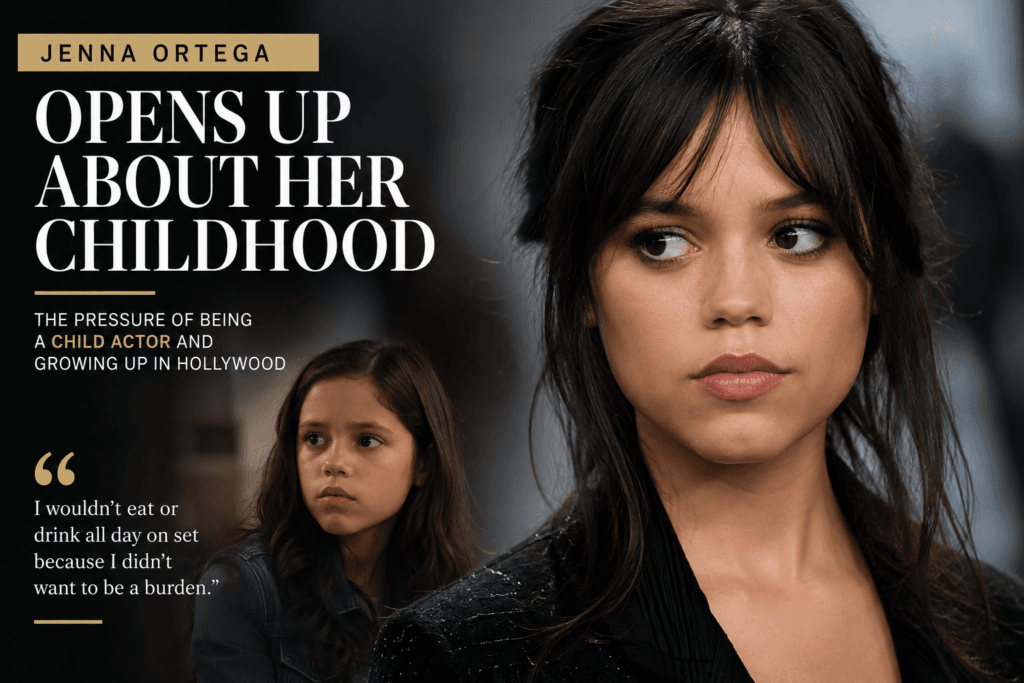
Jenna Ortega began pursuing acting when she was very young. Her early ambition eventually took her from auditions and smaller opportunities to recognizable television and film roles.
Starting so young meant that Ortega learned the professional side of acting while she was still growing up. She became familiar with scripts, rehearsals, cameras, production schedules, publicity, and the expectations of working on a professional set.
Her early credits included Jane the Virgin and Stuck in the Middle. Later, roles in You, the Scream franchise, and Wednesday introduced her to an increasingly larger audience.
However, public success does not always reveal what a young performer experiences behind the scenes.
Ortega has reflected on how strongly she wanted to prove herself during those early years. She wanted to perform well and avoid mistakes, which helps explain why she became so focused on being cooperative and not causing problems.
For a child, that pressure can feel very different from ordinary workplace expectations. An adult may understand that asking for a break or basic assistance is normal. A young performer may instead worry about disappointing people.
That difference is important when considering Jenna Ortega’s childhood career.
Her experience shows how a strong work ethic can sometimes develop alongside a fear of inconveniencing others.
Jenna Ortega’s Childhood Career Started With a Strong Desire to Perform
Jenna Ortega began pursuing acting when she was very young. Her early ambition took her from auditions and smaller opportunities to recognizable television and film roles.
Starting so young meant that Ortega learned the professional side of acting while she was still growing up. She became familiar with scripts, rehearsals, cameras, production schedules, and the expectations of working on a professional set.
Her early credits included Jane the Virgin and Stuck in the Middle. Later, roles in You, the Scream franchise, and Wednesday introduced her to a much larger audience. Anna Osceola’s Hollywood journey offers another example of how performers can gradually build recognition through professional work.
Hollywood careers can also develop through varied roles and opportunities. Scott Eastwood’s Hollywood career provides another example of an actor building a recognizable public identity over time.
However, public success does not always reveal what a young performer experiences behind the scenes.
Ortega has reflected on how strongly she wanted to prove herself during those early years. She wanted to perform well and avoid mistakes, which helps explain why she became focused on being cooperative and not causing problems.
For a child, that pressure can feel very different from ordinary workplace expectations. A young performer may worry about disappointing people even when asking for basic assistance is completely reasonable.
Her experience shows how a strong work ethic can sometimes develop alongside a fear of inconveniencing others.
Jenna Ortega Says She Sometimes Ignored Basic Needs on Set
One of the most striking parts of Jenna Ortega’s recent reflection concerns how she behaved while working as a child actor.
Ortega explained that she became so focused on being cooperative and staying out of everyone’s way that she sometimes avoided asking for things she needed. That included going without food or water during long periods on set.
The important point is not to turn her experience into a sensational story about Hollywood. Instead, her comments reveal the mindset of a young performer who believed that being easy to work with was extremely important.
Looking back as an adult, Ortega appears to have gained a different perspective on that behavior. Her experience highlights the difference between being disciplined and ignoring your own basic needs.
That distinction matters because children should not be expected to manage professional pressure exactly like adults.
A young performer might worry that asking for water could interrupt filming or that requesting food could make them seem difficult. They may also stay quiet because everyone around them appears busy.
However, those fears do not necessarily reflect what the adults actually think.
Jenna Ortega’s experience therefore raises an important question: How much responsibility should a young performer carry for protecting their own well-being?
The answer should not rest entirely on the child.
Adults working with young performers should create an environment where asking for food, water, rest, or assistance feels completely normal. Professional productions should make young actors feel supported rather than afraid to speak up.
Why Jenna Ortega’s Story Matters Beyond Celebrity Culture
Jenna Ortega’s comments have attracted attention partly because she is now one of the most recognizable young actors in Hollywood.
However, the underlying issue is much broader.
Child performers occupy an unusual position. They are employees or professional participants in a highly demanding industry, yet they are also children who are still developing emotionally and socially.
That creates a complicated balance.
A young actor may genuinely love performing. They may feel proud to be on set. They may want to impress directors and fellow cast members. At the same time, they still need adults to recognize when they are tired, hungry, overwhelmed, or uncomfortable.
Ortega’s reflections demonstrate why enthusiasm should not be confused with unlimited capacity.
A child can be excited about a career and still need protection from the pressures surrounding it.
The entertainment industry has rules and safeguards intended to protect young performers, and those protections vary according to jurisdiction, production, and circumstances. However, formal rules alone cannot eliminate every problem.
Culture matters too.
If a young actor receives constant praise for being unusually mature, quiet, punctual, or undemanding, that praise can unintentionally reinforce the idea that having needs is inconvenient.
In Ortega’s case, her recent comments provide a reminder that what looks like impressive professionalism from a distance may sometimes come from anxiety about disappointing other people.
That is why her story deserves to be considered thoughtfully rather than turned into another piece of celebrity gossip.
Jenna Ortega’s Comments Also Change How Fans View Child Stardom
Celebrity culture often focuses on the finished product.
Fans see the successful actor, the major movie, the television premiere, the fashion appearance, or the magazine interview. The years of auditions and uncertainty that came before that success can easily disappear from view.
Jenna Ortega’s career illustrates how different the early stages can look.
She entered the industry young, developed professional experience over time, and eventually became associated with major productions. Her success can make the journey appear inevitable in hindsight, even though childhood careers rarely follow such a simple path.
Her recent comments encourage audiences to reconsider that narrative.
Being a successful child actor does not mean that a young person automatically possesses the emotional tools of an adult. Likewise, being highly motivated does not mean that a child should have to suppress ordinary needs.
There is also an important difference between admiration and romanticizing childhood overwork.
Fans sometimes describe child stars as exceptionally hardworking because they balanced school, auditions, rehearsals, filming, interviews, and other responsibilities. While that dedication can be impressive, it should not become a reason to normalize exhaustion or silence.
Ortega’s reflections make that distinction especially clear.
The goal should not be to criticize a child for trying hard. Instead, it should be to understand why adults around young performers need to create conditions where ambition and well-being can exist together.
That lesson applies to Hollywood, but it also applies to young athletes, musicians, dancers, influencers, and other children who enter demanding professional environments.
Jenna Ortega’s Recent Viral Attention Is a Separate Conversation
The discussion surrounding Ortega has expanded because recent footage and images have generated strong reactions online.
Some viewers have expressed concern about how she looks, particularly after seeing recent interview footage. Others have compared her appearance with broader celebrity conversations about extreme thinness and changing beauty standards.
However, there is a major difference between observing that people are discussing someone’s appearance and claiming to know the reason for that appearance.
The public does not have access to Ortega’s private medical information, personal circumstances, or complete daily life.
Therefore, it would be irresponsible to diagnose an eating disorder, assume a specific medical condition, or claim that her appearance proves something about her health.
That does not mean the public conversation is irrelevant.
The reaction demonstrates how intensely audiences scrutinize female celebrities, especially young women. A single interview can lead to thousands of comments about weight, facial features, clothing, body shape, or perceived changes.
That scrutiny can become overwhelming very quickly.
In Ortega’s case, the most useful discussion is not whether strangers can determine what is happening to her body. They cannot.
Instead, the conversation can focus on the broader cultural pressure placed on women in entertainment and the way appearance-based commentary can overshadow an actor’s actual work.
Her own remarks about childhood self-neglect provide a legitimate topic for discussion because they come from her directly. Speculation about an undisclosed health condition does not.
Keeping those two things separate allows audiences to show concern without crossing the line into unfounded assumptions.
What Can Be Confirmed About Jenna Ortega Right Now?
Several points can be established from Ortega’s recent interview and current coverage.
- She has spoken publicly about her experiences as a child actor.
- She described a strong desire to avoid being a burden to people on set.
- She said that mindset sometimes led her to avoid asking for food or water.
- She now recognizes that failing to look after herself was not necessarily a positive aspect of her childhood professionalism.
- Recent footage has prompted widespread online discussion about her appearance.
- There is not enough public information to responsibly diagnose or explain her current appearance.
That final point is particularly important in an era when social media can turn speculation into an apparent fact within hours.
Ortega’s story is compelling without adding information that she has not provided herself.
Her career already offers a meaningful example of what happens when a talented child grows up inside a demanding industry. Her own reflections allow audiences to examine that experience without inventing details about her private life.
And as her career continues, that perspective may become just as important as the roles that made her famous.
Jenna Ortega Wanted to Be Seen as a Reliable Young Performer
One of the most revealing elements of Jenna Ortega’s recent interview is the motivation behind her behavior.
She was not describing a desire to make herself unhealthy or intentionally punish herself. Instead, she was trying to be dependable.
That distinction changes how the story should be understood.
A young actor may believe that professionalism means never complaining, never delaying production, and never asking for special treatment. Those qualities can sound admirable when viewed from an adult perspective.
Yet children have ordinary needs.
They need food. They need water. They need rest. They need reassurance. They also need adults who understand that asking for those things is not a sign of weakness.
Ortega has now looked back on her younger behavior with more maturity. Her recent comments suggest that she recognizes she was not necessarily taking proper care of herself while trying so hard to be easy to work with.
That realization is important because young performers can easily receive praise for being unusually mature.
A child who sits quietly, follows instructions, and never asks for anything may be described as exceptionally professional. However, adults should also ask whether that behavior comes from confidence or fear.
Those two situations can look almost identical from the outside.
Jenna Ortega’s experience shows why the adults surrounding young performers need to create an environment where children do not feel that their basic needs are an inconvenience.
Jenna Ortega’s Experience Shows the Hidden Side of “Being Easy to Work With”
There is a common idea in professional environments that the best employee is someone who does not create problems.
For adults, that idea can sometimes be useful. Reliability matters. Cooperation matters. Respecting other people’s time matters.
For children, however, the same expectation needs more balance.
A young performer should not have to earn approval by becoming invisible.
That is one of the deeper lessons behind Jenna Ortega’s childhood story.
Her desire to avoid being “in the way” appears to have influenced how she behaved on set. She wanted to minimize disruption, even when that meant failing to pay attention to her own basic needs.
The problem with that mindset is that it can become self-reinforcing.
The child receives praise for being responsible. The praise encourages them to suppress discomfort. Adults see a cooperative performer and continue working with them. The child then becomes even more determined not to disappoint anyone.
Eventually, the behavior can feel normal.
That does not mean every quiet or hardworking child performer is struggling. It also does not mean Ortega’s experience represents every young actor.
Instead, her story offers a useful warning about assumptions.
Professional maturity should not require children to behave as though they have no needs.
The healthiest production environment is one where young performers can be focused and responsible while still being allowed to say, “I need a break,” “I need water,” or “I am tired.”
Those requests should be treated as ordinary parts of working with children, not as disruptions.
Jenna Ortega and the Difference Between Discipline and Self-Neglect
Jenna Ortega’s comments also raise an important distinction between discipline and self-neglect.
Discipline means doing difficult things because they serve a meaningful goal. It can involve learning lines, repeating scenes, attending rehearsals, or preparing physically for a demanding role.
Self-neglect is different.
It happens when a person repeatedly ignores their own basic needs because they believe those needs are less important than the task in front of them.
For a child, that distinction can be especially difficult to understand.
A young actor may hear adults discussing schedules and production deadlines. They may see dozens of people working around them. They may understand that every minute costs money.
Consequently, asking for something simple can feel much bigger than it actually is.
Ortega’s recent reflection is valuable because she now appears able to look at that period from an adult perspective. She can recognize that making few mistakes professionally does not automatically mean she was treating herself well.
That lesson extends beyond acting.
Young people involved in competitive sports, dance, music, modeling, academic competitions, or online content creation can develop similar attitudes.
Working hard is not the problem.
The problem begins when someone believes that their value depends on never needing anything.
That is why Ortega’s story should be framed around balance rather than blame.
She wanted to succeed. She worked hard. She cared about doing a good job.
At the same time, her younger self deserved the same care and attention that she was giving to her career.
Jenna Ortega’s Career Shows How Quickly Childhood Can Become Professional Life
Child performers often experience a strange version of growing up.
Their peers may spend childhood thinking primarily about school, friendships, hobbies, and family life. A young actor can have those experiences too, but professional responsibilities enter the picture much earlier.
Auditions can determine whether they get work. A production schedule can control their days. Publicity can introduce them to strangers. Viewers can develop opinions about their appearance and personality.
Meanwhile, the child is still becoming who they are.
Jenna Ortega has spoken over the years about the unusual experience of growing up in an industry dominated by adults. Her recent interview adds another layer to that history because it shows how deeply she wanted to fit into that professional world.
That desire can be powerful.
Young performers often want adults to take them seriously. They may feel that demonstrating maturity will help them receive better opportunities.
Yet there is a paradox.
The more successfully a child behaves like a professional adult, the easier it can become for others to forget that the person is still a child.
That is why support systems matter.
Parents, guardians, production staff, managers, directors, and other adults all play a role in helping young performers navigate professional expectations.
The child should be encouraged to work hard. However, adults should remain responsible for making sure that hard work does not become an excuse for ignoring the child’s basic needs.
Ortega’s story makes that responsibility especially visible.
Jenna Ortega’s Wednesday Success Came After Years of Preparation
Today, much of the public conversation around Jenna Ortega begins with Wednesday.
The Netflix series transformed her profile. Her portrayal of Wednesday Addams became one of the defining television performances of her generation, and the role helped move her from a successful young actor into global stardom.
However, the role did not create her talent from nothing.
Ortega had already accumulated years of experience before stepping into the black dress and becoming Wednesday Addams.
That background helped her handle a character with unusual demands.
She has previously described the first season as an overwhelming professional experience. The role required extensive preparation, including physical training and learning skills associated with the character. Her work on the famous dance sequence also became a major part of the show’s cultural impact.
Her development continued beyond acting.
During the second season, Ortega also became a producer, giving her greater involvement in creative decisions. That represented a significant shift from being a young performer expected primarily to execute someone else’s vision toward becoming an adult artist with more influence over the production.
That evolution is important.
The child who once worried about getting in the way eventually became someone with a stronger voice behind the camera as well as in front of it.
Her career therefore demonstrates a gradual change in power.
She started by trying to prove herself.
She eventually reached a point where she could help shape the work itself.
Jenna Ortega Has Become More Willing to Speak Her Mind
One of the clearest signs of Jenna Ortega’s professional growth is the increasing control she has over her career.
Her experience on Wednesday appears to have taught her that being a good performer does not necessarily mean agreeing with everything around her.
She has discussed having strong opinions about the character and the writing during the show’s early production. Her willingness to challenge creative decisions became part of her development as an artist.
That is a striking contrast with the younger version of Ortega described in her recent interview.
As a child, she was concerned about becoming an inconvenience.
As an adult, she has become more comfortable expressing disagreement and participating in creative discussions.
That does not mean the earlier version of her was weak.
In fact, the same determination that helped her survive the competitive world of child acting may have contributed to her confidence later.
The difference is that adulthood gave her more freedom to decide how that determination should be used.
She can now choose projects based on creative interest rather than simply trying to prove that she deserves a place.
In her 2026 Esquire interview, Ortega described herself as becoming more focused on stories and characters that feel personally meaningful as she enters a new stage of her career.
That statement suggests a significant shift.
The question is no longer only, “Can I succeed?”
It is increasingly, “What do I actually want to do?”
That is a powerful transition for any performer.
Jenna Ortega’s Next Career Chapter Looks More Selective
Jenna Ortega is entering a period where her choices may matter as much as her popularity.
After the enormous success of Wednesday, she could easily spend years repeating the same type of role. Instead, her recent work suggests a willingness to experiment.
Her projects have included major franchises, darker original films, unusual genre stories, and character-driven material. Her upcoming work includes Klara and the Sun, directed by Taika Waititi, and The Great Beyond, directed by J.J. Abrams, according to her recent Esquire profile.
That variety is important because it demonstrates how far her career has moved beyond childhood television.
Ortega is now in a position where she can consider what kind of actor she wants to become.
That freedom can be especially meaningful after spending so many years trying to establish herself.
Her recent comments suggest that she is thinking carefully about the next stage rather than simply chasing the biggest possible role.
For audiences, that could mean seeing a broader range of performances.
It also creates an interesting contrast with the current online conversation about her.
While social media often reduces celebrities to appearance, relationships, or viral moments, Ortega’s professional trajectory is much more substantial.
She is developing a career with increasing creative control.
Therefore, the most interesting question about Jenna Ortega is not simply what she looks like in a particular video.
It is what she chooses to do with the influence she has earned.
Jenna Ortega’s Viral Video Shows the Problem With Appearance-Based Celebrity Culture
The recent viral discussion surrounding Jenna Ortega shows how quickly celebrity coverage can shift. An interview about her career became part of a wider online conversation after viewers focused heavily on her appearance.
That reaction is not unusual. Social media allows a few seconds of video to be paused, shared, compared with older images, and discussed by thousands of people.
Similar conversations can surround other celebrities when audiences focus on appearance, personal circumstances, or health-related questions. Lucy Davis’s career and personal journey offers another example of how a celebrity’s personal story can become part of a much wider public discussion.
However, seeing someone’s appearance does not mean knowing what is happening in their private life. Lighting, camera angles, styling, clothing, posture, makeup, and ordinary physical changes can all affect how a person looks on screen.
More importantly, strangers cannot determine someone’s medical or psychological condition from a video.
That is why responsible discussion about Jenna Ortega should distinguish between what viewers notice and what viewers know.
Fans can express concern without turning that concern into an unsupported diagnosis. Ortega’s comments about her childhood provide important context about her past, but they do not establish anything about her current health.
A responsible audience can care about a celebrity while still respecting the limits of publicly available information.
Jenna Ortega’s Appearance Should Not Overshadow What She Actually Said
The most valuable part of the current story is something Ortega herself chose to discuss.
She talked about her childhood.
She talked about wanting to be helpful.
She talked about the pressure she placed on herself.
And she reflected on the fact that trying so hard to avoid being a burden sometimes came at the expense of looking after herself.
Those are substantive comments.
Unfortunately, celebrity coverage can quickly move away from a person’s actual words and toward visual speculation.
That shift can erase the meaning of the original interview.
Instead of discussing what Ortega learned from childhood, audiences start debating whether she looks different from an older photograph.
Instead of examining expectations placed on young performers, social media turns the conversation into a ranking of bodies.
Instead of asking whether children in entertainment need stronger support, people attempt to determine private health information from a screen.
None of those approaches adds much value.
A more thoughtful response is to take Ortega’s own words seriously while respecting the limits of what the public can know.
Her story is compelling because it reveals a part of professional childhood that audiences rarely see.
The lesson is not that every child actor experiences the same thing.
The lesson is that young performers should not have to sacrifice basic self-care simply to demonstrate that they deserve to be there.
And that is a much more meaningful conversation than speculation about a viral video.
What Jenna Ortega’s Story Says About Growing Up in Public
Growing up is difficult enough without millions of strangers watching.
For Jenna Ortega, however, significant portions of that process happened while she was building a public career.
That means some of her childhood experiences became part of an entertainment history that audiences could revisit years later.
This creates an unusual problem.
People often judge a former child star by comparing the person they remember with the adult standing in front of them.
Yet the transition from childhood to adulthood is supposed to involve change.
People change their style. Their priorities change. Their confidence changes. Their professional boundaries change.
Ortega’s career demonstrates that transformation particularly well.
She began as a young actor eager to fit into professional environments. She later became a major star who could influence creative decisions and select more ambitious projects.
Her recent interview provides a rare opportunity to hear how she interprets that journey herself.
That perspective is more valuable than a collection of photographs.
It shows that success does not erase the complicated experiences that came before it.
At the same time, difficult childhood experiences do not define an entire adult life.
Ortega’s career continues to evolve.
Her story is therefore not simply about what happened when she was young. It is also about what she has learned since then.
That may ultimately be the most interesting part of her current chapter.
Jenna Ortega and the Pressure on Young Female Stars
Jenna Ortega’s experience fits into a larger conversation about the expectations placed on young women in entertainment.
Female performers are often expected to be talented, professional, attractive, relatable, fashionable, and emotionally composed. Those expectations can become even more complicated when someone grows up in front of a large audience.
These pressures can continue throughout a celebrity’s career. Halle Berry’s approach to confidence, style, and wellness offers another example of how an established actress can navigate public attention while developing her own identity.
Ortega entered the industry as a child. As she became more recognizable, attention expanded beyond her performances to include her appearance, interviews, personality, relationships, and personal choices.
That level of scrutiny is not unique to Jenna Ortega. Gisele Bündchen’s recent family update also shows how quickly a celebrity’s private moments can become part of public discussion.
The problem is that visibility can create a false sense of familiarity.
A young woman may be encouraged to feel confident while simultaneously facing constant opinions about how she looks or behaves. Ortega’s recent experience highlights that contradiction.
A healthier approach is to focus on what celebrities actually share about themselves rather than filling gaps with speculation. For Ortega, that means paying attention to her own words about childhood, work, and career while respecting the parts of her life she has chosen to keep private.
Jenna Ortega’s Childhood Experience Does Not Explain Her Current Health
It is tempting for audiences to connect separate pieces of information into one simple narrative.
Ortega has discussed not eating or drinking enough during certain childhood workdays. Recent footage has led some viewers to express concern about her appearance. Because those stories appeared close together, some people may assume they are automatically connected.
That conclusion is not supported by the available evidence.
Ortega’s comments concern behavior she says occurred when she was a child. They do not establish what her current habits are, nor do they provide a medical explanation for how she looks today.
This distinction is essential.
A responsible article should never turn an old personal anecdote into a diagnosis. It should also avoid presenting fan theories as confirmed information.
The internet frequently rewards certainty because definitive claims generate stronger reactions. Yet celebrity reporting requires the opposite discipline.
Sometimes the most accurate statement is simply that something has not been publicly confirmed.
That is particularly important when discussing food, weight, appearance, or possible medical conditions.
Ortega has every right to decide what she wants to share about her private life. Fans can express concern, but concern should not become entitlement.
The more constructive conversation is about the information she has actually provided: her childhood work habits, her changing relationship with professional expectations, and her growth as an actor.
Those subjects offer genuine insight without making claims that cannot be verified.
Jenna Ortega’s Story Highlights Why Adult Support Matters
Young performers do not enter professional environments alone.
Even when a child appears highly independent, adults remain responsible for creating safe working conditions and recognizing when professional expectations are becoming inappropriate.
California, one of the major centers of the entertainment industry, has specific rules governing minors who work in entertainment. The state’s Department of Industrial Relations says minors working in the entertainment industry require permits, while employers also need authorization to employ them.
The regulations also address supervision and working conditions.
For example, California rules require studio-teacher supervision for certain minors under 16 in specified circumstances, while additional provisions govern parental or guardian involvement.
There are also rules covering working hours and meal periods for young performers.
These protections demonstrate an important principle: children working professionally should not be expected to manage every aspect of their well-being themselves.
That principle makes Ortega’s reflection particularly relevant.
Her younger self may have believed that staying quiet was the responsible choice. Yet the adults around a child performer should be able to recognize that a child might hesitate to speak up.
Good safeguarding therefore involves more than having rules written down.
It also requires adults to make those rules meaningful in everyday situations.
A young performer should know that asking for food, water, rest, help, or clarification is normal.
Jenna Ortega’s Experience Shows Why Rules Alone Are Not Enough
Formal protections are important, but workplace culture also matters.
A production can comply with regulations while a young performer still feels pressure to appear endlessly cooperative.
That is why Ortega’s story raises a question that goes beyond legal requirements.
What does a genuinely supportive environment look like?
It should allow young performers to communicate comfortably. It should make breaks predictable rather than something a child feels guilty requesting. It should give children trusted adults they can approach. It should also ensure that responsibility for safeguarding does not fall on the child.
California’s current framework continues to evolve. For example, legislation effective January 1, 2026, expanded mandated-reporting responsibilities to certain talent agents, managers, and coaches working with minors.
That development reflects a broader recognition that young performers may interact with many adults throughout their careers.
The goal is not to suggest that every production is unsafe or that Ortega’s experience proves a particular systemic failure.
There is not enough information to make that claim.
Instead, her story provides a useful case study in why protections need to work at both the formal and human levels.
A child should not need to become an expert in workplace rights before feeling comfortable asking for something basic.
The adults should establish that safety from the beginning.
When that happens, professionalism and self-care stop being competing priorities.
Jenna Ortega’s Growth Can Be Seen in Her Increasing Creative Control
The evolution of Jenna Ortega’s career is especially interesting because her professional role has changed.
As a child actor, she was primarily entering environments designed and controlled by adults.
As her career developed, her influence increased.
Her work on Wednesday became a turning point. The series gave her international recognition, while the character became closely associated with her own performance style.
She also became a producer on the second season, giving her a more active position in the creative process.
That progression matters because creative control can change the relationship between an actor and a production.
Instead of simply asking whether she is doing what others expect, Ortega can increasingly ask whether the material fits the kind of artist she wants to become.
That is a significant transition.
It also helps explain why her current interviews feel different from stories about her childhood career.
The younger Ortega was trying to prove herself.
The adult Ortega is increasingly making choices.
Those two versions of her can exist without contradiction.
The ambition that helped her establish herself may still be there. What has changed is her ability to direct that ambition toward projects and roles that matter to her.
That is one of the clearest signs of professional maturity.
Maturity is not simply becoming better at following instructions.
Sometimes, it means becoming confident enough to decide which instructions, projects, and expectations deserve your energy.
Jenna Ortega Is Moving Beyond the “Teen Star” Label
Another important part of Ortega’s career is the gradual shift in how Hollywood sees her.
For years, she was often described primarily as a young or teenage actor. That label made sense during the early stages of her career, but it can become restrictive as a performer gets older.
Her recent choices suggest that she is deliberately expanding beyond that image.
Beetlejuice Beetlejuice placed her inside a major legacy franchise while allowing her to play a character with a different tone from Wednesday Addams. Her work in horror and darker projects has also established a recognizable strength in that genre.
At the same time, her upcoming projects point toward further experimentation.
Klára and the Sun, directed by Taika Waititi and based on Kazuo Ishiguro’s novel, gives Ortega the opportunity to play Klara, an artificial friend whose understanding of humanity develops through her experiences. The Great Beyond, directed by J.J. Abrams, represents another major departure in scale and genre. Recent reporting places these projects among the next significant stages of her career.
That variety is important.
A performer who started working as a child can easily become associated with the roles audiences remember from adolescence.
Ortega appears increasingly interested in avoiding that limitation.
Instead of remaining attached to one image, she is building a résumé that gives her room to change.
That may ultimately become one of the most important parts of her legacy.
Jenna Ortega’s Upcoming Roles Could Reveal a New Side of Her Acting
Klara and the Sun is particularly interesting because the role asks Ortega to move away from the emotional style that audiences commonly associate with her.
Klara is not simply another troubled teenager or gothic character.
The story centers on an artificial being observing human relationships and trying to understand emotions, friendship, loneliness, and attachment.
That premise gives Ortega a very different performance challenge.
Rather than relying primarily on sarcasm, intensity, or physical confidence, the role requires her to explore a character whose understanding of the world develops gradually.
Recent behind-the-scenes discussion around the film has emphasized how different the experience was for Ortega. She has described the project as a chance to move away from a category of roles in which she felt somewhat stuck.
That makes the film more than another credit on her résumé.
It represents a deliberate attempt to stretch herself.
The timing is also significant.
After becoming globally identified with Wednesday Addams, Ortega could easily remain in a familiar lane.
Instead, she is taking on characters that allow audiences to see different aspects of her acting.
That approach can be risky.
A familiar performance style gives an actor a recognizable brand. A more experimental approach can produce mixed reactions.
However, Ortega has recently expressed a willingness to learn from both successful and unsuccessful projects rather than treating one result as a permanent judgment of her career.
That attitude could help her build a more durable career.
Jenna Ortega Does Not Need Every Project to Be a Massive Hit
Celebrity culture often treats entertainment careers as a scoreboard.
A movie succeeds, and the actor is declared a rising star.
A movie struggles, and suddenly people question whether the actor has lost momentum.
Real careers are rarely that simple.
Jenna Ortega’s filmography already contains projects with very different levels of critical and commercial reception. Her recent Esquire interview suggests that she does not view less successful experiences as automatically wasted time. Instead, she sees professional growth as a process involving experimentation and mistakes.
That perspective is valuable.
An actor who takes risks will occasionally choose a project that does not connect with audiences.
Avoiding every risk may produce a safer career, but it can also limit artistic growth.
Ortega’s willingness to experiment is therefore part of what makes her next stage interesting.
The objective is not to guarantee that every movie will become a blockbuster.
The objective is to develop enough range that one unsuccessful project does not define the entire career.
That may be especially important for someone who became famous at a young age.
Child stars often become trapped by audience expectations. People remember them in a particular role and want every future performance to recreate the same feeling.
An adult performer, however, needs room to evolve.
Ortega appears to be using that room.
Her career is becoming less about proving that she can succeed and more about discovering where her strengths can take her.
Jenna Ortega and the Meaning of Growing Up in Public
There is another layer to Ortega’s story that is easy to overlook.
When someone becomes famous as a child, the public can develop a strange sense of familiarity with them.
Fans may feel as though they watched that person grow up.
In reality, audiences only see selected moments.
They see interviews, performances, red carpets, photographs, social-media posts, and promotional appearances. They do not see the complete person behind those moments.
That distinction matters.
Ortega’s childhood was not a television series for the public to watch from beginning to end. It was her actual life.
The fact that she worked professionally at a young age does not mean every part of her childhood belongs to the audience.
Her recent comments offer a glimpse into that period because she has chosen to discuss it.
That does not create an obligation for her to explain everything else.
This is particularly relevant when online conversations become focused on appearance.
A celebrity’s visibility does not eliminate their privacy.
Fans can admire an actor, follow their projects, and discuss their performances while still accepting that certain questions have no public answer.
That boundary is not a rejection of fans.
It is a normal part of treating a public figure as a person rather than as permanent content.
Ortega’s story ultimately makes that distinction clearer.
The audience can know something meaningful about her career without needing to know everything about her life.
Jenna Ortega’s Story Is Bigger Than One Viral Interview
The current attention around Jenna Ortega began with comments about her childhood, but the discussion reveals several larger themes.
It raises questions about child labor in entertainment.
It highlights the pressure young performers can put on themselves.
It demonstrates how professional ambition can sometimes become unhealthy when a child believes they must never inconvenience anyone.
It also shows how quickly a celebrity conversation can shift from meaningful testimony to speculation about appearance.
Those issues deserve to be considered separately.
Ortega’s comments about her childhood are worth discussing because they come from her own experience.
The broader conversation about child performers is supported by established workplace protections and research into safeguarding.
Meanwhile, claims about her current health should remain off-limits unless she chooses to discuss them herself or reliable reporting establishes relevant facts.
That distinction makes the story more responsible and, ultimately, more interesting.
There is no need to manufacture drama.
The reality is already compelling.
A young girl entered a competitive industry because she loved acting. She worked hard to establish herself. She became one of the most recognizable young performers of her generation. Along the way, she developed habits that she now views with greater perspective.
Today, she has more control over her career and is choosing roles that challenge her.
That is a story about growth.
And growth is more complicated, more human, and more valuable than any viral headline.
What Fans Can Learn From Jenna Ortega’s Experience
Fans can take several useful lessons from the conversation surrounding Jenna Ortega.
First, success does not mean that a person had a perfect journey.
Someone can achieve extraordinary professional results while still having experiences they later reconsider.
Second, ambition and self-care should not be treated as opposites.
Working hard is valuable, but a person should not have to ignore basic needs to prove dedication.
Third, public concern should come with boundaries.
It is possible to care about a celebrity without diagnosing them, analyzing their body, or demanding private information.
Finally, audiences should remember that former child stars are adults with careers that continue to evolve.
Jenna Ortega is not simply the young performer audiences first encountered years ago.
She is now making creative choices based on her own interests and experience.
That shift should influence how her career is discussed.
Instead of asking whether she still fits an old image, audiences can ask what she is trying to accomplish next.
Instead of reducing her to a viral clip, they can examine the performances that built her career.
And instead of assuming that public concern gives them access to private information, they can respect the line between a celebrity’s public work and personal life.
Those choices create a healthier relationship between audiences and the people they watch.
In Ortega’s case, that may be the most constructive lesson of all.
Jenna Ortega and the Future of Her Career
Jenna Ortega’s next career phase could bring even greater creative independence. She has already moved from child acting into major film and television roles, while her work as a producer has given her more influence behind the scenes.
Her upcoming projects also suggest that she wants to explore different sides of her acting. At the same time, Wednesday remains an important part of her career and continues to connect her with a global audience.
The challenge will be finding the right balance between returning to a successful character and taking creative risks.
Ortega does not need to leave Wednesday behind to prove that she has range. Instead, she can continue the role while choosing projects that offer completely different characters, stories, and genres.
That approach could help her avoid being defined by a single performance.
Her childhood career will always be part of her story, but it does not have to determine where she goes next. In fact, her recent reflections suggest that she has become more comfortable learning from earlier experiences while making decisions based on what she wants today.
Every long career includes successful projects, disappointments, difficult choices, and unexpected opportunities. What matters is how an actor responds to those experiences.
For Jenna Ortega, the next chapter appears less focused on proving that she belongs in Hollywood and more focused on deciding what kind of career she wants to build.
Jenna Ortega: Frequently Asked Questions
What did Jenna Ortega say about working as a child actor?
Jenna Ortega reflected on how strongly she wanted to avoid becoming a burden while working as a young actor. She said that this mindset sometimes led her to go through long work periods without asking for food or water. Her comments were presented as a reflection on her childhood behavior and the pressure she placed on herself to be easy to work with.
Why are people talking about Jenna Ortega again?
Recent coverage has combined two separate conversations. One concerns Ortega’s reflections about her childhood career. Another involves online reactions to recent footage and comments about her appearance. These subjects should not be treated as proof of one another because there is no public evidence establishing a specific connection.
Does Jenna Ortega have a confirmed health condition?
There is no basis in the available reporting to diagnose Jenna Ortega from photographs or video. Appearance alone cannot establish a medical condition. Unless Ortega personally confirms health information or credible reporting provides verified facts, claims about a diagnosis should be treated as speculation.
What made Jenna Ortega famous?
Ortega had a substantial acting career before her global breakthrough. Her early television work included Jane the Virgin and Stuck in the Middle, while later projects such as You and the Scream films expanded her audience. Her role as Wednesday Addams in Netflix’s Wednesday then made her an international star.
Is Jenna Ortega still playing Wednesday Addams?
Yes. Wednesday remains a major part of Ortega’s career, and current reporting indicates that she is involved with the show’s third season. The series continues to be one of her most recognizable projects.
What movies is Jenna Ortega working on?
Among the major upcoming projects reported for Ortega are Klara and the Sun, directed by Taika Waititi, and The Great Beyond, directed by J.J. Abrams. The projects give her opportunities to explore characters outside the gothic teen persona associated with Wednesday.
What can parents learn from Jenna Ortega’s childhood experience?
One important lesson is that children working professionally need adults to protect their well-being rather than relying entirely on the child to speak up. Young performers should be encouraged to communicate basic needs and should understand that asking for food, water, rest, or assistance is normal.
Are child actors protected by workplace rules?
Yes. In California, minors employed in entertainment are subject to specific rules involving permits, working hours, supervision, schooling, and other protections. California’s Department of Industrial Relations maintains regulations specifically addressing minors in entertainment.
What is the biggest lesson from Jenna Ortega’s story?
The biggest lesson is that professionalism should not require a child to suppress basic needs. Ortega’s experience also demonstrates that people can grow beyond the habits they developed when they were young. Her career today reflects greater creative control, broader ambitions, and a willingness to explore different kinds of roles.
Final Thoughts on Jenna Ortega’s Journey
Jenna Ortega’s recent comments offer a glimpse into the less visible side of growing up as a child actor. While audiences often associate child stardom with premieres, successful shows, and early fame, Ortega’s experience also involved pressure to remain professional, cooperative, and never feel like a burden.
That mindset shaped her early career, but it also taught her an important lesson about the difference between working hard and ignoring her own needs.
Today, Ortega has moved far beyond her early years in Hollywood. Her performance in Wednesday made her a global star, while projects such as Beetlejuice Beetlejuice and her upcoming films show her willingness to explore different characters and genres.
Her growing creative influence reflects how much she has changed since becoming a child performer.
At the same time, online reactions to her appearance highlight another challenge of modern celebrity. Fans can watch a few seconds of video and quickly form opinions, but public visibility does not provide access to someone’s private life.
That is why Ortega’s own words should remain at the center of the conversation.
Her story is ultimately about growth, ambition, and learning healthier boundaries. Success does not erase difficult experiences, and dedication does not mean ignoring basic needs.
For Jenna Ortega, growing up in Hollywood has shaped both the person and performer she is today. For audiences, her journey offers a simple reminder: we can care about the people we admire without assuming we know everything about their lives.