
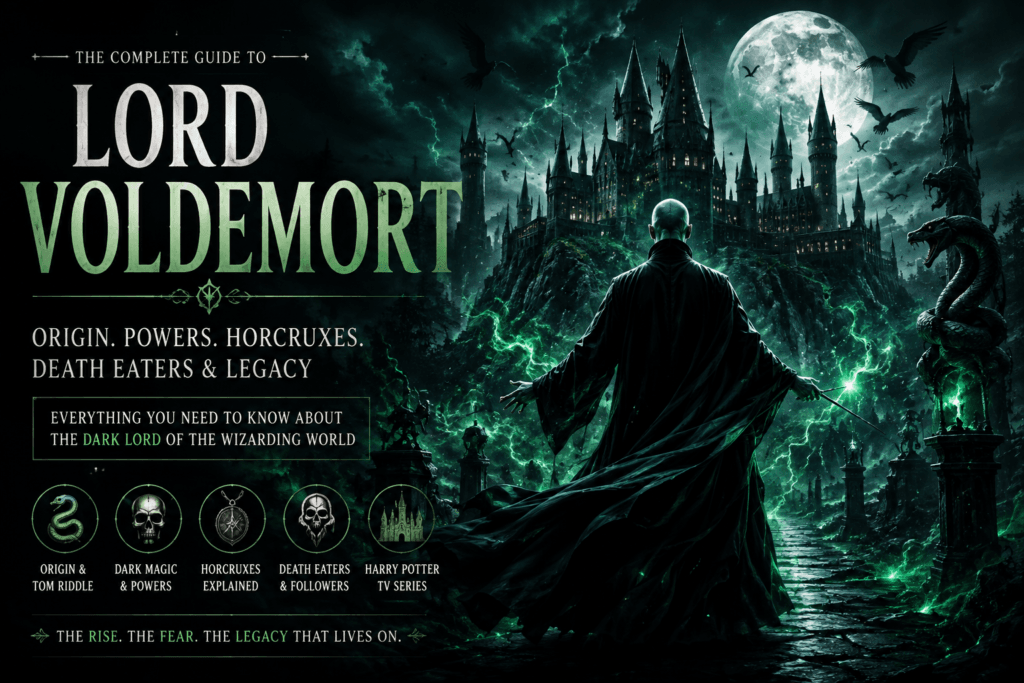
For decades, Lord Voldemort has remained one of the most recognizable villains in modern fiction. His influence stretches far beyond the pages of the Harry Potter novels, shaping films, games, merchandise, fan theories, and countless discussions about the nature of power and fear. Even years after the original story concluded, interest in the Dark Lord continues to grow, especially as new adaptations and projects bring the Wizarding World back into the spotlight.
Unlike many fictional villains who seek wealth or temporary control, Lord Voldemort represents an obsession with absolute power and immortality. His decisions, ambitions, and relentless pursuit of dominance drive nearly every major conflict in the Harry Potter universe. Understanding his journey helps readers appreciate not only the story’s central antagonist but also the themes of courage, friendship, sacrifice, and choice that define the series.
Recent discussions surrounding the upcoming Harry Potter television adaptation have renewed public curiosity about the character. Fans are eager to see how one of literature’s most infamous villains will be portrayed for a new generation. While official production details continue to develop, Lord Voldemort remains at the center of conversations about the future of the Wizarding World.
This comprehensive guide explores the origins, evolution, personality, magical abilities, legacy, and lasting cultural impact of Lord Voldemort. Whether you’re revisiting the Harry Potter series or discovering the character for the first time, this article offers a complete overview of one of fiction’s most unforgettable Dark Wizards.
Who Is Lord Voldemort?
Lord Voldemort is the primary antagonist of the Harry Potter franchise and the most feared Dark Wizard in modern wizarding history. Born as Tom Marvolo Riddle, he transformed himself into Lord Voldemort through years of studying advanced Dark Magic, manipulating others, and pursuing immortality at any cost.
His rise to power changed the Wizarding World forever. Entire communities lived in fear during his reign, and countless witches and wizards suffered because of his campaign for domination. His followers, known as the Death Eaters, carried out attacks, spread fear, and enforced his ideology throughout Britain.
Although Voldemort possessed extraordinary magical talent, his greatest weakness lay in his inability to understand compassion, friendship, or selfless love. These qualities, which he viewed as signs of weakness, ultimately played a crucial role in his downfall.
Quick Facts About Lord Voldemort
| Detail | Information |
|---|---|
| Birth Name | Tom Marvolo Riddle |
| Common Name | Lord Voldemort |
| Nickname | The Dark Lord |
| Species | Wizard |
| House | Slytherin |
| Parents | Tom Riddle Sr. and Merope Gaunt |
| Main Followers | Death Eaters |
| Goal | Achieve immortality and rule the Wizarding World |
| Signature Weapon | Yew wand with phoenix feather core |
| Greatest Obsession | Defeating death |
Lord Voldemort’s Early Life
Every villain has a beginning, and Lord Voldemort’s story starts long before he became the Dark Lord feared across Britain.
Tom Marvolo Riddle entered the world under difficult circumstances. His mother, Merope Gaunt, belonged to an ancient wizarding family whose influence had faded over generations. His father, Tom Riddle Sr., was a wealthy Muggle who never became part of his son’s life.
Growing up without a loving family left young Tom isolated. He spent his childhood in a Muggle orphanage, where he often struggled to connect with others. From an early age, he displayed unusual magical abilities that frightened those around him. Rather than using his gifts to build friendships, he often used them to intimidate and manipulate other children.
These experiences shaped his personality. Instead of developing trust and empathy, Tom learned to rely on control, secrecy, and personal ambition.
Lord Voldemort’s Family Background
Understanding Lord Voldemort requires looking at the two very different families from which he descended.
The Gaunt Family
Tom’s mother came from the Gaunt family, an ancient pure-blood wizarding line that claimed direct ancestry from Salazar Slytherin.
Although the Gaunts valued magical bloodlines, years of isolation and poor decision-making had left the family impoverished. Their pride remained strong, but their influence had nearly disappeared.
Growing up surrounded by stories of Slytherin’s legacy influenced Tom’s belief that magical ancestry determined a person’s worth. This belief later evolved into one of the central ideas behind his movement.
The Riddle Family
Tom’s father belonged to a respected Muggle family with no connection to magic.
Ironically, despite promoting wizarding superiority throughout his life, Voldemort himself was only half-blood. Rather than accepting this reality, he rejected his father’s identity completely and attempted to erase every reminder of that side of his heritage.
This contradiction became one of the defining aspects of his character.
Lord Voldemort’s Childhood Shows Early Warning Signs
Many future villains reveal aspects of their personalities long before gaining power, and Tom Riddle was no exception.
During his years in the orphanage, he demonstrated remarkable intelligence. Caretakers noticed that he learned quickly, observed people carefully, and rarely displayed emotion.
At the same time, several troubling behaviors emerged.
Natural Leadership
Even as a child, Tom possessed the ability to influence others. He often became the center of attention and understood how to persuade or intimidate people to achieve his goals.
Desire for Control
Rather than forming genuine friendships, Tom preferred controlling situations. He disliked feeling vulnerable and constantly sought advantages over those around him.
Lack of Empathy
Perhaps the most concerning trait was his inability to understand or value the feelings of others. He rarely expressed guilt or compassion, viewing people primarily as tools to accomplish his objectives.
These characteristics would continue developing throughout his life.
Lord Voldemort Arrives at Hogwarts
Receiving his Hogwarts acceptance letter marked a turning point in Tom Riddle’s life.
For the first time, he discovered a community where magic was normal rather than feared. Instead of hiding his abilities, he could develop them openly.
His academic performance quickly attracted attention.
An Exceptional Student
Professors recognized Tom as one of the brightest students of his generation. He excelled in nearly every subject and showed particular interest in complex magical theory.
His intelligence allowed him to master difficult spells faster than many classmates.
Respectable Public Image
While many students admired him, few realized what he truly thought.
Tom carefully maintained a polite, respectful appearance around teachers while secretly exploring dangerous forms of magic.
This ability to present different personalities depending on the audience became one of his greatest strengths.
Lord Voldemort and Slytherin House
The Sorting Hat placed Tom Riddle into Slytherin House almost immediately.
The decision reflected his ambition, determination, intelligence, and resourcefulness.
Within Slytherin, Tom gained access to traditions connected with Salazar Slytherin himself. Learning about his famous ancestor strengthened his belief that he was destined for greatness.
His fascination with Slytherin’s history eventually led him to one of Hogwarts’ greatest mysteries.
Lord Voldemort Discovers the Chamber of Secrets
Among Hogwarts’ oldest legends was the story of the Chamber of Secrets—a hidden location supposedly created by Salazar Slytherin.
Most students dismissed the legend as fiction.
Tom Riddle did not.
Using his intelligence and determination, he uncovered secrets that generations of students had failed to solve.
His ability to speak Parseltongue—the language of snakes—allowed him to access places that remained closed to others.
This discovery significantly increased his confidence and reinforced his belief that he possessed a unique destiny.
Why Lord Voldemort Changed His Name
One of the most symbolic moments in Tom Riddle’s life came when he abandoned his birth name.
He no longer wanted any connection to his Muggle father.
Instead, he created a new identity that represented power, fear, and superiority.
The name Lord Voldemort became more than a title—it became a carefully crafted symbol.
By adopting a new identity, he attempted to separate himself completely from his past and present himself as someone destined to reshape the Wizarding World.
His followers embraced this transformation, and eventually many witches and wizards became so frightened that they avoided speaking his name aloud.
Lord Voldemort’s Personality
Although Lord Voldemort possessed incredible magical ability, his personality defined him just as much as his spells.
Several characteristics shaped nearly every decision he made.
Extraordinary Intelligence
Voldemort rarely acted without planning.
He analyzed situations carefully, anticipated possible outcomes, and preferred strategies that gave him long-term advantages.
Ruthless Ambition
Few characters in modern fantasy demonstrate ambition as intense as Voldemort’s.
He never accepted limitations and constantly searched for ways to become stronger.
Charismatic Influence
Despite ruling through fear, Voldemort also inspired loyalty.
Many followers genuinely believed he could transform the Wizarding World.
His confidence, knowledge, and commanding presence made him a persuasive leader.
Fear of Death
Ironically, the wizard who terrified millions feared one thing above everything else—his own mortality.
Instead of accepting death as a natural part of life, Voldemort devoted decades to avoiding it.
This obsession ultimately shaped every major decision he made.
Why Lord Voldemort Still Fascinates Fans
Years after the original Harry Potter story ended, Lord Voldemort continues to attract worldwide attention.
Several factors explain his lasting popularity.
- He remains one of fiction’s most recognizable villains.
- His backstory explores the consequences of choices rather than destiny.
- His rise to power feels carefully developed rather than sudden.
- His motivations are complex enough to inspire ongoing discussion.
- New adaptations continue introducing him to younger audiences.
- Fan theories regularly revisit unanswered questions about his life and magic.
Unlike many one-dimensional villains, Lord Voldemort’s story examines how intelligence, ambition, and fear can combine to create a dangerous leader.
Lord Voldemort’s Rise to Power
After leaving Hogwarts, Tom Riddle disappeared from public attention for a period. Many people believed he was simply beginning an ordinary career in the wizarding world. In reality, he was pursuing a far more dangerous path.
Instead of seeking recognition through legitimate achievements, Riddle traveled extensively to study ancient forms of magic. He searched for forgotten spells, legendary magical artifacts, and forbidden knowledge that most witches and wizards avoided.
During these years, he gradually abandoned the identity of Tom Riddle and fully embraced the title of Lord Voldemort.
His transformation was more than a name change. It marked the beginning of a movement that would eventually threaten the entire Wizarding World.
How Lord Voldemort Built His Following
Every powerful leader needs supporters, and Lord Voldemort proved remarkably skilled at attracting followers.
Rather than recruiting random individuals, he focused on people who shared his beliefs or admired his magical abilities. Some joined because they believed in his vision. Others followed because they feared opposing him.
Over time, this growing network evolved into one of the most dangerous organizations in wizarding history.
Shared Ideology
Many early supporters believed that magical families should hold greater authority than Muggles and those with non-magical ancestry.
Voldemort used these existing prejudices to strengthen his influence.
Personal Ambition
Some followers saw Voldemort as an opportunity to gain power for themselves.
By supporting him, they expected higher status, wealth, or influence once his movement succeeded.
Fear and Intimidation
Not everyone joined willingly.
As Voldemort’s reputation spread, refusing him became increasingly dangerous. Fear became one of his most effective recruitment tools.
Lord Voldemort and the Death Eaters
The most loyal supporters of Lord Voldemort became known as the Death Eaters.
This organization served as both his inner circle and his primary force for carrying out missions across the Wizarding World.
Each member pledged loyalty to Voldemort and accepted his leadership without question.
Responsibilities of the Death Eaters
The Death Eaters performed numerous roles, including:
- Carrying out attacks against Voldemort’s enemies
- Gathering intelligence
- Recruiting additional supporters
- Protecting important locations
- Recovering magical artifacts
- Spreading fear throughout wizarding communities
Although many members possessed considerable magical talent, none rivaled Voldemort’s power.
Lord Voldemort’s Leadership Style
Unlike leaders who inspire through trust or cooperation, Lord Voldemort ruled almost entirely through fear.
He expected complete obedience.
Mistakes often resulted in severe punishment.
Success brought temporary approval but never guaranteed safety.
This leadership style ensured that even his closest followers remained cautious around him.
Absolute Authority
Voldemort rarely accepted advice unless it aligned with his own thinking.
He believed his judgment surpassed everyone else’s.
This confidence strengthened his authority but also limited his willingness to consider alternative perspectives.
Psychological Control
Beyond magical power, Voldemort understood psychology.
He knew how to exploit people’s ambitions, fears, and insecurities.
By controlling emotions, he maintained loyalty even during difficult periods.
Lord Voldemort’s Obsession With Immortality
Perhaps no aspect of Lord Voldemort’s personality influenced history more than his determination to defeat death.
Unlike many powerful wizards who sought knowledge for its own sake, Voldemort viewed every magical discovery through one question:
“Can this help me live forever?”
His fear of mortality became stronger as he gained power.
Instead of accepting that every life eventually ends, he searched for increasingly dangerous magical solutions.
This obsession ultimately led him toward one of the darkest branches of magic ever explored.
Lord Voldemort and Forbidden Magic
Throughout wizarding history, certain magical practices remained prohibited because of their destructive consequences.
Most witches and wizards avoided these subjects entirely.
Lord Voldemort did the opposite.
He actively pursued knowledge that others considered too dangerous.
His willingness to ignore ethical boundaries allowed him to accomplish extraordinary feats—but at tremendous personal cost.
Each step toward greater power moved him further away from ordinary humanity.
Lord Voldemort’s Horcrux Plan
Among all forbidden magical practices, none became more closely associated with Lord Voldemort than the creation of Horcruxes.
A Horcrux is an object that contains a fragment of a wizard’s soul.
By separating the soul into multiple pieces, Voldemort believed he could survive even if his physical body were destroyed.
This decision fundamentally changed his destiny.
Why Lord Voldemort Created Horcruxes
His reasoning reflected several core beliefs.
- Death represented ultimate failure.
- Unlimited power required unlimited survival.
- Fear could only last if its creator remained alive.
- Ordinary magical protections were insufficient.
Creating Horcruxes seemed to offer permanent security.
However, every fragment separated from his soul weakened his humanity.
The Cost of Lord Voldemort’s Pursuit of Power
Power always carries consequences.
In Voldemort’s case, those consequences extended beyond physical appearance.
As his experiments continued, he gradually lost qualities that define ordinary human life.
Emotional Consequences
He became increasingly incapable of understanding:
- Compassion
- Love
- Friendship
- Forgiveness
- Self-sacrifice
These emotions appeared meaningless to him.
Ironically, they later became essential to his defeat.
Physical Changes
Descriptions of Voldemort throughout the series suggest that repeated experimentation with Dark Magic altered his appearance dramatically.
His features became increasingly unnatural, reflecting the corruption of both body and soul.
Rather than resembling the handsome student Tom Riddle once was, he transformed into an intimidating symbol of fear.
Lord Voldemort Begins the First Wizarding War
As Voldemort’s influence expanded, conflict became unavoidable.
His followers launched attacks across magical Britain.
Communities that once felt secure suddenly faced uncertainty.
No one knew where the next attack would occur.
Many people became afraid to speak openly against the Dark Lord.
Others disappeared without explanation.
The Wizarding World entered one of the darkest periods in its modern history.
Lord Voldemort’s Strategy During the War
Unlike traditional military campaigns, Voldemort relied heavily on unpredictability.
His methods included:
- Surprise attacks
- Psychological intimidation
- Secret alliances
- Hidden operations
- Information gathering
- Strategic fear
These tactics made organized resistance extremely difficult.
People often trusted no one outside their closest families.
Why Lord Voldemort Became So Feared
Fear can become more powerful than direct violence.
Voldemort understood this principle exceptionally well.
Instead of relying solely on magical strength, he cultivated a terrifying reputation.
Stories about his abilities spread rapidly.
Many witches and wizards avoided speaking his name altogether.
This practice eventually led to one of the most famous expressions in the Harry Potter universe:
“He-Who-Must-Not-Be-Named.”
The nickname reflected the psychological impact Voldemort had on society.
Even mentioning him became uncomfortable for many people.
Lord Voldemort’s Relationship With Prophecy
One of the most significant turning points in Voldemort’s life involved a prophecy concerning a child who might eventually challenge him.
Rather than ignoring the prediction, Voldemort treated it as an immediate threat.
His determination to prevent the prophecy from becoming reality influenced nearly every major decision that followed.
Ironically, his own actions helped set the prophecy into motion.
This theme reinforces one of the series’ central ideas:
Sometimes attempts to avoid fate can contribute to its fulfillment.
Lord Voldemort and Harry Potter’s Family
Believing the prophecy pointed toward a specific child, Voldemort targeted Harry Potter’s family.
His plan appeared straightforward.
If the child never survived, the prophecy could never come true.
However, events unfolded in an unexpected way.
Instead of eliminating the threat, Voldemort encountered magical protection unlike anything he had anticipated.
The consequences changed wizarding history forever.
Lord Voldemort’s First Defeat
When Voldemort confronted Harry Potter as an infant, he expected another effortless victory.
Instead, the attack failed dramatically.
The protection surrounding Harry caused Voldemort’s physical form to collapse.
Although he survived in an incomplete state, his body was destroyed.
For the first time, the seemingly unstoppable Dark Lord had fallen.
His disappearance shocked both supporters and opponents.
Many believed the threat had ended forever.
Others feared he might eventually return.
What Happened After Lord Voldemort Disappeared?
The years following Voldemort’s disappearance brought cautious optimism.
Many imprisoned Death Eaters claimed they had acted under magical influence.
Others attempted to rebuild ordinary lives.
Meanwhile, Harry Potter grew up unaware of the extraordinary events surrounding his survival.
Unknown to most of the Wizarding World, Voldemort had not truly been defeated.
His long-term plans for survival would eventually allow him to seek a path back to power.
Timeline of Lord Voldemort’s Rise
| Event | Importance |
|---|---|
| Tom Riddle graduates from Hogwarts | Begins independent pursuit of Dark Magic |
| Adopts the name Lord Voldemort | Creates a new identity built on fear |
| Recruits early followers | Lays the foundation for the Death Eaters |
| Studies forbidden magic | Pursues immortality |
| Creates Horcruxes | Attempts to escape death permanently |
| Launches First Wizarding War | Expands influence across Britain |
| Targets Harry Potter | Attempts to prevent prophecy |
| Suffers first defeat | Loses physical body but survives |
Lord Voldemort’s Magical Powers
One of the main reasons Lord Voldemort inspired so much fear was his extraordinary magical ability. Long before he became the Dark Lord, Tom Riddle displayed exceptional intelligence and a natural talent for spellcasting. As he grew older, he combined raw ability with years of study, making him one of the most formidable wizards in the Harry Potter universe.
Unlike many powerful witches and wizards who specialized in a few areas of magic, Voldemort sought mastery over nearly every branch of magical knowledge. His willingness to experiment with dangerous spells and forbidden techniques gave him abilities that very few could match.
Although power defined his reputation, it also became the source of his greatest weakness. His relentless pursuit of magical superiority caused him to overlook qualities that could never be learned through spells alone.
Lord Voldemort’s Greatest Magical Abilities
Lord Voldemort possessed an impressive range of magical skills that distinguished him from almost every other wizard of his era.
Exceptional Spellcasting
Voldemort demonstrated remarkable precision and control when casting spells. He rarely wasted movement and often defeated opponents with speed rather than overwhelming force.
His understanding of magical theory allowed him to adapt quickly during combat and respond to unexpected situations.
Mastery of Dark Magic
Dark Magic became the foundation of Voldemort’s rise to power.
Rather than viewing these spells as forbidden, he considered them valuable tools that could help him achieve his goals.
This approach enabled him to perform magical feats that most witches and wizards would never attempt.
Advanced Magical Knowledge
Beyond combat, Voldemort invested years studying magical history, legendary artifacts, and ancient traditions.
His curiosity extended to forgotten branches of magic that many scholars considered too dangerous to explore.
This extensive knowledge often gave him an advantage over opponents who relied only on conventional spellcasting.
Lord Voldemort and Parseltongue
Among Voldemort’s most distinctive abilities was his gift for speaking Parseltongue, the language of snakes.
This rare magical talent connected him to Salazar Slytherin’s bloodline and allowed him to communicate directly with serpents.
Throughout the series, this ability plays a significant role in several important events.
Why Parseltongue Matters
Speaking Parseltongue provided several advantages.
- Access to locations hidden from ordinary witches and wizards.
- Communication with magical snakes.
- Reinforcement of his connection to Slytherin’s legacy.
- Symbolic representation of secrecy and power.
For Voldemort, Parseltongue represented more than a magical skill—it became part of his identity.
Lord Voldemort’s Wand
Every wizard depends on a wand, and Lord Voldemort’s wand became one of the most recognizable magical objects in the Harry Potter universe.
Its unusual characteristics contributed to several important moments throughout the story.
Unique Features
Voldemort’s wand reflected both his personality and magical style.
It suited a wizard who valued precision, control, and overwhelming offensive capability.
His familiarity with the wand allowed him to perform highly advanced magic with remarkable consistency.
Symbolic Importance
Throughout the series, Voldemort viewed powerful magical objects as extensions of his authority.
His wand represented confidence, dominance, and personal achievement.
Losing control over it, even temporarily, challenged the image of invincibility he carefully cultivated.
Lord Voldemort’s Combat Style
Unlike many duelists who relied on improvisation, Lord Voldemort approached magical combat strategically.
Every movement served a purpose.
He carefully evaluated opponents before launching attacks and rarely underestimated experienced adversaries.
Precision Over Chaos
Voldemort preferred accurate spellcasting rather than unnecessary displays of power.
His attacks often appeared calm, controlled, and deliberate.
This composure made him especially dangerous during duels.
Psychological Pressure
In addition to physical attacks, Voldemort frequently attempted to intimidate opponents.
His reputation alone caused many witches and wizards to lose confidence before battles even began.
This psychological advantage often proved nearly as valuable as magical strength.
Lord Voldemort’s Leadership Through Fear
Power alone did not explain Voldemort’s influence.
He also understood how fear shapes human behavior.
Instead of encouraging loyalty through respect, he relied on intimidation and uncertainty.
Followers never knew how he might react to failure.
Enemies feared becoming his next target.
This environment allowed him to maintain control even when facing organized resistance.
Lord Voldemort and Harry Potter
No relationship defines the Harry Potter series more than the conflict between Harry Potter and Lord Voldemort.
Although they represented opposite philosophies, their lives became connected in unexpected ways.
Opposing Beliefs
Harry valued friendship, loyalty, and self-sacrifice.
Voldemort valued control, power, and personal survival.
These contrasting worldviews shaped every confrontation between them.
Shared Characteristics
Despite their differences, both characters shared several surprising similarities.
- Extraordinary magical ability.
- Connections to Hogwarts.
- Strong determination.
- Courage in dangerous situations.
- Unique links to the wizarding world’s history.
The story repeatedly suggests that choices—not talent alone—determine a person’s character.
Lord Voldemort and Albus Dumbledore
Among all of Voldemort’s opponents, Albus Dumbledore posed the greatest challenge.
Dumbledore combined exceptional magical ability with wisdom, patience, and strategic thinking.
Rather than confronting Voldemort recklessly, he carefully prepared for future conflicts.
Different Views of Power
Their rivalry reflected two opposing philosophies.
Dumbledore believed power should serve others.
Voldemort believed others existed to serve power.
This contrast became one of the central themes of the series.
Lord Voldemort and Severus Snape
Severus Snape occupied one of the most complex positions in the Wizarding World.
At different points in history, he appeared closely connected to Voldemort while maintaining relationships with Hogwarts.
Because of his intelligence and magical ability, Voldemort trusted Snape more than many other followers.
However, trust based on fear can never provide complete certainty.
Their relationship illustrates how deception and hidden motivations influenced the larger conflict.
Lord Voldemort and Bellatrix Lestrange
Among the Death Eaters, Bellatrix Lestrange displayed extraordinary devotion to Lord Voldemort.
Her loyalty extended beyond ordinary obedience.
She believed completely in his vision and willingly accepted dangerous missions.
Why Bellatrix Stood Out
Several qualities distinguished her from other followers.
- Unwavering loyalty.
- Fearless attitude.
- Exceptional magical ability.
- Complete confidence in Voldemort’s leadership.
Even so, Voldemort generally valued usefulness more than emotional attachment.
Lord Voldemort’s Strengths
Many factors contributed to Voldemort’s success.
Brilliant Strategist
He planned years ahead rather than focusing only on immediate victories.
Long-term thinking allowed him to prepare for future challenges.
Extraordinary Intelligence
Voldemort learned quickly and adapted to changing situations.
His deep understanding of magical history often provided valuable insights.
Powerful Leader
Despite ruling through fear, he successfully united many talented witches and wizards under a single cause.
Confidence
His belief in his own abilities remained nearly unshakable.
Confidence often inspired followers while intimidating opponents.
Lord Voldemort’s Weaknesses
Every powerful character has limitations.
Voldemort’s weaknesses proved just as significant as his strengths.
Underestimating Others
Believing himself intellectually superior sometimes caused Voldemort to dismiss opponents too quickly.
This overconfidence influenced several important decisions.
Fear of Death
His obsession with immortality became the driving force behind many risky choices.
Instead of accepting natural limits, he pursued increasingly dangerous solutions.
Inability to Understand Love
Perhaps Voldemort’s greatest weakness involved emotions.
He viewed love, compassion, and friendship as meaningless.
This misunderstanding prevented him from recognizing powerful forms of courage and sacrifice.
Excessive Pride
Pride often clouded Voldemort’s judgment.
Rather than questioning assumptions, he frequently believed his plans could not fail.
Lord Voldemort’s Most Important Battles
Throughout the Harry Potter story, Voldemort participated in several defining confrontations.
Each battle shaped both his reputation and the future of the Wizarding World.
Major Turning Points
Some of the most significant conflicts include:
- The First Wizarding War.
- His confrontation with Harry Potter’s family.
- His return to physical form.
- Battles against the Order of the Phoenix.
- The final conflict at Hogwarts.
These events collectively define his rise and eventual downfall.
Lord Voldemort’s Influence on the Wizarding World
Even when absent, Voldemort influenced society.
Schools increased security.
Families changed daily routines.
Political leaders adjusted policies.
Communities learned to live with uncertainty.
His presence affected nearly every aspect of wizarding life.
Why Lord Voldemort Became a Cultural Icon
Few fictional villains remain relevant across multiple generations.
Lord Voldemort achieved that distinction because he represents universal themes that extend beyond fantasy.
The Fear of Absolute Power
Many stories explore how unchecked ambition can threaten entire societies.
Voldemort embodies this idea.
The Consequences of Choice
His story emphasizes that intelligence alone cannot determine morality.
Personal decisions shape character far more than natural ability.
Symbol of Fear
Across popular culture, Voldemort has become shorthand for overwhelming fear or authoritarian control.
His influence extends well beyond the original books and films.
Lessons Readers Can Learn From Lord Voldemort
Although fictional, Voldemort’s story offers meaningful insights.
Ambition Requires Balance
Ambition can inspire progress.
Without ethics, however, it becomes destructive.
Power Is Not Everything
Leadership based entirely on fear rarely creates lasting stability.
Trust and respect remain essential.
Choices Matter
Throughout the Harry Potter series, characters repeatedly demonstrate that personal choices shape destiny more than background or talent.
This lesson stands at the heart of Voldemort’s story.
Common Myths About Lord Voldemort
As one of fiction’s most discussed villains, Lord Voldemort is surrounded by numerous misconceptions.
| Myth | Reality |
|---|---|
| Voldemort was born evil | His choices, experiences, and ambitions shaped his transformation. |
| He only cared about ruling | Immortality and defeating death motivated many of his decisions. |
| Fear alone kept followers loyal | Some followers genuinely believed in his ideology, while others acted out of fear or personal ambition. |
| He never respected anyone | Although rare, Voldemort recognized intelligence, magical skill, and usefulness in others. |
| His defeat resulted only from stronger magic | Strategic planning, sacrifice, unity, and critical decisions by many characters all contributed to his downfall. |
Lord Voldemort in the Harry Potter TV Series
Interest in Lord Voldemort has surged once again as the upcoming Harry Potter television adaptation moves forward. The new series aims to revisit the beloved Wizarding World with a long-form storytelling approach, allowing more time to develop characters, relationships, and important events from the original novels.
For many fans, one of the biggest questions is how the series will portray Lord Voldemort at different stages of his life. Unlike the films, which had limited screen time to explore his background, a television format has the potential to spend more time on Tom Riddle’s childhood, Hogwarts years, gradual transformation into the Dark Lord, and the choices that shaped his destiny.
The renewed interest in fantasy television isn’t limited to the Wizarding World. Viewers are also looking forward to other ambitious franchise expansions, including our coverage of Avatar Seven Havens (2026): Release Date, Story, Characters, Trailer & Latest Updates, which explores the next chapter of another beloved fantasy universe.
While various casting rumors have circulated online, viewers should distinguish between fan speculation and officially confirmed announcements. Production details can change throughout development, and audiences should rely on official studio updates for verified casting information.
Why Lord Voldemort Could Benefit From a Television Format
A multi-season television series offers opportunities that differ significantly from a feature film.
More Character Development
The original story contains numerous details about Tom Riddle’s past that were only briefly shown in earlier adaptations.
A television series can explore:
- His childhood in the orphanage.
- His relationships with classmates.
- His growing fascination with forbidden magic.
- His gradual loss of humanity.
- The development of his leadership abilities.
These elements help audiences understand how an exceptionally gifted student eventually became the Wizarding World’s most feared Dark Wizard.
Strong world-building and character development are often what turn a successful franchise into a lasting cultural phenomenon. That approach has also defined other acclaimed television universes, as explored in Taylor Sheridan’s Creative Legacy: How His Vision Built the Yellowstone Universe, where long-form storytelling has played a key role in expanding an already popular franchise.
The Harry Potter reboot also reflects a broader industry trend in which major entertainment franchises are finding new audiences through streaming and long-form television. A similar shift can be seen in The Walking Dead Netflix: Everything to Know About the Major AMC Streaming Deal, which explores how another iconic franchise is expanding its reach through a major streaming partnership.
Better World-Building
Long-form storytelling also allows more attention to:
- Wizarding politics.
- Historical conflicts.
- Magical traditions.
- Relationships among Hogwarts houses.
- The rise of the Death Eaters.
Together, these elements create richer context for Lord Voldemort’s journey.
Lord Voldemort’s Lasting Legacy
Very few fictional villains continue influencing popular culture decades after their introduction.
Lord Voldemort remains relevant because his story extends beyond fantasy.
His character represents themes that appear throughout history and literature.
Lord Voldemort’s enduring popularity also shows how unforgettable fictional universes continue attracting new audiences across books, films, and streaming platforms. A similar trend can be seen in Ridley Scott Best Sci-Fi Movie Tops Prime Video Ahead of Sequel Series, where another legendary franchise continues to capture viewers through modern streaming and renewed interest.
The Danger of Unchecked Ambition
Ambition itself is not harmful.
However, ambition without empathy or ethics can become destructive.
Voldemort demonstrates what happens when personal success becomes more important than every other value.
Fear as a Tool of Control
Throughout his rise, Voldemort repeatedly used fear instead of trust.
Although fear produced short-term obedience, it never created genuine loyalty.
This distinction explains why many followers eventually questioned their choices when circumstances changed.
The Importance of Choice
One of the strongest messages in the Harry Potter series is that background does not determine destiny.
Characters constantly face choices.
Lord Voldemort repeatedly chose domination.
Harry Potter repeatedly chose compassion.
Those different decisions shaped completely different futures.
Lord Voldemort in Books, Films, Games, and Popular Culture
Since first appearing in the Harry Potter series, Lord Voldemort has expanded far beyond the original books.
Today, the character appears across numerous forms of entertainment.
Books
The novels provide the most detailed exploration of his history, personality, motivations, and rise to power.
Readers learn about Tom Riddle’s transformation through memories, conversations, and historical accounts.
Films
The movie adaptations introduced Lord Voldemort to millions of viewers worldwide.
His visual design, dialogue, and confrontations became some of the franchise’s most recognizable moments.
Video Games
Many Harry Potter games reference Voldemort directly or indirectly through storylines, magical locations, enemies, and historical events.
Interactive experiences allow players to explore parts of the Wizarding World connected to his legacy.
Theme Park Experiences
Wizarding World attractions include locations and environments influenced by events surrounding Voldemort’s rise and fall.
These experiences help fans immerse themselves in the fictional universe beyond books and films.
Why Lord Voldemort Remains One of Fiction’s Greatest Villains
Literature contains many memorable antagonists.
However, only a small number continue attracting worldwide attention generation after generation.
Several factors explain Voldemort’s lasting popularity.
A Detailed Backstory
Readers witness his transformation from childhood to adulthood.
Understanding his history makes him a more complex character than villains who appear without explanation.
Clear Motivation
His pursuit of immortality remains consistent throughout the series.
Every major decision connects to this central objective.
Memorable Presence
Even during chapters where he does not appear directly, his influence shapes the actions of countless other characters.
Few fictional antagonists maintain such a powerful presence throughout an entire series.
The enduring appeal of Voldemort also highlights how unforgettable characters can elevate an entire story. The same emphasis on powerful storytelling and larger-than-life narratives can be seen in The Odyssey Review: Christopher Nolan Delivers an Epic Worth the Journey, which explores another ambitious epic that blends compelling characters with grand-scale storytelling.
Universal Themes
His story explores:
- Power.
- Identity.
- Fear.
- Leadership.
- Morality.
- Personal responsibility.
These timeless ideas continue resonating with new audiences.
How Lord Voldemort Compares With Other Famous Fictional Villains
| Character | Primary Goal | Leadership Style | Greatest Strength | Greatest Weakness |
|---|---|---|---|---|
| Lord Voldemort | Immortality and domination | Fear and intimidation | Exceptional magical ability | Inability to understand love and sacrifice |
| Darth Vader | Restore order and serve the Empire | Military authority | Combat skill and discipline | Emotional conflict |
| Sauron | Conquer Middle-earth | Absolute domination | Vast supernatural influence | Overconfidence in the One Ring |
| Joker | Spread chaos | Psychological manipulation | Unpredictability | Lack of long-term stability |
Although each villain differs, Lord Voldemort stands out because readers witness nearly every stage of his transformation.
Frequently Asked Questions About Lord Voldemort
Who is Lord Voldemort?
Lord Voldemort is the primary antagonist of the Harry Potter series. Born as Tom Marvolo Riddle, he became the Wizarding World’s most feared Dark Wizard after embracing forbidden magic and pursuing immortality.
What is Lord Voldemort’s real name?
His birth name is Tom Marvolo Riddle.
He later adopted the title “Lord Voldemort” as part of his transformation into the Dark Lord.
Why did Lord Voldemort change his name?
He rejected his birth identity because he wanted to separate himself from his Muggle heritage and create a new identity associated with power, fear, and authority.
Why is Lord Voldemort afraid of death?
Unlike many characters who accept mortality, Voldemort viewed death as the ultimate defeat.
His obsession with avoiding death motivated many of his most important decisions.
What are Horcruxes?
Horcruxes are magical objects containing fragments of a wizard’s soul.
Lord Voldemort created multiple Horcruxes in an attempt to survive physical destruction and achieve a form of immortality.
Why do people avoid saying Lord Voldemort’s name?
During his rise to power, Voldemort became so feared that many witches and wizards avoided speaking his name aloud.
Instead, they used titles such as “He-Who-Must-Not-Be-Named.”
Is Lord Voldemort the strongest wizard?
Lord Voldemort ranks among the most powerful wizards in the Harry Potter universe.
However, magical strength alone does not determine victory, as wisdom, teamwork, courage, and sacrifice also play essential roles throughout the series.
Will Lord Voldemort appear in the Harry Potter TV series?
Because Lord Voldemort is central to the overall story, audiences can reasonably expect the character to play an important role as the series progresses. However, specific appearances, casting, and portrayal depend on the adaptation and official production announcements.
Key Facts About Lord Voldemort
| Category | Details |
|---|---|
| Full Name | Tom Marvolo Riddle |
| Popular Name | Lord Voldemort |
| Nickname | The Dark Lord |
| Hogwarts House | Slytherin |
| Primary Goal | Achieve immortality and dominate the Wizarding World |
| Loyal Followers | Death Eaters |
| Signature Ability | Mastery of Dark Magic |
| Rare Talent | Parseltongue |
| Greatest Strength | Intelligence and magical power |
| Greatest Weakness | Failure to understand love and self-sacrifice |
Final Thoughts on Lord Voldemort
Lord Voldemort remains one of the most influential villains ever created in modern fantasy. His journey from Tom Marvolo Riddle to the Dark Lord is more than a story about magical power—it is a cautionary tale about the consequences of unchecked ambition, fear, prejudice, and the pursuit of control at any cost.
Although his magical abilities made him an extraordinary opponent, they could not replace empathy, trust, or genuine human connection. Throughout the Harry Potter series, those qualities consistently prove stronger than intimidation and domination.
As the Wizarding World prepares for a new television adaptation, interest in Lord Voldemort is likely to remain high. Whether longtime fans revisit the original story or new audiences discover it for the first time, the Dark Lord’s legacy continues to shape conversations about fantasy storytelling, memorable villains, and the timeless battle between fear and hope.
Conclusion
The story of Lord Voldemort is ultimately about choices. Gifted with remarkable intelligence and magical talent, Tom Riddle could have followed many different paths. Instead, his desire for absolute power and immortality transformed him into one of fiction’s most feared antagonists.
His rise changed the Wizarding World, but his downfall also reinforced one of the series’ most enduring messages: courage, friendship, loyalty, and selfless sacrifice can overcome even the darkest forms of evil.
That timeless lesson is one reason Lord Voldemort continues to captivate readers and viewers around the world, ensuring that his place in fantasy literature and popular culture remains secure for generations to come.