
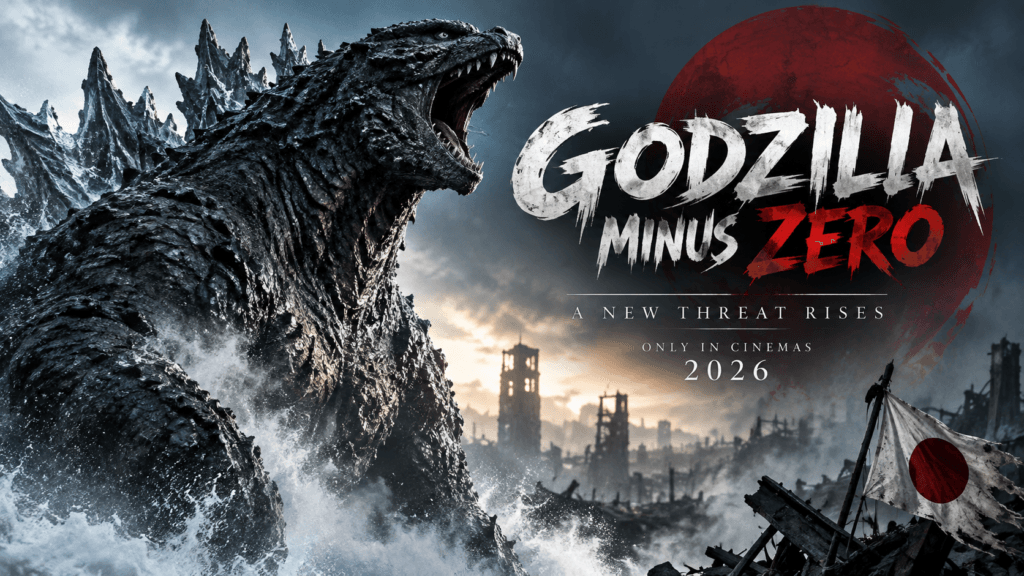
The Godzilla Minus Zero trailer finally gives audiences a clearer look at Takashi Yamazaki’s follow-up to Godzilla Minus One. The new footage expands the story, brings back familiar characters and introduces several new faces. It also makes the sequel look considerably larger in scale.
Set in 1949, the movie takes place two years after the events of Godzilla Minus One. Japan has spent those years trying to recover from war and the devastation caused by Godzilla. Just as that fragile recovery begins to take shape, another catastrophe threatens to destroy it.
The trailer also confirms that Godzilla remains at the center of the story. However, the latest footage suggests that the sequel may broaden the threat beyond the monster alone.
One mysterious moment has already sparked intense fan speculation about another famous kaiju. The trailer does not officially identify that creature, so its identity remains a major question.
For now, one thing is clear: Godzilla Minus Zero is not simply repeating the formula of its predecessor. Yamazaki is expanding the world, increasing the spectacle and continuing the human story that made Godzilla Minus One such a major success.
Godzilla Minus Zero Trailer Gives the Sequel a Bigger Scope
The latest Godzilla Minus Zero trailer turns a tightly guarded sequel into a much clearer picture of what audiences can expect. The story remains rooted in postwar Japan, but the scale of the new crisis appears significantly larger.
Japan has already experienced Godzilla once. By 1949, the country has started rebuilding and trying to restore some sense of normal life. That progress now faces another devastating threat.
This creates an important difference from Godzilla Minus One. The earlier film introduced Godzilla to a nation already shattered by World War II. The sequel begins after people have had time to rebuild their lives.
That change gives the new movie a different emotional foundation. The characters are not simply trying to survive the aftermath of war. They are now trying to protect the future they have worked to create.
Returning stars Ryunosuke Kamiki and Minami Hamabe help maintain the connection with the first film. Their characters bring personal history into the new crisis.
Meanwhile, the trailer emphasizes a more ambitious visual approach. Godzilla appears against larger environments, while the film’s IMAX production promises an even more imposing theatrical presentation.
The result is a sequel that appears to combine the human drama of Minus One with a much bigger monster-movie canvas.
What the Godzilla Minus Zero Trailer Reveals
The new trailer reveals important details about the sequel without giving away its entire story. Instead, it focuses on Godzilla, the returning characters and the new crisis facing Japan.
The story moves forward to 1949. Two years have passed since the events of Godzilla Minus One, giving the country time to begin rebuilding.
That recovery now faces another threat. The official story describes a hard-won peace that suddenly comes under attack, putting the characters in another fight for survival.
The trailer also introduces more members of the returning cast. Several new characters appear as well, giving the sequel a wider human perspective.
That expansion could prove important. Godzilla Minus One worked because its monster story remained closely connected to the people living through the disaster. Godzilla Minus Zero appears determined to maintain that approach.
At the same time, the new footage clearly pushes the spectacle further. Godzilla receives a strong visual presence, and the trailer emphasizes destruction on a larger scale.
The movie’s IMAX production reinforces that direction. This is not simply a standard release receiving premium-format screenings. The production itself was designed for IMAX.
Together, those elements suggest a sequel that wants to feel bigger without losing the grounded storytelling that defined its predecessor.
Godzilla Is Still a Threat
The most important fact in the trailer is also the simplest: Godzilla remains a threat.
The sequel does not treat the previous attack as a closed chapter. Japan has spent two years recovering, but the return of Godzilla puts that progress in danger.
That changes the monster’s role in the story. In Godzilla Minus One, Godzilla arrived in a country already devastated by war. People were struggling to survive before the monster made their situation even worse.
This time, the characters have something new to lose.
Families have begun rebuilding their lives. Communities have started recovering. Japan has also developed new ways to respond to a Godzilla attack.
The returning characters carry memories of the first disaster. Koichi Shikishima and Noriko are therefore not facing an unknown nightmare. They already understand the destruction Godzilla can cause.
That experience may help them prepare. It may also make the threat more frightening because they know exactly what another attack could mean.
The trailer uses that history to connect the two movies. Godzilla’s return is not simply another monster attack.
Instead, it threatens to erase the progress that Japan has made since the first confrontation.
That gives the sequel a stronger emotional foundation. Survival remains important, but protecting the future becomes just as significant.
Japan Faces Another Disaster
The 1949 setting gives Godzilla Minus Zero a strong historical backdrop. Japan is several years removed from World War II, but the country is still dealing with the difficult process of rebuilding.
That makes the timing of Godzilla’s return especially significant.
People have begun creating new lives after years of conflict and destruction. Another monster attack now threatens that sense of recovery.
The returning characters also occupy different positions within this changing society. Hidetaka Yoshioka returns as Kenji Noda, who now leads the Disaster Response Bureau.
Yuki Yamada reprises his role as Shiro Mizushima. Kuranosuke Sasaki also returns as Seiji Akitsu, while Sakura Ando comes back as Sumiko Ota.
Their new circumstances suggest that Japan has learned from its previous encounter with Godzilla. The country is no longer completely caught off guard.
That does not mean its preparations will be enough.
The trailer presents a society attempting to respond to another massive threat while protecting the progress it has made. Scientists, officials and ordinary citizens all have different reasons to fear what is coming.
This creates an important question for the sequel: Can Japan survive Godzilla a second time after finally beginning to rebuild?
The answer will likely shape both the movie’s action and its human drama.
The New Godzilla Minus Zero Cast and Returning Characters
The Godzilla Minus Zero cast combines familiar faces from Godzilla Minus One with several new performers. That mix gives the sequel a direct connection to the earlier film while opening the story to new characters and perspectives.
Ryunosuke Kamiki returns as Koichi Shikishima, while Minami Hamabe reprises Noriko Shikishima. Their return keeps the sequel tied to the emotional story established in the previous movie.
Several supporting actors also return. The lineup includes Hidetaka Yoshioka as Kenji Noda, Yuki Yamada as Shiro Mizushima and Kuranosuke Sasaki as Seiji Akitsu. Sakura Ando returns as Sumiko Ota, while Miou Tanaka reprises Tatsuo Hotta.
The sequel also adds new performers to its ensemble. Min Tanaka plays biologist Kanji Murakami, while Masami Nagasawa and Jun Kunimura join the cast in new roles.
These additions could broaden the human side of the story. The returning characters already understand the danger posed by Godzilla. New characters can approach the crisis from different backgrounds and viewpoints.
That distinction may become important as Japan faces another disaster. The characters are no longer dealing with Godzilla for the first time. They now have experience, memories and a reason to prepare.
The expanded ensemble should therefore help Godzilla Minus Zero continue the character-driven approach of Godzilla Minus One while giving the sequel a wider narrative scope.
Returning Stars From Godzilla Minus One
The returning performers give Godzilla Minus Zero a strong connection to Godzilla Minus One. Their characters bring personal history into the new story.
Ryunosuke Kamiki returns as Koichi Shikishima. His character faced Godzilla during the first film while dealing with the trauma of war and personal loss.
Minami Hamabe also returns as Noriko. Her presence gives the sequel another direct connection to the Shikishima family and the emotional events of the earlier movie.
The supporting cast expands that continuity. Hidetaka Yoshioka returns as Kenji Noda, while Yuki Yamada reprises Shiro Mizushima. Kuranosuke Sasaki also returns as Seiji Akitsu.
Sakura Ando comes back as Sumiko Ota. Miou Tanaka reprises Tatsuo Hotta as well.
These characters now exist in a different Japan. The country has had time to recover, and some of them have taken on new responsibilities.
Kenji Noda is especially notable because he now leads the Disaster Response Bureau. His position suggests that the experience of the previous Godzilla attack has influenced how authorities approach the new threat.
The returning cast therefore serves an important purpose. It allows the sequel to explore how survivors change after a catastrophe while keeping the emotional continuity of the first movie.
New Cast Members in Godzilla Minus Zero
Godzilla Minus Zero also introduces several new performers who could expand the story beyond the characters audiences already know.
One of the most notable additions is Min Tanaka, who plays biologist Kanji Murakami. His scientific background could connect the human story to the effort to understand the latest Godzilla crisis.
The sequel also adds Masami Nagasawa and Jun Kunimura. Their roles give the movie more characters to work with as the story moves deeper into postwar Japan.
However, the filmmakers have kept many details about these newcomers under wraps. The promotional material reveals their involvement without explaining every connection or motivation.
That restraint is useful. It gives the audience enough information to recognize the expanded ensemble without spoiling major story developments.
Murakami stands out because his profession immediately raises questions about the new threat. His involvement could provide a scientific perspective that differs from the military and government responses seen elsewhere in the story.
The new cast also supports the sequel’s larger scope. A broader ensemble can show the crisis from several angles instead of following only one group of survivors.
For now, the safest approach is to focus on what has been confirmed. The new performers add fresh characters, but their full importance will become clearer when the movie reaches theaters.
Why the Godzilla Minus Zero IMAX Presentation Matters
Godzilla Minus Zero has a major technical distinction. It is the first Japanese production filmed for IMAX.
The movie uses IMAX-certified digital cameras, giving Takashi Yamazaki an opportunity to design the film around a large-format presentation.
That choice fits the scale of the story. Godzilla is a character whose impact depends heavily on size, movement and the relationship between the monster and its surroundings.
A larger image can make those elements more immediate. Buildings, streets and landscapes can emphasize just how enormous the creature is compared with the people below.
Sound should also play an important role. IMAX theaters can create a more immersive experience during Godzilla’s roar, destruction and large-scale action sequences.
The latest trailer already points toward that visual ambition. Several moments emphasize the monster’s physical presence and the destruction surrounding it.
This approach also gives the sequel a clear theatrical identity. Godzilla Minus One became a major international success, and its follow-up now arrives with an even stronger emphasis on the big-screen experience.
Importantly, the IMAX connection is not simply a marketing label added after production. The movie was filmed with IMAX-certified equipment from the start.
That means the format forms part of the production itself.
For audiences, the biggest benefit could come during the film’s most spectacular sequences. Godzilla Minus Zero appears designed to make those moments feel enormous.
The First Japanese Production Filmed for IMAX
The IMAX connection sets Godzilla Minus Zero apart from the previous movie in a significant way.
The production used IMAX-certified high-definition digital cameras. That decision allowed the filmmakers to create imagery specifically suited to large-format presentation.
The difference matters for a Godzilla movie. The creature often appears alongside buildings, vehicles, streets and entire city blocks. Those surroundings help audiences understand the monster’s extraordinary scale.
A large screen can strengthen that relationship.
Yamazaki also has unusual creative control over the production. He serves as director, screenwriter and visual effects lead. That combination allows him to shape the story and its visual effects closely.
The trailer suggests that the sequel will make full use of that opportunity. Godzilla receives several imposing shots, while the surrounding destruction adds to the sense of scale.
The sound design could be equally important. Godzilla’s roar and the impact of collapsing structures can become more immersive in a premium theater.
For fans, this creates another reason to consider a theatrical screening. The movie is not simply continuing the story of Godzilla Minus One.
It is also expanding the technical ambition of Yamazaki’s Godzilla universe.
The combination of returning characters, a new postwar setting and an IMAX-focused production gives Godzilla Minus Zero a noticeably larger canvas.
Does the New Trailer Tease King Ghidorah?
The latest Godzilla Minus Zero trailer has given fans another major mystery. Could King Ghidorah be entering Takashi Yamazaki’s Godzilla universe?
The speculation comes from a brief but distinctive sound near the end of the trailer. Longtime fans quickly connected the audio cue to King Ghidorah, one of the most famous monsters in the franchise.
That possibility would be significant. Godzilla Minus One kept its focus largely on Godzilla and the human characters around him. A second major kaiju could take the sequel in a much broader direction.
However, the trailer does not clearly identify the creature. No official confirmation has established King Ghidorah as part of the movie.
For now, the safest description is an apparent second-kaiju tease. King Ghidorah remains a strong fan theory, but it should not be presented as a confirmed character.
The uncertainty may also be intentional. The marketing has revealed more of the sequel while keeping several major surprises hidden.
If the mysterious creature does turn out to be King Ghidorah, the discovery could represent a major turning point for this version of the franchise.
Until then, the sound remains one of the biggest unanswered questions surrounding Godzilla Minus Zero.
What the Trailer Actually Shows
The King Ghidorah theory depends mainly on what viewers hear rather than what they clearly see.
The trailer builds toward its closing moments before introducing a sound that immediately caught the attention of longtime Godzilla fans. That detail has led to speculation about King Ghidorah or another kaiju.
Yet there is no definitive visual reveal. The footage does not clearly show the three-headed monster, and the promotional material does not officially name him.
That distinction matters. Movie trailers often use sound and editing to create mystery. A familiar audio cue can suggest one possibility without confirming the final answer.
The more certain takeaway is that Godzilla Minus Zero appears interested in expanding its monster mythology.
Whether that expansion involves King Ghidorah, another established kaiju or an unexpected creature remains unknown. The film’s marketing has carefully avoided explaining every major development.
That approach gives the sequel an advantage. Fans can discuss the clues without already knowing the answer.
For now, viewers should separate what the trailer confirms from what the trailer suggests.
King Ghidorah belongs firmly in the second category.
Why a Second Kaiju Would Change the Sequel
A second major kaiju could fundamentally change the dynamic of Godzilla Minus Zero.
Godzilla Minus One worked in part because Godzilla remained the overwhelming physical threat. Ordinary people faced a creature that seemed almost impossible to stop.
Another monster would create a different kind of conflict. Humanity might no longer face a single enemy. Instead, people could find themselves caught between multiple enormous forces.
If the mysterious creature is King Ghidorah, the sequel could move closer to the classic monster-versus-monster tradition associated with the wider Godzilla franchise.
That would represent a major expansion for Yamazaki’s version of the story.
Still, another kaiju would not automatically mean a complete change in tone. The sequel could use the larger conflict to explore the same themes of fear, survival and resilience.
The 1949 setting could make that especially compelling. Japan is still rebuilding, so another massive confrontation would place additional pressure on a society recovering from war.
There is also a creative challenge. Godzilla Minus One gained much of its power from its serious human drama.
Adding another iconic monster could shift the balance toward spectacle. Yamazaki will need to maintain the emotional connection that made the first film distinctive.
That balance may determine whether a larger kaiju story feels like a natural progression or simply a bigger sequel.
How Godzilla Minus Zero Continues Godzilla Minus One
Godzilla Minus Zero directly continues the world established by Godzilla Minus One. The story, however, moves several years forward.
The sequel takes place in 1949, two years after the events of the first film. Japan has had time to begin rebuilding, but the country still carries the consequences of war and its encounter with Godzilla.
That timeline creates a different dramatic environment. Godzilla Minus One focused on a nation struggling through the immediate aftermath of World War II.
The sequel moves into a period when people have started creating new lives. Another disaster now threatens that fragile progress.
Returning characters strengthen this connection. Koichi Shikishima and Noriko remain part of the story, while several supporting characters also return.
Their presence allows the sequel to explore what happens after surviving the original Godzilla attack. The characters have memories of the previous crisis, and those experiences can shape their decisions.
New characters and institutions also broaden the world. Japan appears better prepared to respond this time, with organized efforts aimed at dealing with the threat.
That does not guarantee success.
Instead, the sequel can explore whether experience and preparation are enough when Godzilla returns.
This approach gives Godzilla Minus Zero room to expand while preserving the emotional foundation of Godzilla Minus One.
The Story Moves From 1945 to 1949
The move from the immediate postwar years to 1949 creates a clear difference between the two movies.
Godzilla Minus One begins around the end of World War II. Its characters live through a country struggling with destruction, loss and uncertainty.
Four years later, Japan has entered a different stage. The country has begun rebuilding, and people are trying to establish more stable lives.
The sequel’s story takes place two years after the events of Minus One. That relatively short gap keeps the previous film’s consequences relevant.
Koichi Shikishima and Noriko remain connected to the new story. Their return gives audiences familiar emotional anchors as the situation changes around them.
The wider cast also reflects this progression. Kenji Noda, played by Hidetaka Yoshioka, now leads the Disaster Response Bureau.
His new position suggests that Japan has learned from the previous encounter. Authorities have had time to consider how they might respond if Godzilla returns.
That creates an interesting contrast with the first movie. The characters now have knowledge that they did not possess before.
Unfortunately, preparation may not be enough.
The 1949 setting therefore does more than establish when the story happens. It shows a country that has started moving forward, only to face another threat capable of destroying that progress.
From Survival to a New Fight
The emotional link between the two movies comes from one central idea: surviving Godzilla does not erase the consequences of his destruction.
The characters in Godzilla Minus One endured war, loss and devastation before confronting the monster. By 1949, they have had time to rebuild parts of their lives.
Godzilla’s return threatens that stability.
The conflict can therefore become more personal. The characters are not fighting only to survive another attack. They are also trying to protect the future they have worked to create.
The expanded cast allows the sequel to explore that idea from different perspectives.
Some characters already understand Godzilla through personal experience. Others may approach the crisis through science, government planning or organized response.
Kenji Noda’s position within the Disaster Response Bureau is especially important. His role suggests that Japan has developed a more structured approach to the threat.
That preparation could make the response more effective. It could also reveal how difficult it is to control a force as powerful as Godzilla.
The first film asked whether people could find a reason to live after devastating loss. Godzilla Minus Zero can build on that theme by asking whether they can keep rebuilding when another nightmare arrives.
That gives the sequel a natural emotional progression.
Rather than simply repeating Minus One, the new film can explore recovery, resilience and the fear of losing everything again.