
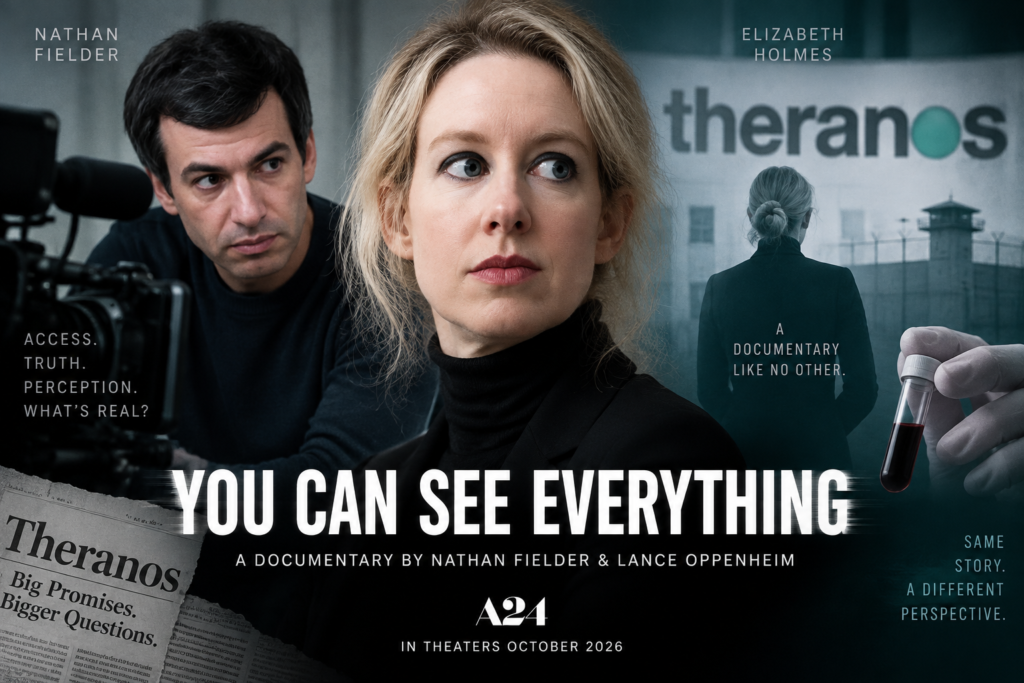
The Elizabeth Holmes documentary has taken an unexpected turn with You Can See Everything, a secret film from Nathan Fielder and Lance Oppenheim that suddenly emerged at the 2026 Telluride Film Festival. Instead of another conventional examination of the Theranos scandal, the documentary follows Holmes through an unusually intimate period of her life and then pushes into much stranger territory.
The film begins 34 days before Holmes was due to report to federal prison. At that point, she invited a skeptical film crew to document her life with her partner, Billy Evans, and their young children. What started as an attempt to capture Holmes’s perspective developed into a three-year filmmaking project.
Directed by Fielder and Oppenheim, You Can See Everything was kept largely secret until its surprise Telluride screening. A24 has announced a theatrical release in October 2026, while the studio’s teaser has now given audiences their first official glimpse at the film.
That combination makes the documentary especially intriguing. Holmes’s story has already been explored through books, documentaries and scripted television. This time, however, the filmmakers had direct access to Holmes during a pivotal moment, while Fielder’s unconventional approach creates a much less predictable film.
Elizabeth Holmes Documentary: What Is You Can See Everything?
You Can See Everything is a documentary about Elizabeth Holmes, the former Theranos founder whose rise and collapse became one of Silicon Valley’s most closely scrutinized scandals.
The film is directed by Nathan Fielder and Lance Oppenheim. Fielder initially questioned whether another project about Holmes was necessary. After meeting her, however, his uncertainty about her personality and presentation became part of the reason he wanted to continue. Oppenheim had learned that Holmes was looking for filmmakers to document her life, setting the project in motion.
The documentary begins with Holmes opening her home to the crew shortly before she entered federal prison. She and Evans presented the access as an opportunity to show what they believed the public had misunderstood about Holmes. That setup gives the movie a personal starting point rather than beginning with the familiar history of Theranos.
However, You Can See Everything reportedly does not remain a straightforward observational documentary. As Fielder becomes increasingly involved in the story, questions about honesty, control and performance become central to the film. The filmmakers also use reenactments and increasingly unconventional sequences, turning the documentary into something considerably more experimental than a standard true-crime production.
That approach is important because the film is not simply asking what happened at Theranos. It also examines how Holmes presents herself and how filmmakers decide what to believe.
You Can See Everything Release Date and Theatrical Plans
A24 has confirmed that You Can See Everything will arrive in theaters in October 2026. The film received its surprise world premiere at the Telluride Film Festival on September 6, where it occupied the festival’s previously secret screening slot.
For now, October is the confirmed theatrical window. An exact nationwide release date has not been clearly established by the available official information, so readers should treat specific dates circulating online with caution.
The film’s theatrical rollout is particularly notable because of its length and unusual festival debut. Reports from Telluride describe the documentary as running for approximately 174 minutes, or nearly three hours.
When does You Can See Everything come out?
The documentary is scheduled for a theatrical release in October 2026 through A24. The studio has not yet provided a complete public schedule for every market, so the exact date may vary as the theatrical rollout develops.
Will You Can See Everything stream online?
A streaming service and streaming release date have not been confirmed in the information currently available. For now, the confirmed plan is a theatrical release.
That means audiences should not assume a specific streaming platform or digital date until A24 makes an official announcement.
Elizabeth Holmes Documentary Trailer: What the Teaser Reveals
The first official teaser for You Can See Everything immediately establishes the unusual relationship between Holmes and Fielder. Rather than presenting a conventional collection of archival footage and talking-head interviews, the teaser places the two in direct conversation.
Fielder appears skeptical as he questions Holmes about whether she is genuinely being herself. Holmes, meanwhile, remains composed while caring for her newborn child. That simple setup creates the central tension of the documentary: how much can the audience trust what it sees?
The teaser also avoids explaining the film’s biggest developments. That restraint appears intentional. Viewers who attended Telluride have described the documentary as moving far beyond its initial setup, with reenactments and major shifts in tone that are difficult to understand from the short promotional footage alone.
That makes the teaser more of a mood-setter than a traditional plot preview. It introduces Holmes, Fielder and the central question of the filmmaker-subject relationship without giving away the film’s later surprises.
For audiences already familiar with the Theranos story, that may be the most compelling part of the marketing. The documentary does not need to convince viewers that Holmes’s story is remarkable. Instead, it asks what happens when an unconventional filmmaker gets unusually close to the person at the center of it.
Why Nathan Fielder Made an Elizabeth Holmes Documentary
Nathan Fielder’s decision to make an Elizabeth Holmes documentary did not begin with a simple desire to revisit the Theranos scandal. He initially questioned whether audiences needed another project about Holmes after years of intense media coverage.
That changed after he met Holmes. Instead of approaching her story only as a completed scandal, Fielder became interested in the gap between the public’s understanding of Holmes and the way Holmes understood herself. That uncertainty became a driving force behind the project.
Fielder’s involvement also changes the documentary’s perspective. He is not simply observing Holmes from a distance. His skepticism becomes part of the filmmaking process, creating a relationship in which the subject and filmmaker continually test each other.
The result is a documentary built around access and uncertainty. Holmes gets an opportunity to present her own perspective, while Fielder approaches that perspective with obvious questions about credibility and self-presentation.
That tension gives You Can See Everything its central dramatic engine. Instead of asking only what Holmes did, the film explores how she behaves when given control over the camera—and what happens when the person behind that camera refuses to accept everything at face value.
Fielder’s interest in Holmes
Fielder’s curiosity appears to come from contradiction. Holmes remains one of the most recognizable figures from the Theranos scandal, yet her public image has always contained competing interpretations.
To some observers, she became a symbol of Silicon Valley’s culture of ambition and deception. To others, her story raised broader questions about image, persuasion and the ability to construct a convincing version of reality.
Fielder’s filmmaking has often explored similar tensions between ordinary behavior and constructed performance. That makes Holmes an unusually fitting subject for his style.
Rather than simply retelling the Theranos timeline, the documentary allows the audience to watch an interaction develop between Holmes and the filmmakers. The uncertainty becomes part of the experience.
That approach also explains why the film reportedly evolved over several years. The filmmakers did not know at the beginning exactly what the project would become. Holmes’s willingness to participate created opportunities that a conventional retrospective documentary would not have had.
Lance Oppenheim’s role
Lance Oppenheim co-directed the documentary with Fielder and brought a documentary filmmaking background to the project.
His role matters because You Can See Everything developed from real access rather than a predetermined traditional documentary format. The filmmakers had to respond to what they encountered while filming Holmes and her family.
That flexibility helped the project move beyond a standard interview-driven production. The final film reportedly incorporates observational footage alongside constructed and reenacted material, creating a deliberately complicated relationship between documentary evidence and performance.
How the Elizabeth Holmes Documentary Was Made in Secret
One of the most unusual aspects of You Can See Everything is how long the project remained largely outside the public conversation.
The filmmakers began shooting after Holmes agreed to let them document her life shortly before she reported to federal prison. Rather than announce a major documentary project immediately, the production developed quietly.
That secrecy gave the filmmakers time to work without the normal publicity cycle surrounding a high-profile documentary. It also meant that audiences learned about the project only when the film was ready to make a major public appearance.
The secrecy finally ended at the 2026 Telluride Film Festival, where You Can See Everything appeared as a surprise screening. The reveal immediately turned the documentary into one of the festival’s major talking points.
The project reportedly continued for roughly three years. That extended period allowed the filmmakers to follow changes in Holmes’s life and, importantly, reconsider what kind of film they were actually making.
The production’s unusual path helps explain why the documentary has generated so much curiosity. The audience is not simply waiting for another Holmes interview or another summary of Theranos. Instead, the film arrives after years of largely unseen work and promises a perspective that could not have existed without Holmes’s direct participation.
What the Elizabeth Holmes Documentary Covers About Holmes
The documentary begins during a particularly consequential period in Holmes’s life. She was preparing to enter federal prison while also living with Billy Evans and raising their young children.
That personal setting gives the filmmakers access to a side of Holmes that differs sharply from the public image created during the Theranos years. Instead of seeing her primarily through corporate presentations, courtroom coverage and news reports, viewers encounter her within an everyday family environment.
Holmes before prison
Holmes’s situation creates an unusual documentary subject. Her public reputation had already been established, her criminal case had reached a major conclusion, and her imprisonment was approaching.
Yet she still wanted to communicate her version of events.
That desire becomes important to the documentary because Holmes is not merely a passive subject. She actively participates in the filmmaking process and allows cameras into her personal life.
The filmmakers can therefore observe both what Holmes says and how she behaves in situations that appear less controlled than a formal interview.
The contrast creates a more complicated portrait. The documentary does not need to declare whether every moment represents an authentic Holmes or a carefully managed presentation. Instead, it gives viewers material from which to make their own judgments.
The documentary’s questions about truth and perception
The most interesting question is not simply whether Holmes tells the truth. It is how anyone can determine where sincerity ends and performance begins.
That question fits the documentary’s title, You Can See Everything. Seeing more of someone’s life does not necessarily mean understanding that person completely.
Fielder’s skepticism gives the film another layer. Holmes controls much of what she is willing to share, while the filmmakers decide how to interpret and present what they observe.
As a result, the documentary turns its own production into part of its subject. The camera records Holmes, but it also records the filmmakers trying to understand Holmes.
That distinction separates the project from a conventional true-crime documentary. The audience is encouraged to think not only about the events surrounding Theranos, but also about the reliability of appearances, explanations and documentary storytelling itself.
Elizabeth Holmes, Theranos and the Story Behind the Documentary
To understand why another Holmes documentary matters, it helps to remember the scale of the Theranos story.
Holmes founded Theranos with the promise of transforming blood testing. The company attracted enormous attention and substantial investment while Holmes became one of the most recognizable young entrepreneurs in Silicon Valley.
The company’s claims later faced intense scrutiny. Reporting raised questions about whether Theranos’s technology could perform the broad range of blood tests Holmes had promoted.
The company’s collapse eventually led to criminal proceedings against Holmes. A federal jury convicted her on four investor-related fraud counts in 2022, and a federal judge sentenced her to more than 11 years in prison.
That history has already been documented extensively. Books, podcasts, documentaries and scripted productions have examined the rise and fall of Theranos from multiple angles.
The significance of You Can See Everything, therefore, does not depend on introducing audiences to the basic scandal. Most viewers approaching the film will already know the broad outline.
Instead, the documentary’s value comes from what happened afterward: Holmes became a person who had already been extensively interpreted by the media, yet she continued to have her own version of the story.
That creates the central question for this new film: what changes when the subject gets another chance to tell her story directly?
How You Can See Everything Differs From Earlier Elizabeth Holmes Projects
The Elizabeth Holmes story has already appeared in documentaries, books and scripted television, so You Can See Everything faces a difficult challenge: finding something audiences have not already seen.
CLIMAX Magazine has also covered other major movie projects, including Robert De Niro’s The Whisper Man.
Its biggest distinction is access. Earlier projects largely reconstructed the Theranos story through reporting, interviews, archival material and dramatization. This documentary instead spends significant time with Holmes herself and observes her after the collapse of Theranos.
That shift changes the focus. The film is not primarily interested in explaining how Theranos rose and fell. It examines Holmes as a person after the scandal had already reshaped her life.
The filmmakers also make their own relationship with Holmes part of the story. Their skepticism does not remain hidden behind the camera. Instead, the audience watches an ongoing attempt to understand a subject who has spent years defending her own version of events.
That makes the documentary less straightforward than a conventional true-crime production. It asks viewers to consider not only what Holmes says, but also how people construct narratives about themselves.
The result is a film that can function as both a portrait of Holmes and an examination of documentary filmmaking itself.
The Dropout and scripted portrayals
One useful comparison is Hulu’s The Dropout, which dramatized Holmes’s rise and the collapse of Theranos through scripted storytelling.
A scripted series can reconstruct private conversations, compress timelines and use actors to interpret real people. You Can See Everything has a different starting point because its filmmakers could directly observe Holmes.
That distinction matters. Instead of asking an actor to recreate Holmes’s behavior, the documentary gives audiences Holmes’s own words, reactions and interactions.
The two approaches therefore serve different purposes. The Dropout helps audiences experience a dramatized version of the Theranos saga, while You Can See Everything explores what happens when the real Holmes becomes an active participant in the filmmaking process.
Earlier documentaries about Theranos
Previous documentaries have already established the major facts surrounding Theranos. They examined the company’s technology claims, investors, employees, whistleblowers and eventual collapse.
The new film does not need to compete by repeating that material at greater length. Its advantage comes from moving the camera closer to Holmes herself.
That makes the documentary less about discovering the existence of the scandal and more about examining the person left at its center.
What Makes You Can See Everything So Unusual?
The unusual quality of You Can See Everything comes from its willingness to question the normal boundaries of documentary filmmaking.
At first, the premise sounds familiar: filmmakers receive access to a controversial public figure and record her life. But the project gradually becomes more complicated as Fielder’s skepticism enters the film and the filmmakers begin examining their own relationship with Holmes.
That approach creates an unusual feedback loop. Holmes is performing her version of reality for the camera, while the filmmakers are simultaneously deciding how much of that performance they trust.
The documentary reportedly pushes this idea further through reenactments and constructed sequences. Those choices make the viewer think about what counts as documentary evidence and whether a recreated moment can reveal something that ordinary observation cannot.
Documentary versus performance
This tension becomes one of the film’s most important ideas.
Holmes spent years developing a public identity around innovation, ambition and certainty. Now the documentary places her in front of filmmakers who are openly interested in whether that identity remains intact.
The camera therefore becomes more than a recording device. It becomes part of the interaction.
Rather than offering a simple answer about Holmes’s sincerity, the film appears to embrace uncertainty. A moment can feel genuine and constructed at the same time.
That ambiguity fits Fielder’s broader interest in situations where ordinary social behavior becomes difficult to separate from performance. Here, however, the stakes are much higher because the subject carries a real criminal conviction and a highly contested public history.
Why the Filmmaker-Subject Relationship Matters
The relationship between Holmes and the filmmakers gives You Can See Everything much of its dramatic tension.
Holmes agreed to participate because she wanted an opportunity to show audiences another side of her life. The filmmakers, meanwhile, approached her with skepticism. Those motivations are not identical.
That difference creates an important imbalance. Holmes wants to communicate, but the filmmakers do not have to accept her explanation. They can observe contradictions, ask difficult questions and decide what ultimately belongs in the finished film.
The audience consequently becomes part of that process. Viewers must make their own judgments about what they are seeing.
Holmes controls access—but not the final meaning
Giving filmmakers access to your life does not mean controlling the finished documentary.
Holmes can decide what she says and which aspects of her life she allows the crew to observe. Yet Fielder and Oppenheim control the camera, editing and final structure.
That distinction creates a fascinating conflict between participation and interpretation.
The documentary can therefore be read on two levels. On one level, it is an intimate portrait of Holmes after Theranos. On another, it is a study of what happens when a public figure attempts to shape her own narrative while filmmakers retain editorial independence.
Why the approach feels different
Traditional documentary storytelling often separates the subject from the filmmaker. Interviews provide information, archival footage supplies context, and narration guides the audience.
You Can See Everything appears to reduce that distance.
The filmmakers’ presence becomes part of the experience, making the process of documenting Holmes almost as important as the events being documented.
How the Documentary’s Style Changes the Theranos Story
The familiar Theranos story follows a recognizable arc: ambitious founder, revolutionary promise, growing suspicion, investigative reporting, corporate collapse and criminal prosecution.
You Can See Everything starts after much of that story has already happened.
That decision gives the documentary a different rhythm. Instead of building toward the revelation that something went wrong at Theranos, it begins with an audience that already knows the outcome.
The question becomes what remains to discover.
From scandal to character study
The documentary’s emphasis on Holmes’s personal life allows it to function partly as a character study.
Her relationship with Evans, her children and the period surrounding her imprisonment provide a setting that contrasts sharply with the corporate world associated with Theranos.
This does not erase the scandal. Instead, it places the person behind the headlines in an environment where corporate titles and investor presentations no longer provide the same protection.
The shift also allows the filmmakers to examine how Holmes behaves when the central institution of her life—Theranos—is gone.
Why the post-Theranos period matters
Holmes’s life after Theranos offers a different kind of documentary material. The company cannot be rebuilt, the courtroom proceedings have already happened, and the public has formed strong opinions.
Yet Holmes still has a story she wants to tell.
That makes the documentary less concerned with uncovering an old corporate scandal and more interested in the continuing struggle over how that scandal should be remembered.
What We Know About the Documentary’s Cast and Filmmakers
You Can See Everything centers on three people whose relationship drives much of the film: Elizabeth Holmes, Nathan Fielder and Billy Evans. Lance Oppenheim co-directs alongside Fielder.
Elizabeth Holmes
Holmes is the documentary’s central subject. The film begins shortly before she reports to federal prison, when she allows the filmmakers unusual access to her home and family life. That access gives the documentary a perspective that earlier Theranos projects could not easily provide.
Nathan Fielder
Fielder serves as co-director and becomes increasingly involved in the events he is documenting. His previous work, including Nathan for You and The Rehearsal, has frequently blurred the boundaries between documentary observation, constructed situations and performance. That background makes his approach to Holmes particularly distinctive.
Lance Oppenheim
Oppenheim co-directs the project and brings a more traditional documentary background to the partnership. His previous work includes Some Kind of Heaven, Spermworld and the HBO docuseries Ren Faire.
The film also features Billy Evans, Holmes’s partner, whose role becomes increasingly important after Holmes enters prison. According to festival reporting, Evans becomes the filmmakers’ primary connection to Holmes once direct access changes.
What Early Reviews and Telluride Reactions Are Saying
The first reactions to You Can See Everything suggest that the film is far stranger than its basic premise indicates.
Its Telluride premiere generated strong responses because viewers entered the screening knowing very little. The festival kept the film’s identity secret, required attendees to secure their phones before entering, and revealed Fielder and Oppenheim only when the screening began.
Early reviews have generally focused on the documentary’s ambition, unsettling tone and refusal to provide simple answers.
One review praised the film as a compelling and thought-provoking examination of truth, while also criticizing some of its ethical blind spots. Another Telluride report described it as difficult, provocative and unforgettable, giving it a highly favorable assessment.
The strongest point of agreement is that this is not a conventional Theranos documentary. Reviewers have highlighted the way Fielder and Oppenheim gradually transform the project, making the filmmaking process itself part of the story.
That response also explains why spoilers could significantly reduce the impact of the movie. The filmmakers have reportedly asked audiences not to reveal its biggest developments, and several early reviews have deliberately avoided describing the later twists.
What We Still Don’t Know About You Can See Everything
Despite the surprise premiere and first teaser, several practical details about You Can See Everything remain unclear.
A24 has confirmed a theatrical release in October 2026, but the available announcements have not established a complete streaming plan. That means viewers should not assume the documentary will arrive on a particular streaming service immediately after its theatrical run.
There is also a deliberate information gap around the film’s biggest developments. The filmmakers have treated several later sequences as major surprises, and early coverage has avoided explaining them in detail.
What is confirmed so far includes:
- Title: You Can See Everything
- Directors: Nathan Fielder and Lance Oppenheim
- Subject: Elizabeth Holmes
- Distributor: A24
- World premiere: 2026 Telluride Film Festival
- Theatrical release: October 2026
The film’s runtime is reported at roughly 174 minutes, making it an unusually substantial documentary feature.
Another unanswered question concerns how audiences will respond once the film reaches a wider theatrical audience. Telluride viewers experienced it as a surprise, without the usual trailers and promotional campaign that prepare audiences for a film’s tone.
That means the broader reception could still change considerably once the documentary reaches theaters.
Elizabeth Holmes Documentary FAQ
What is the new Elizabeth Holmes documentary called?
The new Elizabeth Holmes documentary is titled You Can See Everything. Nathan Fielder and Lance Oppenheim directed the film, which follows Holmes during the period surrounding her imprisonment and expands into a three-year filmmaking project. A24 unveiled the documentary as a surprise screening at the 2026 Telluride Film Festival.
Who directed You Can See Everything?
Nathan Fielder and Lance Oppenheim co-directed You Can See Everything. Fielder is known for projects such as Nathan for You and The Rehearsal, while Oppenheim has directed documentaries including Some Kind of Heaven and Spermworld. Their different filmmaking backgrounds help explain the movie’s unusual blend of observational documentary and constructed material.
When is You Can See Everything being released?
A24 has confirmed a theatrical release for October 2026. The documentary premiered at the Telluride Film Festival on September 6, 2026, as the festival’s secret screening. A specific wider release date has not been established in the available announcements.
Is Elizabeth Holmes in the documentary?
Yes. Holmes is the central subject of You Can See Everything. The project began when she invited a skeptical film crew to document her life shortly before she entered federal prison. The filmmakers subsequently continued working on the project for roughly three years.
Where can I watch You Can See Everything?
The confirmed plan is to release You Can See Everything in theaters in October 2026 through A24. A streaming service and streaming release date have not been announced in the currently available information. Therefore, readers should wait for an official announcement before assuming where the documentary will stream.
Is You Can See Everything based on a true story?
Yes. The documentary centers on the real-life Elizabeth Holmes and her life after the collapse of Theranos. However, it is not simply a chronological retelling of the Theranos scandal. The filmmakers had direct access to Holmes and her family, and the project developed into a broader examination of Holmes, perception and documentary storytelling.
Final Takeaway on the Elizabeth Holmes Documentary
The new Elizabeth Holmes documentary is arriving at a point when audiences already know the broad outline of the Theranos scandal. That makes You Can See Everything interesting for a different reason.
Nathan Fielder and Lance Oppenheim did not simply reconstruct the events that turned Holmes into one of Silicon Valley’s most controversial figures. They gained access to Holmes herself, beginning shortly before she entered prison and continuing the project across three years. The result reportedly became much more unconventional than the original premise suggested.
That access is the film’s biggest selling point. Holmes has spent years being interpreted by journalists, investigators, filmmakers and dramatists. This time, viewers can watch her interact directly with filmmakers who are openly questioning what they see and hear.
The documentary’s unusual production also gives it an advantage over another straightforward Theranos retrospective. Its central mystery is no longer simply what happened to Theranos. Instead, it asks what happens when a filmmaker gets exceptionally close to someone whose public identity has already been shaped by years of controversy.
For now, the key facts are clear: You Can See Everything premiered secretly at Telluride, A24 will release it theatrically in October 2026, and the documentary promises a very different look at Elizabeth Holmes from the projects that came before it.