
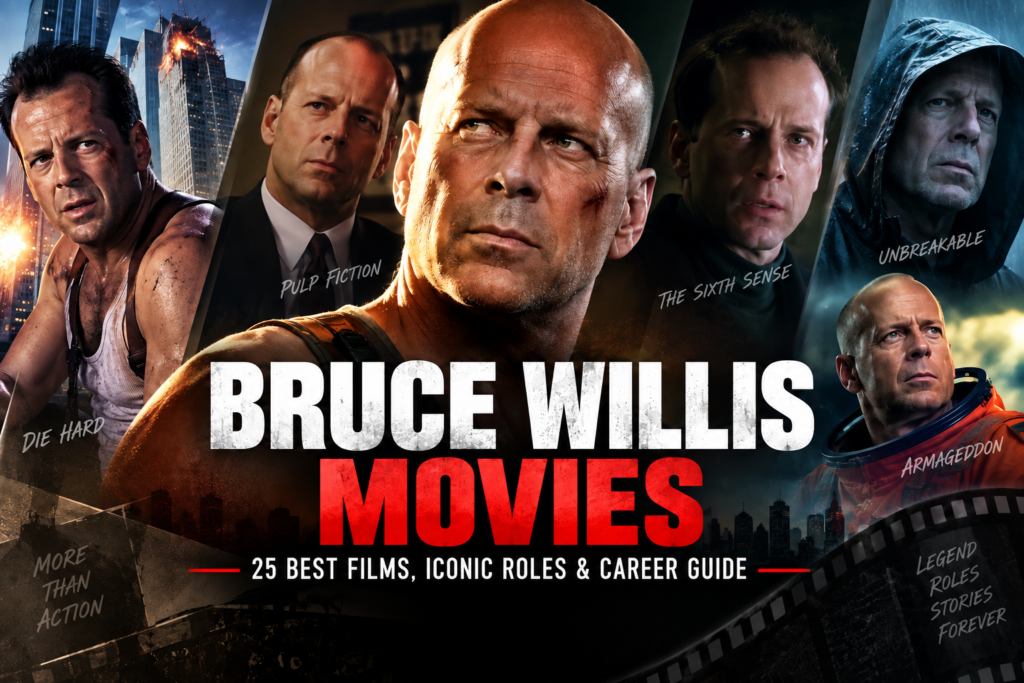
When people talk about Bruce Willis movies, Die Hard usually comes up first. That makes sense: John McClane turned Willis into one of Hollywood’s defining action stars. However, his career reaches far beyond a single franchise. Over several decades, Willis moved between action, crime, science fiction, comedy, horror, drama, and ensemble films, often using the same dry humor and understated screen presence in very different ways.
His filmography includes major hits such as Pulp Fiction, Armageddon, The Sixth Sense, The Fifth Element, Unbreakable, Red, and Looper. His strongest-reviewed movies also show how broad his career became. Rotten Tomatoes currently lists Die Hard, Looper, Moonrise Kingdom, Pulp Fiction, Nobody’s Fool, 12 Monkeys, and The Sixth Sense among his highest-rated films.
So, where should you begin? If you want the essential Bruce Willis experience, start with Die Hard for action, Pulp Fiction for crime drama, 12 Monkeys for science fiction, and The Sixth Sense for a quieter dramatic performance. From there, his filmography opens into some surprisingly different territory.
Bruce Willis Movies: Where to Start
Why Bruce Willis Became a Movie-Star Name
Before becoming a major film star, Willis gained widespread attention as David Addison on the television series Moonlighting. His combination of sarcasm, charm, physical comedy, and effortless confidence made him stand out on television. Then Die Hard arrived in 1988 and changed the scale of his career.
Willis played John McClane, a New York police officer trapped inside a Los Angeles skyscraper during a terrorist takeover. Instead of presenting McClane as an invincible super-soldier, the film made him vulnerable, exhausted, frightened, and constantly improvising. That quality helped make the character feel different from many action heroes of the era. Rotten Tomatoes currently gives Die Hard a 94% Tomatometer score.
That balance became central to Willis’ movie persona. He could deliver a tough line, but he could also look battered, confused, or genuinely vulnerable. As a result, audiences could connect with him even when his characters were caught in spectacular situations.
The Essential Bruce Willis Movies at a Glance
For a first-time viewer, these films provide a strong introduction to different sides of his career:
- Die Hard (1988) — the defining action performance.
- Pulp Fiction (1994) — a memorable crime-film role.
- 12 Monkeys (1995) — intense science fiction.
- The Fifth Element (1997) — futuristic action with comedy.
- The Sixth Sense (1999) — restrained supernatural drama.
- Unbreakable (2000) — a quieter take on the superhero genre.
- Looper (2012) — Willis returning to science fiction decades later.
- Moonrise Kingdom (2012) — an understated ensemble performance.
These choices also reveal an important point: the best Bruce Willis movies are not necessarily the ones built around the biggest explosions. His strongest work often comes when directors give his familiar persona a new setting or emotional dimension.
The 10 Best Bruce Willis Movies to Watch First
Choosing the ten best is subjective, but a strong starter list should balance critical reputation, cultural impact, performance, genre variety, and rewatchability. Die Hard is the obvious starting point, while Pulp Fiction, 12 Monkeys, and The Sixth Sense demonstrate how effectively Willis could step outside conventional action roles.
| Rank | Movie | Year | Why Watch It |
|---|---|---|---|
| 1 | Die Hard | 1988 | His defining action role |
| 2 | Pulp Fiction | 1994 | A sharp crime-film performance |
| 3 | 12 Monkeys | 1995 | One of his most intense roles |
| 4 | The Sixth Sense | 1999 | Quiet, emotional dramatic work |
| 5 | The Fifth Element | 1997 | Stylish science-fiction action |
| 6 | Unbreakable | 2000 | A restrained superhero mystery |
| 7 | Looper | 2012 | A compelling later-career sci-fi role |
| 8 | Moonrise Kingdom | 2012 | A softer ensemble performance |
| 9 | Armageddon | 1998 | Large-scale blockbuster entertainment |
| 10 | Red | 2010 | Action mixed with veteran-star comedy |
The list is deliberately varied. Someone who only watches Die Hard sees the action icon, while someone who follows the list in order gets a much fuller picture of Willis as a performer.
Bruce Willis Movies of the 1980s
Moonlighting to Movie Stardom
Willis entered movies after establishing himself on television, and his early film work showed that Hollywood saw commercial potential in his personality as well as his acting ability. He appeared in projects such as Blind Date, Sunset, and Die Hard during the latter half of the decade.
The turning point was Die Hard. Released in 1988 and directed by John McTiernan, the movie placed Willis in a relatively unusual position for a major action film: its hero was not an unstoppable machine. John McClane gets hurt, runs out of options, and repeatedly has to think his way through danger.
That vulnerability became part of the character’s appeal. McClane talks back to himself, makes mistakes, and reacts to extraordinary circumstances like an ordinary person might. Willis’ comic timing helped keep the character human without undermining the danger around him.
The result was more than another successful action movie. Die Hard established a screen persona that Willis could revisit for years: the sarcastic, resilient everyman who survives because he refuses to quit.
Die Hard Changes Everything
The impact of Die Hard became especially clear as Willis moved into the 1990s. Hollywood now had an established action star who could also carry comedy and drama. That combination gave him opportunities beyond straightforward action vehicles.
The first Die Hard remains the clearest representation of what made his movie-star persona work. It combined physical action with humor, tension, and a protagonist who could be vulnerable without becoming passive. Rotten Tomatoes currently lists it as Willis’ highest-rated film, with a 94% Tomatometer score.
That foundation would become important because the next decade pushed Willis into considerably different territory. Instead of simply repeating the formula, some of his most interesting 1990s movies challenged audiences to see him in new ways.
Bruce Willis Movies of the 1990s
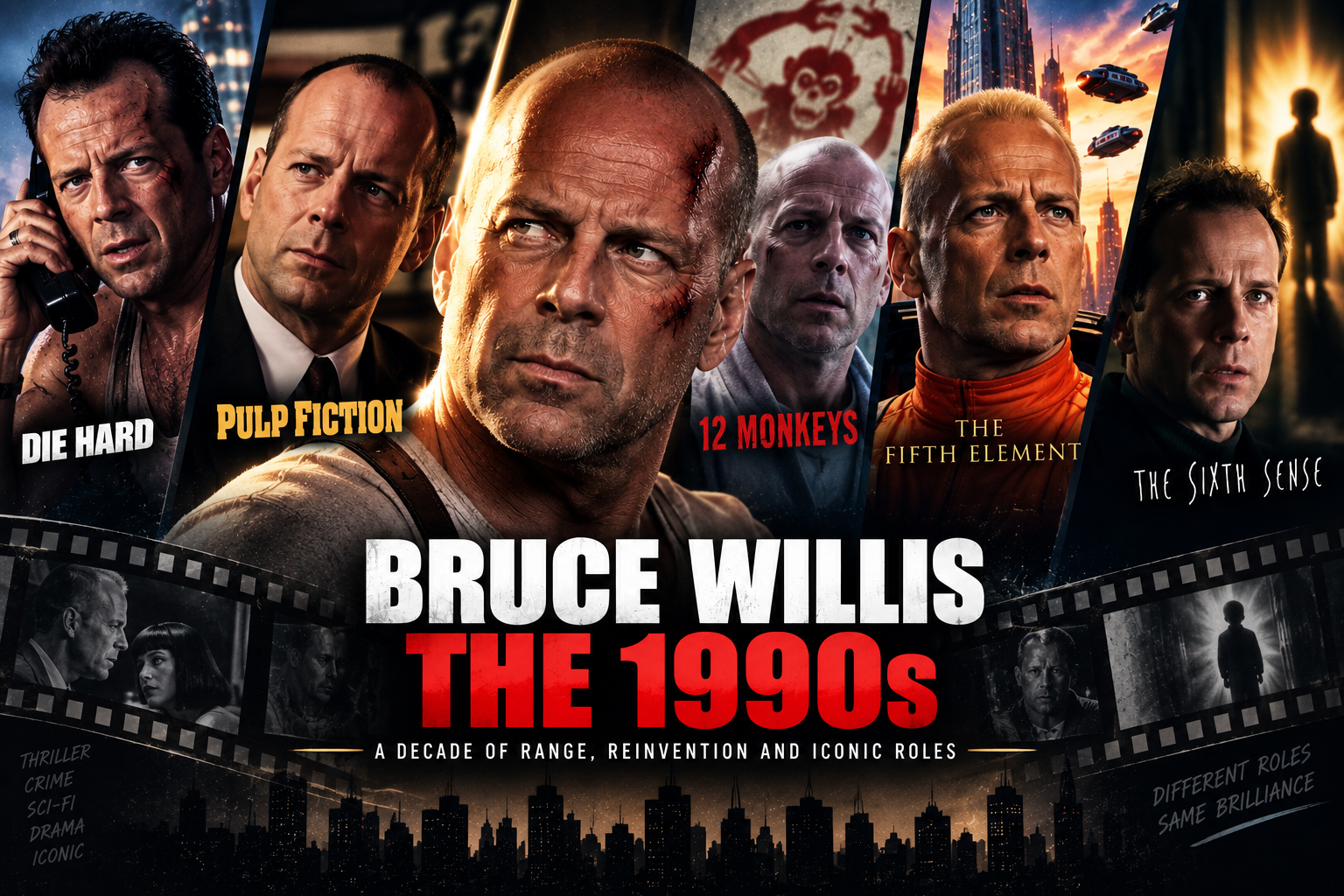
The 1990s turned Bruce Willis from a successful action star into a much more versatile Hollywood leading man. He returned as John McClane in Die Hard 2 and Die Hard with a Vengeance, but some of his most memorable work came from movies that moved well beyond the franchise.
Pulp Fiction and a New Kind of Bruce Willis Role
Quentin Tarantino’s Pulp Fiction gave Willis a very different kind of showcase. He played Butch Coolidge, a boxer who refuses to follow the plan handed to him by a powerful crime boss. The role demanded toughness, but it also relied on tension, dark humor, and moments of unexpected vulnerability.
Willis’ presence worked particularly well because Tarantino did not simply recreate the John McClane formula. Butch feels more guarded and morally complicated. His storyline also places Willis alongside an ensemble cast that includes John Travolta, Samuel L. Jackson, and Uma Thurman.
The film became one of the defining American movies of the decade, and Willis’ performance remains an important part of his filmography. It also demonstrated that audiences would follow him outside traditional blockbuster action.
The Sixth Sense, 12 Monkeys, and The Fifth Element
Willis continued to experiment throughout the decade. In 12 Monkeys, he played James Cole, a prisoner sent into a dangerous mission involving time travel and a devastating pandemic. The performance is far more psychologically intense than his action persona suggests.
Then came The Fifth Element, where he returned to action but with a deliberately playful science-fiction setting. As Korben Dallas, Willis combined physical comedy, sarcasm, and blockbuster spectacle.
In 1999, The Sixth Sense offered perhaps the biggest contrast. Willis played Malcolm Crowe, a child psychologist dealing with a troubled young patient. The performance depends on restraint rather than swagger, allowing silence and subtle reactions to carry much of the story. The movie became one of his most recognizable dramatic successes and reinforced his ability to carry a genre film without relying on constant action.
Bruce Willis Movies of the 2000s
The 2000s brought another shift. Willis continued making mainstream action films, yet several projects gave him opportunities to explore darker, stranger, or more restrained characters.
Unbreakable and His More Dramatic Roles
M. Night Shyamalan’s Unbreakable arrived in 2000 and reunited Willis with the director following The Sixth Sense. Instead of making Willis an obvious superhero, the film builds its story around David Dunn, a security guard who gradually begins questioning his own physical abilities and identity.
The film remains an interesting example of how superhero stories can focus on character and mythology rather than conventional comic-book spectacle, a theme that remains central to major Marvel characters such as Doctor Doom.
Willis plays Dunn with deliberate understatement. He spends much of the movie observing events rather than dominating them, which makes the character’s eventual transformation feel more personal. The film also established an unusual superhero mythology years before comic-book adaptations became Hollywood’s dominant blockbuster genre.
During the decade, Willis also appeared in films including The Whole Nine Yards, Bandits, Hostage, Sin City, 16 Blocks, and Lucky Number Slevin. These projects covered comedy, crime, thriller, action, and neo-noir territory.
Sin City deserves particular attention because its highly stylized world allowed Willis to play another version of the weary protector archetype. His role as police detective John Hartigan emphasizes sacrifice and determination rather than the wisecracking energy associated with McClane.
Redefining John McClane
Willis returned to his signature character in 2007 with Live Free or Die Hard. Nearly two decades after the original, John McClane had become an older action hero operating in a world increasingly shaped by computers and digital threats.
The movie updated the formula without abandoning McClane’s basic personality. He remained stubborn, sarcastic, resourceful, and willing to throw himself into danger. The fourth film also introduced a younger generation of characters around him, including Justin Long’s Matt Farrell.
By this stage, Willis had already built a career that could stand independently of Die Hard. However, McClane remained his most recognizable screen creation. The return demonstrated how strongly audiences associated Willis with the character while also showing that the actor could carry the franchise into a different era.
Bruce Willis Movies of the 2010s
The 2010s produced one of the most interesting combinations in Willis’ later film career. He appeared in large action projects while also taking supporting roles in acclaimed ensemble movies and returning to science fiction.
Looper, Red, and Moonrise Kingdom
Looper stands out as one of the strongest examples of Willis using his established persona in a fresh context. Rian Johnson’s 2012 science-fiction thriller casts Joseph Gordon-Levitt as a younger version of a time-traveling assassin, with Willis playing his older self.
The unusual casting creates a natural connection between Willis’ familiar action-star image and the movie’s time-travel premise. Yet the story gives the character motivations and conflicts that go beyond simply being a tough action hero.
The same year, Willis appeared in Wes Anderson’s Moonrise Kingdom. His role as Captain Sharp is quieter and more melancholy than many of his commercial films. The performance demonstrates how effectively his understated delivery could fit Anderson’s carefully controlled style.
Earlier, Red had allowed Willis to blend action and comedy as retired CIA operative Frank Moses. The film surrounded him with veteran performers including Helen Mirren, John Malkovich, and Morgan Freeman. Rather than presenting aging as a limitation, Red turned the characters’ experience into part of the entertainment.
Later Action and Ensemble Roles
Willis continued appearing in action-oriented projects throughout the decade, including G.I. Joe: Retaliation, A Good Day to Die Hard, RED 2, and Once Upon a Time in Venice. He also returned to the world of Unbreakable through Glass in 2019.
Glass brought David Dunn back alongside characters from Unbreakable and Split, creating a crossover between Shyamalan’s earlier superhero stories. Willis’ performance once again relied on restraint, reinforcing the quieter characterization that had distinguished Dunn from conventional comic-book heroes.
His 2010s filmography therefore resists a simple label. While action remained an important part of his identity, movies such as Looper, Moonrise Kingdom, and Glass showed that his screen presence could still serve very different types of storytelling.
The Best Bruce Willis Action Movies
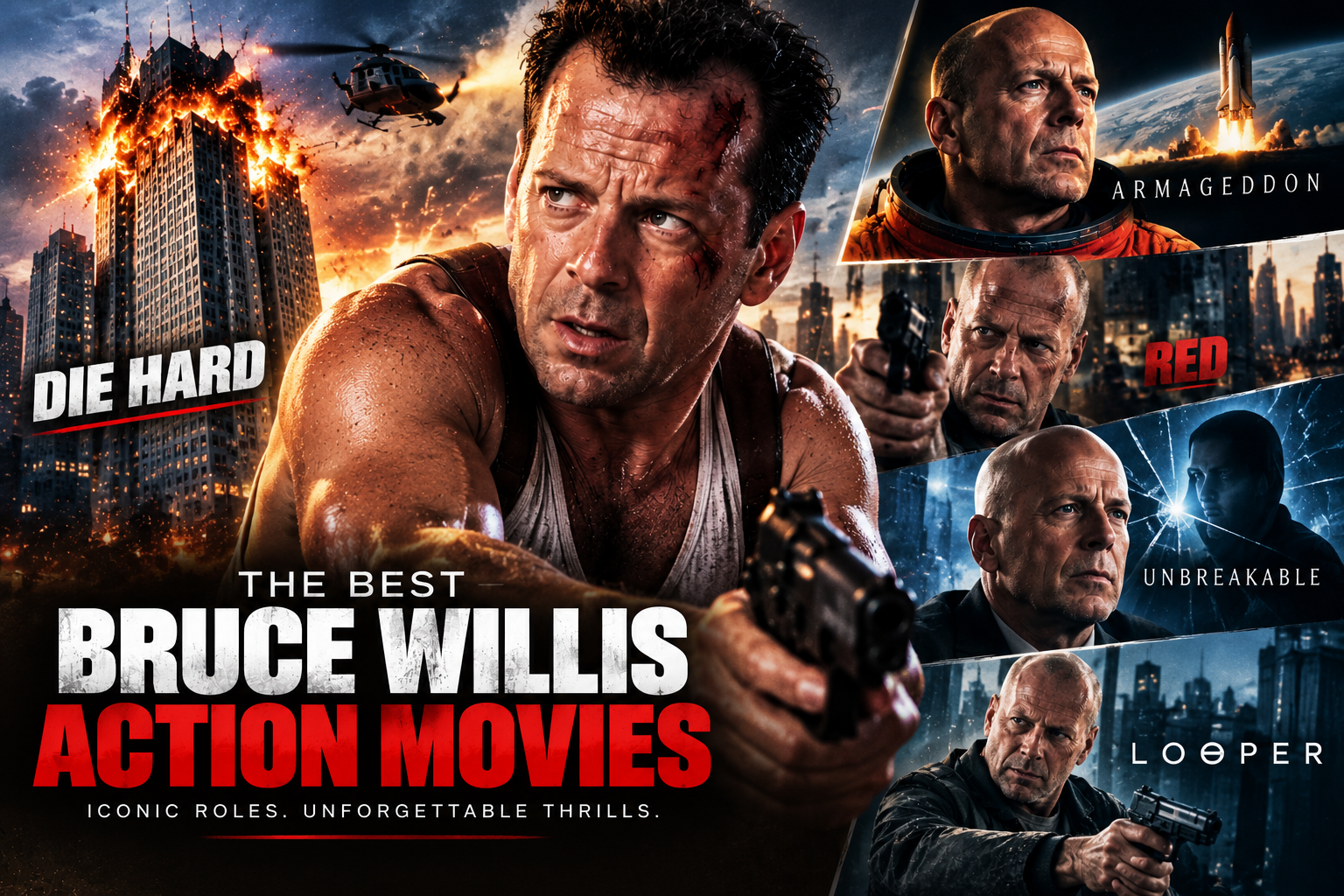
Bruce Willis built much of his movie-star identity around action, but his best action films work because they give the spectacle a recognizable human center. He often played characters who could get hurt, make mistakes, or use humor to deal with impossible situations. That formula made his action roles feel more approachable than the invincible heroes common in the genre.
Die Hard Franchise
The Die Hard series remains the foundation of Willis’ action career. The original 1988 film introduced John McClane as a New York police officer caught in a hostage crisis at Nakatomi Plaza. Die Hard 2 followed in 1990, moving the character into an airport crisis, while Die Hard with a Vengeance paired McClane with Samuel L. Jackson for a larger-scale New York adventure.
After a long gap, Willis returned as McClane in Live Free or Die Hard in 2007. The fourth film modernized the franchise around cyberterrorism while keeping McClane’s sarcastic personality intact. A Good Day to Die Hard followed in 2013 and moved the story to Russia.
For viewers who want to understand why Willis became an action icon, the original Die Hard should remain the first stop.
Standalone Action Favorites
His action filmography also includes several movies that deserve attention outside the franchise. The Last Boy Scout combines Willis’ humor with a darker buddy-action formula, while 16 Blocks gives him a more grounded role as a troubled police officer.
For viewers who enjoy exploring modern action cinema beyond established franchises, our guide to Street Fighter Movie (2026) offers another look at the genre’s latest big-screen revival.
The Fifth Element takes his action persona into colorful science fiction, and Red adds veteran-star comedy to the formula. Armageddon, meanwhile, uses Willis as the emotional anchor of a huge disaster blockbuster.
Together, these movies show how flexible his action persona could become.
Bruce Willis Movies That Show His Range
Willis’ reputation as an action star can sometimes overshadow the variety of performances scattered throughout his career. Some of his most interesting films reduce the explosions and place greater emphasis on character, atmosphere, or psychological tension.
His work in Unbreakable is particularly interesting because it approaches the superhero genre from a much more character-driven perspective, a tradition that continues to evolve in projects such as the X-Men MCU reboot.
Crime and Drama
Pulp Fiction remains one of the clearest examples. Butch is tough, but the character operates inside a morally complicated crime story rather than a traditional hero narrative. Willis brings physical credibility to the role while allowing the film’s strange humor and tension to shape his performance.
Nobody’s Fool offers another important contrast. Based on Richard Russo’s novel, the movie places Willis in a supporting role alongside Paul Newman rather than making him the central action figure. That change in scale demonstrates how effectively he could work within an ensemble.
16 Blocks similarly strips away much of the glamour. Willis plays Jack Mosley, a New York detective whose exhaustion and personal problems become central to the story. The film uses his familiar toughness but gives it a more worn-down quality.
These performances matter because they reveal an actor who could adapt his established screen image instead of simply repeating it.
Comedy, Mystery, and Science Fiction
Willis also had a strong relationship with comedy. The Whole Nine Yards and The Whole Ten Yards allowed him to use his dry delivery in lighter surroundings, while Moonrise Kingdom placed him inside Wes Anderson’s distinctive ensemble style.
His comedic side is worth exploring alongside newer Netflix comedy releases, including 72 Hours, which offers a very different approach to fast-paced movie humor.
Science fiction provided another particularly successful outlet. 12 Monkeys demands a much more emotionally unstable performance, while Looper uses Willis’ action-star identity as part of its time-travel concept.
Then there is The Sixth Sense, where Willis largely abandons the wisecracking action persona. His performance as Malcolm Crowe depends on quiet reactions and emotional restraint. The result became one of his most recognizable dramatic roles.
Bruce Willis Movies Ranked by Critical Reception
Critical reception offers a useful way to separate enduringly acclaimed films from movies remembered mainly for their commercial appeal. It should not, however, be treated as the only measure of quality. Audience nostalgia, genre expectations, cultural influence, and individual taste all affect how a Bruce Willis movie is remembered.
Several titles stand out when critical reception becomes part of the conversation. Rotten Tomatoes currently lists Die Hard at 94%, while Looper, Moonrise Kingdom, Pulp Fiction, Nobody’s Fool, 12 Monkeys, and The Sixth Sense also rank among his strongest-reviewed films.
| Movie | Year | Genre | Why It Matters |
|---|---|---|---|
| Die Hard | 1988 | Action | Defined Willis as an action star |
| Pulp Fiction | 1994 | Crime | Expanded his dramatic range |
| 12 Monkeys | 1995 | Sci-Fi | One of his most intense performances |
| The Fifth Element | 1997 | Sci-Fi/Action | Combined spectacle with comedy |
| The Sixth Sense | 1999 | Thriller/Drama | Showed his restrained dramatic side |
| Unbreakable | 2000 | Superhero/Thriller | Reimagined the superhero protagonist |
| Looper | 2012 | Sci-Fi | Connected his classic persona with modern sci-fi |
| Moonrise Kingdom | 2012 | Comedy/Drama | Highlighted his understated ensemble work |
The list reveals something important about his career. His most critically respected films span more than two decades and multiple genres. That makes it difficult to define Willis only by Die Hard.
Bruce Willis Movies Fans Often Overlook
The biggest Bruce Willis titles naturally dominate search results, but his filmography contains several movies that deserve a second look. These films may not have the same cultural footprint as Die Hard or Pulp Fiction, yet they reveal different sides of his acting.
Underrated 1990s and 2000s Films
Last Man Standing is an especially interesting choice for viewers who enjoy hard-edged crime stories. Willis plays a gunslinger caught between rival factions, bringing his familiar coolness into a stylized Prohibition-era setting.
The Last Boy Scout is another worthwhile pick. The film combines detective-story elements, dark humor, and aggressive action while giving Willis a cynical protagonist who feels closer to his rougher 1990s roles.
Hostage offers a more serious alternative. Willis plays a former hostage negotiator pulled into another dangerous crisis, and the movie puts greater emphasis on guilt, responsibility, and psychological pressure.
16 Blocks deserves similar attention because it gives Willis one of his more grounded action performances. His character is physically and emotionally worn down, making the eventual struggle feel more personal.
Later Movies Worth Knowing About
Among his later work, Moonrise Kingdom stands apart because it barely resembles the action vehicles that defined his commercial career. His performance as Captain Sharp is quiet, awkward, and occasionally tender.
Motherless Brooklyn also provides a different context, placing Willis within a crime mystery built around a larger ensemble.
For longtime fans, these movies can make an excellent companion watchlist alongside the obvious classics. They demonstrate that exploring Bruce Willis’ filmography means looking beyond the films that made him famous.
Bruce Willis Movies Fans Often Overlook
Not every worthwhile Bruce Willis performance came from one of his biggest box-office releases. His filmography contains several smaller films, unusual genre experiments, and supporting appearances that can get lost beside Die Hard, Pulp Fiction, and The Sixth Sense. For viewers exploring his career more deeply, these movies provide a useful second layer to the familiar favorites.
Underrated Picks From His Earlier Career
Last Man Standing gives Willis a particularly hard-edged role. The 1996 crime film draws from the classic Yojimbo setup and places him between competing criminal groups during Prohibition. His performance leans into the detached confidence audiences associated with him while giving the character a darker environment.
The Last Boy Scout is another strong choice for fans who prefer Willis at his most sarcastic. Released in 1991, the action comedy pairs a cynical private investigator with an explosive conspiracy. The movie combines hard-boiled dialogue with the physical intensity that became a major part of Willis’ early-1990s screen identity.
16 Blocks takes a different approach. Instead of presenting Willis as an effortlessly capable hero, the film makes his character’s exhaustion and personal failures part of the story. That vulnerability gives the action more weight.
Later Films Worth Revisiting
Moonrise Kingdom remains one of the most interesting departures from Willis’ usual roles. Wes Anderson’s 2012 film casts him as Captain Sharp, a police officer whose awkwardness and loneliness sit far away from John McClane’s confidence.
Motherless Brooklyn also deserves attention from viewers interested in his later supporting work. The film surrounds Willis with a large ensemble and a period crime mystery, allowing his presence to contribute to the story without requiring him to carry the entire movie.
These choices show why a deeper Bruce Willis watchlist should include more than his obvious blockbusters. His lesser-known projects can reveal unexpected sides of the actor.
Bruce Willis and the Die Hard Legacy
Few actor-character partnerships have become as closely associated with one another as Bruce Willis and John McClane. The character defined the public image of Willis as an action star, but the success of the series came from more than explosions and stunts.
Why John McClane Became Iconic
McClane works because he does not behave like a traditional superhuman action hero. He gets injured, becomes exhausted, complains, improvises, and occasionally finds himself completely outmatched. Willis’ humor keeps the character approachable even when the circumstances become extreme.
The original Die Hard also placed its hero in a contained environment. McClane cannot simply walk away from the crisis, so he has to use whatever resources he can find. That setup lets Willis sell the character’s intelligence and stubbornness alongside his physical courage.
The formula proved remarkably durable. Each sequel increased the scale, yet McClane remained recognizably McClane: a reluctant problem-solver who would rather complain about the situation than pretend he enjoys being a hero.
The Die Hard Movies in Release Order
For anyone exploring Bruce Willis movies through his signature franchise, the five films are best approached in release order:
| Film | Year | John McClane |
|---|---|---|
| Die Hard | 1988 | Bruce Willis |
| Die Hard 2 | 1990 | Bruce Willis |
| Die Hard with a Vengeance | 1995 | Bruce Willis |
| Live Free or Die Hard | 2007 | Bruce Willis |
| A Good Day to Die Hard | 2013 | Bruce Willis |
The first film remains the essential starting point. The sequels show how the character and franchise evolved as Willis moved through different stages of his career.
The long gap between Die Hard with a Vengeance and Live Free or Die Hard also mirrors a broader change in Hollywood action cinema. By 2007, digital technology and cyberterrorism had become natural parts of blockbuster storytelling, giving McClane a new kind of threat to confront.
The Bruce Willis Movie He Regretted Turning Down
One of the more intriguing stories in Willis’ career involves a movie in which he never appeared in the central role he wanted. The film was Ocean’s Eleven, Steven Soderbergh’s 2001 remake of the classic heist movie.
Why Willis Passed on Ocean’s Eleven
Willis later expressed regret about not taking the role of casino owner Terry Benedict. The part ultimately went to Andy Garcia, who played the character opposite George Clooney’s Danny Ocean.
The interesting detail is that Willis’ decision did not come from simply disliking the project. Reports about the situation indicate that he felt the script had not developed the Benedict character enough when he first encountered it. In hindsight, the finished movie made the role considerably more attractive.
Ocean’s Eleven became a major success and launched a popular trilogy. Looking back, Willis acknowledged that he had missed an opportunity. His later connection to the franchise made the story even more interesting: he appeared in Ocean’s Twelve as a fictionalized version of himself.
How the Role Went to Andy Garcia
Garcia’s performance gave Terry Benedict a controlled, sophisticated presence that contrasted nicely with Clooney’s charismatic thief. The character became one of the movie’s central obstacles without turning into a conventional action villain.
The casting story is useful because it illustrates an unusual aspect of Willis’ career. By the early 2000s, he had enough star power to consider major supporting parts from a position of strength. Yet even established actors can misjudge how a screenplay, director, or ensemble will ultimately shape a role.
For fans researching Bruce Willis movies, the Ocean’s Eleven story provides a reminder that his career is also full of roads not taken. Some of those decisions mattered more in hindsight than they appeared to at the time.
Bruce Willis Movies by Genre
One of the easiest ways to explore Bruce Willis’ filmography is by genre. His career covers far more ground than action alone, and each category highlights a different part of his screen persona.
| Genre | Recommended Bruce Willis Movies |
|---|---|
| Action | Die Hard, Die Hard with a Vengeance, Red |
| Crime | Pulp Fiction, Lucky Number Slevin |
| Science Fiction | 12 Monkeys, Looper |
| Thriller | The Sixth Sense, 16 Blocks |
| Science-Fiction Action | The Fifth Element |
| Superhero | Unbreakable, Glass |
| Comedy | The Whole Nine Yards |
| Drama | Nobody’s Fool |
| Ensemble Comedy-Drama | Moonrise Kingdom |
His genre variety also explains why there is no single definition of the “typical” Bruce Willis performance. In one movie, he might play a wisecracking police officer. In another, he can become a troubled psychologist, a time traveler, a boxer, or a quiet small-town police captain.
That versatility is one of the strongest reasons to explore his filmography beyond the biggest action franchises.
Bruce Willis Movies for Different Types of Viewers
Rather than asking which single Willis movie is “the best,” a better question is what kind of movie you want to watch. His catalog offers an easy starting point for different tastes.
If You Want Pure Action
Start with Die Hard. It remains the clearest introduction to Willis as an action star. Follow it with Die Hard with a Vengeance, The Fifth Element, Red, or 16 Blocks for different versions of his action persona.
If You Want Crime or Thriller
Pulp Fiction is the obvious choice for crime fans, while The Sixth Sense works for viewers who prefer mystery and supernatural suspense. 12 Monkeys adds a darker science-fiction thriller element.
If You Want Something Different
Try Moonrise Kingdom for an understated ensemble performance or Unbreakable for a slower, character-focused superhero story. Nobody’s Fool is another option for viewers interested in seeing Willis outside a conventional leading-man role.
This approach makes a Bruce Willis watchlist easier to personalize. New viewers can begin with the genre they already enjoy instead of working through decades of movies chronologically.
Bruce Willis’ Final Film Years
Willis’ later filmography contains a large number of releases, particularly between 2020 and 2022. During this period, he appeared in projects across action, thriller, science fiction, and crime genres, including Survive the Game, Cosmic Sin, Fortress, Wrong Place, Paradise City, and the Detective Knight series.
His 2020–2022 Movie Output
The sheer volume of releases during these years makes this period different from earlier stages of his career. Instead of a small group of major theatrical projects each year, his later filmography includes many lower-profile productions released across different platforms.
Among the notable titles are Motherless Brooklyn from 2019, Glass from 2019, and a series of action films released during the following years. Letterboxd’s actor listing records numerous later credits, while Apple TV’s career page highlights Willis’ extensive film work and identifies him as a retired actor. (letterboxd.com)
Why His Filmography Ends on a Different Note
For longtime audiences, the contrast can feel striking. Willis once headlined some of Hollywood’s biggest theatrical releases, while many of his final movies received much less mainstream attention.
That does not erase the importance of the earlier work. If anything, it makes the larger filmography easier to understand as a career that had already passed through several distinct phases: television breakthrough, action superstardom, critical experimentation, blockbuster success, ensemble work, and extensive later-career genre filmmaking.
For viewers discovering his work today, the best approach is to begin with the major films that established his reputation and then explore the less familiar titles.
Frequently Asked Questions About Bruce Willis Movies
What is the best Bruce Willis movie?
Die Hard is the strongest starting point because it combines Willis’ humor, physical performance, and everyman quality in the role that defined his movie-star career. However, viewers who prefer drama or science fiction may favor The Sixth Sense, 12 Monkeys, Pulp Fiction, or Looper. The “best” choice ultimately depends on whether you value action, dramatic performance, critical reception, or genre innovation.
How many movies has Bruce Willis been in?
The number depends on how a database counts acting credits, cameos, television films, and other appearances. Letterboxd’s actor page currently lists 160 acting credits. That figure should not automatically be treated as a definitive count of feature films alone because film databases use different classification systems.
What are Bruce Willis’ best action movies?
Die Hard is the essential choice, followed by Die Hard with a Vengeance, The Fifth Element, Red, 16 Blocks, and The Last Boy Scout. Armageddon is also worth watching if you want Willis in a large-scale Hollywood blockbuster rather than a contained action thriller.
Which Bruce Willis movie should I watch first?
Start with Die Hard if you have never seen a Bruce Willis movie. It explains the foundation of his action-star persona better than almost any other film. After that, Pulp Fiction and The Sixth Sense provide useful contrasts and show how effectively he could work outside conventional action roles.
What was Bruce Willis’ biggest movie?
There is no single answer unless “biggest” refers specifically to box office, cultural impact, or critical reputation. Die Hard became his defining franchise, while Armageddon became one of the major blockbuster successes associated with his career. The Sixth Sense was another enormous commercial success and demonstrated that Willis could anchor a supernatural thriller.
How many Die Hard movies did Bruce Willis make?
Bruce Willis appeared as John McClane in five Die Hard movies: Die Hard (1988), Die Hard 2 (1990), Die Hard with a Vengeance (1995), Live Free or Die Hard (2007), and A Good Day to Die Hard (2013). The original remains the most important film in the franchise and the clearest introduction to the character.
Final Takeaway on Bruce Willis Movies
The best way to understand Bruce Willis movies is to look beyond the obvious action hits. Die Hard created his iconic screen persona, but Pulp Fiction showed that he could operate inside a darker crime story. 12 Monkeys pushed him toward intense science fiction, The Sixth Sense demonstrated his dramatic restraint, and Unbreakable gave him a quieter interpretation of the superhero archetype.
His later work added even more variety, from Looper and Moonrise Kingdom to Glass and a long run of action and thriller projects.
For someone building a first Bruce Willis watchlist, there is no need to begin with the entire filmography. Start with Die Hard, then move to Pulp Fiction, 12 Monkeys, The Sixth Sense, and Unbreakable. After those five, explore The Fifth Element, Looper, Red, Moonrise Kingdom, and the overlooked titles that match your preferred genre.
That journey reveals why Willis became such a lasting movie star. His greatest contribution was not simply playing tough characters. It was bringing humor, vulnerability, attitude, and personality to them. Those qualities allowed him to move between genres while remaining instantly recognizable. And that is ultimately what makes his filmography worth revisiting: the familiar Bruce Willis image is only the beginning of the story.