
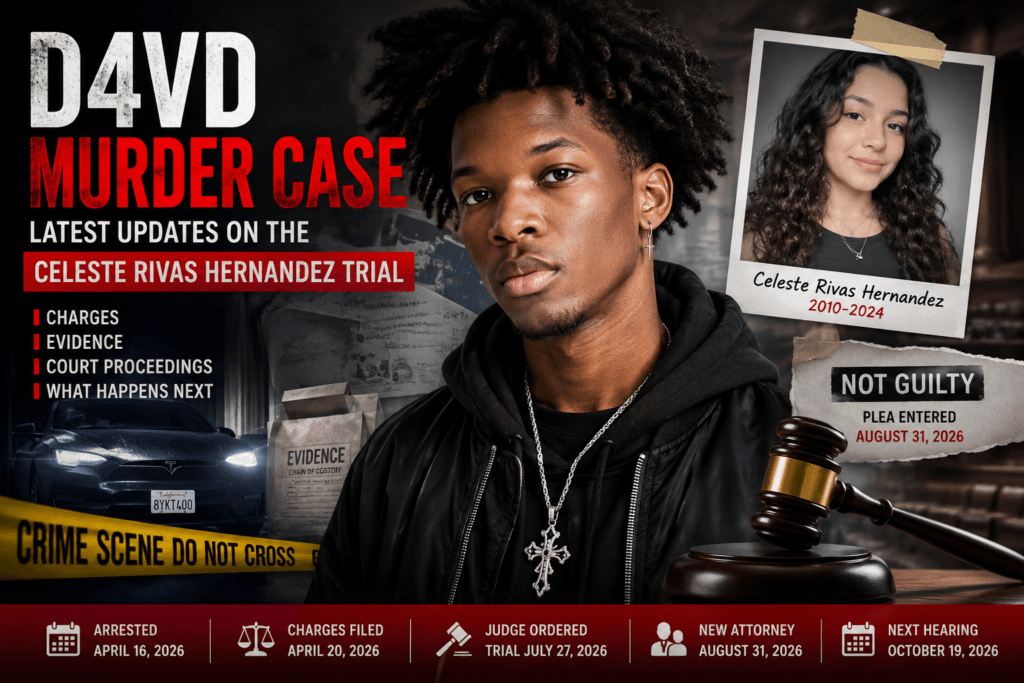
D4vd is facing a major legal battle in Los Angeles after prosecutors charged the singer, whose legal name is David Anthony Burke, in connection with the death of 14-year-old Celeste Rivas Hernandez. Burke has pleaded not guilty and remains legally presumed innocent unless a jury finds him guilty. The case has now moved toward trial after a judge determined that prosecutors presented enough evidence for the charges to proceed.
The latest development came on August 31, 2026, when Burke returned to court for another arraignment. His previous defense lawyers were allowed to withdraw, and public defender Walid Kandeel took over his representation. Burke again entered a not-guilty plea to the charges. His next court appearance is scheduled for October 19, 2026.
What Is Happening With D4vd Right Now?
D4vd’s case is now headed toward a trial following months of investigation and court proceedings. Prosecutors have charged him with murder with special circumstances, sexual abuse of a child under 14, and unlawful mutilation of human remains in connection with Celeste Rivas Hernandez’s death. Burke has denied the allegations through his not-guilty pleas.
The latest court development involves a change in his legal representation. On August 31, Burke’s high-profile private attorneys, including Blair Berk and Marilynne Bednarski, were granted permission to withdraw. The court then placed his representation with public defender Walid Kandeel. No public reason was given for the private lawyers’ withdrawal.
Kandeel asked the court to postpone the arraignment, but the judge declined. Burke therefore entered another not-guilty plea that same day. His next scheduled court date is October 19.
The case remains unresolved. A judge’s decision to allow the prosecution to proceed does not amount to a conviction. At trial, prosecutors will still have to prove their allegations beyond a reasonable doubt.
Who Is D4vd?
D4vd is the professional name of David Anthony Burke, a singer who built a large online following before the criminal investigation became public. His music career expanded rapidly, giving him a significant audience and making the case especially prominent in entertainment news.
The legal proceedings now involve the same public figure whose music career had been developing internationally before investigators connected him to the investigation surrounding Celeste Rivas Hernandez.
Burke’s public profile matters to the story because prosecutors have alleged that his career created a possible motive connected to their theory of the killing. Those allegations remain contested and will ultimately be tested through the criminal justice process.
For readers searching for D4vd today, however, his music career is only part of the story. The central issue is the criminal case and the evidence prosecutors say connects him to Celeste’s death.
D4vd’s Career Before the Case
Before the investigation dominated headlines, D4vd had established himself as a rising music artist. His songs gained substantial attention through online platforms, helping him build a large listener base.
That career trajectory later became relevant to prosecutors’ theory of the case. The Los Angeles County District Attorney’s Office has alleged that Burke feared information about his relationship with Celeste could damage his growing career. That allegation forms part of the prosecution’s broader theory about motive.
However, motive remains an allegation presented by prosecutors, not a finding of guilt. The defense will have the opportunity to challenge the prosecution’s interpretation of the evidence, and a jury will ultimately determine whether the charges have been proven.
What Happened to Celeste Rivas Hernandez?
Celeste Rivas Hernandez was 14 when investigators began examining the circumstances surrounding her death. Her remains were discovered in 2025 inside a Tesla registered to D4vd, and investigators later identified her through dental records. The discovery became the starting point for a much larger homicide investigation.
According to the investigative timeline reported by ABC7, Celeste had previously been reported missing from her Lake Elsinore home. Prosecutors later alleged that she and Burke had an ongoing relationship and that they spent time together during 2024 and 2025. Those claims form part of the prosecution’s case.
The investigation developed significantly after authorities identified Celeste’s remains. In September 2025, investigators searched a Hollywood Hills property associated with Burke. Authorities reported finding evidence they believed was consistent with the handling of human remains, with testing indicating the presence of blood matching Celeste’s DNA.
The medical examiner ultimately classified Celeste’s death as a homicide. The investigation continued for months before authorities arrested Burke in April 2026 and prosecutors formally brought the criminal case against him.
The prosecution’s allegations remain allegations. The court proceedings will determine whether the evidence meets the legal standard required for a conviction.
What Charges Does D4vd Face?
Prosecutors have brought multiple serious charges against D4vd in connection with Celeste Rivas Hernandez’s death. The charges include murder with special circumstances, sexual abuse of a child under 14, and unlawful mutilation of human remains. Burke has pleaded not guilty.
| Charge | What it concerns |
|---|---|
| Murder with special circumstances | The prosecution’s central allegation concerning Celeste’s death |
| Sexual abuse of a child under 14 | Allegations concerning Burke’s relationship with Celeste |
| Unlawful mutilation of human remains | Allegations concerning the treatment and handling of Celeste’s remains |
The distinction between being charged and being convicted is critical. A criminal charge represents an allegation brought by prosecutors. It does not establish that the defendant committed the alleged offense.
The judge’s earlier ruling that Burke must stand trial also does not mean the court found him guilty. Instead, the ruling allowed the prosecution to continue pursuing the case after the preliminary-hearing evidence met the applicable threshold for the case to proceed.
At a future trial, prosecutors will have to prove the charges beyond a reasonable doubt. The defense can challenge the evidence, question witnesses, dispute the prosecution’s interpretation of events, and present its own arguments.
D4vd’s Preliminary Hearing and the Evidence Presented
D4vd’s five-day preliminary hearing in July 2026 gave prosecutors an opportunity to present evidence supporting their allegations before Judge Charlaine Olmedo. The hearing included testimony from investigators, forensic specialists and other witnesses, along with photographs and digital records. Burke’s defense challenged parts of that evidence and continued to maintain his innocence.
Prosecutors presented evidence concerning the Hollywood Hills home connected to Burke, his Tesla, digital communications and items investigators recovered during searches. They argued that these pieces of evidence supported their theory of how Celeste Rivas Hernandez died and what happened afterward.
The hearing did not determine Burke’s guilt. Instead, the judge had to decide whether prosecutors had shown enough evidence and probable cause for the criminal case to proceed to trial.
That distinction matters. A preliminary hearing uses a lower evidentiary threshold than a criminal trial. The prosecution will eventually have to prove its case beyond a reasonable doubt if the matter reaches a jury.
DNA and Forensic Evidence
Forensic testimony became one of the central parts of the hearing. LAPD criminalist Samantha Tosch testified that DNA collected from apparent blood stains on several items in Burke’s garage was consistent with Celeste’s DNA. The evidence included material from a rowing machine, a green tarp and a Tesla charging plug.
Another criminalist testified about possible blood evidence found on garage flooring and gym mats. However, the defense highlighted an important limitation: some chemical testing could indicate the possible presence of blood but could not independently establish that the substance was definitely blood.
Prosecutors also presented evidence involving fragments and other physical materials recovered during the investigation. Investigators testified that some fragments associated with an inflatable pool matched plastic material found on Celeste’s remains.
The defense questioned investigators about the extent of testing, including why additional DNA analysis was not performed on certain chainsaws and other items. That line of questioning could become important at trial because the defense can challenge how strongly individual pieces of forensic evidence connect Burke to the alleged killing.
Digital Evidence and Messages
Digital evidence also played a significant role in prosecutors’ presentation. Investigators examined Burke’s phone records, vehicle-related data and messages that prosecutors say help establish his relationship with Celeste and the circumstances surrounding the final period of her life.
Among the material discussed in court were messages involving sex, pregnancy and abortion, along with references to emergency contraception. Prosecutors have argued that these communications help establish the nature of the relationship they allege existed between Burke and Celeste.
Investigators also examined vehicle and cellular information. Prosecutors used that type of digital evidence to build a timeline around Burke, his Tesla and locations connected to the investigation.
The prosecution’s interpretation of those records remains contested. Digital communications can establish contact, timing or location, but their meaning often depends on the surrounding circumstances. The defense therefore has the opportunity to challenge the prosecution’s interpretation and argue that individual messages or records do not prove the broader allegations.
The preliminary hearing also brought attention to messages reportedly exchanged between Burke and Celeste shortly before her death. Prosecutors presented those communications as part of their theory about the relationship and a possible motive.
Ultimately, a jury would have to consider the full context of the digital evidence rather than isolated messages.
Why Did the Judge Order D4vd to Stand Trial?
After five days of testimony and evidence, Los Angeles County Superior Court Judge Charlaine Olmedo ruled on July 27 that the prosecution had presented enough evidence to move the case toward trial. The ruling found probable cause for the charges against Burke.
That decision represents an important procedural milestone, but it does not mean the judge found Burke guilty. A preliminary hearing asks whether the prosecution has presented sufficient evidence to justify continuing the criminal case. A trial requires a much higher standard: prosecutors must prove guilt beyond a reasonable doubt.
The hearing included testimony from nearly a dozen witnesses and evidence covering forensic findings, digital records and the investigation into Celeste’s death.
The prosecution’s case also has unresolved issues that the defense can explore. Public reporting from the hearing noted that investigators did not identify a witness who directly saw the killing, and authorities had not recovered a confirmed murder weapon. The defense can use such gaps to challenge the prosecution’s theory and create reasonable doubt.
At the same time, prosecutors argued that the combined evidence was sufficient to continue the case. The judge agreed that the legal threshold for a trial had been met.
The next stage will therefore shift the focus from whether the case can proceed to whether prosecutors can ultimately prove each charge beyond a reasonable doubt.
D4vd Pleads Not Guilty Again as Lawyers Withdraw
D4vd’s legal defense changed dramatically on August 31, 2026, when his private attorneys withdrew from the case during a Los Angeles court hearing. Burke, whose legal name is David Anthony Burke, then moved to representation through the Los Angeles County Public Defender’s Office. Deputy Public Defender Walid Kandeel took over the defense.
Burke appeared before Los Angeles County Superior Court Judge Charlaine Olmedo for his second arraignment. He confirmed that he wanted new representation and again pleaded not guilty to the charges. His new attorney asked the judge to postpone the proceeding to allow the defense team more time to prepare, but the judge denied the request.
The withdrawal involved attorneys Blair Berk, Marilynne Bednarski and Regina Peter. Their departure does not mean they found Burke guilty, nor does it establish any weakness in the defense. The former attorneys said they withdrew after it was determined that Burke qualified for appointed counsel and stated that they continued to support his defense.
Burke’s next scheduled court appearance is October 19, 2026. The case remains pending, and the prosecution still has to prove every charge beyond a reasonable doubt.
What Has D4vd’s Defense Said?
The Defense Position
Burke’s defense has consistently challenged the prosecution’s allegations rather than accepting its interpretation of the evidence. During the preliminary hearing, defense attorneys questioned investigators about forensic testing, the handling of evidence and the strength of the connection between individual pieces of evidence and the alleged killing.
That approach is likely to remain important as the case moves closer to trial. Prosecutors have presented a combination of physical, forensic and digital evidence, but the defense can challenge how that evidence was collected, interpreted and connected to the charges.
The case also highlights why readers should separate allegations from established facts when following high-profile celebrity investigations. For another example of how allegations involving a public figure can develop through statements, reporting and legal proceedings, see our coverage of Jared Leto Responds to Allegations.
One significant issue concerns the difference between circumstantial evidencfe and direct evidence. Public reporting from the preliminary hearing indicated that prosecutors did not present an eyewitness who claimed to have watched Burke kill Celeste. The defense can therefore argue that prosecutors must persuade a jury by connecting multiple pieces of circumstantial evidence into one convincing account.
At the same time, prosecutors argue that the evidence collectively establishes Burke’s involvement. A judge already found sufficient evidence for the case to proceed, but that ruling does not determine the final outcome.
Burke remains presumed innocent. The defense will have the opportunity to challenge the prosecution’s theory, question witnesses, contest evidence and present its own explanation of the events.
D4vd’s Change in Legal Representation
The switch from a prominent private defense team to appointed counsel has attracted considerable attention because Burke had previously been represented by high-profile attorneys. Blair Berk, Marilynne Bednarski and Regina Peter had represented him during the preliminary-hearing stage.
The court later determined that Burke qualified for publicly appointed representation. The precise circumstances behind the change were not publicly explained beyond the statements from the former attorneys and the court proceedings. Reports have raised questions about Burke’s financial situation, particularly because prosecutors have previously discussed his earnings from his music career. However, those financial questions should not be confused with evidence concerning the murder allegations.
Public defender Walid Kandeel now faces the task of preparing the defense for the next stage of a complicated homicide prosecution. His team will need to review the evidence presented during the preliminary hearing, examine investigative records and determine which parts of the prosecution’s case can be challenged.
The change also gives the new defense team an opportunity to develop its own strategy. That could include challenging forensic conclusions, questioning the interpretation of digital communications, disputing the prosecution’s theory of motive or raising questions about how investigators reconstructed the timeline.
For now, the change in attorneys does not alter Burke’s charges or his not-guilty plea.
What Happens Next in the D4vd Case?
The immediate next step is another court appearance scheduled for October 19, 2026. That hearing will take place after Burke’s new public defender has had additional time to become familiar with the case.
The prosecution has indicated that it remains prepared to move forward once the defense is ready. Los Angeles County District Attorney Nathan Hochman said the change in representation does not affect the prosecution’s position or its readiness to proceed.
Another unresolved issue concerns punishment if Burke were eventually convicted. Prosecutors have indicated that the death penalty remains under consideration, although no final decision had been made as of the August 31 hearing. The defense can submit mitigation material for prosecutors to consider before a final decision.
The eventual trial will require a different standard from the preliminary hearing. Prosecutors will have to prove the charges beyond a reasonable doubt, while the defense can challenge both the evidence and the prosecution’s interpretation of events.
For that reason, the preliminary-hearing ruling should be viewed as a step toward trial, not as a prediction of the verdict.
D4vd Case Timeline
The D4vd case developed over several years before investigators publicly identified Burke as a murder suspect. According to prosecutors and investigative records reported by multiple outlets, Burke and Celeste Rivas Hernandez first met when she was much younger. Investigators later examined their communications, her disappearance, Burke’s property and the Tesla connected to him.
A simplified timeline helps separate the earlier investigation from the later criminal proceedings:
| Date | Major development |
|---|---|
| 2022 | Investigators say Burke and Celeste first met. |
| November 2023 | Prosecutors allege their relationship became sexual. |
| February 2024 | Authorities contacted Burke after Celeste was reported missing. |
| April 2025 | Prosecutors allege Celeste was killed. |
| September 2025 | Celeste’s remains were discovered in a Tesla connected to Burke. |
| April 16, 2026 | Burke was arrested on suspicion of murder. |
| April 20, 2026 | Prosecutors filed murder and related charges; Burke pleaded not guilty. |
| July 27, 2026 | After a five-day preliminary hearing, a judge ruled the case could proceed to trial. |
| August 31, 2026 | Burke’s private attorneys withdrew, he received a public defender and pleaded not guilty again. |
| October 19, 2026 | His next scheduled court appearance is set. |
The timeline reflects allegations and procedural developments, not findings that Burke committed the crimes.
Major Developments Before D4vd’s Arrest
The investigation began long before Burke’s arrest. Authorities had previously encountered his name while investigating Celeste’s disappearance in February 2024. According to NBC Los Angeles, Riverside County officials contacted Burke after identifying his phone number in Celeste’s records. A welfare check followed at a Hollywood Hills residence he had rented.
The case changed dramatically after Celeste’s remains were discovered in September 2025 in a Tesla that authorities connected to Burke. Investigators subsequently examined the vehicle, properties associated with him, electronic devices and other physical evidence.
The Los Angeles County Medical Examiner later classified Celeste’s death as a homicide. The April 2026 medical examiner findings reported multiple penetrating injuries as the cause of death.
Burke was arrested on April 16, 2026, approximately seven months after the discovery of Celeste’s remains. At the time of his arrest, he had not yet been formally charged. His attorneys immediately maintained that he was innocent and said the evidence would show he did not cause Celeste’s death.
Four days later, prosecutors formally charged Burke. The charges included first-degree murder with special circumstances, continuous sexual abuse of a child under 14 and unlawful mutilation of human remains. Burke pleaded not guilty.
The case then moved from a police investigation into a formal criminal prosecution.
What Happened During the 2026 Court Proceedings?
The first major phase of the prosecution involved the preliminary hearing. Prosecutors presented evidence over five days in July 2026, including testimony concerning forensic findings, digital communications and physical evidence recovered during the investigation.
The hearing also exposed areas that the defense could challenge. Prosecutors relied heavily on circumstantial evidence and forensic findings rather than presenting a direct eyewitness account of the alleged killing. The defense questioned investigators about testing procedures, evidence collection and the interpretation of individual pieces of evidence.
On July 27, Judge Charlaine Olmedo concluded that the prosecution had presented enough evidence for the case to proceed to trial. That ruling represented a major turning point because the court rejected the possibility of ending the prosecution at the preliminary stage.
However, the ruling did not determine guilt. The trial stage carries a substantially higher burden. Prosecutors will need to convince a jury beyond a reasonable doubt, while the defense can challenge the evidence and present its own arguments.
The case then entered another significant phase on August 31, when Burke’s private lawyers withdrew and public defender Walid Kandeel assumed representation. Burke again pleaded not guilty.
What Happens Next in the D4vd Case?
The next scheduled court appearance is October 19, 2026. By then, Burke’s new defense team will have had additional time to review the prosecution’s evidence and prepare for the proceedings ahead.
The October hearing does not necessarily mean the trial itself will begin that day. Criminal cases often involve additional hearings, evidence disputes, motions and scheduling decisions before a jury is selected.
One major issue still surrounding the case is the potential punishment prosecutors may seek if Burke is eventually convicted. The Los Angeles County District Attorney’s Office has been considering whether to pursue the death penalty. That decision remains separate from the question of whether Burke is guilty.
The prosecution will ultimately have to establish every required element of the charges beyond a reasonable doubt. Meanwhile, the defense can challenge forensic evidence, digital records, witness testimony and the prosecution’s theory of motive and events.
For now, the most important confirmed development is that the case has survived the preliminary-hearing stage and is moving toward trial. The final outcome remains unresolved.
Why the D4vd Case Has Drawn So Much Attention
The case has attracted unusually broad attention because it combines a high-profile young musician with a homicide investigation involving a teenage victim. D4vd had already developed a large audience through viral music releases before authorities arrested him in 2026.
Celebrity-related criminal cases can quickly become major online stories when public interest, social media discussion and ongoing investigations intersect. CLIMAX Magazine has also examined other high-profile cases involving entertainers, including BigXthaPlug Arrested in Texas.
The allegations are also unusually serious, involving murder, alleged sexual abuse and the alleged unlawful handling of human remains. As a result, each major court development has generated significant public interest.
At the same time, the case illustrates why separating allegations from established facts matters. Prosecutors have presented a theory supported by physical, forensic and digital evidence, while Burke has pleaded not guilty and his defense has disputed the prosecution’s interpretation.
The preliminary-hearing ruling means the evidence was sufficient for the case to continue. It does not establish that the allegations are true.
That distinction will remain central as the case moves toward trial. The evidence presented so far will face further scrutiny, and the eventual verdict will depend on what prosecutors and the defense establish in court.
Frequently Asked Questions About D4vd
Who is D4vd?
D4vd is the stage name of David Anthony Burke, a singer who gained widespread attention through his music and online audience. His career grew significantly before the criminal investigation involving Celeste Rivas Hernandez became public. Burke is now facing criminal charges in Los Angeles and has pleaded not guilty. His legal case is separate from his previous music career, and the charges remain allegations unless proven in court.
Readers following the broader intersection of celebrity culture and viral online stories can also read our coverage of Kai Cenat Police Video Explained, which examines how a widely circulated piece of footage became the subject of online speculation.
What is D4vd accused of?
Prosecutors have charged Burke with murder with special circumstances, continuous sexual abuse of a child under 14, and unlawful mutilation of human remains in connection with Celeste Rivas Hernandez’s death. Burke has pleaded not guilty to the charges. The prosecution has presented physical, forensic and digital evidence, while the defense has challenged aspects of that evidence. A judge has ruled that the case can proceed to trial, but that ruling does not establish guilt.
Did D4vd plead guilty?
No. Burke has pleaded not guilty. He entered another not-guilty plea during his August 31, 2026 court appearance after his previous private attorneys withdrew and a public defender took over his case. His plea means the prosecution must continue pursuing the charges rather than proceeding on the basis of an admission of guilt.
Is D4vd going to trial?
Yes. A Los Angeles County Superior Court judge ruled in July 2026 that prosecutors had presented sufficient evidence for the case to proceed to trial. However, a trial date is different from a preliminary-hearing ruling. Burke remains presumed innocent, and prosecutors will have to prove their case beyond a reasonable doubt before a jury if the case reaches a jury trial.
Who is representing D4vd now?
Public defender Walid Kandeel is now representing Burke. His previous private attorneys, including Blair Berk, Marilynne Bednarski and Regina Peter, withdrew from the case during the August 31 hearing. The change in representation does not change the charges against Burke or his not-guilty plea.
When is D4vd’s next court hearing?
Burke’s next scheduled court appearance is October 19, 2026. The hearing will take place after his new defense team has had additional time to review the case. The October proceeding does not necessarily mean that the trial itself will begin that day.
What happened to Celeste Rivas Hernandez?
Celeste Rivas Hernandez was 14 when investigators began examining her disappearance and death. Her remains were discovered in September 2025 inside a Tesla connected to Burke. The Los Angeles County Medical Examiner classified her death as a homicide. Prosecutors later connected Burke to the case and filed criminal charges against him. The circumstances surrounding her death remain the subject of the criminal prosecution.
What to Know About the D4vd Case
The D4vd case has now reached a critical stage. Burke has pleaded not guilty, his previous private defense team has withdrawn, and public defender Walid Kandeel is preparing to represent him as the prosecution moves forward. A judge’s July ruling allowed the case to proceed after finding sufficient evidence for a trial, but that decision did not determine the singer’s guilt.
The prosecution’s case includes forensic findings, digital evidence and other investigative material. The defense, meanwhile, has challenged aspects of the evidence and retains the right to contest the prosecution’s interpretation of the events.
The next major date is October 19, 2026. Until then, important questions remain about the evidence, defense strategy and eventual trial schedule.
For readers following D4vd’s case, the most important distinction is between an allegation, a court ruling and a conviction. The charges describe what prosecutors allege happened. The preliminary-hearing decision allowed the prosecution to continue. Only a final adjudication can determine whether the charges have been proven beyond a reasonable doubt.
The case therefore remains unresolved, and future court proceedings will determine how the allegations are tested and ultimately resolved.