
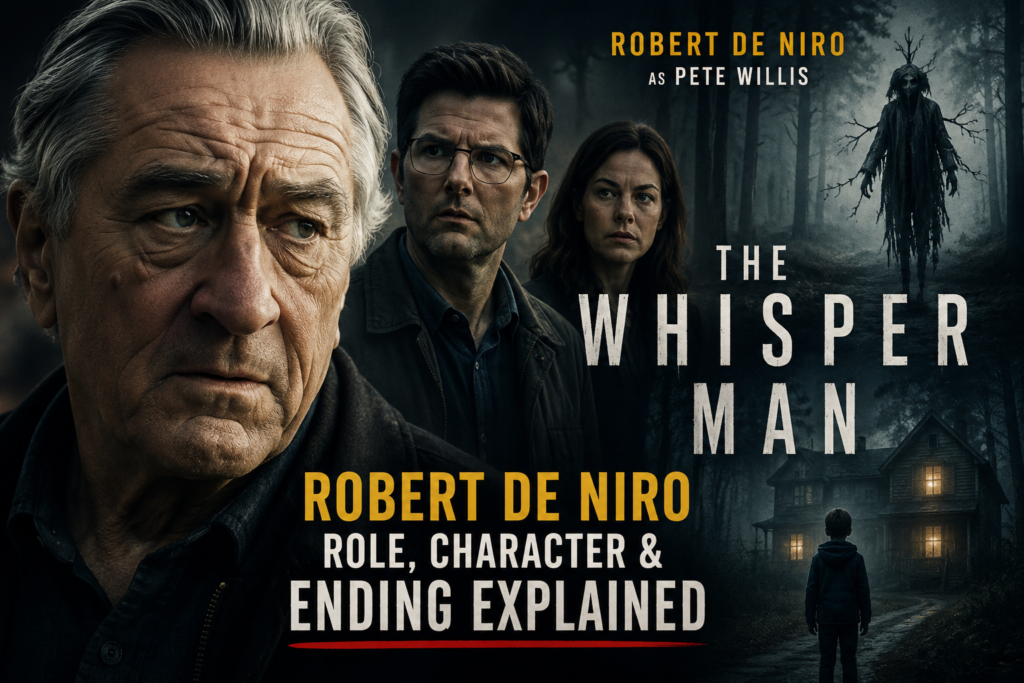
Robert De Niro takes on a very different kind of role in Netflix’s The Whisper Man. He plays Pete Willis, a retired detective whose career remains tied to one of the most disturbing serial-killer cases in his town’s history. When a new child disappears under circumstances that resemble the old crimes, Pete finds himself pulled back into an investigation he thought he had left behind.
The case becomes even more personal when Pete learns that the missing child is his grandson, Jake. His estranged son, Tom Kennedy, has returned to the town with Jake following the death of his wife. That reunion forces Pete to confront two unfinished parts of his past: the Whisper Man case and his fractured relationship with his son.
Directed by James Ashcroft and adapted from Alex North’s novel, The Whisper Man combines a serial-killer mystery with a family drama. That combination gives De Niro’s character more to do than simply provide the veteran-detective perspective. Pete becomes one of the story’s main links between its past crimes and its present-day threat.
Robert De Niro in The Whisper Man: Who Does He Play?
Robert De Niro plays Pete Willis, a retired detective who previously investigated the serial killer known as the Whisper Man. Years before the main events of the movie, Pete helped put Frank Carter behind bars after a series of child murders. However, the case never completely left him. Pete continued to believe that something about the investigation remained unresolved.
Pete Willis and His History With the Case
Pete’s connection to the original Whisper Man investigation gives him knowledge that the younger detectives do not have. When a new series of crimes begins to resemble the old killings, authorities turn toward the retired investigator for answers.
The similarities are unsettling. The original Whisper Man abducted children, and the new crimes suggest that someone may be copying his methods. Pete therefore becomes an important source of historical context while the police try to determine whether they are dealing with a copycat, an accomplice, or a continuation of the original killer’s influence.
Yet Pete’s involvement is not simply professional. The case also brings him back into the life of Tom, his estranged son. That connection changes the emotional stakes of the investigation.
Why Pete Returns to the Investigation
At first, Pete does not appear eager to return to police work. He has already spent years carrying the weight of the original case. However, Jake’s disappearance gives him a reason he cannot ignore.
Jake is not just another missing child. He is Pete’s grandson, a boy Pete has never properly known because of his damaged relationship with Tom. Once Jake becomes the target, Pete has both a professional reason and a deeply personal one to find him.
That combination drives his return and makes his role central to the film’s mystery.
What Is Robert De Niro’s Role in The Whisper Man?
Pete Willis serves as the film’s connection between the original Whisper Man murders and the new investigation. As the detective who helped capture Frank Carter, he understands the killer’s behavior in a way that Tom and the current investigators cannot easily replicate.
Pete as a Retired Detective
Pete’s experience becomes particularly valuable because the new crimes appear to echo the methods associated with Frank Carter. His knowledge allows the investigation to look beyond the surface similarities and consider whether the person responsible has a direct connection to the original case.
However, the movie does not portray Pete as an infallible crime-solving machine. His history with the case has left emotional scars, and those scars affect how he approaches the new investigation. He is still searching for answers connected to the old crimes, including questions that remained unresolved after Carter’s arrest.
That history also gives Pete a reason to take the threat seriously before everyone else understands how personal it will become.
Pete as Tom Kennedy’s Estranged Father
Pete’s second role is even more important to the emotional story. He is Tom’s father, but the two men have been separated for years. Their relationship has suffered because Pete devoted so much of himself to his career and the Whisper Man investigation.
When Tom needs help finding Jake, the old resentment cannot simply disappear. Instead, the investigation forces both men to confront their shared history while racing against time.
This makes Pete’s character more complicated than a conventional retired detective. He is simultaneously trying to solve a crime, protect his grandson, and repair a relationship that has been broken for years. De Niro’s restrained approach allows those tensions to remain largely beneath the surface rather than turning Pete into an overly dramatic character.
Robert De Niro and Adam Scott’s Father-Son Dynamic
The relationship between Pete Willis and Tom Kennedy gives The Whisper Man much of its emotional weight. Tom is a grieving father trying to protect his young son, while Pete is a former detective who has spent years living with the consequences of his choices.
Why Tom and Pete Are Estranged
Tom’s relationship with Pete has deteriorated long before Jake disappears. The film deliberately avoids turning their history into a long exposition dump. Instead, their strained interactions reveal that Pete’s commitment to his police work came at a significant personal cost.
That approach also makes their reunion uncomfortable. Tom does not suddenly forget years of resentment simply because Pete has investigative experience. At the same time, Pete clearly wants another opportunity to connect with his son.
The result is a relationship built around things neither man easily says. Their shared crisis becomes the pressure point that brings those unresolved emotions back to the surface.
Pete’s Chance to Reconnect With Tom and Jake
Jake’s kidnapping gives Pete something he never had before: a direct opportunity to act as a grandfather rather than remain a distant figure in Tom’s life.
For Tom, however, Pete’s help carries mixed emotions. He needs the retired detective’s expertise, but accepting that help also means confronting the father he believes failed him.
That tension makes their partnership more interesting than a straightforward detective team-up. They are not simply working together to solve a case. They are two members of the same family trying to save a child while dealing with years of anger, grief, and regret.
As the investigation develops, Pete’s professional instincts and Tom’s personal desperation begin to overlap. Finding Jake becomes the one goal that can temporarily put their differences aside.
Robert De Niro and Adam Scott’s Father-Son Dynamic
Pete Willis and Tom Kennedy are connected by more than the investigation into Jake’s disappearance. Their troubled history gives the mystery an emotional dimension, because every step Pete takes toward finding his grandson also brings him closer to the son he has struggled to understand.
Why Tom and Pete Are Estranged
Pete spent much of his life defined by his work as a detective. His pursuit of the Whisper Man became a major part of that identity, but the obsession came with a personal cost. His relationship with Tom suffered, leaving a distance between father and son that neither man has easily crossed.
Tom’s return puts that history back in front of Pete. He has already lost his wife and now faces the disappearance of his child, so his emotional state leaves little room for old family arguments. Pete, meanwhile, has to confront the consequences of being absent when Tom needed him.
Their scenes work because neither character receives an easy emotional reset. Pete cannot simply become the supportive father Tom always wanted, and Tom cannot instantly forgive years of disappointment. Instead, the danger surrounding Jake forces them to cooperate before they can fully repair their relationship.
That tension also gives De Niro a quieter dramatic challenge. Pete’s regret rarely needs a long speech. His actions around Tom and Jake reveal how badly he wants to make up for lost time.
Pete’s Chance to Reconnect With Tom and Jake
Jake’s disappearance changes Pete’s place in the family. For the first time, his skills as a detective directly serve the people from whom he has become separated.
Finding Jake therefore becomes personal on several levels. Pete wants to protect his grandson, but he also wants to prove to Tom that he can still be there when his family needs him.
That emotional motivation helps explain why Pete refuses to remain a distant observer as the investigation becomes more dangerous.
How Robert De Niro’s Character Connects to the Original Whisper Man
Pete’s greatest advantage is his history with Frank Carter, the man imprisoned for the original Whisper Man murders. Pete knows the case from the inside, and that knowledge becomes crucial when another child disappears.
Pete Willis and Frank Carter
Frank Carter represents Pete’s unresolved past. Years earlier, Pete helped bring him to justice, yet the case continues to shape the retired detective’s thinking.
When Pete visits Carter in prison, their conversation takes the investigation in a new direction. Carter makes comments that lead Pete to consider a connection between the original killer and the person now targeting children.
The possibility of a copycat changes the question facing investigators. Instead of asking only whether another serial killer has emerged, Pete begins looking for a link between Carter’s crimes and the new offender.
That distinction matters because the new Whisper Man does not necessarily need to be Frank Carter himself. The danger may come from someone who learned from him, inherited his methods, or became influenced by his legacy.
Pete’s experience allows him to recognize that possibility sooner than others.
The Clue That Changes Pete’s Investigation
The key breakthrough comes from Pete’s conversation with Carter. Carter’s remarks about Tom and the nature of the crimes push Pete toward a disturbing theory involving Carter’s son, Francis Jr.
Pete realizes that the new crimes may have a direct family connection to the original Whisper Man. That insight gives the investigation a new target and explains why the similarities between the old and new cases are too significant to dismiss.
The discovery also strengthens one of the film’s central ideas: violence can leave a legacy that extends beyond the person who originally committed it.
For Pete, the revelation is especially disturbing because his old case has suddenly become connected to his own family crisis. The detective who once investigated Frank Carter now has to use that same knowledge to save his grandson.
Robert De Niro and Michael Keaton’s Prison Scenes
The scenes between Pete Willis and Frank Carter bring together two actors with very different screen energies. De Niro plays Pete as controlled and guarded, while Michael Keaton’s Carter carries the unsettling confidence of someone who understands the power he still has over the people who investigated him.
Why Pete Needs Frank Carter
Pete cannot simply treat Carter as an old case file. Carter remains one of the few people capable of providing insight into the psychology behind the original murders.
That makes their prison conversations uncomfortable. Pete wants information, but Carter knows that any information he provides can affect Pete emotionally. Their exchange becomes a psychological contest as much as an interrogation.
Pete also has to decide how much of Carter’s testimony he can trust. A convicted serial killer has every reason to manipulate the investigator who put him away.
Still, Carter’s comments give Pete a crucial direction. They encourage him to reconsider the relationship between the original crimes and the new disappearances.
The De Niro-Keaton Contrast
The tension works because De Niro does not need to overpower the scenes. Pete’s restraint creates a useful contrast with Carter’s unsettling composure.
Their interactions also underline Pete’s history. He is not meeting Carter as an ordinary detective. He is confronting a man whose crimes shaped his career and contributed to the personal damage he carried long after the case ended.
That history makes every exchange feel loaded, even when the dialogue remains controlled.
The New Whisper Man and the Copycat Question
Once Pete recognizes a possible connection to Francis Jr., the mystery shifts from a simple kidnapping investigation into a question of inheritance and imitation.
Is the New Killer Copying Frank Carter?
The new crimes resemble the original Whisper Man case closely enough to suggest deliberate imitation. However, the film’s mystery is not simply about whether someone copied Carter’s methods. It also asks why that person would want to continue the pattern.
Francis Jr.’s connection to his father provides the missing piece. The original killer’s influence did not necessarily end when Frank Carter went to prison.
Pete’s experience makes him particularly sensitive to that possibility. He understands how Carter operated, but he also recognizes that another person could transform those methods into something new.
This is where Pete’s detective skills become essential to the story. He can identify patterns because he lived through the original investigation.
Why the Connection Matters to Pete
The revelation becomes more frightening because Jake is already missing. Pete is no longer studying an old case from a safe distance. He is watching the consequences of that case reach his own family.
His investigation therefore becomes a race against both time and history.
The deeper Pete digs, the clearer it becomes that defeating the new Whisper Man requires understanding the original one. His past is not merely background information. It provides the clues needed to protect Jake.
That connection ultimately makes Pete one of the film’s most important characters, even though Tom remains the central protagonist.
What Happens to Robert De Niro’s Character?
Pete Willis’ investigation eventually leads him directly back to the house where the nightmare began. By this point, Pete and Tom understand that the new Whisper Man is Frank Carter Jr., and they know Jake remains in immediate danger. Pete’s final stretch in the story is therefore less about solving the case and more about making sure his grandson survives.
Pete’s Final Encounter With the New Whisper Man
Frank Carter Jr. takes Jake back to Tom and Jake’s home, turning the place into the setting for the final confrontation. Pete and Tom follow the trail and arrive while Jake remains trapped inside the house.
The location has particular significance because Pete’s old investigation and the new crimes have gradually converged there. The discovery of Tony Smith’s remains beneath the property already established the house as part of the Whisper Man’s history. Now it becomes the site where Pete makes his final stand.
Pete finds Jake in the crawlspace and works to free him. However, Frank Jr. attacks before Pete can get the boy completely out of danger. The confrontation turns violent, and Pete suffers a fatal stab wound to the abdomen.
Even after being seriously injured, Pete focuses on Jake rather than himself. His final priority is getting his grandson away from the killer.
Pete’s Last Act for Jake
Pete’s death completes the transformation that began when Jake disappeared. Earlier in the story, he is a grandfather separated from his son and grandson. By the climax, he willingly puts himself between Jake and the person trying to kill him.
Pete tells Jake to run after being stabbed, giving the boy the chance to escape. His final act therefore becomes an expression of both love and redemption. He cannot repair every mistake he made as a father, but he can protect the next generation of his family.
Director James Ashcroft has described Pete’s sacrifice as the completion of his personal journey. The retired detective has spent years carrying the consequences of the original Whisper Man case, and saving Jake becomes his opportunity to finally confront that history on his family’s behalf.
The Meaning Behind Pete Willis’ Ending
Robert De Niro’s character does not simply die to create a dramatic climax. Pete’s final moments complete the film’s larger examination of fathers, sons, and the damage that can pass from one generation to another.
Pete’s Sacrifice and His Relationship With Tom
Pete’s relationship with Tom remains unresolved in a conventional sense. They do not get years together to rebuild their family, and Pete cannot undo the choices that caused their estrangement.
Instead, the film gives them a different kind of reconciliation. Pete’s actions show Tom what he could not communicate easily through conversation: he is willing to risk everything for his family.
That matters because Tom has spent much of his life judging Pete through the lens of his absence. Pete’s final decision gives Tom another perspective. The retired detective may have failed as a father in important ways, but he refuses to fail his grandson when the decisive moment arrives.
The connection also mirrors Tom’s own struggle with Jake. Tom’s relationship with his son has become strained by grief and conflict, yet the crisis gives him an opportunity to understand how easily a parent can lose emotional connection with a child.
Pete’s sacrifice therefore becomes part of a larger cycle of fathers trying, sometimes imperfectly, to protect their sons.
Why His Death Matters to the Story
Pete’s death removes the character who understands the original Whisper Man better than anyone else. More importantly, it forces Tom to continue without the father he spent years resenting.
That makes the ending bittersweet rather than simply triumphant. Jake survives, but the family pays a significant price.
Netflix’s ending explanation frames Pete’s death as the completion of his journey toward personal redemption. His final act allows him to protect Jake while finally confronting the case that damaged his life and his relationship with Tom.
How Pete’s Death Connects the Film’s Fathers and Sons
One of The Whisper Man‘s strongest ideas is that its central crime story keeps returning to damaged family relationships. Pete and Tom represent one version of that conflict, while Frank Carter and his son represent a much darker version.
Pete, Tom, and Jake
Pete’s relationship with Tom begins with distance, while Tom’s relationship with Jake becomes strained after the death of Jake’s mother. The film uses these relationships to show how grief and emotional isolation can affect different generations.
Jake’s kidnapping forces Tom to recognize how much his son needs him. At the same time, Pete realizes that his own opportunity to reconnect with his family may be running out.
That parallel gives Pete’s final decision additional meaning. He protects Jake at precisely the moment when Tom is trying to become the father his son needs.
The three generations therefore form the emotional structure underneath the thriller. Pete’s past choices affect Tom, Tom’s struggles affect Jake, and Jake’s disappearance forces both men to confront those patterns.
Frank Carter’s Darker Legacy
Frank Carter’s relationship with his son provides the disturbing opposite of Pete’s sacrifice. Instead of protecting his child, Frank’s influence contributes to the creation of another killer.
Frank Jr. becomes obsessed with gaining approval from a father who never gave him the acceptance he wanted. Netflix’s explanation identifies this father-son dynamic as central to the mystery behind the new Whisper Man.
That contrast makes Pete’s ending more significant. Both fathers leave powerful legacies, but Pete ultimately chooses protection while Frank’s legacy leads to destruction.
The film does not suggest that one heroic act erases years of mistakes. Instead, it argues that a person’s final choices can still carry enormous emotional weight.
What Happens to Frank Carter Jr. After Pete’s Death?
Pete’s sacrifice gives Tom and Jake the opportunity to survive, but the story still has one final confrontation to resolve.
Tom Takes Over the Fight
After Pete frees Jake, Tom continues the pursuit of Frank Jr. The struggle moves through the house, eventually bringing the killer to the damaged attic area that Tom had noticed earlier.
The setting itself becomes part of the resolution. Frank Jr. falls through a fragile section of the floor, ending the immediate threat to Tom and Jake.
This moment matters because Pete is no longer there to finish the investigation. Tom must act on his own, showing that the son who once needed his father’s help can ultimately protect his own child.
Frank Carter’s Final Role
Frank Carter survives the main confrontation and remains imprisoned. His relationship with Frank Jr. reaches its own horrifying conclusion when father and son are reunited.
Rather than welcoming his son, Frank kills him through the same kind of cruelty associated with his earlier crimes. The reunion becomes the final expression of the toxic legacy that Pete and Tom were trying to escape.
Pete’s story and Frank’s story therefore end in opposite ways. Pete gives his life so Jake can live, while Frank’s influence ultimately destroys his own son.
That contrast reinforces the film’s central question: what does a parent leave behind in the lives of their children?
Why Robert De Niro’s Role Is More Important Than It First Appears
Robert De Niro’s Pete Willis may initially look like the familiar veteran detective brought in to explain an old serial-killer case. However, the character gradually becomes one of the film’s emotional anchors.
Pete connects the original murders to the present investigation, but he also connects three generations of the Kennedy family. His knowledge helps identify the threat, while his personal choices give the ending its emotional consequences.
Netflix describes Pete as a character balancing two challenges at once: navigating the criminal investigation and trying to rebuild his fractured relationship with Tom.
That dual purpose explains why the role depends more on restraint than spectacle. Pete does not need to dominate every scene. His history, regrets, and concern for his family give even his quieter moments weight.
By the time he reaches the climax, the central question is no longer whether Pete can solve another case. It is whether he can finally do something for his family that his career and past mistakes prevented him from doing before.
For Robert De Niro, that emotional conflict makes Pete Willis more than a supporting detective figure. His performance helps connect the film’s crime mystery with its themes of family, regret, and redemption.
His answer comes through action rather than words.
And that action costs him his life.
Is Robert De Niro Good in The Whisper Man?
Robert De Niro’s performance as Pete Willis works best when the character remains controlled rather than openly emotional. Pete carries years of professional trauma, family regret, and unfinished business, so the restrained approach fits a man who has learned to keep difficult feelings beneath the surface.
What Works About His Performance
De Niro gives Pete an experienced presence without turning him into a larger-than-life action hero. The character’s authority comes from his history. He knows Frank Carter, understands the original investigation, and recognizes details that younger investigators might overlook.
That experience also creates a believable contrast with Adam Scott’s Tom. Tom approaches the crisis as a desperate father, while Pete approaches it with the instincts of a veteran investigator. Their different perspectives occasionally clash, but they eventually complement each other.
The performance also benefits from De Niro’s ability to communicate emotion through small reactions. Pete’s concern for Jake does not require constant speeches about how much he loves his grandson. His willingness to keep investigating, despite his age and the danger involved, communicates that attachment more effectively.
The Los Angeles Times praised the controlled quality of De Niro’s work, particularly in the way he and Scott build the film’s father-son relationship.
Why Some Critics Disagree
Not every critic has found the performance equally effective. Some reviews argue that De Niro’s low-key approach makes Pete feel less emotionally forceful than the story requires.
That criticism is understandable because The Whisper Man frequently shifts between family drama and psychological thriller. In the quieter scenes, Pete’s restraint can feel appropriate. During the more intense moments, however, viewers looking for a stronger emotional release may find the performance understated.
Ultimately, whether De Niro’s approach works depends on what the viewer expects from the role. Pete is not designed as a flashy detective. He is a tired man carrying the consequences of his past, and De Niro plays him accordingly.
How Pete Willis Fits Into The Whisper Man’s Bigger Story
Pete’s importance extends beyond his ability to identify clues. His character helps The Whisper Man connect its murder mystery with its deeper ideas about family, grief, and the consequences parents leave behind.
Fatherhood, Trauma, and Generational Damage
The film repeatedly places fathers and sons at the center of its conflict. Pete and Tom have a damaged relationship, while Tom struggles to remain emotionally connected to Jake after losing his wife.
Frank Carter’s family history presents a much darker version of the same problem. His influence helps shape Francis Jr., whose actions continue the violence associated with his father.
These relationships create a pattern across different generations. Each father leaves something behind in his child, whether that legacy takes the form of love, neglect, trauma, or violence.
Pete’s story offers one possible interruption of that pattern. He cannot change how he treated Tom in the past, but he can choose differently when Jake’s life is at risk.
His final decision therefore matters beyond the immediate rescue. Pete demonstrates that a damaged parent can still make a selfless choice, even when redemption comes too late to repair everything.
Why the Story Is More Than a Serial Killer Mystery
The murder investigation provides the film’s suspense, but the family relationships provide its emotional foundation.
The Whisper Man mythology works because the characters are not simply trying to identify a killer. They are also dealing with what violence does to families long after the original crime ends.
Pete represents the generation that confronted Frank Carter directly. Tom represents the generation forced to live with the consequences of that history. Jake represents the child who could inherit the damage unless someone breaks the cycle.
That structure makes Pete’s presence especially important. He gives the audience a direct connection to the original case while also becoming part of the Kennedy family’s present-day struggle.
The Whisper Man Ending and Robert De Niro’s Legacy in the Story
The ending gives Pete Willis a tragic but purposeful conclusion. His death is not an isolated shock designed only to increase the stakes. Instead, it completes the character’s movement from distant father and retired detective to protector of his family.
Pete’s Final Sacrifice
Pete dies after confronting Frank Carter Jr. while trying to protect Jake. Even after receiving a fatal wound, he focuses on getting the boy to safety.
That decision changes the meaning of his entire storyline. Earlier, Pete’s relationship with Tom is defined by everything he failed to do. At the end, his actions speak more clearly than any apology could.
He cannot return to the past. He cannot erase the years that separated him from Tom. However, he can prevent the same emotional distance from defining his relationship with Jake.
His final act also gives Tom the chance to survive and continue protecting his son.
What His Death Means
Pete’s death leaves Tom without his father just as the two men begin to understand each other again. That makes the resolution deliberately bittersweet.
Jake survives, and Tom ultimately confronts the threat himself. Yet their survival comes at Pete’s expense.
The ending therefore treats Pete’s sacrifice as an act of redemption rather than a complete restoration of his family. His mistakes still matter. His death does not erase them.
Instead, Pete finally makes the choice his character has been moving toward: when his family needs him, he puts them ahead of himself.
That is what gives Robert De Niro’s role its lasting importance within The Whisper Man. He begins the film as a man defined by an old case and a broken family relationship. He ends it by using both his experience and his remaining strength to protect the next generation.
Why Robert De Niro’s Role Matters to The Whisper Man
Robert De Niro’s Pete Willis begins The Whisper Man looking like a familiar thriller character: the retired detective who understands the killer better than everyone else. By the end, however, his importance goes much deeper.
Pete connects the film’s original murders with the new investigation, but he also connects its different generations. His history with Frank Carter explains how the past continues to affect the present, while his relationship with Tom shows how professional obsession can damage a family.
Pete’s Story Is About More Than Solving a Case
Pete has already spent years dealing with the consequences of the original Whisper Man investigation. Returning to the case gives him another chance to use that experience, but Jake’s disappearance changes his motivation.
This time, the person in danger is his grandson. Pete therefore cannot remain emotionally detached from the investigation.
His actions also help Tom move beyond their fractured relationship. Pete does not receive a simple reconciliation or a chance to explain away every mistake. Instead, his actions become the clearest statement of what he feels.
That distinction makes the character more believable. The Whisper Man does not suggest that one heroic moment can erase years of family problems. It shows that people can still make meaningful choices after making serious mistakes.
De Niro’s Character as the Film’s Emotional Link
Pete also gives the audience a direct connection to Frank Carter’s original crimes. Without him, the history behind the Whisper Man would remain largely theoretical.
Because Pete lived through the original investigation, the new threat feels personal. His knowledge helps expose the connection between Frank and Francis Jr., while his family relationship gives the investigation emotional consequences.
That combination makes Pete essential to both sides of the film: the mystery and the family drama.
What The Whisper Man Ultimately Says About Family
Although The Whisper Man operates as a psychological thriller, its story repeatedly returns to the question of what parents pass on to their children.
Pete, Tom, Frank, and Francis Jr. represent different versions of that relationship. Their experiences show that a parent’s influence can shape a child’s life long after the parent has stopped being physically present.
Pete and Tom Represent a Broken Cycle
Pete’s mistakes leave Tom with resentment and emotional distance. Tom then risks carrying some of that distance into his own relationship with Jake.
The kidnapping forces both men to confront that pattern. Pete gets one final opportunity to protect his grandson, while Tom realizes how important it is to remain present for his own child.
Pete’s sacrifice becomes the turning point. He cannot repair the past, but he can help prevent the damage from continuing into another generation.
Frank and Francis Jr. Show the Opposite Outcome
Frank Carter’s relationship with Francis Jr. represents a much darker inheritance. Instead of breaking away from his father’s influence, Francis Jr. becomes consumed by it.
That contrast gives the film’s ending additional weight. Pete’s final act protects the next generation, while Frank’s legacy contributes to its destruction.
The two stories ultimately present opposite ideas of fatherhood. One character chooses sacrifice and protection when it matters most. The other leaves behind fear, violence, and psychological damage.
That thematic contrast helps explain why Pete’s storyline remains important even after his death.
Robert De Niro in The Whisper Man: Final Verdict
Robert De Niro’s performance succeeds because Pete Willis does not need to dominate every scene. The character works through accumulated history, quiet regret, investigative experience, and the growing realization that his family needs him.
For viewers primarily interested in De Niro, the role offers something different from the actor’s more overtly intense crime performances. Pete is older, tired, and emotionally guarded. His power comes from what he has experienced rather than from constant displays of authority.
The performance may feel too restrained for viewers expecting a more explosive turn, but that restraint also fits Pete’s character. He is a man who has spent years carrying difficult memories without openly discussing them.
More importantly, Pete’s role has a clear narrative purpose. He explains the connection to the original Whisper Man, helps identify the new threat, and gives the family story its most tragic sacrifice.
His ending also provides the film with one of its clearest emotional statements: the past can damage a family, but people can still choose what they do with that damage.
For Robert De Niro, The Whisper Man is therefore less about delivering a showy performance and more about giving a familiar thriller archetype emotional history.
Pete Willis may enter the story as a retired detective, but he leaves it as a grandfather who finally puts his family before the case.
Frequently Asked Questions About Robert De Niro in The Whisper Man
Who does Robert De Niro play in The Whisper Man?
Robert De Niro plays Pete Willis, a retired detective who previously investigated and helped capture serial killer Frank Carter. When a new child disappears under circumstances connected to the original crimes, Pete becomes involved again. The case becomes deeply personal because the missing child, Jake, is his grandson.
Is Robert De Niro the Whisper Man?
No. Robert De Niro does not play the Whisper Man. He plays Pete Willis, the retired detective connected to the original investigation. The movie’s present-day killer has a different identity and a direct connection to Frank Carter.
Does Robert De Niro’s character die in The Whisper Man?
Yes. Pete Willis dies during the final confrontation with Frank Carter Jr. after helping Jake escape. Even after suffering a fatal injury, Pete’s priority remains protecting his grandson. His death completes his character arc and becomes a major part of the film’s emotional resolution.
Who is Pete Willis in The Whisper Man?
Pete Willis is a former detective who investigated the original Whisper Man murders. His experience with Frank Carter makes him valuable when a new series of crimes appears to follow the same pattern. Pete is also Tom Kennedy’s estranged father and Jake’s grandfather, giving the investigation a deeply personal dimension.
Does Robert De Niro appear with Michael Keaton?
Yes. De Niro shares important scenes with Michael Keaton, who plays imprisoned serial killer Frank Carter. Their interactions are significant because Pete’s knowledge of Carter’s original crimes helps him understand the connection between the old case and the new killer.
Is The Whisper Man based on a true story?
No. The Whisper Man is a fictional thriller adapted from Alex North’s novel of the same name. The story uses fictional characters and crimes rather than dramatizing a real serial-killer case.
Where can you watch The Whisper Man?
The Whisper Man is a Netflix film. Robert De Niro stars alongside Adam Scott, Michelle Monaghan, Michael Keaton, and other cast members in the 2026 thriller.
Conclusion
Robert De Niro’s role in The Whisper Man is ultimately about much more than playing a retired detective. Pete Willis carries the history of the original investigation, understands Frank Carter better than most people, and becomes essential to uncovering the connection behind the new crimes.
At the same time, his personal story gives the thriller its emotional center. His fractured relationship with Tom and his connection to Jake turn the investigation into a final chance to protect the family he once struggled to stay close to.
Pete cannot undo his past. He cannot rebuild his relationship with Tom over many years. What he can do is make one final choice that puts Jake’s life ahead of his own.
That choice defines Robert De Niro as Pete Willis and gives his performance its strongest meaning. Rather than relying on a dramatic transformation, he lets Pete’s actions reveal the regret, loyalty, and determination driving the character.
In the end, Pete Willis is not remembered simply as the detective who once caught the Whisper Man. He becomes the grandfather who finally breaks the cycle of family damage by choosing to protect the next generation.